Goa Board Class 12 Question Paper June 2018 History (New Pattern)
Finished viewing? Save it for later —
Download Goa Board Class 12 Question Paper June 2018 History (New Pattern) (PDF · 4 pages)About Goa Board Class 12 Question Paper June 2018 History (New Pattern)
Goa Board Class 12 Question Paper June 2018 History (New Pattern) is available here for free download. Published by Goa Board for Class 12, this question paper can be viewed online or downloaded as a PDF (4 pages). Candidates preparing for Class 12 can use Goa Board Class 12 Question Paper June 2018 History (New Pattern) to understand the exam pattern, the type of questions asked, and the overall difficulty level.
Frequently Asked Questions
How can I download Goa Board Class 12 Question Paper June 2018 History (New Pattern)?
Open this page and click the Download button to save Goa Board Class 12 Question Paper June 2018 History (New Pattern) as a PDF. It is completely free on AglaSem Docs.
Is Goa Board Class 12 Question Paper June 2018 History (New Pattern) free to download?
Yes. Goa Board Class 12 Question Paper June 2018 History (New Pattern) can be viewed online and downloaded as a PDF free of cost on AglaSem Docs.
How many pages does Goa Board Class 12 Question Paper June 2018 History (New Pattern) have?
Goa Board Class 12 Question Paper June 2018 History (New Pattern) contains 4 pages, which you can read online or download together as a single PDF.
Where can I find more Class 12 study material?
You can find more Class 12 question papers, sample papers, syllabus, and answer keys on AglaSem Docs.
Goa Board Class 12 Question Paper June 2018 History (New Pattern) – Text
Read the full text of this question paper below — useful to quickly search, copy and reference the content online without downloading the PDF.
📄 View text version (4 pages)
Page 1
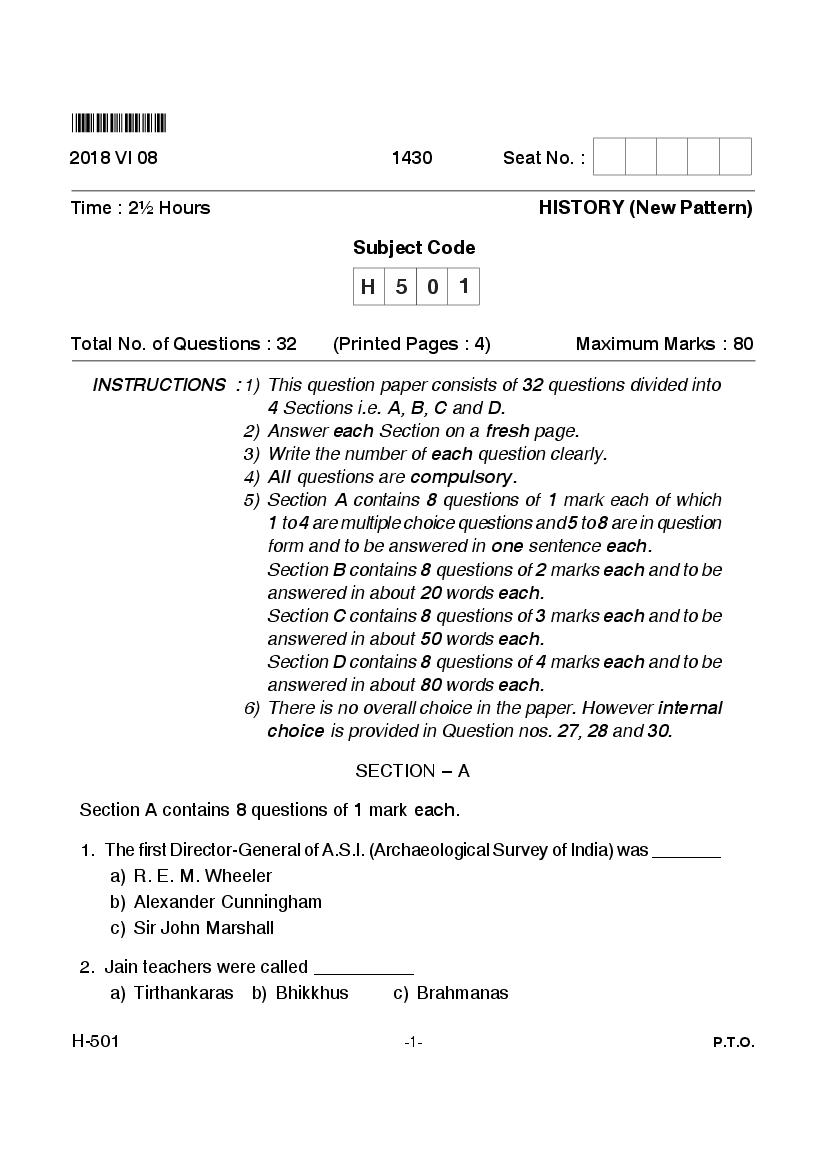
Time : 2½ Hours HISTORY (New Pattern)
Subject Code
H 5 0 1
Total No. of Questions : 32 (Printed Pages : 4) Maximum Marks : 80
INSTRUCTIONS : 1) This question paper consists of 32 questions divided into
4 Sections i.e. A, B, C and D.
2) Answer each Section on a fresh page.
3) Write the number of each question clearly.
4) All questions are compulsory.
5) Section A contains 8 questions of 1 mark each of which
1 to 4 are multiple choice questions and 5 to 8 are in question
form and to be answered in one sentence each.
Section B contains 8 questions of 2 marks each and to be
answered in about 20 words each.
Section C contains 8 questions of 3 marks each and to be
answered in about 50 words each.
Section D contains 8 questions of 4 marks each and to be
answered in about 80 words each.
6) There is no overall choice in the paper. However internal
choice is provided in Question nos. 27, 28 and 30.
SECTION – A
Section A contains 8 questions of 1 mark each.
1. The first Director-General of A.S.I. (Archaeological Survey of India) was _______
a) R. E. M. Wheeler
b) Alexander Cunningham
c) Sir John Marshall
2. Jain teachers were called __________
a) Tirthankaras b) Bhikkhus c) Brahmanas
H-501 -1- P.T.O.
Page 2
a) Shiva b) Jagannath c) Krishna
4. In 1565, Rama Raya, the Chief Minister of Vijayanagara was defeated by the
combined armies of Bijapur, Ahmadnagar and Golconda at the battle of ______
a) Panipat b) Plassey c) Talikota
5. Name the author of the chronicle ‘Ain-i-Akbari’.
6. Name the Goan appointed as prefect of Goa in 1835.
7. In which place did Rani Lakshmi Bai assume leadership of the revolt of 1857 ?
8. Where did Gandhiji make his first public appearance in 1916 after returning
from South Africa ?
SECTION – B
Section B contains 8 questions of 2 marks each and are to be answered in about
20 words each.
9. Why do we say that the Harappans were concerned about the privacy of their
homes ?
10. What were the duties of the samantas in the Gupta empire ?
11. What were “Camp towns” according to Bernier ?
12. Mention any two sources for the study of the Vijayanagara empire.
13. How did the Mughals maintain good relationship with the Jesuits ?
14. Why was the Anglo-Portuguese Treaty signed between the British and the
Portuguese in 1878 ?
15. What attempts were made by the British to repress the revolt of 1857 ? (any two
16. Why was Gandhiji regarded as a “people’s leader” ? (any two points)
H-501 -2-
Page 3
Section C contains 8 questions of 3 marks each and are to be answered in about 50
words each.
17. Examine the political organisation of the Harappan civilization according to
archaeologists.
18. Explain the principles of Buddhism (any three).
19. How did Guru Nanak preach nirguna bhakti ?
20. Why were agricultural tracts incorporated within the fortified areas of the
Vijayanagara empire ?
21. How did forests benefit the Mughal State ?
22. Why was the Uniform Civil Code of 1867 regarded as a milestone development
for the cause of Goan women ?
23. Explain the British need to annex Awadh to the British empire in 1856.
24. How did the Dandi March of 1930 show its effect on the people of India ?
SECTION – D
Section D contains 8 questions of 4 marks each and are to be answered in about
80 words each.
25. Explain the Great Bath as a notable structure in the Indus Valley civilization.
(any 4 points)
26. Explain the different coins in circulation in the sixth century BCE. (any four
27. What were the view points of Al-Biruni on Indian caste system ?
OR
What were the views of foreign travellers on women and slaves in medieval
India ? (any four points)
H-501 -3- P.T.O.
Page 4
OR
Write a note on Mahanavami dibba.
29. Examine the religious policy of the Mughals.
30. Write a note on the ‘Economic Blockade’ imposed on Goa in 1955.
OR
Enumerate the contributions of the following great Goans in arousing political
consciousness amongst people.
a) Francisco Luis Gomes
b) Fr. Alvares.
31. Explain the features of the “Subsidiary Alliance” devised by Lord Wellesley in
1798.
32. What were the conditions of Indian society when Gandhi came back to India in
1915 ?
_____________________
H-501 -4-
Document Details
| Board / Org | Goa Board |
| Exam | Class 12 |
| Type | Question Paper |
| Pages | 4 |
| Updated | 22 Jul 2026 |