CBSE Class 10 Question Paper 2025 Foundation Skills for Sciences
Finished viewing? Save it for later —
Download CBSE Class 10 Question Paper 2025 Foundation Skills for Sciences (PDF · 16 pages)About CBSE Class 10 Question Paper 2025 Foundation Skills for Sciences
CBSE Class 10 Question Paper 2025 Foundation Skills for Sciences is available here for free download. Published by CBSE for Class 10, this question paper can be viewed online or downloaded as a PDF (16 pages). Candidates preparing for Class 10 can use CBSE Class 10 Question Paper 2025 Foundation Skills for Sciences to understand the exam pattern, the type of questions asked, and the overall difficulty level.
Frequently Asked Questions
How can I download CBSE Class 10 Question Paper 2025 Foundation Skills for Sciences?
Open this page and click the Download button to save CBSE Class 10 Question Paper 2025 Foundation Skills for Sciences as a PDF. It is completely free on AglaSem Docs.
Is CBSE Class 10 Question Paper 2025 Foundation Skills for Sciences free to download?
Yes. CBSE Class 10 Question Paper 2025 Foundation Skills for Sciences can be viewed online and downloaded as a PDF free of cost on AglaSem Docs.
How many pages does CBSE Class 10 Question Paper 2025 Foundation Skills for Sciences have?
CBSE Class 10 Question Paper 2025 Foundation Skills for Sciences contains 16 pages, which you can read online or download together as a single PDF.
Where can I find more Class 10 study material?
You can find more Class 10 question papers, sample papers, syllabus, and answer keys on AglaSem Docs.
CBSE Class 10 Question Paper 2025 Foundation Skills for Sciences – Text
Read the full text of this question paper below — useful to quickly search, copy and reference the content online without downloading the PDF.
📄 View text version (16 pages)
Page 1
. -
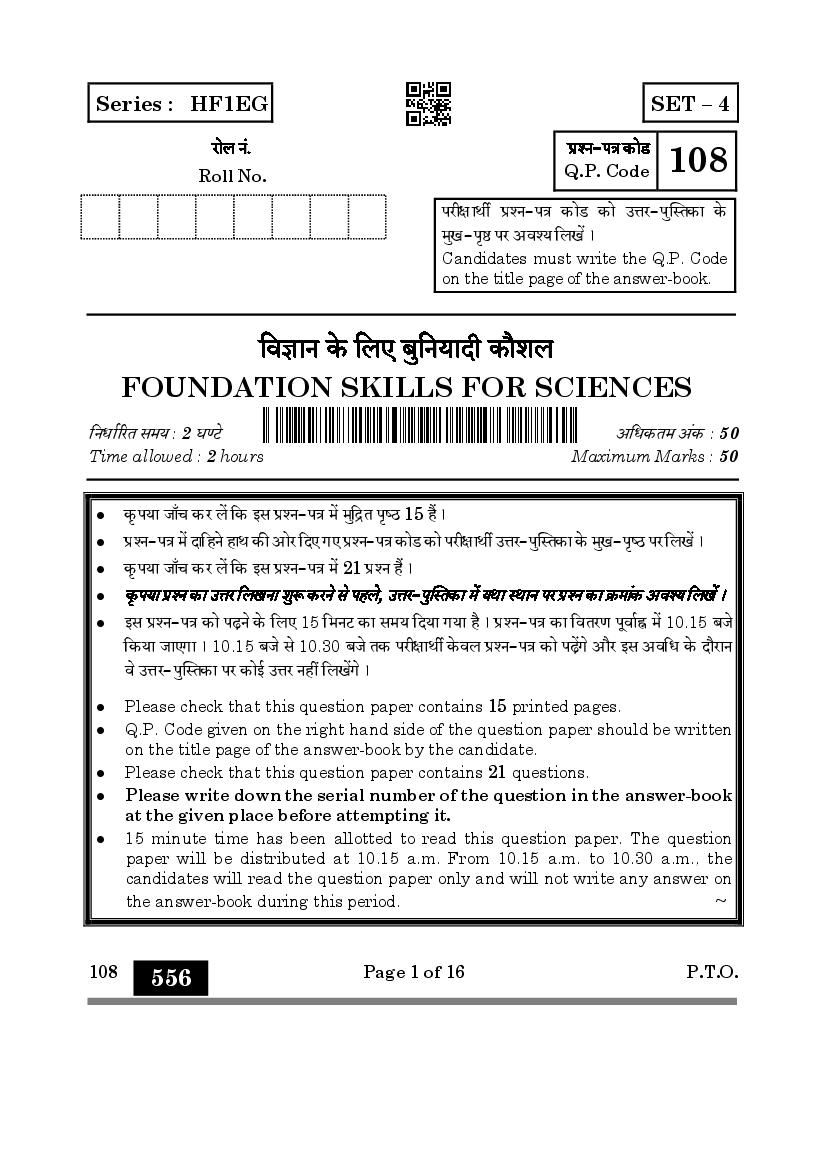
Roll No. Q.P. Code 108
- -
-
Candidates must write the Q.P. Code
on the title page of the answer-book.
FOUNDATION SKILLS FOR SCIENCES
: 2 : 50
Time allowed : 2 hours Maximum Marks : 50
● - 15
● - - - -
● - 21
● , -
● - 15 - 10.15
10.15 10.30 -
-
● Please check that this question paper contains 15 printed pages.
● Q.P. Code given on the right hand side of the question paper should be written
on the title page of the answer-book by the candidate.
● Please check that this question paper contains 21 questions.
● Please write down the serial number of the question in the answer-book
at the given place before attempting it.
● 15 minute time has been allotted to read this question paper. The question
paper will be distributed at 10.15 a.m. From 10.15 a.m. to 10.30 a.m., the
candidates will read the question paper only and will not write any answer on
the answer-book during this period. ~
108 556 Page 1 of 16 P.T.O.
Page 2
(1)
(2) - 21 –
(3)
(4) (5 + 16 =) 21 , () 2
(5 + 10 =) 15
(5)
(6) : (24 )
(i) 05
(ii)
(iii)
(iv)
(v) /
(7) : (26 )
(i) 16
(ii) 10
(iii)
(iv)
(v) /
108 Page 2 of 16 ~
Page 3
(1) Please read the instructions carefully.
(2) This Question Paper consists of 21 questions in two sections : Section A
& Section B.
(3) Section A has Objective type questions whereas Section B contains
Subjective type questions.
(4) Out of the given (5 + 16 =) 21 questions, a candidate has to answer
(5 + 10 =) 15 questions in the allotted (maximum) time of 2 hours.
(5) All questions of a particular section must be attempted in the correct
order.
(6) Section A : Objective Type Questions (24 Marks)
(i) This section has 05 questions.
(ii) It is mandatory for every student to complete all the questions as
per instructions.
(iii) There is no negative marking.
(iv) Do as per the instructions given.
(v) Marks allotted are mentioned against each question/part.
(7) Section B : Subjective Type Questions (26 Marks)
(i) This section has 16 questions.
(ii) A candidate has to do 10 questions.
(iii) There is no negative marking.
(iv) Do as per the instructions given.
(v) Marks allotted are mentioned against each question/part.
108 Page 3 of 16 ~ P.T.O.
Page 4
( )
1. 6 4 41=4
(i) , _______ 1
(A)
(B)
(C)
(D)
(ii) (Stress management) ABC ‘A’ ? 1
(iii) ______ 1
(iv) ______
1
(v) 1
(vi) ______ (sustainable development)
1
108 Page 4 of 16 ~
Page 5
(Objective Type Questions)
1. Answer any 4 out of the given 6 questions on employability skills. 41=4
(i) You are taking a long time to give a reply. This is a type of 1
(A) Positive feedback
(B) No feedback
(C) Negative feedback
(D) Performance based feedback
(ii) What the letter ‘A’ stands for ABC of Stress Management ? 1
(iii) The force within you that drives you to simply do things is
_________. 1
(iv) When the _________ key is turned on, it helps you overwrite
characters to the right of cursor. 1
(v) Write an example of self-employment. 1
(vi) The most important factor for sustainable development is
_________. 1
108 Page 5 of 16 ~ P.T.O.
Page 6
(i) ,
? 1
(A) (B)
(C) (D)
(ii) (SQP) 1
(A) (B)
(C) (D)
(iii)
1
(A) (Test tube) (B) (Beakers)
(C) (Burettes) (D) (Pipettes)
(iv) (ions)
(ions) – 1
(A) (Base) (B) (Acid)
(C) (Solvent) (D) (Reagent)
108 Page 6 of 16 ~
Page 7
(i) Which market research technique brings together a small group of
physicians, patients or key opinion leaders ? 1
(A) Observational research
(B) Interviews
(C) Surveys
(D) Focus Group
(ii) The most important component of Standard Operating Procedure
(SQP) is 1
(A) Compliance
(B) Responsibilities
(C) Training
(D) Efficiency
(iii) The long thin glass tubes with valve at the bottom used for
measuring and dispensing precise amount of liquid – 1
(A) Test tube (B) Beakers
(C) Burettes (D) Pipettes
(iv) The substance that can donate hydrogen ions or accept hydroxyl ions
in solution is 1
(A) Base (B) Acid
(C) Solvent (D) Reagent
108 Page 7 of 16 ~ P.T.O.
Page 8
- 1
(A) (Health care providers)
(B) (Regulatory Authorities)
(C) (Research and development companies)
(D) (Manufacturing Companies)
(vi) ,
,
? 1
(A) (Descriptive research)
(B) (Explanatory research)
(C) (Exploratory research)
(D) - (Co-relational research)
3. 6 5 51=5
(i) 1
(ii) (functional group) 1
(iii)
? 1
108 Page 8 of 16 ~
Page 9
medicines and developed them into viable treatments – 1
(A) Health care providers
(B) Regulatory Authorities
(C) Research and development companies
(D) Manufacturing companies
(vi) The type of research whose primary purpose is to explain why events
occur to build, elaborate, extend or test a theory – 1
(A) Descriptive research
(B) Explanatory research
(C) Exploratory research
(D) Co-relational research
3. Answer any 5 out of the given 6 questions. 51=5
(i) Write any one element of research design. 1
(ii) Give one example of functional group. 1
(iii) What type of chemical is used to determine the end point of a
chemical reaction during titration ? 1
108 Page 9 of 16 ~ P.T.O.
Page 10
(v) (quality) ? 1
(vi) RCPA 1
4. 6 5 51=5
(i) ? 1
(ii) ,
? 1
(iii) 1
(iv) ? 1
(v) (QMS)
1
(vi)
1
5. 6 5 51=5
(i) 1
(ii) (Six Sigma) ? 1
(iii) A 1
108 Page 10 of 16 ~
Page 11
tube ? 1
(v) What do you mean by quality ? 1
(vi) Write any one benefit of RCPA. 1
4. Answer any 5 out of the given 6 questions. 51=5
(i) What do you mean by innovation ? 1
(ii) What type of medicinal products are derived from living organisms
like cells, tissues or micro-organisms ? 1
(iii) Name the substance that is used to dissolve a solute. 1
(iv) Which class of glassware has the highest level of accuracy ? 1
(v) Name the international standard that outlines the requirements for
a Quality Management System (QMS). 1
(vi) Name the research method that is used to collect data from selected
group of individuals. 1
5. Answer any 5 out of the given 6 questions. 51=5
(i) Write any one primary purpose of Competitor analysis. 1
(ii) What do you mean by Six Sigma ? 1
(iii) Name the material used to manufacture class A glassware. 1
108 Page 11 of 16 ~ P.T.O.
Page 12
(v) () (Key Players)
1
(vi) (innovation) 1
–
( )
5 3
20 30 32=6
6. (effective communication) ? 2
7. ? 2
8. ? 2
9. 2
10. ‘’ 2
6 4 20-30 42=8
11. 2
12. (quality standards) 2
108 Page 12 of 16 ~
Page 13
(v) Name any two key players involved in Pharmaceutical Industry. 1
(vi) Write the two basic categories of innovation. 1
Section – B
(Subjective Type Questions)
Answer any 3 out of the given 5 questions on Employability Skills.
Answer each question in 20-30 words. 32=6
6. What are the different barriers of effective communication ? 2
7. What are the steps involved in management of stress ? 2
8. How do you protect your data from theft and viruses in computer ? 2
9. Write any two qualities required for a successful entrepreneur. 2
10. Write any two advantages of using ‘Kulhads’ over disposable plastic and
paper cups. 2
Answer any 4 out of the given 6 questions in 20-30 words each. 42=8
11. Write the strategy for successful marketing. 2
12. Write any two benefits of implementing quality standards in an
organization. 2
108 Page 13 of 16 ~ P.T.O.
Page 14
14. (Chemicals)
2
15. (medicine manufacturing) 2
16. 2
5 3 50-80 : 3 4 = 12
17.
4
18. 4
19.
4
20.
4
21. (medicine manufacturing)
4
_______________
108 Page 14 of 16 ~
Page 15
14. Name the two chemicals with their potential hazards used in laboratory. 2
15. Mention the role of Regulatory Authorities in medicine manufacturing. 2
16. Name the perspectives on which research methodology is categorised in
pharmaceutical industry. 2
Answer any 3 out of the given 5 questions in 50-80 words each. 3 4 = 12
17. Explain any two key factors that influence the consumer behaviour in the
context of life sciences products. 4
18. Describe the role of International Standards in ensuring quality
compliance. 4
19. Write some potential hazards that may arise due to improper cleaning of
glassware in laboratory. 4
20. State the important points that are required for proper labelling of
chemicals in a laboratory. 4
21. Describe the different steps involved in the process of manufacturing
medicine. 4
_______________
108 Page 15 of 16 ~ P.T.O.
Page 16
Document Details
| Board / Org | CBSE |
| Exam | Class 10 |
| Type | Question Paper |
| Pages | 16 |
| Updated | 24 Sep 2026 |