AP PGCET 2023 Syllabus Geology
Finished viewing? Save it for later —
Download AP PGCET 2023 Syllabus Geology (PDF · 3 pages)About AP PGCET 2023 Syllabus Geology
AP PGCET 2023 Syllabus Geology is available here for free download. Published by APSCHE for AP PGCET, this syllabus can be viewed online or downloaded as a PDF (3 pages). Candidates preparing for AP PGCET can use AP PGCET 2023 Syllabus Geology to understand the exam pattern, the type of questions asked, and the overall difficulty level.
Frequently Asked Questions
How can I download AP PGCET 2023 Syllabus Geology?
Open this page and click the Download button to save AP PGCET 2023 Syllabus Geology as a PDF. It is completely free on AglaSem Docs.
Is AP PGCET 2023 Syllabus Geology free to download?
Yes. AP PGCET 2023 Syllabus Geology can be viewed online and downloaded as a PDF free of cost on AglaSem Docs.
How many pages does AP PGCET 2023 Syllabus Geology have?
AP PGCET 2023 Syllabus Geology contains 3 pages, which you can read online or download together as a single PDF.
Where can I find more AP PGCET study material?
You can find more AP PGCET question papers, sample papers, syllabus, and answer keys on AglaSem Docs.
AP PGCET 2023 Syllabus Geology – Text
Read the full text of this syllabus below — useful to quickly search, copy and reference the content online without downloading the PDF.
📄 View text version (3 pages)
Page 1
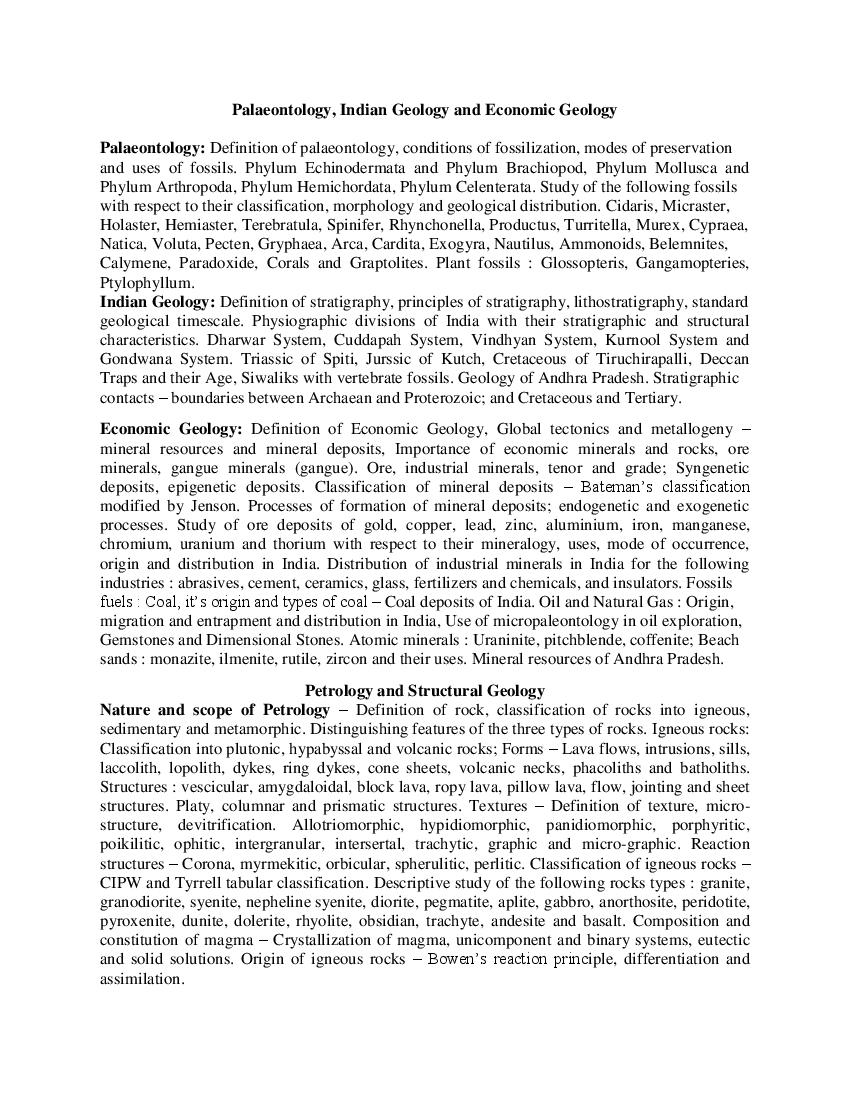
Palaeontology: Definition of palaeontology, conditions of fossilization, modes of preservation
and uses of fossils. Phylum Echinodermata and Phylum Brachiopod, Phylum Mollusca and
Phylum Arthropoda, Phylum Hemichordata, Phylum Celenterata. Study of the following fossils
with respect to their classification, morphology and geological distribution. Cidaris, Micraster,
Holaster, Hemiaster, Terebratula, Spinifer, Rhynchonella, Productus, Turritella, Murex, Cypraea,
Natica, Voluta, Pecten, Gryphaea, Arca, Cardita, Exogyra, Nautilus, Ammonoids, Belemnites,
Calymene, Paradoxide, Corals and Graptolites. Plant fossils : Glossopteris, Gangamopteries,
Ptylophyllum.
Indian Geology: Definition of stratigraphy, principles of stratigraphy, lithostratigraphy, standard
geological timescale. Physiographic divisions of India with their stratigraphic and structural
characteristics. Dharwar System, Cuddapah System, Vindhyan System, Kurnool System and
Gondwana System. Triassic of Spiti, Jurssic of Kutch, Cretaceous of Tiruchirapalli, Deccan
Traps and their Age, Siwaliks with vertebrate fossils. Geology of Andhra Pradesh. Stratigraphic
contacts – boundaries between Archaean and Proterozoic; and Cretaceous and Tertiary.
Economic Geology: Definition of Economic Geology, Global tectonics and metallogeny –
mineral resources and mineral deposits, Importance of economic minerals and rocks, ore
minerals, gangue minerals (gangue). Ore, industrial minerals, tenor and grade; Syngenetic
deposits, epigenetic deposits. Classification of mineral deposits – Bateman’s classification
modified by Jenson. Processes of formation of mineral deposits; endogenetic and exogenetic
processes. Study of ore deposits of gold, copper, lead, zinc, aluminium, iron, manganese,
chromium, uranium and thorium with respect to their mineralogy, uses, mode of occurrence,
origin and distribution in India. Distribution of industrial minerals in India for the following
industries : abrasives, cement, ceramics, glass, fertilizers and chemicals, and insulators. Fossils
fuels : Coal, it’s origin and types of coal – Coal deposits of India. Oil and Natural Gas : Origin,
migration and entrapment and distribution in India, Use of micropaleontology in oil exploration,
Gemstones and Dimensional Stones. Atomic minerals : Uraninite, pitchblende, coffenite; Beach
sands : monazite, ilmenite, rutile, zircon and their uses. Mineral resources of Andhra Pradesh.
Petrology and Structural Geology
Nature and scope of Petrology – Definition of rock, classification of rocks into igneous,
sedimentary and metamorphic. Distinguishing features of the three types of rocks. Igneous rocks:
Classification into plutonic, hypabyssal and volcanic rocks; Forms – Lava flows, intrusions, sills,
laccolith, lopolith, dykes, ring dykes, cone sheets, volcanic necks, phacoliths and batholiths.
Structures : vescicular, amygdaloidal, block lava, ropy lava, pillow lava, flow, jointing and sheet
structures. Platy, columnar and prismatic structures. Textures – Definition of texture, micro-
structure, devitrification. Allotriomorphic, hypidiomorphic, panidiomorphic, porphyritic,
poikilitic, ophitic, intergranular, intersertal, trachytic, graphic and micro-graphic. Reaction
structures – Corona, myrmekitic, orbicular, spherulitic, perlitic. Classification of igneous rocks –
CIPW and Tyrrell tabular classification. Descriptive study of the following rocks types : granite,
granodiorite, syenite, nepheline syenite, diorite, pegmatite, aplite, gabbro, anorthosite, peridotite,
pyroxenite, dunite, dolerite, rhyolite, obsidian, trachyte, andesite and basalt. Composition and
constitution of magma – Crystallization of magma, unicomponent and binary systems, eutectic
and solid solutions. Origin of igneous rocks – Bowen’s reaction principle, differentiation and
assimilation.
Page 2
transportation, stratification. Sedimentary structures : types of bedding, surface marks, deformed
bedding and solution structures. Classification of sedimentary rocks : Clastic – rudaceous,
arenaceous, and argillaceous; Non-Clastic – calcareous, carbonaceous, ferruginous, phosphatic,
and evaporates. Descriptive study of the following sedimentary rocks – conglomerate,
breccshiva, sandstone, grit, arkose, greywacke, shale, limestone, and shelly limestone.
Metamorphic rocks: Definition of metamorphism, agencies of metamorphism, types of
metamorphism, grades and zones of metamorphism. Metamorphic minerals – stress and anti
stress minerals – Structures of metamorohic rocks – Cataclastic, maculose, schistose, granulose
and gneissose. Textures of metamorphic rocks – crystalloblastic, xenoblastic and idioblastic.
Classification of metamorphic rocks – concept of metamorphic facies. Cataclastic metamorphism
of argillaceous and arenaceous rocks. Thermal metamorphism of argillaceous, arenaceous and
calcareous rocks. Dynamothermal metamorphism of argillaceous, arenaceous and basic igneous
rocks. Plutonic metamorphism, metasomatism and additive processes. Definition of anatexis and
palingenesis. Descriptive study of the following metamorphic rocks : gneiss, schist, slate,
phyllite, quartzite, marble, granulite, eclogite, Behaviorion, migmatite, charnockite and
khondalite.
Structural Geology: Definition of structural geology, aim and objectives of structural geology;
Importance of study of structures, primary and secondary structures; Outcrops, attitude of
beds;Strike, dip and apparent dip, and Use of Bronton sonmpass. Primary structures. Folds –
description, nomenclature and recognition in the field. Joints – geometrical and genetic
classification. Faults – geometrical and genetic classification and recognition in the field. Effects
of faults on the outcrops. Unconformities – definition, types, and recognition in the field.
Distinguishing the faults from unconformities. Definitions of overlap, offlap, outlier, cleavage,
schistosity, foliation and lineation.
Physical Geology, Crystallography and Mineralogy
Physical Geology: General aspects, definition of geology – Basic assumptions of Geology – Its
Relationship with other sciences – Branches of geology – Aim and applications of Geology.
Earth as a planet – its shape, size, density – movements and their effects. Origin and age of the
earth. Geological processes – exogenic and endogenic. Definition of weathering – types of
weathering of rocks – physical and chemical. Definition of erosion and denudation, cycle of
erosion, transportation and deposition, agents of erosion. Rivers: erosion, transportation and
deposition of river (fluvial) cycle in different stages – Development of typical landforms by river
erosion and deposition. V-shaped valley, waterfall, alluvial fan, meander, ox-bow lake, flood
plane, natural plane, peneplain and delta. Types of rivers. Glaciers: Definition of a glacier –
types – development of typical landforms by glacial erosion and deposition – cirque, U-shaped
valley – changing valley; Rocks – monadrocks, morains, drum-line, kama, eskors and varves,
characteristic features of glaciated regions. Groundwater : storage of ground water – porosity,
permeability, acquifer, water table – zone of saturation, artesian well, spring, geysers –
development of typical landforms by erosion and deposition by groundwater (Karst topography),
sinkhole, cavern, stalactites and stalagmites. Seas: Offshore profile – landforms of sea – marine
deposits and coral reefs. Lacustrine deposits, atmospheric circulation, weather and climatic
changes, land-air-sea interaction. Earth’s heat budget and global climatic changes.
Page 3
pedestal rock – mushroom topography – Incelberg – Ventifacts – locus and sand dunes.
Earth movements: definition of diastrophism, epirogenic and orogenic movements – mountains.
Basic concepts of isostasy, continental drift and plate tectonics.
Earthquakes : causes, kinds of earthquake waves, mode of propagation, intensity of
earthquakes, Richter’s scale, seismograph and seismogram. Effects of earthquakes, earthquake
zones, interior of the earth.
Volcanoes : origin and products
Crystallography : Definition of crystal – amorphous and crystalline states – morphology of
crystals – face, edge, solid angle and interfacial angle. Forms : simple, combination, closed and
open forms. Symmetry : Plane, axis, centre, crystallographic axes, parameters, indices,
crystallographic notation – Parameter system of Weiss, Index system of Miller. Classification
of Crystals into ‘7’ systems. Morphological study of the following classes of symmetry : a)
Cubic system – Normal (Galena) type, b) Tetragonal system – Zircon type, c) Hexagonal system
– Beryl type, d) Trigonal system – Calcite type, e) Orthorhombic system – Barytes type, f)
Monoclinic system – Gypsum type, and g) Triclinic system – Axinite type. Twinning in crystals
– definition of twin, twin plane, twin axis and composition plane.
Mineralogy : Definition of a mineral – Classification of minerals into rock forming and ore
forming minerals. Physical properties of minerals – colour, streak, play of colours, opalescence,
asterism, transparency, luster, luminescence, fluorescence, form, hardness, tenacity, cleavage,
parting, fracture, specific gravity, magnetic properties, electrical properties, pyro- and
piezoelectricity. Modes of mineralformation : Occurrence and association of minerals.
Chemical properties of minerals – isomorphism – solid solution – polymorphism – allotropy,
pseudomorphism, radioactivity, silicate structure. Descriptive Mineralogy: Study of physical
and chemical properties and mode of occurrence of the following mineral groups: Nesosilicate –
Olivine, garnet and aluminum silicates; Sorosilicate – epidote; Cyclosilicate – beryl; Inosilicate
– pyroxene and amphibole; Phyllosilicate – mica, hydrous magnesium silicate; Tektosilicate –
feldspars, feldspathoids and quartz; Miscellaneous – staurolite, tourmaline, zircon, calcite,
corundum and apatite. Optical Mineralogy: Optical properties of minerals – Isotropic and
Anisotropic – Polarized light, refractive index – Double refraction, Uniaxial and Biaxial minerals
– Nicol Prism and it’s construction, Concept of crossed nicols. Petrological (Polarizing)
Microscope – Its mechanical and optical parts – behavior of isotropic and anisotropic mineral
between crossed nicols – extinction, pleochroism, interference colour. Optical properties of
important minerals.
*************