ICSE Class 10 Sample Paper 2026 Chemistry
Finished viewing? Save it for later —
Download ICSE Class 10 Sample Paper 2026 Chemistry (PDF · 20 pages)About ICSE Class 10 Sample Paper 2026 Chemistry
ICSE Class 10 Sample Paper 2026 Chemistry is available here for free download. Published by CISCE for Class 10, this sample paper can be viewed online or downloaded as a PDF (20 pages). Candidates preparing for Class 10 can use ICSE Class 10 Sample Paper 2026 Chemistry to understand the exam pattern, the type of questions asked, and the overall difficulty level.
Frequently Asked Questions
How can I download ICSE Class 10 Sample Paper 2026 Chemistry?
Open this page and click the Download button to save ICSE Class 10 Sample Paper 2026 Chemistry as a PDF. It is completely free on AglaSem Docs.
Is ICSE Class 10 Sample Paper 2026 Chemistry free to download?
Yes. ICSE Class 10 Sample Paper 2026 Chemistry can be viewed online and downloaded as a PDF free of cost on AglaSem Docs.
How many pages does ICSE Class 10 Sample Paper 2026 Chemistry have?
ICSE Class 10 Sample Paper 2026 Chemistry contains 20 pages, which you can read online or download together as a single PDF.
Where can I find more Class 10 study material?
You can find more Class 10 question papers, sample papers, syllabus, and answer keys on AglaSem Docs.
ICSE Class 10 Sample Paper 2026 Chemistry – Text
Read the full text of this sample paper below — useful to quickly search, copy and reference the content online without downloading the PDF.
📄 View text version (20 pages)
Page 1
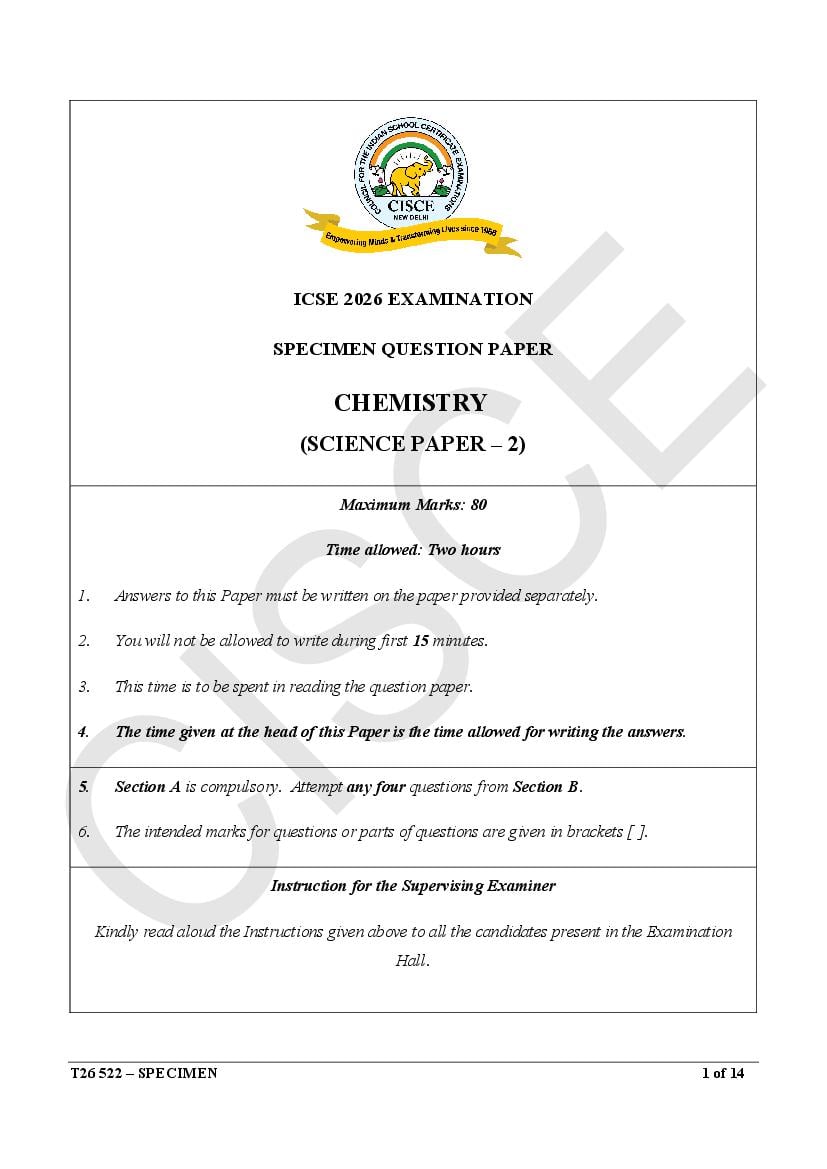
SPECIMEN QUESTION PAPER
CHEMISTRY
(SCIENCE PAPER – 2)
Maximum Marks: 80
Time allowed: Two hours
1. Answers to this Paper must be written on the paper provided separately.
2. You will not be allowed to write during first 15 minutes.
3. This time is to be spent in reading the question paper.
4. The time given at the head of this Paper is the time allowed for writing the answers.
5. Section A is compulsory. Attempt any four questions from Section B.
6. The intended marks for questions or parts of questions are given in brackets [ ].
Instruction for the Supervising Examiner
Kindly read aloud the Instructions given above to all the candidates present in the Examination
Hall.
T26 522 – SPECIMEN 1 of 14
Page 2
The Specimen Question Paper in the subject provides a realistic
format of the Board Examination Question Paper and should be used
as a practice tool. The questions for the Board Examination can be set
from any part of the syllabus. However, the format of the Board
Examination Question Paper will remain the same as that of the
Specimen Question Paper.
Page 3
(Attempt all questions from this Section.)
Question 1
Choose the correct answers to the questions from the given options. [15]
(Do not copy the question, write the correct answers only.)
(i) Which of the following will dissociate in aqueous solution, to give a
positive ion other than hydronium ion, and a negative ion other than
hydroxyl ion?
(a) KOH
(b) dil. HCl
(c) NaCl [Understanding
(d) CH3COOH & Application]
(ii) A compound P is heated in a test tube with sodium hydroxide solution.
A red litmus paper held at the mouth of the test tube turns blue.
Which of the following could compound P be?
(a) Zinc sulphate
(b) Copper sulphate
(c) Ferrous sulphate
(d) Ammonium sulphate [Understanding]
(iii) Assertion (A): Aqueous solution of potassium chloride can conduct
electricity.
Reason (B): Conduction of electric current is due to the presence of
free ions.
(a) (A) is true and (R) is false.
(b) (A) is false and (R) is true.
(c) Both (A) and (R) are true and (R) is the correct explanation of (A).
(d) Both (A) and (R) are true, but (R) is not the correct explanation of
(A). [Understanding]
T26 522 – SPECIMEN 2 of 14
Page 4
(a) OH-1
(b) H3O+
(c) NH4+
(d) H+ [Understanding
& Application]
(v) Four reactions are shown below in the diagram:
1. 2.
3. 4.
Which reactions produce water?
(a) 1 and 2
(b) 1 and 3
(c) 3 and 4 [Understanding
(d) 2 and 3 & Application]
T26 522 – SPECIMEN 3 of 14
Page 5
turns acidified potassium dichromate solution from orange to green.
Which of the following could be compound X?
(a) Lead nitrate
(b) Copper carbonate
(c) Sodium chloride [Recall &
(d) Potassium sulphite Understanding]
(vii) The volume occupied by 2 moles of a gas at STP is:
(a) 22.4L
(b) 2.24L
(c) 44.8L [Understanding]
(d) 4.48L
(viii) Identify from the following metal oxide which can react with an acid as
well as an alkali.
(a) Silver oxide
(b) Calcium oxide
(c) Copper(II) oxide
(d) Aluminium oxide [Understanding]
(ix) The structures of four hydrocarbons are shown below:
How many isomers of butene are shown in the above structures?
(a) 1
(b) 2
(c) 3
(d) 4 [Analysis]
T26 522 – SPECIMEN 4 of 14
Page 6
(a) Al
(b) S
(c) Mg [Understanding
(d) Na & Application]
(xi) For which pH change is there the maximum increase in acidity?
Initial pH Final pH
(a) 1 3
(b) 2 6
(c) 3 1
[Understanding
(d) 6 2
& Application]
(xii) The equation below shows the reaction between element ‘X’ and dilute
sulphuric acid.
X(s) + H2SO4 (aq.) XSO4 (aq.) + H2 (g)
Which particles are responsible for conducting electricity in dilute
sulphuric acid and compound XSO4?
(a) Electrons
(b) Only positive ions
(c) Only negative ions
[Understanding]
(d) Both positive and negative ions
(xiii) Methanol and ethanol belong to the same homologous series.
What does this statement mean?
(a) Their molecules contain atoms only of carbon and hydrogen.
(b) Their molecules have the same number of carbon atoms.
(c) They have the same functional group.
(d) They have the same relative molecular mass. [Understanding]
T26 522 – SPECIMEN 5 of 14
Page 7
and 10 grams of hydrogen gas is:
(a) 2.2 :1
(b) 1: 2.2
(c) 1:10
(d) 10:1
[Application]
(xv) In the process of Electrorefining of Copper shown in the diagram below,
which of the following statements is correct?
(a) The anode is made of pure Copper.
(b) The cathode is made of impure Copper.
(c) Copper is deposited at the anode.
(d) Copper ions from the anode move to the cathode and get deposited [Understanding]
as pure Copper.
T26 522 – SPECIMEN 6 of 14
Page 8
(i) Electroplating steel objects with silver involves a three-step process. [5]
step 1 A coating of copper is applied to the object.
step 2 A coating of nickel is applied to the object.
step 3 The coating of silver is applied to the object.
(a) A diagram of the apparatus used for step 1 is shown.
1. The chemical process taking place on the surface of the object
is Cu2 + (aq) + 2e- Cu(s)
What is the observation seen on the surface of the object?
2. Explain why the concentration of copper ions in the
electrolyte remains constant throughout step1.
(b) Give two changes which would be needed in order to coat nickel
onto the object in step 2.
[Understanding
(c) Write down the reaction taking place at the positive electrode
& Application]
during step 3.
(ii) Identify the following: [5]
(a) A bond formed between two atoms by sharing of a pair of electrons,
with both electrons being provided by the same atom.
(b) A salt formed by the complete neutralisation of an acid by a base.
(c) A reaction in which the hydrogen of an alkane is replaced by a
halogen.
T26 522 – SPECIMEN 7 of 14
Page 9
atom.
(e) A homogenous mixture of two or more metals or a metal and a non-
metal in a definite proportion in their molten state.
[Recall]
(iii) Complete the following by choosing the correct answers from the bracket: [5]
(a) When dilute sulphuric acid reacts with zinc granules, the gas
evolved is __________ (hydrogen / carbon dioxide), which can be
tested using a burning splint.
(b) A solution of copper(II) sulphate in sodium hydroxide solution
forms a __________ (pale blue / green) precipitate.
(c) In methane, each hydrogen atom share(s) __________ (one / two)
electron(s) with the central carbon atom to complete its valence
shell.
(d) The electron affinity of element X is greater than that of element Y.
The oxidising power of X is likely to be ________ (more / less) than
that of element Y.
(e) The naturally occurring compound of a metal from which the metal
can be extracted is called its _________ (ore / mineral). [Recall &
Understanding]
(iv) Match Column A with Column B. [5]
Column A Column B
(a) Aluminium 1. Covalent compound
(b) Sulphuric acid 2. Carbonate ore
(c) Calcination 3. Hall Heroult’s process
[Recall &
(d) Calcium Chloride 4. Contact Process Understanding]
(e) Carbon tetrachloride 5. Electrovalent compound
T26 522 – SPECIMEN 8 of 14
Page 10
1.
2.
(b) Draw the structural diagram for the following compounds:
1. but-2-yne
2. 1, 1, 1, trichloro methane
[Understanding]
3. pentan -2-ol
SECTION B (40 Marks)
(Attempt any four questions.)
Question 3
(i) Give one significant observation when: [2]
(a) Excess of chlorine gas reacts with ammonia. [Recall &
(b) Zinc nitrate is strongly heated in a test tube. Understanding]
(ii) Give reasons: [2]
(a) When ammonia gas is passed over black copper oxide in a
combustion tube a reddish-brown substance is left behind.
(b) Quick lime is not used to dry hydrogen chloride gas. [Understanding]
(iii) The electron affinity of an element X is greater than that of element Y. [3]
(a) How is the oxidising power of X likely to compare with that of Y?
(b) How is the electronegativity of X likely to compare with that of Y?
(c) State whether X is likely to be placed to the left or to the right of Y
[Application]
in the periodic table?
T26 522 – SPECIMEN 9 of 14
Page 11
(a) Ammonium chloride reacts with calcium hydroxide.
(b) Nitric acid reacts with zinc carbonate.
(c) Concentrated sulphuric acid is added to hydrated copper sulphate. [Recall]
Question 4
(i) Name the main metal present in the following alloys: [2]
(a) Duralumin
(b) Brass [Recall]
(ii) Write balanced chemical equations for the following: [2]
(a) Laboratory preparation of hydrochloric acid from a less volatile
acid.
[Recall &
(b) Bromine gas is passed over ethene in the presence of carbon
Understanding]
tetrachloride.
(iii) Abhishek was given a salt ‘X’ for analysis which was white in colour. On [3]
strong heating it produced a yellow residue, a colourless gas, and also a
reddish-brown gas. The solution of the salt ‘X’ when tested with excess
of ammonium hydroxide produced a chalky white insoluble precipitate.
(a) Name the coloured gas evolved when Abhishek heated the salt
strongly.
(b) Which cation was present in the sample given to Abhishek?
(c) Identify the salt given to Abhishek for analysis. [Understanding]
(iv) In a round bottom flask, a mixture of ethanol, acetic acid and concentrated [3]
sulphuric acid was heated:
(a) Name the type of reaction occurring in the above set up.
(b) What is the role of sulphuric acid in this reaction?
(c) State one observation that takes place during the reaction. [Understanding]
T26 522 – SPECIMEN 10 of 14
Page 12
(i) Identify the reactant and write the balanced equation for the following: [2]
Nitric acid reacts with compound Q to give a salt Calcium nitrate, water
and carbon dioxide. [Understanding]
(ii) What will be the mass of carbon dioxide that will contain the same [2]
number of molecules as present in 3.2g of oxygen gas? [Understanding
[At. Wt: O=16, C=12] & Application]
(iii) State the property exhibited by sulphuric acid in each of the following [3]
reactions:
(a) Sulphur with concentrated sulphuric acid.
(b) Conversion of ferrous sulphide to hydrogen sulphide gas using
sulphuric acid.
[Recall &
(c) Ethanol with concentrated sulphuric acid. Understanding]
(iv) Give balanced equations for the following: [3]
(a) Laboratory preparation of ethyne from calcium carbide.
(b) Conversion of acetic acid to ethyl acetate.
(c) Laboratory preparation of nitric acid. [Recall]
Question 6
(i) A student was asked to perform two experiments in the laboratory based [2]
on the instructions given:
Observe the picture given below and state one observation for each of the
Experiments 1 and 2 that you would notice on mixing the given solutions.
(a) Experiment 1
T26 522 – SPECIMEN 11 of 14
Page 13
[Understanding]
(ii) You are provided with the list of chemicals mentioned below in the box: [2]
Sodium hydroxide solution, copper carbonate, zinc,
hydrochloric acid, copper, dilute sulphuric acid
Using suitable chemicals from the list given, write balanced chemical
equation for the preparation of the salts mentioned below:
(a) copper sulphate [Understanding
(b) sodium zincate & Application]
(iii) Solid ammonium dichromate decomposes as under: [3]
(NH4)2Cr2O7 N2 + Cr2O3 + 4H2O
If 126 g of ammonium dichromate decomposes, calculate:
(a) the number of moles of ammonium dichromate that undergoes
decomposition.
(b) the mass of chromic oxide formed at the same time.
(c) the volume of nitrogen gas evolved at STP. [Understanding
[At. Wt: N=14, Cr =52, O=16, H=1] & Application]
(iv) Identify the reactants P, Q and R in the following reactions: [3]
(a) Copper oxide + P Copper + water
(b) Iron pyrite + Q Iron oxide + Sulphur dioxide
(c) Sodium chloride + R Sodium nitrate + Silver chloride [Application]
T26 522 – SPECIMEN 12 of 14
Page 14
(i) Give reasons for the following: [2]
(a) Nitric acid does not normally liberate hydrogen gas when it reacts
with active metals.
(b) Silver-plated cutlery is not considered as pure silver. [Understanding]
(ii) The following questions relate to the extraction of Aluminium by [2]
electrolysis.
(a) Name the other compound which contains aluminium added to
alumina.
(b) Give a balanced equation for the reaction that takes place at the
[Recall]
cathode.
(iii) Give balanced equations for each of the following: [3]
(a) Action of warm water on aluminium nitride.
(b) Oxidation of carbon with conc. nitric acid.
(c) Laboratory preparation of ethanol by using chloroethane and [Recall &
aqueous sodium hydroxide. Understanding]
(iv) Rohit has solution X, Y and Z that has pH 2, 7 and 13 respectively. [3]
Which solution:
(a) will liberate sulphur dioxide gas when heated with sodium sulphite?
(b) will liberate ammonia gas when reacted with ammonium chloride?
(c) will not have any effect on litmus paper? [Application]
Question 8
(i) State giving reasons if: [2]
(a) zinc metal and aluminium metal can be distinguished by heating the
metal powders separately in two different test tubes with
concentrated sodium hydroxide solution.
(b) calcium nitrate and lead nitrate can be distinguished by adding
ammonium hydroxide solution to the salt solution. [Understanding]
T26 522 – SPECIMEN 13 of 14
Page 15
[Recall &
[Atomic No.: N = 7, H = 1]
Understanding]
(iii) Write balanced chemical equation for the following conversions (A to C): [3]
ZnSO4 Zn ZnS
Zn(OH)2 [Understanding
& Application]
(iv) L, M and N are three elements with atomic numbers 13, 7 and 10 [3]
respectively. Answer the following questions using only the alphabets
given. Do not identify the elements.
Which element:
(a) can combine with hydrogen to form a gas which produces dense
white fumes with concentrated HCl?
(b) has zero electron affinity?
(c) can form an ionic compound with oxygen? [Understanding]
T26 522 – SPECIMEN 14 of 14
Page 16
DRAFT MARKING SCHEME – CHEMISTRY (SCIENCE PAPER 2)
Question 1 [15x1]
(i) (c) NaCl
(ii) (d) ammonium sulphate
(iii) (c) Both (A) and (R) are the true and (R) is the correct explanation of (A).
(iv) (b) H3O+
(v) (c) 3 and 4
(vi) (d) Potassium sulphite
(vii) (c) 44.8L
(viii) (d) Aluminium oxide
(ix) (b) 2
(x) (d) Na
(xi) (d) 6 2
(xii) (d) Both positive and negative ions
(xiii) (c) They have the same functional group.
(xiv) (c) 1:10
(xv) (d) Copper ions from the anode move to the cathode and get deposited as pure
Copper.
Question 2
(i) (a) (1) reddish brown deposit/ pink deposit/ mass increases [2+2+1]
(2) As anode released Copper ions the concentration of copper ions does
not decrease
(b) Anode should be made up of Nickel and the electrolyte should be aq. Nickel
sulphate or any salt solution of Nickel
(c) Ag Ag+ + e-
(ii) (a) Coordinate bond [5x1]
(b) Normal salt
(c) Substitution
T26 522 - SPECIMEN 1 of 5
Page 17
(e) alloy
(iii) (a) Hydrogen [5x1]
(b) pale blue
(c) one
(d) more
(e) ore
(iv) (a) 3 [5x1]
(b) 4
(c) 2
(d) 5
(e) 1
(v) (a) 1. propanol [3+2]
2. pentene
(b) 1. but-2-yne
2. 1,1,1,trichloro methane
3. pentan -2-ol
Question 3
(i) (a) Yellow oily explosive liquid [2]
(b) reddish-brown gas/ a gas which rekindles a glowing splinter/ a residue
which is yellow when hot and white when cold is formed
T26 522 - SPECIMEN 2 of 5
Page 18
(b) because quick lime reacts with hydrogen chloride gas
(iii) (a) X has more oxidising power than Y [3]
(b) X will be more electronegative than Y
(c) X will be placed to the right of Y
(iv) (a) 2NH4Cl + Ca(OH)2 CaCl2 + 2H2O + 2NH3 [3]
(b) 2HNO3 + ZnCO3 Zn(NO3)2 + H2O + CO2
(c) H2SO4 + CuSO4. 5H2O CuSO4 + 5H2O + H2SO4
Question 4
(i) (a) Aluminium [2]
(b) Copper
(ii) (a) NaCl + conc. H2SO4 NaHSO4 + HCl [2]
(b) C2H4 + Br2 C2H4Br2
(iii) (a) Nitrogen dioxide [3]
(b) lead ion
(c) Lead nitrate
(iv) (a) Esterification [3]
(b) dehydrating agent
(c) Fruity smell is obtained
Question 5
(i) Q is Calcium carbonate or Calcium bicarbonate [2]
CaCO3 + 2HNO3 Ca(NO3)2 + H2O +CO2
OR
Ca(HCO3)2 + 2HNO3 Ca(NO3)2 + 2H2O + 2CO2
(ii) 3.2 g of oxygen contains 6.023×10²² molecules [2]
so 4.4g of CO2 will contain 6.023×10²² molecules
Answer 4.4g of CO2
T26 522 - SPECIMEN 3 of 5
Page 19
(b) Acidic property
(c) dehydrating property
(iv) (a) CaC2 + 2H2O Ca(OH)2 + C2H2 [3]
(b) CH3COOH + C2H5OH CH3COOC2H5 + H2O
(c) NaNO3 + conc. H2SO4 NaHSO4 + 2HNO3
Question 6
(i) (a) White precipitate is formed. [2]
(b) blue precipitate dissolves to form an inky blue solution.
(ii) (a) CuCO3 + H2SO4 CuSO4 + H2O + CO2 [2]
(b) Zn + 2NaOH Na2ZnO2 + H2
(iii) (a) 252 g of Ammonium dichromate = 1mole [3]
126 g of Ammonium dichromate = 0.5 moles
(b) 252 g of ammonium dichromate gives 152 g of chromic oxide
126 g of ammonium dichromate provides 152×126/ 252 = 76 g of chromic
oxide
(c) 252 g of ammonium dichromate produces 22.4 l of nitrogen
126 g of ammonium dichromate produces 22.4×126/ 252 = 11.2 l of nitrogen
(iv) (a) Hydrogen [3]
(b) Oxygen
(c) Silver Nitrate
Question 7
(i) (a) Nitric Acid is a very strong oxidising agent and hence oxidises hydrogen [2]
to water. So, it is not used for obtaining hydrogen from metals.
(b) because it is not made fully of silver only its top coating is of silver
(ii) (a) Cryolite [2]
+ –
(b) Al³ + 3e Al
T26 522 - SPECIMEN 4 of 5
Page 20
(b) C + 4HNO3 CO2 + 2H2O + 4NO2
(c) C2H5Cl + aq. NaOH C2H5OH + NaCl
(iv) (a) X [3]
(b) Z
(c) Y
Question 8
(i) (a) No, both will liberate hydrogen gas which burns with a pop sound [2]
(b) Yes, white ppt. will be formed with lead nitrate but no ppt. is formed with
calcium nitrate/ or no visible reaction
(ii) [2]
(iii) A = Zn + H2SO4 ZnSO4 + H2 [3]
B = Zn + S ZnS
C = ZnSO4 + 2NaOH Zn(OH)2 + Na2SO4 or with NH4OH
(iv) (a) M [3]
(b) N
(c) L
T26 522 - SPECIMEN 5 of 5
Document Details
| Board / Org | CISCE |
| Exam | Class 10 |
| Type | Sample Paper |
| Pages | 20 |
| Updated | 24 Sep 2026 |