Goa Board Class 9 Sample Paper 2027 Social Science
Finished viewing? Save it for later —
Download Goa Board Class 9 Sample Paper 2027 Social Science (PDF · 22 pages)About Goa Board Class 9 Sample Paper 2027 Social Science
Goa Board Class 9 Sample Paper 2027 Social Science is available here for free download. Published by Goa Board for Class 9, this sample paper can be viewed online or downloaded as a PDF (22 pages). Candidates preparing for Class 9 can use Goa Board Class 9 Sample Paper 2027 Social Science to understand the exam pattern, the type of questions asked, and the overall difficulty level.
Frequently Asked Questions
How can I download Goa Board Class 9 Sample Paper 2027 Social Science?
Open this page and click the Download button to save Goa Board Class 9 Sample Paper 2027 Social Science as a PDF. It is completely free on AglaSem Docs.
Is Goa Board Class 9 Sample Paper 2027 Social Science free to download?
Yes. Goa Board Class 9 Sample Paper 2027 Social Science can be viewed online and downloaded as a PDF free of cost on AglaSem Docs.
How many pages does Goa Board Class 9 Sample Paper 2027 Social Science have?
Goa Board Class 9 Sample Paper 2027 Social Science contains 22 pages, which you can read online or download together as a single PDF.
Where can I find more Class 9 study material?
You can find more Class 9 question papers, sample papers, syllabus, and answer keys on AglaSem Docs.
Goa Board Class 9 Sample Paper 2027 Social Science – Text
Read the full text of this sample paper below — useful to quickly search, copy and reference the content online without downloading the PDF.
📄 View text version (23 pages)
Page 1
Goa Board Class 9
Sample Paper 2027
Social Science
EXAM YEAR TYPE SUBJECT
Goa Class 9 2027 Sample Paper Social Science
Notes · Sample Papers · Previous Year Papers · Mock Tests
Page 2
m .co
m .co s e m
se l a
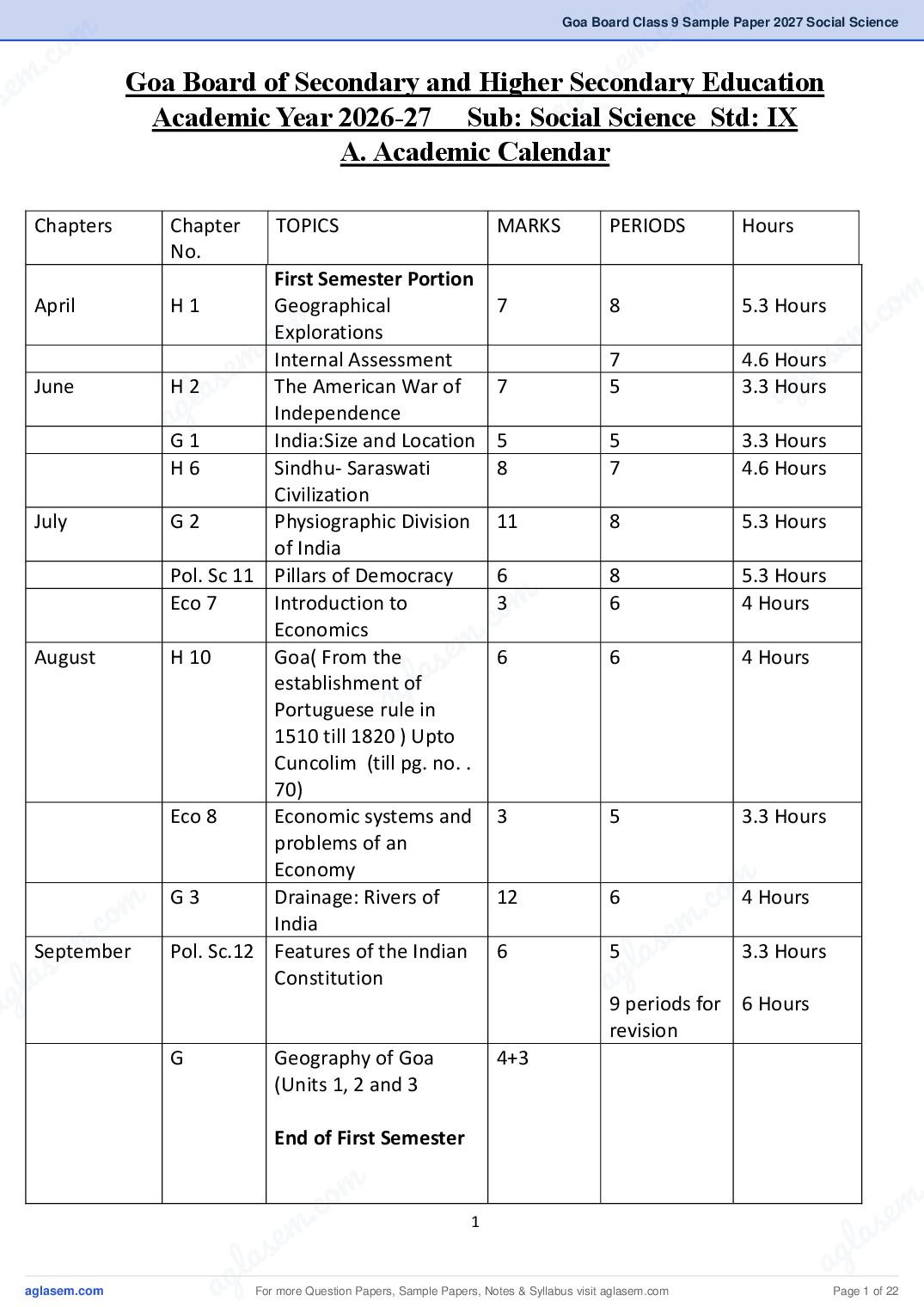
Goa Board of Secondary and Higher Secondary Education
ag Science Std: IX
Academic Year 2026-27 Sub: Social
A. Academic Calendar
Chapters Chapter TOPICS MARKS PERIODS Hours
No.
First Semester Portion
m
April H1
m
Geographical 7 8 5.3 Hours
.co
m .co
Explorations
s e m
s e Internal Assessment 7
l
4.6 Hours
a
June H2
g l a The American War of 7 5
ag
3.3 Hours
a
G1
Independence
India:Size and Location 5 5 3.3 Hours
H6 Sindhu- Saraswati 8 7 4.6 Hours
Civilization
July G2 Physiographic Division 11 8 5.3 Hours
of India
Pol. Sc 11 Pillars of Democracy 6 8 5.3 Hours
m
.co
Eco 7 Introduction to 3 6 4 Hours
Economics
e m6
August H 10 Goa( From the
las 6 4 Hours
establishment of
Portuguese rule in ag
1510 till 1820 ) Upto
Cuncolim (till pg. no. .
70)
Eco 8 Economic systems and 3 5 3.3 Hours
problems of an
Economy
m
m G3 Drainage: Rivers of 12 6 c. o 4 Hours
m.co India
5 a s e m
s e
September Pol. Sc.12 Features of the Indian 6
l 3.3 Hours
g la Constitution a9gperiods for 6 Hours
a
revision
G Geography of Goa 4+3
(Units 1, 2 and 3
End of First Semester
m .
.co s e m
em a
1
s l
l a ag
ag For more Question Papers, Sample Papers, Notes & Syllabus visit Page 1 of 22
Page 3
Portion
H3 The French Revolution 5 9 6 Hours
November G4 Climate 10+1 8 5.3 Hours
Pol. Sc 13 Fundamental Rights 6 5 3.3 Hours
and Fundamental
Duties
H 10 Goa(From the 6 6 4 Hours
establishment of
Portuguese rule in
1510 till 1820) Mateus
de Castro Mahale and
Maratha-Portuguese
Relations
December H4 Age of Industrialisation 6 10 6.6 Hours
Field Trip 5 3.3 Hours
January G5 Natural Vegetation and 9 +1 9 6 Hours
Wildlife
Pol. Sc 14 Electoral System 6 5 3.3 Hours
Eco 9 Food Security 4 5 3.3 Hours
February H5 South Indian Dynasties 5 7 4.6 Hours
H8 Mahajanapadas 6 7 4.6 Hours
Mauryan Empire and
the Gupta Empire.
G6 Population 10+1 6 4 Hours
G Geography of Goa 4
(Unit, 5, 6 and 7)
March Internal Assessment 7 4.6 Hours
Map Work:
Only the following maps are for Map Work (Testing)
(I Semester) i. Goa Political Fig 1.5
ii. Goa Physical (only highlands) Fig 2.12
iii. Goa Rivers Fig 3.9
(II Semester) i. Rainfall Distribution Fig 4.1
ii. Types of Forest in India 5.1
iii. Density of Population of India Fig 6.6
2
For more Question Papers, Sample Papers, Notes & Syllabus visit Page 2 of 22
Page 4
m .co
.co
m Note: s em
se g la
a
Units and sub-units not for evaluation
History- Political science.
1. The Russian Revolution (whole lesson)
2. Vedic Period (Whole lesson)
3. Sindhu-Saraswati Civilization (Only Nature Worship not for Evaluation)
m
.co
4. Mahajanapadas, Maurayan and Gupta Empire
m
.co
(Sixteen Mahajanpadas at a glance. (Table) is not for evaluation.)
e m
em
Some important Mahajanapadas (The Kingdom Kashi, Koshala, Avanti and Gandhara
l as
as
not for evaluation)
l ag
ag
5. Features Of Indian Constitution (Sources of the Indian Constitution is only for reading
and not for evaluation.)
6. Fundamental Rights and Fundamental Duties (Fundamental Duties of citizens is only
for subjective evaluation.)
7. All tables and matter inside boxes are not for evaluation.
8. Articles mentioned in the political science units are not for evaluation.
m
Geography- Economics
m .co
1. Pg. 36. The box is not for testing. as
e
l
ag
2. Learn more on pg. 37 not for testing.
3. Drainage patterns on pg.30.
4. Learn more, pg.40.
5. Boxes on pg.50.
6. Pg.52.
7. Pg.56.
8. Pg.77. Table 6.1.
m
m .co
.co
9. Pg. 79. Table 6.2
e m
e m
10.Pg. 82. Table 6.3
las
las 11.Pg. 86. Tables 6.4 and 6.5.
ag
ag
m .
.co s e m
em a
3
s l
l a ag
ag For more Question Papers, Sample Papers, Notes & Syllabus visit Page 3 of 22
Page 5
Geographical Explorations
Learning Objectives
❖ To understand the factors that led to the geographical discoveries.
❖ To acquire knowledge of various explorers and their explorations.
❖ To analyse the effects of geographical discoveries.
Learning Outcome
❖ Explain factors that led to the geographical explorations.
❖ Identify explorers and the places discovered by them.
❖ Assess the impact of geographical exploration on Asia, Africa and America.
American War of Independence
Learning Objectives
❖ To understand the relationship between the colonies and England.
❖ To analyse the policy of taxation followed by England towards its colonies.
❖ To analyse the significance of the American Revolution.
Learning Outcomes
❖ Explains the relationship between the colonies and England.
❖ Critically analyse the taxation policy of England towards its colonies.
❖ Evaluate the significance of the American Revolution.
Sindhu-Saraswati Civilization
Learning Objectives.
❖ To understand the geographical extent and essential sites of the Sindhu-Saraswati
Civilization.
❖ To understand the social, cultural, and political life of the Sindhu Saraswati Civilization.
❖ To analyse the reasons for the decline of the Sindhu Saraswati Civilization.
Learning Outcomes
❖ Locates the sides of the Sindhu Saraswati Civilization on the map.
❖ Compares the town planning of the Sindhu Saraswati Civilization with modern town planning.
❖ Explains how environmental changes led to the decline of the Civilization.
Physiographic Division of India
Learning Objectives
❖ To acquire knowledge of the Continental Drift Theory and India's landforms.
❖ To interpret the interdependence of various landforms.
❖ To compare and contrast various physical features.
4
For more Question Papers, Sample Papers, Notes & Syllabus visit Page 4 of 22
Page 6
m .co
c. oLearning Outcomes s em
m a
se ❖ Students comprehend the geological process of forming a g lthe Indian subcontinent and India.
❖ Students identify different physiographic divisions and their characteristics.
❖ Students correlate with the physical features of Goa.
Pillars of Indian Democracy
Learning Objectives
❖ To acquire knowledge of the working of the parliamentary system of India.
m
❖ To acquire knowledge of the organization of the judicial system in India.
m .co
.co
❖ To understand the role of the media in strengthening democracy in India.
s e m
s em l a
la ag
Learning Outcomes
❖ Discusses thegrole of the three organs of the government in democracy.
a
❖ Explains the various levels of the judiciary.
❖ Critically analyse the role of the media.
Introduction to Economics
Learning Objectives
❖ To enable the students to understand Economics’ meaning, nature and key concepts.
m
Learning Outcomes
.co
s em
❖ The student will understand the basic concepts of economics and their relevance in daily life.
g la rule in 1510 till 1820)
a
Goa (From the Establishment of Portuguese
Learning Objectives
❖ To acquire knowledge of the Portuguese conquest of Goa.
❖ To understand the causes of rebellions against the Portuguese regime in Goa.
❖ To analyse the relations between the Marathas and the Portuguese.
Learning Outcomes
❖ Explains how the Portuguese established their rule in Goa.
m
m
❖ Evaluates the role played by the Goans in opposing Portuguese rule in Goa.
.co
m .co
❖ Analyses the role of Chhatrapati Shivaji and Chhatrapati Sambhaji in Goan history.
s e m
s eEconomic Systems &Problems of an Economy
g la
g la LEARNING OBJECTIVES a
a ❖ To understand the various economic systems.
❖ To understand the economic problem.
LEARNING OUTCOMES
❖ Students can recognize problems related to Capitalism, Socialism and Mixed Economy &
how to deal with those economic systems.
❖ Students should understand and put into practice that our wants should not be more than
m .
.co m
our resources.
s e
em a
5
s l
l a ag
ag For more Question Papers, Sample Papers, Notes & Syllabus visit Page 5 of 22
Page 7
LEARNING OBJECTIVES
❖ To acquire knowledge of the origin and the drainage basins of the major rivers of India.
❖ To understand the importance of the rivers and lakes of India and Goa.
❖ To compare and contrast the different river systems.
Learning Outcomes
❖ Students will list the number of rivers in India and Goa and their economic and ecological
significance.
❖ Students will be able to explain the importance of rivers in India.
❖ Students will be able to differentiate between east-flowing and west-flowing rivers
❖ Students will be able to identify drainage patterns.
Features of the Indian Constitution
Learning Objectives
❖ To understand the making of the Indian Constitution.
❖ To acquire knowledge of the salient features of the Indian Constitution.
❖ To evaluate the role of the Constitution in nation-building.
Learning Outcome
❖ Explains the formation of the Indian Constitution.
❖ Discusses the salient features of the Indian Constitution
❖ Appreciates the role of the Constitution of India in nation-building.
The French Revolution
Learning Objectives
❖ To understand the nature of the French Society.
❖ To analyse the role of the French monarch in the French Revolution.
❖ To discuss the factors leading to the French Revolution
❖ Identify the main events of the French Revolution.
❖ To assess the significance of the French Revolution
Learning Outcome
❖ Critically analyse the nature of French society.
❖ Examine the various factors leading to the French society.
❖ Discuss the significance of the French Revolution.
CLIMATE
Learning Objectives
❖ To know the difference between climate and weather.
❖ To understand the factors influencing India's climate.
❖ To comprehend the characteristics of various seasons.
❖ To evaluate the impact of monsoons on India's economy.
❖ To understand the influence of winds on the climate of Goa.
6
For more Question Papers, Sample Papers, Notes & Syllabus visit Page 6 of 22
Page 8
m .co
c. o❖
❖
m
Learning Outcomes
m s
Students differentiate between weather, climate, and factors influencing seasons. e
se ❖
g l a
Students comprehend the climate of India in general and the Indian monsoon system in
particular.
❖ Students compare and contrast the climate of Goa and India.
a
Fundamental Rights and Fundamental Duties
Learning Objectives
❖ To acquire knowledge of fundamental rights.
❖ To understand the significance of the fundamental duties.
m
.co
❖ To understand the difference between the Directive Principles of State policy and the Fundamental
m
.co e m
rights.
Learning Outcomes
em l as
las
❖ Recalls the fundamental ag
g
rights given to the citizens of India.
❖ Explains theaimportance of following fundamental duties.
❖ Differentiates between the Directive Principles of State policy and the Fundamental rights.
Age of Industrialisation
m
.co
em
Learning Objectives
s
latheir inventions.
❖ To understand the factors that led to the Industrial Revolution in England.
a g
❖ To acquire knowledge of inventors and
❖ To analyse the effects of the Industrial Revolution on India and England in particular and the
world in general.
Learning Outcomes
❖ Discuss the factors leading to the Industrial Revolution.
❖ Compares the domestic system and the factory system.
❖ Identify the inventors and their inventions.
o m
m c
. the continents
c. o examine the effects of the Industrial Revolution on workers,
❖ Critically
s e m
children,
e m l a
s
of Asia and Africa and the environment.
la Natural Vegetation and Wildlife ag
ag ❖ LEARNING OBJECTIVES
❖ To acquire knowledge of factors influencing plant and animal diversity.
❖ To understand factors influencing vegetation and wildlife.
❖ To develop an understanding of the vegetation and wildlife of Goa.
❖ To develop a concern about the need to protect biodiversity.
m .
.co s e m
em a
7
s l
l a ag
ag For more Question Papers, Sample Papers, Notes & Syllabus visit Page 7 of 22
Page 9
❖ Students appreciate the need for biodiversity and comprehend the types of vegetation in
India and Goa.
❖ Students develop steps and skills to conserve flora and fauna in India and Goa.
Electoral System
Learning Objectives
❖ To understand the Electoral System of India.
❖ To analyse the role of the Election Commission in conducting free and fair elections in India.
Learning Outcomes.
❖ Explain the election system in India.
❖ Critically evaluates the role of the election commission.
FOOD SECURITY
LEARNING OBJECTIVES
❖ To understand the concept of Food Security.
❖ Need for food security.
❖ New programmes of the public distribution system, buffer stock.
❖ Dimensions of food security.
LEARNING OUTCOMES
❖ To apply the knowledge learnt regarding food security to improve the social welfare,
efficiency and economic development.
South Indian Dynasty
Learning Objectives
❖ To understand the significance of the Sangam literature to the Tamil Society.
❖ To acquire knowledge of the various dynasties that ruled South India.
Learning Outcomes
❖ Analyse the significance of the Sangam literature in the history, society and economy of
South India.
❖ Explains the contribution of the South Indian dynasties to the history of South India.
Mahajanapadas, Mauryan And Gupta Empire
Learning Objectives
❖ To understand the causes for the rise of Mahajanapadas.
❖ To understand and analyse the factors that led to the decline of the Maurya and the Gupta
Empire.
❖ To evaluate the role of Chanakya and the Mauryan rulers in the growth and expansion of the
Mauryan rule.
Learning Outcome
❖ Discusses the causes for the rise of Mahajanpadas.
❖ Critically examines the factors that led to the decline of the Maurya and the Gupta Empire.
8
For more Question Papers, Sample Papers, Notes & Syllabus visit Page 8 of 22
Page 10
c
❖mEvaluates the role of Chanakya and the Mauryan rulers in the growth
. and expansion of the
c. o Mauryan rule. s e m
m a
se POPULATION ag l
LEARNING OBJECTIVES
❖ To understand the characteristics of the Indian and Goan populations.
❖ To understand the meaning of people as a resource.
❖ To study the efforts to improve the quality of the population and measures taken to control
population growth.
m
LEARNING OUTCOMES
m .co
.co
❖ Students will understand the size, growth and distribution of population in India and Goa.
m s e m
s e
❖ Students will understand the factors responsible for population growth and migration in India. l a
l a
❖ The students will also understand the measures to check population growth and population policy
g ag
in India. a
Curricular Goals, Competencies and Pedagogy
m
Sr. Name of the Chapter Curricular
.co
Competencies Pedagogy
em2.3, 2.4,
No Goals
1. Geographical CG-2 s
la 2.5
2.1, Debates and discussions
Explorations
ag the results of Early trade
activities.
Incorporate technology.
(such as web quest, ppts,
videos etc.)
2. American War of CG-2 2.1, 2.3, 2.4 Role Play.
Independence Incorporate technology.
Incorporate technology.
3. India Size and Location Locating all the states and
m
the union territories along
m with the neighbouring
.co
.co e m
countries of India on the
e m las
political map of India.
las g
Incorporate technology.
a
g
4. Sindhu- Saraswati CG -1 C. 1.1, 1.2, 1.3. Debates and Discussions
a Civilization on the causes for the
decline of the civilization.
Charts, collages, models.
and Incorporate
technology.
5. Physiographic division
of India Incorporate technology.
m .
.co s e m
em a
9
s l
l a ag
ag For more Question Papers, Sample Papers, Notes & Syllabus visit Page 9 of 22
Page 11
the role of media.
Discussions on the three
organs of the government.
Mock parliament. Charts.
7. Introduction to CG. 7, CG. C. 7.1, 8.2 Interactive discussions on
Economics 8 sharing about the economic
choices that they make
daily. Short quizzes to
asses understanding of key
concepts. Incorporate
technology.
8. Goa( From the CG-3 C.3.2 Roleplay, debate and
establishment of discussion. Incorporate
Portuguese till 1510 to technology.
1820)
9. Economic systems and CG.7 C. 7.1, 7.2, 7.3 Debates, Case studies, and
problems of an CG.8 C. 8.1, 8.2, 8.4, group discussion.
economy 8.5 Incorporate technology.
10. Drainage: Rivers of CG. 4 C.4.1, 4.3, 4.4, Interactive lectures with
India 4.5, 4.6. visual aids.
11. Features of the Indian CG. 5 C. 5.1, 5.2, 5.4 Role Play. Debate,
Constitution Discussion, Visit to the
State Assembly.
Incorporate technology.
12. The French Revolution CG-2 2.1, 2.3, 2.4, Comparative analysis of
2.5 the French society's estate
system with that of the
Indian system. Incorporate
technology.
13. Climate Incorporate technology
such as
14. Fundamental Rights and CG. 5 C. 5.3, 5.4. Debates, discussions, and
Fundamental Duties learning. Preparing charts
and collages. Incorporate
technology.
15. Age of Industrialisation CG-2 2.4, Debates and Discussions
CG-4 4.5 on the Effects of the
Industrial Revolution. Visit
to a factory.
Incorporate technology.
16. Natural Vegetation and CG. 4 C. 4.1, 4.2, 4.3, Visual aids, fieldtrips,
Wildlife 4.4, 4.5. quizzes, and group
discussions. Incorporate
technology
17. Electoral System CG. 5 C. 5.2, 5.3. Discussion. Role play,
mock polls in the school.
Interview with local
leaders. Incorporate
technology
18. Food Security CG. 8 C. 8.1, 8.4, 8.5 Debates, case studies, and
group discussions.
Incorporate technology.
10
For more Question Papers, Sample Papers, Notes & Syllabus visit Page 10 of 22
Page 12
m19. South Indian Dynasty c
C.1.1, 1.3, 1.4. Incorporate. technology.
c. o 20. Mahajanapadas m Charts. Ppts.
CG.1
m
CG. 1 1.1, 1.2, 1.3,
s e
Discussions.
se
Mauryan Empire and 1.4.
l a
Documentaries etc.
the Gupta Empire.
21. Population
CG. 5
CG. 6,
C.5.1.
C. 6.4 agIncorporate technology
Incorporate technology.
CG. 8 C.8.1. such as web quest.
C. INTERNAL ASSESSMENT SCHEME 2026-27.
STD: IX SUB: SOCIAL SCIENCE MARKS: 20
m
m .co
.co m
_______________________________________________________________________________
s e
INSTRUCTIONS:
s emactivities, along with assessment criteria, are given. l a
gand ongoing
l a
1. Four innovative
a
ag are the two topics for the
2. First semester, two topics: Goa: past and present, and the Major rivers of Goa
pollution,
3. Two topics for the second semester: Traditional occupation of Goa and Festivals: By product of
seasons, Students may choose any one.
4. Each activity has a maximum of 20 marks.
5. Rubrics for assessment are given below.
6. The write up may include a maximum of 250 words.
m
.co
1) Goa: past and present.
e m
s
Criteria Excellent ( 4marks) Very good Good (2marks) Satisfactory (1mark)
la
(3marks)
g
1.Theories
regarding origin
Includes four
theories. a
Includes three
theories.
Includes two
theories.
Includes one theory.
Some research is
of Goa(4mks) Evidence of Well researched Satisfactorily done.
thorough research Well documented researched.
Well documented
2.Interesting Includes eight facts. Includes six facts. Includes four facts. Includes only two
facts about pre- Extreme creativity Very creatively Attempts to be facts.
Portuguese in organization organized. Creative in Little or no
m
.co
Goa (4mks) organization. attempt at
o m Creativity.
m . c s emnot much relevant
s e achievements.
3.Recent Extremely relevant Very informative
a
Informative to a
certain extentlwith
g
a
information with with latest
l a
ag
(4mks) latest updates information bit older information
Variety of sources Well referred, Only two sources Only E- source
4. Sources of used like Books, e- used more than of Information used. (unreliable sources)
Information and source, interviews of two sources. Few visuals used,
visuals. expert, etc. Includes expert Visuals are well lay out works fine.
(4mks) opinion. selected and Shows
Very appropriate
some variety.
visuals used in a
Appropriate visuals
creative manner.
very well laid out
m .
.co s e m
em a
11
s l
l a ag
ag For more Question Papers, Sample Papers, Notes & Syllabus visit Page 11 of 22
Page 13
(4mks) knowledge of the knowledge of content. knowledge of content.
content. content. Some effort. Little effort.
Shows a great Shows a lot of Good use of Visual Satisfactory use of
deal of efforts. Efforts. aid. Visual aid.
Very effective use Effective use of
of visual aid. visual aid.
2) Major rivers of Goa and ongoing pollution.
Criteria Excellent(5) Very Good(4) Good(3) Satisfactory(2) Fair(1)
Identification Students are able Students are able Students are able Students are Students are
of the major to identify all the to identify all the to identify some able to identify able to identify
rivers of Goa major rivers of major rivers and major rivers of only the major only two major
(5mks) Goa, namely, the their features, but Goa with some rivers of Goa rivers of Goa
Mandovi, the fail to identify the omission of their
Zuari, the Sal and source features
the Chapora,
with their
sources and
important
features
Understandin Students Students Students Students Students fail to
g the ongoing understand all understand only understand only understand only understand the
pollution and the causes of some causes of the causes of the causes of causes of
its ongoing pollution ongoing pollution ongoing pollution ongoing ongoing
consequences and its and its and some effects pollution pollution
(5mks) consequences on consequences on on human life
human life human life
Organization Students present Students present Students present Students Students
and Clarity information in a information in a information with present present
(5mks) clear logical and generally clear some information information in a
well-organized and organized organization but only in bits and disorganized
manner manner lacks clarity pieces and unclear
manner
Uses Evidence Students support Students support Students support Students use Students
(5mks) the matter with the matter with the matter with limited provide little or
maps/Charts/ some evidence some evidence evidence to no evidence to
Data/Graphs but it may not be support the support the
entirely relevant matter matter
12
For more Question Papers, Sample Papers, Notes & Syllabus visit Page 12 of 22
Page 14
m .co
m .co s e m
se g l a
a
3) Traditional occupation of Goa (Any one)
Criteria Excellent(5) Very Good(4) Good(3) Satisfactory(2) Fair(1)
1. Introduction, Provides Enumerates key Enumerates Lists only a few Fails to give
m
.co
including origin, Comprehensive facts about the key facts about facts about the any relevant
practice, and
m
and insightful origin and the origin, origin, description information
.co m
Causes for the facts about the practice of the description and and practice of the about the origin,
decline of the
m
origin and practice occupation in the practice of the occupation in the
s e
description and
traditional
s e
of the occupation. past with occupation in past without
l a
practice of the
occupation.
g l a Lists more than accuracy.
Lists five causes
the past with accuracy.
Able to trace only ag
occupation in
a
(5mks) five causes with less accuracy. the past.
detail and clarity with details for Lists four four causes or The causes
for the decline. the decline. causes with fewer, but without listed are
some details for any details. incorrect with
the decline. major mistakes.
2. Efforts to Able to trace Able to trace Able to state Able to state a Not able to
preserve the the maximum some steps with a a few steps, but few steps without trace any correct
traditional steps with a detailed with poor any relevant steps.
occupations by detailed explanation. explanation. explanation
m
.co
the Community explanation
and the State
Government.
e m
(5mks)
la s
Few g
used,asuch as
3. Sources of A variety of sources Well- Only E- E- Poor and
Information and sources used, like referenced with source suggests
Photos. Books, e-sources, Books and e- more than two insufficient
(5mks) interviews, visits sources, without sources and research.
to a place of work, any interviews, expert opinion. Some relevant
etc. visits to the place visuals are used. Visuals used
of work, etc. Visuals are are limited and
Very well selected not entirely
appropriate Effective use of and laid out. relevant.
m
visuals were used visual aids.Shows
.co
in a creative some
m
.co
manner.
em
Variety.
em4.Presentation s
laconfidant
l as Very confident Demonstrate
Has some g
Not
aSome effort.
very poor
ag
(5mks) and demonstrated full knowledge of content. knowledge of
complete the content. knowledge of content.
knowledge of the Shows a great content. Good use of Little effort.
content. deal of effort. Shows a lot of Visual aid. Satisfactory
Evidence of a lot Very effective Effort. use of Visual aid
of efforts use of visual aid Effective use
Very creative and of visual aid.
effective use of
visual aid
m .
.co s e m
em a
13
s l
l a ag
ag For more Question Papers, Sample Papers, Notes & Syllabus visit Page 13 of 22
Page 15
Criterion Excellent (05) Very good (04) Good (03) Satisfactory Fair (01)
(02)
Identificatio Students are able Students are able Students are able Students are Students fail to
n of to identify the key to identify the to identify some able to identify identify any
seasonal festivals and the major festivals and of the more only a few festivals that are
festivals(5m cultural events that cultural events that prominent festivals or directly influenced
ks) are tied to the are directly festivals cultural events by changing
seasonal changes influenced by the associated with that are related seasons
throughout the seasonal changes seasonal to seasonal
year. with only minor changes, but miss changes.
omissions or several key
inaccuracies. examples.
Explanation Students provide a Students provide Students Students only Students fail to
of seasonal thorough and adequate details of provide limited provide basic provide any
influences details explanation how the seasonal information information meaningful
(5 mks) of how specific changes influence about the about the origin explanation of how
seasonal changes the festivals and relationship and significance seasonal changes
directly shape and cultural celebrations. between of the seasonal shape or influence
give rise to the seasonal changes that the festivals and
festivals, rituals changes and influence cultural
and cultural festivals. festivals.
celebrations
associated with
those seasons
originality Presents the Presents the Presents the Presents the
and information in a information in an information in information in Presents the
clarity(5mks highly logical and organised manner somewhat in an disorganised information in a
) well-structured but lacks clarity or unclear manner and unclear disorganised and
manner. Effectively organisation. Uses and also lacks in manner. unclear manner..
uses relevant relevant examples to clarity in certain Arguments and No relevant
examples and vivid support key points areas. Examples explanations examples are used
details to illustrate used to are often to illustrate key
key points. illustrate points difficult to points.
are limited or follow and lack
not entirely coherence.
relevant. Examples used
are not relevant
or do not
effectively
support the
points made.
14
For more Question Papers, Sample Papers, Notes & Syllabus visit Page 14 of 22
Page 16
m .co
m .co s em
se g la
Source of Provides factual, Provides factual,
a
Provides a Provides The information
information (5 reliable, up-to- reliable, up-to-date limited source information, provided did not
mks) date and but has not with only but without match.
reflective reflected factual and particular
information on information with reflective sources of
current practices current practices information information.
and trends in and trends in about the
m
festivals and festivals with festival for the
.co
celebrations by seasonal season
m
.co
season. celebrations, with
e m
s
the season
e m l a
l as ag
ag
D. Blue Print and Model Paper
STD 9 SOCIAL SCIENCE BLUEPRINT OF THE FIRST SEMESTER EXAM MODEL PAPER 2026
om
Objective Remembering Understanding Application Analysis Evaluation Creation Total
Forms of Questions
E/L
SA VSA O E/LA SA VSA O
E/L
.
SA c VS
O
E/L
SA VSA O
E/L
SA
VS
O
E/L
SA
VS
O
m
A A A A A A A A
Content /Sub-units
s e
la
H1 Geographical
g
2(2) 1(1) 1 (1) 2(1) 1(1) 7
Exlporation
H.2 American War of
Independence
1 (1) a
1(1) 1(1) 1(1) 3(1) 7
G.1 India Size and
2(1) 2(1) 1(1) 5
Location
H6. Sindhu-
1(1) 2(1) 1(1) 4(2)
SarawatiCivilisation 8
Eco 7 Introduction to
Economics 1(1) 1(1) 1(1) 3
G.2Physiographic
Division of India 3(1) 4(2) 1(1) 2(1) 1(1) 11
m
Pol.11. Pillars of
c. o
Democracy 1(1) 1(1) 2(1) 2(1) 6
m
c. o
H.10. Goa Till Pg. No.70 1(1) 3(3) 2(1) 6
Eco.8 Eonomic System
e m
em
and Problems 1(1) 2(1)
las 3
s g
G.3 Drainage: Rivers of
l a India 2(2) 2(2) 2(2) 1(1)
a 2(1) 1(1) 1(1) 11
ag
Pol.12. Features of the
Indian Constitution 2(1) 1(1) 1(1) 1(1) 1(1) 6
Geography of Goa 5(5) 2(1) 4+3
Total 21 18 13 16 10 2 80
Note: Figures in the bracket indicate no. of questions, while outside the bracket indicate marks.
m .
.co s e m
em a
15
s l
l a ag
ag For more Question Papers, Sample Papers, Notes & Syllabus visit Page 15 of 22
Page 17
STD: IX SOCIAL SCIENCE
MARKS ALLOTED: 80 TIME: 3 Hrs
---------------------------------------------------------------------------------------------------
GENERAL INSTRUCTIONS:
(i) This question paper has 60 questions in all. All questions are compulsory.
(ii) Marks are indicated against the question.
(iii) There is no overall choice. However, internal choice has been provided
for questions 50 and 51.
(iv) In addition to these, separate instructions are given wherever necessary.
--------------------------------------------------------------------------------------------------------
Choose and write the correct alternative from those given below each
statement. (20)
1. The Spanish geographical explorations began during the reign of______.
• Queen Isabella and King Ferdinand
• Prince Henry
• Francis I
• Henry VII
2. The first American colony founded by the British was_____.
• Virginia
• Georgia
• Maryland
• Rhodes Island
3. To boost English industries, the British Parliament enacted ____.
• The Stamp Act
• The Navigation Act
• Sugar Act
• Law prohibiting the manufacture of goods.
4. Two statements are given as Assertion (A) and Reason(R). Study the statements
carefully and identify the correct alternative:
Assertion (A): Vasco da Gama was able to discover a sea route to India.
Reason (R): Prince Henry improved the sailing ship Caravel, making it capable of long
voyages through the open sea in stormy weather.
16
For more Question Papers, Sample Papers, Notes & Syllabus visit Page 16 of 22
Page 18
m Choose and write the correct option: .co
c. o • Both A and R are true, and R is the correct explanation ofseA.m
m la of A.
se a g
• Both A and R are true, but R is not the correct explanation
• A is true, but R is false.
• A is false, but R is true.
5. Harappa was situated on the banks of the river ______.
• Narmada
• m
.co
Ravi
m
• Chenab
.co s e m
• Beas
s em l a
g a following statements are correct?
lthe ag
a
6. Which of
I. The Sindhu Saraswati Civilisation buried the dead with their heads towards the north
and their feet towards the South.
II. They were buried in a sitting posture.
III. They were buried with objects like pottery, beads, etc.
IV. They were treated with spices and oil.
m
• I, II, III are correct, and IV is wrong.
m .co
• All the above are correct. s e
• g la
Only I and III are correct.
a
• Only III is correct.
7. Two statements are given as Assertion (A) and Reason(R). Study the statements
carefully and identify the correct alternative:
Assertion (A): The Seven Years' War ultimately broke off relations between England
and its colonies.
m
.co
Reason (R ): After the war, England resorted to the most unreasonable methods of
m
.co
taxing the colonies.
e m
e m
Choose and write the correct option:
l as
• Both A and R are true, and R is the correct explanation of A.
s g
la • Both A and R are true, but R is not the correct explanation
a of A.
ag
• A is true, but R is false.
• A is false, but R is true.
m .
.co s e m
em a
17
s l
l a ag
ag For more Question Papers, Sample Papers, Notes & Syllabus visit Page 17 of 22
Page 19
• Francisco Mascarenhas
• Mateus de Castro Mahale
• Timayya
• Yusuf Adilshah
9. ‘Certain provisions of the Indian Constitution can be amended easily, while
certain amendments are difficult.’ What does it say about the Indian Constitution?
• The Indian Constitution is too flexible.
• The Indian Constitution is too rigid.
• The Indian Constitution is neither flexible nor rigid.
• The Indian Constitution is rigid as well as flexible.
10. The organ of the government responsible for implementing laws passed by
the Parliament is the _____.
• Legislature
• Executive
• Judiciary
• Media
11. In which of the following islands will you find a Bird sanctuary?
• Bitra
• Amindivi
• Pitli
• Minicoy
12. Which of the following factors leads to economic problems?
• Unlimited wants
• Limited resources
• Limited wants
• Unlimited resources
13. Which of the following landforms is formed due to the Divergent Plate
Boundary?
• The Himalayas
• The Great Northern Plains
• The Narmada Valley
• The Deccan Plateau
18
For more Question Papers, Sample Papers, Notes & Syllabus visit Page 18 of 22
Page 20
c
m14. Which of the following goods are used for producing consumer
. goods?
c. o • Intermediate Goods s e m
m a
se • Private Goods ag l
• Public Goods
• Social goods
15. Food is categorised as consumer goods as ________.
• it is used for final consumption purpose
m
.co
• it is not used for consumption purpose
m
.co
• it is sold to the public by private firms
m public by the government s e m
s
• it is offered to ethe g l a
l a a
16. Whatag will be the time on Longitude 60 degrees West when it is 3.00 pm on
Longitude 15 degrees East?
• 10.00 am
• 8.00 am
• 12 noon
• 9.00 am
o m
c
17. One of the features of a mixed economy. is_________.
s em
• Collective Ownership
g la
• Private Property a
• No competition
• Economic Planning
18. A river in Central India dries up in summer, what is the nature of this river?
• Seasonal
m
.co
• Perennial
m
c. o Glacier fed
•
s e m
s em• Inland drainage g l a
g la 19. Two statements are given as Assertion (A) and Reason(R).
a Study the statements
a carefully and identify the correct alternative:
Assertion (A): The Narmada River forms an estuary at its mouth.
Reason (R): The Narmada flows westward into the Arabian Sea through a rift valley.
m .
.co s e m
em a
19
s l
l a ag
ag For more Question Papers, Sample Papers, Notes & Syllabus visit Page 19 of 22
Page 21
• Both A and R are true, and R is the correct explanation of A
• Both A and R are True, but R is not the correct explanation of A
• A is true, but R is false
• A is false, but R is true
20. A city on the banks of the Yamuna faces water pollution. Which of the following
do you think causes the problem?
• Heavy Rainfall
• Sewage
• Non-perennial nature
• Melting of snow
The words in Column B bear a particular relationship with those in Column A.
Write in Column ‘D’ the words bearing a similar relationship to those in Column
‘C’. (3)
A B C D
21.Subordinate Governor High Court 21. __________
Court Judges Judges
22.Columbus Italian Sailor Bartholomew 22.____________
Diaz
23. Portugal Prince Henry France 23.____________
• Identify the following personalities with the help of the two clues given below. (3)
24. ⚫ He is the author of the Two Treatises of Government.
⚫ He influenced the American Revolution.
25. ⚫ He was one of the Chieftains of Cuncolim.
⚫ He escaped the massacre by jumping into the river Sal.
26. ⚫ He Crossed Atlantic Ocean and rounded South America.
⚫ He lost his life in Philippines.
Choose and write odd one from the following. (2)
27.⚫ Tiswadi
⚫ Bardez
⚫ Salcete
⚫ Pernem
20
For more Question Papers, Sample Papers, Notes & Syllabus visit Page 20 of 22
Page 22
m .co
c. o 28. Jivlo Naik s e m
m ⚫
a
se ⚫Moluco Naik
⚫ Kalgo Naik ag l
⚫ Aga Naik,
• Give a geographical term for each of the following: (2)
29. A geographical barrier that topographically separates drainage basins.
30. A triangular landform formed at the mouth of a river.
m
• Complete the analogy:
m (3)
.co
.co
31. Dendritic Drainage: Indo-Gangetic Plains; Rectangular Drainage_________.
s e m
s em l a
a
32. River Zuari: Hills of Sanguem ; River Mandovi: _________.
g l ag
a Gangotri Glacier; Yamuna: _____________.
33. Ganga:
• Answer the following questions in two sentences each: (32 )
34. Analyse the effects of geographical explorations on the natives from Africa.
35. How was the town planning of Dholavira different from the other Harappan cities?
m
.co
36. ‘The streets and the lanes of the cities of Sindh Saraswati civilisation were well
em
planned.’ Justify.
s
laa challenge to the democratic system?
37. Analyse the reasons for the decline of the Sindhu Saraswati Civilisation.
a g
38. In what way could the media pose
39. The Prime Minister enjoys a vital position in the Indian democracy. Discuss.
40. Evaluate the significance of the Port of Goa to the Portuguese Eastern Empire.
41. State any two salient features of the Indian Constitution.
42. Why do we need Indian Standard Time?
m
.co
43. The difference between the duration of day and night is hardly felt in
m
c. oKanyakumari compared to Ladakh. Analyse. s e m
s em44. Why are most of the desert regions sparsely populated? gla
g la 45. India would have to face many economic problems in thea absence of
a
the Himalayan Rivers. Explain.
46. Why is the Northern Plains the most fertile region of our country?
47. ‘The Lowlands of Goa are economically important’. Justify.
48. Why is a mixed economy better than Capitalism and Socialism?
m
49. Write two points of difference between the Western and Eastern Ghats. .
.co s e m
em a
21
s l
l a ag
ag For more Question Papers, Sample Papers, Notes & Syllabus visit Page 21 of 22
Page 23
50. Evaluate the significance of the Second Continental Congress in the American War of
Independence.
OR
50. Were colonists justified in raising the slogan, ‘No taxation without representation’
Explain
51 ‘The Himalayan ranges act as a natural protective wall for India’. Explain.
OR
51. ‘The Eastern Coastal plain of India is very important to us.’ Explain.
• Read the following extracts and answer the questions set below:
The Committee, led by Dr Bhimrao Ambedkar, included provisions for equality, justice,
liberty, and fraternity in the Constitution. It also prohibited untouchability and provided
for the rights of Scheduled Castes and Scheduled Tribes.
52. Name the committee that drafted the Constitution of India. (1)
53. How did the Constitution strengthen the local and the urban communities? (1)
54. If an Indian citizen feels oppressed, what solution is provided to him/her by the
Constitution? (1)
• Lakes in India are not only of geographical importance but also support the
tourism Industry.
55. How do lakes promote tourism? (1)
56. Analyse how lakes contribute to maintaining ecological balance in the environment.
(1)
57. Name any two fresh water lakes of Goa. (1)
• On the given outline map of Goa, mark the following. Prepare an index of the
symbols used by you.
58. The Headquarters of the Tiswadi Taluka. (1)
59. Highland of Canacona. (1)
60. River Mandovi. (1)
Note: Second Semester Paper pattern will be the same. No separate sample paper
will be provided for the Second Semester. Teachers have to adhere to the
distribution of marks allotted for the Second Semester in the Academic Calendar.
22
For more Question Papers, Sample Papers, Notes & Syllabus visit Page 22 of 22
Document Details
| Board / Org | Goa Board |
| Exam | Class 9 |
| Type | Sample Paper |
| Pages | 22 |
| Updated | 03 Nov 2026 |