ICSE Class 10 Sample Paper 2026 History & Civics
Finished viewing? Save it for later —
Download ICSE Class 10 Sample Paper 2026 History & Civics (PDF · 19 pages)About ICSE Class 10 Sample Paper 2026 History & Civics
ICSE Class 10 Sample Paper 2026 History & Civics is available here for free download. Published by CISCE for Class 10, this sample paper can be viewed online or downloaded as a PDF (19 pages). Candidates preparing for Class 10 can use ICSE Class 10 Sample Paper 2026 History & Civics to understand the exam pattern, the type of questions asked, and the overall difficulty level.
Frequently Asked Questions
How can I download ICSE Class 10 Sample Paper 2026 History & Civics?
Open this page and click the Download button to save ICSE Class 10 Sample Paper 2026 History & Civics as a PDF. It is completely free on AglaSem Docs.
Is ICSE Class 10 Sample Paper 2026 History & Civics free to download?
Yes. ICSE Class 10 Sample Paper 2026 History & Civics can be viewed online and downloaded as a PDF free of cost on AglaSem Docs.
How many pages does ICSE Class 10 Sample Paper 2026 History & Civics have?
ICSE Class 10 Sample Paper 2026 History & Civics contains 19 pages, which you can read online or download together as a single PDF.
Where can I find more Class 10 study material?
You can find more Class 10 question papers, sample papers, syllabus, and answer keys on AglaSem Docs.
ICSE Class 10 Sample Paper 2026 History & Civics – Text
Read the full text of this sample paper below — useful to quickly search, copy and reference the content online without downloading the PDF.
📄 View text version (19 pages)
Page 1
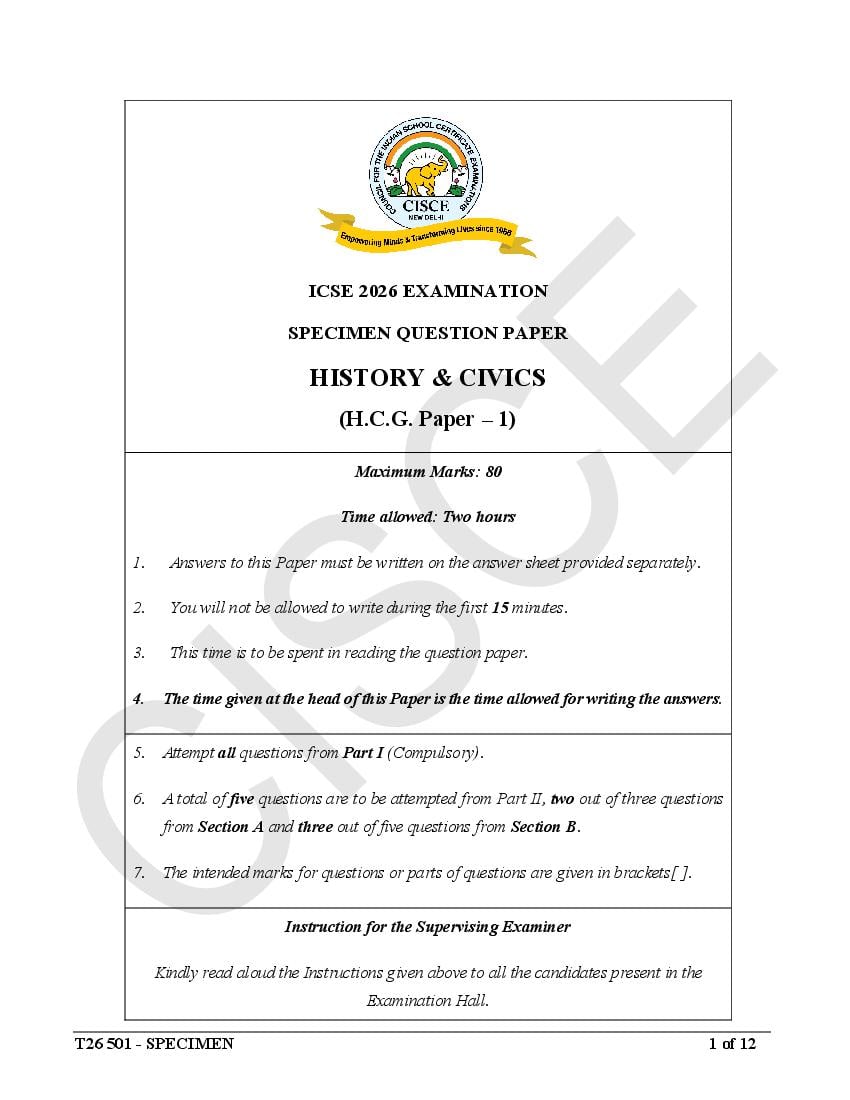
SPECIMEN QUESTION PAPER
HISTORY & CIVICS
(H.C.G. Paper – 1)
Maximum Marks: 80
Time allowed: Two hours
1. Answers to this Paper must be written on the answer sheet provided separately.
2. You will not be allowed to write during the first 15 minutes.
3. This time is to be spent in reading the question paper.
4. The time given at the head of this Paper is the time allowed for writing the answers.
5. Attempt all questions from Part I (Compulsory).
6. A total of five questions are to be attempted from Part II, two out of three questions
from Section A and three out of five questions from Section B.
7. The intended marks for questions or parts of questions are given in brackets[ ].
Instruction for the Supervising Examiner
Kindly read aloud the Instructions given above to all the candidates present in the
Examination Hall.
T26 501 - SPECIMEN 1 of 12
Page 2
The Specimen Question Paper in the subject provides a realistic
format of the Board Examination Question Paper and should be used
as a practice tool. The questions for the Board Examination can be set
from any part of the syllabus. However, the format of the Board
Examination Question Paper will remain the same as that of the
Specimen Question Paper.
Page 3
Attempt all questions from this Part
Question 1
Choose the correct answers to the questions from the given options. [16]
(Do not copy the question, write the correct answers only.)
(i) Identify the exclusive powers of the Rajya Sabha.
P: Can introduce a new All India Service
Q: Can impeach the President
R: Can never be dissolved as a whole
S: Can introduce a Money Bill
(a) P and Q
(b) R and S
(c) P and R
(d) Q and S [Recall]
(ii) Who made the amendment which resulted in the headline given below?
(a) The Supreme Court
(b) The President
(c) The Parliament
(d) The Prime Minister [Recall]
T26 501 - SPECIMEN 2 of 12
Page 4
Person Age [In Description
years]
W 34 Is a Professor in a Government College
X 35 Has taken up citizenship of the United
States of America
Y 27 Is a reputed sportsperson
Z 36 Is a scientist
Select the person who fulfils the eligibility criteria to become the President of
India.
(a) W
(b) X
(c) Y
(d) Z [Understanding]
(iv) Observe the given picture. In case of a similar unruly situation in the Lok
Sabha, choose the action that may be taken by the Speaker.
(a) Adjourn the house for lack of quorum.
(b) Dissolve the Lok Sabha.
(c) Adjourn the house for lack of discipline.
[Application]
(d) Disqualify the members under Anti-defection law.
T26 501 - SPECIMEN 3 of 12
Page 5
The Union ministers are collectively responsible to the Prime Minister.
(a) Lok Sabha
(b) Rajya Sabha
(c) President
(d) Speaker [Application]
(vi) Residents of Jodhpur, X and Y got married in the year 2014 and after 4 months
of wedlock, petty family issues and arguments resulted in their separation for
6 years. The matter was placed before the Bench of Lok Adalat Family Court,
Jodhpur wherein all efforts were made to reunite the family again. With
constant efforts of counselling, parties agreed to live together and withdraw
their Divorce Petition.
Case Study, Lok Adalat, District – Jodhpur
Which advantage of the Lok Adalat is highlighted in the above case?
(a) Saves money
(b) Speedy justice
(c) Works on the spirit of compromise
(d) Reduces the burden on High Courts [Application]
(vii) Assertion (A): The Indian National Congress was formed in 1885.
Reason (R): The main aim of the Indian National Congress at its inception
was to demand complete independence for India.
(a) (A) is true and (R) is false.
(b) (A) is false and (R) is true.
(c) Both (A) and (R) are true, and (R) is the correct explanation of (A).
(d) Both (A) and (R) are true, but (R) is not the correct explanation of (A). [Analysis]
T26 501 - SPECIMEN 4 of 12
Page 6
events:
1. The Dandi March
2. The Second Round Table Conference
3. The Simon Commission
(a) 3-1-2
(b) 1-3-2
(c) 3-2-1
(d) 2-1-3
[Understanding]
(ix) The area in which Anand stays has had no water supply for three days in spite
of repeated complaints. The residents have a meeting and discuss a few
methods to resolve this problem. Being a follower of the beliefs and methods
of the Early Nationalists, which of the following methods is Anand NOT
LIKELY to approve?
(a) Peaceful procession by the residents
(b) Follow the method of boycott
(c) Write a petition to the government
(d) Write an article in the newspaper highlighting the problem
[Application]
(x) Identify the cities most affected by American action in World War II.
(a) Rome, Berlin
(b) Tokyo, Berlin
(c) Hiroshima, Nagasaki
(d) Tokyo, Rome [Recall]
T26 501 - SPECIMEN 5 of 12
Page 7
(a) Organising the Grand Delhi
(b) The Arms Act
(c) Reduction of the maximum age of Civil Service Examination
(d) The Vernacular Press Act
(xii) Identify the odd one out of the following Assertive Nationalists Leaders.
(a) Bipin Chandra Pal
(b) Dadabhai Naoroji
(c) Lala Lajpat Rai
(d) Bal Gangadhar Tilak [Analysis]
(xiii) Read the description and choose the correct option-
This was a significant event in Indian history. Many underlying causes of the
revolt included economic exploitation, social reforms, and political
annexations by the British. Even in its failure it ignited nationalism in the
people of India. Its immediate cause was___________.
(a) introduction of the Doctrine of Lapse
(b) annexation of Indian states by the British
(c) use of greased cartridges in Enfield rifles
(d) establishment of English as the medium of instruction [Recall]
T26 501 - SPECIMEN 6 of 12
Page 8
(a) China
(b) Japan
(c) Russia
(d) Britain [Application]
(xv) Identify the correct pair from the given options.
(a) Surendranath Banerjee – Assertive Nationalist
(b) Raja Ram Mohan Roy – Delhi Durbar
(c) Dadabhai Naoroji – First President of Congress
(d) Jyotiba Phule – Women’s Education [Understanding]
(xvi) Which of the following scenarios describes the Non-Alignment Policy
(NAM)?
(a) A country forms a military alliance only with the United States.
(b) A country maintains relations with both factions during the Cold War and
does not take sides.
(c) A country is part of a religious movement advocating non-violence
(d) A country aligns with the Soviet Union and receives military aid. [Understanding]
T26 501 - SPECIMEN 7 of 12
Page 9
(i) Read the extract given below and answer the question which follow: [2]
Congress member’s adjournment motion disallowed. The notice, along with
another moved demanding a discussion on China, was disallowed in the Lok
Sabha.
The Times of India, Feb 10, 2023
Who can allow or disallow the above motion? What does this motion mean? [Understanding]
(ii) Which category of power is being exercised by the President in the following: [2]
(a) Approval of Bills
(b) Appointment of the Supreme Court judges [Recall]
(iii) The whole plan may not be perfect but like all plans, its success will depend [2]
on the spirit of goodwill with which it is carried out.
-Lord Mountbatten
Give two reasons for the acceptance of the above plan by the Congress. [Understanding]
(iv) Imagine you were an artisan in the year 1856. Mention any two ways in which [2]
the economic policies of the British would have affected you. [Understanding]
(v) Look at the picture given and answer. [2]
Identify the leader seen in the picture above. Mention any one of his
[Recall]
contributions.
T26 501 - SPECIMEN 8 of 12
Page 10
[Recall]
(vii) Mention any two ideologies of the dictators. [2]
[Recall]
PART II
SECTION A (20 Marks)
Attempt any two questions from this Section.
Question 3
The Union Legislature of India is the law-making body of the country. With reference
to the Parliament, answer the following questions:
(i) Mention any three key differences in power between the Lok Sabha and the [3]
Rajya Sabha that make the Lok Sabha more influential. [Analysis]
(ii) Rajya Sabha adjourned sine die, overall productivity at 79 percent. [3]
- Deccan Herald, 21 December 2023.
Who can adjourn the above session? Explain the composition of this house. [Recall]
(iii) Mention any four legislative powers of the Parliament. [4]
[Recall]
Question 4
The President is the nominal head of the executive and the first citizen of the country.
With reference to this, answer the following questions:
(i) The President is the nominal head of the country and cannot act independently. [3]
Mention any three legislative powers of the President which justify the
nominal position. [Understanding]
(ii) Mention any three points to enumerate the financial powers vested in the [3]
President of India. [Recall]
(iii) Describe the constitutional procedure to remove the President. [4]
[Recall]
T26 501 - SPECIMEN 9 of 12
Page 11
The Supreme Court of India is the highest court of the Republic of India. With
reference to the Supreme Court, answer the following questions:
(i) Who appoints the judges of the Supreme Court? [3]
What is the composition of the Supreme Court? [Recall]
(ii) Under Article 129, the Supreme Court of India is called a Court of Record. [3]
Justify this statement with any three points. [Analysis]
(iii) Explain the following terms: [4]
(a) Revisory Jurisdiction
(b) Original Jurisdiction [Recall]
SECTION B (30 Marks)
Attempt any three questions from this Section.
Question 6
The Indian Rebellion of 1857 was a major uprising against the rule of the British East
India Company. With reference to this, answer the following questions:
(i) The British used many policies of expansion. Mention any three such policies. [3]
[Recall]
(ii) Analyse the impact of the failure of the Revolt of 1857 on the Mughals and the [3]
Peshwas. [Recall]
(iii) The Indian army was reorganised after 1858, to prevent the reoccurrence of [4]
another uprising. Justify this statement by stating any four changes made in the
army after the Revolt. [Analysis]
T26 501 - SPECIMEN 10 of 12
Page 12
Nationalism refers to the feeling of oneness that emerges when people consider
themselves as one nation. With reference to the growth of nationalism, answer the
following:
(i) Name the first President of the Congress. Mention any two objectives of the [3]
Congress. [Recall]
(ii) Whether it is fiction, non-fiction, or periodical, all kinds of literature [3]
contributed at large in the national consciousness of India in pre-independence
times. Mention any three points to analyse the role of the press in the growth [Analysis]
of nationalism.
(iii) Explain any two policies of Lord Lytton that showcased his attitude of racial [4]
superiority, eventually leading to the growth of nationalism. [Recall]
Question 8
Read the excerpt given below and answer the questions that follow-
The March, which took place in India, was led by Mohandas Gandhi to protest British
rule in India. During the march, thousands of Indians followed Gandhi from his
religious retreat near Ahmedabad to the Arabian Sea coast, a distance of some 240
miles. The march resulted in the arrest of nearly 60,000 people, including Gandhi
himself. ”
— The Marion (Ohio) Star [Edited]
(i) Name the March being discussed above. Which movement did this March lead [3]
to? In which year was that movement launched? [Recall]
(ii) The movement which began with this March made a considerable impact on [3]
the social and political surroundings of the country. Analyse this statement by
mentioning any three impacts. [Analysis]
(iii) Mention any four clauses of the treaty which led to the suspension of this [4]
movement. [Recall]
T26 501 - SPECIMEN 11 of 12
Page 13
Look at the picture given below and answer the following questions:
(i) How did the assassination mentioned above become a cause for the First World [3]
War? [Recall]
(ii) Mention any three points to analyse how Europe was reorganised because of [3]
the war triggered by this incident. [Recall]
(iii) The Germans described the Treaty of Versailles as harsh and humiliating. Give [4]
any four reasons that justify this statement. [Analysis]
Question 10
The United Nations Organisation aims to maintain international peace. With reference
to its organs and agencies, answer the following:
(i) What is the composition of the International Court of Justice? [3]
[Recall]
(ii) Mention any three exclusive functions of the General Assembly. [3]
[Recall]
(iii) Kolkata’s famous Durga Puja received the intangible heritage tag. Which [4]
agency of the United Nations is authorised to give this tag? Mention any three [Application &
other contributions of that agency in the preservation of culture. Recall]
T26 501 - SPECIMEN 12 of 12
Page 14
DRAFT MARKING SCHEME - HISTORY AND CIVICS (H.C.G. PAPER 1)
PART I
(Attempt all questions from this Part.)
Question 1 [16x1]
(i) (c) P and R
(ii) (c) The Parliament
(iii) (d) Z
(iv) (c) adjourn the house for lack of discipline.
(v) (a) Lok Sabha
(vi) (c) Works on the spirit of compromise
(vii) (a) (A) is true and (R) is false.
(viii) (a) 3-1-2
(ix) (b) Follow the method of boycott
(x) (c) Hiroshima, Nagasaki
(xi) (d) The Vernacular Press Act
(xii) (b) Dadabhai Naoroji
(xiii) (c) Use of greased cartridges in Enfield rifles
(xiv) (b) Japan
(xv) (d) Jyotiba Phule – Women’s Education
(xvi) (b) A country maintains relations with both factions during the Cold War and
does not take sides.
Question 2
(i) The Speaker of the Lok Sabha. [1+1]
To give up on the business of the house and take up a matter of urgent importance.
(ii) (a) Approval of Bills - Legislative [2]
(b) Appointment of the Supreme Court judges – Executive
T26 501 - SPECIMEN 1 of 6
Page 15
working with the League in the Interim Government had convinced the Congress
that it is impossible to have a joint administration / The League had joined the
Government to obstruct and not to cooperate / The only alternative to partition was
a weak Centre / A smaller India with a strong authority was better than a bigger
State with a weak Centre / Any further continuation of British rule would mean a
greater calamity for India / Any further delay in transfer of power could lead to a
Civil War / Partition would rid the Constitution of separate electorates and other
undemocratic procedures.
(Any two)
(iv) Loss of livelihood / spinning and weaving stopped / heavy taxation/competition [2]
from machine made goods/loss of patronage / unavailability of raw materials / Any
other relevant point. (Any two)
(v) Bal Gangadhar Tilak [2]
He advocated Swadeshi, Swaraj and Boycott / He started two newspapers Mahratta
and Kesri / Revived the Ganapathi and Shivaji festival / Organised the Akharas
and Lathi Clubs for the youth / He led a no rent campaign / Opposed the Partition
of Bengal / Launched the Home Rule Movement / Gave the slogan ‘Swaraj is my
birthright and I shall have it.’ / Advocated National Education / He is regarded as
the ‘Forerunner of Gandhi’ / He wrote three great works – Gitarahasya / The Orion
/ The Arctic Home in the Vedas.
(Any one)
(vi) States were prohibited from entering into secret treaties and alliances / could not [2]
maintain huge armies / had to respect each other’s independence/had to refer their
mutual disputes if any to the League / had to take necessary action as directed by
the League / had to promote cultural, social and economic cooperation.
(Any two)
(vii) Belief in totalitarian rule/despise democratic political systems/state is supreme / [2]
suppress rights of citizens / one party-one leader / believe in aggressive
nationalism / imperialism / regard war as an instrument / anti-democratic / anti-
communist.
[Any two]
PART II
SECTION A
(Attempt any two questions from this Section.)
Question 3
(i) Motions of No-Confidence against the government can only be introduced and [3]
passed in the Lok Sabha/the Council of Ministers is answerable to the Lok Sabha
only/ enjoy power only until they enjoy the trust of the house Money bills can be
T26 501 - SPECIMEN 2 of 6
Page 16
it/Budget is passed/controls the national purse/has complete control over finance/
In case of a deadlock between the two houses, the will of the Lok Sabha prevails
due to its higher numerical strength/Can pass an Adjournment Motion
(Any three)
(ii) The Chairman or the Vice President of India [1+2]
There is a total of 250 members, 238 from the states and 12 members are
nominated by the President.
(iii) To make laws in the union list / Matters in the concurrent list / Residuary powers [4]
or matters not mentioned in 3 lists / Matters in the state list - during an emergency
or approved by 2/3 majority by the Rajya Sabha or when two or more states ask /
Ordinances must be approved / Powers during emergency.
(Any four)
Question 4
(i) The President performs the following functions on the advice of the Prime Minister [3]
and his cabinet-Addresses the first session of the Parliament / sends messages to
the Parliament / can summon and prorogue the Parliament / can dissolve the Lok
Sabha/nominates 12 members to the Rajya Sabha / gives assent to a bill to make it
a law / can promulgate ordinances / can give his/her assent to some state bills /
Previous sanction to the Money bills / Introduction of Bills / Give approval for
introduction of Bills regarding alteration of State / formation of state / Can call for
a joint session of parliament.
(Three points)
(ii) Approve introduction of Money Bills / Annual budget is presented on behalf of [3]
the President / Annual Financial statement is laid on his behalf / can authorized
withdrawal of advances from the Consolidated Fund of India / Appoints the
Finance Commission.
(Any three points)
(iii) Can be introduced in any house / passed by 2/3 majority and sent to the second [4]
house / in the second house it is investigated and the President can also be present/
If both houses pass it by 2/3 majority the President will be impeached.
Question 5
(i) The President [1+2]
33 judges and 1 Chief justice.
(Any two points)
(ii) Its judgement and orders are preserved as a record / This can be produced in any [3]
court as precedents / future references / If a person commits a contempt of court,
T26 501 - SPECIMEN 3 of 6
Page 17
as the Guardian of the constitution.
(Any three points)
(iii) (a) Revisory Jurisdiction – The Supreme Court revises its own cases to remove [2+2]
any error that might have crept in because the judgements of the Supreme
Court are like laws.
(b) Original Jurisdiction - The cases that come to the Supreme Court in the first
instance.
Section B
(Attempt any three questions from this Section.)
Question 6
(i) Doctrine of Lapse/Subsidiary Alliance / Pretext of misgovernance/outright wars [1+1+1]
[Any three]
(ii) The rule of the Mughals came to an end / as Bahadur Shah was deported / The rule [3]
of the Peshwas ended as Nana Saheb fled from the country.
(iii) The strength of the European troops in India was increased/ European troops were [4]
kept in key geographical and military positions / All Indian artillery units except
the mountain units were disbanded/Sophisticated weapons were not given to the
Indians / discrimination on the basis of caste was practised/introduction of caste
and community in regiments/newspaper and journals were kept away from
soldiers.
(Any four points)
Question 7
(i) W.C. Bonnerjee [1+2]
To promote friendly relations between nationalist political workers from different
parts of the country/To develop and consolidate feelings of national unity
irrespective of caste, religion or province/to formulate popular demands and
present them before the government /to train and organize public opinion.
(Any two points)
(ii) The press helped spread the ideals of patriotism, modern liberal ideas of liberty / [3]
freedom / equality / home rule / and independence / criticized the British policies
/ helped Indians exchange views / made them aware of the happenings in the world
/ Any other relevant point.
(Any three points)
T26 501 - SPECIMEN 4 of 6
Page 18
/ Organising the Grand Delhi Durbar / reduced the maximum age for the Indian
Civil Service Examination from 21 to 19 years / removed the import duties on
British textiles which destroyed Indian Industries
(Any three points)
Question 8
(i) Dandi March [1+1+1]
Civil Disobedience Movement
1930
(ii) Created patriotic feelings / widened the base of freedom struggle / made people [3]
understand the significance of non-violence / there was improvement in the status
of the depressed classes / women became part of the movement/new methods of
propaganda like Prabhat Pheris were used / Congress took part in Legislative
elections.
(Any three points)
(iii) The British agreed to- [4]
Withdraw all ordinances and end prosecutions/release all political prisoners,
except those guilty of violence / permit peaceful picketing of liquor and foreign
cloth shops / restore the confiscated properties of satyagrahis / permit the free
collection of salt by persons near seacoast.
The Congress agreed to:
Suspend the Civil Disobedience Movement/participate in the Second Round Table
Conference / not to press for investigation into police atrocities.
(Any four points)
Question 9
(i) Archduke Francis Ferdinand, the heir to the throne of Austria was assassinated at [1+1+1]
Sarajevo, the capital of Bosnia on June 28, 1914. This assassination was carried
out by a secret society called ‘Union of Death’ formed by extremist Serbian
nationalists whose aim was to unite all Serbians into a single state. Austria served
an ultimatum to Serbia making 11 demands. Serbia accepted most of them except
those that would have led to the loss of sovereignty. On July 28 1914, Austria
declared war on Serbia. This was the beginning of the First World War.
(Any three points of explanation)
(ii) Three ruling dynasties {Russia, Germany and Austria} were destroyed / The rule [3]
of Ottomans came to an end / Austria and Hungary became separate independent
states / Monarchy collapsed and there was a rise of democracy / It was an end of
European Supremacy / USA emerged as the world Superpower / Led to the rise of
dictatorship / Any other relevant point.
(Any three points)
T26 501 - SPECIMEN 5 of 6
Page 19
/ The area of the Rhine valley was demilitarized and the German territory, west of
Rhine was to be occupied by the Allied troops for 15 years / Danzig became a free
port in Polish territory / Lost Alsace Lorraine to France / The Saar coal mines were
given to France / Lost all her colonies to the allies / The German force was
restricted to 1 lakh / the Navy to 15,000 men / and 24 ships / The Air force and
submarines were banned / German merchant ships were distributed among the
allies / Germany had to supply huge quantities of coal to France / Germany ceded
the Ruhr industrial areas to the allies/German colonies in the Pacific and the areas
under her control in China were given to Japan/ Italy got only two small islands
and the coastal region of Dalmatia / Belgium- Got Eupen-et –Malmedy / Germany
ceded Schleswig to Denmark / Complete Independence was granted to Belgium,
Poland, Czechoslovakia and Yugoslavia / The League of Nations was set up to
maintain peace and prevent another war.
(Any four points)
Question 10
(i) Consists of 15 judges / Elected for a period of 9 years / Elected by General [3]
Assembly and Security Council / Each judge is from different country / Elects its
President and Vice President for a period of 3 years / Appoints a registrar / Retired
judge may be re-elected.
(Any three points)
(ii) To make recommendations in maintenance of international peace and security / [3]
discuss any question relating to peace and security / to make recommendations on
any question within the scope of the charter / initiate studies/to make
recommendations to promote international political, social and economic
cooperation / make recommendations for peaceful settlement of disputes / receive
and consider reports from Security Council and other organs / to consider and
approve the budget of the United Nations/to elect the non-permanent members of
the Security Council / The ECOSOC / Trusteeship Council and judges of the
International Court of Justice / Uniting for peace / to appoint Secretary-General on
the recommendation of the Security Council / Admission of new members /
Amend the charter / Distribute the Contributions among member states / friendly
relations between nations.
(Any three points)
(iii) UNESCO [1+3]
Provides technical advice and assistance/provides funds to preserve monuments
and works of art/prepared a World Heritage list / identifies monuments to be
protected / protects rare manuscripts / encourages artistic creations in literature and
fine arts / cultural development through films / Any other relevant point.
(Any three points)
T26 501 - SPECIMEN 6 of 6
Document Details
| Board / Org | CISCE |
| Exam | Class 10 |
| Type | Sample Paper |
| Pages | 19 |
| Updated | 24 Sep 2026 |