ICSE Class 10 Sample Paper Early Year Physical Activity Facilitator
Finished viewing? Save it for later —
Download ICSE Class 10 Sample Paper Early Year Physical Activity Facilitator (PDF · 23 pages)About ICSE Class 10 Sample Paper Early Year Physical Activity Facilitator
ICSE Class 10 Sample Paper Early Year Physical Activity Facilitator is available here for free download. Published by CISCE for Class 10, this sample paper can be viewed online or downloaded as a PDF (23 pages). Candidates preparing for Class 10 can use ICSE Class 10 Sample Paper Early Year Physical Activity Facilitator to understand the exam pattern, the type of questions asked, and the overall difficulty level.
Frequently Asked Questions
How can I download ICSE Class 10 Sample Paper Early Year Physical Activity Facilitator?
Open this page and click the Download button to save ICSE Class 10 Sample Paper Early Year Physical Activity Facilitator as a PDF. It is completely free on AglaSem Docs.
Is ICSE Class 10 Sample Paper Early Year Physical Activity Facilitator free to download?
Yes. ICSE Class 10 Sample Paper Early Year Physical Activity Facilitator can be viewed online and downloaded as a PDF free of cost on AglaSem Docs.
How many pages does ICSE Class 10 Sample Paper Early Year Physical Activity Facilitator have?
ICSE Class 10 Sample Paper Early Year Physical Activity Facilitator contains 23 pages, which you can read online or download together as a single PDF.
Where can I find more Class 10 study material?
You can find more Class 10 question papers, sample papers, syllabus, and answer keys on AglaSem Docs.
ICSE Class 10 Sample Paper Early Year Physical Activity Facilitator – Text
Read the full text of this sample paper below — useful to quickly search, copy and reference the content online without downloading the PDF.
📄 View text version (23 pages)
Page 1
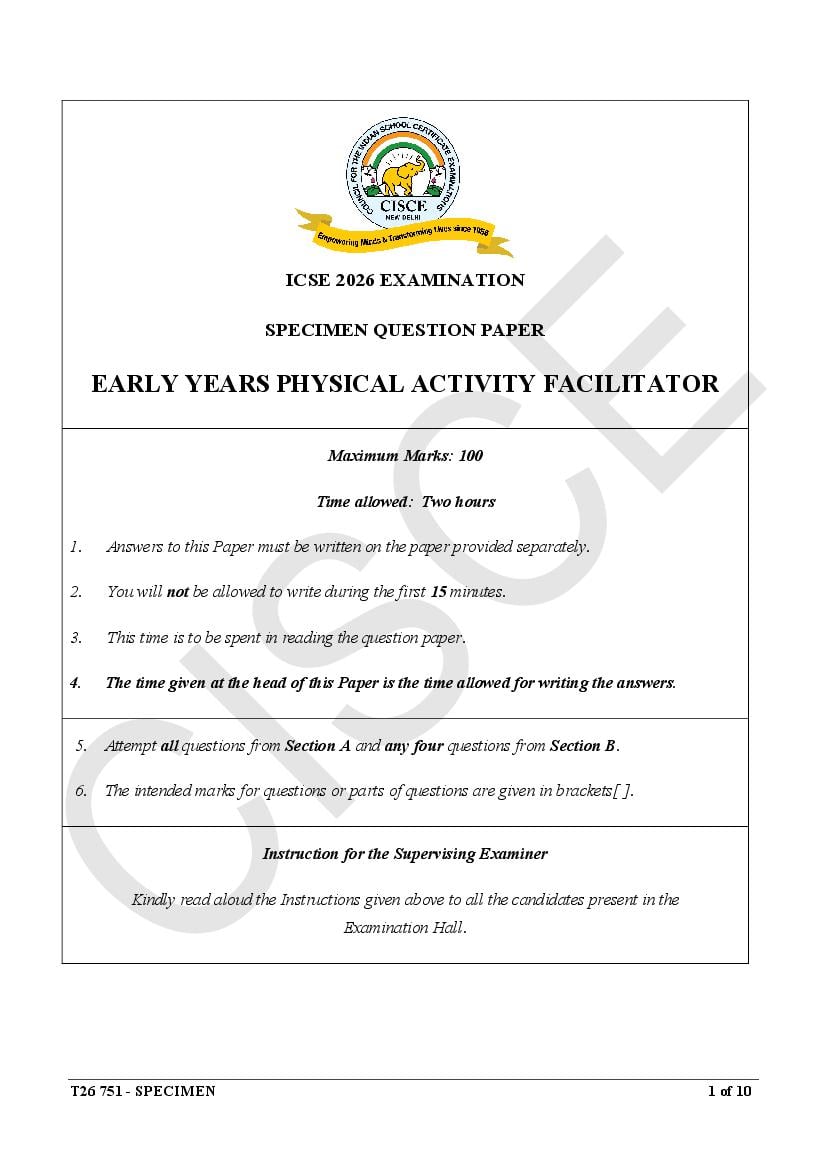
SPECIMEN QUESTION PAPER
EARLY YEARS PHYSICAL ACTIVITY FACILITATOR
Maximum Marks: 100
Time allowed: Two hours
1. Answers to this Paper must be written on the paper provided separately.
2. You will not be allowed to write during the first 15 minutes.
3. This time is to be spent in reading the question paper.
4. The time given at the head of this Paper is the time allowed for writing the answers.
5. Attempt all questions from Section A and any four questions from Section B.
6. The intended marks for questions or parts of questions are given in brackets[ ].
Instruction for the Supervising Examiner
Kindly read aloud the Instructions given above to all the candidates present in the
Examination Hall.
T26 751 - SPECIMEN 1 of 10
Page 2
The Specimen Question Paper in the subject provides a realistic
format of the Board Examination Question Paper and should be used
as a practice tool. The questions for the Board Examination can be set
from any part of the syllabus. However, the format of the Board
Examination Question Paper will remain the same as that of the
Specimen Question Paper.
Page 3
(Attempt all questions from this Section.)
Question 1 [20]
Choose the correct answers to the questions from the given options.
(Do not copy the question, write the correct answers only.)
(i) Every type of communication is affected by its .
(a) reception
(b) transmission
(c) non - regulation
(d) context
(ii) Shital was running with a high temperature. The word high is a/an:
(a) adjective
(b) adverb
(c) noun
(d) predicate
(iii) What does T stand for in the SMART method of setting goals?
(a) Truthful
(b) Tested
(c) Time-bound
(d) Tough
(iv) Which of the following shortcut keys is used to cut a file?
(a) Ctrl+x
(b) Ctrl+c
(c) Ctrl+a
(d) Ctrl+v
T26 751 - SPECIMEN 2 of 10
Page 4
(a) Formative
(b) Diagnostic
(c) Summative
(d) Subjective
(vi) What should be the aim of a physical activity facilitator?
(a) Social development
(b) Wholesome development
(c) Physical development
(d) Mental development
(vii) Assertion (A): Non-verbal communication can be more effective
than verbal communication.
Reason (B): Non-verbal signal can convey emotions and attitudes
more accurately.
(a) (A) is true and (R) is false.
(b) (A) is false and (R) is true.
(c) Both (A) and (R) are true and (R) is the correct explanation of
(A).
(d) Both (A) and (R) are true, but (R) is not the correct explanation
of (A).
(viii) Identify the odd one.
(a) Self-awareness
(b) Stress management
(c) Sleeping
(d) Productivity
T26 751 - SPECIMEN 3 of 10
Page 5
(a) Social
(b) Economic
(c) Physical
(d) Cultural
(x) With reference to first aid, what does ABC stand for?
(a) Airway, Bandage and Call medical emergencies
(b) Airway, Breathing and Circulation
(c) Ambulance, Bandage and Circulation
(d) Airway, Breathing and Call medical emergencies
(xi) Which of the following is NOT a skill related to physical fitness?
(a) Speed
(b) Agility
(c) Muscular strength
(d) Reaction time
(xii) Which of the following is NOT a computer virus?
(a) Firewall
(b) Worms
(c) Online predator
(d) Trojan horse
(xiii) The objective of feedback is to:
(a) improve the performance of a person.
(b) critically analyze the skill of a person.
(c) judge the performance of a person.
(d) find the negative points of a person.
T26 751 - SPECIMEN 4 of 10
Page 6
(a) Cardiopulmonary resuscitation
(b) Cardiopulsary reunification
(c) Cardiopulmonary respiration
(d) Cardio plastic resuscitation
(xv) Swami owns a large retail shop. Radha owns a small shop of
handcrafted apparels. Radha does not call herself an entrepreneur.
Identify the misconception about entrepreneurship that can be related
to the above statement?
(a) Every business idea needs to be special or unique.
(b) A person needs to have a big business to be called an
entrepreneur.
(c) A person needs a lot of money to start a business.
(d) Entrepreneurs are born not made.
(xvi) A stressed person can stimulate endorphin release by regular activity
and exercise.
(a) True
(b) False
(xvii) Ethnic, religious, and social differences are cultural barriers to
communication.
(a) True
(b) False
T26 751 - SPECIMEN 5 of 10
Page 7
(a) True
(b) False
(xix) Solar power, geothermal heating and cooling systems, and wind
energy reduce a community dependency on gas, coal and other such
forms of energy.
(a) True
(b) False
(xx) Observe the given picture.
Choose the correct option with which the above picture is associated.
(a) Solar energy
(b) Crop rotation
(c) Rainwater harvesting
(d) Wind energy
Question 2
(i) Fill in the blanks with the correct option given in the bracket: [5]
(a) __________ assessment is also known as assessment of
learning. [Formative / Summative]
(b) A team in basketball consists of ___________ players in all.
[8 / 12]
(c) Sprain is the injury of________. [Muscles / Ligaments]
T26 751 - SPECIMEN 6 of 10
Page 8
[2.24mts / 2.43mts]
(e) _________ requires self-mystery, self-control, self-
responsibility, and self-direction. [ Self – discipline /
Innovation]
(ii) Write True or False: [5]
(a) The barriers which are related to an individual’s mental and
emotional state are called psychological barriers.
(b) Negative stress can lead to mental as well as physical problems.
(c) Your beliefs control your thoughts and feelings.
(d) An entrepreneur needs a lot of investment in terms of money.
(e) High blood pressure is a common sign of stress.
Question 3
(i) What is the main purpose of inventory management? [2]
(ii) Explain two factors which influence recreational activities. [2]
(iii) Define sustainable development. [2]
(iv) Write any two characteristics of effective communication. [2]
(v) Why does a sender need feedback? [2]
SECTION B
(Answer any four questions from this Section.)
Question 4
(i) What is stress? Mention any three steps to manage stress. [5]
(ii) Write a short note on SMART method to set goals. [5]
T26 751 - SPECIMEN 7 of 10
Page 9
(a) Mention any three ways to protect computer data from theft and
viruses.
(b) Explain any two types of non-verbal communication with one
example each.
Question 5
(i) What are the various factors which influence the selection of any [5]
sports equipment?
(ii) Write a short note on how you would conduct a physical security [5]
risk assessment.
(iii) Mention any five important qualities of a successful entrepreneur. [5]
Question 6
(i) What is free play? List any two advantages and any two [5]
disadvantages of free play.
(ii) Who is a social entrepreneur? Mention any four characteristics of [5]
social entrepreneurship.
(iii) Describe the various activities that can be conducted by an Early [5]
Years Physical Activity Facilitator.
Question 7
(i) What is the difference between Natural environment and Artificial [5]
environment?
(ii) Explain the importance of clean water and sanitation towards [5]
sustainable development.
(iii) Name five primary goals of sustainability. Explain any two. [5]
T26 751 - SPECIMEN 8 of 10
Page 10
(i) (a) (b) [5]
(c) (d)
(e) (f)
List any five equipment from the pictures given above and mention
their usage.
(ii) Draw a well-labelled diagram of a basketball court with [5]
specifications and dimensions.
(iii) Being an Early Years Physical Activity Facilitator, name any three [5]
points that you will keep in mind while selecting an activity and the
precautionary measures you will take during the activity?
T26 751 - SPECIMEN 9 of 10
Page 11
(i) What are the benefits of following an energy conservation policy? [5]
(ii) Briefly explain, how you would teach the passing skill in volleyball [5]
to the students.
(iii) How is effective communication helpful in dealing with customers? [5]
T26 751 - SPECIMEN 10 of 10
Page 12
MARKING SCHEME – EARLY YEARS PHYSICAL ACTIVITY FACILITATOR
SECTION A
Question 1 [20]
(i) (d) context
(ii) (a) adjective
(iii) (c) Time-bound
(iv) (a) Ctrl+x
(v) (d) Subjective
(vi) (b) Wholesome development
(vii) (c) Both (A) and (R) are true and (R) is a correct explanation of (A).
(viii) (c) Sleeping
(ix) (b) Economic
(x) (b) Airway, Breathing and Circulation
(xi) (d) Reaction time
(xii) (a) Firewall
(xiii) (a) improve the performance of a person.
(xiv) (c) Cardiopulmonary respiration
(xv) (b) A person needs to have a big business to be called an entrepreneur.
(xvi) (a) True
(xvii) (a) True
(xviii) (a) True
(xix) (a) True
(xx) (d) Wind energy
Question 2
(i) (a) Summative [5]
(b) 12
(c) Ligaments
(d) 2.43mts
(e) Self – discipline
T26 751 – SPECIMEN 1 of 12
Page 13
(b) True
(c) True
(d) False
(e) True
Question 3
(i) The main purpose of inventory management is to ensure the right products are [2]
available in the right quantity at the right time while minimizing costs.
(ii) 1. Time: People need free time to enjoy recreational activities. If they are busy, [2]
they may not have time to play or relax.
2. Place and Equipment: People need places like parks or playgrounds and
things like balls or bicycles to do many fun activities.
(iii) Sustainable development means using resources in a way that meets present needs [2]
without harming the ability of future generations to meet their own needs.
(iv) 1. Clarity: The message is clear and easy to understand. [2]
2. Listening: Both sides listen to each other carefully.
(v) A sender needs feedback to know if the message was received and understood [2]
correctly. It helps improve communication.
SECTION B
Question 4
(i) Stress is your body's natural reaction to any demand or challenge. It happens when [5]
you feel worried, pressured, or overwhelmed by something. Stress can make your
heart beat faster, make you feel tense, or make it hard to focus. Some stress is normal
and can help you stay alert, but too much stress can be harmful.
1. Identify Stressors: The first step to managing stress is recognizing what
causes it. Keep a journal or note when you feel stressed and what triggered it.
This awareness can help you anticipate and plan how to deal with stressful
situations.
2. Practice Relaxation Techniques: Techniques such as deep breathing
exercises, meditation, progressive muscle relaxation, or mindfulness can calm
your mind and reduce physical symptoms of stress. Regular practice can make
you more resilient when stress occurs.
T26 751 – SPECIMEN 2 of 12
Page 14
triggers the release of endorphins, chemicals that improve mood. Even a daily
30-minute walk can make a big difference.
4. Maintain a Healthy Lifestyle: Eating a balanced diet, getting enough sleep,
and avoiding excessive caffeine or alcohol can strengthen your body’s ability
to cope with stress.
5. Time Management: Organize your tasks, set priorities, and break large
projects into smaller steps. Effective planning can prevent last-minute rushes
and reduce feelings of being overwhelmed.
6. Build Strong Social Support: Talking to friends, family, or support groups
can provide emotional comfort and practical help. Sometimes just sharing your
feelings can lighten your stress load.
7. Set Realistic Goals and Expectations: Don’t try to do everything perfectly
or take on more than you can handle. Learn to say no and delegate tasks when
possible.
8. Develop Healthy Coping Skills: Engage in hobbies, creative activities, or
other enjoyable pursuits that distract from stress. Avoid negative coping
behaviours like smoking, overeating, or substance abuse, which may worsen
stress in the long run.
9. Seek Professional Help if Needed: If stress becomes unmanageable, causing
anxiety or depression, consulting a mental health professional like a counsellor
or therapist can be very beneficial.
(Any five)
(ii) SMART Method to Set Goals: [5]
The SMART method is a widely used framework for setting effective and
achievable goals, especially in sports. It ensures that athletes set goals that are clear,
realistic, and motivating. SMART stands for:
S – Specific: Goals should be clear and well-defined. Instead of saying “I want to
be better at basketball,” a specific goal would be “I want to improve my free throw
percentage by 10%.”
M – Measurable: Progress should be trackable. Measurable goals help athletes
know when they’ve achieved success. For example, “Run 5 kilometres in under 25
minutes.”
A – Achievable: Goals should be challenging but realistic, based on the athlete’s
current abilities. Setting overly ambitious goals can lead to frustration and burnout.
R – Relevant: The goal must be meaningful and aligned with the athlete’s personal
or team objectives. A swimmer focusing on sprint events should not set a goal
related to long-distance performance unless it supports their main focus.
T – Time-bound: Every goal needs a deadline to create urgency and focus. For
instance, “Increase my bench press by 10 kg in 8 weeks.”
T26 751 – SPECIMEN 3 of 12
Page 15
viruses, malware, and spyware. Keeping it updated ensures better
protection.
2. Use Strong Passwords: Use passwords that are hard to guess. A strong
password includes letters (uppercase and lowercase), numbers, and
special characters.
3. Enable a Firewall: A firewall acts as a barrier between your computer
and external threats. It blocks suspicious activity and prevents
unauthorized access.
4. Regular Software Updates: Always keep your operating system,
antivirus, and software updated. Updates often fix security holes that can
be exploited by hackers.
5. Backup Your Data: Keep copies of your important files on external hard
drives or cloud storage. This helps you recover your data in case of theft
or virus attacks.
6. Avoid Suspicious Emails and Links: Do not open emails or click on
links from unknown sources. They may contain harmful viruses or
phishing attempts.
7. Use Encryption: Encrypting your data ensures that even if someone gets
access to your files, they won’t be able to read them without a password.
8. Secure Wi-Fi Networks: Use a password-protected Wi-Fi connection to
prevent unauthorized users from accessing your data.
(Any two)
(b) Non-verbal communication is the way we send messages and express
ourselves without using words. It includes body language, facial expressions,
gestures, posture, eye contact, and tone of voice. Sometimes, non-verbal
signals are stronger than spoken words.
Types of Non-Verbal Communication with Examples:
1. Facial Expressions: The face shows emotions like happiness, sadness,
anger, and surprise.
Example: A smile shows friendliness, while a frown may show
displeasure.
2. Gestures: Movements of hands and arms to express thoughts.
Example: Nodding your head to say “yes” or waving your hand to say
“hello.
3. Posture: The way you stand or sit can show confidence or nervousness.
Example: Standing tall with shoulders back shows confidence, while
slouching may show lack of interest.
4. Eye Contact: Making eye contact shows attention and honesty.
Example: Looking someone in the eye during a conversation shows you
are listening and interested.
5. Body Movements: Movements like shaking legs or tapping fingers can
show nervousness or impatience.
Example: Crossing arms may show defensiveness or disagreement.
T26 751 – SPECIMEN 4 of 12
Page 16
Example: Saying “I’m fine” in a sad tone may actually mean the person
is not fine.
(Any two)
Question 5
(i) Selection of right sports equipment is very important. It helps players play better [5]
and stay safe. Here are the main things to think about when selecting equipment:
1. Type of Sport: Different sports need different equipment.
Example: Football needs a ball and shoes with studs.
Cricket needs a bat, ball, pads, and helmet.
2. Age and Skill Level: Younger or new players need lighter and easier
equipment. Professional players use advanced equipment.
Example: A child uses a smaller bat than an adult.
3. Safety: Some equipment keeps players safe.
Example: Helmets, gloves, pads, and guards.
4. Quality and Durability: Good quality equipment lasts longer and works
better.
5. Cost or Budget: Some equipment is expensive. People choose based on how
much money they can spend.
6. Rules of the Game: Equipment must follow the rules of the sport.
Example: The size of a cricket bat must follow official rules.
7. Place of Play: Where you play (indoor or outdoor) also matters.
Example: Different shoes for grass and for hard ground.
8. Comfort and Fit: The equipment should feel good and fit well.
Example: Shoes that fit properly help you run better.
9. New Technology: Some equipment has new features that help improve your
game.
Example: Lightweight rackets or smart watches to track fitness.
10. Coach Advice: Coaches can help you choose the best equipment for your
needs.
Conclusion: Right equipment helps you play better and stay safe. Always choose
what fits your sport, age, skill, and comfort.
(Any five)
(ii) To keep a place safe, we must check for any risks. Here’s how I would do a physical [5]
security risk assessment:
1. Know What to Protect: First, I will make a list of important things like
people, buildings, machines, and documents.
T26 751 – SPECIMEN 5 of 12
Page 17
fire, break-ins, or accidents.
3. Check Weak Areas: I will look for areas that are not safe – like broken doors,
no cameras, or dark places.
4. See What Security Is There: I will check what safety systems are already in
place – such as guards, cameras, lights, or alarms.
5. Decide the Risk Level: I will think about how big each risk is and how likely
it is to happen.
6. Suggest Better Safety Steps: I will give ideas to fix the weak points – like
adding locks, more lights, training staff, or improving emergency plans.
7. Write a Simple Plan: I will make a clear and simple plan to follow for safety.
(Any five)
(iii) A successful entrepreneur is someone who starts and grows a business by using [5]
smart ideas and hard work. To become successful, an entrepreneur needs some
special qualities. Here are five important ones:
1. Confidence: A good entrepreneur believes in themselves and their ideas. They
are not afraid to take risks or face problems. Confidence helps them take the
first step and keep going even when things get tough.
Example: If their first business idea fails, they still try again with a new one.
2. Hardworking: Success does not come overnight. Entrepreneurs work long
hours and do not give up easily. They keep trying until they reach their goal.
Example: They may work late nights or weekends to complete their business
tasks.
3. Creativity: Entrepreneurs think of new and smart ideas to solve problems or
make life easier. They often start businesses with fresh ideas that no one has
tried before.
Example: Creating a mobile app that helps people order food quickly.
4. Decision-Making Skills: Entrepreneurs have to make many decisions every
day, like hiring workers, buying materials, or choosing products. Good
decision-making helps the business grow.
Example: Choosing the right place to open a new shop.
5. Leadership: An entrepreneur is also a leader. They guide their team, motivate
them, and help them do better. A good leader keeps everyone working together
and focused on goals.
Example: Leading a team to complete a project on time.
To be a successful entrepreneur, a person must be confident, hardworking, creative,
a good decision-maker, and a strong leader. These qualities help them face
challenges and grow a successful business.
T26 751 – SPECIMEN 6 of 12
Page 18
(i) Free play refers to unstructured, spontaneous, and self-directed play where children [5]
choose their own activities without adult direction. It typically involves
imagination, creativity, and physical or social interaction.
Two Advantages of Free Play:
1. Promotes Creativity and Imagination: Children invent games, scenarios,
and rules, helping develop their creativity and problem-solving skills.
2. Enhances Social Skills: During free play with others, children learn to
cooperate, negotiate, and resolve conflicts, fostering strong social
development.
Two Disadvantages of Free Play:
1. Lack of Structure May Lead to Risky Behaviour: Without adult
supervision, children might engage in unsafe or inappropriate activities.
2. Unequal Participation: Some children may dominate play, while others may
feel excluded or unsure of how to join in, leading to social imbalance.
(ii) A social entrepreneur is a person who pursues innovative solutions to social [5]
problems. They use entrepreneurial principles to develop, fund, and implement
solutions that directly improve society. These individuals are often seen as change-
makers in their communities and beyond.
Characteristics of Social Entrepreneurship:
1. Mission-Driven: The central focus is to create social impact rather than
maximize profits.
2. Innovation: Social entrepreneurs think creatively to find unique solutions to
complex social issues.
3. Sustainability: Social enterprises aim to be financially self-sufficient, often
reinvesting profits into their mission.
4. Measurable Impact: Success is measured not just by financial returns, but by
the extent of social change created.
(iii) Activities conducted by Early Years Physical Activity Facilitator: [5]
• Gross Motor Activities: Obstacle courses, running games, ball games,
climbing.
• Fine Motor Activities: Threading beads, playdough, drawing building blocks.
• Movement and Dance: Action songs, creative movement, simple dance
routines.
• Balance and Sensory: Balance beams, sensory paths, simple yoga/stretching.
• Outdoor Play: Nature walks, sand and water play, gardening.
• Structured Games: Parachute games, relay races, balloon or bean bag toss.
• Rest and Relaxation: Breathing exercises, calm storytelling with gentle
movement.
T26 751 – SPECIMEN 7 of 12
Page 19
development, promote positive attitude toward physical activity.)
(Any five)
Question 7
(i) The natural environment and artificial environment are two distinct types of [5]
surroundings that have different characteristics.
Natural Environment
The natural environment refers to the physical surroundings that occur naturally on
Earth, including:
1. Landscapes (forests, mountains, deserts)
2. Water bodies (oceans, rivers, lakes)
3. Atmosphere (air, weather, climate)
4. Living organisms (plants, animals, microorganisms)
Artificial Environment
The artificial environment, on the other hand, refers to the surroundings that are
created by humans, including:
1. Built structures (buildings, roads, bridges)
2. Urban areas (cities, towns)
3. Agricultural environments (farms, gardens)
4. Indoor environments (homes, offices)
(ii) Clean water and good sanitation are very important for building a better and [5]
healthier world. Here's why they matter for sustainable development:
1. Good Health: Clean water helps prevent diseases like diarrhoea and cholera.
When people have clean water to drink and good toilets to use, they stay
healthier.
2. More Time for School and Work: In many places, people, especially women
and children, spend hours collecting water. If clean water is nearby, they can
use that time to go to school or work instead.
3. Better Education: Schools with clean toilets and water help children stay in
school, especially girls who may miss school during their periods if there are
no proper facilities.
4. Protects the Environment: When toilets and waste are managed properly, it
keeps rivers, lakes, and land clean. This helps nature and wildlife too.
5. Fights Poverty: Healthy people can work and earn money. Clean water and
toilets help families save money on medicine and stay strong enough to work.
6. Prepares for the Future: Managing water wisely helps us deal with problems
like droughts and floods caused by climate change.
(Any five)
T26 751 – SPECIMEN 8 of 12
Page 20
1. Environmental protection
2. Economic growth
3. Social development
4. Efficient use of resource
5. Preservation of biodiversity
Explanation of Two Goals:
1. Environmental Protection: This goal focuses on keeping our air, water, and
land clean and safe. It includes reducing pollution, fighting climate change,
and protecting forests, oceans, and wildlife. A healthy environment is essential
for people to live well now and in the future.
2. Economic Growth: Sustainability supports growing the economy in a way
that creates jobs and improves lives, without harming the environment. It
means using resources wisely so that businesses and communities can thrive
long-term, not just for short-term profit.
3. Social development: Social development is the process of improving the well-
being of every individual in society so they can reach their full potential. It
focuses on creating conditions that allow people to lead healthy, productive,
and meaningful lives.
4. Efficient Use of Resources: Efficient use of resources means using natural
materials like water, energy, minerals, and raw materials in a way that
maximizes their value, reduces waste, and minimizes environmental impact.
5. Preservation of biodiversity: Prevention of biodiversity loss refers to the
actions and strategies taken to protect and preserve the variety of life forms on
Earth—including animals, plants, fungi, and microorganisms and their natural
habitats.
Question 8
(i) (a) Hockey Stick: A long stick with a curved end used to hit the ball in the game [5]
of hockey.
(b) Wicket (in cricket): A set of three vertical stumps and two small horizontal
bails used as a target for the bowler and a goal for the batsman to protect.
(c) Stopwatch: A device used to measure time in seconds and minutes, commonly
used in sports to track how long an event or activity takes.
(d) Badminton Racket: A racket used to hit a shuttlecock over a net during a
game of badminton. It can be played by two (singles) or four players (doubles).
(e) Basketball Ring: A metal hoop with a net attached, fixed to a backboard.
Players try to throw the basketball through the ring to score points.
(f) Table Tennis Racket: A small paddle used to hit the ball in table tennis. It has
a flat surface with rubber on each side.
T26 751 – SPECIMEN 9 of 12
Page 21
Free throw
line
1. Court Dimensions
Length: 28 meters
Width: 15 meters
2. Key Areas
Free Throw Line Distance: 4.6 meters
3-Pointer Line Distance: 6.75 meters
3. Basket Specifications
Rim Height: 3.05 meters (10ft)
Rim Diameter: 45 cm
Backboard Size: 1.8 m wide × 1.05 m height
Center Circle Diameter: 3.6 meters
Free Throw Circle Diameter: 3.6 meter
No-Charge Semi-Circle: 1.25 meters radius
(iii) Points to Keep in Mind While Selecting an Activity: [5]
1. Age-appropriate – The activity should match the children’s age and
developmental stage.
2. Fun and engaging – Activities should be enjoyable to keep children
interested.
3. Simple instructions – Activities should be easy to understand and follow.
4. Inclusive – All children, regardless of ability, should be able to participate.
T26 751 – SPECIMEN 10 of 12
Page 22
running, jumping, or balancing.
6. Space and equipment – Ensure enough space and safe equipment are
available.
(Any three)
Precautionary Measures During the Activity:
1. Supervision – Always watch children closely during the activity.
2. Safe environment – Check that the play area is clean and free of hazards.
3. Warm-up – Begin with a simple warm-up to prepare their bodies.
4. Hydration – Ensure children stay hydrated, especially in warm weather.
5. First aid ready – Keep a first aid kit nearby in case of minor injuries.
6. Clear rules – Set and explain safety rules before starting the activity.
(Any two)
Question 9
(i) Making use of solar power, geothermal heating and cooling system and wind energy [5]
can significantly reduce a community dependency on gas, coal and other forms of
energy.
1. Lower energy bills – You save money by using less electricity and fuel.
2. Reduced environmental pollution – Less energy consumption means fewer
harmful emissions.
3. Conservation of natural resources – It helps preserve resources like coal, oil,
and water for future generations.
4. A healthier environment – Cleaner air and reduced global warming.
5. Improved energy security – Reduces dependence on imported energy and
supports sustainability.
(ii) To teach the passing skill in volleyball, I would follow these steps: [5]
1. Explain the purpose: Tell students that passing is used to receive a serve or a
low ball and send it accurately to a teammate.
2. Demonstrate the technique: Stand with feet shoulder-width apart. Knees
slightly bent, arms straight and together. Hands joined, thumbs flat and
pointing forward. Contact the ball with the forearms (not the hands).
3. Use drills and practice: Begin with tossing and catching drills to develop
hand-eye coordination. Progress to simple partner passing. Gradually add
movement and teamwork drills.
4. Give feedback and correct posture: Watch each student and guide them to
keep their arms firm and not swing too much.
5. Make it fun: Include games and friendly challenges to keep students
motivated and engaged.
T26 751 – SPECIMEN 11 of 12
Page 23
understand the situation or product better. It shows honesty and
professionalism, which builds trust.
2. Solves Problems Quickly: When you listen carefully and speak clearly,
problems can be solved faster. It prevents misunderstandings and confusion.
3. Increases Satisfaction: Customers feel respected and valued when they are
heard. This leads to better cooperation and satisfaction.
4. Improves Relationships: Good communication creates a positive relationship
over time. It helps in teamwork and working together for the best outcomes.
5. Providing Valuable Information: Clearly conveying information about
products, services or policies helps customers make informed decisions.
T26 751 – SPECIMEN 12 of 12
Document Details
| Board / Org | CISCE |
| Exam | Class 10 |
| Type | Sample Paper |
| Pages | 23 |
| Updated | 24 Sep 2026 |