PSEB 10th Model Test Paper 2023 Science
Finished viewing? Save it for later —
Download PSEB 10th Model Test Paper 2023 Science (PDF · 3 pages)About PSEB 10th Model Test Paper 2023 Science
PSEB 10th Model Test Paper 2023 Science is available here for free download. Published by Punjab Board for Class 10, this sample paper can be viewed online or downloaded as a PDF (3 pages). Candidates preparing for Class 10 can use PSEB 10th Model Test Paper 2023 Science to understand the exam pattern, the type of questions asked, and the overall difficulty level.
Frequently Asked Questions
How can I download PSEB 10th Model Test Paper 2023 Science?
Open this page and click the Download button to save PSEB 10th Model Test Paper 2023 Science as a PDF. It is completely free on AglaSem Docs.
Is PSEB 10th Model Test Paper 2023 Science free to download?
Yes. PSEB 10th Model Test Paper 2023 Science can be viewed online and downloaded as a PDF free of cost on AglaSem Docs.
How many pages does PSEB 10th Model Test Paper 2023 Science have?
PSEB 10th Model Test Paper 2023 Science contains 3 pages, which you can read online or download together as a single PDF.
Where can I find more Class 10 study material?
You can find more Class 10 question papers, sample papers, syllabus, and answer keys on AglaSem Docs.
PSEB 10th Model Test Paper 2023 Science – Text
Read the full text of this sample paper below — useful to quickly search, copy and reference the content online without downloading the PDF.
📄 View text version (3 pages)
Page 1
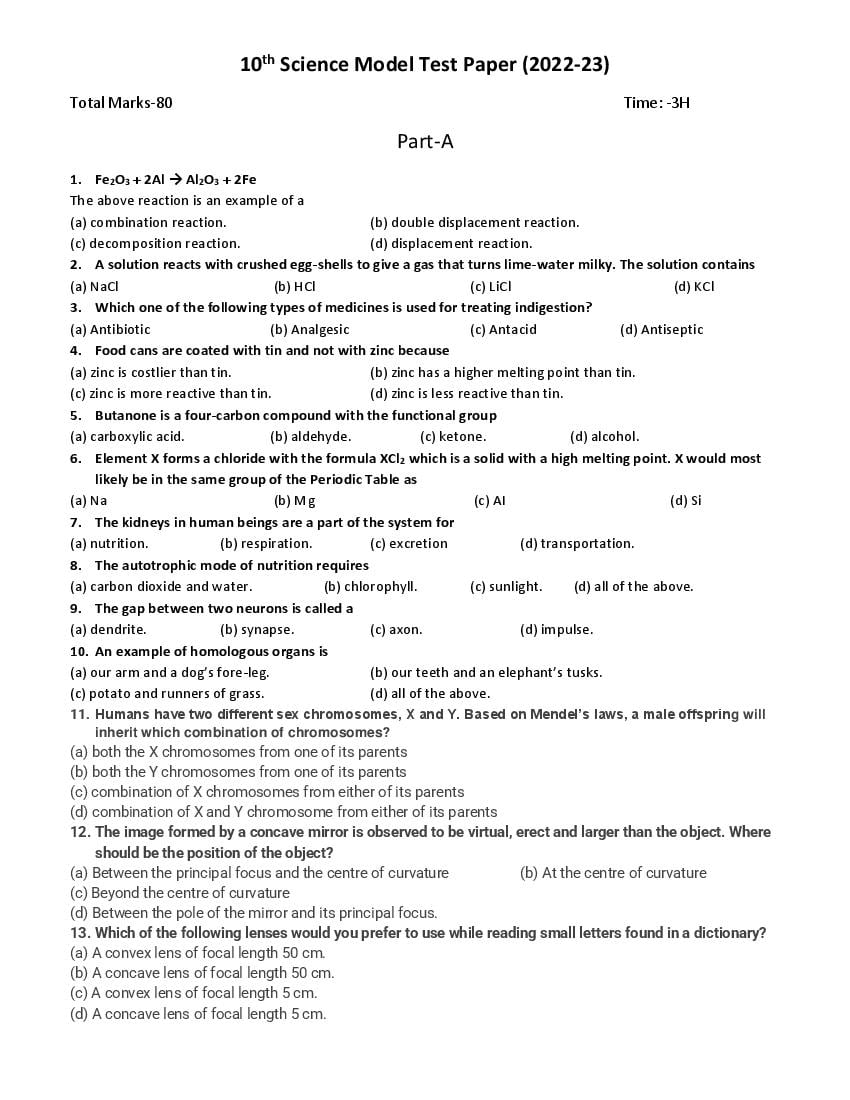
Total Marks-80 Time: -3H
Part-A
1. Fe2O3 + 2Al → Al2O3 + 2Fe
The above reaction is an example of a
(a) combination reaction. (b) double displacement reaction.
(c) decomposition reaction. (d) displacement reaction.
2. A solution reacts with crushed egg-shells to give a gas that turns lime-water milky. The solution contains
(a) NaCl (b) HCl (c) LiCl (d) KCl
3. Which one of the following types of medicines is used for treating indigestion?
(a) Antibiotic (b) Analgesic (c) Antacid (d) Antiseptic
4. Food cans are coated with tin and not with zinc because
(a) zinc is costlier than tin. (b) zinc has a higher melting point than tin.
(c) zinc is more reactive than tin. (d) zinc is less reactive than tin.
5. Butanone is a four-carbon compound with the functional group
(a) carboxylic acid. (b) aldehyde. (c) ketone. (d) alcohol.
6. Element X forms a chloride with the formula XCl2 which is a solid with a high melting point. X would most
likely be in the same group of the Periodic Table as
(a) Na (b) Mg (c) AI (d) Si
7. The kidneys in human beings are a part of the system for
(a) nutrition. (b) respiration. (c) excretion (d) transportation.
8. The autotrophic mode of nutrition requires
(a) carbon dioxide and water. (b) chlorophyll. (c) sunlight. (d) all of the above.
9. The gap between two neurons is called a
(a) dendrite. (b) synapse. (c) axon. (d) impulse.
10. An example of homologous organs is
(a) our arm and a dog’s fore-leg. (b) our teeth and an elephant’s tusks.
(c) potato and runners of grass. (d) all of the above.
11. Humans have two different sex chromosomes, X and Y. Based on Mendel’s laws, a male offspring will
inherit which combination of chromosomes?
(a) both the X chromosomes from one of its parents
(b) both the Y chromosomes from one of its parents
(c) combination of X chromosomes from either of its parents
(d) combination of X and Y chromosome from either of its parents
12. The image formed by a concave mirror is observed to be virtual, erect and larger than the object. Where
should be the position of the object?
(a) Between the principal focus and the centre of curvature (b) At the centre of curvature
(c) Beyond the centre of curvature
(d) Between the pole of the mirror and its principal focus.
13. Which of the following lenses would you prefer to use while reading small letters found in a dictionary?
(a) A convex lens of focal length 50 cm.
(b) A concave lens of focal length 50 cm.
(c) A convex lens of focal length 5 cm.
(d) A concave lens of focal length 5 cm.
Page 2
(a) wood (b) gobar-gas (c) nuclear energy (d) coal
15. Most of the sources of energy we use represent stored solar energy. Which of the following is not
ultimately derived from the Sun’s energy?
(a) geothermal energy (b) wind energy (c) nuclear energy (d) bio-mass.
16. Which of the following are environment-friendly practices?
(a) Carrying cloth-bags to put purchases in while shopping
(b) Switching off unnecessary lights and fans
(c) Walking to school instead of getting your mother to drop you on her scooter
(d) All of the above
17. Tehri Dam is built on which river?
(a) Ravi (b) Ganga (c) Yamuna (d) Sutlej
Part-B
18. Product in activity shown in figure is dissolved in water. What is the formula and nature of compound so
formed by dissolving in water?
19. Why does an aqueous solution of an acid conduct electricity?
20. Why does micelle formation take place when soap is added to water?
21. Why do you think the noble gases are placed in a separate group?
22. How does chemical coordination take place in animals?
23. How is the sex of the child determined in human beings?
24. Define the Pole and Principal focus of a concave mirror.
25. What is the function of 1) Pupil and 2) ciliary muscles in human eye?
26. Name and explain rule shown in figure.
27. What are the disadvantages of fossil fuels?
28. Can any source of energy be pollution-free? Why or why not?
29. What changes would you suggest in your home in order to be environment-friendly?
Part-C
30. Define Oxidation. Identify the substances that are oxidised and the substances that are reduced in the
following reactions.
CuO(s) + H2(g) → Cu(s) + H2O(l)
Page 3
Of compound shown in figure? What is the name
of functional group present in compound?
32. How does the electronic configuration of an atom relate to its position in the Modern Periodic Table?
33. What are the differences between aerobic and anaerobic respiration? Name some organisms that use the
anaerobic mode of respiration.
34. Draw the structure of a neuron and explain its function.
35. What is Myopia? What are the reasons for it? How the defect is corrected? Draw diagram of Myopic eye.
36. What is the principle of electric motor? Draw and explain it. In which direction will rod ‘AB’ shown in figure
will move?
37. Give any two ways in which non-biodegradable substances would affect the environment.
Part-D
38. Differentiate between metal and non-metal on the basis of their chemical properties.
Or
a) Why is sodium kept immersed in kerosene oil?
b) What are amphoteric oxides? Give two examples of amphoteric oxides.
39. a) How does binary fission differ from multiple fission?
b) What are the advantages of sexual reproduction over asexual reproduction?
Or
a) Draw a labelled diagram of the longitudinal section of a flower.
b) What are the changes seen in girls at the time of puberty?
40. a) On what factors does the resistance of a conductor depend?
b) What is (a) the highest, (b) the lowest total resistance that can be secured by combinations of four coils of
resistance 4 Ω, 8 Ω, 12 Ω, 24 Ω?
Or
Define and explain ohm’s Law. Calculate resistance of conductor
from graph.
Document Details
| Board / Org | Punjab Board |
| Exam | Class 10 |
| Type | Sample Paper |
| Pages | 3 |
| Language | english |
| Updated | 22 Jul 2026 |