Goa Board Class 10 Sample Paper 2026 Home Vegetable Garden
Finished viewing? Save it for later —
Download Goa Board Class 10 Sample Paper 2026 Home Vegetable Garden (PDF · 15 pages)About Goa Board Class 10 Sample Paper 2026 Home Vegetable Garden
Goa Board Class 10 Sample Paper 2026 Home Vegetable Garden is available here for free download. Published by Goa Board for Class 10, this sample paper can be viewed online or downloaded as a PDF (15 pages). Candidates preparing for Class 10 can use Goa Board Class 10 Sample Paper 2026 Home Vegetable Garden to understand the exam pattern, the type of questions asked, and the overall difficulty level.
Frequently Asked Questions
How can I download Goa Board Class 10 Sample Paper 2026 Home Vegetable Garden?
Open this page and click the Download button to save Goa Board Class 10 Sample Paper 2026 Home Vegetable Garden as a PDF. It is completely free on AglaSem Docs.
Is Goa Board Class 10 Sample Paper 2026 Home Vegetable Garden free to download?
Yes. Goa Board Class 10 Sample Paper 2026 Home Vegetable Garden can be viewed online and downloaded as a PDF free of cost on AglaSem Docs.
How many pages does Goa Board Class 10 Sample Paper 2026 Home Vegetable Garden have?
Goa Board Class 10 Sample Paper 2026 Home Vegetable Garden contains 15 pages, which you can read online or download together as a single PDF.
Where can I find more Class 10 study material?
You can find more Class 10 question papers, sample papers, syllabus, and answer keys on AglaSem Docs.
Goa Board Class 10 Sample Paper 2026 Home Vegetable Garden – Text
Read the full text of this sample paper below — useful to quickly search, copy and reference the content online without downloading the PDF.
📄 View text version (15 pages)
Page 1
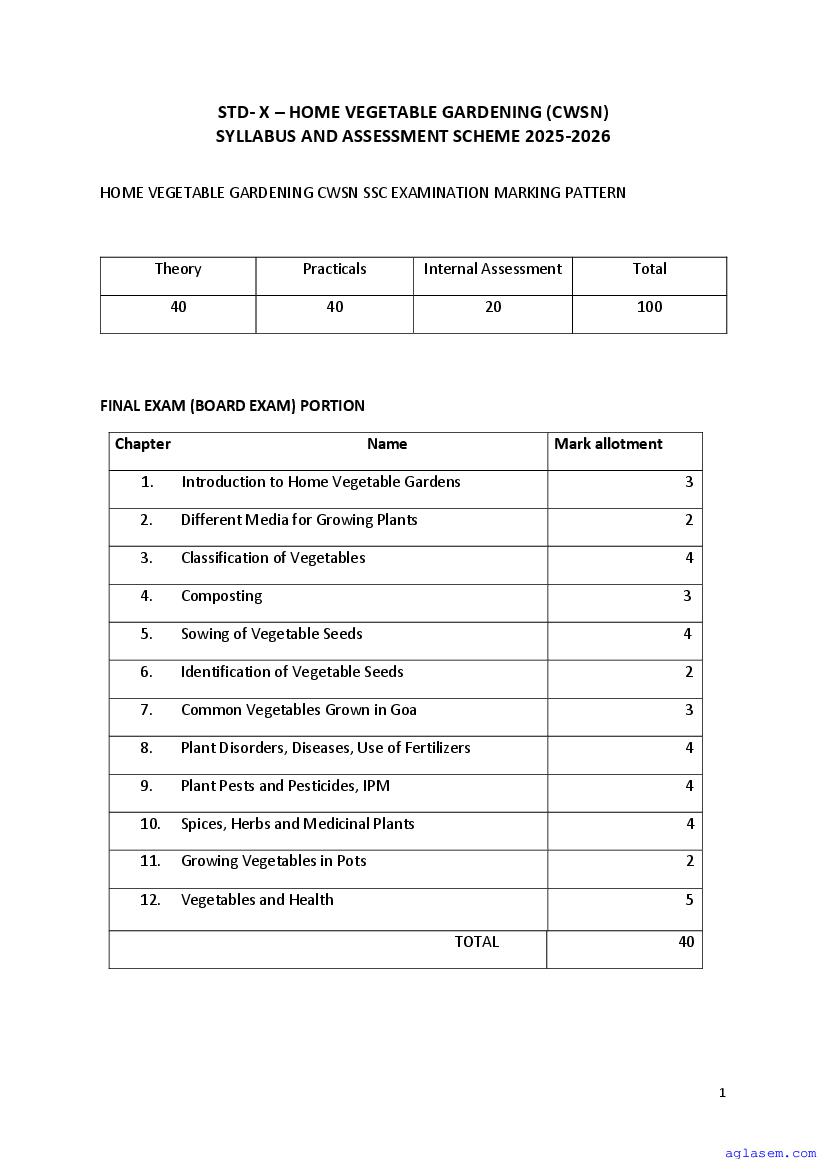
SYLLABUS AND ASSESSMENT SCHEME 2025-2026
HOME VEGETABLE GARDENING CWSN SSC EXAMINATION MARKING PATTERN
Theory Practicals Internal Assessment Total
40 40 20 100
FINAL EXAM (BOARD EXAM) PORTION
Chapter Name Mark allotment
1. Introduction to Home Vegetable Gardens 3
2. Different Media for Growing Plants 2
3. Classification of Vegetables 4
4. Composting 3
5. Sowing of Vegetable Seeds 4
6. Identification of Vegetable Seeds 2
7. Common Vegetables Grown in Goa 3
8. Plant Disorders, Diseases, Use of Fertilizers 4
9. Plant Pests and Pesticides, IPM 4
10. Spices, Herbs and Medicinal Plants 4
11. Growing Vegetables in Pots 2
12. Vegetables and Health 5
TOTAL 40
1
Page 2
Objective Knowledge Understanding Application Skill Total
No Chapter Name VSA SA VSA SA VSA SA VSA SA
1 Introduction 1(1) 1(1) 1(1) 3(3)
to home
vegetable
gardens
2 Different 2(1) 2(1)
media for
growing
plants
3 Classification 1(1) 1(1) 1(1) 1(1) 4(4)
of vegetables
4 Composting 1(1) 2(2) 3(3)
5 Sowing of 1(1) 2(2) 1(1) 4(4)
vegetable
seeds
6. Identification 1(1) 1(1) 2(2)
of seeds
7. Common 1(1) 1(1) 1(1) 3(3)
vegetables
grown in Goa
8 Plant 2(1) 1(1) 1(1) 4(3)
Disorders and
diseases, use
of Fertilizers
9 Plant pests 1(1) 2 (2) 1(1) 4(4)
and
pesticides,
IPM
2
Page 3
and Medicinal
plants
11. Growing 2(1) 2(1)
vegetables in
pots
12. Vegetable and 1(1) 1(1) 1(1) 2(1) 5(4)
Health
NOTE: Figures outside the bracket indicate marks
Figures inside the bracket indicate the number of question
DESIGN OF THE QUESTION PAPER
SUBJECT: HOME VEGETABLE GARDENING
(For children with special needs) 2025-26
Subject Code: 1071 Maximum Marks: 40
Duration- 2 hours
INSTRUCTONS:
1. All questions are compulsory
2. Figures to the right indicate marks allotted to each question
3. All answers should be written in the space provided.
________________________________________________________________
1. Fill in the blanks with the most suitable words from the brackets below:
1. Hydrophonics is the method of growing plants in _______________ (1)
• Cocopeat
• Moss
3
Page 4
• Air
2. Seeds of Ridge Gourds are sown: (1)
• Broadcasting
• Transplanting
• Drilling
• Dibbling
3. The additive that is added to the compost pit to hasten (quicken) the
decomposition process: (1)
• Cow dung slurry
• Plastic
• Glass
• Rubber
4. An example of fruit vegetables: (1)
• Brinjal, Tomato, Capsicum
• Peas and Beans
• Potato
• Cauliflower
5. What is the spacing required while sowing palak seeds? (1)
• 20 cm
• 5cm
• 10 cm
• 15 cm
6. Growing of two or more plants close together to benefit each other for pest
control, pollination is called _______________________ (1)
• Companion Gardening
• Crop Rotation
• Continuous Harvesting
4
Page 5
7. The vitamin that is lost from vegetables on cooking is _____________ (1)
• Vitamin B
• Vitamin D
• Vitamin C
• Vitamin D
8. Having vegetables in your garden ready for harvesting throughout the year is
called ___________________ (1)
• Continuous Harvesting
• Crop Rotation
• Monoculture
• Companion Gardening
9. Aloe Vera is propagated from ______________________ (1)
• seed
• leaf
• offsets
• rhyzomes
10. A liquid nutrient for the garden that consists of five main ingredients from
the cow is _____________________ (1)
• Effective Micro organisms
• Panchagavya
• Compost
• Powdery mildew
11. Tambdibhaji is _____________________ (1)
• Malabar spinach
• green spinach
• red spinach
• palak
5
Page 6
• offset
• seed
• cutting
• rhizome
13. The soil that does not hold nutrients is: (1)
• Clayey soil
• Sandy soil
• Loamy soil
• Rocky soil
14. The Advantage of Flat bed is: (1)
• More difficult to prepare
• Water logging in rainy climate
• No added soil required
• Requires more soil
15. The vegetable good for healthy eyes is ______________________ (1)
• Potato
• Cauliflower
• Carrot
• Beetroot
16. _____________ is used to cover the compost pit (1)
• Wire mesh
• Glass sheet
• Plastic cover
• Metal sheet
17. Vegetables that form a pod in which the seeds are formed ___________ (1)
• Root Vgetables
6
Page 7
• Stem Vegetables
• Legume Vegetables
18. Bags that are made from synthetic plastic material with holes cut into the
sides to allow drainage of water are _____________ (1)
• Jute Bags
• Grow Bags
• Paper Bags
• Plastic Bags
19. Aubergine or egg plant is another name for _____________ (1)
• Pumpkin
• tomato
• potato
• brinjal
20. An important biopesticide is _____________ (1)
• sticky trap
• crop rotation
• neem
• continuous harvesting
Answer in two sentences:
21. Why is compost brew like liquid gold for the vegetables and plants? (2)
22. State two health benefits of curry leaves (2)
7
Page 8
__________________
A. Bottle gourd
B. Ridge gourd
C. Snake gourd
D. Ivy gourd
Name the following:
24. One physical method used in IPM (1)
________________________________
25. One symptom of plant disease. (1)
_________________________________
Look at the picture and answer the questions below:
26. This covering spread over the soil is called: (1)
_________________
• Leaf collection
• Mulching
• Composting
27. Name any two climber vegetables. (1)
_________________________
8
Page 9
29.The picture shows powdery mildew on a leaf. (2)
(a) What is powdery mildew due to?
(b) How can we prevent this disease?
Look at the picture and answer the question: (1)
30. Which part of the plant is eaten as a vegetable?
_____________________
• modified flower
• modified leaves
• modified stem
31. Name any two kitchen wastes we can use for composting. (1)
9
Page 10
point)(1)
________________________________________________________________
33. What is the method used in staking called? (1)
34. Name the method of pest control shown in the picture: (1)
35. Why Vegetables are important for health ( 1 point) (1)
36. Draw a picture of a Bottle Gourd. (2)
OR
Draw a picture of ladyfingers
10
Page 11
S.No Name
1. Different Vegetable Seeds
2. Gardening Tools
3. Preparing Cocopeat from blocks
4. Preparing soil mix for vegetables
5. Fruit Vegetables
6. Leaf Vegetables
7. Climber Vegetables
8. Preparing a Bed
9. Planting Ridge gourd/Bottle gourd/Pumpkin
10. Planting Tomato/ Brinjal Seeds in a Seed Tray
11. Transplanting Tomato/Brinjal Seeds
12. Staking of a tomato plant
13. Preparing a bio-fertilizer (cow’s urine) spray
14. Planting Palak seeds in a pot
15. Planting a seedling in a pot
16. Planting a Malabar spinach/Ivy Gourd cutting
17. Plant Pests
18. Preparing a fertilizer/anti-fungal spray
11
Page 12
20. Planting Black Pepper
21. Planting herbs
22. Preparing a nutrient brew
23. Vegetables rich in Iron/Calcium
24. Vegetables rich in Vitamins (any two)
PRACTICAL MARKING SCHEME
Identification Viva Journal Procedure Writing of Total
Procedure
10 05 05 15 05 40
Identification: Identification of Plants, Media and Tools
INTERNAL ASSESSMENT SCHEME 2025-26 STD-X
1. A list of activities and assessment criteria for Internal Assessment of 20 marks are listed under 6
topics.
2. Students may choose anyone from the six.
3. Each activity is allotted 20 marks. Rubrics for the activities is given below.
4. Record of every activity of the student has to be maintained on hard/soft copy for the board
5. Submission of Internal Assessment(IA) should be submitted in November.
1. Interviewing a Farmer
Instructions: Student has to visit a farmer, interview him and document the answers of the
interview.
The interview has to be documented and submitted to school.
12
Page 13
1. How do you increase the fertility of your soil?
2. What type of crops do you grow in your area?
3. What would you describe as the most difficult aspect of working on a farm?
4. Can you suggest any method for repelling pests and weeds?
5. Do you prefer working on small farms or large farms?
6. What made you choose farming as a career?
7. What is one of the biggest changes you’ve observed in the agriculture industry?
8. Which tools do you think are the most essential to have on a successful farm?
9. Do you feel modern technique or traditional farming is better?
10. Click a picture of you along with the farmer learning one method of farming.
Name/ Name of Understanding Data Pictures of Written Total
Roll No the Farmer the topic collection the activity Report
5 5 5 5 20
2. Cocopeat Fibre Media
Instructions: Student has to collect coconut husks, make the coir powdery and provide one bag of
cocopeat to the school. Refer chapter-2 , Different Media for Growing Vegetables. Pictures while
making the media, has to be documented.
Name/ Roll Understanding Procedure Pictures of Written Total
No the topic (Oral) the activity Report
5 5 5 5 20
3. Physical control method in IPM.
Instructions: Student has to place a sticky fly trap around any vegetable plant and coat the paper
with a sticky substance like sugar syrup, honey etc to which the flies get stuck. After 10days student
has to submit the sticky trap to the school along with pictures of the procedure in making the sticky
fly trap. Refer chapter-Plant Disorders and Diseases. (Physical Method)
Name/ Roll Type of Understanding Procedure Pictures of Written Total
No IPM the topic (Oral) the activity Report
5 5 5 5 20
13
Page 14
Instructions: Student has to prepare one vegetable dish using two herbs and three spices. Student
has to bring the dish to school along with pictures on a chart/page while preparing the dish.
Name/ Roll Name the Name of Procedure Pictures of Relevance Total
No vegetable herbs/spices (Oral) the activity to the topic
used used
5 5 5 5 20
5. Germination of vegetable seeds
Instructions: Student has to sow any one seed (spinach or brinjal) in a pot. Student has to click the
pictures of the process of germination for 4 to 8 weeks and document it.
Name/ Roll Name the Method of Procedure Pictures of Relevance Total
No seed sowing (Oral) the activity to the topic
(written)
5 5 5 5 20
6. Preparation of Compost at home
Instructions: Student has to follow the steps of composting in a pit/tub. Refer chapter- Composting,
click pictures and bring minimum 500 grams of compost (1 packet) to school when it is ready.
Name/ Roll Name the Method of 500 grams/ Pictures of the Total
No decomposing composting activity
1 packet of
material used (written)
compost
5 5 5 5 20
14
Page 15
Document Details
| Board / Org | Goa Board |
| Exam | Class 10 |
| Type | Sample Paper |
| Pages | 15 |
| Updated | 24 Sep 2026 |