AP PGCET 2023 Syllabus Zoology
Finished viewing? Save it for later —
Download AP PGCET 2023 Syllabus Zoology (PDF · 4 pages)About AP PGCET 2023 Syllabus Zoology
AP PGCET 2023 Syllabus Zoology is available here for free download. Published by APSCHE for AP PGCET, this syllabus can be viewed online or downloaded as a PDF (4 pages). Candidates preparing for AP PGCET can use AP PGCET 2023 Syllabus Zoology to understand the exam pattern, the type of questions asked, and the overall difficulty level.
Frequently Asked Questions
How can I download AP PGCET 2023 Syllabus Zoology?
Open this page and click the Download button to save AP PGCET 2023 Syllabus Zoology as a PDF. It is completely free on AglaSem Docs.
Is AP PGCET 2023 Syllabus Zoology free to download?
Yes. AP PGCET 2023 Syllabus Zoology can be viewed online and downloaded as a PDF free of cost on AglaSem Docs.
How many pages does AP PGCET 2023 Syllabus Zoology have?
AP PGCET 2023 Syllabus Zoology contains 4 pages, which you can read online or download together as a single PDF.
Where can I find more AP PGCET study material?
You can find more AP PGCET question papers, sample papers, syllabus, and answer keys on AglaSem Docs.
AP PGCET 2023 Syllabus Zoology – Text
Read the full text of this syllabus below — useful to quickly search, copy and reference the content online without downloading the PDF.
📄 View text version (4 pages)
Page 1
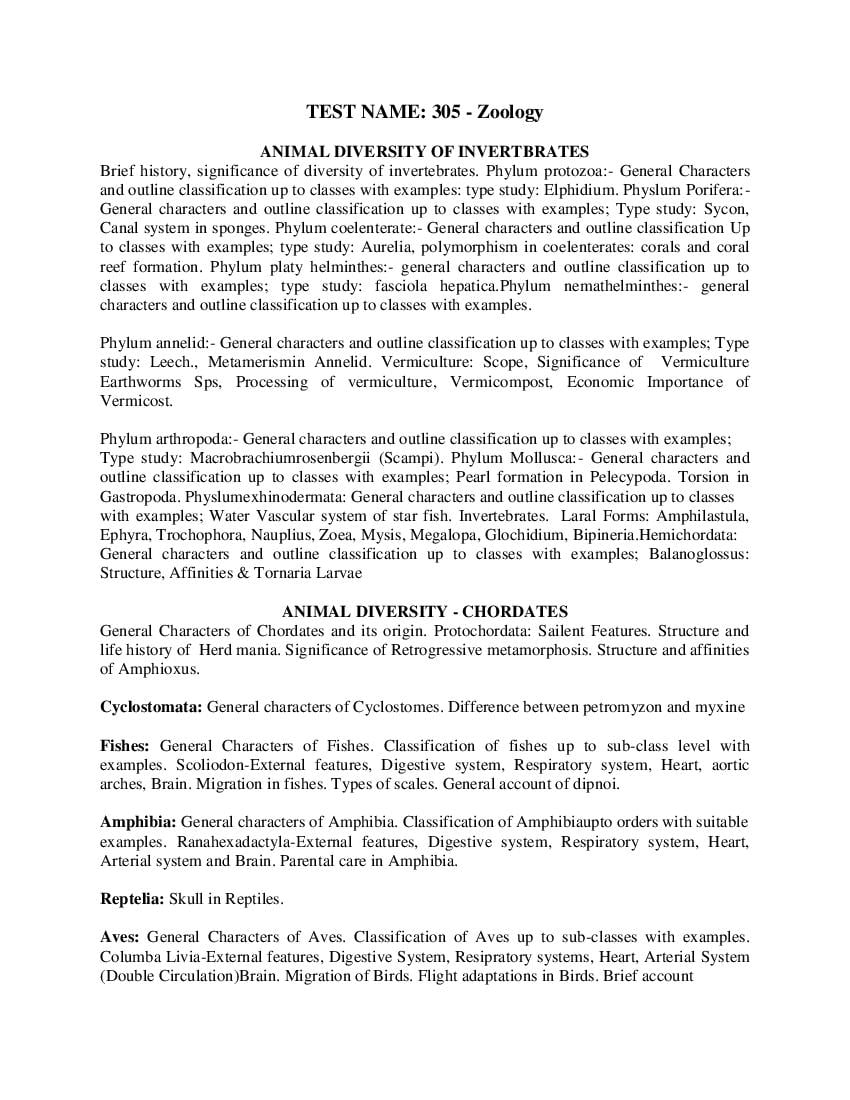
ANIMAL DIVERSITY OF INVERTBRATES
Brief history, significance of diversity of invertebrates. Phylum protozoa:- General Characters
and outline classification up to classes with examples: type study: Elphidium. Physlum Porifera:-
General characters and outline classification up to classes with examples; Type study: Sycon,
Canal system in sponges. Phylum coelenterate:- General characters and outline classification Up
to classes with examples; type study: Aurelia, polymorphism in coelenterates: corals and coral
reef formation. Phylum platy helminthes:- general characters and outline classification up to
classes with examples; type study: fasciola hepatica.Phylum nemathelminthes:- general
characters and outline classification up to classes with examples.
Phylum annelid:- General characters and outline classification up to classes with examples; Type
study: Leech., Metamerismin Annelid. Vermiculture: Scope, Significance of Vermiculture
Earthworms Sps, Processing of vermiculture, Vermicompost, Economic Importance of
Vermicost.
Phylum arthropoda:- General characters and outline classification up to classes with examples;
Type study: Macrobrachiumrosenbergii (Scampi). Phylum Mollusca:- General characters and
outline classification up to classes with examples; Pearl formation in Pelecypoda. Torsion in
Gastropoda. Physlumexhinodermata: General characters and outline classification up to classes
with examples; Water Vascular system of star fish. Invertebrates. Laral Forms: Amphilastula,
Ephyra, Trochophora, Nauplius, Zoea, Mysis, Megalopa, Glochidium, Bipineria.Hemichordata:
General characters and outline classification up to classes with examples; Balanoglossus:
Structure, Affinities & Tornaria Larvae
ANIMAL DIVERSITY - CHORDATES
General Characters of Chordates and its origin. Protochordata: Sailent Features. Structure and
life history of Herd mania. Significance of Retrogressive metamorphosis. Structure and affinities
of Amphioxus.
Cyclostomata: General characters of Cyclostomes. Difference between petromyzon and myxine
Fishes: General Characters of Fishes. Classification of fishes up to sub-class level with
examples. Scoliodon-External features, Digestive system, Respiratory system, Heart, aortic
arches, Brain. Migration in fishes. Types of scales. General account of dipnoi.
Amphibia: General characters of Amphibia. Classification of Amphibiaupto orders with suitable
examples. Ranahexadactyla-External features, Digestive system, Respiratory system, Heart,
Arterial system and Brain. Parental care in Amphibia.
Reptelia: Skull in Reptiles.
Aves: General Characters of Aves. Classification of Aves up to sub-classes with examples.
Columba Livia-External features, Digestive System, Resipratory systems, Heart, Arterial System
(Double Circulation)Brain. Migration of Birds. Flight adaptations in Birds. Brief account
Page 2
Mammalia and Zoogeography: General Characters of mammalia. Classification of Mammalia
up to sub classes with examples. Dentition in Mammals.
Zoogeography: Characteristics and fauna of Oriental region, Australian Region, Ethiopian
Region.
CYTOLOGY, GENETICS AND EVOLUTION
Cytology: Definition, History, Prokaryotic and eukaryotic cells, virus, viroid’s. Mycoplasma.
Electron microscopic structure of eukaryotic cell. Plasma Membrane-Different models of plasma
Membrane.
Cell Organelles: Structure and functions of Endoplasmic Reticulum. Structure and functions of
Golgi apparatus. Structure and Functions of Lysosomes. Structure and functions of Ribosomes.
Structure and functions of Mitochondria. Nucleus. Chromatin-Structure and Significance,
Chromosomes-Structure, Types, Functions.
Genetics: Mendel’s work on transmission of traits. Principles of inheritance. Incomplete
dominance and co-dominance. Lethal alleles, Epistasis, Pleiotropy. Sex Determination. Sex
Linked inheritance. Linkage and crossing over .Extra chromosomal inheritance. Human
Karyotyping
Evolution: Origin of life. Lamarckism, Darwinism, Neo-Darwinism, Hardy-Weinberg
Equilibrium. Variations, isolating mechanisms, natural selection. Types of natural Selection
(Directional, Stabilizing, disruptive). Artificial Selections and forces of evolution. Speciation
(Allopatric and Sympatric). Macro evolutionary principles (Examples: Darwin’s finches).
EMBRYOLOGY, PHYSIOLOGY, ECOLOGY, ANIMAL BEHAVIOUR
Embryology: Gametaogenesis & Fertilization. Types of Eggs – A lecithil, Microliecithil,
Mesoliecithil, Megalecithil & Centrolecithil. Development of Frog up to gastrulation. Formation
of primary germ layers and their fate. .Foetal membrane of chick .Placentaion in mammals.
Physiology: Digestion: Definition, digestion of Carbohydrates, Proteins and Lipids. Absorption
of digested food materials .Respiration: Pulmonary Ventilation & Transport of Respiratory
Gases.
Circulation: Human Heart – Structure & Function and Cardiac Cycle. Excretion: Structure of
Human Kidney & Nephron and Urine Formation .Nerve Impulse: Nature, Origin and
Propagation-Local circuit theory, Saltatory Conduction & Synaptic Transmission. Muscle
Contraction: Ultra Structure of Skeletal Muscle Fiber & Sliding Filament Theory .Human
Endocrine Glands & Their Hormones: Hypothalamus, Pituitary, Pineal, Thyroid, Parathyroid and
Adrenal glands, Pancreas and gonads.
Ecology: Meaning & Scope of Ecology. Pond exosystem – Biotic & Abiotic factors
(Temperature, Light, Water), Food Chain & Energy Flow.Bio-geo chemical cycles of nitrogen,
Page 3
Interactions: Mutualism, Commensalism, Competition and Predation.
Animal Behaviour: Animal Behaviour: Defination & Types. Innate Behaviour: Taxes &
Reflexes-Reflex Arc Mechanism. Learned Behaviour: Associate Learning (Eg. Classical
Conditioning &Instrumental Learning).Learning & Memory. Biological Clocks & Circadian
Rhythms.
ANIMAL BIOTECHNOLOGY
Restriction modification systems: Types I, II and III. Mode of action,
nomenclature,applications of Type II restriction enzymes in genetic engineering
DNA modifying enzymes and their applications: DNA polymerases.
Terminaldeoxynucleotidyl transferase, kinases and phosphatases, and DNA ligases
Cloning Vectors: Plasmid vectors:pBR and pUC series, Bacteriophage lambda and M13 based
vectors, Cosmids, BACs, YACs,
Techniques of Recombinant DNA technology
Gene delivery: Use of linkers and adaptors Microinjection, electroporation, biolistic method
(gene gun), liposome and viral-mediated delivery. Basics of PCR .Sanger’s method of DNA
sequencing- traditional and automated sequencing. Southern, Northern and Western blotting,
Preparation and uses.
Animal Cell Technology: Natural and Synthetic. Primary culture, secondary culture, continuous
cell lines; Protocols for Primary Cell Culture; Established Cell lines (common examples such as
MRC, HeLa, CHO, BHK, Vero); Cell fusion, Production of Monoclonal antibodies (mAb),
Applications of mAb. Types of stem cells, applications
Manipulation of reproduction in animals: Artificial Insemination, In vitro fertilization, super
ovulation, Embryo transfer, Embryo cloning.
Applied Biotechnology: Fermentation: Different types of Fermentation: Short notes on -
Submerged & Solid state; batch, Fed batch & Continuous; Stirred tank, Air Lift, Fixed Bed and
Fluidized; Downstream processing - Filtration, centrifugation, extraction, chromatography, spray
drying and lyophilization
ANIMAL HUSBANDRY
General introduction to poultry farming. Principles of poultry housing. Poultry houses. Systems
of poultry farming. Management of chicks, growers and layers. Management of Broilers.
Poultry feed management – Principles of feeding. Nutrient requirements for different stages of
layers and broilers. Methods of feeding. Poultry diseases – viral, bacterial, fungal and parasitic
(two each); symptoms, control and management.
Selection, care and handling of hatching eggs. Egg testing. Methods of hatching. Brooding and
Page 4
Breeds of Dairy Cattle and Buffaloes – Definition of breed; Classification of Indian Cattle
breeds, exotic breeds and Indian buffalo breeds. Systems of inbreeding and crossbreeding.
Housing of dairy animals – Selection of site for dairy farm; systems of housing – loose, housing
system. Conventional dairy barn. Cleaning and sanitation of dairy farm. Weaning of calf.
Castration and dehorning. Deworming and Vaccination programme. Records to be maintained
in a dairy farm.
Care and management of dairy animals - Care and management of calf, heifer, milk animal, dry
and pregnant animal, bulls and bullocks.
IMMUNOLOGY
Overview of Immune system: Introduction to basic concepts in Immunology. Innate and
adaptive immunity.
Cells and organs of Immune system: Cells of immune system. Organs of immune system.
Basic properties of antigens. B and T cell epitopes, haptens and adjuvants. Factors influencing
immunogenicity. Structure of antibody. Classes and functions of antibodies. Monoclonal
antibodies. Structure and functions of major histocompatibility complexes. Exogenes and
Endogenes pathways of antigen presentation and processing. Classification and brief description
of various types of hyper sensitivities. General introduction to vaccines. Types of vaccines.
************