ICSE Class 10 Sample Paper 2026 Physics
Finished viewing? Save it for later —
Download ICSE Class 10 Sample Paper 2026 Physics (PDF · 23 pages)About ICSE Class 10 Sample Paper 2026 Physics
ICSE Class 10 Sample Paper 2026 Physics is available here for free download. Published by CISCE for Class 10, this sample paper can be viewed online or downloaded as a PDF (23 pages). Candidates preparing for Class 10 can use ICSE Class 10 Sample Paper 2026 Physics to understand the exam pattern, the type of questions asked, and the overall difficulty level.
Frequently Asked Questions
How can I download ICSE Class 10 Sample Paper 2026 Physics?
Open this page and click the Download button to save ICSE Class 10 Sample Paper 2026 Physics as a PDF. It is completely free on AglaSem Docs.
Is ICSE Class 10 Sample Paper 2026 Physics free to download?
Yes. ICSE Class 10 Sample Paper 2026 Physics can be viewed online and downloaded as a PDF free of cost on AglaSem Docs.
How many pages does ICSE Class 10 Sample Paper 2026 Physics have?
ICSE Class 10 Sample Paper 2026 Physics contains 23 pages, which you can read online or download together as a single PDF.
Where can I find more Class 10 study material?
You can find more Class 10 question papers, sample papers, syllabus, and answer keys on AglaSem Docs.
ICSE Class 10 Sample Paper 2026 Physics – Text
Read the full text of this sample paper below — useful to quickly search, copy and reference the content online without downloading the PDF.
📄 View text version (23 pages)
Page 1
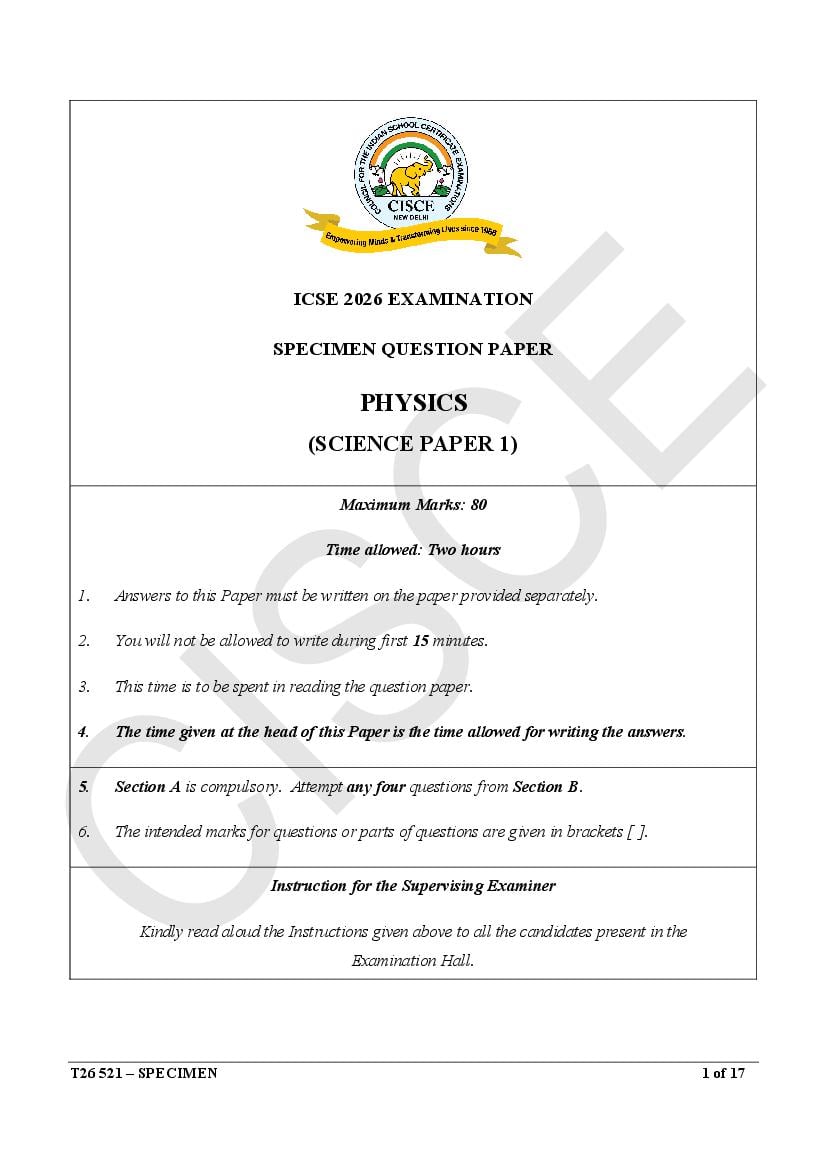
SPECIMEN QUESTION PAPER
PHYSICS
(SCIENCE PAPER 1)
Maximum Marks: 80
Time allowed: Two hours
1. Answers to this Paper must be written on the paper provided separately.
2. You will not be allowed to write during first 15 minutes.
3. This time is to be spent in reading the question paper.
4. The time given at the head of this Paper is the time allowed for writing the answers.
5. Section A is compulsory. Attempt any four questions from Section B.
6. The intended marks for questions or parts of questions are given in brackets [ ].
Instruction for the Supervising Examiner
Kindly read aloud the Instructions given above to all the candidates present in the
Examination Hall.
T26 521 – SPECIMEN 1 of 17
Page 2
The Specimen Question Paper in the subject provides a realistic
format of the Board Examination Question Paper and should be used
as a practice tool. The questions for the Board Examination can be set
from any part of the syllabus. However, the format of the Board
Examination Question Paper will remain the same as that of the
Specimen Question Paper.
Page 3
(Attempt all questions from this Section.)
Question 1
Choose the correct answers to the questions from the given options. [15]
(Do not copy the question, write the correct answers only.)
(i) A moment of couple has a tendency to rotate the body in an
anticlockwise direction. The moment of couple is taken as:
(a) positive
(b) negative
(c) maximum
(d) zero [Recall]
(ii) The kinetic energy of a given body depends on the:
(a) position
(b) centre of gravity
(c) momentum
(d) displacement [Understanding]
(iii) During power production in a coal-based thermoelectric power plant,
the correct sequence of energy conversions taking place is:
(a) heat mechanical chemical
(b) heat mechanical electrical
(c) chemical heat light
(d) heat chemical electrical [Recall]
T26 521 – SPECIMEN 2 of 17
Page 4
She lubricates the pulley.
Which of the following statements is true regarding the performance of
the pulley used?
(a) Mechanical Advantage decreases and efficiency increases.
(b) Velocity Ratio increases and efficiency decreases.
(c) Mechanical Advantage remains unchanged and efficiency
increases.
(d) Velocity Ratio remains unchanged and efficiency increases. [Application]
(v) Inside the prism, during the dispersion of white light, compared to blue,
red light:
(a) slows down less and refracts more.
(b) slows down more and refracts less.
(c) slows down more and refracts more. [Recall &
(d) slows down less and refracts less. Application]
(vi) When objects are viewed through the rising heat of a campfire they appear
to shimmer. The optical phenomenon responsible for this effect is:
(a) refraction
(b) reflection
(c) scattering
(d) total internal reflection [Recall]
(vii) A convex lens with a focal length of 12 cm has an object at a distance
of 20 cm in front of the lens. A blurred image is obtained on the screen
placed at a distance of 23 cm in front of the lens. In order to obtain a
clear image, the screen has to be moved:
(a) towards the lens.
(b) away from the lens.
(c) to a position very far from the lens.
(d) either towards or away from the lens. [Application]
T26 521 – SPECIMEN 3 of 17
Page 5
conditions.
Reason(R): In foggy weather, light gets scattered by tiny water
droplets, reducing visibility.
(a) (A) is true but (R) is false.
(b) (A) is false but (R) is true.
(c) Both (A) and (R) are true and (R) is the correct explanation of (A).
(d) Both (A) and (R) are true, but (R) is not the correct explanation of [Understanding
(A). & Recall]
(ix) Two sound waves X and Y have the same amplitude and the same wave
pattern but their frequencies are 60 Hz and 120 Hz respectively, then:
(a) X will be shriller and Y will be grave.
(b) X will be grave and Y will be shriller.
(c) X will differ in quality than Y.
(d) X is louder than Y. [Understanding]
(x) In the circuit given below, identify the correct relation between the
currents flowing through the 2 Ω, 3 Ω, and 5 Ω resistors:
(a) current through 2Ω > current through 3Ω
(b) current through 5Ω < current through 3Ω
(c) current through 2Ω = current through 5Ω [Understanding
(d) current through 5Ω > current through 3Ω & Recall]
T26 521 – SPECIMEN 4 of 17
Page 6
(a) black
(b) green
(c) yellow
(d) red
[Recall]
(xii) For an ideal step up transformer:
𝑉𝑉𝑉𝑉𝑉𝑉𝑉𝑉𝑉𝑉𝑉𝑉𝑉𝑉 𝑝𝑝𝑝𝑝𝑝𝑝𝑝𝑝𝑝𝑝𝑝𝑝𝑝𝑝
(a) >1
𝑉𝑉𝑉𝑉𝑉𝑉𝑉𝑉𝑉𝑉𝑉𝑉𝑉𝑉 𝑠𝑠𝑠𝑠𝑠𝑠𝑠𝑠𝑠𝑠𝑠𝑠𝑠𝑠𝑠𝑠𝑠𝑠
𝐶𝐶𝐶𝐶𝐶𝐶𝐶𝐶𝐶𝐶𝐶𝐶𝐶𝐶 𝑝𝑝𝑝𝑝𝑝𝑝𝑝𝑝𝑝𝑝𝑝𝑝𝑝𝑝
(b) <1
𝐶𝐶𝐶𝐶𝐶𝐶𝐶𝐶𝐶𝐶𝐶𝐶𝐶𝐶 𝑠𝑠𝑠𝑠𝑠𝑠𝑠𝑠𝑠𝑠𝑠𝑠𝑠𝑠𝑠𝑠𝑠𝑠
𝑛𝑛𝑛𝑛𝑛𝑛𝑛𝑛𝑛𝑛𝑛𝑛 𝑜𝑜𝑜𝑜 𝑡𝑡𝑡𝑡𝑡𝑡𝑡𝑡𝑡𝑡𝑝𝑝𝑝𝑝𝑝𝑝𝑝𝑝𝑝𝑝𝑝𝑝𝑝𝑝
(c) =1
𝑛𝑛𝑛𝑛𝑛𝑛𝑛𝑛𝑛𝑛𝑛𝑛 𝑜𝑜𝑜𝑜 𝑡𝑡𝑡𝑡𝑡𝑡𝑡𝑡𝑡𝑡 𝑠𝑠𝑠𝑠𝑠𝑠𝑠𝑠𝑠𝑠𝑠𝑠𝑠𝑠𝑠𝑠𝑠𝑠
𝑝𝑝𝑝𝑝𝑝𝑝𝑝𝑝𝑝𝑝 𝑝𝑝𝑝𝑝𝑝𝑝𝑝𝑝𝑝𝑝𝑝𝑝𝑝𝑝
(d) =1
𝑝𝑝𝑝𝑝𝑝𝑝𝑝𝑝𝑝𝑝 𝑠𝑠𝑠𝑠𝑠𝑠𝑠𝑠𝑠𝑠𝑠𝑠𝑠𝑠𝑠𝑠𝑠𝑠
[Application]
(xiii) Heat capacity of a body is the:
(a) energy needed to melt a body without change in its temperature.
(b) energy needed to raise the temperature of a body by 1°C.
(c) increase in volume of the body when its temperature increases by 1°C.
(d) total amount of internal energy that is constant.
[Recall]
(xiv) The amount of heat energy required to melt a given mass of a substance
at its melting point, without any rise in its temperature is called the:
(a) specific heat capacity.
(b) specific latent heat of fusion.
(c) latent heat of fusion.
(d) specific latent heat of freezing. [Recall]
T26 521 – SPECIMEN 5 of 17
Page 7
after emitting an alpha particle. How many protons and neutrons are left
in the nucleus after an alpha emission?
(a) protons = 93, neutrons = 142
(b) protons = 95, neutrons = 144
(c) protons = 93, neutrons = 144
(d) protons = 95, neutrons = 142 [Understanding]
Question 2
(i) Complete the following by choosing the correct answers from the [6]
bracket:
(a) A ___________ [Class II/Class III] lever will always have
M.A. > 1.
(b) A boy uses a GPS device to locate his missing friend in a crowded
area; the system primarily uses __________ [ultraviolet waves /
microwaves] to track the location.
(c) Unit of specific heat capacity is _______. [kg2m2s-2K-1 / m2s-2K-1]
(d) The threshold of hearing is __________. [0dB, 20Hz]
(e) Two copper wires can have different resistivity if they have
different __________. [lengths / temperatures]
(f) The reaction responsible for the production of energy in the sun is [Recall &
__________. [Nuclear Fusion / Nuclear Fission] Understanding]
(ii) Match the movement of the body part in Column A to the class of lever [2]
in Column B.
Movement of the body part Class of lever
Column A Column B
(a) Nodding head • Class III
(b) Lifting body weight on your toes • Class II
[Understanding]
• Class I
T26 521 – SPECIMEN 6 of 17
Page 8
[2]
(b) Give one reason why the waves mentioned in (a) is used for the
above purpose. [Recall]
Question 3
(i) (a) Refer to the diagram given below. A lens is made of two materials
[2]
of different refractive indices (µ1, µ2) as shown. If the rays are
coming from a distant object, then how many images will be seen? [Understanding]
(b) A glass lens always forms a virtual, erect, and diminished image
of an object kept in front of it. Identify the lens. [Recall]
(ii) The image given below displays kilowatt-hour meter readings recorded
[2]
at two distinct points in time.
Assuming a continuously running 2000W air conditioner as the sole
electrical device in use, calculate the time interval, in hours, between
these two meter readings. [Application]
T26 521 – SPECIMEN 7 of 17
Page 9
be the most probable position (W, X, Y, Z or O) of the new centre of
gravity:
(a) if a piece of clay is attached at point A?
(b) if the pentagon is cut along the line PQ? (Of the remaining part
DCBQPE)
[Understanding]
[Recall]
(iv) A solid of mass 60 g at 100°C is placed in 150 g of water at 20°C. The
[2]
final steady temperature is 25°C. Calculate the heat capacity of the
solid. [Understanding
& Evaluate]
[sp. heat capacity of water = 4.2 J g -1 K -1 ]
(v) The diagram given below shows a copper wire wound around a U-shape [2]
soft iron bar. An iron pin is brought near the arrangement. First Source [Recall]
P and then Source Q are connected across AB, each operating
independently.
(a) State True or False: Source P as well as Source Q, when
connected across AB, can attract the iron pin.
(b) Justify your answer to (a) with a suitable reason.
T26 521 – SPECIMEN 8 of 17
Page 10
that has the highest penetrating power. [Recall]
(b) Does the emission of the above-mentioned radiation result in a
change in the mass number? [Understanding]
(vii) Advanced optical sensors in air-to-air missiles use fiber optic cables to [3]
transmit light signals with minimal loss. This relies on a physical
phenomenon that confines light within the fibers, making the system
very dependable for guiding the missile precisely.
(a) Name the optical phenomenon that allows light signals to remain
confined within the fiber optic cables during transmission.
(b) Explain the two main conditions necessary for this phenomenon
to occur. [Application]
SECTION B (40 Marks)
(Attempt any four questions from this Section.)
Question 4
(i) The diagram below shows a fish in the tank and its image seen on the [3]
surface of water.
[Understanding
(a) Name the phenomenon responsible for the formation of this
& Recall]
image.
T26 521 – SPECIMEN 9 of 17
Page 11
liquids of refractive indices 𝜇𝜇2 and 𝜇𝜇3 as shown in the diagrams
below. The refractive indices are such that µ2 > µ1 and µ1 > µ3.
How would a parallel incident beam of light refract when it
comes out of the lens in each of the cases shown above?
(1) in Figure a.
[Application]
(2) in Figure b.
(ii) A scientist lowers a metallic ruler vertically into a transparent oil tank. [3]
The ruler touches an object placed at the bottom of the tank and gets
wet up to the 25 cm mark. If the refractive index of the glycerin is 1.25:
(a) up to which mark will the ruler get wet, if the scientist lowers it
[Evaluate]
up to the image of the object?
(b) how will this length in (a) change if another liquid of μ>1.25 is
used? [Understanding]
(iii) (a) A mixture of red, blue, and green light rays is passed through a [4]
convex lens, as illustrated in the diagram below. State whether the [Understanding]
ray passes through a single point or through different points on the
principal axis after refraction.
T26 521 – SPECIMEN 10 of 17
Page 12
prism.
(c) State one use of the radiation mentioned by you in (b) above. [Recall]
(d) Name one type of radiation with a wavelength greater than that of [Recall]
the radiation mentioned by you in (b) above.
Question 5
(i) An object is placed at a distance of 24 cm in front of a convex lens of [3]
focal length 8 cm.
(a) What is the nature of the image so formed?
[Understanding
(b) Calculate the distance of the image from the lens. & Evaluate]
(ii) The diagram below shows a cooling curve for a substance X: [3]
(a) State the temperatures at which the substance condenses.
[Recall]
(b) Mention the temperature range in which the substance is in its
liquid state.
[Understanding]
(c) State True or False: The amount of heat released when a
substance is cooled by 10°C in its liquid state is greater than the
heat released when it is cooled by the same amount in its solid
state.
T26 521 – SPECIMEN 11 of 17
Page 13
burner, a lump of copper of mass 0 .12 kg is heated on the flame for a
long time. The copper then is quickly transferred into a beaker of
negligible heat capacity containing 0.84 kg of water and the temperature
of the water rose from 15 °C to 35 °C. Calculate the temperature of the
flame.
[Given sp. Heat capacity of copper = 0.4 Jg-1 oC-1,
Sp. Heat capacity of water = 4.2 Jg-1 oC-1.]
[Understanding
& Application]
Question 6
(i) [3]
A metal rod AB of length 80 cm is balanced at 45 cm from the end A
with 100 gf weights suspended from the two ends.
(a) If this rod is cut at the centre C, then compare the weight of AC to
[Understanding
the weight of BC. (Use >, < or =)
& Application]
(b) Give a reason for your answer in (a).
(ii) For each of the following scenarios, state whether the work done by [3]
gravity is positive, negative, or zero.
(a) A person walks on a levelled road.
(b) A person climbs a ladder. [Understanding
(c) A car in a neutral gear is coming down the slope. & Recall]
(iii) A, B, C and D are four points on a hemispherical cup placed inverted [4]
on the ground. Diameter BC = 360 cm and AE =R/3 (R is the radius of
the cup). A small spherical mass 500 g at rest at the point A, slides down
along the smooth surface of the cup. Assuming that there is no loss of
energy, calculate its:
T26 521 – SPECIMEN 12 of 17
Page 14
(b) Speed at the point B (lowest point).
[Application &
(c) Kinetic Energy at D (g = 10 ms-2).
Evaluate]
Question 7
(i) A block and tackle system of pulleys has velocity ratio 4. [3]
(a) Draw a labelled diagram of the system indicating clearly, the
direction of the load and effort. [Recall]
(b) Calculate the potential energy gained by load of 100 kgf, lifted by [Understanding
this pulley to a height of 5 m. (g = 10 ms-2) & Evaluate]
(ii) A person standing in front of a cliff fires a gun and hears its echo after [3]
3s. Speed of sound in air is 336 ms-1:
(a) Calculate the distance of the person from the cliff.
(b) After moving a certain distance from the cliff, he fires the gun
again and this time the echo is heard 1.5 s later than the first. [Understanding
Calculate the distance that the person has moved. & Evaluate]
T26 521 – SPECIMEN 13 of 17
Page 15
The above picture shows a mother pushing her daughter sitting on a
swing. The swing is going through the positions A, B, C where A and
C are extreme positions and B is the mean position.
(a) Which is the right position i.e. at A, B or C, for the mother to give
a constant periodic push to the swing, every time in the forward
direction, to increase the amplitude of the swing?
(b) Name the phenomenon involved in this.
(c) On the basis of this example, explain how this phenomenon helps
to increase the amplitude of the swing. [Application]
Question 8
(i) The circuit depicted in the figure is employed for studying Ohm's Law. [3]
Instead of using a standard resistor, a student opts for a glass tube filled
with mercury (tube 1), connected to the circuit through two electrodes
E1 & E2. He records the readings of the ammeter and voltmeter, thereby
calculates the resistance. The student repeats the experiment by
substituting tube 1 with tube 2, where the same amount of mercury fills
the tube 2.
T26 521 – SPECIMEN 14 of 17
Page 16
the following:
(a) Resistance in both cases. [Understanding
(b) Voltmeter readings in both cases. & Application]
(c) Specific resistance in both cases.
(ii) An appliance with a metal covering, rated at 2 kW, 220 V, is to be [3]
connected in a circuit. Given below are four diagrams (P, Q, R & S)
depicting different circuit configurations,
(a) Identify the safest circuit.
(b) Write two reasons, supported by mathematical calculations, where [Application &
applicable, to justify your choice. Evaluate]
(iii) A nichrome wire X with length (l) & cross-sectional area (A) is [4]
connected to a 10 V source and another nichrome wire Y with length
(2 l) & cross-sectional area (A/2), is connected to a 20 V source.
(a) Compare the resistances of wires X and Y. [Given that the
resistivity of nichrome is (ρ).]
(b) Compare the electrical power consumed by each wire.
(c) Compare the masses of these wires. (Given that the density of
nichrome is d.)
(d) State True or False: Wire X and wire Y both show the same rise [Analyse &
in temperature in the same time. Evaluate]
T26 521 – SPECIMEN 15 of 17
Page 17
(i) Three bulbs of powers P1, P2 and P3 (P1<P2<P3) are connected in a [3]
certain way that P3 glows brightest.
(a) What type of connection exists between these bulbs?
(b) Compare the voltage across these bulbs. (Use >, < or =)
(c) Will the circuit still function if one of the bulbs is fused? [Recall]
(ii) The given diagram shows the output of an AC generator. If the speed
[3]
of the generator coil is doubled, then:
(a) what is the effect on the physical quantity indicated by ‘a’?
(b) what is the effect on the physical quantity indicated as ‘b’?
(c) give reason for your answer in (b). [Understanding]
(iii) The graph (Fig. A) illustrates the correlation between the number of [4]
protons (x-axis) and the number of neutrons (y-axis) for elements A, B,
C, D, and E in the periodic table. These elements are denoted by the
letters rather than their conventional symbols.
T26 521 – SPECIMEN 16 of 17
Page 18
(a) Identify the radioactive radiation emitted when element C decays
into element E. Represent this using a nuclear reaction.
(b) What is the special name given to elements D and E?
(c) If element C transforms into element B by emitting a radioactive
ray, how will this ray behave in an electric field?
T26 521 – SPECIMEN 17 of 17
Page 19
DRAFT MARKING SCHEME – PHYSICS (SCIENCE PAPER 1)
Question 1 [1x15]
(i) (a) positive
(ii) (c) momentum
(iii) (b) heat mechanical electrical
(iv) (d) Velocity Ratio remains unchanged and efficiency increases.
(v) (d) slows down less and refracts less
(vi) (a) refraction
(vii) (b) away from the lens
(viii) (c) Both (A) and (R) are true and (R) is the correct explanation of (A).
(ix) (b) X will be grave and Y will be shriller
(x) (c) current through 2 Ω = current through 5 Ω
(xi) (b) green
𝑝𝑝𝑝𝑝𝑝𝑝𝑝𝑝𝑝𝑝 𝑝𝑝𝑝𝑝𝑝𝑝𝑝𝑝𝑝𝑝𝑝𝑝𝑝𝑝
(xii) (d) =1
𝑝𝑝𝑝𝑝𝑝𝑝𝑝𝑝𝑝𝑝 𝑠𝑠𝑠𝑠𝑠𝑠𝑠𝑠𝑠𝑠𝑠𝑠𝑠𝑠𝑠𝑠𝑠𝑠
(xiii) (b) energy needed to raise the temperature of a body by 1°C
(xiv) (c) latent heat of fusion
(xv) (c) protons = 93, neutrons = 144
Question 2
(i) (a) Class II [1]
(b) microwaves [1]
2 -2 -1
(c) ms K [1]
(d) 0dB [1]
(e) temperature [1+1]
(f) Nuclear fusion
(ii) (a) Nodding head Class I [1]
(b) Lifting body weight on your toes Class II [1]
(iii) (a) Ultrasonic waves [1]
(b) They travel long distance without deviation / not easily absorbed by the medium [1]
OR can be confined to a narrow beam.
T26 521 - SPECIMEN 1 of 5
Page 20
(i) (a) 2 images will be seen. [1]
(b) concave lens. [1]
(ii) Energy spent =1567-856 =711kWh [1]
Time in hours = 711/2 =355.5 hours [1]
(iii) (a) X [1]
(b) Z [1]
(iv) By principle of mixtures [1]
Heat lost = heat gained
(m x c x ∆T) metal = (m c ∆T) water [1]
c’ x 75 = 150 x 4.2 x 5
c’ = 42 J K -1
(v) (a) True [1]
(b) Both currents AC & DC produce magnetic field around it. [1]
(vi) (a) gamma /γ [1]
(b) No. [1]
(vii) (a) total internal reflection [1]
(b) 1. Light ray should travel from denser to rarer medium [1]
2. Angle of incidence must be greater than critical angle. [1]
Question 4
(i) (a) Total internal reflection. [1]
(b) 1. Converge [1]
2. Diverge [1]
(ii) (a) Real depth =25 cm [1+1]
Refractive index =1.25
Apparent depth =Real depth /refractive index
25/1.25 =20 cm.
(b) length will decrease [1]
(iii) (a) Different points. [1]
(b) Ultraviolet radiation [1]
(c) Sterilization purposes / Detecting purity of gems, eggs/ in producing vitamin D [1]
(d) Visible or infra-red or microwaves or radio waves. [1]
T26 521 - SPECIMEN 2 of 5
Page 21
(i) (a) Real, inverted [1]
1 1
(b) 𝑣𝑣 − 𝑢𝑢 = 𝑓𝑓 ∴
1 1
−
1
=
1 [1]
𝑣𝑣 −24 8
[1]
(identifying ‘U’ and ‘f’ with correct sign convention)
1 3−1
= 24 ∴ 𝑣𝑣 = 12 𝑐𝑐𝑐𝑐
𝑣𝑣 [1]
(ii) (a) 150°C - [1+1]
(b) 150°C to 60°C
(c) True. [1]
(iii) Heat lost by Cu = 0.12 × 400 × (𝑡𝑡 − 35) [1x4]
Heat gained by water = 0.84 × 4200 × (35 − 15)
0.84×4200×20
𝑡𝑡 − 35 = 0.12×400
= 7 × 42 × 5 = 1470 0𝐶𝐶
𝑡𝑡 = 1470 + 35 = 1505 0𝐶𝐶
Question 6
(i) (a) Weight of AC < weight of BC [1]
(b) Even though the weights present are the same at both ends, the torque arm of B is [2]
less than the torque arm of A.
This means the moment of the weight of the rod acts from side B and the C.G. lies
beyond 40. Thus, more weight is concentrated between C to B.
(ii) (a) No work is done. [1]
(b) Negative work is done. [1]
(c) Positive work is done. [1]
(iii) (a) Potential energy at A relative to B [1]
PEA = mgh
= 0.5 x 10 x 1.8 = 9J
(b) Speed at point B (lowest point) [1]
Using energy conservation
PE at A = KE at B => mgh = ½ mv2
v = √ 2gh = √ 2 x 10 x 1.8
= 6m/s
(c) Kinetic and Potential energy at D [1+1]
Therefore, height above B = 2R/3
= 1.2m
P.E. at D = mgh
= 0.5 x 10 x 1.2 = 6J
K.E. at D = TE -PE at D = 9-6 =3J
T26 521 - SPECIMEN 3 of 5
Page 22
(i)
(a) Pulleys drawn correctly with support
Correct connection of tackle, Marking load, effort with correct direction and [1+1]
tension
(b) U = mgh = 100×10×5
[1]
U = 5000 J
(ii) (a) d = (s×t)/2 ∴d=(336×3)/2 [1+1]
d =168×3=504 m
(b) d=(s×t) / 2 [1]
∴ d = (336×1.5)/2 = 168×1.5 = 252 m
Distance moved = 504 – 252 = 252 m
(iii) (a) At A [1]
(b) Resonance [1]
(c) The natural frequency of the swing will match the frequency of the force applied [1+1]
by mother this will increase the amplitude.
Question 8
(i) (a) Resistance of the tube2 < resistance of the tube 1 [1]
(b) The voltmeter reading for tube 1 is the same as the voltmeter reading for tube 2. [1]
(c) The specific resistance in both the cases is the same. [1]
(ii) (a) S [1]
(b) metal body of appliance is earthed [1+1]
I = PV = 2000/220 =9.09 A 10A fuse is appropriate
T26 521 - SPECIMEN 4 of 5
Page 23
(𝑎𝑎) 𝑅𝑅𝑅𝑅𝑅𝑅 𝑋𝑋 = 𝑅𝑅𝑅𝑅𝑅𝑅 𝑌𝑌 = =4 𝑅𝑅𝑅𝑅 ∶ 𝑅𝑅𝑅𝑅 = 1: 4
𝐴𝐴 𝐴𝐴 𝐴𝐴
2
𝑉𝑉 2 𝑡𝑡 102 𝑉𝑉 2 𝑡𝑡 202 [1+1]
(𝑏𝑏) 𝑃𝑃𝑃𝑃 = = 𝑅𝑅 𝑃𝑃𝑃𝑃 == 𝑅𝑅 = 4𝑅𝑅 ∴ 𝑃𝑃𝑃𝑃: 𝑃𝑃𝑃𝑃 = 1: 1
𝑅𝑅
𝐴𝐴
(c) 𝑚𝑚𝑚𝑚𝑚𝑚𝑚𝑚 𝑜𝑜𝑜𝑜 𝑋𝑋 = 𝐴𝐴 × 𝑙𝑙 × 𝑑𝑑 = 𝑚𝑚𝑚𝑚𝑚𝑚𝑚𝑚 𝑜𝑜𝑜𝑜 𝑌𝑌 = 2 × 2𝑙𝑙 × 𝑑𝑑 ∴ 𝑚𝑚𝑚𝑚: 𝑚𝑚𝑚𝑚 = 1: 1
(d) True
𝑉𝑉 2 𝑡𝑡
𝑄𝑄𝑄𝑄 = 𝑚𝑚𝑚𝑚𝑚𝑚𝑚𝑚 = 𝐴𝐴𝐴𝐴 × 𝑐𝑐 × 8 = 𝑅𝑅 = 𝑃𝑃𝑃𝑃 × 𝑡𝑡 →eq 1
𝑉𝑉 2 𝑡𝑡
𝑄𝑄𝑄𝑄 = 𝑚𝑚𝑚𝑚𝑚𝑚𝑚𝑚 = 𝐴𝐴𝐴𝐴 × 𝑐𝑐 × 𝛥𝛥𝛥𝛥 = 𝑅𝑅 = 𝑃𝑃𝑃𝑃 × 𝑡𝑡 →eq 2
Eq1/eq2 =1 (𝑟𝑟𝑟𝑟𝑟𝑟𝑟𝑟 𝑖𝑖𝑖𝑖 𝑡𝑡𝑡𝑡𝑡𝑡𝑡𝑡𝑡𝑡𝑡𝑡𝑡𝑡𝑡𝑡𝑡𝑡𝑡𝑡𝑡𝑡 𝑤𝑤𝑤𝑤𝑤𝑤𝑤𝑤 𝑏𝑏𝑏𝑏 𝑠𝑠𝑠𝑠𝑠𝑠𝑠𝑠 𝑖𝑖𝑖𝑖 𝑏𝑏𝑏𝑏𝑏𝑏ℎ 𝑤𝑤𝑤𝑤𝑤𝑤𝑤𝑤𝑤𝑤 )
Question 9
(i) (a) parallel [2+1]
(b) V1 = V2 = V3
(c) Yes
(ii) (a) It will be doubled. [1]
(b) It will be halved. [1]
(c) If speed is doubled, it means time of a cycle will be halved. [1]
(iii) (a) 𝛽𝛽 : 238 238 0
92𝐶𝐶 → 93𝐸𝐸 + −1𝛽𝛽 [1]
(b) isotopes [1]
(c) It will shift towards the negative plate [1+1]
T26 521 - SPECIMEN 5 of 5
Document Details
| Board / Org | CISCE |
| Exam | Class 10 |
| Type | Sample Paper |
| Pages | 23 |
| Updated | 24 Sep 2026 |