ICSE Class 10 Specimen Paper 2022 Physical Education Semester 1
Finished viewing? Save it for later —
Download ICSE Class 10 Specimen Paper 2022 Physical Education Semester 1 (PDF · 13 pages)About ICSE Class 10 Specimen Paper 2022 Physical Education Semester 1
ICSE Class 10 Specimen Paper 2022 Physical Education Semester 1 is available here for free download. Published by CISCE for Class 10, this sample paper can be viewed online or downloaded as a PDF (13 pages). Candidates preparing for Class 10 can use ICSE Class 10 Specimen Paper 2022 Physical Education Semester 1 to understand the exam pattern, the type of questions asked, and the overall difficulty level.
Frequently Asked Questions
How can I download ICSE Class 10 Specimen Paper 2022 Physical Education Semester 1?
Open this page and click the Download button to save ICSE Class 10 Specimen Paper 2022 Physical Education Semester 1 as a PDF. It is completely free on AglaSem Docs.
Is ICSE Class 10 Specimen Paper 2022 Physical Education Semester 1 free to download?
Yes. ICSE Class 10 Specimen Paper 2022 Physical Education Semester 1 can be viewed online and downloaded as a PDF free of cost on AglaSem Docs.
How many pages does ICSE Class 10 Specimen Paper 2022 Physical Education Semester 1 have?
ICSE Class 10 Specimen Paper 2022 Physical Education Semester 1 contains 13 pages, which you can read online or download together as a single PDF.
Where can I find more Class 10 study material?
You can find more Class 10 question papers, sample papers, syllabus, and answer keys on AglaSem Docs.
ICSE Class 10 Specimen Paper 2022 Physical Education Semester 1 – Text
Read the full text of this sample paper below — useful to quickly search, copy and reference the content online without downloading the PDF.
📄 View text version (13 pages)
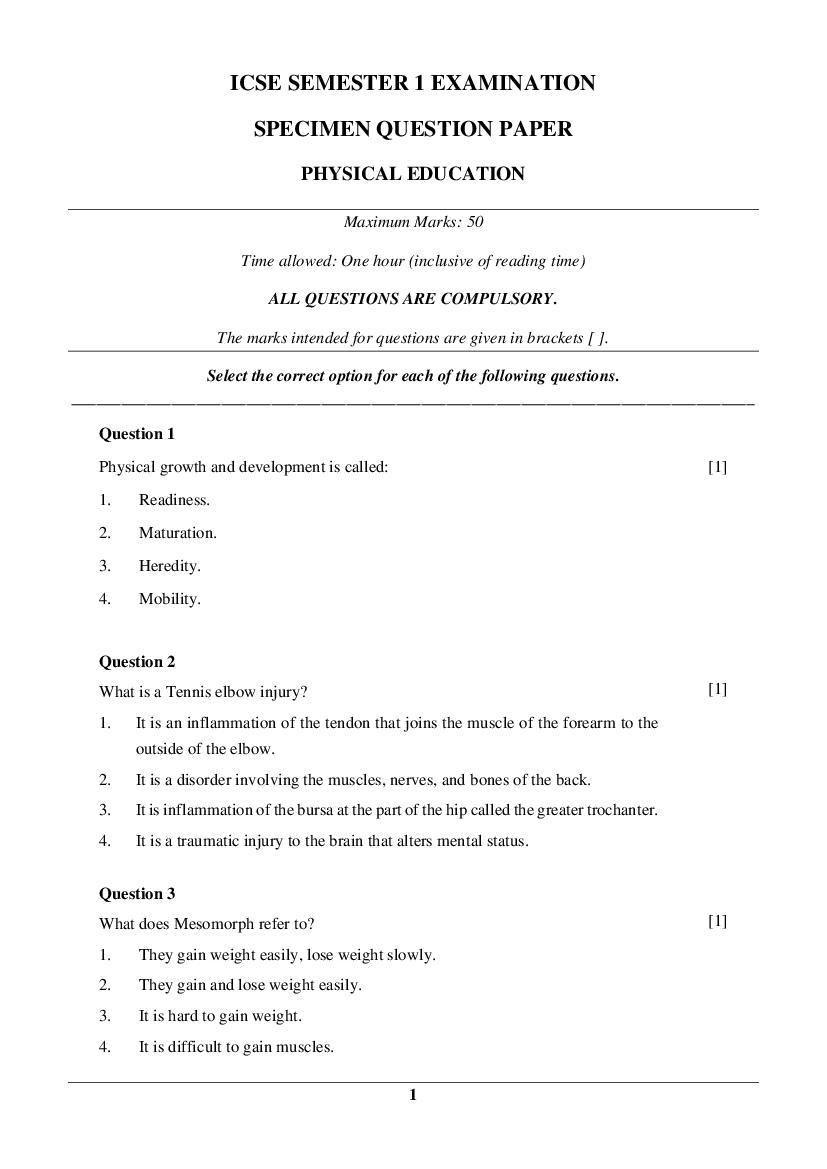
Page 1
SPECIMEN QUESTION PAPER
PHYSICAL EDUCATION
Maximum Marks: 50
Time allowed: One hour (inclusive of reading time)
ALL QUESTIONS ARE COMPULSORY.
The marks intended for questions are given in brackets [ ].
Select the correct option for each of the following questions.
__________________________________________________________________________________
Question 1
Physical growth and development is called: [1]
1. Readiness.
2. Maturation.
3. Heredity.
4. Mobility.
Question 2
What is a Tennis elbow injury? [1]
1. It is an inflammation of the tendon that joins the muscle of the forearm to the
outside of the elbow.
2. It is a disorder involving the muscles, nerves, and bones of the back.
3. It is inflammation of the bursa at the part of the hip called the greater trochanter.
4. It is a traumatic injury to the brain that alters mental status.
Question 3
What does Mesomorph refer to? [1]
1. They gain weight easily, lose weight slowly.
2. They gain and lose weight easily.
3. It is hard to gain weight.
4. It is difficult to gain muscles.
1
Page 2
Which physical fitness test is used to assess cardiovascular endurance? [1]
1. Push- ups test.
2. Sit and reach test.
3. Sit-ups test.
4. Cooper run test.
Question 5
To prevent an injury, one should always: [1]
1. Warm up properly.
2. Have appropriate fitness levels before playing.
3. Wear the appropriate equipment.
4. All of the above.
Question 6
The ability to maintain equilibrium when stationary or moving: [1]
1. Accuracy.
2. Flexibility.
3. Balance.
4. Agility.
Question 7
The influence of peer group is more in: [1]
1. Adulthood Stage.
2. Adolescence Stage.
3. Infancy Stage.
4. Childhood Stage.
2
Page 3
It is the ability to use the senses together with body parts during movement: [1]
1. Power.
2. Agility.
3. Speed.
4. Coordination.
Question 9
The systematic planning of athletic or physical training is called: [1]
1. Periodization.
2. Specificity.
3. Frequency.
4. Variance.
Question 10
Factors that influence human growth and development are: [1]
1. Heredity.
2. Environment.
3. Gender.
4. All of the above.
Question 11
What is the most common symptom of an ACL injury? [1]
1. Pain, swelling along the inner part of the leg.
2. A loud “pop” or a “popping” sensation in the knee with severe pain.
3. Pain on the bottom of the foot near the heel.
4. Tenderness when you touch the ankle. Instability in the ankle.
3
Page 4
Which of the following statements is correct? [1]
1. Language acquisition is faster in girls in their teens.
2. Skills like catching, jumping, throwing are slower in boys.
3. Girls don’t grow taller.
4. Gender does not influence growth and development.
Question 13.
__________ is essential for the healthy development of the child. [1]
1. Proper nutrition.
2. Recreation.
3. Fibrous food.
4. Exertion
Question 14.
Which among the following are the objectives of physical education? [1]
1. Physical development and psychological development.
2. Social development, emotional development.
3. Neuro-muscular development, mental development.
4. All of the above.
Question 15.
If someone has a broken bone, which of the following statements is true? [1]
1. If we do not support the limb, it may cause further injury and pain.
2. If we do not support the limb, the person will be able to move the limb more
easily and reduce the pain.
3. If we do not support the limb, it doesn’t matter.
4. None of the above.
4
Page 5
Which is not the psychological development objective of physical education? [1]
1. To develop self-confidence and self-esteem.
2. To develop the ability to use one’s body to express one’s ideas, attitudes and
emotions.
3. To develop the ability to plan, implement and evaluate decisions.
4. To develop alertness of mind, deep concentration through various physical
activities.
Question 17.
The best way to prevent sports injuries is: [1]
1. Stay calm.
2. Good warming up and stretching.
3. Not to do too much effort.
4. Not to play at all.
Question 18.
The risk for shin splint injury is more if you: [1]
1. Cycle for a longer duration.
2. Have flat feet or very rigid foot arches.
3. Swim a lot.
4. Have a collision in football.
Question 19.
The process by which a child learns to interact with others around them is called: [1]
1. Physical development.
2. Psychological development.
3. Emotional development.
4. Social development.
5
Page 6
Which of the following is the Psychological Development objective of Physical [1]
Education?
1. To develop organ systems such as the muscular system, digestive system
properly.
2. To develop understanding and appreciation of the culture which is worldwide.
3. To develop the ability to deal with success and failure with equanimity.
4. To develop alertness of mind, deep concentration through various physical
activities.
Question 21.
The physical makeup of a person's body is called their __________. [1]
1. Size.
2. Height.
3. Shape.
4. Body type.
Question 22.
What does the principle of variance suggest? [1]
1. Major changes in training helps in sports performance.
2. Minor changes in training helps in sports performance.
3. No changes in training helps in sports performance.
4. None of the above.
Question 23.
Mesomorph tends to have ………… metabolism. [1]
1. Slow metabolism.
2. Average to Fast metabolism.
3. Medium metabolism.
4. High metabolism.
6
Page 7
Which of the following statement is true with respect to Growth: [1]
1. It stops when maturity has been attained.
2. Is continuous throughout life.
3. Is a progressive series of changes.
4. Cannot be measured.
Question 25.
What physical traits are associated with an Ectomorph? [1]
1. Broad Shoulders.
2. Thin Build.
3. Large Frame.
4. Small Feet.
Question 26.
What is physical fitness? [1]
1. Any physical activities that improve your ability to complete tasks.
2. The ability to do everyday tasks without getting tired.
3. The way your body adapts to the stress of exercise.
4. All of the above.
Question 27.
Which of the following is most likely to increase the risk of leg and foot fracture: [1]
1. Gradual increase in intensity of training.
2. Warm up and cool down.
3. Stretching the leg muscle.
4. High arches and low flexibility of the lower body.
7
Page 8
The progressive series of changes that occur in an orderly predictable pattern as a [1]
result of maturation and experience is called:
1. Development.
2. Growth.
3. Both.
4. None.
Question 29.
How does a MCL injury occur? [1]
1. Falling on the outside of the hip or banging the hip on any hard surface.
2. Putting strain on calf muscle during repeated exercise or physical activity.
3. Car accident.
4. Improper landing after a jump.
Question 30.
The ability of your joints to move through a full range of motion is called: [1]
1. Agility.
2. Co-ordination.
3. Flexibility.
4. Speed.
Question 31.
What is the name of the fitness test for power? [1]
1. 100 m run.
2. Standing broad jump.
3. Cooper Run test.
4. Zig zag test.
8
Page 9
What is an ACL injury? [1]
1. It is a pain along the inside edge of the shin bone.
2. It is a tear or sprain of the anterior cruciate ligament.
3. It is the inflammation of the plantar fascia ligament.
4. It is a tear or sprain of the Medial Collateral ligament.
Question 33.
The years between the onset of puberty and beginning of adulthood is the stage of: [1]
1. Adolescence.
2. Childhood.
3. Adulthood.
4. Infancy.
Question 34.
Being able to change direction quickly in a game of basketball is a good example of [1]
which skill related component?
1. Speed.
2. Coordination.
3. Agility.
4. Power.
Question 35.
The power of memory, thinking and decision making gets increased in which stage [1]
of Growth and Development?
1. Childhood stage.
2. Infancy.
3. Adulthood.
4. Adolescence.
9
Page 10
Which somatotypes are at a greater risk of becoming obese? [1]
1. Endomorph.
2. Mesomorph.
3. Ectomorph.
4. Athletic.
Question 37
According to the Principle of Continuity, training program should be: [1]
1. Regular.
2. Irregular.
3. Once a week.
4. Once a month.
Question 38.
The stage from the age of 19-65 years is called: [1]
1. Childhood Stage.
2. Infancy Stage.
3. Adolescence Stage.
4. Adulthood Stage.
Question 39
What is a muscle strain? [1]
1. It is an inflammation of the tendon that joins the muscle of the forearm to the
outside of the elbow.
2. It is an injury of muscles caused by the overstress or overstretch of muscles or
due to violent pull.
3. It is a tear or sprain of the anterior cruciate ligament.
4. It is an inflammation of the bursa.
10
Page 11
The mnemonic RICE stands for: [1]
1. Rest, Innervate, Compression, Elevation.
2. Rest, Ice, Compression, Elevation.
3. Rest, Ice, Contusion, Elevation.
4. Rest, Ice Contraction, Elevation.
Question 41
The ability to move from one point to another in the shortest period of time: [1]
1. Power.
2. Agility.
3. Speed.
4. Balance.
Question 42
The transmission of traits from parents to off-springs is called: [1]
1. Environment.
2. Genes.
3. Heredity.
4. Biology.
Question 43
The ability of the muscle to exert maximum force is: [1]
1. Muscular endurance.
2. Flexibility.
3. Agility.
4. Muscular strength.
11
Page 12
Which of the following is NOT the objective of physical education? [1]
1. Physical development.
2. Psychological development.
3. Neuro-muscular development.
4. Sedentary lifestyle.
Question 45
A stress fracture is a: [1]
1. It is a fatigue induced a tiny crack or a small sliver in a bone.
2. It occurs when the ligaments that support the ankle are stretched.
3. It is a traumatic injury to the brain that alters mental status.
4. It is the inflammation of the plantar fascia ligament.
Question 46
What is cardiovascular endurance? [1]
1. It is the ability of a muscle or group of muscles to sustain repeated contractions.
2. It is the ability of the heart and lungs to supply oxygen-rich blood to the
working muscle tissues.
3. It is the ability of muscles to overcome resistance and produce force.
4. It is the range of motion in a joint or group of joints or the ability to move joints
effectively through a complete range of motion.
Question 47
Following is the objective of psychological development in physical education: [1]
1. To guide a person to make his body strong, well-shaped and good looking.
2. To develop positive thoughts, ideas, behaviour, attitude, conduct and responses.
3. To develop the ability to respect the attitudes and values of others.
4. To develop the ability to control various emotions like fear, pleasure, hope,
anger.
12
Page 13
In which part of the body can you suffer a “Concussion”: [1]
1. Leg.
2. Elbow.
3. Head.
4. Knee.
Question 49
The cool-down period is designed to: [1]
1. Help reduce muscle stiffness and soreness.
2. Lower body temperature.
3. Redistribute pooled blood after exercise.
4. All of the above.
Question 50
In which stage the physical growth is rapid? [1]
1. Early childhood.
2. Adolescence.
3. Old age.
4. Infancy.
13
Document Details
| Board / Org | CISCE |
| Exam | Class 10 |
| Type | Sample Paper |
| Pages | 13 |
| Language | english |
| Updated | 22 Jul 2026 |