Finished viewing? Save it for later —
Download NCERT Book Class 11 Geography (Fundamental of Physical Geography) Chapter 13 Movements of Ocean Water (PDF · 6 pages)About NCERT Book Class 11 Geography (Fundamental of Physical Geography) Chapter 13 Movements of Ocean Water
NCERT Book Class 11 Geography (Fundamental of Physical Geography) Chapter 13 Movements of Ocean Water is available here for free download. Published by NCERT for Class 11, this books can be viewed online or downloaded as a PDF (6 pages). Candidates preparing for Class 11 can use NCERT Book Class 11 Geography (Fundamental of Physical Geography) Chapter 13 Movements of Ocean Water to understand the exam pattern, the type of questions asked, and the overall difficulty level.
Frequently Asked Questions
How can I download NCERT Book Class 11 Geography (Fundamental of Physical Geography) Chapter 13 Movements of Ocean Water?
Open this page and click the Download button to save NCERT Book Class 11 Geography (Fundamental of Physical Geography) Chapter 13 Movements of Ocean Water as a PDF. It is completely free on AglaSem Docs.
Is NCERT Book Class 11 Geography (Fundamental of Physical Geography) Chapter 13 Movements of Ocean Water free to download?
Yes. NCERT Book Class 11 Geography (Fundamental of Physical Geography) Chapter 13 Movements of Ocean Water can be viewed online and downloaded as a PDF free of cost on AglaSem Docs.
How many pages does NCERT Book Class 11 Geography (Fundamental of Physical Geography) Chapter 13 Movements of Ocean Water have?
NCERT Book Class 11 Geography (Fundamental of Physical Geography) Chapter 13 Movements of Ocean Water contains 6 pages, which you can read online or download together as a single PDF.
Where can I find more Class 11 study material?
You can find more Class 11 question papers, sample papers, syllabus, and answer keys on AglaSem Docs.
NCERT Book Class 11 Geography (Fundamental of Physical Geography) Chapter 13 Movements of Ocean Water – Text
Read the full text of this books below — useful to quickly search, copy and reference the content online without downloading the PDF.
📄 View text version (1 page)
Page 1
MOVEMENTS OF OCEAN WATER
T
he ocean water is dynamic. Its physical wavelength of the wave, the wave breaks. The
characteristics like temperature, largest waves are found in the open oceans.
salinity, density and the external Waves continue to grow larger as they move
forces like of the sun, moon and the winds and absorb energy from the wind.
influence the movement of ocean water. The Most of the waves are caused by the wind
horizontal and vertical motions are common driving against water. When a breeze of two
in ocean water bodies. The horizontal motion knots or less blows over calm water, small
refers to the ocean currents and waves. The ripples form and grow as the wind speed
vertical motion refers to tides. Ocean currents increases until white caps appear in the
are the continuous flow of huge amount of breaking waves. Waves may travel thousands
water in a definite direction while the waves of km before rolling ashore, breaking and
are the horizontal motion of water. Water moves dissolving as surf.
ahead from one place to another through ocean A wave’s size and shape reveal its origin.
currents while the water in the waves does not Steep waves are fairly young ones and are
move, but the wave trains move ahead. The probably formed by local wind. Slow and
vertical motion refers to the rise and fall of water steady waves originate from far away places,
in the oceans and seas. Due to attraction of possibly from another hemisphere. The
the sun and the moon, the ocean water is raised maximum wave height is determined by the
up and falls down twice a day. The upwelling strength of the wind, i.e. how long it blows and
of cold water from subsurface and the sinking the area over which it blows in a single direction.
of surface water are also forms of vertical Waves travel because wind pushes the
motion of ocean water. water body in its course while gravity pulls the
crests of the waves downward. The falling water
WAVES pushes the former troughs upward, and the
Waves are actually the energy, not the water
as such, which moves across the ocean surface.
Water particles only travel in a small circle as a
wave passes. Wind provides energy to the
waves. Wind causes waves to travel in the ocean
and the energy is released on shorelines. The
motion of the surface water seldom affects the
stagnant deep bottom water of the oceans. As
a wave approaches the beach, it slows down.
This is due to the friction occurring between
the dynamic water and the sea floor. And, when
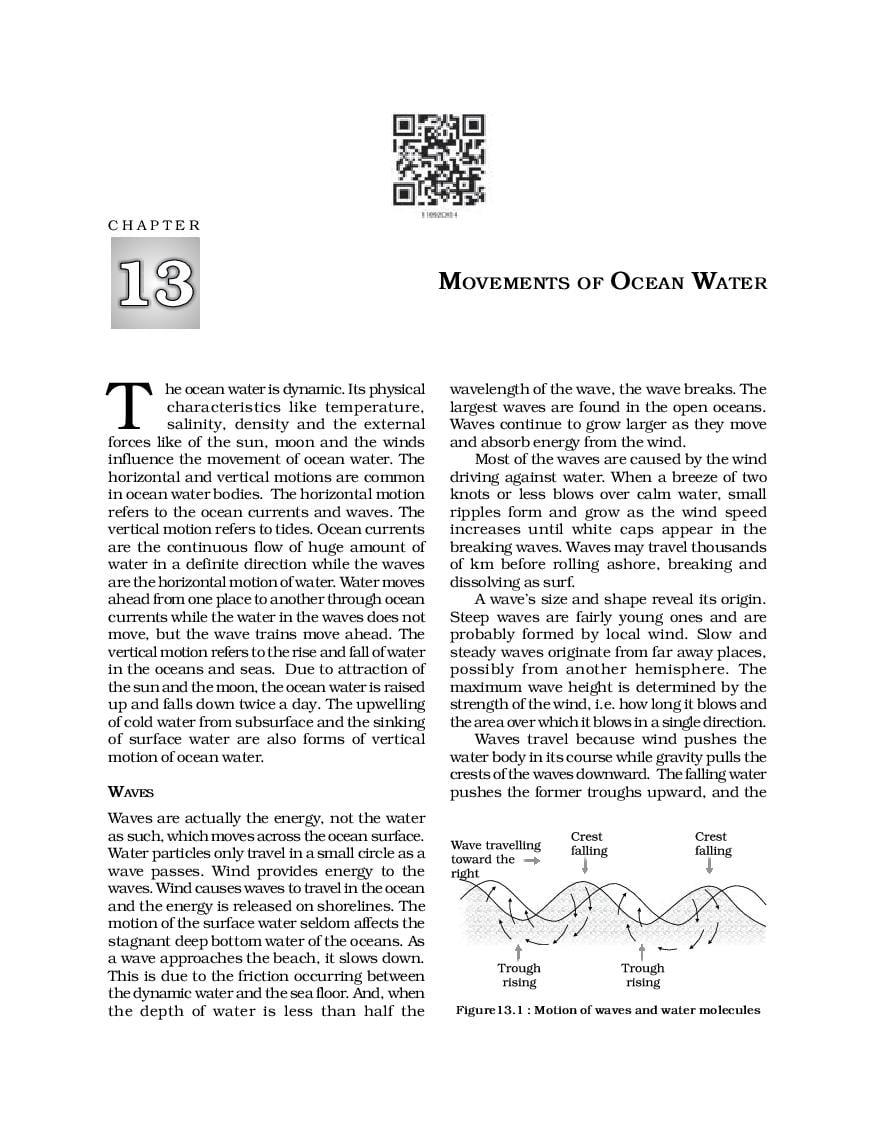
the depth of water is less than half the Figure13.1 : Motion of waves and water molecules
Showing the first page only. Download the PDF above for the complete document.
Document Details
| Board / Org | NCERT |
| Exam | Class 11 |
| Type | Books |
| Pages | 6 |
| Updated | 29 Aug 2026 |