Finished viewing? Save it for later —
Download NCERT Book Class 11 Geography (Fundamental of Physical Geography) Chapter 11 World Climate and Climate Change (PDF · 8 pages)About NCERT Book Class 11 Geography (Fundamental of Physical Geography) Chapter 11 World Climate and Climate Change
NCERT Book Class 11 Geography (Fundamental of Physical Geography) Chapter 11 World Climate and Climate Change is available here for free download. Published by NCERT for Class 11, this books can be viewed online or downloaded as a PDF (8 pages). Candidates preparing for Class 11 can use NCERT Book Class 11 Geography (Fundamental of Physical Geography) Chapter 11 World Climate and Climate Change to understand the exam pattern, the type of questions asked, and the overall difficulty level.
Frequently Asked Questions
How can I download NCERT Book Class 11 Geography (Fundamental of Physical Geography) Chapter 11 World Climate and Climate Change?
Open this page and click the Download button to save NCERT Book Class 11 Geography (Fundamental of Physical Geography) Chapter 11 World Climate and Climate Change as a PDF. It is completely free on AglaSem Docs.
Is NCERT Book Class 11 Geography (Fundamental of Physical Geography) Chapter 11 World Climate and Climate Change free to download?
Yes. NCERT Book Class 11 Geography (Fundamental of Physical Geography) Chapter 11 World Climate and Climate Change can be viewed online and downloaded as a PDF free of cost on AglaSem Docs.
How many pages does NCERT Book Class 11 Geography (Fundamental of Physical Geography) Chapter 11 World Climate and Climate Change have?
NCERT Book Class 11 Geography (Fundamental of Physical Geography) Chapter 11 World Climate and Climate Change contains 8 pages, which you can read online or download together as a single PDF.
Where can I find more Class 11 study material?
You can find more Class 11 question papers, sample papers, syllabus, and answer keys on AglaSem Docs.
NCERT Book Class 11 Geography (Fundamental of Physical Geography) Chapter 11 World Climate and Climate Change – Text
Read the full text of this books below — useful to quickly search, copy and reference the content online without downloading the PDF.
📄 View text version (1 page)
Page 1
WORLD CLIMATE AND
CLIMATE CHANGE
T
he world climate can be studied by related them to the distribution of vegetation
organising information and data on and used these values for classifying the
climate and synthesising them in climates. It is an empirical classification based
smaller units for easy understanding, on mean annual and mean monthly
description and analysis. Three broad temperature and precipitation data. He
approaches have been adopted for classifying introduced the use of capital and small letters
climate. They are empirical, genetic and to designate climatic groups and types.
applied. Empirical classification is based on Although developed in 1918 and modified over
observed data, particularly on temperature a period of time, Koeppen’s scheme is still
and precipitation. Genetic classification popular and in use.
attempts to organise climates according to their Koeppen recognised five major climatic
causes. Applied classification is for specific groups, four of them are based on temperature
purpose. and one on precipitation. Table 11.1 lists the
climatic groups and their characteristics
KOEPPE N ’S SCHEME OF CLASSIFICATION according to Koeppen. The capital letters : A,C,
OF C LIMATE
D and E delineate humid climates and B dry
climates.
The most widely used classification of climate The climatic groups are subdivided into
is the empirical climate classification scheme types, designated by small letters, based on
developed by V. Koeppen. Koeppen identified seasonality of precipitation and temperature
a close relationship between the distribution characteristics. The seasons of dryness are
of vegetation and climate. He selected certain indicated by the small letters : f, m, w and s,
values of temperature and precipitation and where f corresponds to no dry season,
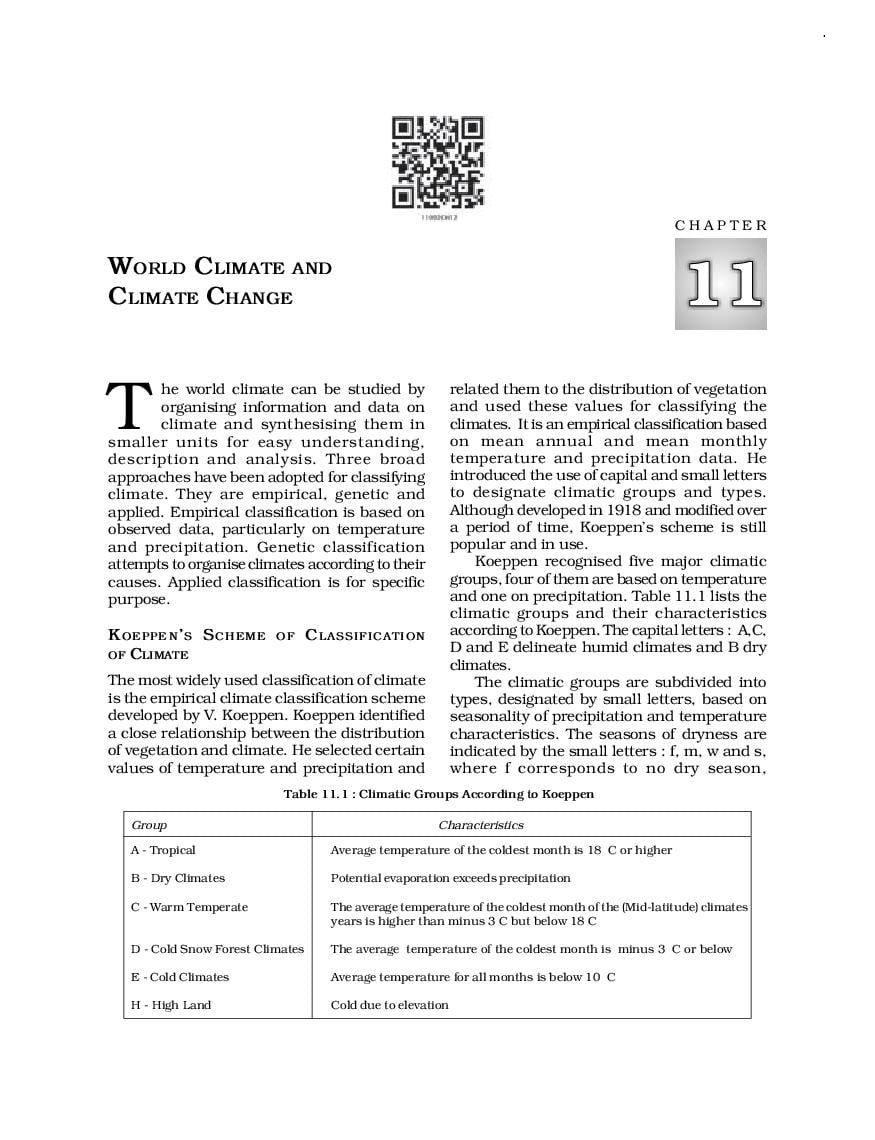
Table 11.1 : Climatic Groups According to Koeppen
Group Characteristics
A - Tropical Average temperature of the coldest month is 18° C or higher
B - Dry Climates Potential evaporation exceeds precipitation
C - Warm Temperate The average temperature of the coldest month of the (Mid-latitude) climates
years is higher than minus 3°C but below 18°C
D - Cold Snow Forest Climates The average temperature of the coldest month is minus 3° C or below
E - Cold Climates Average temperature for all months is below 10° C
Showing the first page only. Download the PDF above for the complete document.
Document Details
| Board / Org | NCERT |
| Exam | Class 11 |
| Type | Books |
| Pages | 8 |
| Updated | 29 Aug 2026 |