Finished viewing? Save it for later —
Download NCERT Book Class 11 Geography (Fundamental of Physical Geography) Chapter 10 Water in the Atmosphere (PDF · 5 pages)About NCERT Book Class 11 Geography (Fundamental of Physical Geography) Chapter 10 Water in the Atmosphere
NCERT Book Class 11 Geography (Fundamental of Physical Geography) Chapter 10 Water in the Atmosphere is available here for free download. Published by NCERT for Class 11, this books can be viewed online or downloaded as a PDF (5 pages). Candidates preparing for Class 11 can use NCERT Book Class 11 Geography (Fundamental of Physical Geography) Chapter 10 Water in the Atmosphere to understand the exam pattern, the type of questions asked, and the overall difficulty level.
Frequently Asked Questions
How can I download NCERT Book Class 11 Geography (Fundamental of Physical Geography) Chapter 10 Water in the Atmosphere?
Open this page and click the Download button to save NCERT Book Class 11 Geography (Fundamental of Physical Geography) Chapter 10 Water in the Atmosphere as a PDF. It is completely free on AglaSem Docs.
Is NCERT Book Class 11 Geography (Fundamental of Physical Geography) Chapter 10 Water in the Atmosphere free to download?
Yes. NCERT Book Class 11 Geography (Fundamental of Physical Geography) Chapter 10 Water in the Atmosphere can be viewed online and downloaded as a PDF free of cost on AglaSem Docs.
How many pages does NCERT Book Class 11 Geography (Fundamental of Physical Geography) Chapter 10 Water in the Atmosphere have?
NCERT Book Class 11 Geography (Fundamental of Physical Geography) Chapter 10 Water in the Atmosphere contains 5 pages, which you can read online or download together as a single PDF.
Where can I find more Class 11 study material?
You can find more Class 11 question papers, sample papers, syllabus, and answer keys on AglaSem Docs.
NCERT Book Class 11 Geography (Fundamental of Physical Geography) Chapter 10 Water in the Atmosphere – Text
Read the full text of this books below — useful to quickly search, copy and reference the content online without downloading the PDF.
📄 View text version (1 page)
Page 1
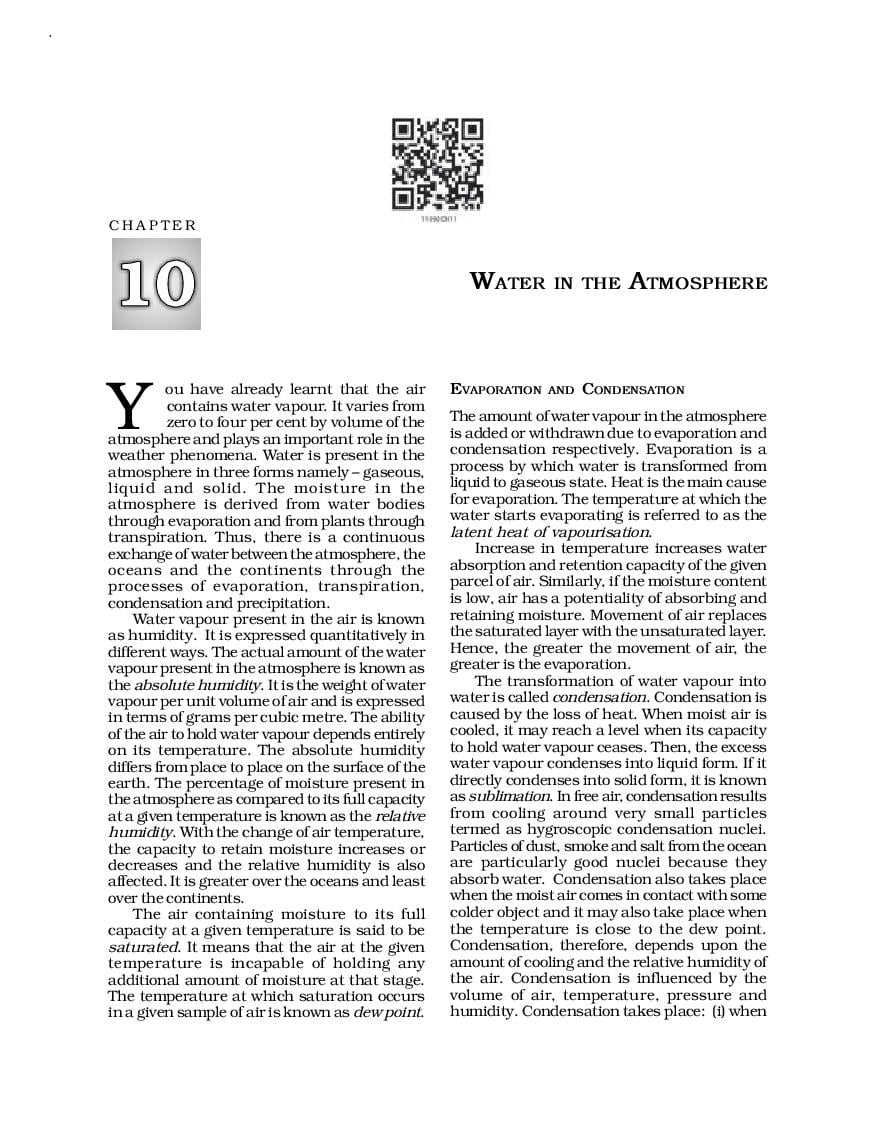
WATER IN THE ATMOSPHERE
Y
ou have already learnt that the air EVAPORATION AND CONDENSATION
contains water vapour. It varies from
zero to four per cent by volume of the The amount of water vapour in the atmosphere
atmosphere and plays an important role in the is added or withdrawn due to evaporation and
weather phenomena. Water is present in the condensation respectively. Evaporation is a
atmosphere in three forms namely – gaseous, process by which water is transformed from
liquid and solid. The moisture in the liquid to gaseous state. Heat is the main cause
atmosphere is derived from water bodies for evaporation. Latent heat of vaporisation is
through evaporation and from plants through the amount of heat energy required to convert
transpiration. Thus, there is a continuous a unit mass of a liquid into vapour without a
exchange of water between the atmosphere, the change in temperature.
oceans and the continents through the Increase in temperature increases water
processes of evaporation, transpiration, absorption and retention capacity of the given
condensation and precipitation. parcel of air. Similarly, if the moisture content
Water vapour present in the air is known is low, air has a potentiality of absorbing and
as humidity. It is expressed quantitatively in retaining moisture. Movement of air replaces
different ways. The actual amount of the water the saturated layer with the unsaturated layer.
vapour present in the atmosphere is known as Hence, the greater the movement of air, the
the absolute humidity. It is the weight of water greater is the evaporation.
vapour per unit volume of air and is expressed The transformation of water vapour into
in terms of grams per cubic metre. The ability water is called condensation. Condensation is
of the air to hold water vapour depends entirely caused by the loss of heat. When moist air is
on its temperature. The absolute humidity cooled, it may reach a level when its capacity to
differs from place to place on the surface of the
hold water vapour ceases. Then, the excess
earth. The percentage of moisture present in
water vapour condenses into liquid form. In free
the atmosphere as compared to its full capacity
air, condensation results from cooling around
at a given temperature is known as the relative
very small particles termed as hygroscopic
humidity. With the change of air temperature,
condensation nuclei. Particles of dust, smoke
the capacity to retain moisture increases or
and salt from the ocean are particularly good
decreases and the relative humidity is also
nuclei because they absorb water.
affected. It is greater over the oceans and least
over the continents. Condensation also takes place when the moist
The air containing moisture to its full air comes in contact with some colder object and
capacity at a given temperature is said to be it may also take place when the temperature is
saturated. It means that the air at the given close to the dew point. Condensation, therefore,
temperature is incapable of holding any depends upon the amount of cooling and the
additional amount of moisture at that stage. relative humidity of the air. Condensation is
The temperature at which saturation occurs influenced by the volume of air, temperature,
in a given sample of air is known as dew point. pressure and humidity. Condensation takes
Showing the first page only. Download the PDF above for the complete document.
Document Details
| Board / Org | NCERT |
| Exam | Class 11 |
| Type | Books |
| Pages | 5 |
| Updated | 29 Aug 2026 |