CG PET 2021 Question Paper
Finished viewing? Save it for later —
Download CG PET 2021 Question Paper (PDF · 56 pages)About CG PET 2021 Question Paper
CG PET 2021 Question Paper is available here for free download. Published by CG Vyapam for CG PET, this question paper can be viewed online or downloaded as a PDF (56 pages). Candidates preparing for CG PET can use CG PET 2021 Question Paper to understand the exam pattern, the type of questions asked, and the overall difficulty level.
Frequently Asked Questions
How can I download CG PET 2021 Question Paper?
Open this page and click the Download button to save CG PET 2021 Question Paper as a PDF. It is completely free on AglaSem Docs.
Is CG PET 2021 Question Paper free to download?
Yes. CG PET 2021 Question Paper can be viewed online and downloaded as a PDF free of cost on AglaSem Docs.
How many pages does CG PET 2021 Question Paper have?
CG PET 2021 Question Paper contains 56 pages, which you can read online or download together as a single PDF.
Where can I find more CG PET study material?
You can find more CG PET question papers, sample papers, syllabus, and answer keys on AglaSem Docs.
CG PET 2021 Question Paper – Text
Read the full text of this question paper below — useful to quickly search, copy and reference the content online without downloading the PDF.
📄 View text version (56 pages)
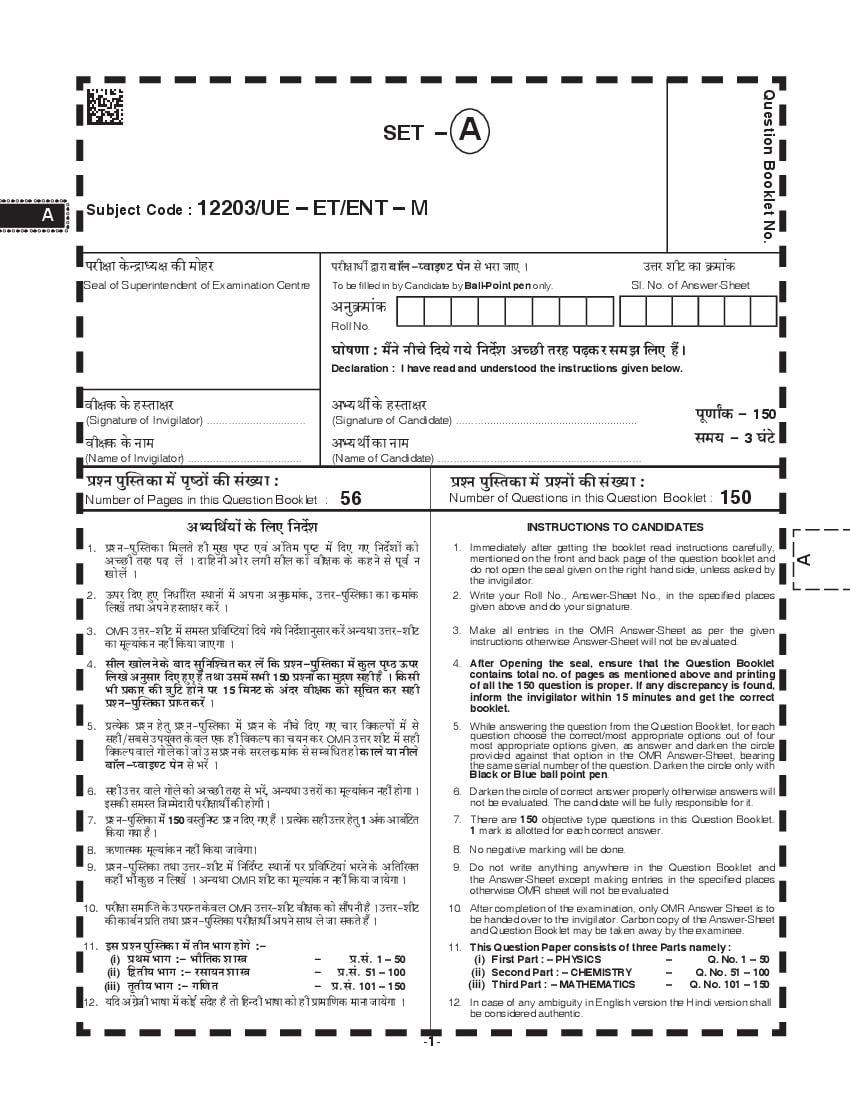
Page 1
SET – A
Subject Code : 12203/UE – ET/ENT – M
fafafafafafafafa
afafaf
A
afafafafafafafaf
narjm Ho$ÝÐmÜ`j H$s _moha narjmWu Ûmam ~m°b-ßdmBÊQ> noZ go ^am OmE & CÎma erQ> H$m H«$_m§H$
Seal of Superintendent of Examination Centre To be filled in by Candidate by Ball-Point pen only. Sl. No. of Answer-Sheet
AZwH«$_m§H$
Roll No.
KmofUm : _¢Zo ZrMo {X`o J`o {ZX}e AÀN>r Vah n‹T>H$a g_P {bE h¢Ÿ&
Declaration : I have read and understood the instructions given below.
drjH$ Ho$ hñVmja Aä`Wu Ho$ hñVmja
(Signature of Invigilator) ................................ (Signature of Candidate) ............................................................ nyUmªH$ - 150
drjH$ Ho$ Zm_ Aä`Wu H$m Zm_ g_` - 3 K§Qo
(Name of Invigilator) ..................................... (Name of Candidate) ..................................................................
àíZ nwpñVH$m _| n¥îR>m| H$s g§»`m : àíZ nwpñVH$m _| àíZm| H$s g§»`m :
Number of Pages in this Question Booklet : 56 Number of Questions in this Question Booklet : 150
Aä`{W©`m| Ho$ {bE {ZX}e instructionS To candidates
1. àíZ-nwpñVH$m {_bVo hr _wI n¥îR> Ed§ A§{V_ n¥îR> _| {XE JE {ZX}em| H$mo 1. Immediately after getting the booklet read instructions carefully,
mentioned on the front and back page of the question booklet and
A
AÀN>r Vah n‹T> b| Ÿ& Xm{hZr Amoa bJr grb H$mo drjH$ Ho$ H$hZo go nyd© Z
Imob| Ÿ& do not open the seal given on the right hand side, unless asked by
the invigilator.
2. D$na {XE hþE {ZYm©[aV ñWmZm| _| AnZm AZwH«$_m§H$, CÎma-nwpñVH$m H$m H«$_m§H$ 2. Write your Roll No., Answer-Sheet No., in the specified places
{bI| VWm AnZo hñVmja H$a| Ÿ& given above and do your signature.
3. OMR CÎma-erQ> _| g_ñV à{dpîQ>`m§ {X`o J`o {ZX}emZwgma H$a| AÝ`Wm CÎma-erQ> 3. Make all entries in the OMR Answer-Sheet as per the given
H$m _yë`m§H$Z Zht {H$`m OmEJm Ÿ& instructions otherwise Answer-Sheet will not be evaluated.
4. grb ImobZo Ho$ ~mX gw{ZpíMV H$a b| {H$ àíZ-nwpñVH$m _| Hw$b n¥îR> D$na 4. After Opening the seal, ensure that the Question Booklet
{bIo AZwgma {XE hþE h¢ VWm Cg_| g^r 150 àíZm| H$m _wÐU ghr h¡ Ÿ& {H$gr contains total no. of pages as mentioned above and printing
^r àH$ma H$s Ìw{Q> hmoZo na 15 {_ZQ> Ho$ A§Xa drjH$ H$mo gy{MV H$a ghr of all the 150 question is proper. If any discrepancy is found,
inform the invigilator within 15 minutes and get the correct
àíZ-nwpñVH$m àmßV H$a| Ÿ& booklet.
5. àË`oH$ àíZ hoVw àíZ-nwpñVH$m _| àíZ Ho$ ZrMo {XE JE Mma {dH$ënm| _| go 5. While answering the question from the Question Booklet, for each
ghr/g~go Cn`wŠV Ho$db EH$ hr {dH$ën H$m M`Z H$a OMR CÎma erQ> _| ghr question choose the correct/most appropriate options out of four
most appropriate options given, as answer and darken the circle
{dH$ën dmbo Jmobo H$mo Omo Cg àíZ Ho$ gab H«$_m§H$ go gå~§{YV hmo H$mbo `m Zrbo provided against that option in the OMR Answer-Sheet, bearing
~m°b-ßdmBÊQ> noZ go ^a| Ÿ& the same serial number of the question. Darken the circle only with
Black or Blue ball point pen.
6. ghr CÎma dmbo Jmobo H$mo AÀN>r Vah go ^a|, AÝ`Wm CÎmam| H$m _yë`m§H$Z Zht hmoJm & 6. Darken the circle of correct answer properly otherwise answers will
BgH$s g_ñV {Oå_oXmar narjmWu H$s hmoJr & not be evaluated. The candidate will be fully responsible for it.
7. àíZ-nwpñVH$m _| 150 dñVw{ZîR> àíZ {XE JE h¢ Ÿ& àË`oH$ ghr CÎma hoVw 1 A§H$ Am~§{Q>V 7. There are 150 objective type questions in this Question Booklet.
{H$`m J`m h¡ & 1 mark is allotted for each correct answer.
8. F$UmË_H$ _yë`m§H$Z Zht {H$`m OmdoJm& 8. No negative marking will be done.
9. àíZ-nwpñVH$m VWm CÎma-erQ> _| {Z{X©îQ> ñWmZm| na à{dpîQ>`m§ ^aZo Ho$ A{V[aŠV 9. Do not write anything anywhere in the Question Booklet and
H$ht ^r Hw$N> Z {bI| Ÿ& AÝ`Wm OMR erQ> H$m _yë`m§H$Z Zht {H$`m Om`oJm & the Answer-Sheet except making entries in the specified places
otherwise OMR sheet will not be evaluated.
10. narjm g_mpßV Ho$ CnamÝV Ho$db OMR CÎma-erQ> drjH$ H$mo gm¢nZr h¡ & CÎma-erQ> 10. After completion of the examination, only OMR Answer Sheet is to
H$s H$m~©Z à{V VWm àíZ-nwpñVH$m narjmWu AnZo gmW bo Om gH$Vo h¢ & be handed over to the invigilator. Carbon copy of the Answer-Sheet
and Question Booklet may be taken away by the examinee.
11. Bg àíZ nwpñVH$m _| VrZ ^mJ hmo§Jo :- 11. This Question Paper consists of three Parts namely :
(i) àW_ ^mJ :- ^m¡{VH$ emñÌ - à.g§. 1 – 50 (i) First Part : – Physics – Q. No. 1 – 50
(ii) {ÛVr` ^mJ :- agm`Z emñÌ - à.g§. 51 – 100 (ii) Second Part : – Chemistry – Q. No. 51 – 100
(iii) V¥Vr` ^mJ :- J{UV - à.g§. 101 – 150 (iii) Third Part : – Mathematics – Q. No. 101 – 150
12. `{X A§JO
o« r ^mfm _| H$moB© g§Xho h¡ Vmo {hÝXr ^mfm H$mo hr àm_m{UH$ _mZm Om`oJm Ÿ& 12. In case of any ambiguity in English version the Hindi version shall
be considered authentic.
-1-
Page 2
He
ITE
WR
T
NO
DO
-2- Set-A
Page 3
Physics ^m¡{VH$ emñÌ
1. The variation of induced emf (F) with 1. `{X EH$ N>moQ>m XÊS> Mwå~H$ Hw§$S>br Ho$ Aj H$s {Xem
time (t) in a coil if a short bar magnet _| EH$ g_mZ doJ go J{V H$aVm hmo, Vmo Hw§$‹S>br _|
is moved along its axis with a constant ào[aV {dÚwV dmhH$ ~b (F) H$m g_` (t) Ho$ gmW
velocity is best represented as n[adV©Z g~go R>rH$ àX{e©V {H$`m Om gH$Vm h¡
(A) (A)
(B) (B)
(C) (C)
(D) (D)
-3- Set-A
Page 4
The magnetic flux linked with a coil at 2. {H$gr jU ‘t’ na Hw§$S>br go gå~Õ Mwå~H$s` âbŠg
any instant ‘t’ is given by φ = 5t3 – 100t. φ = 5t3 – 100t h¡ & t = 2 goH|$S> na Hw§$‹S>br _|
The emf induced in the coil at ào[aV {dÚwV dmhH$ ~b h¡
t = 2 second is
(A) –40 V (B) +40 V (A) –40 dmoëQ> (B) +40 dmoëQ>
(C) +140 V (D) +300 V (C) +140 dmoëQ> (D) +300 dmoëQ>
3. The potential energy of a particle 3. gab AmdÎm© J{V H$aVo hþE H$U Ho$ {dñWmnZ H$m _mZ
executing SHM is 2.5 J, when its CgHo$ Am`m_ Ho$ AmYo hmoZo H$s pñW{V _| pñW{VO
displacement is half of amplitude. The
total energy of the particle is
D$Om© 2.5 Oyb h¡ & H$U H$s Hw$b D$Om© H$m _mZ h¡
(A) 2.5 J (A) 2.5 Oyb
(B) 5.0 J (B) 5.0 Oyb
(C) 7.5 J (C) 7.5 Oyb
(D) 10.0 J (D) 10.0 Oyb
4. A horizontal stretched string fixed at two XmoZm| {gam| na {\$Šg²S> VZr hþB© j¡{VO S>moar H$mo
4.
ends, is vibrating in its fifth harmonic {ZåZ{b{IV g_rH$aU Ûmam CgH$s nm§Mdr g§ZmXr
frequency according to the equation
Amd¥{Îm go XmobZ H$am`m OmVm h¡ &
( )
y ( x, t ) = ( 0.01 m) sin 62.8 m−1 x
( )
y ( x, t ) = ( 0.01 m) sin 62.8 m−1 x
(
cos 628 s −1 t
) (
cos 628 s −1 t
)
Assuming π = 3.14, the correct π = 3.14 _mZVo hþE, ghr H$WZ h¡
statement is
(A) the number of nodes is 5 (A) {Zñn§Xm| H$s g§»`m 5 h¡
(B) the length of the string is 0.5 m (B) S>moar H$s bå~mB© 0.5 _rQ>a h¡
(C) the fundamental frequency is (C) _yb Amd¥{Îm H$m _mZ 100 hQ²©>O h¡
100 Hz
(D) the fifth harmonic frequency is (D) nm§Mdo g§ZmXr H$s Amd¥{Îm 100 hQ²©>O h¡
100 Hz
-4- Set-A
Page 5
field produced does not depend upon {H$g na {Z^©a Zht H$aVm h¡ ?
(A) Number of turns per unit length (A) à{V BH$mB© bå~mB© _| MŠH$am| H$s g§»`m
(B) Current flowing (B) àdm{hV Ymam
(C) Radius of the solenoid (C) n[aZm{bH$m H$s {ÌÁ`m
(D) All of the above (D) CnamoŠV g^r
6. 6.
Above circuit shows a square loop ABCD D$na {XImE n[anW _| EH$ dJm©H$ma byn ABCD
with edge length a. The resistance of H$s ^wOm H$s bå~mB© a h¡ & Vma ABC H$m à{VamoY
the wire ABC is r and that of ADC is r d Vma ADC H$m à{VamoY 2r h¡ & g^r Vma EH$
2r. The value of magnetic field at the
centre O of the loop assuming uniform g_mZ hmoZo na byn Ho$ Ho$ÝÐ> O na Mwå~H$s` joÌ
wire is H$m _mZ h¡
2µ 0 i 2µ 0 i 2µ 0 i 2µ 0 i
(A) (B) ⊗ (A) (B) ⊗
3πa 3πa 3πa 3πa
2µ 0 i 2µ 0 i (C) 2µ 0 i (D) 2µ 0 i
(C) (D) ⊗ ⊗
πa πa πa πa
7. A black hole is an object whose 7. H¥$îU {dda H$m JwéËdr` joÌ BVZm A{YH$ hmoVm h¡ {H$
gravitational field is so strong that àH$me ^r CgHo$ JwéËdr` joÌ go ~mha Zht Am gH$Vm &
even light cannot escape from it. To
what approximate radius would earth
`{X n¥Ïdr {OgH$m Ðì`_mZ 5.98 × 1024 kg h¡ H$mo
(mass = 5.98 × 1024 kg) have to be H¥$îU {dda ~ZmZm hmo, Vmo CgH$s {ÌÁ`m H$mo {H$VZm
compressed to be a black hole H$_ H$aZm hmoJm ?
(A) 10–6 m (B) 10–2 m (A) 10–6 m (B) 10–2 m
(C) 102 m (D) 10–9 m (C) 102 m (D) 10–9 m
-5- Set-A
Page 6
rod of mass M, length l about an axis n[aV: Omo CgHo$ bå~dV² VWm CgHo$ EH$ {gao go
perpendicular to it through one end ?
hmoH$a AmVm h¡ O‹S>Ëd AmKyU© hmoJm
Ml 2 Ml 2
(A) (A)
12 12
Ml 2 Ml 2
(B) (B)
5 5
Ml 2 Ml 2
(C) (C)
6 6
Ml 2 Ml 2
(D) (D)
3 3
9. 9.
In above circuit, potential difference Cnamo³V n[anW ‘| A d B Ho$ ~rM
between A and B is {d^dmÝVa h¡
(A) 0 volt (A) 0 dmoëQ>
(B) 5 volt (B) 5 dmoëQ>
(C) 10 volt (C) 10 dmoëQ>
(D) 15 volt (D) 15 dmoëQ>
-6- Set-A
Page 7
The internal resistance of two cells {XImE JE n[anW ‘| Xmo gobm| Ho$ AmÝV[aH$ à{VamoY
shown are 0.1 Ω and 0.3 Ω. If 0.1 Ω d 0.3 Ω h¡ & ¶{X R = 0.2 Ω hmo, Vmo
R = 0.2 Ω, the potential difference gob Ho$ n[aV: {d^dmÝVa hmoJm
across the cell
(A) Y will be zero (A) Y H$m eyݶ
(B) X will be zero (B) X H$m eyݶ
(C) X and Y will be 2V (C) X d Y H$m 2V
(D) X will be > 2V and Y will be < 2V (D) X H$m > 2V d Y H$m < 2V
11. The stress at which extension of a 11. dh {~ÝXþ {Og na {H$gr nXmW© H$mo ItMZo na
material takes place more quickly as à{V~b bJm`o J`o ^ma H$s VwbZm _| A{YH$
compare to the increase in load is
VoOr go ~XbVm h¡
called
(A) Elastic point (A) àË`mñW {~ÝXw
(B) Plastic point (B) AàË`mñW {~ÝXw
(C) Breaking point (C) ^§OZ {~ÝXw
(D) None of the above (D) Cn`w©ŠV _| go H$moB© Zht
-7- Set-A
Page 8
is ‘‘B’’. If it is subjected to uniform h¡ & `{X Bg na EH$ g_mZ Xm~ ‘p’ bJm`m Om`o Vmo
pressure ‘p’, the fractional decrease
in radius is
CgHo$ {ÌÁ`m _| {^ÝZmË_H$ H$_r hmoJr
B B
(A) (A)
3p 3p
3p 3p
(B) (B)
B B
p p
(C) 3B (C) 3B
p p
(D) (D)
B B
13. The focal lengths of the objective 13. EH$ XÿaXeu Ho$ A{^Ñî`H$ VWm Zo{ÌH$m boÝgm| H$s
and the eye piece of a telescope are \$moH$g Xÿ[a`m§ H«$_e: 50 go_r Am¡a 5 go_r h¡ & ñnîQ>
50 cm and 5 cm respectively. Least
distance of distinct vision is 25 cm. ÑpîQ> H$s Ý`yZV_ Xÿar 25 go_r h¡ & XÿaXem] H$mo BgHo$
The telescope is focussed for distinct A{^Ñî`H$ go 200 go_r Xÿa aIo n¡_mZo na ñnîQ> ÑpîQ>
vision on a scale placed at a distance Ho$ {bE \$moH$g {H$`m OmVm h¡ & V~ A{^Ñî`H$ VWm
of 200 cm away from objective then
the separation between the objective Zo{ÌH$m boÝgm| Ho$ ~rM Xÿar H$m _mZ h¡
and the eye piece is
(A) 100 cm (A) 100 go_r
(B) 75 cm (B) 75 go_r
(C) 70.8 cm (C) 70.8 go_r
(D) 60.8 cm (D) 60.8 go_r
-8- Set-A
Page 9
diameter telescope at a wavelength 5000 A Va§JX¡¿¶© Ho$ {bE H$moUr¶ {d^oXZ
of 5000 A is of the order of gr‘m H$m H«$‘ hmoJm
(A) 10–6 rad (B) 106 rad (A) 10–6 ao{S>¶Z (B) 106 ao{S>¶Z
(C) 10–4 rad (D) 104 rad (C) 10–4 ao{S>¶Z (D) 104 ao{S>¶Z
15. The equivalent capacitance of the 15. {XE JE {MÌ Ho$ AZwgma g§¶moOZ ‘| A Am¡a B Ho$
combination as shown in figure n[aUm_r Ym[aVm h¡
between A and B is
(A) 2 µF (A) 2 µF
(B) 1 µF (B) 1 µF
(C) 3 µF (C) 3 µF
(D) 6 µF (D) 6 µF
16. The potential difference across 2 µF 16. {XE JE n[anW Ho$ AZwgma 2 µF dmbo g§Ym[aÌ ‘|
capacitor in the circuit shown in {d^dmÝVa hmoJm
(A) 12 V (A) 12 V
(B) 4 V (B) 4 V
(C) 6 V (C) 6 V
(D) 18 V (D) 18 V
-9- Set-A
Page 10
17. `{X EH$ BboŠQ´>mZ v doJ go Mwå~H$s` joÌ B H$s
of magnetic field B with the velocity v , {Xem _| J{V H$a> ahm hmo, Vmo Cg na bJZo dmbm
then the force on electron is
~b h¡
(A) Zero (A) eyÝ`
( )
(B) e v ⋅ B
( )
(B) e v ⋅ B
( )
(C) e v × B ( )
(C) e v × B
(D) None of the above (D) CnamoŠV _| go H$moB© Zht
18. 18.
In above figure electron enters into D$na {XImE {MÌ _| EH$ BboŠQ´>mZ Mwå~H$s` joÌ
magnetic field B. It deflects in the B _| àdoe H$aVm h¡ & dh {H$g {Xem _| {djo{nV
direction hmoJm ?
(A) +ve X direction (A) YZmË_H$ X {Xem _|
(B) –ve X direction (B) F$UmË_H$ X {Xem _|
(C) +ve Y direction (C) YZmË_H$ Y {Xem _|
(D) –ve Y direction (D) F$UmË_H$ Y {Xem _|
19. For a certain gas the ratio of specific 19. {H$gr J¡g Ho$ {d{eîQ> Cî_mAm| H$m AZwnmV
heats is given to be r = 1.5. For this r = 1.5 h¡ & Bg J¡g Ho$ {b`o
gas
3R 3R 3R 3R
(A) Cp = (B) Cv = (A) Cp = (B) Cv =
J J J J
5R 5R 5R 5R
(C) Cp = (D) Cv = (C) Cp = (D) Cv =
J J J J
-10- Set-A
Page 11
to gravity g on the distance r from the n¥Ïdr H$s JwéËdr` ËdaU g VWm Jmobo Ho$ n¥Ïdr Ho$
centre of the earth assumed to be a
sphere of radius R of uniform density
Ho$ÝÐ go Xÿar r ~rM Ho$ gå~ÝY H$mo J«m\$ go àX{e©V
is shown in figure below. {H$`m J`m h¡ &
The correct figure is ghr J«m\$ H$mo MwZ|
(A) g (A) g
r r
R R
(B) (B)
(C) (C)
(D) (D)
-11- Set-A
Page 12
of four particles placed at the vertices H$U Ho$ H$maU Cg dJ© Ho$ Ho$ÝÐ na JwéËdr` {d^d
of a square of side ‘‘l’’
H$m _mZ hmoJm
Gm2 Gm2
(A) − 4 2 (A) −4 2
l l
Gm Gm
(B) − 5.41 (B) − 5.41
l l
Gm Gm
(C) − 4 2 (C) −4 2
l l
Gm2 Gm2
(D) 5.41 (D) 5.41
l l
22. A steel wire of length l has a 22. EH$ l bå~mB© Ho$ ñQ>rb Vma H$m Mwå~H$s¶ AmKyU©
magnetic moment M. It is then bent M h¡ & A~ ¶{X Bgo AY© d¥ÎmmH$ma Mmn ‘| _mo‹S>m
into a semicircular arc. The new Om`, Vmo Z¶m Mwå~H$s¶ AmKyU© hmoJm
magnetic moment is
(A) 2M (A) 2M
π π
(B) M (B) M
π π
(C) M (C) M
l l
(D) M × l (D) M × l
23. The vertical component of earth’s 23. EH$ ñWmZ na n¥Ïdr Ho$ Mwå~H$s¶ joÌ H$m CÜdm©Ya
magnetic field at a place is 3 times KQ>H$, j¡{VO KQ>H$ H$m 3 JwZm h¡, Vmo Bg
the horizontal component. The value ñWmZ na Z{V Ho$ H$moU H$m ‘mZ h¡
of angle of dip at this place is
(A) 60° (A) 60°
(B) 45° (B) 45°
(C) 30° (C) 30°
(D) 29° (D) 29°
-12- Set-A
Page 13
moving particle is shown below. The _| Xem©`m J`m h¡ & H$U H$m VmËj{UH$ doJ {H$g
instantaneous velocity of the particle
is negative at the point {~ÝXþ na F$UmË_H$ hmoJm ?
D
Displacement C E F
Time
(A) E (B) F (A) E (B) F
(C) C (D) D (C) C (D) D
25. The heart of a man pumps 5 litres of 25. EH$ _Zwî` H$m öX` 1 {_ZQ> _| 5 brQ>a IyZ Y_{Z`m|
blood through the arteries per minute H$mo ^oOVm h¡ öX` H$m Xm~ 150 mm nmam-ñVå^ Ho$
at a pressure of 150 mm of mercury
column. If the density of the mercury be
~am~a h¡ & `{X nmao H$m KZËd 13.6 × 10³ kg/m3
13.6 × 10³ kg/m3 and g = 10 m/s2 then VWm g = 10 m/s2 hmo, Vmo öX` H$s j_Vm (dmQ>
the power (in watt) is _|) {H$VZr hmoJr ?
(A) 1.50 (A) 1.50
(B) 1.70 (B) 1.70
(C) 2.35 (C) 2.35
(D) 3.0 (D) 3.0
26. A capacitor of 10µF charged upto 26. EH$ 10µF Ho$ g§Ym[aÌ H$mo 250 dmoëQ> Ûmam
250 volts is connected in parallel with Amdo{eV H$a 100 dmoëQ> go Amdo{eV 5µF dmbo
another capacitor of 5µF charged g§Ym[aÌ Ho$ gmW g‘mÝVa H«$‘ ‘| Omo‹S> m OmVm h¡ &
upto 100 volts. The common potential is C^¶{ZîR> {d^d h¡
(A) 500 V (A) 500 V
(B) 400 V (B) 400 V
(C) 300 V (C) 300 V
(D) 200 V (D) 200 V
-13- Set-A
Page 14
The effective resistance between the A d D Ho$ ‘ܶ Vwë¶ à{VamoY 3 Ω h¡ & CnamoŠV
points A and D is 3 Ω. The value of R n[anW ‘| R H$m ‘mZ h¡
in above circuit is
(A) 6 Ω (B) 3 Ω (A) 6 Ω (B) 3 Ω
(C) 2 Ω (D) 1 Ω (C) 2 Ω (D) 1 Ω
28. A certain number of spherical drops of 28. r {ÌÁ`m H$s Ðd H$s Hw$N> {ZpíMV JmobmH$ma ~y§Xo
a liquid of radius r coalesce to form a {_bH$a EH$ ~‹S>r ~yX§ ~ZmVo h¢ {OgH$s {ÌÁ`m R VWm
single big drop of radius R and volume V.
If T is the surface tension of the liquid
Am`VZ V h¡ & `{X Ðd H$m n¥îR> VZmd T hmo Vmo
then
1 1 1 1
(A) energy = 4VT − is
r R
(A) D$Om© = 4VT r − R CËg{O©V hmoJr
released
1 1 1 1
(B) energy = 3VT + is (B) D$Om© = 3VT + Ademo{fV hmoJr
r R r R
absorbed
1 1 1 1
(C) energy = 3VT − is (C) D$Om© = 3VT − CËg{O©V hmoJr
r R r R
released
(D) energy is neither released nor (D) D$Om© Z Vmo CËg{O©V hmoJr Z hr Ademo{fV
absorbed hmoJr
-14- Set-A
Page 15
experiment is doubled the stopping Xmo JwZm {H$¶m Om` Vmo {ZamoYr {d^d (stopping
potential will potential) hmoJm
(A) be doubled (A) Xmo JwZm
(B) be halved (B) AmYm
(C) become more than double (C) Xmo JwZm go Á¶mXm
(D) become less than double (D) Xmo JwZm go H$‘
30.
The energy of an electron in nth orbit is 30. EH$ Bbo³Q´>mZ H$m n H$jm ‘| D$Om© En = −132 .6 ev
n
given by En = −132 .6 ev. The energy Ûmam {X¶m OmVm h¡ & Bbo³Q´>mZ H$mo ‘yb AdñWm
n
required to take an electron from go {ÛVr¶ CÎmo{OV AdñWm ‘| bo OmZo Ho$ {bE
ground state to the second excited Amdí¶H$ D$Om©
state
(A) 13.6 ev (B) 12.09 ev (A) 13.6 ev (B) 12.09 ev
(C) 1.51 ev (D) 0.85 ev (C) 1.51 ev (D) 0.85 ev
31. The electric potential at a point (x, y) 31. g‘Vb xy ‘| q~Xþ (x, y) na {dÚwV {d^d
in the xy-plane is given by V = – kxy. V = – kxy Ûmam {X¶m J¶m h¡ & ‘yb q~Xþ go r
The electric field intensity at a distance Xÿar na {dÚwV joÌ H$s Vrd«Vm ~XbVm h¡
r from the origin varies is
(A) 2r2 (B) 2r (A) 2r2 (B) 2r
(C) r2 (D) r (C) r2 (D) r
32. Three charges – q, Q and – q are 32. VrZ Amdoe – q, Q Am¡a – q g‘mZ Xÿar na
placed at equal distances on a straight EH$ gab aoIm ‘| aIm J¶m h¡ & ¶{X VrZ
line. If the potential energy of the Amdoem| Ho$ {ZH$m¶ H$m pñW{VO D$Om© eyݶ h¡,
system of three charges is zero, then Vmo Q : q H$m AZwnmV h¡
the ratio of Q : q is
(A) 2 : 1 (B) 1 : 2 (A) 2 : 1 (B) 1 : 2
(C) 1 : 4 (D) 4 : 1 (C) 1 : 4 (D) 4 : 1
-15- Set-A
Page 16
How much resistance must be put in D$na {XImE goVw H$mo g§V{w bV H$aZo hoVw à{VamoY S
parallel to the resistance S to balance Ho$ g_mÝVa H«$_ _| {H$VZm à{VamoY bJmZm
the above bridge ?
nS>oJm ?
44 44
(A) 24 Ω (B) Ω (A) 24 Ω (B) Ω
9 9
132 132
(C) Ω (D) 18.2 Ω (C) Ω (D) 18.2 Ω
5 5
34. 34.
In the above circuit, the heat produced D$na {XImE n[anW _| 5Ω à{VamoY _| CËnÞ
in 5Ω resistance is 10 calories per D$î_m 10 H¡$bmoar/goHo§$S> h¡ & 4Ω à{VamoY _| CËnÞ
second. The heat produced in 4Ω
resistance is
D$î_m h¡
(A) 1 cal/sec. (A) 1 H¡$bmoar/goH|$S>
(B) 2 cal/sec. (B) 2 H¡$bmoar/goH|$S>
(C) 3 cal/sec. (C) 3 H¡$bmoar/goH|$S>
(D) 4 cal/sec. (D) 4 H¡$bmoar/goH|$S>
-16- Set-A
Page 17
are used to connect two reservoirs of heat H$mo Xmo AbJ-AbJ Vmn Ho$ Cî_r` hm¡O (heat
at different temperatures. Which one will
reservoirs) go Omo‹S>m J`m h¡ & {ZåZ{b{IV _|
conduct most heat ?
go {H$g g§`moOZ Ûmam Cî_m H$m MmbZ gdm©{YH$
hmoJm ?
(A) r = 1 cm, l = 1 m (A) r = 1 go_r, l = 1 _rQ>a
(B) r = 2 cm, l = 2 m (B) r = 2 go_r, l = 2 _rQ>a
(C) r = 1 cm, l = ½ cm (C) r = 1 go_r, l = ½ go_r
(D) r = 2 cm, l = ½ m (D) r = 2 go_r, l = ½ _rQ>a
36. A wall has two layers A and B, each 36. EH$ Xrdma H$s Xmo naVo A Am¡a B {d{^ÝZ nXmWm] go
made of different materials. The ~Zr h¡ & XmoZm| naVm| H$s _moQ>mB©`m± g_mZ h¡ & naV A H$s
thickness of both the layers is the same.
The thermal conductivity of A, KA = 3 KB.
D$î_m MmbH$Vm KA = 3 KB h¡ & Bg Xrdma Ho$ {gam|
The temperature difference across the na VmnmÝVa 20°C h¡ & Vmnr` gmå`mdñWm _|,
wall is 20°C. In thermal equilibrium
θ1 θ0 θ2 θ1 θ0 θ2
A B A B
(A) the temperature difference across (A) naV A Ho$ {gam| na VmnmÝVa 15°C h¡
A = 15°C
(B) rate of heat transfer across A is (B) A Ho$ {gam| go D$î_m g§MaU H$s Xa B Ho$ {gam|
more than across B go Á`mXm h¡
(C) rate of heat transfer across both (C) XmoZm| naVm| go D$î_m g§MaU H$s Xa
is same g_mZ h¡
(D) temperature difference across B (D) naV B Ho$ {gam| na VmnmÝVa 15°C h¡
is 15°C
-17- Set-A
Page 18
wavelength 590 nm and an unknown
Ho$ {_lU Ûmam `§J {Û pñbQ> àH$m{eV {H$`m OmVm
wavelength, illuminates Young’s
double slit and gives rise to two h¡ & Bggo àmßV ì`{VH$aU à{Vê$n XmoZm| Va§JX¡¿`m]
overlapping interference patterns on go àmßV ì`{VH$aU à{Vê$nm| H$m g§`wŠV à{Vê$n
the screen. The central maximum àmßV hmoVm h¡ & XmoZm| Va§JX¡¿`m] go àmßV ì`{VH$aU
of both light coincides. Further it is
{MÌ H$m Ho$ÝÐr` CpÀMîR> gånmVr hmoVm h¡ VWm kmV
observed that the third bright fringe of
known light coincides with the fourth Va§JX¡¿`© H$m Vrgam XrßV CpÀMîR>, AkmV Va§JX¡¿`©
bright of the unknown light. From this Ho$ Mm¡Wo XrßV CpÀMîR> Ho$ gånmVr hmoVm h¡ & Xr JB©
data, the wavelength of the unknown OmZH$mar go AkmV Va§JX¡¿`© H$m _mZ h¡
light is
(A) 442.5 nm (B) 398.4 nm (A) 442.5 nm (B) 398.4 nm
(C) 532.8 nm (D) 672.3 nm (C) 532.8 nm (D) 672.3 nm
38. A light ray travels through two media A 38. EH$ àH$me {H$aU Xmo àH$mer` _mÜ`_ A Am¡a B
4 4 3
and B having, refractive indices of {OZHo$ AndV©Zm§H$ H«$_e: Am¡a 2 h¡, go JwOaVr
3 3
3
and respectively. If the thickness h¡ & `{X _mÜ`_ A Am¡a B H$s Mm¡‹S>mB© H«$_e:
2
of the medium A is 4 cm and that of 4 go_r Am¡a 6 go_r h¡ V~ XmoZm| _mÜ`_m| H$s g§`wŠV
B is 6 cm, then the optical path length àH$mer` Xÿar h¡
in the combined media will be
7 7
(A) (A)
3 3
12 12
(B) (B)
3 3
37 37
(C) (C)
3 3
43 43
(D) (D)
3 3
-18- Set-A
Page 19
have decay constants 5λ and λ Ho$ j¶ {Z¶Vm§H$ H«$‘e: 5λ Ed§ λ h¡ & t = 0 na
respectively. At t = 0, they have the CZHo$ Zm{^H$m| H$s g§»¶m g‘mZ h¡, {H$VZo g‘¶
same number of nuclei, the ratio of ~mX A Am¡a B Ho$ Zm{^H$m| Ho$ g§»¶m H$m AZwnmV
number of nuclei of A to those of B
() ( ) hmoJm ?
2
2
1
will be 1 after a time e
e
(A) 4 λ (B) 2 λ (A) 4 λ (B) 2 λ
(C) 1 λ (D) 1 λ (C) 1 λ (D) 1 λ
4 2 4 2
40. The half-life period of a radioactive 40. EH$ ao{S>¶moEp³Q>d nXmW© H$s AY©Am¶w H$mb
substance is 5 min. The amount of 5 {‘ZQ> h¡ & 20 {‘ZQ> ‘| nXmW© H$s {H$VZr ‘mÌm
substance decayed in 20 min will be j¶ hmoJr ?
(A) 6.25% (B) 25% (A) 6.25% (B) 25%
(C) 75% (D) 93.75% (C) 75% (D) 93.75%
41. A coefficient of static friction for steel 41. ~\©$ na bmoho H$m ñW¡{VH$ Kf©U JwUm§H$ 0.1 h¡, Vmo
on ice is 0.1. The coefficient of the ~\©$ na bmoho H$m gnu Kf©U JwUm§H$ hmo gH$Vm h¡
sliding friction therefore can be
(A) 0.1 (B) 0.11 (A) 0.1 (B) 0.11
(C) 0.08 (D) 1.1 (C) 0.08 (D) 1.1
42. The time dependence of a physical 42. {H$gr ^m¡{VH$ am{e p H$s g_` na {Z^©aVm {ZåZ
quantity p is given by p = p0 exp (–at2), àH$ma go {X`m J`m h¡ p = p0 exp (–at2), Ohm±
where a is a constant and t is the time.
t g_` Ed§ a EH$ {Z`Vm§H$ h¡
The constant ‘‘a’’
(A) is dimensionless (A) a {d_mhrZ am{e hmoJr
(B) has dimensions [T–2] (B) a H$s {d_m [T–2] hmoJr
(C) has dimensions [T2] (C) a H$s {d_m [T2] hmoJr
(D) has dimensions of p (D) a H$s {d_m dhr hmoJr Omo p H$s {d_m h¡
-19- Set-A
Page 20
conductor, semiconductors and A§Vamb H$m ‘mZ H«$_e: EG1, EG2 Ed§ EG3
insulators are EG1, EG2 and EG3
h¡ & BZHo$ ~rM g§~§Y h¡
respectively. The relation among
them is
(A) EG1 = EG2 = EG3 (A) EG1 = EG2 = EG3
(B) EG1 > EG2 > EG3 (B) EG1 > EG2 > EG3
(C) EG1 < EG2 < EG3 (C) EG1 < EG2 < EG3
(D) EG1 < EG2 > EG3 (D) EG1 < EG2 > EG3
44. The dominant mechanisms for motion 44. {g{bH$mZ p-n g§{Y ‘| AJ« Ed§ níM A{^ZV ‘|
of charge carriers in forward and Amdoe dmhH$ Ho$ J{V Ho$ {bE à^mdr à{H«$¶m h¡
reverse biased silicon p-n junction
are
(A) Drift in forward biased, diffusion (A) AJ« A{^ZV ‘| AZwJ‘Z, níM A{^ZV ‘|
in reverse bias {dgaU
(B) Diffusion in forward biased, drift (B) AJ« A{^ZV ‘| {dgaU, níM A{^ZV ‘|
in reverse bias AZwJ‘Z
(C) Diffusion in both forward and (C) AJ« Ed§ níM A{^ZV XmoZm| ‘| {dgaU
reverse bias
(D) Drift in both forward and reverse (D) AJ« Ed§ níM A{^ZV XmoZm| ‘| AZwJ‘Z
bias
45.
A light wave travels from glass to 45. EH$ àH$me {H$aU H$m±M go nmZr _| Om ahr h¡ & H$m±M
water. The refractive index for glass 3 4
3 4 VWm nmZr H$m AndV©Zm§H$ H«$_e: 2 Am¡a h¡ &
and water are and respectively. 3
2 3 H«$mpÝVH$ H$moU H$m _mZ h¡
The value of the critical angle will be
−1 8 9 −1 8 9
(A) sin (B) sin−1 (A) sin (B) sin−1
9 8 9 8
−1 1 3 −1 1 3
(C) sin (D) sin−1 (C) sin (D) sin−1
2 4 2 4
-20- Set-A
Page 21
image having the same size as object. dmñV{dH$ à{V{~å~ ~ZmVm h¡ & O~ CÎmb boÝg
When the object and the convex lens
Am¡a dñVw H$mo EH$ Ðd _| Sw>~mo {X`m OmVm h¡, V~
are immersed in a liquid, the real
image formed is enlarged two times the dmñV{dH$ à{V{~å~ dñVw Ho$ AmH$ma go XþJwZo AmH$ma
object size. The refractive index of the H$m ~ZVm h¡ & Ðd H$m AndV©Zm§H$ h¡
liquid is
11 12 11 12
(A) (B) (A) (B)
12 11 12 11
13 3 13 3
(C) (D) (C) (D)
11 2 11 2
47. A diatomic gas initially at 18°C is 47. EH$ {Ûna_mU{dH$ J¡g {OgH$m àma§{^H$ Vmn 18°C
compressed adiabatically to one eighth h¡, CgH$m éÕmoî_ g§nrS>Z H$a Am`VZ H$mo àma§{^H$
of its original volume. The temperature
after compression will be
Am`VZ H$m AmR>dm± ^mJ {H$`m OmVm h¡ & gånrS>Z
Ho$ níMmV CgH$m Vmn hmoJm
(A) 18°C (B) 395.4°C (A) 18°C (B) 395.4°C
(C) 144°C (D) 887.4°C (C) 144°C (D) 887.4°C
48. One mole of an ideal monochromatic 48. EH$ _mob _moZmoH$« mo_{o Q>H$ AmXe© J¡g H$mo àH«$_
gas expands till its temperature doubles V2T = {Z`Vm§H$ Ho$ AÝVJ©V Vmn Xmo JwZm hmoZo VH$
under the process V2T = constant. If
the initial temperature is 400 K, the
àgm[aV {H$`m OmVm h¡ & `{X J¡g H$m àmapå^H$
work done by the gas is Vmn 400 K h¡, V~ J¡g Ûmam {H$`m J`m H$m`© h¡
(A) 400 R (A) 400 R
(B) 200 R (B) 200 R
(C) –200 R (C) –200 R
(D) indeterminate (D) Zht kmV {H$`m Om gH$Vm
-21- Set-A
Page 22
a railway carriage travelling at a speed
H$aVo hþE {H$gr aob Ho$ {S>ã~o _| EH$ bmobH$ Ûmam à{V
‘V’ m/s round a curve ‘a’ metre makes
n oscillations per second. If the railway goH$ÊS> n XmobZ {H$`o OmVo h¢ & `{X `h aob {S>ã~m
carriage is at rest the same pendulum {dam_mdñWm _| hmo, Vmo bmobH$ Ûmam à{V goH$ÊS> n1
makes n1 oscillation per second when the XmobZ {H$`o OmVo h¢ & V~ V2 H$m _mZ h¡
carriage is stationary, the value of V2 is
n4 n4
(A) a g n4 − 1 (A) a g n4 − 1
1 1
(B) a g (n − n )
4 4
1 (B) a g (n − n )
4 4
1
4 4
n4 n4
(C) a g 1 − (C) a g 1 −
n4
1
n4
1
a n4 a n4
(D) 1 − (D) 1 −
g n4
1 g n4
1
50.
In young’s double slit experiment, the 50. `§J Ho$ {Û pñbQ> à`moJ _|, XmoZm| pñbQ>m| go AmZo dmbo
ratio of amplitude of light coming from àH$me Ho$ Am`m_ H$m AZwnmV 2 : 3 h¡ & `{X I0
two slits is 2 : 3. If I0 be the maximum
intensity, the resultant intensity I when
A{YH$V_ Vrd«Vm hmo, Vmo n[aUm_r Vrd«Vm I Š`m hmoJr
λ
they interfere at path difference O~ do nWmÝVa na ì`{VH$aU H$aVo h¢ ?
λ 3
will be :
3
(λ is the wavelength of light used) (λ à`wŠV àH$me H$s Va§JX¡¿`© h¡)
7 9 7 9
(A) I (B) I (A) I (B) I
25 0 25 0 25 0 25 0
5 3 5 3
(C) I (D) I (C) I (D) I
7 0 25 0 7 0 25 0
-22- Set-A
Page 23
Chemistry agm`Z emñÌ
51. In AgBr crystal, the ion size lies in 51. AgBr {H«$ñQ>b _| Am`Z AmH$ma Ag+ < < Br – Ho$
the order Ag+ < < Br –. The AgBr H«$_ _| ahVm h¡ & AgBr {H«$ñQ>b _| {ZåZ{b{IV
crystal should have the following {deofVm hmoZr Mm{hE
characteristics
(A) Defectless (perfect) crystal (A) {dH$maa{hV (CÎm_) {H«$ñQ>b
(B) Schottky defect only (B) Ho$db ñH$m°Q>H$s {dH$ma
(C) Frenkel defect only (C) Ho$db \«|$H$b {dH$ma
(D) Both Schottky and Frenkel (D) ñH$m°Q>H$s Am¡a \«|$H$b {dH$ma XmoZm|
defects
52. Which of the following statement is 52. {ZåZ{b{IV _| go H$m¡Z-gm H$WZ fQ>H$moUr` ~§X
not true about the hexagonal close doîQ>Z Ho$ ~mao _| gË` Zht h¡ ?
packing ?
(A) The coordination number is 12 (A) g_Ýd`Z g§»`m 12 h¡
(B) It has 74% packing efficiency (B) BgH$s doîQ>Z j_Vm 74% h¡
(C) Tetrahedral voids of the second (C) {ÛVr` naV Ho$ MVwî\$bH$s` [apŠV`m± V¥Vr`
layer are covered by the sphere naV Ho$ Jmobo Ûmam AmÀN>m{XV h¡
of the third layer
(D) In this arrangement spheres of the (D) Bg ì`dñWm _| Mm¡Wr naV Ho$ Jmobo nhbr naV
fourth layer are exactly aligned Ho$ gmW nyU©V: g§ ao{IV hmoVo h¡§
with those of the first layer
53. The half-life of two radioactive nuclides 53. Xmo ao{S>`moY_u Zm{^H$m| A d B H$s AYm©`w 1 Am¡a 2
‘A’ and ‘B’ are ‘1’ and ‘2’ minutes {_ZQ> H«$_e: h¡ & ‘A’ Am¡a ‘B’ Ho$ ~am~a ^ma
respectively. Equal weights of ‘A’ and
‘B’ are taken separately and allowed
AbJ-AbJ {bE OmVo h§¡ Am¡a 4 {_ZQ> VH$
to disintegrate for 4 minutes. What {dK{Q>V hmoZo {X`m OmVm h¡ & {dK{Q>V ‘A’ Am¡a ‘B’
will be the ratio of weight of A and B Ho$ ^ma H$m AZwnmV Š`m hmoJm ?
disintegrated ?
(A) 1 : 1 (A) 1 : 1
(B) 1 : 4 (B) 1 : 4
(C) 1 : 2 (C) 1 : 2
(D) 1 : 3 (D) 1 : 3
-23- Set-A
Page 24
had 1% 14C (t½ = 5760 years). Now as (t½ = 5760 df©) 1% hmoVm h¡ & A~ MmaH$mob Ho$
charcoal, it has only 0.25% 14C. How long
ê$n _| Bg_| Ho$db 0.25% 14C h¡ & bH$S>r H$m
has the piece of wood been buried ?
Qw>H$S>m {H$VZo g_` Ho$ {bE X~m`m OmEJm ?
(A) 9133 years (A) 9133 df©
(B) 11520 years (B) 11520 df©
(C) 5760 years (C) 5760 df©
(D) 17280 years (D) 17280 df©
55. One of the most widely used drugs in 55. Xdm Am`moS>oŠg _| g~go ì`mnH$ ê$n go BñVo_mb
medicine iodex is H$s OmZodmbr S´>J _| go EH$ Š`m h¡ ?
(A) Methyl salicylate (A) {_WmBb g¡{b{gboQ>
(B) Ethyl salicylate (B) B©WmBb g¡{b{gboQ>
(C) Acetyl salicylic acid (C) E{gQmB>b g¡{b{g{bH$ E{gS>
(D) None of the above (D) CnamoŠV _| go H$moB© Zht
H H
O O
+ NaOH (Conc.) + NaOH (gmÝÐ)
56. Ph O 56. Ph O
O_– Na+ _
OH O Na+ OH O
O– Na
Na + +
Ph Ph
O O
The reaction is known as A{^{H«$`m OmZm OmVm h¡
(A) Cannizzaro’s reaction (A) H¡${ZOoamo A{^{H«$`m Ûmam
(B) Crossed-Cannizzaro reaction (B) H«$mg-H¡${ZOoamo A{^{H«$`m Ûmam
(C) Internal crossed Cannizzaro (C) BÝQ>aZb H«$mg H¡${ZOoamo A{^{H«$`m Ûmam
reaction
(D) Aldol condensation (D) EëS>mob gKZZ Ûmam
-24- Set-A
Page 25
HCl and H2S Adjo{nV Zht hmo gH$Vm ?
(A) Pd2+ (A) Pd2+
(B) Zn2+ (B) Zn2+
(C) Ag+ (C) Ag+
(D) None of the above (D) Cn`w©ŠV _| go H$moB© Zht
58. The Geometrical isomerism is 58. Á`m{_Vr` g_md`dVm àX{e©V H$aVm h¡
shown by
CH2 CH2
(A) (A)
CH2 CH2
(B) (B)
CHCl CHCl
(C) (C)
CHCl CHCl
(D) (D)
-25- Set-A
Page 26
was found to contain C = 26.7% and C = 26.7% Am¡a H = 2.2% nm`m J`m &
H = 2.2%. The vapour density of diethyl S>mB©E{Wb B©Wa H$m dmîn KZËd 73 {_bm& Aåb
ester was found to be 73. What is the H$m AUwgyÌ Š`m h¡ ?
molecular formula of the acid ?
(A) CH2O2 (A) CH2O2
(B) C2H2O4 (B) C2H2O4
(C) C3H3O4 (C) C3H3O4
(D) C4H4O4 (D) C4H4O4
60. For the molecular formula C5H10 60. AUwgyÌ C5H10 Ho$ {bE gå^m{dV g§aMZmË_H$
possible structural isomers are g_md`dr h¡
(A) 6 (A) 6
(B) 3 (B) 3
(C) 4 (C) 4
(D) 5 (D) 5
61. For the reaction, 61. A{^{H«$`m N2 + 3H2 2NH3 + D$î_m
N2 + 3H2 2NH3 + heat Ho$ {bE
(A) KP = KC (A) KP = KC
(B) KP = KC(RT)–1 (B) KP = KC(RT)–1
(C) KP = KC(RT)–2 (C) KP = KC(RT)–2
(D) KP = KC.RT (D) KP = KC.RT
-26- Set-A
Page 27
3 to 6, its H+-ion concentration will be H+-Am`Z gm§ÐVm hmoJr
(A) Reduced to half (A) AY© VH$ H$_
(B) Doubled (B) XmoJwZr
(C) Reduced by 1000 times (C) 1000 JwUm H$_
(D) Increased by 1000 times (D) 1000 JwUm A{YH$
63. Hess’s law deals with 63. hog H$m {Z`_ ______ go g§~§{YV h¡ &
(A) Changes in heat of reaction (A) A{^{H«$`m H$s D$î_m _| n[adV©Z
(B) Rate of reaction (B) A{^{H«$`m H$s Xa
(C) Equilibrium constant (C) g§VwbZ {Z`Vm§H$
(D) Influence of pressure on volume (D) EH$ J¡g Ho$ Am`VZ na Xm~ H$m à^md
of a gas
64. A reaction is not feasible, if 64. EH$ A{^{H«$`m g§^d Zht h¡, `{X
(A) ∆H is positive and ∆S is also (A) ∆H YZmË_H$ h¡ Am¡a ∆S ^r YZmË_H$ h¡
positive
(B) ∆H is positive and ∆S is negative (B) ∆H YZmË_H$ h¡ Am¡a ∆S F$UmË_H$ h¡
(C) ∆H is negative and ∆S is also (C) ∆H F$UmË_H$ h¡ Am¡a ∆S ^r F$UmË_H$ h¡
negative
(D) ∆H is negative and ∆S is positive (D) ∆H F$UmË_H$ h¡ Am¡a ∆S YZmË_H$ h¡
65. The pka1 and pka2 values of alanine 65. Ebo{ZZ H$m pka1 Ed§ pka2_mZ H«$_e: 2.3
are 2.3 and 9.7 respectively. The Ed§ 9.7 h¡& Ebo{ZZ H$m g_d¡ÚwV {~ÝXþ h¡
isoelectric point of alanine is
(A) 3 (A) 3
(B) 7 (B) 7
(C) 8 (C) 8
(D) 6 (D) 6
-27- Set-A
Page 28
enzymes : H$s{OE :
I. Enzymes lack in nucleophilic I. EÝOmB_ _| Zm{^H$s` ñZohr H$s H$_r
groups. hmoVr h¡&
II. Enzymes are highly specific in II. A{^{H«$`mAm| H$mo$ CËào[aV H$aZo _| EÝOmB_
catalysing reactions. AË`{YH$ {d{eîQ> hmoVr h¢&
III. Enzymes catalyse chemical III. EÝOmB_ CËào[aV amgm`{ZH$ A{^{H«$`m _|
reactions by lowering of g{H«$`U D$Om© H$mo H$_ H$aVm h¢&
activation energy.
IV. Pepsin is a proteolytic enzyme. IV. noßgrZ EH$ àmoQ>mobmB{Q>H$ EÝOmB_ h¡ &
Correct statements are : ghr H$WZ h¡ :
(A) (I) only (A) Ho$db (I)
(B) (I) and (IV) (B) (I) Ed§ (IV)
(C) (I) and (III) (C) (I) Ed§ (III)
(D) (II), (III) and (IV) (D) (II), (III) Ed§ (IV)
67. The correct order of second ionisation 67. C, N, O VWm F Ho$ {bE {ÛVr` Am`ZZ {d^d
potential of C, N, O and F is H$m ghr H«$_ h¡
(A) F > O > N > C (A) F > O > N > C
(B) O > F > N > C (B) O > F > N > C
(C) C > N > O > F (C) C > N > O > F
(D) O > N > F > C (D) O > N > F > C
-28- Set-A
Page 29
the correct answer using the codes ZrMo {XE JE H$moS> go ghr CÎma H$m M`Z {H${OE :
given below :
List – I List – II gyMr – I gyMr – II
a. Fullerene 1. Lanthanoid a. \w$boarZ 1. boÝWoZmBS>
b. Promethium 2. Actinoid b. àmo_r{W`_ 2. EŠQ>rZmBS>
c. Water 3. Allotrope c. Ob 3. Anê$n
d. Lawrencium 4. Lewis Base d. bma|{g`_ 4. bwBg jma
(A) a – 3, b – 1, c – 4, d – 2 (A) a – 3, b – 1, c – 4, d – 2
(B) a – 3, b – 2, c – 4, d – 1 (B) a – 3, b – 2, c – 4, d – 1
(C) a – 2, b – 1, c – 4, d – 3 (C) a – 2, b – 1, c – 4, d – 3
(D) a – 2, b – 3, c – 1, d – 4 (D) a – 2, b – 3, c – 1, d – 4
69. Which one does not exhibit 69. {ZåZ _| go H$m¡Z-gm AZwMåw ~H$s` àX{e©V Zht H$aVm ?
paramagnetism ?
(A) NO2 (A) NO2
(B) NO (B) NO
(C) ClO2– (C) ClO2–
(D) ClO2 (D) ClO2
70. The non-metal which is not affected by 70. H$m¡Z-gm AYmVw NaOH Ho$ gmW à^m{dV Zht
NaOH hmoVm ?
(A) Si (A) Si
(B) S (B) S
(C) P (C) P
(D) C (D) C
-29- Set-A
Page 30
the product [Z] is CËnmX [Z] h¡
(A) CH2OH (A) CH2OH
(B) COOC2H5 (B) COOC2H5
(C) CH2NH2 (C) CH2NH2
(D) CH3 (D) CH3
72. The class of medicinal products used 72. VZmd Ho$ CnMma _| à`wŠV Am¡fYr` CËnmXm|
to treat stress is H$m dJ© Š`m H$hbmVm h¡ ?
(A) Analgesics (A) EZmëOo{gŠg
(B) Antiseptics (B) E§Q>rgopßQ>Šg
(C) Antihistamines (C) E§Q>r{hñQ>m_mBÝg
(D) Tranquillizers (D) Q´>¢pŠdbmBµOg©
73. Standardisation of Na2S2O3 using 73. K2Cr2O7 H$s ghm`Vm go Na2S2O3 H$m
K2Cr2O7 by iodometry, the equivalent à_mUrH$aU Am`moS>mo{_Q´>r {d{Y go H$aZo
weight of K2Cr2O7 is na K2Cr2O7 H$m Vwë`m§H$s ^ma hmoJm
(A) Molecular weight/2 (A) AUw^ma/2
(B) Molecular weight/6 (B) AUw^ma/6
(C) Molecular weight/3 (C) AUw^ma/3
(D) Same as molecular weight (D) AUw^ma Ho$ ~am~a
-30- Set-A
Page 31
Na[BH(OCH3)3] is Zm_H$aU h¢
(A) Sodium hydrido trimethoxo (A) gmo{S>`_ hmBS´>mBS>mo Q´>mB{_WmoŠgmo ~moaoQ> (III)
borate (III)
(B) Sodium hydrido trimethoxy (B) gmo{S>`_ hmBS´>mBS>mo Q´>mB{_WmoŠgr ~moaoQ> (II)
borate (II)
(C) Sodium hydrido trimethoxo (C) gmo{S>`_ hmBS´>mBS>mo Q´>mB{_WmoŠgmo ~moamoZ
boron
(D) Sodium hydro trimethoxo (D) gmo{S>`_ hmBS´> mo Q´>mB{_WmoŠgmo ~moaoQ> (III)
borate (III)
75. The oxidation numbers of iron in 75. Fe4[Fe(CN)6]3_o§ Am`aZ H$m AmŠgrH$aU
Fe4[Fe(CN)6]3 are respectively g§»`m H«$_e: h¢
(A) +2, +3 (A) +2, +3
(B) +2, +2 (B) +2, +2
(C) +3, +3 (C) +3, +3
(D) +3, +2 (D) +3, +2
76. The number of bridging carbonyl group 76. Fe2(CO)9 _| goVw H$m~m}{Zb H$s g§»`m h¢
in Fe2(CO)9 has
(A) One (A) EH$
(B) Two (B) Xmo
(C) Three (C) VrZ
(D) Four (D) Mma
-31- Set-A
Page 32
passed over V2O5 catalyst at 500°C V2O5 na àdm{hV H$aZo na XoVm h¡
gives
(A) Oxalic acid (A) AmŠgo{bH$ Aåb
(B) Glyoxal (B) ½bmBŠgm°b
(C) Fumaric acid (C) â`y_o{aH$ Aåb
(D) Maleic anhydride (D) _¡boBH$ EZhmBS´>mBS>
78. Ozonolysis of 2,3-Dimethyl-1-Butene 78. 2,3-S>mB{_WmBb-1-ã`yQ>rZ H$m AmoO
µ moZmobmB{gg
followed by reduction with zinc and Ho$ ~mX qµOH$ Am¡a nmZr H$s H$_r Š`m XoVm h¡ ?
water gives
(A) Methanoic acid and 3-Methyl-2- (A) _oWoZmoBH$ E{gS> Am¡a 3-{_WmBb-2-
Butanone ã`wQ>mZmoZ
(B) Methanal and 3-Methyl-2- (B) _oWZb$Am¡a 3-{_WmBb-2-ã`wQ>mZmoZ
Butanone
(C) Methanal and 2-Methyl-3- (C) _oWZb$Am¡a 2-{_WmBb-3-ã`wQ>mZmoZ
Butanone
(D) Methanoic acid and 2-Methyl-3- (D) _oWoZmoBH$ E{gS> Am¡a 2 -{_WmBb- 3 -
Butanone ã`wwQ>mZmoZ
79. On strong heating lead nitrate gives 79. boS> ZmBQ´>oQ> AË`{YH$ J_© H$aZo na XoVm h¡
(A) PbO2, PbO, NO2 (A) PbO2, PbO, NO2
(B) PbO, NO2, O2 (B) PbO, NO2, O2
(C) PbO, NO, O2 (C) PbO, NO, O2
(D) PbO, NO, NO2 (D) PbO, NO, NO2
-32- Set-A
Page 33
equimolecular mixture of two gases àmßV hmoZo dmbm \$sHo$ Zrbo a§J H$m Ðd h¡
at –30°C is
(A) N2O (A) N2O
(B) N2O3 (B) N2O3
(C) N2O4 (C) N2O4
(D) N2O5 (D) N2O5
81. The pair of elements with almost 81. Xmo VËd {OgH$m bJ^J g_mZ na_mUw {ÌÁ`m h¢
similar atomic radii is
(A) Ti, Zr (A) Ti, Zr
(B) Mo, W (B) Mo, W
(C) Ni, Pd (C) Ni, Pd
(D) Cr, Mo (D) Cr, Mo
82. The number of moles of KMnO4 that 82. Aåbr` {db`Z _| EH$ _mob gë\$mBQ> Ho$ gmW
will be needed to react with one mole {H«$`m H$aZo Ho$ {bE KMnO4 Ho$ {H$VZo _mob H$s
of sulphite in an acidic solution is Amdí`H$Vm hmoJr ?
(A) 2/5 (A) 2/5
(B) 3/5 (B) 3/5
(C) 4/5 (C) 4/5
(D) 1 (D) 1
-33- Set-A
Page 34
available is Š`m h¡ ?
(A) 20 to 40 (A) 20 go 40
(B) 40 to 60 (B) 40 go 60
(C) 80 to 100 (C) 80 go 100
(D) 100 to 120 (D) 100 go 120
84. Nitrobenzene on electrolytic 84. à~b Aåbr` _mÜ`_ _| BboŠQ´>mo{b{Q>H$ H$s H$_r
reduction in strongly acidic medium go ZmBQ´>mo~|OrZ Š`m XoVm h¡ ?
gives
(A) Aniline (A) E{Z{bZ
(B) P-aminophenol (B) nr-E{_Zmo\o$Zmob
(C) M-nitroaniline (C) E_-ZmBQ´>moE{Z{bZ
(D) Nitrosobenzene (D) ZmBQ´>mogmo~|µOrZ
85. Which one of the following is correct 85. A{YemofU Ho$ {bE {ZåZ _| H$m¡Z-gm gË` h¡ ?
for adsorption ?
(A) ∆G > 0 (A) ∆G > 0
(B) ∆S > 0 (B) ∆S > 0
(C) ∆S < 0 (C) ∆S < 0
(D) ∆H > 0 (D) ∆H > 0
-34- Set-A
Page 35
iron ? Zht h¡ ?
(A) Limonite (A) {b_moZmBQ>
(B) Cassiterite (B) Ho$grQ>oamBQ>
(C) Magnetite (C) _o¾oQ>mBQ>
(D) Siderite (D) grS>oamBQ>
87. Which one of the following reaction is 87. {ZåZ _| go H$m¡Z-gr A{^{H«$`m {ZñVmnZ àH«$_ H$m
an example for calcination process ? EH$ CXmhaU h¡ ?
∆ ∆
(A) MgCO3 → MgO + CO2 (A) MgCO3 → MgO + CO2
(B) 2ZnS + 3O2 → 2ZnO + 2SO2 (B) 2ZnS + 3O2 → 2ZnO + 2SO2
(C) 2Zn + O2 → 2ZnO (C) 2Zn + O2 → 2ZnO
(D) 2Ag + 2HCl + [O] → 2AgCl + H2O (D) 2Ag + 2HCl + [O] → 2AgCl + H2O
88. Ellingham diagram represents 88. EbrÝK_ {MÌ Xem©Vm h¡
(A) Change of ∆H with temperature (A) Vmn Ho$ gmW ∆H _| n[adV©Z
(B) Change of ∆G with pressure (B) Xm~ Ho$ gmW ∆G _| n[adV©Z
(C) Change of (∆G – T∆S) with (C) Vmn Ho$ gmW (∆G – T∆S) _| n[adV©Z
temperature
(D) Change of ∆G with temperature (D) Vmn Ho$ gmW ∆G _| n[adV©Z
-35- Set-A
Page 36
by strong bases or C4HgLi or Grignard `m {J«JZmS©> A{^H$_©H$ Ûmam àma§^ hmoVm h¡,
reagent known as OmZm OmVm h¡
(A) Free radical polymerization (A) _wŠV _ybH$ ~hþbrH$aU Ûmam
(B) Step growth addition polymerization (B) ñQ>on J«moW E>{S>eZ (`moJ) ~hþbrH$aU Ûmam
(C) Cationic addition polymerization (C) YZm`{ZH$ `moJ ~hþbrH$aU Ûmam
(D) Anionic addition polymerization (D) F$Um`{ZH$ `moJ ~hþbrH$aU Ûmam
90. Synthetic rubber that can be prepared 90. E{WbrZ ŠbmoamBS> Ed§ gmo{S>`_ nm°brgë\$mBS>
by polymerising ethylene chloride and Ho$ ~hþbrH$aU go àmßV g§íbo{fH$ a~‹S> OmZm
sodium polysulphide is known as OmVm h¡
(A) Buna-S (A) ã`yZm-S Ûmam
(B) Thiokol (B) Wm`moH$mob Ûmam
(C) Buna-N (C) ã`yZm-N Ûmam
(D) Neoprene (D) {Z`moàrZ Ûmam
91. Catalyst increases rate of reaction 91. CËàoaH$ A{^{H«$`m H$s Xa ~‹T>mVm h¡ Š`m|{H$
because
(A) It decreases ∆H (A) `h ∆H KQ>mVm h¡
(B) It increases ∆H (B) `h ∆H ~‹T>mVm h¡
(C) It decreases activation energy (C) `h g{H«$`H$mar D$Om© KQ>mVm h¡
(D) It increases activation energy (D) `h g{H«$`H$mar D$Om© ~‹T>mVm h¡
-36- Set-A
Page 37
14.5 min. What percentage of the {_ZQ> h¡ & 24 {_ZQ> Ho$ níMmV² A{^H$maH$ H$m
reactant will remain after 24 min ?
{H$VZm à{VeV ~MoJm ?
(A) 68.2% (A) 68.2%
(B) 18.3% (B) 18.3%
(C) 31.8% (C) 31.8%
(D) 45.5% (D) 45.5%
93. The oxidation state of sulphur in Caro’s 93. Ho$amo Aåb VWm _me©b Aåb _| gë\$a H$s
and Marshall’s acid are respectively AmŠgrH$aU AdñWm H«$_e: hmoJr
(A) +4, +6 (A) +4, +6
(B) +8, +6 (B) +8, +6
(C) +6, +6 (C) +6, +6
(D) +6, +4 (D) +6, +4
94. When water is electrolysed, hydrogen 94. O~ Ob H$m {dÚwV AnKQ>Z hmoVm h¡, Vmo hmBS´>moOZ
and oxygen gases are produced. If VWm AmŠgrOZ J¡go§ ~ZVr h¡ & `{X Ho$WmoS> na
1.008 g of H2 is liberated at cathode.
What mass of O 2 is formed at the
hmBS´>moOZ J¡g H$m CËgO©Z 1.008 J«m_ hmoVm h¡,
anode ? Vmo EZmoS> na O2 H$s _mÌm {H$VZr hmoJr ?
(A) 4g (A) 4g
(B) 8g (B) 8g
(C) 16g (C) 16g
(D) 32g (D) 32g
-37- Set-A
Page 38
reacts with sodium metal to form an gmW {H«$`m go EH$ EbrgmBpŠbH$ hmBS´>moH$m~©Z XoVm
alicyclic hydrocarbon. The derivative is h¡& ì`wËnÞ h¡
(A) 2,2 dibromobutane (A) 2,2 S>mB©~«mo_moã`yQ>oZ
(B) 1,1 dibromopropane (B) 1,1 S>mB©~«mo_moàmonoZ
(C) 1,4 dibromobutane (C) 1,4 S>mB©~«mo_moã`yQ>oZ
(D) 1,2 dibromoethane (D) 1,2 S>mB©~«mo_moB©WoZ
H2 / Lindlar’s Na / liquid NH3 H2 / {bÊSba Na / Ðd NH3
96. X ← H3CC ≡ CCH3 →Y
96. X ← H3CC ≡ CCH3 →
Catalyst CËàaoH$
s Na / liquid NH3 H2 / {bÊSba Na / Ðd NH3
H3CC ≡
CCH3 →Y
← H3CC ≡ CCH3 → Y
CËàaoH$ X Am¡a Y H«$_e: h¡§
X and Y respectively are
(A) Cis, Trans but-2-ene (A) {gg, Q´>m§g ã`yQ>-2-B©Z
(B) Both Trans-but-2-ene (B) XmoZm| Q´>m§g-ã`yQ-2-B©Z
(C) Trans, Cis-but-2-ene (C) Q´>m§g, {gg-ã`yQ>-2-B©Z
(D) Both Cis-but-2-ene (D) XmoZmo§ {gg-ã`yQ-2-B©Z
97. According to Bohr’s theory, the energy 97. ~moa Ho$ {gÕm§V Ho$ AZwgma, H-na_mUw Ho$ n = 6 go
required for the transition of H-atom n = 8 AdñWm _| A§VaU hoVw dm§{N>V D$Om© h¡
from n = 6 to n = 8 state is
(A) Equal to energy required for the (A) n = 5 go n = 7 AdñWm _| A§VaU hoVw dm§{N>V
transition from n = 5 to n = 7 state D$Om© Ho$ ~am~a
(B) Equal to energy required for the (B) n = 7 go n = 9 AdñWm _| A§VaU hoVw dm§{N>V
transition from n = 7 to n = 9 D$Om© Ho$ ~am~a
state
(C) Less than in (A) (C) (A) _| go H$_
(D) None of the above (D) Cn`w©ŠV _| go H$moB© Zht
-38- Set-A
Page 39
for 4-d electrons is g_wƒ` h¡
(A) 4, 3, 2, +½ (A) 4, 3, 2, +½
(B) 4, 2, 1, 0 (B) 4, 2, 1, 0
(C) 4, 3, –2, +½ (C) 4, 3, –2, +½
(D) 4, 2, 1, –½ (D) 4, 2, 1, –½
99. In piperidine , the hybrid state 99. {nnarS>mBZ _|, N Ûmam n[aH$pënV g§H$a
assumed by N is pñW{V h¡
(A) sp (A) sp
(B) sp2 (B) sp2
(C) sp3 (C) sp3
(D) dsp2 (D) dsp2
100. A binary liquid solution is prepared 100. EH$ {ÛAmYmar Ðd {db`Z n-hoßQ>oZ Am¡a BWoZm°b
by mixing n-heptane and ethanol. H$mo {_bmH$a V¡`ma {H$`m OmVm h¡ & {ZåZ{b{IV
Which one of the following statement H$WZm| _| go H$m¡Z-gm EH$ {db`Z Ho$ ì`dhma go
is correct regarding the behaviour of
the solution ?
g§~§{YV h¡ ?
(A) The solution is non-ideal, showing (A) {db`Z AmXe© a{hV h¡, Omo amCëQ> Ho$ {Z`_
+ve deviation from Raoult’s law go YZmË_H$ {dMbZ Xem©Vm h¡
(B) The solution is non-ideal, showing (B) {db`Z AmXe© a{hV h¡, Omo amCëQ> Ho$ {Z`_
–ve deviation from Raoult’s law go F$UmË_H$ {dMbZ Xem©Vm h¡
(C) n-heptane shows +ve deviation (C) amCëQ> Ho$ {Z`_ go n-hoßQ>Zo YZmË_H$ {dMbZ
while ethanol shows –ve deviation Am¡a BWoZm°b F$UmË_H$ {dMbZ Xem©Vm h¡
from Raoult’s law
(D) The solution formed is an ideal (D) ~Zm {db`Z EH$ AmXe© {db`Z h¡
solution
-39- Set-A
Page 40
Mathematics J{UV
101. If A is a square matrix of order n × n and 101. `{X A EH$ n × n H$mo{Q> H$m dJ©g_ (ñŠdo`a)
K is a scalar, then adj (KA) is equal to Amì`yh h¡ VWm K EH$ A{Xe am{e h¡, Vmo adj (KA)
H$m _mZ ~am~a hmoJm
(A) K adj A (A) K adj A
n n
(B) K adj A (B) K adj A
n–1 n–1
(C) K adj A (C) K adj A
(D) Kn + 1 adj A (D) Kn + 1 adj A
102. The number of all three digited even 102. VrZ A§H$m| dmbr {H$VZr g_ g§»`mE± h¡ {OZ_| EH$
numbers such that, if 5 is one of the A§H$ 5 hmoJm, Vmo AJbm A§H$ 7 hmoJm ?
digits, then next digit is 7 is
(A) 360 (A) 360
(B) 365 (B) 365
(C) 370 (C) 370
(D) 375 (D) 375
103. In an equilateral triangle, the ratio of 103. g_~mhþ {Ì^wO _|, AÝV:d¥Îm, n[ad¥Îm VWm ~{h:d¥Îm
the incircle, circumcircle and excircle H$m AZwnmV hmoJm
are in the ratio
(A) 1 : 2 : 3 (A) 1 : 2 : 3
(B) 2 : 3 : 4 (B) 2 : 3 : 4
(C) 1 : 3 : 2 (C) 1 : 3 : 2
(D) 1 : 1 : 1 (D) 1 : 1 : 1
-40- Set-A
Page 41
f(x) = tan(5x + 3) in radians is _| hmoJm
π π
(A) π (B) (A) π (B)
4 10 4 10
π π π π
(C) (D) (C) (D)
5 6 5 6
π/2 π/2
dx dx
105. The value of ∫ is 105. ∫ 1+ cot x H$m _mZ hmoJm
0
1 + cot x 0
π π π π
(A) (B) (A) (B)
2 4 2 4
1 1
(C) (D) 1 (C) (D) 1
2 2
106. The area between the curve y2 = 4x, 106. dH«$ y2 = 4x, x-Aj, ^wO (Am{S>©ZoQ>) x = 0
x-axis and the ordinate x = 0 and VWm x = a Ho$ ~rM H$m joÌ\$b hmoJm
x = a is
4 2 8 2 4 2 8 2
(A) a (B) a (A) a (B) a
3 3 3 3
2 2 5 2 2 2 5 2
(C) a (D) a (C) a (D) a
3 3 3 3
107. Which is not an input device of a 107. H$åß`yQ>a H$m EH$ BZnwQ> {S>dmBg {ZåZ{b{IV _| go
computer ? H$m¡Z-gm Zht h¡ ?
(A) Scanner (A) ñH¡$Za
(B) Joystick (B) Om°`pñQ>H$
(C) Keyboard (C) H$s~moS>©
(D) None of the above (D) CnamoŠV _| go H$moB© Zht
-41- Set-A
Page 42
(A) System Software (A) {gñQ>_ gm°âQ>do`a
(B) Utility Software (B) `y{Q>{b{Q> gm°âQ>do`a
(C) Application Software (C) EpßbHo$eZ gm°âQ>do`a
(D) None of the above (D) CnamoŠV _| go H$moB© Zht
109.
Solution of the differential equation 109. AdH$b g_rH$aU dy = y + φ(y / x)
dy y φ(y / x ) dx x φ ′(y / x )
= + is H$m hb h¡
dx x φ ′(y / x )
(A) φ (y/x) = kx (A) φ (y/x) = kx
(B) x φ (y/x) = k (B) x φ (y/x) = k
(C) φ (y/x) = ky (C) φ (y/x) = ky
(D) y φ (y/x) = k (D) y φ (y/x) = k
110. Differential equation of those circles 110. _yb q~Xþ go JwOaZo dmbo Am¡a {OZH$m H|$Ð y-Aj
which pass through origin and their na hmo, CZ d¥Îmmo§ H$m AdH$b g_rH$aU hmoJm
centres lie on y-axis will be
dy dy
(A) (x − y ) + 2xy = 0 (A) (x − y ) + 2xy = 0
2 2 2 2
dx dx
(B) (x 2 − y 2 ) dy − 2xy = 0 (B) (x 2 − y 2 ) dy − 2xy = 0
dx dx
dy dy
(C) (x 2 − y 2 ) − xy = 0 (C) (x 2 − y 2 ) − xy = 0
dx dx
dy dy
(D) (x 2 − y 2 ) + xy = 0 (D) (x 2 − y 2 ) + xy = 0
dx dx
-42- Set-A
Page 43
(1, –1), directrix along x – y + 1 = 0 and (1, –1), {Z`ÝVm x – y + 1 = 0 VWm CËH«o$ÝÐVm
eccentricity 2 is 2 h¡
(A) x2 – y2 = 1 (A) x2 – y2 = 1
(B) xy = 1 (B) xy = 1
(C) 2xy – 4x + 4y + 1 = 0 (C) 2xy – 4x + 4y + 1 = 0
(D) 2xy + 4x – 4y – 1 = 0 (D) 2xy + 4x – 4y – 1 = 0
112. The mirror image of parabola y2 = 4x 112. nadb` y2 = 4x H$m (1, 2) q~Xþ na ñne© aoIm
relative to tangent to the parabola at Ho$ gmnoj Xn©U à{Vq~~ hmoJm
the point (1, 2) is
(A) (x – 1)2 = 4(y + 1) (A) (x – 1)2 = 4(y + 1)
(B) (x + 1)2 = 4(y + 1) (B) (x + 1)2 = 4(y + 1)
(C) (x + 1)2 = 4(y – 1) (C) (x + 1)2 = 4(y – 1)
(D) (x – 1)2 = 4(y – 1) (D) (x – 1)2 = 4(y – 1)
113. If f(a) < 0 and f(b) > 0, then one root of 113. `{X f(a) < 0 Am¡a f(b) > 0, Vmo g_rH$aU
the equation f(x) = 0 is f(x) = 0 H$m EH$ _yb h¡
(A) either a or b (A) `m Vmo a `m b
(B) less than a and greater than b (B) a go N>moQ>m Am¡a b go ~‹S>m
(C) lies between a and b (C) a Am¡a b Ho$ _Ü`
(D) none of these (D) BZ_| go H$moB© Zht
114. Which of the following is primary 114. {ZåZ{b{IV _| go H$m¡Z-gm H$åß`yQ>a H$m àmB_ar
storage of computer ? ñQ>moaoO h¡ ?
(A) RAM (A) a¡_
(B) ROM (B) amo_
(C) Hard Disc (C) hmS>© {S>ñH$
(D) None of the above (D) CnamoŠV _| go H$moB© Zht
-43- Set-A
Page 44
115.
The co-ordinates of a point on the line 115. aoIm = = z − 1 na pñWV Cg q~Xþ Ho$
2 −3
x y +1
= = z − 1 at a distance 11 from {ZX}em§H$ Omo q~Xþ (1, –1, 1) go 11 H$s Xÿar na h¡
2 −3
the point (1, –1, 1) are
(A) (2, –4, 2) (A) (2, –4, 2)
(B) (1, –2, 4) (B) (1, –2, 4)
1 −2 3 1 −2 3
(C) , , (C) , ,
7 7 7 7 7 7
(D) (–2, 4, –2) (D) (–2, 4, –2)
z−4 z−4
116. If the lines x – 2 = y – 3 = and 116. `{X aoImE± x – 2 = y – 3 = Am¡a
−K x −1 y − 4 −K
x −1 y − 4 = = z − 5 g_Vbr` hmo, Vmo K H$m
= = z − 5 are coplanar, then K 2
K 2
K have
(A) Any value (A) H$moB© ^r _mZ hmoJm
(B) Exactly one value (B) Ho$db EH$ _mZ hmoJm
(C) Exactly two values (C) Ho$db Xmo _mZ hm|Jo
(D) Exactly three values (D) Ho$db VrZ _mZ hm|Jo
x, x ≥0 x, x ≥0
117. If f(x ) = , then at x = 0 117. `{X f(x) = , V~ x = 0 na
− x, x < 0 − x, x < 0
(A) f(x) is not continuous (A) f(x) gVV Zht h¡
(B) f(x) is differentiable (B) f(x) AdH$bZr` h¡
(C) f(x) is continuous but not (C) f(x) gVV h¡ naÝVw AdH$bZr` Zht h¡
differentiable
(D) None of these (D) BZ_| go H$moB© Zht
-44- Set-A
Page 45
(A) 2 log x (B) 2 log | x | (A) 2 log x (B) 2 log | x |
(C) |log x2 | (D) (log x)2 (C) |log x2 | (D) (log x)2
119. Three dice are thrown together. The 119. VrZ nm§go EH$ gmW \|$Ho$ OmVo h¢ & g^r g_ g§»`m
probability that all will show even Xem©`|Jo, BgH$s àm{`H$Vm h¡
number is
(A) 3/216 (A) 3/216
(B) 9/216 (B) 9/216
(C) 27/216 (C) 27/216
(D) None of these (D) BZ_| go H$moB© Zht
120. Correlation coefficient is 120. ghg§~§Y JwUm§H$ hmoVm h¡
(A) Arithmetic mean of regression (A) g_ml`U JwUm§H$m| H$m g_m§Va _mÜ`
coefficient
(B) Harmonic mean of regression (B) g_ml`U JwUm§H$m| H$m hamË_H$ _mÜ`
coefficient
(C) Geometric mean of regression (C) g_ml`U JwUm§H$m| H$m JwUmoÎma _mÜ`
coefficient
(D) None of these (D) BZ_| go H$moB© Zht
πx πx
121. The value of lim (1 − x ) tan = 121. lim (1 − x ) tan H$m _mZ hmoJm
x →1 2 x →1 2
(A) π (B) π (A) π (B) π
2 2
(C) 2 (D) 0 (C) 2 (D) 0
π π
-45- Set-A
Page 46
1 , x≠0 1 , x≠0
122. If f(x) = e x + 1 , then 122. `{X f(x) = e x + 1 , Vmo
0 , x=0 0 , x=0
(A) lim f(x ) = 1 (A) lim f(x ) = 1
x → 0+ x → 0+
(B) lim f(x ) = 1 (B) lim f(x ) = 1
x → 0− x → 0−
(C) f(x) is continuous at x = 0 (C) x = 0 na f(x) gVV h¡
(D) None of these (D) BZ_| go H$moB© Zht
123. The unit vector parallel to the resultant 123. 2i + 4j – 5k Am¡a i + 2j + 3k Ho$ n[aUm_r g{Xe
vector of 2i + 4j – 5k and i + 2j + 3k is H$s g_mZm§Va {Xem _| BH$mB© g{Xe hmoJm
3i + 6 j − 2k 3i + 6 j − 2k
(A) (A)
7 7
i+ j+k i+ j+k
(B) (B)
3 3
i + j + 2k i + j + 2k
(C) (C)
6 6
−i − j + 8k −i − j + 8k
(D) (D)
69 69
– and –
124. If a
–
b are two unit vectors such that
– 124. `{X Xmo BH$mB© g{Xe a– Am¡a b– Bg àH$ma h¢ {H$
– – – 4b –
a + 2b and 5a are perpendicular – + 2b
a Am¡a 5a– – 4b– EH$ Xÿgao na b§~dV² h¢,
to each other, then angle between – a
–
and b is
Vmo a– Am¡a b– Ho$ ~rM H$m H$moU hmoJm
π π
(A) (A)
4 4
π π
(B) (B)
3 3
−1 1 −1 1
(C) cos (C) cos
3 3
−1 2 −1 2
(D) cos (D) cos
7 7
-46- Set-A
Page 47
(A) 2 (B) –2 (A) 2 (B) –2
(C) 1 (D) –1 (C) 1 (D) –1
126. If straight line y = 4x – 5 is tangent to 126. `{X gab aoIm y = 4x – 5 dH«$ y2 = px3 + q
the curve y2 = px3 + q at (2, 3), then H$mo {~ÝXþ (2, 3) na ñne© H$aVm h¡, Vmo
(A) p = 2, q = –7 (A) p = 2, q = –7
(B) p = –2, q = 7 (B) p = –2, q = 7
(C) p = –2, q = –7 (C) p = –2, q = –7
(D) p = 2, q = 7 (D) p = 2, q = 7
127. The equation of straight line passing 127. q~XþAm| (4, –5, –2) Am¡a (–1, 5, 3) go hmoH$a
through the points (4, –5, –2) and OmZo dmbr gab aoIm H$m g_rH$aU hmoJm
(–1, 5, 3) is
y+5 y+5
(A) x − 4 = = −z − 2 (A) x − 4 = = −z − 2
−2 −2
y−5 y−5
(B) x + 1 = = 3−z (B) x + 1 = = 3−z
2 2
x y z x y z
(C) = = (C) = =
−1 5 3 −1 5 3
x y z x y z
(D) = = (D) = =
4 −5 −2 4 −5 −2
128. If the direction ratio of two lines are 128. Xmo aoImAm| Ho$ ~rM H$m H$moU hmoJm, `{X CZ aoImAm|
given by Ho$ {Xer` AZwnmV
3lm – 4ln + mn = 0 3lm – 4ln + mn = 0
l + 2m + 3n = 0 l + 2m + 3n = 0
then the angle between the lines is Ûmam {X`o OmVo h¢
π π π π
(A) (B) (A) (B)
2 3 2 3
π π π π
(C) (D) (C) (D)
4 6 4 6
-47- Set-A
Page 48
points
x 1 2 3 4 x 1 2 3 4
y 1 4 9 16 y 1 4 9 16
Using Trapezoidal rule, find the area Vmo g_b§~ MVw^w©O {Z`_ go, dH«$ X-Aj Am¡a
bounded by the curve, X-axis and lines aoImAm| x = 1, x = 4 go {Kao joÌ H$m joÌ\$b
x = 1, x = 4. kmV H$s{O`o &
(A) 20.5 sq. unit (A) 20.5 dJ© BH$mB©
(B) 21.5 sq. unit (B) 21.5 dJ© BH$mB©
(C) 22.5 sq. unit (C) 22.5 dJ© BH$mB©
(D) 23.5 sq. unit (D) 23.5 dJ© BH$mB©
130. The iteration formula for 130. Ý`yQ>Z-a¡ngZ {d{Y Ho$ {b`o nwZamd¥Îm gyÌ h¡
Newton-Raphson method is
f( x n ) f( x n )
(A) xn+1 = xn + (A) xn+1 = xn +
f ′( x n ) f ′( x n )
f(xn−1) f(xn−1)
(B) xn+1 = xn + (B) xn+1 = xn +
f ′( x n ) f ′( x n )
f( x n ) f( x n )
(C) xn+1 = xn − (C) xn+1 = xn −
f ′( x n ) f ′( x n )
f(xn−1) f(xn−1)
(D) xn+1 = xn − (D) xn+1 = xn −
f ′( x n ) f ′( x n )
-48- Set-A
Page 49
through (–3, 2) and cutting an intercept OmVr h¡ Am¡a Ajm| go ~am~a n[a_mU VWm {dnarV
equal in magnitude but opposite in sign
from the axes is given by
{MÝh dmbo A§V:I§S> H$mQ>Vr h¡, hmoJm
(A) x – y + 5 = 0 (A) x – y + 5 = 0
(B) x + y – 5 = 0 (B) x + y – 5 = 0
(C) x – y – 5 = 0 (C) x – y – 5 = 0
(D) x + y + 5 = 0 (D) x + y + 5 = 0
132. The angle between the tangents drawn 132. nadb` y2 = 4x na q~Xþ (1, 4) go ItMr JB©
from the point (1, 4) to the parabola ñne© aoImAm| Ho$ ~rM H$m H$moU hmoJm
y2 = 4x is
π π π π
(A) (B) (A) (B)
6 4 6 4
π π π π
(C) (D) (C) (D)
3 2 3 2
133. The function f(x) = 2x3 – 15x2 + 36x – 48 133. \$bZ f(x) = 2x3 – 15x2 + 36x – 48 A§Vamb
on the interval (4, 5) is (4, 5) _| hmoJm
(A) Increasing (A) dÕ©_mZ
(B) Decreasing (B) õmg_mZ
(C) Constant (C) pñWa
(D) Nothing can be said (D) Hw$N> Zht H$hm Om gH$Vm
134. Which of the following functions is 134. {ZåZ _| go H$m¡Z-gm \$bZ ñd`§ H$m ì`wËH«$_ h¡ ?
inverse of itself ?
1− x 1− x
(A) f(x ) = (A) f(x ) =
1+ x 1+ x
(B) f(x ) = 5log x (B) f(x ) = 5log x
(C) f(x ) = 2x ( x −1) (C) f(x ) = 2x ( x −1)
(D) None of these (D) BZ_| go H$moB© Zht
-49- Set-A
Page 50
geometrical mean G 1 and G 2 and
VWm g_mÝVa _mÜ` A aIm Om`|, V~ G1 + G2
2 2
arithmetic mean A are placed, then the G2 G1
G2 G2 H$m _mZ hmoJm
value of 1 + 2 is
G2 G1
A A
(A) (A)
2 2
(B) A (B) A
(C) 2A (C) 2A
(D) None of these (D) BZ_| go H$moB© Zht
136. The value of 136. 4 + 2 (1 + 2) log 2 +
(
2 1 + 22 ) (log 2)
2
2
4 + 2 (1 + 2) log 2 +
(2 1 + 22 ) (log 2)
( ) (log 2) + . . . H$m _mZ hmoJm
2
2 2 1 + 23
+ 3
+
(
2 1 + 23 ) (log 2) + . . . is
3
3
3
(A) 10 (A) 10
(B) 12 (B) 12
(C) log(32.42) (C) log(32.42)
(D) log(22.32) (D) log(22.32)
–1
137. The angle of a triangle are cot 2 and 137. EH$ {Ì^wO Ho$ H$moU cot–1 2 VWm cot–1 3 h¡, Vmo
–1
cot 3, then the third angle is Vrgam H$moU hmoJm
π 3π π 3π
(A) (B) (A) (B)
4 4 4 4
π π π π
(C) (D) (C) (D)
6 3 6 3
-50- Set-A
Page 51
138. In a triangle ABC, B =
3
and C = .
4
∆ ABC _|, `{X B = 3 , C = 4 VWm
138.
Let D divides BC internally in the ratio D, BC H$mo 1 : 3 AÝV: AZwnmV _| {d^m{OV H$a|,
sin BAD sin BAD
1 : 3, then equals Vmo H$m _mZ hmoJm
sin CAD sin CAD
1 1
(A) (A)
6 6
1 1
(B) (B)
3 3
1 1
(C) (C)
3 3
2 2
(D) (D)
3 3
139. The value of ∫ x log x dx is 139. ∫ x log x dx H$m _mZ hmoJm
x2 x2 x2 x2
(A) log x − +c (A) log x − +c
2 2 2 2
2 2 2 2
(B) x log x − x + c (B) x log x − x + c
2 4 2 4
2 2 2 2
(C) x log x + x + c (C) x log x + x + c
2 2 2 2
(D) None of these (D) BZ_| go H$moB© Zht
The value of ∫ e [tan x − log(cos x )]dx ∫ e [tan x − log(cos x)]dx H$m _mZ ~VmAmo &
x x
140. 140.
(A) ex log (sec x) + c (A) ex log (sec x) + c
(B) ex log (cosec x) + c (B) ex log (cosec x) + c
(C) ex log (cos x) + c (C) ex log (cos x) + c
(D) ex log (sin x) + c (D) ex log (sin x) + c
-51- Set-A
Page 52
141. If | –a| = 2, |b | = 3, a– .b = 0 and 141. `{X | –a| = 2, – –
|b | = 3, a– .b = 0 Am¡ a
– – × (a
– × (a –×–
– × (a b ))), then – – – × (a
– × (a
– × (a –×–
c=a c =? c=a b ))), Vmo –
c H$m _mZ
hmoJm
(A) 32 (B) 48 (A) 32 (B) 48
(C) 96 (D) 24 (C) 96 (D) 24
142. Projection of 2i + 3j + 2k on the vector 142. 2i + 3j + 2k H$m g{Xe i + 2j – k na àjon
i + 2j – k will be hmoJm
(A) 5 6 (A) 5 6
3 3
(B) 6 (B) 6
3 3
(C) (C)
2 2
(D) Cannot be projected (D) àjo{nV Zht {H$`m Om gH$Vm
143. If 3 ≤ 3t – 18 ≤ 18, then which one of 143. `{X 3 ≤ 3t – 18 ≤ 18, V~ {ZåZ{b{IV _| go
the following is correct ? H$m¡Z-gm ghr h¡ ?
(A) 15 ≤ 2t + 1 ≤ 20 (A) 15 ≤ 2t + 1 ≤ 20
(B) 8 ≤ t ≤ 12 (B) 8 ≤ t ≤ 12
(C) 8 ≤ t + 1 < 13 (C) 8 ≤ t + 1 < 13
(D) 21 ≤ 3t ≤ 24 (D) 21 ≤ 3t ≤ 24
n
144.
If Cr = Cr and (C0 + C1) (C1 + C2) . . . 144. `{X Cr = nCr VWm (C0 + C1) (C1 + C2) . . .
( n + 1) ( n + 1)
n n
(Cn+1 + Cn) = K. , then the value (Cn+1 + C ) = K.
n
, V~ k H$m _mZ
n n
of k is hmoJm
(A) C0 C1 C2 . . . Cn (A) C0 C1 C2 . . . Cn
(B) C12 C22 . . . Cn2 (B) C12 C22 . . . Cn2
(C) C1 + C2 + . . . + Cn (C) C1 + C2 + . . . + Cn
(D) C0C1 + C1C2 + C2C3 + . . . + CnCn + 1 (D) C0C1 + C1C2 + C2C3 + . . . + CnCn + 1
-52- Set-A
Page 53
The order and degree of the dy dy
differential equation 145. AdH$b g_rH$aU −4 − 7x = 0 Ho$
dx dx
dy dy H$mo{Q> Ed§ KmV h¢
−4 − 7x = 0 are
dx dx
1 1
(A) ,1 (B) 2, 1 (A) ,1 (B) 2, 1
2 2
(C) 1, 1 (D) 1, 2 (C) 1, 1 (D) 1, 2
dy
146.
The solution of the differential 146. AdH$b g_rH$aU = 1 + x + y + xy
dy dx
equation = 1 + x + y + xy is H$m hb h¡
dx
x2 x2
(A) log (1 + y ) = x + +c (A) log (1 + y ) = x + +c
2 2
x2 x2
(B) (1 + y )2 = x + +c (B) (1 + y )2 = x + +c
2 2
(C) log (1 + y) = log (1 + x) + c (C) log (1 + y) = log (1 + x) + c
(D) None of these (D) BZ_| go H$moB© Zht
147.
The probabilities of solving a problem 147. A, B, C Ûmam {H$gr g_ñ`m H$mo hb H$aZo H$s
1
by A, B, C are 12 , 13 and 4 àm{`H$Vm H«$_e: 12 , 13 Am¡a 14 h¡ & `{X
respectively. If they work independently, do ñdV§Ì H$m`© H$aVo h¢, Vmo g_ñ`m Ho$ hb hmoZo H$s
then the probability that the problem
àm{`H$Vm h¡
will be solved is
(A) 1 (B) 1 1 1
4 2 (A) 4 (B) 2
(C) 3 4 (D) 4 5 (C) 3 4 (D) 4 5
-53- Set-A
Page 54
by taking all the digits 1, 2, 3, 4, 5 is {d^m{OV hmoZo H$s àm{`H$Vm h¡
divisible by 4 is
(A) 1/5 (A) 1/5
(B) 1/4 (B) 1/4
(C) 1/3 (C) 1/3
(D) None of these (D) BZ_| go H$moB© Zht
149. Let z1 and z2 are two complex numbers 149. _mZ br{OE z1 d z2 Xmo gpå_l g§»`m`o§ h¢ {OZHo$
whose principal arguments are α and β, _w»` H$moUm§H$ α d β Bg àH$ma h¡ {H$ α + β > π,
such that α + β > π, then the principal Vmo (z1 z2) H$m _w»` H$moUm§H$ hmoJm
argument of (z1 z2) is
(A) α + β + π (A) α + β + π
(B) α + β – π (B) α + β – π
(C) α + β – 2π (C) α + β – 2π
(D) α + β (D) α + β
150. The common roots of the equations 150. g_rH$aUm| z3 + 2z2 + 2z + 1 = 0 Am¡a
z3 + 2z2 + 2z + 1 = 0 and z1985 + z100 + 1 = 0 Ho$ C^`{ZîR> _yb kmV
z1985 + z100 + 1 = 0 are H$s{O`o &
(A) –1, ω (A) –1, ω
(B) –1, ω2 (B) –1, ω2
(C) ω, ω2 (C) ω, ω2
(D) 1, ω, ω2 (D) 1, ω, ω2
-54- Set-A
Page 55
Page 56
CÎma A§{H$V H$aZo H$m g_` : 3 K§Q>o A{YH$V_ A§H$ : 150 afafafafafafafafaf
afafaf
Time for making answers : 3 Hours Maximum Marks : 150 fafafafafafafafaf
ZmoQ> :
1. Bg àíZ nwpñVH$m _| VrZ ^mJ-àW_ ^mJ ^m¡{VH$ emñÌ 50 àíZ, {ÛVr` ^mJ agm`Z emñÌ 50 àíZ, V¥Vr` ^mJ
J{UV 50 àíZ h¡ & àË`oH$ àíZ 1 A§H$ H$m h¡ & g^r 150 àíZ hb H$aZm A{Zdm`© h¡ &
2. àíZm| Ho$ CÎma Xr JB© OMR CÎmaerQ> (Am§gaerQ>) na A§{H$V H$s{OE Ÿ&
3. F$UmË_H$ _yë`m§H$Z Zht {H$`m OmdoJm Ÿ&
4. {H$gr ^r Vah Ho$ H¡$bHw$boQ>a `m bm°J Q>o~b Ed§ _mo~mBb \$moZ H$m à`moJ d{O©V h¡ Ÿ&
5. OMR CÎmaerQ> (Am§gaerQ>) H$m à`moJ H$aVo g_` Eogr H$moB© AgmdYmZr Z ~aV| {Oggo `h \$Q> Om`o `m Cg_| _mo‹S>
`m {gbdQ> Am{X n‹S> Om`o {OgHo$ \$bñdê$n dh Iam~ hmo Om`o Ÿ&
Note :
1. This question Booklet contains Three Parts – First Part Physics has 50 questions,
Second Part Chemistry has 50 questions and Third Part Mathematics has
50 questions. Each question carries 1 mark. All 150 questions are compulsory.
2. Indicate your answers on the OMR Answer-Sheet provided.
3. No negative marking will be done.
4. Use of any type of calculator or log table and mobile phone is prohibited.
5. While using OMR Answer-Sheet care should be taken so that the Answer-Sheet does
not get torn or spoiled due to folds and wrinkles.
-56- Set-A
Document Details
| Board / Org | CG Vyapam |
| Exam | CG PET |
| Type | Question Paper |
| Pages | 56 |
| Updated | 09 Jun 2026 |