UGC NET Syllabus for Criminology 2020
Finished viewing? Save it for later —
Download UGC NET Syllabus for Criminology 2020 (PDF · 8 pages)About UGC NET Syllabus for Criminology 2020
UGC NET Syllabus for Criminology 2020 is available here for free download. Published by NTA for UGC National Eligibility Test, this syllabus can be viewed online or downloaded as a PDF (8 pages). Candidates preparing for UGC National Eligibility Test can use UGC NET Syllabus for Criminology 2020 to understand the exam pattern, the type of questions asked, and the overall difficulty level.
Frequently Asked Questions
How can I download UGC NET Syllabus for Criminology 2020?
Open this page and click the Download button to save UGC NET Syllabus for Criminology 2020 as a PDF. It is completely free on AglaSem Docs.
Is UGC NET Syllabus for Criminology 2020 free to download?
Yes. UGC NET Syllabus for Criminology 2020 can be viewed online and downloaded as a PDF free of cost on AglaSem Docs.
How many pages does UGC NET Syllabus for Criminology 2020 have?
UGC NET Syllabus for Criminology 2020 contains 8 pages, which you can read online or download together as a single PDF.
Where can I find more UGC National Eligibility Test study material?
You can find more UGC National Eligibility Test question papers, sample papers, syllabus, and answer keys on AglaSem Docs.
UGC NET Syllabus for Criminology 2020 – Text
Read the full text of this syllabus below — useful to quickly search, copy and reference the content online without downloading the PDF.
📄 View text version (8 pages)
Page 1
UGC NET
Syllabus · Criminology
EXAM YEAR TYPE SUBJECT
UGC NET — Syllabus Criminology
Notes · Sample Papers · Previous Year Papers · Mock Tests
Page 2
m .co
c. o
e m
em l a s
s a g
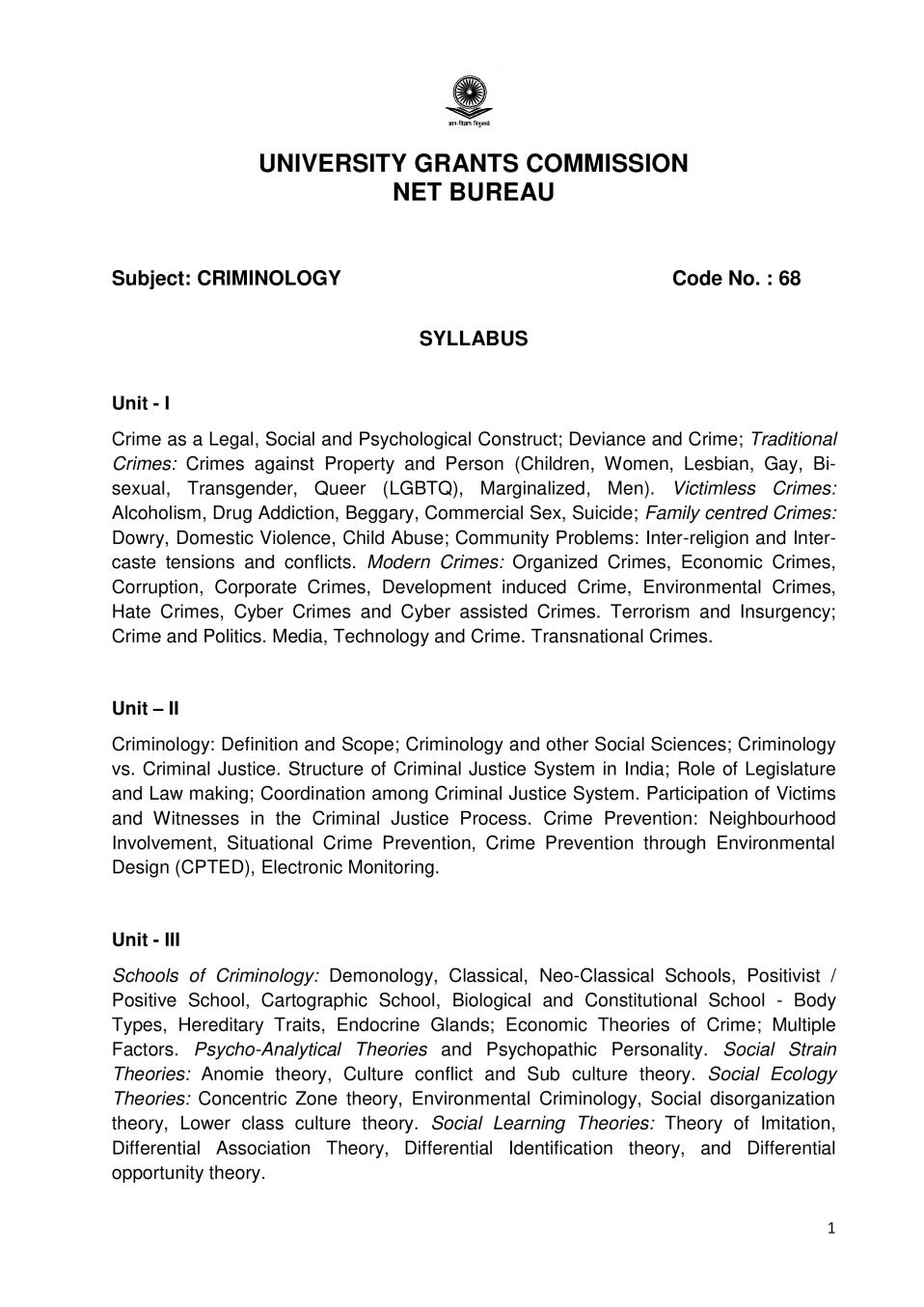
UNIVERSITY GRANTS COMMISSION
NET BUREAU
m
c. o
Subject: CRIMINOLOGY Code No. : 68
m
.co s e m
m a
SYLLABUS
s e g l
Unit - I la a
ag
Crime as a Legal, Social and Psychological Construct; Deviance and Crime; Traditional
Crimes: Crimes against Property and Person (Children, Women, Lesbian, Gay, Bi-
sexual, Transgender, Queer (LGBTQ), Marginalized, Men). Victimless Crimes:
Alcoholism, Drug Addiction, Beggary, Commercial Sex, Suicide; Family centred Crimes:
Dowry, Domestic Violence, Child Abuse; Community Problems: Inter-religion and Inter-
caste tensions and conflicts. Modern Crimes: Organized Crimes, Economic Crimes,
m
co
Corruption, Corporate Crimes, Development induced Crime, Environmental Crimes,
.
Hate Crimes, Cyber Crimes and Cyber assisted Crimes. Terrorism and Insurgency;
s em
Crime and Politics. Media, Technology and Crime. Transnational Crimes.
g l a
Unit – II a
Criminology: Definition and Scope; Criminology and other Social Sciences; Criminology
vs. Criminal Justice. Structure of Criminal Justice System in India; Role of Legislature
and Law making; Coordination among Criminal Justice System. Participation of Victims
and Witnesses in the Criminal Justice Process. Crime Prevention: Neighbourhood
Involvement, Situational Crime Prevention, Crime Prevention through Environmental
m
co
Design (CPTED), Electronic Monitoring.
m .
c. oUnit - III se
m
s em Schools of Criminology: Demonology, Classical, Neo-Classicalg l a Schools, Positivist /
gla a
a Positive School, Cartographic School, Biological and Constitutional School - Body
Types, Hereditary Traits, Endocrine Glands; Economic Theories of Crime; Multiple
Factors. Psycho-Analytical Theories and Psychopathic Personality. Social Strain
Theories: Anomie theory, Culture conflict and Sub culture theory. Social Ecology
Theories: Concentric Zone theory, Environmental Criminology, Social disorganization
theory, Lower class culture theory. Social Learning Theories: Theory of Imitation,
Differential Association Theory, Differential Identification theory, and Differential
m .
co
opportunity theory.
. e m
e m l as
a s g
1
l a
ag For more Question Papers, Sample Papers, Notes & Syllabus visit Page 1 of 7
Page 3
Social Control Theories: Drift and Neutralization theory, Containment theory, Social
bond theory. Social Conflict Theories: Labelling Theory, Radical Criminology, Conflict
Criminology, Critical Criminology, Realist Criminology. Modern Theories: Routine
Activities theory, Rational Choice theory, Shaming theory, Broken windows theory,
Feminist Criminology, Masculinity theory, Life Course theory, Integrated theories,
Space Transition theory. Contemporary Perspectives: Cultural Criminology, News
making Criminology, Peacemaking Criminology, Green Criminology, Visual
Criminology, Cyber Criminology, Positive Criminology, Translational Criminology.
Unit - V
Legal Approaches: Accusatorial and Inquisitorial; Substantive and Procedural Laws-
Criminal Liability, Strict Liability; Indian Penal Code-General Exceptions, Offences
Against Property; Criminal Procedure Code; Cognizable and Non-Cognizable offences,
Bailable and Non-bailable, Compoundable and Non-compoundable offences;
Investigation of Crimes; Complaint, F. I. R. Arrest, Search, Seizure, Police Custody,
Judicial Remand and Bail; Types of Evidence, Admissibility of Confession, Dying
declaration. Human Rights: Fundamental rights, Rights of accused and victims, Rights
of persons in custody, Rights of prisoners. Supreme Court Landmark Judgments on
Criminal Justice Reforms, The Protection of Human Rights Act, Protection of Children
from Sexual Offences Act (POCSO) Act - Salient features.
Unit - VI
Criminological Research: Importance and Types - Descriptive, Analytical, Experimental,
Exploratory and Doctrinal. Quantitative vs Qualitative research. Mixed Methods. Main
Steps in Criminological Research. Ethics and Confidentiality in Criminal Justice
Research. Researcher Fraud and Plagiarism. Crime and Criminal Justice Data.
Statistical Applications in Criminological Research.
Unit - VII
Penology – definition, nature and scope. Punishment-in ancient, medieval and modern
times. Punishment: Significance, Concept, Aims and Types. Theories of Punishment.
Sentencing – Principles, Policies and Procedures. Capital Punishment. Recent
approaches to Punishment – Restorative Justice, Restitution and Victim-offender
Mediation. History and evolution of Prison legislations – Prison Manuals and rules.
Various Prison Reforms Committees and Commissions. Standard Minimum Rules for
Non-custodial Measures (Tokyo Rules) and Nelson Mandela Rules for the Treatment of
Prisoners.
2
For more Question Papers, Sample Papers, Notes & Syllabus visit Page 2 of 7
Page 4
m .co
c. o Unit - VIII
e m
em l a s
s a g
Development of various prison systems - Penitentiary, Pennsylvania, Auburn system.
Evolution and development of Prison system in India. Institutional Treatment: Meaning
and purpose. Prison Types and Classification of Prisoners. Adult Institutions: Central,
District and Sub Jails. Women Institutions: Vigilance Home, Protective home. Open
Prisons. Accommodation, food and medical care in prisons. Correctional Programmes –
Educational, work and prison panchayats. Community based Corrections: Probation
and Admonition: Concept and Scope, Historical development of probation. Probation in
m
c. o
India – Probation of offenders Act. Parole: Meaning and Scope. After Care services in
m
co m
India. Current problems and challenges in Correctional Administration.
m . s e
a s e g la
Juvenile gand Youth Justice: Definition and Concept. Delinquency. Children in a
l
Unit - IX
a
conflict
with Law; Children and Vulnerability. Truancy and Vagrancy. Youth Crimes. Main
Features of latest Juvenile Justice Act; Institutions: Juvenile Justice Board, Child
Welfare Committee, Observation Homes, Juvenile Homes, Special Homes, and ‘fit’
Institutions; Juvenile Aftercare Services. Juvenile Police Unit. UN Documents: United
Nations Standard Minimum Rules for Juvenile Justice (Beijing Rules) and UN Riyadh
Guidelines. Prevention of Delinquency.
m
c. o
em Concepts of Victimology. UN Declaration
Unit - X
Historical development of Victimology. s
g la of Crime and Abuse of Power, 1985. Victim –
Basic
Offender relationship. Impact of aVictimization– Physical, Financial and Psychological
of Basic Principles of Justice for Victims
(including Post-Traumatic Stress Disorder (PTSD), (Acute Stress Disorder (ASD),
resilience, posttraumatic growth, anger and the way victims are viewed) Impact.
Primary, Secondary and Tertiary Victimization. Role of NGOs in Victim Assistance.
Criminological perspectives: Repeat victimization, routine activities, lifestyle exposure,
fear of crime, punitivity and victimization surveys including cost of crime. Effects of
m
crime on victims. Legal perspectives: Rights of the Crime Victims as per Criminal
m .co
Procedure Code (CrPC) and other Laws- Victim Compensation Schemes.
c. o se
m
Contemporary Developments in Victimology: Mass Victims and Mass Victimisation,
em la
Clinical Victimology, Therapeutic Jurisprudence, Cyber Victimology, Positive
las Victimology.
a g
ag
************* *
.
m .
.co s e m
e m l a
a s g
3
l a
ag For more Question Papers, Sample Papers, Notes & Syllabus visit Page 3 of 7
Page 5
Page 6
. e
em las
as ag
m
om . co
.c e m
e m l a s
l a s ag
ag
m
. co
s em
g l a
a
m
m c. o
c. o s e m
s em la
gla ag
a
m . c
c. o s e m
m a
se
For more Question Papers, Sample Papers, Notes & Syllabus visit
g lPage 5 of 7
Page 7
Page 8
. e
em las
as ag
m
om . co
.c e m
e m l a s
l a s ag
ag
m
. co
s em
g l a
a
m
m c. o
c. o s e m
s em la
gla ag
a
m . c
c. o s e m
m a
se
For more Question Papers, Sample Papers, Notes & Syllabus visit
g lPage 7 of 7
Document Details
| Board / Org | NTA |
| Exam | UGC National Eligibility Test |
| Type | Syllabus |
| Pages | 8 |
| Updated | 15 Jul 2026 |