Goa Board Class 10 Sample Paper 2026 Kathak
Finished viewing? Save it for later —
Download Goa Board Class 10 Sample Paper 2026 Kathak (PDF · 20 pages)About Goa Board Class 10 Sample Paper 2026 Kathak
Goa Board Class 10 Sample Paper 2026 Kathak is available here for free download. Published by Goa Board for Class 10, this sample paper can be viewed online or downloaded as a PDF (20 pages). Candidates preparing for Class 10 can use Goa Board Class 10 Sample Paper 2026 Kathak to understand the exam pattern, the type of questions asked, and the overall difficulty level.
Frequently Asked Questions
How can I download Goa Board Class 10 Sample Paper 2026 Kathak?
Open this page and click the Download button to save Goa Board Class 10 Sample Paper 2026 Kathak as a PDF. It is completely free on AglaSem Docs.
Is Goa Board Class 10 Sample Paper 2026 Kathak free to download?
Yes. Goa Board Class 10 Sample Paper 2026 Kathak can be viewed online and downloaded as a PDF free of cost on AglaSem Docs.
How many pages does Goa Board Class 10 Sample Paper 2026 Kathak have?
Goa Board Class 10 Sample Paper 2026 Kathak contains 20 pages, which you can read online or download together as a single PDF.
Where can I find more Class 10 study material?
You can find more Class 10 question papers, sample papers, syllabus, and answer keys on AglaSem Docs.
Goa Board Class 10 Sample Paper 2026 Kathak – Text
Read the full text of this sample paper below — useful to quickly search, copy and reference the content online without downloading the PDF.
📄 View text version (18 pages)
Page 1
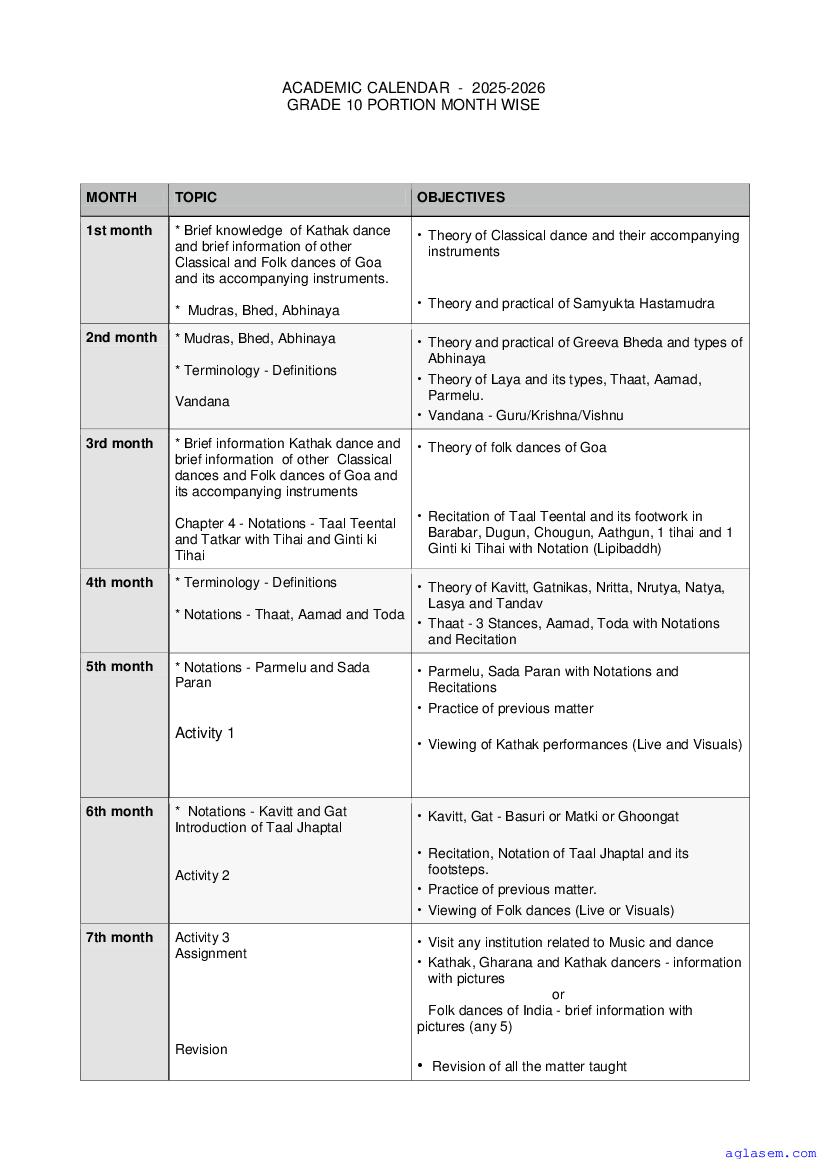
GRADE 10 PORTION MONTH WISE
MONTH TOPIC OBJECTIVES
1st month * Brief knowledge of Kathak dance • Theory of Classical dance and their accompanying
and brief information of other instruments
Classical and Folk dances of Goa
and its accompanying instruments.
* Mudras, Bhed, Abhinaya • Theory and practical of Samyukta Hastamudra
2nd month * Mudras, Bhed, Abhinaya • Theory and practical of Greeva Bheda and types of
Abhinaya
* Terminology - Definitions
• Theory of Laya and its types, Thaat, Aamad,
Vandana Parmelu.
• Vandana - Guru/Krishna/Vishnu
3rd month * Brief information Kathak dance and • Theory of folk dances of Goa
brief information of other Classical
dances and Folk dances of Goa and
its accompanying instruments
Chapter 4 - Notations - Taal Teental • Recitation of Taal Teental and its footwork in
and Tatkar with Tihai and Ginti ki Barabar, Dugun, Chougun, Aathgun, 1 tihai and 1
Tihai Ginti ki Tihai with Notation (Lipibaddh)
4th month * Terminology - Definitions • Theory of Kavitt, Gatnikas, Nritta, Nrutya, Natya,
Lasya and Tandav
* Notations - Thaat, Aamad and Toda
• Thaat - 3 Stances, Aamad, Toda with Notations
and Recitation
5th month * Notations - Parmelu and Sada • Parmelu, Sada Paran with Notations and
Paran Recitations
• Practice of previous matter
Activity 1
• Viewing of Kathak performances (Live and Visuals)
6th month * Notations - Kavitt and Gat • Kavitt, Gat - Basuri or Matki or Ghoongat
Introduction of Taal Jhaptal
• Recitation, Notation of Taal Jhaptal and its
Activity 2 footsteps.
• Practice of previous matter.
• Viewing of Folk dances (Live or Visuals)
7th month Activity 3 • Visit any institution related to Music and dance
Assignment
• Kathak, Gharana and Kathak dancers - information
with pictures
or
Folk dances of India - brief information with
pictures (any 5)
Revision
• Revision of all the matter taught
Page 3
Chapters
Remembering (10 marks) Understanding (16marks) Application (10 marks) Create (4 Marks) Total
MCQ VSA SA LA MCQ VSA SA LA MCQ VSA SA LA MCQ VSA SA LA
1 Q.1.3 Q.2. E Q.3. D 8
(1)
(1) (3)
Q.1.4 Q.2. F
(1) (1)
Q.1.6
(1)
2 Q.1.5 Q.2. B Q.1.2 Q.3. B. Q.1.7 8
(1) (1) (1) (3) (1)
Q.2.D
(1)
3 Q.1.1 Q.2.A Q.2.C Q.3.A 12
(1) (1) (1) (3)
Q.1.8 Q.1.9 Q.3. C
(1) (1) (3)
Q.1.10
(1)
4 Q.4. Q.4 (4) 12
(8)
10 16 10 4 40
Page 5
GOA Alto Betim Goa 403521
Grade 10
Subject: Art education - Kathak Dance
Syllabus for Kathak Dance
Theory 40 Marks
Practical 60 Marks (40 Practicals + 10 Orals + 10 Assignment)
Total Marks 100
Theory - 40 Marks
• KNOWLEDGE OF KATHAK AND BREIF INFORMATION OF OTHER CLASSICAL DANCES
AND FOLK DANCES OF GOA AND ITS ACCOMPANYING INSTRUMENTS.
10 MARKS
•
• MUDRAS, BHEDA, ABHINAYA - SANYUKTA HASTAMUDRA, GREEVA BHEDA AND TYPES
OF ABHINAYA IN BRIEF. 10 MARKS
•
• TERMINOLOGY - DEFINITIONS OF AAMAD, THAAT, PARMELU, LAYA AND IT’ S TYPES,
LASYA AND TANDAV, GAT NIKAS, KAVITT AND NRUTTA, NRITYA, NATYA. 10 MARKS
•
• NOTATIONS/LIPIBADDH - TO WRITE TAAL TEENTAL THEKA, TAAL JHAPTAL THEKA,
TODA, PARAN & TIHAI IN TAAL TEENTAL. 10 MARKs
• _____________________________________________________________________________
_______
Practical 60 Marks (40 Practicals + 10 Orals + 10 Assignment
• VANDANA - GURU/KRISHNA/VISHNU. - 4 MARKS
ADVANCED TEENTAL
• THAAT - 3 STANCES - 3 MARKS
• AAMAD - 3 MARKS
• TATKAAR - BARABAR, DUGUN. CHOUGUN, AATHGUN WITH TIHAI - 5 MARKS
• TODA OR CHAKRADAR TODA - 3 MARKS
• SADA PARAN - 3 MARKS
• PARMELU - 3 MARKS
• KAVITT. 4 MARKS
• GAT - BASURI/MATKI/GHOONGAT - 4 MARKS
• GINTI KI TIHAI (ONLY 1) - 2 MARKS
• INTRODUCTION OF SANYUKTA HASTAMUDRA WITH USES AND GREEVA BHADA - 4
MARKS
• INTRODUCTION OF TAAL JHAPTAL, ONLY LEGS - 2 MARKS
______________________________________________________________________________
_________
ACTIVITY 1 - VIEWING OF KATHAK PERFORMANCES (LIVE OR VISUALS)
ACTIVITY 2 - VIEWING OF FOLK DANCES LIVE OR VISUALS)
Page 6
ASSIGNMENT - 10 MARKS
KATHAK, GHARANA, KATHAK DANCERS - (INFORMATION WITH PICTURES)
OR
FOLK DANCES OF INDIA (BRIEF INFORMATION WITH PICTURES ANY 5)
Guidelines for the teachers to follow
• To develop interest amongst the students and train them professionally for better mental
alertness, quick reflexes, improving concentration and to maintain body posture.
• To refer books like “ Anga Kavya” by Pt. Birju Maharaj Ji; “ Kathak Nritya Shiksha PART 1 & 2”
by Dr. Puru Dadheech, “ Kathak - Volume 1 - A theoractical and Practical guide by Marami
Medhi, Debashish Talukdar, ‘ Kathak Nrutya Vol 1 by Nayana Nagle and Mohini Khatri
• To give thorough knowledge about other classical dance forms and folk dances of India.
• To engage students in dance productions of classical or folk dances to boost their stage
confidence, camera consciousness and groom the students professionally.
Page 7
403521
Practical Assessment for Kathak Dance - Grade 10 (Rubrics)
Criteria Excellent Very Good Good Needs
(5) (4) (3 ) Improvement
(2)
Knowledge of The student Demonstrate The student The student 5 marks
subject and demonstrates s a strong shows recalls a few (Orals)
Musicality excellent knowledge understandin steps and makes
knowledge of of g the steps in attempts, but
Information of Tal matter , performance dance but fails to perform 2 marks
teental and Taal showing a full , few errors makes some well.
Jhaptal understandin in errors that
g of rhythm in performance disturbs
Vandana dance style however it his/her 4 marks
and hears and doesn’t performance.
interprets interfere
dance to with
music or performance
notations .
Page 8
eat and who accurate in accurate with to maintain a orals
Bols maintains a beat, tempo the beat, Beat but
(compositi precise and rhythm tempo, frequently goes
ons) counts and throughout rhythm of off – beat (losing
recitation rhythm of the dance dance the beat) and
(understan music, sequences sequences also tries to sync
ding of demonstrates and and also good with Taal and
Taal) a thorough proficient in in reciting fails to
understandin reciting Taal bols with understand it.
Technique, g of tempo (bols). minimum The same in
posture/b and beat, Composition efforts. recitation also. 22 marks
ody line staying s performed Compositions The student
and orals perfectly in with performed remembers some
rhythm attention with of the technique
Thaat - 3 throughout with details adequate of dance steps
marks the of technique techniques. which results into
Aamad - 3 performance. and shows wrong body line
mks They can skill in dance
Tatkar - 5 recite Bols style
mks flawlessly and
Toda/C.to can
da - 3mks accurately
S Paran - 3 respond to
mks the
Parmelu - theoretical
3 mks aspects
G tihai - 2 outlined in
mks the syllabus.
Compositions
performd
with great
attention to
quality of
hand
movements,
foot works
and body line.
Also
demonstrates
an excellent
understandin
g of dance
style
Page 9
Efforts performs performs mostly focus during their
exceptionally well with focuses on performance,
Samyukta with great good his/her displaying
hastmudra confidence, confidence performance minimum
and expressive displaying but is bit expressions,
Greeva facial and strong facial unsure of footwork and
Bheda - 4 gestures and expressions, themselves very low
mrks footwork with footwork I.e. lack of confidence with 12 marks
correct body and body confidence stage fear and
Gat - 4 alignment. language and practice. fails to perform
marks This that well.
demonstrates effectively
Kavitt - 4 the significant draws
mrks efforts put attention.
into riyaz
(practice) for
the actual
performance
Activity 1, The student The student The student The student 10 marks
2, 3 has done the has done the has done the hasn’t been able
given given given to submit the
Assignmen assignment assignment assignment assignment in a
t exactly and in in a neat satisfactorily required manner
a perfect manner well under under the topic
manner under the the topic given to them
under the topic given given to The student fails
topic given to to them. them. to attend the
them with the The students The students activity Total= 60
• Kathak, mentioned attends attends the marks
Gharana and guidelines. activities activities
Kathak The students assigned to assigned to
dancers -
also attends him/her and him/her and
information
with pictures all the 3 understands tries to
activities the subject understand
or assigned to better. the subject
Folk dances him/her and
of India - brief understands
information
the subject
with
pictures (any 5) excellently
Page 10
OTHER CLASSICAL DANCE AND FOLK DANCE OF GOA AND ITS
ACCOMPANYING INSTRUMENTS - 10 MARKS
Brief information of Kathak dance:
Kathak dance is one of the eight classical dance form of India. It is North Indian classical dance
style originated from the state of Uttar Pradesh. It is also known as Kushilav, Natvari nritya. The
word Kathak is derived from the word Katha which means story telling. In the ancient days
Kathakas (story tellers) used to be appointed in temples for narrating mythological stories.
Gradually these story tellers started performing dance along with narrating stories. The Kathak is
originated from Vrundavan and Mathura.
In the Indian history when temples were destroyed, all these Kathakas scattered. Some of them
went to the court of new Muslim Rulers, some went under the patronage of Hindu Emperor and
rest tried to maintain their tradition. So during this period, three main Gharanas of Kathak came int
existence .i.e. Lucknow Gharana, Jaipur Gharana and Benaras Gharana and later Raigad
Gharana.
• The main feature of kathak dance is its complex footwork of its rhythmic pattern and chakkars
(spins).
• Musical instruments used are Tabla, Pakhawaj, Sarangi, Sarod, Flute, Harmonium, Sitar etc.
• The dancer wears 100-200 bells called Ghungaroo in their legs.
• Padhant is the bols recited by the performer or Guru himself.
• Languages used are Braja Bhasha, Hindi, Sanskrit, Urdu and regional languages.
• Style - Hindustani Sangeet Padhati is used.
• Costume-women wears Ghagra, choli, odhani and costume called Peshwaj which includes
anarkali, churidar pyjama and jacket, chunni, Topi (cap) with feathers and jewellery.
• Men wears dhoti with Kambar patta, churidar pyjama, angarkha, dupatta, cap, pagadi etc.
Gurus:- Pt. Bindadin Maharaj ji, Pt. Shambhu Maharaj ji, Kalika Prasad, Pt. Janaki Prasad, Pt.
Gauri Shankar ji
Page 1
Page 11
Dadhich, Dr. Vibha Dadich, Pt. Shama Bhate, Shovana Narayan and many more.
Classical dance styles of India
I. Sattriya (from year 2000)- North Indian Classical Dance originated from North Eastern Region -
Assam
II. Manipuri - North Indian Classical Dance originated from Manipur
III. Kathak - North Indian Classical Dance originated from Uttar Pradesh
IV. Kathakali - South Indian Classical Dance originated from Kerala
V. Mohiniyattam - South Indian Classical Dance originated from Kerala
VI. Kuchipudi - South Indian Classical Dance originated from Andhra Pradesh
VII. Odissi - South Indian Classical Dance originated from Odisha
VIII. Bharatnatyam - South Indian Classical Dance originated from Tamil Nadu
Folk dances of Goa
Goa has a rich cultural heritage and the beautiful tradition of folk dances.They are performed for
the harvest, traditional and religious festivals in Goa.Goan Folk dances are influenced by Indian as
well a Portuguese culture.Every dance features traditional attire and energetic movement and
accompanying local instrument called Ghumat, Dhol, Taaso, Kassale and many more.
Some of the folk dances of Goa are:
Kunbi, Dhalo, Dhekhani, Fugadi, Ghode modni, Dhangar, Morullo, Samai Nrutya, Mando, Goff,
Musal and many more.
Page 2
Page 12
GREEVA BHEDA AND TYPES OF ABHINAYA - 10 MARKS
Mudra:- A mudra is symbolic hand gestures used in dance. The word mudra comes from Sanskrit
and it means ‘ gesture’ . It is prominent mode of communication in dance and the dramatic arts in
India. As per Abhinay darpan, there are two types of mudra:
• Asamyukta Hastmudra - single hand gesture. There are 32 hastmudra
• Samyukta Hastmudra - double or two hand gestures. There are 23 hastmudra (mentioned
below)
- 1) Anjali- to do namaskar
- 2 )Kapot- to show lotus bud opening
- 3) Karkat- Stitching of limbs
- 4) Swastik - used in refusing and quarrelling etc
- 5) Dola - used to start dance
- 6) Pushpaput - used fro worshipping ,offering flowers ,arghya in worship etc.
- 7) Utsang - used to show love, to embrace, the gesture used to show wearing Baju band
jewellery.
- 8) Shivlinga - use to display Lord Shiva or Shivaling
- 9) Katakavardhan - to tell marriage, bond, worship, two things etc.
- 10 )Kartariswastik - used to show branches of trees, mountains etc.
- 11) Shakat - used to depict a monster, a scary figure.
- 12) Shankha - used for blowing a shankha (conch shell)
- 13) Chakra - used for meeting, placing one object on another etc.
- 14) Samputa - used in the expression of covering the object, friendship, meeting etc.
- 15) Paash - used in the demonstration of quarrel, union, friendship, chain etc.
- 16) Keelak - to show friendly talk.
- 17) Matsya - to show fish.
- 18) Kurma - to show turtle, tortoise.
- 19) Varaha -to show Boar (wild pig)
Page 3
Page 13
- 21) Naagbandh - to show pair of snakes, creeper.
- 22) Khatawa - to show bed, used to convey a sense of cleverness.
- 23) Bherunda - to show a bird couple.
- Bheda:
Griva bheda are neck movements used in dance. As per Abhinaya Darpan, there are four types of
griva bheda .
I. Sundari:-neck moved horizontally on both sides, used in affection, effort, expansion and to
give approval etc.
II. Tiraschina:-neck moved like a snake in both sides and upwards.Used to show sword or
movement of snake
III. Parivartita - neck moved from right to left like a half moon.Used to describe he action of Lasya
dance, affection etc.
IV. Prakampita:-neck moved from backward and forward like pigeon’ s neck. Used to describe
the movement of horse.
Abhinaya:
The expressions which are shown to express poetic meanings is Abhinaya. Here the emphasis ie
more on facial expressions than the rhythmic movement.The Abhinaya is divided into..
I. Angikabhinay - Expressing the meanings of lyrics using body parts like Head, hands, legs etc.
II. Vachikabhinay - expressing the story using the narrations in the dance drama.
III. Aharyabhinay - Imitating the costumes, jewellery, make-up etc. in dance.
IV. Satvikabhinay - Showing the Bhava (moods).
Page 4
Page 14
1. Laya and its types: ’ Laya’ means ‘ merge’ . The speed of time, passing in the action of
singing, dancing or playing music is called ‘ Laya’ . There are three kinds of Laya Vilambit,
Madhya and Drut:
a. Vilambit:- A very slow speed in music, dance and vocals
b. Madhya:- When the speed is neither slow nor fast. The . It is double of Vilambit laya.
c. Drut:- Fast speed which is double of Madhya laya.
2. Thaat:- Thaat, in general means graceful attitude. It is the beginning part of the pure dance in
Kathak. In Thaat, the dancer stands in some typical pose, moves his/her eyes, eyebrows, neck,
shoulders, arms, chest, wrist to the accompaniment of low rhythm played on Tabla and Nagma. It
is performed in Vilambit laya.
3. Aamad:- is a Persian word which means to enter. It is generally presented after Thaat but at the
beginning of the performance. After building a structure of dance in thaat, the dancer takes the
entry on stage with a small pieces of composition. Eg. तक thoonga
4. Parmelu:- is a competition in which syllabus sounds like different drums or percussion
instruments are combined with the Natwari bols. Some of the words used in Parmelu are jhan jhan,
thadunga, thoonga noonga etc.
5. Kavitt:- is a poetic composition set to taal. Very often a Natwari piece is affixed to it. The
meaning is interrupted by different gestures, while laya is marked by the feet. Although these
compositions show Abhinaya, but they are considered to be a part of nritta because of rhythm and
beat. Eg. choom choom, cha nananana
6. Gat Nikas:- is the simplest form of Gat. The word Gat Nikas has been derived from two words -
Gat+Nikas. Gat means Chaal or Chalan and Nikas means to emerge. To emerge out with the
chaal (Palta)making a mudra is called Gat Nikas.There are various types of Gat
nikas.e.g.Sidhi(simple),mukut, Ghungat, Basuri, matki, rukhsar.
Page 5
Page 15
- Nritta:-Dance without emotions is called Nritta. In other words “ Shuddha Nritta” is that aspect
of dance in which there is no place for emotions and expressions, only the Angas are operated
on Taal - Laya. Thaat, Tukada, Paran, Tatkar etc. are included in Nritta.
- Natya:- is a part of Nartan Kriya which means to act. It is the act of imitating a certain
character’ s movement, colour, speech, dress etc. The Gatbhav of Kathak dance is also
considered under Natya.
- Nritya:-The union of Natya and Nritta is called Nritya. The act of expressing with the movement
of Angas according to the Taal and laya is called Nritya. Thumri, bhajan in kathak dance comes
under the Nritya.
8. Tandav:- It is believed that the Lord Shiva (Shankar) after defeating the demon Tripurasur,
opened the third eye and performed a Raudra and Veer Rasa, pure dance in fast pace called
Tandav Nritya. It is mainly male dominated dance and danced by lord Shiva.
- Lasya:- It is mythological belief that when Lord Shiva killed Tripurasur, Godess Parvati pleased
with the destruction of demons, and performed a shringar Rasa dominant dance, which is called
Lasya. It is female dominated dance.
- Vandana:- is to offer salutation to Lord. Vandana is the composition in which words in praise of
Lord are blended with other dance bols forming a rhythmic piece. Vandana is mostly performed
first by the kathak dancers. e.g. Gan Gan Ganapati…
Page 6
Page 16
Information of Taal Teentaal
Matra - 16; Taali 1,5,13; Khali 9; Vibhag 4 (4-4-4-4)
1. 2. 3. 4. 5. 6. 7. 8
| |
x 2
9. 10. 11. 12. 13. 14. 15. 16
त त त त | |
o 3
______________________________________________
Information of Taal Jhaptal
Matra - 10; Taali 1,3,8; Khali 6; Vibhag 4 (2-3-2-3)
1. 2. 3. 4. 5. 6. 7. 8. 9. 10
| |त | |
X. 2. O. 3
_____________________________________________
Toda - notation
Paran - notation
Tihai - notation
Note:
Session 1- explain syllabus
Explain ACADEMIC CALENDAR
Session 2-model question paper
Blue print
Practical assessment /rubrics
Page 7
Page 17
SUBJECT : ART EDUCATION - KATHAK DANCE
Q1. Select and write the appropriate option from those given below each question(10Marks)
1. In which laya Thaat is performed?
a. Vilambit
b. Madhya
c. Drut
d. Ati drut
2. Mudras performed by joining 2 hands known as
a. Samyukta
b. Asamyukta
c. Vaachik
d. Tirashchina
3. Which of the following is Indian Classical dance form?
a. Satriya
b. Bihu
c. Kunbi
d. Garba
4. Instruments used in Kathak dance
a. Dholak
b. Mridangam
c. Ghumat
d. Tabla
5. As per Abhinaya darpan, how many Greeva Bheda are there?
a. 2
b. 1
c. 4
d. 5
6. Which of the following dance comes under folk dance style?
a. Kathak
b. Musal
c. Manipuri
d. Kathakali
7. Which of the following mudra is Samyukta hasta mudra?
a. Shikhar
b. Sarpshisha
c. Kartari Mukha
d. Shiva Linga
8. Dance style performed by Goddess Parvati?
a. Tandav
b. Lasya
c. Rasa
d. Ballet
9. ‘ Aamad’ word is derived from which language
a. Marathi
b. Gujarati
Page 18
d. English
10. The combination of Bhav, Rasa and Abhinaya is called
a. Nritta
b. Nrutya
c. Natya
d. Poem
Q2. Answer the following questions in one line. 6 marks
a. What is the laya with fast tempo called?
b. Name the types of Abhinaya.
c. What is the meaning of ‘ Aamad’ ?
d. As per the Abhinaya Darpan, which Samyukta mudra is used to show a pair of snakes?
e. Name the Gharanas of Kathak dance.
f. Write any two Folk dances of Goa.
Q.3. Answer the following in 2-3 sentences. 12 marks
a. Define Parmelu.
Or
What is Gat Nikas?
b. Name the types of Greev Bheda.
Or
Write the 2 uses of Utsanga and Pushpaputa Hastamudra.
c. Write two differences between Lasya and Tandav.
Or
Write two differences between Nritta and Nrutya.
d. What is the difference between Classical dance and Folk dance (any 3 points)
Or
What is the difference between Kathak and Bharatnatyam? (Any 3 points)
Q.4. Write notations with information (any 3). 12 marks
a. Taal Teental Theka
b. Taal Jhaptal Theka
c. Toda in Taal Teental
d. Sada paran in Taal Teental
e. Tihai in taal Teental
__________________________________________________________________________
Page 19
Q1-1]Vilambit
2]Samyukta
3]Sattriya
4]Tabla
5]4
6]Musal dance
7]Shivalinga
8]Lasya
9]Farsi/Persian
10]Nrutya
Q2-a)The Laya which has fast tempo is called Drut Laya.
b)Angik,Vachik,Aharya,and Satvik.
c)Amad is to enter on the stage signifying the start of the performance.
d)Naagbandh hastmudra is used to show a pair of snakes.
e)Jaipur,Lucknow,Banaras,Raigarh .
f)Kunbi,Dhalo etc.
Q3-a)Parmelu-defination
Or
Gat Nikas-defination
b)Greeva bheda-
Or
Uses of Utsang and Pushpaput
c)Lasya Tandav
1.by Parvati. 1.by Shiva
2.Shringar rasa. 2.Raudra and Veer rasa
3.Female dominated 3. Male dominated
Or
Nritta- 1)Pure dance form that focuses on rhythm and movement
2)Shows beauty through its fundamental expression
3)thaat ,paran, tukada
Nritya-1)It is a dance that communicate the theme
2)Is a narrative type of dance that portrays poetry through graceful movement
3)Thumari, Bhajan
d)Classical Dance —1)It aims to convey emotions or stories through movement and gestures
2)It demands years of rigorous training to master the technique
3)It is perform on stage
Folk dance — 1)It expresses the joy and energy of community.
2)It can be learned by anyone with minimal instruction.
3)It is performed in community celebrations like harvest, wedding, etc
Or
Bharatnatyam- 1) South Indian classical dance.
2) The dancers mostly perform in Aramandi.
3) It uses Carnatic music.
Kathak- 1)North Indian classical dance style.
2) It is not performed in Aramandi and the dancers mostly dance in Sampaad.
Page 20
Q4. Notations
Document Details
| Board / Org | Goa Board |
| Exam | Class 10 |
| Type | Sample Paper |
| Pages | 20 |
| Updated | 24 Sep 2026 |