UGC NET Syllabus for Environmental Science 2020
Finished viewing? Save it for later —
Download UGC NET Syllabus for Environmental Science 2020 (PDF · 11 pages)About UGC NET Syllabus for Environmental Science 2020
UGC NET Syllabus for Environmental Science 2020 is available here for free download. Published by NTA for UGC National Eligibility Test, this syllabus can be viewed online or downloaded as a PDF (11 pages). Candidates preparing for UGC National Eligibility Test can use UGC NET Syllabus for Environmental Science 2020 to understand the exam pattern, the type of questions asked, and the overall difficulty level.
Frequently Asked Questions
How can I download UGC NET Syllabus for Environmental Science 2020?
Open this page and click the Download button to save UGC NET Syllabus for Environmental Science 2020 as a PDF. It is completely free on AglaSem Docs.
Is UGC NET Syllabus for Environmental Science 2020 free to download?
Yes. UGC NET Syllabus for Environmental Science 2020 can be viewed online and downloaded as a PDF free of cost on AglaSem Docs.
How many pages does UGC NET Syllabus for Environmental Science 2020 have?
UGC NET Syllabus for Environmental Science 2020 contains 11 pages, which you can read online or download together as a single PDF.
Where can I find more UGC National Eligibility Test study material?
You can find more UGC National Eligibility Test question papers, sample papers, syllabus, and answer keys on AglaSem Docs.
UGC NET Syllabus for Environmental Science 2020 – Text
Read the full text of this syllabus below — useful to quickly search, copy and reference the content online without downloading the PDF.
📄 View text version (11 pages)
Page 1
UGC NET
Syllabus ·
Environmental Sciences
EXAM YEAR TYPE SUBJECT
UGC NET — Syllabus Environmental Sciences
Notes · Sample Papers · Previous Year Papers · Mock Tests
Page 2
. e
em las
as ag
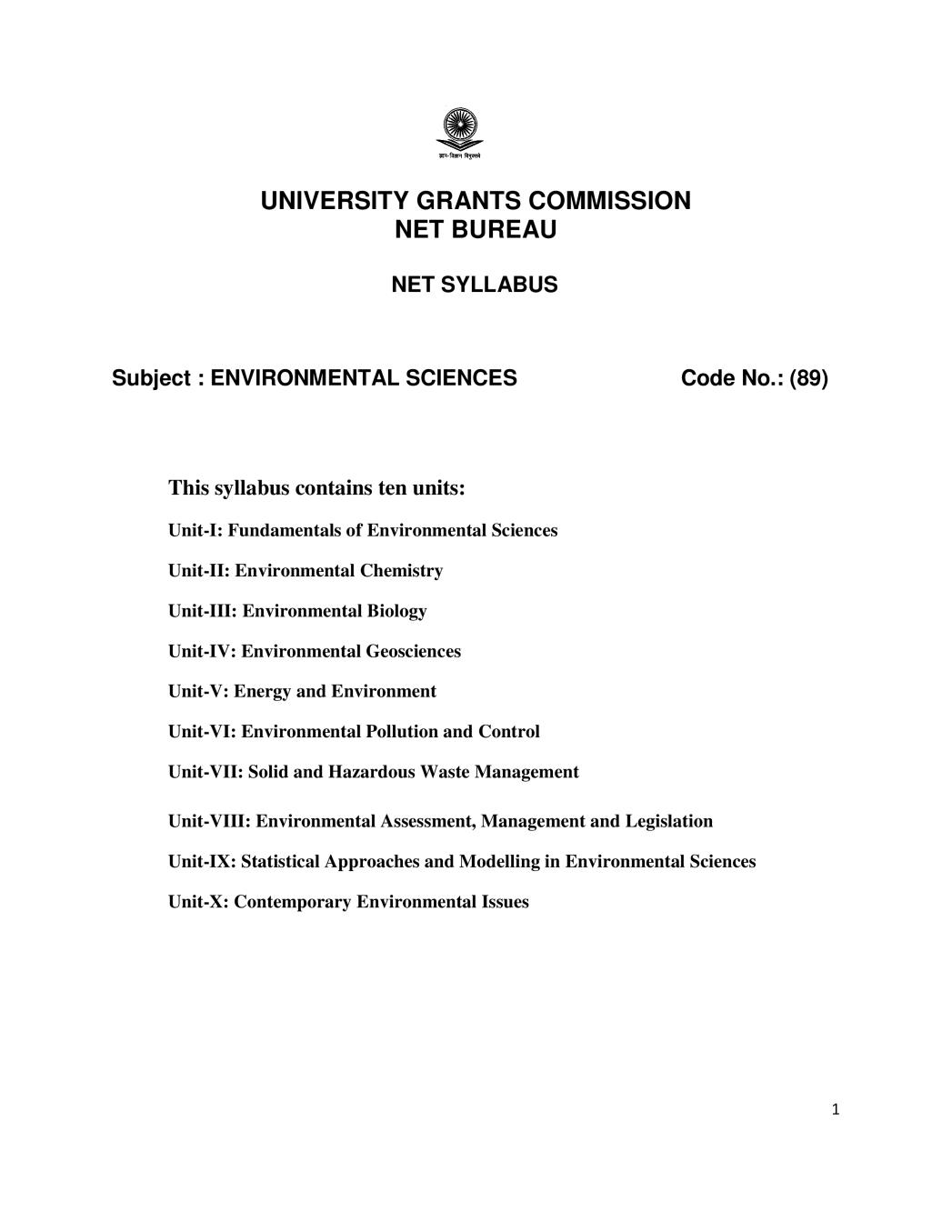
UNIVERSITY GRANTS COMMISSION
m
NET BUREAU
om . co
.c
NET SYLLABUS
e m
m e l a s
l a s a g
Subjectag
: ENVIRONMENTAL SCIENCES Code No.: (89)
This syllabus contains ten units:
Unit-I: Fundamentals of Environmental Sciences
m
Unit-II: Environmental Chemistry
. co
s em
a
Unit-III: Environmental Biology
g l
Unit-IV: Environmental Geosciences
a
Unit-V: Energy and Environment
Unit-VI: Environmental Pollution and Control
Unit-VII: Solid and Hazardous Waste Management
m
Unit-VIII: Environmental Assessment, Management and Legislation
m c. o
c. o Unit-X: Contemporary Environmental Issues m
Unit-IX: Statistical Approaches and Modelling in Environmental Sciences
s e
s em la
gla ag
a
1
m . c
c. o s e m
m a
se
For more Question Papers, Sample Papers, Notes & Syllabus visit
g l
Page 1 of 10
Page 3
Definition, Principles and Scope of Environmental Science.
Structure and composition of atmosphere, hydrosphere, lithosphere and
biosphere.
Laws of thermodynamics, heat transfer processes, mass and energy transfer
across various interfaces, material balance.
Meteorological parameters - pressure, temperature, precipitation, humidity,
mixing ratio, saturation mixing ratio, radiation and wind velocity, adiabatic
lapse rate, environmental lapse rate. Wind roses.
Interaction between Earth, Man and Environment. Biogeographic provinces
of the world and agro-climatic zones of India. Concept of sustainable
development.
Natural resources and their assessment. Remote Sensing and GIS: Principles
of remote sensing and GIS. Digital image processing and ground truthing.
Application of remote sensing and GIS in land cover/land use planning and
management (urban sprawling, vegetation study, forestry, natural resource),
waste management and climate change.
Environmental education and awareness. Environmental ethics.
Unit-II: Environmental Chemistry
Fundamentals of Environmental Chemistry: Classification of elements,
Stoichiometry, Gibbs’ energy, chemical potential, chemical kinetics,
chemical equilibria, solubility of gases in water, the carbonate system,
unsaturated and saturated hydrocarbons, radioisotopes.
Composition of air. Particles, ions and radicals in the atmosphere. Chemical
speciation. Chemical processes in the formation of inorganic and organic
particulate matters, thermochemical and photochemical reactions in the
atmosphere, Oxygen and Ozone chemistry. Photochemical smog.
2
For more Question Papers, Sample Papers, Notes & Syllabus visit Page 2 of 10
Page 4
. e
em las
as ag
Hydrological cycle. Water as a universal solvent. Concept of DO, BOD and
COD. Sedimentation, coagulation, flocculation, filtration, pH and Redox
potential (Eh).
Inorganic and organic components of soils. Biogeochemical cycles –
nitrogen, carbon, phosphorus and sulphur.
m
om
Toxic chemicals: Pesticides and their classification and effects. Biochemical
. co
.c e m
m s
aspects of heavy metals (Hg, Cd, Pb, Cr) and metalloids (As, Se). CO, O3,
s e
PAN, VOC and POP. Carcinogens in the air.
g l a
g a a
l of analytical methods: Titrimetry, Gravimetry, Bomb Calorimetry,
a
Principles
Chromatography (Paper Chromatography, TLC, GC and HPLC), Flame
photometry, Spectrophotometry (UV-VIS, AAS, ICP-AES, ICP-MS),
Electrophoresis, XRF, XRD, NMR, FTIR, GC-MS, SEM, TEM.
Unit-III: Environmental Biology
m
Ecology as an inter-disciplinary science. Origin of life and speciation.
Human Ecology and Settlement.
c. o
e m Structures - Biotic and Abiotic
l a s flow in ecosystems, energy flow models,
Ecosystem Structure and functions:
agBiogeochemical cycles, Ecological succession.
components. Functions - Energy
food chains and food webs.
Species diversity, Concept of ecotone, edge effects, ecological habitats and
niche. Ecosystem stability and factors affecting stability. Ecosystem services.
Basis of Ecosystem classification. Types of Ecosystem: Desert (hot and
cold), forest, rangeland, wetlands, lotic, lentic, estuarine (mangrove),
Oceanic.
o m
m c
. of different
c. o Biomes: s
m
e Highland Icy
Concept, classification and distribution. Characteristics
em l a
s g
biomes: Tundra, Taiga, Grassland, Deciduous forest biome,
gla Alpine Biome, Chapparal, Savanna, Tropical Rain
a
forest.
a Population ecology: Characteristics of population, concept of carrying
capacity, population growth and regulations. Population fluctuations,
dispersion and metapopulation. Concept of ‘r’ and ‘k’ species. Keystone
species.
3
m . c
c. o s e m
m a
se
For more Question Papers, Sample Papers, Notes & Syllabus visit
g l
Page 3 of 10
Page 5
predation, herbivory, parasitism and allelopathy. Biological invasions.
Biodiversity and its conservation: Definition, types, importance of
biodiversity and threats to biodiversity. Concept and basis of identification
of ‘Hotspots’; hotspots in India. Measures of biodiversity. Strategies for
biodiversity conservation: in situ, ex situ and in vitro conservation. National
parks, Sanctuaries, Protected areas and Sacred groves in India. Concepts of
gene pool, biopiracy and bio-prospecting. Concept of restoration ecology.
Extinct, Rare, Endangered and Threatened flora and fauna of India.
Concept of Industrial Ecology.
Toxicology and Microbiology: Absorption, distribution and excretion of
toxic agents, acute and chronic toxicity, concept of bioassay, threshold limit
value, margin of safety, therapeutic index, biotransformation. Major water
borne diseases and air borne microbes.
Environmental Biotechnology: Bioremediation – definition, types and role
of plants and microbes for in situ and ex situ remediation. Bioindicators,
Biofertilizers, Biofuels and Biosensors.
Unit-IV: Environmental Geosciences
Origin of earth. Primary geochemical differentiation and formation of core,
mantle, crust, atmosphere and hydrosphere. Concept of minerals and rocks.
Formation of igneous and metamorphic rocks. Controls on formation of
landforms - tectonic including plate tectonic and climatic. Concept of steady
state and equilibrium, Energy budget of the earth. Earth’s thermal
environment and seasons. Coriolis force, pressure gradient force, frictional
force, geo-strophic wind field, gradient wind. Climates of India, western
disturbances, Indian monsoon, droughts, El Nino, La Nina. Concept of
residence time and rates of natural cycles. Geophysical fields.
Weathering including weathering reactions, erosion, transportation and
deposition of sediments. Soil forming minerals and process of soil formation,
Identification and characterization of clay minerals, Soil physical and
4
For more Question Papers, Sample Papers, Notes & Syllabus visit Page 4 of 10
Page 6
. e
em las
as ag
chemical properties, soil types and climate control on soil formation, Cation
exchange capacity and mineralogical controls.
Geochemical classification of elements, abundance of elements in bulk earth,
crust, hydrosphere and biosphere. Partitioning of elements during surficial
geologic processes, Geochemical recycling of elements. Paleoclimate.
m
om
Distribution of water in earth, hydrology and hydrogeology, major basins
. co
.c
and groundwater provinces of India, Darcy’s law and its validity,
e m
e m l a s
s g
groundwater fluctuations, hydraulic conductivity, groundwater tracers, land
l a a
ag
subsidence, effects of excessive use of groundwater, groundwater quality.
Pollution of groundwater resources, Ghyben-Herzberg relation between
fresh-saline water.
Natural resource exploration and exploitation and related environmental
concerns. Historical perspective and conservation of non-renewable
resources.
m
co
Natural Hazards: Catastrophic geological hazards - floods, landslides,
.
em
earthquakes, volcanism, avalanche, tsunami and cloud bursts. Prediction of
l a s
hazards and mitigation of their impacts.
ag
Unit-V: Energy and Environment
Sun as source of energy; solar radiation and its spectral characteristics.
Fossil fuels: classification, composition, physico-chemical characteristics
and energy content of coal, petroleum and natural gas. Shale oil, Coal bed
Methane, Gas hydrates. Gross-calorific value and net-calorific value.
m
c. o
Principles of generation of hydro-power, tidal energy, ocean thermal energy
m
c. o m
conversion, wind power, geothermal energy, solar energy (solar collectors,
s e
em a Nuclear reactor –
photo-voltaic modules, solar ponds).
s g l
gla Nuclear energy - fission and fusion, Nuclear
a
fuels,
a principles and types.
Bioenergy: methods to produce energy from biomass.
Environmental implications of energy use; energy use pattern in India and
the world, emissions of CO2 in developed and developing countries
5
m . c
c. o s e m
m a
se
For more Question Papers, Sample Papers, Notes & Syllabus visit
g l
Page 5 of 10
Page 7
exploitation of solar, wind, hydro and nuclear energy sources.
Unit-VI: Environmental Pollution and Control
Air Pollution:
Sources and types of Pollutants - Natural and anthropogenic sources,
primary and secondary pollutants. Criteria air pollutants. Sampling and
monitoring of air pollutants (gaseous and particulates); period, frequency
and duration of sampling. Principles and instruments for measurements of (i)
ambient air pollutants concentration and (ii) stack emissions. Indian National
Ambient Air Quality Standards. Impact of air pollutants on human health,
plants and materials. Acid rain. Dispersion of air pollutants. Mixing
height/depth, lapse rates, Gaussian plume model, line source model and area
source model. Control devices for particulate matter: Principle and working
of: settling chamber, centrifugal collectors, wet collectors, fabric filters and
electrostatic precipitator. Control of gaseous pollutants through adsorption,
absorption, condensation and combustion including catalytic combustion.
Indoor air pollution, Vehicular emissions and Urban air quality.
Noise Pollution:
Sources, weighting networks, measurement of noise indices (Leq, L10, L90,
L50, LDN, TNI). Noise dose and Noise Pollution standards. Noise control and
abatement measures: Active and Passive methods. Vibrations and their
measurements. Impact of noise and vibrations on human health.
Water Pollution:
Types and sources of water pollution. Impact on humans, plants and
animals. Measurement of water quality parameters: sampling and analysis
for pH, EC, turbidity, TDS, hardness, chlorides, salinity, DO, BOD, COD,
nitrates, phosphates, sulphates, heavy metals and organic contaminants.
Microbiological analysis – MPN. Indian standards for drinking water
(IS:10500, 2012). Drinking water treatment: Coagulation and flocculation,
Sedimentation and Filtration, Disinfection and Softening. Wastewater
Treatment: Primary, Secondary and Advanced treatment methods. Common
effluent treatment plant.
6
For more Question Papers, Sample Papers, Notes & Syllabus visit Page 6 of 10
Page 8
. e
em las
as ag
Soil Pollution:
Physico-chemical and biological properties of soil (texture, structure,
inorganic and organic components). Analysis of soil quality. Soil Pollution
control. Industrial effluents and their interactions with soil components. Soil
m
micro-organisms and their functions - degradation of pesticides and
om
synthetic fertilizers.
. co
.c e m
e m l a s
s g
Thermal, Marine Pollution and Radioactive:
l a a
ag
Sources of Thermal Pollution, Heat Islands, causes and consequences.
Sources and impact of Marine Pollution. Methods of Abatement of Marine
Pollution. Coastal management. Radioactive pollution – sources, biological
effects of ionizing radiations, radiation exposure and radiation standards,
radiation protection.
Unit-VII: Solid and Hazardous Waste Management
m
. co
em
Solid Waste - types and sources. Solid waste characteristics, generation
a s
rates, solid waste components, proximate and ultimate analyses of solid
g l
a
wastes.
Solid waste collection and transportation: container systems - hauled and
stationary, layout of collection routes, transfer stations and transportation.
Solid waste processing and recovery – Recycling, recovery of materials for
recycling and direct manufacture of solid waste products. Electrical energy
m
c. o
generation from solid waste (Fuel pellets, Refuse derived fuels), composting
m
c. o e m
and vermicomposting, biomethanation of solid waste. Disposal of solid
em a s
wastes – sanitary land filling and its management, incineration of solid
l
las waste.
a g
ag
Hazardous waste – Types, characteristics and health impacts. Hazardous
waste management: Treatment Methods – neutralization, oxidation
reduction, precipitation, solidification, stabilization, incineration and final
disposal.
7
m . c
c. o s e m
m a
se
For more Question Papers, Sample Papers, Notes & Syllabus visit
g l
Page 7 of 10
Page 9
Fly ash: sources, composition and utilisation.
Plastic waste: sources, consequences and management.
Unit-VIII: Environmental Assessment, Management and Legislation
Aims and objectives of Environmental Impact Assessment (EIA).
Environmental Impact Statement (EIS) and Environmental Management
Plan (EMP). EIA Guidelines. Impact Assessment Methodologies. Procedure
for reviewing EIA of developmental projects. Life-cycle analysis, cost-
benefit analysis. Guidelines for Environmental Audit. Environmental
Planning as a part of EIA and Environmental Audit. Environmental
Management System Standards (ISO14000 series). EIA Notification, 2006
and amendments from time to time. Eco-labeling schemes.
Risk Assessment - Hazard identification, Hazard accounting, Scenarios of
exposure, Risk characterization and Risk management.
Overview of Environmental Laws in India: Constitutional provisions in
India (Article 48A and 51A). Wildlife Protection Act, 1972 amendments
1991, Forest Conservation Act, 1980, Indian Forest Act, Revised 1982,
Biological Diversity Act, 2002, Water (Prevention and Control of Pollution)
Act, 1974 amended 1988 and Rules 1975, Air (Prevention and Control of
Pollution) Act, 1981 amended 1987 and Rules 1982, Environmental
(Protection) Act, 1986 and Rules 1986, Motor Vehicle Act, 1988, The
Hazardous and Other Waste (Management and Transboundary Movement)
Rules, 2016, The Plastic Waste Management Rules, 2016, The Bio-Medical
Waste Management Rules, 2016, The Solid Waste Management Rules, 2016,
The e-waste (Management) Rules 2016, The Construction and Demolition
Waste Management Rules, 2016, The Manufacture, Storage and Import of
Hazardous Chemical (Amendment) Rules, 2000, The Batteries
(Management and Handling) Rules, 2010 with Amendments, The Public
Liability Insurance Act, 1991 and Rules 1991, Noise Pollution (Regulation
8
For more Question Papers, Sample Papers, Notes & Syllabus visit Page 8 of 10
Page 10
. e
em las
as ag
and Control) Rules, 2000, Coastal Regulation Zones (CRZ) 1991 amended
from time to time.
National Forest Policy, 1988, National Water Policy, 2002, National
Environmental Policy, 2006.
m
Environmental Conventions and Agreements: Stockholm Conference on
om
Human Environment 1972, Montreal Protocol, 1987, Conference of Parties
. co
.c e m
m s
(COPs), Basel Convention (1989, 1992), Ramsar Convention on Wetlands
se
(1971), Earth Summit at Rio de Janeiro, 1992, Agenda-21, Global
g l a
l a a
ag
Environmental Facility (GEF), Convention on Biodiversity (1992),
UNFCCC, Kyoto Protocol, 1997, Clean Development Mechanism (CDM),
Earth Summit at Johannesburg, 2002, RIO+20, UN Summit on Millennium
Development Goals, 2000, Copenhagen Summit, 2009. IPCC, UNEP, IGBP.
Unit-IX: Statistical Approaches and Modelling in Environmental
Sciences
m
co
Attributes and Variables: types of variables, scales of measurement,
.
em
measurement of Central tendency and Dispersion, Standard error, Moments
a s
– measure of Skewness and Kurtosis, Basic concept of probability theory,
l
a g
Sampling theory, Distributions - Normal, log-normal, Binomial, Poisson, t,
2
and F-distribution. Correlation, Regression, tests of hypothesis (t-test, 2-
test ANOVA: one-way and two-way); significance and confidence limits.
Approaches to development of environmental models; linear, simple and
multiple regression models, validation and forecasting. Models of population
growth and interactions: Lotka-Voltera model, Leslie’s matrix model.
m
m c. o
Unit-X: Contemporary Environmental Issues
c. o Global Environmental Issues – Biodiversity loss, Climate s e mchange, Ozone
s em g l a for environmental
la a
layer depletion. Sea level rise. International efforts
ag protection.
National Action Plan on Climate Change (Eight National missions –
National Solar Mission, National Mission for Enhanced Energy Efficiency,
National Mission on Sustainable Habitat, National Water Mission, National
Mission for Sustaining the Himalayan Ecosystem, National Mission for a
9
m . c
c. o s e m
m a
se
For more Question Papers, Sample Papers, Notes & Syllabus visit
g l
Page 9 of 10
Page 11
Mission on Strategic Knowledge for Climate Change).
Current Environmental Issues in India: Environmental issues related to
water resource projects - Narmada dam, Tehri dam, Almatti dam, Cauvery
and Mahanadi, Hydro-power projects in Jammu & Kashmir, Himachal and
North-Eastern States.
Water conservation-development of watersheds, Rain water harvesting and
ground water recharge.
National river conservation plan – Namami Gange and Yamuna Action Plan.
Eutrophication and restoration of lakes. Conservation of wetlands, Ramsar
sites in India.
Soil erosion, reclamation of degraded land, desertification and its control.
Climate change - adaptability, energy security, food security and
sustainability.
Forest Conservation – Chipko movement, Appiko movement, Silent Valley
movement and Gandhamardhan movement. People Biodiversity register.
Wild life conservation projects: Project tiger, Project Elephant, Crocodile
Conservation, GOI-UNDP Sea Turtle project, Indo-Rhino vision.
Carbon sequestration and carbon credits.
Waste Management – Swachha Bharat Abhiyan.
Sustainable Habitat: Green Building, GRIHA Rating Norms.
Vehicular emission norms in India.
Epidemiological Issues: Fluorosis, Arsenocosis, Goitre, Dengue.
Environmental Disasters: Minnamata Disaster, Love Canal Disaster, Bhopal
Gas Disaster, 1984, Chernobyl Disaster, 1986, Fukusima Daiichi nuclear
disaster, 2011.
10
For more Question Papers, Sample Papers, Notes & Syllabus visit Page 10 of 10
Document Details
| Board / Org | NTA |
| Exam | UGC National Eligibility Test |
| Type | Syllabus |
| Pages | 11 |
| Updated | 15 Jul 2026 |