UGC NET Syllabus for Forensic Science 2020
Finished viewing? Save it for later —
Download UGC NET Syllabus for Forensic Science 2020 (PDF · 10 pages)About UGC NET Syllabus for Forensic Science 2020
UGC NET Syllabus for Forensic Science 2020 is available here for free download. Published by NTA for UGC National Eligibility Test, this syllabus can be viewed online or downloaded as a PDF (10 pages). Candidates preparing for UGC National Eligibility Test can use UGC NET Syllabus for Forensic Science 2020 to understand the exam pattern, the type of questions asked, and the overall difficulty level.
Frequently Asked Questions
How can I download UGC NET Syllabus for Forensic Science 2020?
Open this page and click the Download button to save UGC NET Syllabus for Forensic Science 2020 as a PDF. It is completely free on AglaSem Docs.
Is UGC NET Syllabus for Forensic Science 2020 free to download?
Yes. UGC NET Syllabus for Forensic Science 2020 can be viewed online and downloaded as a PDF free of cost on AglaSem Docs.
How many pages does UGC NET Syllabus for Forensic Science 2020 have?
UGC NET Syllabus for Forensic Science 2020 contains 10 pages, which you can read online or download together as a single PDF.
Where can I find more UGC National Eligibility Test study material?
You can find more UGC National Eligibility Test question papers, sample papers, syllabus, and answer keys on AglaSem Docs.
UGC NET Syllabus for Forensic Science 2020 – Text
Read the full text of this syllabus below — useful to quickly search, copy and reference the content online without downloading the PDF.
📄 View text version (10 pages)
Page 1
UGC NET
Syllabus · Science
EXAM YEAR TYPE SUBJECT DETAILS
UGC NET — Syllabus Science Forensic
Notes · Sample Papers · Previous Year Papers · Mock Tests
Page 2
. e
em las
as ag
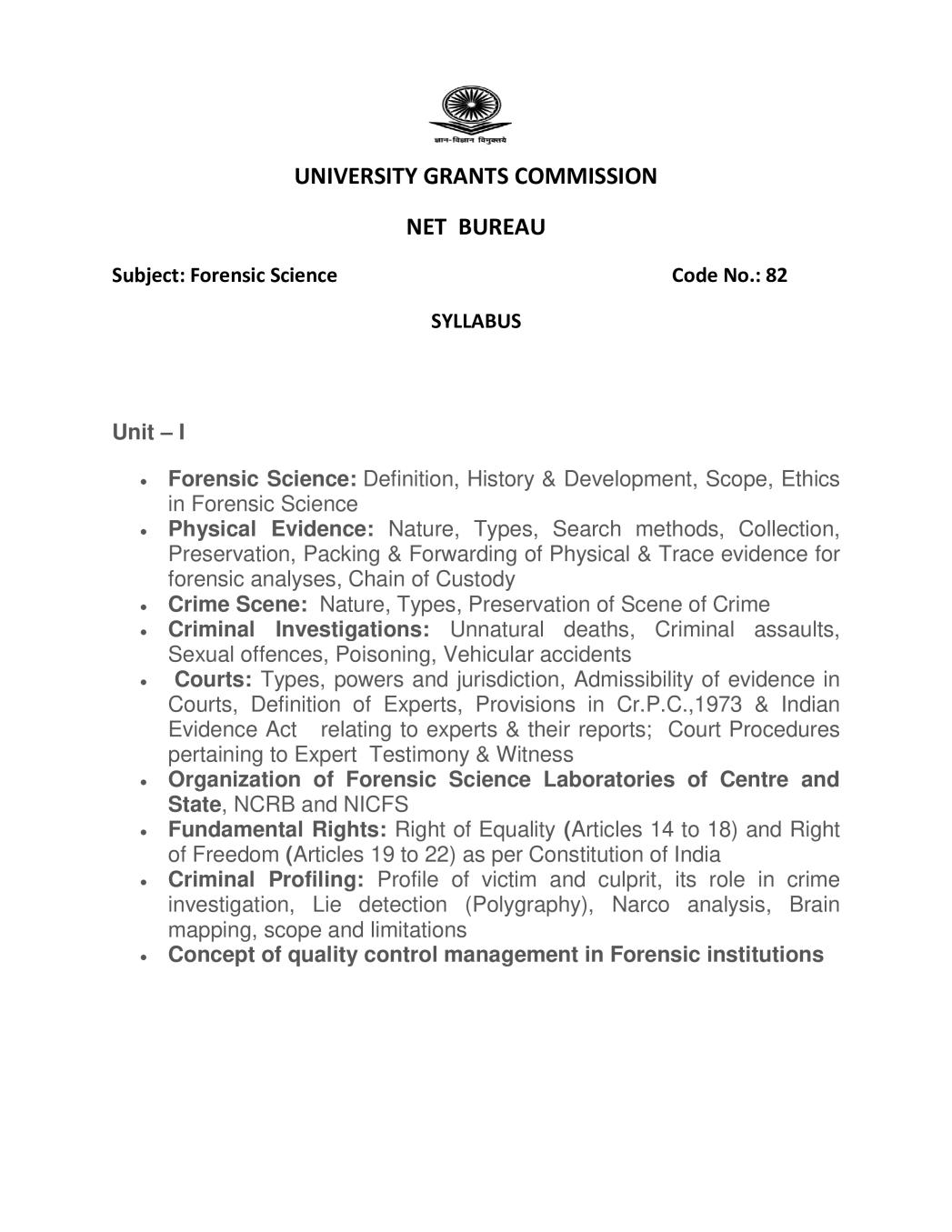
UNIVERSITY GRANTS COMMISSION
NET BUREAU
m
om . co
c m
Subject: Forensic Science Code No.: 82
m . se
se SYLLABUS
g l a
l a a
ag
Unit – I
Forensic Science: Definition, History & Development, Scope, Ethics
in Forensic Science
Physical Evidence: Nature, Types, Search methods, Collection,
m
co
Preservation, Packing & Forwarding of Physical & Trace evidence for
.
em
forensic analyses, Chain of Custody
s
Crime Scene: Nature, Types, Preservation of Scene of Crime
g l a
Criminal Investigations: Unnatural deaths, Criminal assaults,
a
Sexual offences, Poisoning, Vehicular accidents
Courts: Types, powers and jurisdiction, Admissibility of evidence in
Courts, Definition of Experts, Provisions in Cr.P.C.,1973 & Indian
Evidence Act relating to experts & their reports; Court Procedures
pertaining to Expert Testimony & Witness
Organization of Forensic Science Laboratories of Centre and
State, NCRB and NICFS
m
c. o
Fundamental Rights: Right of Equality (Articles 14 to 18) and Right
m
c. o
of Freedom (Articles 19 to 22) as per Constitution of India
e m
s
Criminal Profiling: Profile of victim and culprit, its role in crime
s em la
investigation, Lie detection (Polygraphy), Narco analysis, Brain
la ag
mapping, scope and limitations
ag Concept of quality control management in Forensic institutions
m . c
c. o s e m
m a
se
For more Question Papers, Sample Papers, Notes & Syllabus visit
g l Page 1 of 9
Page 3
Microscopy: Polarizing, Comparison, Stereoscopic, Fluorescent and
Electron Microscopes
Spectrophotometry: UV, Visible, IR, Raman, Atomic absorption,
Emission
Neutron Activation Analysis
X – rays and x-ray based techniques such as XRD, XRF
Mass Spectroscopy
Chromatographic Techniques: TLC, GLC, HPLC,HPTLC
Hyphenated Techniques: GC-MS, LC-MS, IR-MS and ICP-MS
Electrophoresis: High and Low voltage electrophoresis,
Immunoelectrophoresis
Immunoassays: Principle, Types ,Techniques and applications
Unit – III
Detection and Identification of Blood stains
Determination of Species of Origin
Blood Group Systems
Techniques of Determination of Blood groups of Blood Stains
Detection of Seminal and other body fluids and their Blood
Grouping, Red cells Enzymes, Serum Proteins of forensic
significance
Disputed Paternity & Maternity
DNA: Structure, DNA as genetic marker, DNA Extraction and
Profiling Techniques
DNA Phenotyping and RNA Profiling & their applications
Wild life Forensics: Wild life (Protection) Act,1972, Scope,
Evidences and Identification
For more Question Papers, Sample Papers, Notes & Syllabus visit Page 2 of 9
Page 4
. e
em las
as Unit – IV ag
Analysis of Ethyl alcohol in beverages , liquors, biological fluids
and breath
Analysis of Methanol and Denaturants
Illicit liquors
Analysis of Chemicals in Trap Cases
m
om
Metabolism and Chemical examination of :
. co
.c e m
m s
Insecticides & Pesticides, Tranquillizers & Sedatives, Hypnotics
se
Stimulants, Narcotics, Opiates, Drugs of abuse; Analyses of above
g l a
l a a
ag
and their Toxicity
Plant poisons
Metallic Poisons
Extraction, Isolation & Clean-up procedures, Identification of
common poisons from viscera, tissues and body fluids
m
Unit – V
. co
em
Fire arms: Types, Classification, Ammunition and their Compositions
l a s
Forensic examination of Firearms, Ammunition, Firearms’
a g
projectiles (Bullets, Shots, Slug etc.), Shell case
Gunshot residues analysis
Concept of Velocity, Penetration, Dispersion, Ricochet, Accidental
Discharge, Determination of Range in firearm cases
Examination of Country made firearms
Basics of Internal, External and Terminal Ballistics
Tool marks: Meaning, Types and Examination
Restoration of Erased Markings on Metal Surfaces
m
om c. o
c.Unit e m
em l a s
s
–
g
VI
gla Fire and Arson: Analyses of Petroleum aProducts and other
a incendiary materials
Explosives: Definition, Types and Analyses
m . c
c. o s e m
m a
se
For more Question Papers, Sample Papers, Notes & Syllabus visit
g l Page 3 of 9
Page 5
and their examination
Investigation in Explosion and Arson related cases
Photography: Types, application in criminal investigation &
Forensic evidence examination
Unit – VII
Hair & Fibers: Nature, Types, Structure and Examination
Pollens and Diatoms: Their application in Forensic investigation
Dust & Soil: Nature, Types, Forensic Examination
Paint, Lacquer & Varnishes: Nature, composition and forensic
examination
Glass: Composition, Types, Fractures, Examination
Cement, Mortar and Concrete: General Composition, Forensic
Analysis
Computer Forensics: Introduction, Types of Computer crimes,
Digital evidence- Seizure, Acquisition and Forensic examination
Mobile Phone Forensics
Unit – VIII
Fingerprints: History, Characteristics, Types, Classification,
Preservation, Development, Lifting and Comparison, Examination of
Chance Prints, Computerization of Fingerprints, AFIS
Track Marks: Foot Prints, Shoe Prints, Tire Marks, Their
Preservation & Casting, Comparison, Skid marks. Gait pattern
Biometric Systems of Identification and its relevance
Voice Analysis: Introduction, Significance, Structure of Human Voice
apparatus, Voice spectrography, Voice analysis, Legal aspects and
limitations
For more Question Papers, Sample Papers, Notes & Syllabus visit Page 4 of 9
Page 6
. e
em las
as Unit – IX ag
Documents: Definition, Types, Preliminary examination of
documents
Reproduction of documents through photographic and mechanical
means and their examination
m
Examination of Alterations such as Erasures, Obliterations &
Additions
om . co
.c
Indentations, Secret writings and Charred documents
e m
e m l a s
s
Inks, Papers and their scientific examinations with modern methods
l a
Age of documents
a g
ag
Examination of Typescripts, Printed matter including currency notes
and lottery tickets. Mechanical impressions
Hand writings: Class and Individual characteristics of Handwritings,
Factors affecting handwritings, Standard samples for comparison,
Comparison of hand-written texts
Anonymous and disguised writings
Identification of hand writings, signatures, detection of forged
m
co
signature and forgeries
Examination of Credit Cards and Similar materials
.
s em
g l a
Unit –X a
Modes & Manner of deaths, Sexual offences and its medicolegal
importance, Amendments in law related to sexual offences
Post – mortem examination and Post – mortem changes,
Estimation of time since death
m
Injuries & Wounds: Types, Medicolegal importance, Gunshot
m c. o
wounds
c. o e m
Determination of Species of Origin, Sex , Age, Stature, and
em
individual identification through skeletal remains
la s
las Identification through Skull superimposition and facial
ag
ag reconstruction
Human dentition, Type of teeth, determination of Age, Bite
marks
Forensic Entomology: Introduction, Insects of forensic
importance, Insects on Carrion, Forensic applications
m . c
c. o s e m
m a
se
For more Question Papers, Sample Papers, Notes & Syllabus visit
g l Page 5 of 9
Page 7
Page 8
. e
em las
as ag
m
om . co
.c e m
e m l a s
l a s a g
ag
m
. co
s em
g l a
a
m
m c. o
c. o s e m
s em la
gla ag
a
m . c
c. o s e m
m a
se
For more Question Papers, Sample Papers, Notes & Syllabus visit
g l Page 7 of 9
Page 9
Page 10
. e
em las
as ag
m
om . co
.c e m
e m l a s
l a s a g
ag
m
. co
s em
g l a
a
m
m c. o
c. o s e m
s em la
gla ag
a
m . c
c. o s e m
m a
se
For more Question Papers, Sample Papers, Notes & Syllabus visit
g l Page 9 of 9
Document Details
| Board / Org | NTA |
| Exam | UGC National Eligibility Test |
| Type | Syllabus |
| Pages | 10 |
| Updated | 15 Jul 2026 |