UGC NET Syllabus for Human Right and Duties 2020
Finished viewing? Save it for later —
Download UGC NET Syllabus for Human Right and Duties 2020 (PDF · 12 pages)About UGC NET Syllabus for Human Right and Duties 2020
UGC NET Syllabus for Human Right and Duties 2020 is available here for free download. Published by NTA for UGC National Eligibility Test, this syllabus can be viewed online or downloaded as a PDF (12 pages). Candidates preparing for UGC National Eligibility Test can use UGC NET Syllabus for Human Right and Duties 2020 to understand the exam pattern, the type of questions asked, and the overall difficulty level.
Frequently Asked Questions
How can I download UGC NET Syllabus for Human Right and Duties 2020?
Open this page and click the Download button to save UGC NET Syllabus for Human Right and Duties 2020 as a PDF. It is completely free on AglaSem Docs.
Is UGC NET Syllabus for Human Right and Duties 2020 free to download?
Yes. UGC NET Syllabus for Human Right and Duties 2020 can be viewed online and downloaded as a PDF free of cost on AglaSem Docs.
How many pages does UGC NET Syllabus for Human Right and Duties 2020 have?
UGC NET Syllabus for Human Right and Duties 2020 contains 12 pages, which you can read online or download together as a single PDF.
Where can I find more UGC National Eligibility Test study material?
You can find more UGC National Eligibility Test question papers, sample papers, syllabus, and answer keys on AglaSem Docs.
UGC NET Syllabus for Human Right and Duties 2020 – Text
Read the full text of this syllabus below — useful to quickly search, copy and reference the content online without downloading the PDF.
📄 View text version (12 pages)
Page 1
UGC NET
Syllabus · Human
Rights Duties
EXAM YEAR TYPE SUBJECT
UGC NET — Syllabus Human Rights Duties
Notes · Sample Papers · Previous Year Papers · Mock Tests
Page 2
. e
em las
as ag
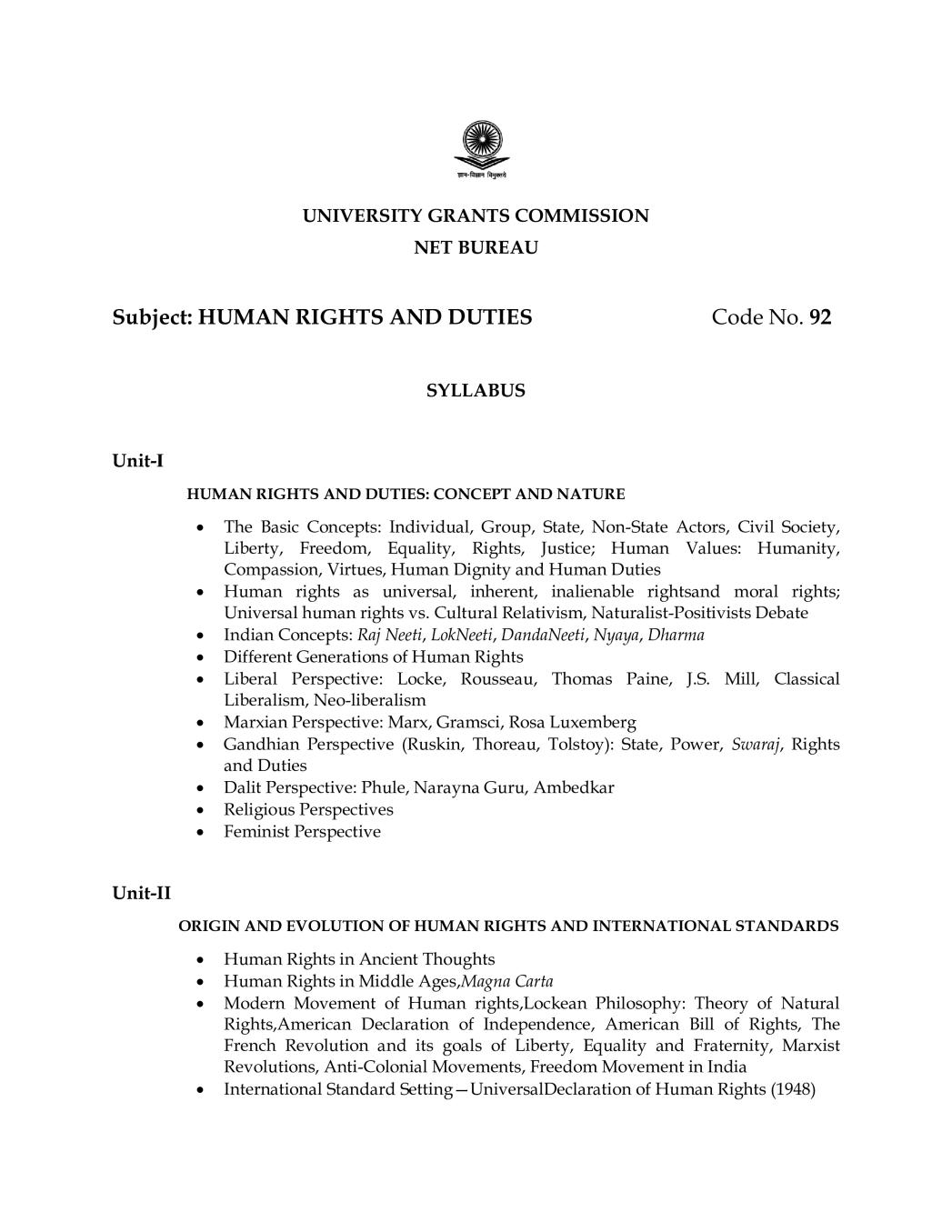
UNIVERSITY GRANTS COMMISSION
m
co
NET BUREAU
.c om e m .
e m l a s
s
Subject: HUMAN RIGHTS AND DUTIES Code No. 92
l a ag
ag SYLLABUS
Unit-I
HUMAN RIGHTS AND DUTIES: CONCEPT AND NATURE
The Basic Concepts: Individual, Group, State, Non-State Actors, Civil Society,
m
co
Liberty, Freedom, Equality, Rights, Justice; Human Values: Humanity,
.
Compassion, Virtues, Human Dignity and Human Duties
em
Human rights as universal, inherent, inalienable rightsand moral rights;
l a s
Universal human rights vs. Cultural Relativism, Naturalist-Positivists Debate
g
a
Indian Concepts: Raj Neeti, LokNeeti, DandaNeeti, Nyaya, Dharma
Different Generations of Human Rights
Liberal Perspective: Locke, Rousseau, Thomas Paine, J.S. Mill, Classical
Liberalism, Neo-liberalism
Marxian Perspective: Marx, Gramsci, Rosa Luxemberg
Gandhian Perspective (Ruskin, Thoreau, Tolstoy): State, Power, Swaraj, Rights
and Duties
Dalit Perspective: Phule, Narayna Guru, Ambedkar
Religious Perspectives
m
c. o
Feminist Perspective
m
c. o s e m
em a
Unit-II
s g l
la a
ORIGIN AND EVOLUTION OF HUMAN RIGHTS AND INTERNATIONAL STANDARDS
ag Human Rights in Ancient Thoughts
Human Rights in Middle Ages,Magna Carta
Modern Movement of Human rights,Lockean Philosophy: Theory of Natural
Rights,American Declaration of Independence, American Bill of Rights, The
French Revolution and its goals of Liberty, Equality and Fraternity, Marxist
Revolutions, Anti-Colonial Movements, Freedom Movement in India
International Standard Setting—UniversalDeclaration of Human Rights (1948)
m . c
c. o s e m
m a
se
For more Question Papers, Sample Papers, Notes & Syllabus visit
g lPage 1 of 11
Page 3
International Standards: UN Sponsored or „Core‟International Conventions
onHuman Rights: International Covenant on Civil and Political Rights (ICCPR),
International Covenant on Economic, Social and Cultural Rights (ICESCR),
Convention on the Elimination of ALL Forms of Discrimination against Women
(CEDAW), Convention against Torture, Rights of Child Convention, Convention
on the Rights of Migrant workers, Convention against Racial Discrimination
(CRD), Convention on Rights of Persons with Disabilities (CRPD)
State Responsibility for Protection of Human Rights: The Concept of the
“Responsibility to Protect”
Vienna Declaration on Human Rights 1993
Helsinki Declaration
ASEAN Declaration
Unit-III
SOCIETY, ECONOMY, POLITY, RELIGION AND CULTURE—THEIR INTER-
RELATIONSHIP
Impact ofSocial Structure on Human Behaviour; Role ofSocializations inHuman
Values, Human Rights and Duties
Science and Technology, Modernization, Globalization and Dehumanization
Social Stratification: Racial andCaste Prejudice and Discrimination; Human
Rights Issues of Weaker Sections andEthnic Minorities
Women: Gender Discrimination, Domestic Violence andOffences against Women;
Gender Sensitive Laws
Children: Child Abuse, Child Labour, Street Children
Social Structure andSocial Problems: Social and Communal Conflicts andSocial
Harmony
Rural Poverty, Unemployment, Bonded Labour, Modern Forms of Slavery
Urban Poverty, Slums, Lack of Basic Civil Amenities, Sex Workers
Rights of Refugees, Rights of Indigenous People, Aged Persons, Migrant
Workers and Human Rights Violations, Human Rights of Persons with
Disabilities (PwDs) under the Rights of Persons with Disabilities Act, 2016Rights
of Displaced Persons
Challenges in Human Rights: Religious Fundamentalism, Terrorism,
Underdevelopment, Human trafficking International Crimes,
Unit IV
STATE AND INDIVIDUAL LIBERTY
The Changing Nature ofState with Special Reference tothe Developing Countries
Soft State, Interventionist State, Welfare State, Repressive State
Political Regimes andHuman Rights
Impact of Science and Technology on Human Rights and Duties
Human Rights andInternational Politics: Emergence ofa New Global Order—
Tehran Conference (1968)—Vienna Conference (1993)
For more Question Papers, Sample Papers, Notes & Syllabus visit Page 2 of 11
Page 4
. e
em las
as ag
International Humanitarian Law: 1949 Geneva Conventions and Additional
Protocols of 1977—International Red Cross Society
International Criminal Tribunals(Rwanda and Former Yugoslavia) and the
International Criminal Court (ICC)
International Intervention: The Question ofNation-State, Citizenship
m
andSovereignty
co
om .
Right of Self-Determination: Autonomous Movements, Secessionist Movements
c m
.
Grassroots Movements andHuman Rights
m s e
s e g l a
Unit-V
g l a a
a
UN AND VARIOUSAGENCIES, INTERGOVERNMENTAL (IGOs) AND
NON-GOVERNMENTAL ORGANIZATIONS (INGOs)
UN: Establishment, Objectives, and the Charter Provisions
UN Principal Organs: General Assembly, Economic and Social Council, Security Council
Subsidiary Organ: Human Rights Council
The Human Rights Council Advisory Committee
Specialized Agencies: UNICEF, UNESCO, ILO, WHO
m
co
INGOs such as the International Commission of Jurists (ICJ), Amnesty International (AI),
.
Human Rights Watch, Greenpeace
em
People‟s Union for Civil Liberties (PUCL), People‟s Union for Democratic Rights (PUDR)
l a s
and Other Civil and Democratic Rights Organizations in India.
a g
UN High Commission forRefugees (UNHCR)
UN Commission ontheStatus ofWomen
UN High Commissioner for Human Rights
Unit-VI
GROWTH MODELS AND HUMAN RIGHTS
m
c. o
m
Models of Development: Growth Approach, Basic Needs Approach, Sustainable
c. o m
Human Development, Rio Declaration on Environment and Development, 1992,
s e
em
Rio +20, Conservation of Natural Resources, Agenda 21, Bio-Diversity
s la
Convention 1992
la ag
Globalization andHuman Rights: Dynamics ofGlobalization, Emergence
ag
ofMarket Forces,Assertion ofCivil Society, Retreat ofState, Privatization,
Liberalization
Emergence of Information Age
Economic Growth Strategies (Developing Countries): Implications for Poverty
Eradication, Employment issues, Planned Development andSocial Inequality
World Trade Organization: Implication for Human Rights,Impact on Developing
Countries with special referencetoIndia
m . c
c. o s e m
m a
se
For more Question Papers, Sample Papers, Notes & Syllabus visit
g lPage 3 of 11
Page 5
Rights (TRIPS), Trade Related Investment Measures (TRIMS),General Agreement
on Trade and Services (GATS), Agreement On Agriculture (AOA)
Transnational Corporations (TNCs) and Human Rights Situation in Developing
Countries
Right to Development: The Third World Concerns, Working Group
Recommendations, UNDP—initiatives, UN Declaration on the Right to
development
State and Development of the Marginalized/Disadvantaged Groupsin India: The
Poor, the Unemployed andthe Socially Dislocated People
Workers‟ Rights, Minimum Wages Act—Problems of Implementation, Right to
Security of Food, Health, Education
Unit-VII
DEVELOPMENT, UNDERDEVELOPMENT AND SOCIAL ACTION
Need for Collective Action in Developing Societies and Methods of Social Action
Land, Water and Forest Issues with special reference to India
Social Movements: Political, Social and Religious Reform
National Commission for Women, Children, Minorities, Scheduled Castes and
Scheduled Tribes
Backward Class, Dalit and Women Movements
Agrarian and Peasant Movements
Right to a Healthy Environment
Principle of Sustainable Development
Ecological and Environment Movements
Civil Societies and NGOs, NGOs of India
Unit-VIII
HUMAN RIGHTS AND INDIAN CONSTITUTION
Indian Civilization: Change and Continuity.
Indian Constitution: Freedom Movement
Indian Constitution: Sociological Foundation
Constitutional Vision of Role ofthe State
Constitutional Vision of Freedom: Fundamental Rights and the International
standards
Constitutional Vision of Justice: Directive Principles of State Policy and
international standards
Public Interest Litigation (PIL), Indian Judiciary and Human Rights
Judicial Interpretations: Landmark JudgmentsFundamental Duties
Constitutional Amendments
Fundamental Duties
For more Question Papers, Sample Papers, Notes & Syllabus visit Page 4 of 11
Page 6
. e
em las
as ag
Unit-IX
CONSTITUTIONAL GOVERNANCE
m
co
Rule of law, Good Governance
om .
Constitutional Organs: Inter-and intra-Relationships/Conflict and Cooperation.
.c e m
Fundamental Rights and Repressive Laws: Preventive Detention and Anti-
e m a s
Terrorist Legislations, Armed Forces Special Power Act
a s
Imposition of National Emergency: The Societal Experience.
g l
l a
ag
The Criminal Justice System: Crime, Punishment and Human Rights with Special
Reference to IPC &Cr. P.C.and Indian Evidence Act
Economic, Social and Cultural Rights: The Directive Principles of State Policy:
The Question of Effectiveness and Enforcement; their relationship with
Fundamental Rights
Legislation forthe Weaker Sections: The Questions of Enforcement
Law Enforcing Agencies: Police, Military and Para-Military Forces—Emerging
Experience
Human Rights Enforcement: The Protection of Human Rights Act, 1993, NHRC,
m
State Human Rights Commissions, Human Rights Courts
. co
Human Rights Education: Problems and Prospects
s em
l a
agOF HUMAN RIGHTS
Unit-X
INTERNATINAL ENFORCEMENT
Treaty Bodies under the „Core‟ Human Rights Conventions: General Overview
“Universal Periodic Review” and “Special Procedures”
Human Rights Committee (HRC)
Committee on Economic and Social Rights (CESCR)
Committee on Elimination of All Forms of Discrimination against
Women(CEDAW)
m
c. o
European Court of Human Rights (ECHR)
m
Inter-American Commission on Human Rights
c. o e m
Inter-American Court of Human Rights
em a s
African Commission on Human and Peoples‟ Rights
s
g l
la
African Court of Justice and Human rights 2008
g a
a *******************************************************************************************
m . c
c. o s e m
m a
se
For more Question Papers, Sample Papers, Notes & Syllabus visit
g lPage 5 of 11
Page 7
Page 8
. e
em las
as ag
m
om . co
.c e m
e m l a s
l a s ag
ag
m
. co
s em
g l a
a
m
m c. o
c. o s e m
s em la
gla ag
a
m . c
c. o s e m
m a
se
For more Question Papers, Sample Papers, Notes & Syllabus visit
g lPage 7 of 11
Page 9
Page 10
. e
em las
as ag
m
om . co
.c e m
e m l a s
l a s ag
ag
m
. co
s em
g l a
a
m
m c. o
c. o s e m
s em la
gla ag
a
m . c
c. o s e m
m a
se
For more Question Papers, Sample Papers, Notes & Syllabus visit
g lPage 9 of 11
Page 11
Page 12
. e
em las
as ag
m
om . co
.c e m
e m l a s
l a s ag
ag
m
. co
s em
g l a
a
m
m c. o
c. o s e m
s em la
gla ag
a
m . c
c. o s e m
m a
se
For more Question Papers, Sample Papers, Notes & Syllabus visit
g l
Page 11 of 11
Document Details
| Board / Org | NTA |
| Exam | UGC National Eligibility Test |
| Type | Syllabus |
| Pages | 12 |
| Updated | 15 Jul 2026 |