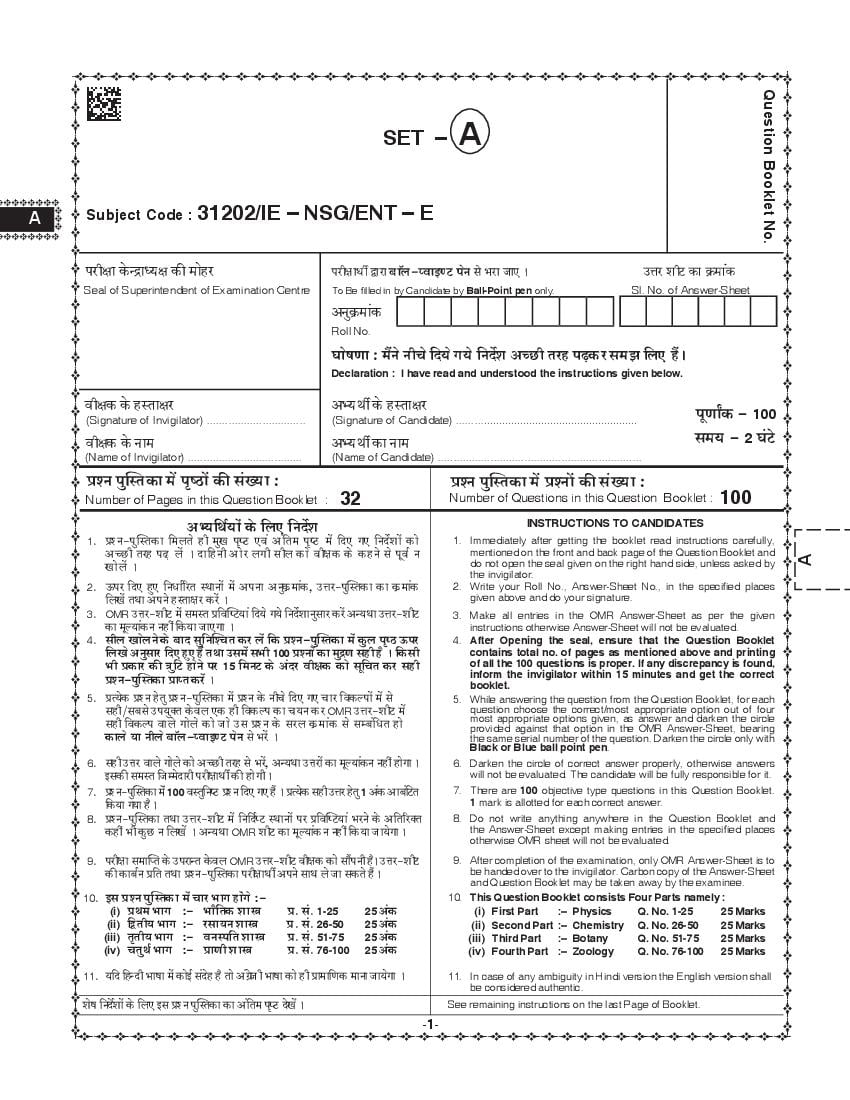
CG B.Sc Nursing 2021 Question Paper
Finished viewing? Save it for later —
Download CG B.Sc Nursing 2021 Question Paper (PDF · 32 pages)About CG B.Sc Nursing 2021 Question Paper
CG B.Sc Nursing 2021 Question Paper is available here for free download. Published by CG Vyapam for CG B.Sc Nursing, this question paper can be viewed online or downloaded as a PDF (32 pages). Candidates preparing for CG B.Sc Nursing can use CG B.Sc Nursing 2021 Question Paper to understand the exam pattern, the type of questions asked, and the overall difficulty level.
Frequently Asked Questions
How can I download CG B.Sc Nursing 2021 Question Paper?
Open this page and click the Download button to save CG B.Sc Nursing 2021 Question Paper as a PDF. It is completely free on AglaSem Docs.
Is CG B.Sc Nursing 2021 Question Paper free to download?
Yes. CG B.Sc Nursing 2021 Question Paper can be viewed online and downloaded as a PDF free of cost on AglaSem Docs.
How many pages does CG B.Sc Nursing 2021 Question Paper have?
CG B.Sc Nursing 2021 Question Paper contains 32 pages, which you can read online or download together as a single PDF.
Where can I find more CG B.Sc Nursing study material?
You can find more CG B.Sc Nursing question papers, sample papers, syllabus, and answer keys on AglaSem Docs.
CG B.Sc Nursing 2021 Question Paper – Text
Read the full text of this question paper below — useful to quickly search, copy and reference the content online without downloading the PDF.
📄 View text version (32 pages)
Page 1
DDDDDDDDDDDDDDDDDDDDDDDDDDDDDDDDDDDDDDDDDDDDDDDDDDDDDD
DDDDDDDDDDDDDDDDDDDDDDDDDDDDDDDDDDDDDDDDDDDDDDDDDDDDDD
Question Booklet No.
SET – A
JJJJJJJJ
AA Subject Code : 31202/IE – NSG/ENT – E
JJJ
A
JJJJJJJJ
narjm Ho$ÝÐmÜ`j H$s _moha narjmWu Ûmam ~m°b-ßdmBÊQ> noZ go ^am OmE & CÎma erQ> H$m H«$_m§H$
Seal of Superintendent of Examination Centre To be filled in by Candidate by Ball-Point pen only. Sl. No. of Answer-Sheet
AZwH«$_m§H$
Roll No.
KmofUm : _¢Zo ZrMo {X`o J`o {ZX}e AÀN>r Vah n‹T>H$a g_P {bE h¢Ÿ&
Declaration : I have read and understood the instructions given below.
drjH$ Ho$ hñVmja Aä`Wu Ho$ hñVmja
(Signature of Invigilator) ................................ (Signature of Candidate) ............................................................ nyUmªH$ - 100
drjH$ Ho$ Zm_ Aä`Wu H$m Zm_ g_` - 2 K§Qo
(Name of Invigilator) ..................................... (Name of Candidate) ..................................................................
àíZ nwpñVH$m _| n¥îR>m| H$s g§»`m : àíZ nwpñVH$m _| àíZm| H$s g§»`m :
Number of Pages in this Question Booklet : 32 Number of Questions in this Question Booklet : 100
Aä`{W©`m| Ho$ {bE {ZX}e instructionS To candidates
1. àíZ-nwpñVH$m {_bVo hr _wI n¥îR> Ed§ A§{V_ n¥îR> _| {XE JE {ZX}em| H$mo 1. Immediately after getting the booklet read instructions carefully,
AÀN>r Vah n‹T> b| Ÿ& Xm{hZr Amoa bJr grb H$mo drjH$ Ho$ H$hZo go nyd© Z mentioned on the front and back page of the Question Booklet and
A
Imob| Ÿ& do not open the seal given on the right hand side, unless asked by
the invigilator.
2. D$na {XE hþE {ZYm©[aV ñWmZm| _| AnZm AZwH«$_m§H$, CÎma-nwpñVH$m H$m H«$_m§H$ 2. Write your Roll No., Answer-Sheet No., in the specified places
{bI| VWm AnZo hñVmja H$a| Ÿ& given above and do your signature.
3. OMR CÎma-erQ> _| g_ñV à{dpîQ>`m§ {X`o J`o {ZX}emZwgma H$a| AÝ`Wm CÎma-erQ> 3. Make all entries in the OMR Answer-Sheet as per the given
H$m _yë`m§H$Z Zht {H$`m OmEJm Ÿ& instructions otherwise Answer-Sheet will not be evaluated.
4. grb ImobZo Ho$ ~mX gw{ZpíMV H$a b| {H$ àíZ-nwpñVH$m _| Hw$b n¥îR> D$na 4. After Opening the seal, ensure that the Question Booklet
{bIo AZwgma {XE hþE h¢ VWm Cg_| g^r 100 àíZm| H$m _wÐU ghr h¡ Ÿ& {H$gr contains total no. of pages as mentioned above and printing
^r àH$ma H$s Ìw{Q> hmoZo na 15 {_ZQ> Ho$ A§Xa drjH$ H$mo gy{MV H$a ghr of all the 100 questions is proper. If any discrepancy is found,
inform the invigilator within 15 minutes and get the correct
àíZ-nwpñVH$m àmßV H$a| Ÿ& booklet.
5. àË`oH$ àíZ hoVw àíZ-nwpñVH$m _| àíZ Ho$ ZrMo {XE JE Mma {dH$ënm| _| go 5. While answering the question from the Question Booklet, for each
ghr/g~go Cn`wŠV Ho$db EH$ hr {dH$ën H$m M`Z H$a OMR CÎma-erQ> _| question choose the correct/most appropriate option out of four
most appropriate options given, as answer and darken the circle
ghr {dH$ën dmbo Jmobo H$mo Omo Cg àíZ Ho$ gab H«$_m§H$ go gå~§{YV hmo provided against that option in the OMR Answer-Sheet, bearing
H$mbo `m Zrbo ~m°b-ßdmBÊQ> noZ go ^a| Ÿ& the same serial number of the question. Darken the circle only with
Black or Blue ball point pen.
6. ghr CÎma dmbo Jmobo H$mo AÀN>r Vah go ^a|, AÝ`Wm CÎmam| H$m _yë`m§H$Z Zht hmoJm & 6. Darken the circle of correct answer properly, otherwise answers
BgH$s g_ñV {Oå_oXmar narjmWu H$s hmoJr & will not be evaluated. The candidate will be fully responsible for it.
7. àíZ-nwpñVH$m _| 100 dñVw{ZîR> àíZ {XE JE h¢ Ÿ& àË`oH$ ghr CÎma hoVw 1 A§H$ Am~§{Q>V 7. There are 100 objective type questions in this Question Booklet.
{H$`m J`m h¡ & 1 mark is allotted for each correct answer.
8. àíZ-nwpñVH$m VWm CÎma-erQ> _| {Z{X©îQ> ñWmZm| na à{dpîQ>`m§ ^aZo Ho$ A{V[aŠV 8. Do not write anything anywhere in the Question Booklet and
H$ht ^r Hw$N> Z {bI| Ÿ& AÝ`Wm OMR erQ> H$m _yë`m§H$Z Zht {H$`m Om`oJm & the Answer-Sheet except making entries in the specified places
otherwise OMR sheet will not be evaluated.
9. narjm g_mpßV Ho$ CnamÝV Ho$db OMR CÎma-erQ> drjH$ H$mo gm¢nZr h¡& CÎma-erQ 9. After completion of the examination, only OMR Answer-Sheet is to
H$s H$m~©Z à{V VWm àíZ-nwpñVH$m narjmWu AnZo gmW bo Om gH$Vo h¢ & be handed over to the invigilator. Carbon copy of the Answer-Sheet
and Question Booklet may be taken away by the examinee.
10. Bg àíZ nwpñVH$m _| Mma ^mJ hmo§Jo :- 10. This Question Booklet consists Four Parts namely :
(i) àW_ ^mJ :- ^m¡{VH$ emñÌ à. g§. 1-25 25 A§H$ (i) First Part :– Physics Q. No. 1-25 25 Marks
(ii) {ÛVr` ^mJ :- agm`Z emñÌ à. g§. 26-50 25 A§H$ (ii) Second Part :– Chemistry Q. No. 26-50 25 Marks
(iii) V¥Vr` ^mJ :- dZñn{V emñÌ à. g§. 51-75 25 A§H$ (iii) Third Part :– Botany Q. No. 51-75 25 Marks
(iv) MVwW© ^mJ :- àmUr emñÌ à. g§. 76-100 25 A§H$ (iv) Fourth Part :– Zoology Q. No. 76-100 25 Marks
11. `{X {hÝXr ^mfm _| H$moB© g§Xh
o h¡ Vmo A§JO
o« r ^mfm H$mo hr àm_m{UH$ _mZm Om`oJm Ÿ& 11. In case of any ambiguity in Hindi version the English version shall
be considered authentic.
eof {ZX©e
o m| Ho$ {bE Bg àíZ nwpñVH$m H$m A§{V_ n¥îR> XoI| & See remaining instructions on the last Page of Booklet.
-1-
DDDDDDDDDDDDDDDDDDDDDDDDDDDDDDDDDDDDDDDD
Page 2
He
ITE
WR
T
NO
DO
-2- Set-A
Page 3
Physics ^m¡{VH$ emñÌ
1. When a system is taken from state ‘a’ 1. O~ EH$ {ZH$m` H$mo {MÌ Ho$ AZwgma EH$ AdñWm
to state ‘c’ along path adc, as shown ‘a’ go Xÿgao AdñWm ‘c’ VH$ nW adc _| bo Om`m
in figure, it is found that Q = 65 cal OmVm h¡, Vmo Q = 65 H¡$bmoar VWm W = 34 H¡$bmoar
and W = 34 cal. Along the path abc,
Q = 46 cal, then along the path abc, W is
nm`m OmVm h¡& nW abc _| Q = 46 H¡$bmoar h¡, Vmo
nW abc _| W H$m _mZ hmoJm
(A) 8 cal (A) 8 H¡$bmoar
(B) 12 cal (B) 12 H¡$bmoar
(C) 14 cal (C) 14 H¡$bmoar
(D) 16 cal (D) 16 H¡$bmoar
2. Three discs A, B and C having radii 2. VrZ MH$Vr ({S>ñH$) A, B Ed§ C {OgHo$ {ÌÁ`mE±
2m, 4m and 6m respectively are H«$_e: 2 _r, 4 _r Ed§ 6 _r h¡, H$mo CgHo$ ~mhar
coated with carbon black on their gVh na H$mbm H$m~©Z H$m bon {H$`m J`m &
outer surfaces. The wavelength
corresponding to maximum intensity
A{YH$V_ Vrd«>Vm Ho g§JV Va§JX¡¿`© H«$_e:
are 300 nm, 400 nm and 500 nm 300 nm, 400 nm Ed§ 500 nm h¡& CgHo$
respectively. The power radiated by Ûmam {dH${gV epŠV (power radiated)
them are θA, θB and θC respectively. H«$_e: θA, θB Ed§ θC h¡, Vmo$
Then
(A) θA is maximum (A) θA A{YH$V_ h¡
(B) θB is maximum (B) θB A{YH$V_ h¡
(C) θC is maximum (C) θC A{YH$V_ h¡
(D) θA = θB = θC (D) θA = θB = θC
-3- Set-A
Page 4
motion between x = – a and x = +a. The
AmdVu J{V H$a ahm h¡ & CgHo$ {bE 0 go a 2 VH$
time taken for it to go from 0 to a is
2 OmZo _| bJm g_` T1 d a 2 go a VH$ OmZo _| bJm
T1 and to go from a 2 to a is T2, then
g_` T2 hmo, Vmo
(A) T1 = π , T2 = π (A) T1 = π , T2 = π
6ω 2ω 6ω 2ω
π π π π
(B) T1 = , T2 = (B) T1 = , T2 =
6ω 3ω 6ω 3ω
π π π π
(C) T1 = , T2 = (C) T1 = , T2 =
3ω 6ω 3ω 6ω
π π π π
(D) T1 = , T2 = (D) T1 = , T2 =
3ω 2ω 3ω 2ω
4. The magnetic field at O due to current in 4. EH$ AZ§V MmbH$ {MÌ Ho$ AZwgma byn ~ZmVm h¡ &
the wire segment BC of the infinite wire Vma Ho$ ^mJ BC _| àdm{hV Ymam Ho$ H$maU {~ÝXþ
forming a loop as shown in figure is O na CËnÝZ Mwå~H$s` joÌ H$m _mZ hmoJm
µ0I µ0I
(A)
4πd
(cos φ1 + cos φ2 ) (A)
4πd
(cos φ1 + cos φ2 )
µ 0 2I µ 0 2I
(B) (B)
4π d 4π d
µ0I µ0I
(C)
4πd
(sin φ1 + sin φ2 ) (C)
4πd
(sin φ1 + sin φ2 )
µ0 I µ0 I
(D) (D)
4π d 4π d
-4- Set-A
Page 5
electrodes during electrolysis when AnKQ>Z Ho$ Xm¡amZ EH$ {dÚwV Ûma (electrode)
1 coulomb of electricity is passed is
go _wŠV nXmW© H$hbmVm h¡
(A) Chemical equivalent (A) amgm`{ZH$ g_Vwë`
(B) Electrochemical equivalent (B) {dÚwV amgm`{ZH$ g_Vwë`
(C) Equivalent weight (C) g_Vwë` ^ma
(D) One mol (D) EH$ _mob
6. A beam of electrons is accelerated 6. EH$ BboŠQ´>mZ nw§O H$mo V {d^dmÝVa go Ëd[aV {H$`m
through a potential difference V. It OmVm h¡, Am¡a Bgo EH$ g_mZ Mwå~H$s` joÌ go
is then passed normally through a bå~dV² JwOmam OmVm h¡, Ohm± dh “r” {ÌÁ`m Ho$
uniform magnetic field where it moves
d¥Îmr` nW na Ky_Vm h¡ & `{X `h “2r” {ÌÁ`m Ho$
in a circle of radius “r”. It would have
moved in a circle of radius “2r” if it were d¥Îm _| Ky_Vm Vmo àma§^ _| {d^dmÝVa Wm
initially accelerated through a potential
difference
(A) 2 V (B) 2 V (A) 2V (B) 2 V
(C) 2 2 V (D) 4 V (C) 2 2 V (D) 4 V
7. If the intensity of magnetic field at a 7. R {ÌÁ`m Ho$ EH$ Ymamdmhr Hw$ÊS>br Ho$ Aj Ho$ {H$gr
point on the axis of current carrying {~ÝXþ na Mwå~H$s` joÌ H$s Vrd«Vm CgHo$ Ho$ÝÐ na
coil of radius R is half of that at the Mwå~H$s` joÌ H$s Vrd«Vm H$s AmYr hmo, Vmo dh {~ÝXþ
centre of the coil, then the distance of
that point from the centre of the coil
Hw$ÊS>br Ho$ Ho$ÝÐ go {H$VZr Xÿar na hmoJm ?
will be
R R
(A) (B) R (A) (B) R
2 2
3R 3R
(C) (D) 0.766 R (C) (D) 0.766 R
2 2
-5- Set-A
Page 6
Prescribe a lens for his spectacles, so h¡ & 12 _rQ>a H$s Xÿar VH$ gm\$ XoIZo Ho$ {bE Mí_|
that he can see clearly upto 12 meters _| H$m¡Z-gm b|g gwPm`m OmEJm ?
−3 −3
(A) D (A) D
4 4
(B) 3D (B) 3D
1 1
(C) − D (C) − D
4 4
(D) – 4D (D) – 4D
9. The electron in a hydrogen atom 9. EH$ hmBS´>moOZ na_mUw _| BboŠQ´>mZ CËÎmo{OV AdñWm
makes a transition from an excited go _yb AdñWm _| g§H«$_U H$aVm h¡ & {ZåZ _o§ go
state to the ground state. Which of the H$m¡Z-gm H$WZ ghr h¡ ?
following statement is true ?
(A) Its kinetic energy increases and (A) BgH$s J{VO D$Om© ~‹T>Vr h¡ VWm BgH$s
its potential and total energy pñW{VO Ed§ Hw$b D$Om© KQ>Vr h¡
decreases
(B) Its kinetic energy decreases, (B) BgH$s J{VO D$Om© KQ>Vr h¡ pñW{VO D$Om© ~‹T>Vr
potential energy increases and its h¡ VWm Hw$b D$Om© g_mZ ~Zr ahVr h¡
total energy remains the same
(C) Its kinetic energy and total energy (C) BgH$s J{VO VWm Hw$b D$Om© KQ>Vr h¡ VWm
decreases and its potential energy pñW{VO D$Om© ~‹T>Vr h¡
increases
(D) Its kinetic, potential and total (D) BgH$s J{VO, pñW{VO VWm Hw$b D$Om© KQ>Vr h¡
energy decreases
++ +
10. The ratio of the wavelengths for n = 2 to 10. n = 2 go n = 1 g§H«$_U Li , He VWm H _|
++ +
n = 1 transition in Li , He and H is hmoZo na àmßV Va§JX¡¿`m] H$m AZwnmV h¡
(A) 1 : 4 : 9 (B) 9 : 4 : 1 (A) 1 : 4 : 9 (B) 9 : 4 : 1
(C) 4 : 9 : 36 (D) 36 : 9 : 4 (C) 4 : 9 : 36 (D) 36 : 9 : 4
-6- Set-A
Page 7
a tower of height h metre. It takes OmVm h¡ & O_rZ VH$ nhþ±MZo _| Cgo T goH$ÊS>
T second to reach the ground. What is bJVm h¡ & T 3 goH$ÊS> Ho$ ~mX J|X H$s pñW{V Š`m
the position of the ball in T second ? hmoJr ?
3
(A) metre from the ground
h
(A) O_rZ go h _rQ>a
9 9
(B) metre from the ground
7h
(B) O_rZ go 7h _rQ>a
9 9
(C) 8h metre from the ground (C) O_rZ go 8h _rQ>a
9 9
17h
17h
(D) metre from the ground (D) O_rZ go _rQ>a
18 18
12. Power applied to a particle varies 12. EH$ H$U na Amamo{nV epŠV g_` Ho$ gmW
with time as P = (3t2 – 2t + 1) Watt, P = (3t2 – 2t + 1) dmQ> Ho$ AZwgma ~Xb ahm
where t is in second. Find the h¡, Ohm± t goH$ÊS> _| h¡ & J{VO D$Om© _| g_`
change in kinetic energy between
t = 2 sec Ed§ t = 4 sec Ho$ ~rM n[adV©Z kmV
t = 2 sec and t = 4 sec.
H$s{OE &
(A) 32 J (B) 46 J (A) 32 J (B) 46 J
(C) 61 J (D) 100 J (C) 61 J (D) 100 J
13. What will be the effect on the weight of 13. n¥Ïdr Ho$ gVh na aIo hþE EH$ dñVw Ho$ ^ma _| Š`m
a body placed on the surface of earth if à^md n‹S>oJm `{X n¥Ïdr AMmZH$ AnZo KyU©Z Ho$
earth suddenly starts rotating with half AmYo H$moUr` doJ Ho$ gmW Ky_Zm àma§^ H$a Xo ?
of its angular velocity of rotation ?
(A) No effect (A) H$moB© à^md Zht
(B) Weight will decrease (B) ^ma KQ> Om`oJm
(C) Weight will increase (C) ^ma ~‹T> Om`oJm
(D) Weight will become zero (D) ^ma eyÝ` hmo Om`oJm
-7- Set-A
Page 8
V(x, y, z) = 6xy – y + 2yz, the electric J`m h¡ V(x, y, z) = 6xy – y + 2yz, Vmo {~ÝXþ
field at point (1, 1, 0) is
(1, 1, 0) na {dÚwV joÌ H$m _mZ hmoJm
∧ ∧ ∧
∧ ∧ ∧
(A) − 2 i + 3 j + k (A) − 2 i + 3 j + k
∧ ∧ ∧
∧ ∧ ∧
(B) − 6 i + 9 j + k (B) − 6 i + 9 j + k
∧ ∧ ∧
∧ ∧ ∧
(C) − 3 i + 5 j + 3 k (C) − 3 i + 5 j + 3 k
∧ ∧ ∧
∧ ∧ ∧
(D) − 6 i + 5 j + 2 k (D) − 6 i + 5 j + 2 k
15. A charge q is placed at the centre of 15. EH$ Amdoe q Xmo g_mZ Amdoem| Q H$mo Omo‹S>Zo
the line joining two equal charges Q. dmbr aoIm Ho$ _Ü` _| aIm h¡ & VrZ Amdoem| go ~Zm
The system of the three charges will `h {ZH$m` g§VwbZ _| hmoJm `{X Amdoe q H$m _mZ
be in equilibrium, if q is equal to
hmoJm
Q Q Q Q
(A) (B) − (A) (B) −
4 4 4 4
Q Q Q Q
(C) (D) − (C) (D) −
2 2 2 2
16.
A sound source is moving towards a EH$ Üd{ZòmoV pñWa àojH$ H$s Amoa Üd{Z Ho$ doJ
16.
stationary observer with 1 of the H$m 110 doJ go J{V H$a ahm h¡& dmñV{dH$ Ed§
10
speed of sound. The ratio of real to Am^mgr Amd¥{Îm H$m AZwnmV h¡
apparent frequency is
9 10 9 10
(A) (B) (A) (B)
10 11 10 11
2 2 2 2
(C) (D) (C) (D)
10 10 10 10
11 9 11 9
-8- Set-A
Page 9
as shown in the given figure. The A Ed§ B Ho$ _Ü` g_Vwë` à{VamoY hmoJm
equivalent resistance between
A and B is
(A) 4 Ω (B) 8 Ω (A) 4 Ω (B) 8 Ω
(C) 4.5 Ω (D) 15 Ω (C) 4.5 Ω (D) 15 Ω
18. A rocket is going away from the 18. EH$ amHo$Q> 0.2 C Mmb go n¥Ïdr go Xÿa Om ahm h¡ ,
earth at a speed 0.2 C, where C is Ohm± C àH$me H$s Mmb$ h¡ & amHo$Q> 4 × 10⁷ hQ²>©O
the speed of light. It emits a signal
of frequency 4 × 10⁷ Hz. What will
Amd¥{Îm H$m {gJZb CËg{O©V H$aVm h¡ & n¥Ïdr na
be the frequency observed by an CnpñWV àojH$ Ûmam ào{jV Amd¥{Îm hmoJr ?
observer on the earth ?
(A) 4 × 10⁶ Hz (B) 3.2 × 10⁷ Hz (A) 4 × 10⁶ hQ²>©O (B) 3.2 × 10⁷ hQ²>©O
(C) 3 × 10⁶ Hz (D) 5 × 10⁷ Hz (C) 3 × 10⁶ hQ²>©O (D) 5 × 10⁷ hQ²>©O
19. A concave mirror of focal length f (in air) 19. EH$ AdVb Xn©U {OgH$s \$moH$g Xÿar f (hdm _|)
is immersed in water (µ = 4/3). The focal h¡, H$mo nmZr (µ = 4/3) _| Sw>~m {X`m J`m h¡ & nmZr
length of the mirror in water will be _| Xn©U H$s \$moH$g Xÿar hmoJr
4 4
(A) f (B) f (A) f (B) f
3 3
3 7 3 7
(C) f (D) f (C) f (D) f
4 3 4 3
-9- Set-A
Page 10
radius are joined end to end and Omo‹S>m J`m VWm ^ma bQ>H$m`m J`m & `{X Vmam| Ho$
loaded. If the Young’s modulus of the
materials of the wires are Y1 and Y2,
nXmW© H$m `§J àË`mñWVm JwUm§H$ Y1d Y2 h¡, Vmam|
the combination behaves as a single H$m g§`moOZ EH$ Vma H$s Vah ì`dhma H$aVm h¡, Vmo
wire of Young’s modulus CgH$m `§J àË`mñWVm hmoJm
(A) Y1 + Y2 (B) Y1 Y2 (A) Y1 + Y2 (B) Y1 Y2
Y1 + Y2 2Y1 Y2 Y1 + Y2 2Y1 Y2
(C) (D) (C) (D)
2 Y1 + Y2 2 Y1 + Y2
21. An ice cube of volume 1m3 is kept 21. EH$ ~\©$ H$m Qw>H$‹S>m {OgH$m Am`VZ 1_r3 h¡, Cgo
in a gravity free room. When ice has JwéËdmH$f©U _wŠV H$_ao _| aIm J`m h¡ & O~ ~\©$
melted, the surface area of ice is {nKb MwH$m hmoJm, Vmo ~\©$ H$m n¥îR> joÌ\$b hmoJm
1 1 1 1
(A) ( 9π ) 3 (B) (18π ) 3 (A) ( 9π ) 3 (B) (18π ) 3
1 1 1 1
(C) ( 36π ) 3 (D) ( 27π ) 3 (C) ( 36π ) 3 (D) ( 27π ) 3
22. A coil in the shape of an equilateral 22. EH$ 0.02 _rQ>a ^wOm dmbo g_~mhþ {Ì^wO H$s
triangle of side 0.02 m is suspended AmH¥${V dmbr Hw$ÊS>br H$mo CgHo$ EH$ erf© go
from its vertex such that it is hanging EH$ CÜdm©Ya Vb _| EH$ ñWm`r Mwå~H$ {OgH$m
in a vertical plane between the pole
pieces of permanent magnet producing
Mwå~H$s` joÌ (EH$ g_mZ) 5 × 10⁻² Q>oñbm h¡,
magnetic field (uniform) of 5 × 10⁻² T. Ho$ Y«wdm| Ho$ ~rM bQ>H$m`m OmVm h¡ & `{X Hw$ÊS>br go
If a current of 0.1 A is passed through 0.1 Epån`a H$s Ymam àdm{hV H$s Om`|, V~
the coil, what is the couple acting ? Hw$ÊS>br na bJZo dmbo ~b`w½_ H$m _mZ h¡
(A) 5 3 × 10⁻⁷ N-m (A) 5 3 × 10⁻⁷ Ý`yQ>Z-_rQ>a
(B) 5 3 × 10⁻¹⁰ N-m (B) 5 3 × 10⁻¹⁰ Ý`yQ>Z-_rQ>a
3 3
(C) × 10–7 N-m (C) × 10–7 Ý`yQ>Z-_rQ>a
5 5
(D) None of these (D) BZ_o§ go H$moB© Zht
-10- Set-A
Page 11
of two different materials of same Cî_r` MmbH$Vm Ho$ Xmo {d{^Þ àH$ma Ho$ nXmWm] Ho$
thickness and thermal conductivities Xmo g_mZmÝVa naVm| H$m ~Zm hþAm h¡ & nÅ>r (ñb¡~)
K1 and K2. The equivalent thermal
conductivity of the slab is
H$m Vwë` Cî_r` MmbH$Vm hmoJm
K1 K1
(A) K1 – K2 (B) (A) K1 – K2 (B)
K2 K2
2K1 K 2 K1 + K 2 2K1 K 2 K1 + K 2
(C) (D) (C) (D)
K1 + K 2 2K1 K 2 K1 + K 2 2K1 K 2
24. The circuit has two oppositely connected 24. {MÌ _|$ Xem©`o J`o n[anW _o§ Xmo nañna {dnarV {Xem
ideal diodes in parallel as shown in the _§o g_mÝVa H«$_ _| gpÝY S>m`moS> Ow‹S>o h¡ & n[anW _|
figure. What is the current flowing in the ~hZo dmbr Ymam H$m _mZ h¡
circuit ?
(A) 1.71 A (B) 2.00 A (A) 1.71 Epån`a (B) 2.00 Epån`a
(C) 2.31 A (D) 1.33 A (C) 2.31 Epån`a (D) 1.33 Epån`a
25. Two tangent galvanometers having 25. g_mZ {ÌÁ`m Ho$ Xmo ñne©Á`m Ymam_mnr H$mo loUrH«$_
coils of the same radius are connected _o§ Omo‹S>m J`m h¡ & {H$gr Ymam H$mo BZ Ymam_m{n`m| _§o
in series. A current flowing in them àdm{hV H$aZo na CËnÝZ {djon H«$_e: 60° VWm
produces deflections 60° and 45°
45° h¡ & BZ Ymam_m{n`m| H$s Hw$ÊS>br _o§ \o$am| H$s
respectively. The ratio of the number
of turns in the coils is g§»`m H$m AZwnmV h¡
1 1
(A) 1 (B) (A) 1 (B)
3 3 +1 3 3 +1
3 3 −1 3 3 −1
(C) (D) (C) (D)
1 3 +1 1 3 +1
-11- Set-A
Page 12
Chemistry agm`Z emñÌ
26. Coconut charcoal at –373 K temperature 26. –373 K Vmn na H$moH$moZQ> MmaH$mob EH$ {_lU
adsorbs a mixture of
H$mo A{Yemo{fV H$aVm h¡
(A) He, Kr, Ne (A) He, Kr, Ne
(B) Kr, Xe, Ne (B) Kr, Xe, Ne
(C) He, Ne, Ar (C) He, Ne, Ar
(D) Ar, Kr, Xe (D) Ar, Kr, Xe
27. Paris green is 27. no[ag J«rZ h¡
(A) Cu(CH3COO)2.3Cu(AsO2)2 (A) Cu(CH3COO)2. 3Cu(AsO2)2
(B) Co(AlO2)2 (B) Co(AlO2)2
(C) Cu3(AsO3)2. 2H2O (C) Cu3(AsO3)2. 2H2O
(D) Cu(CH3COO)2 (D) Cu(CH3COO)2
28. In solid CuSO4. 5H2O, Copper is 28. CuSO4. 5H2O R>mog _|, H$mna go g_pÝdV h¡
coordinated to
(A) One sulphate ion (A) EH$ gë\o$Q> Am`Z
(B) One water molecule (B) Ob H$m EH$ AUw
(C) Five water molecules (C) Ob H$m nm±M AUw
(D) Four water molecules (D) Ob H$m Mma$AUw
-12- Set-A
Page 13
Compounds and are VWm `m¡{JH$ H«$_e: h¡
respectively
(A) (A)
(B) (B)
(C) (C)
(D) (D)
30. When C6H5 N2Cl is reduced with 30. O~ C6H5N2Cl H$mo Na2SnO2Ho$ gmW
Na2SnO2, the product is AnM{`V {H$`m OmVm h¡, Vmo CËnmX h¡
(A) (B) (A) (B)
(C) (D) (C) (D)
-13- Set-A
Page 14
matched ?
(A) Orlon – Vinylchloride (A) Amoabm°Z – {dZmBbŠbmoamBS>
(B) Kodel – Terephthalic Acid (B) H$moS>ob – Q>oarâW¡{bH$ Aåb
(C) Neoprene – 2-bromo-1,3-butadiene (C) {Z`moàrZ – 2-~«mo_mo-1, 3-ã`yQ>mS>mBZ
(D) Dextrin – fructose (D) S>oŠñQ´>rZ – \«$ŠQ>moO
32. The polymer obtained from 32. gr~ogrH$ Aåb Am¡a hoŠgm{_W¡brZ-S>m>BA_rZ
condensation of sebacic acid and Ho$ gKZ>Z go ~Zm ~hþbH$ H$hbmVm h¡
hexamethylene diamine is called
(A) Dacron (B) Nylon-6,6 (A) S>oH«$mZ (B) ZmBbmZ-6,6
(C) Nylon-6,10 (D) Dynel (C) ZmBbmZ-6,10 (D) S>mBZob
33. The ionization energy of the hydrogen 33. hmBS´>moOZ na_mUw H$s Am`ZrH$aU D$Om© H$mo Bg
atom can be expressed as (Given that àH$ma ì`ŠV {H$`m Om gH$Vm h¡ ({X`m J`m h¡ {H$
R∝ = 109737 cm–1) R∝ = 109737 go_r–1)
(A) 109737 cm–1 (A) 109737 go_r–1
(B) 13.6 eV (B) 13.6 eV
(C) 2.1787 � 10–18 J (C) 2.1787 � 10–18 J
(D) All the above way (D) CnamoŠV g^r VarHo$ go
34. Among CH4, NH3, SO 2− 4 , XeF 4 and 4 , XeF4 Am¡a BF3 Ho$ ~rM
34. CH4, NH3, SO 2−
BF3 the number of species having drEgB©nrAma _m°S>b Ho$ AZwgma, MVwî\$bH$s`
tetrahedral shape according to vsepr AmH$ma dmbr àOm{V`m| H$s g§»`m {H$VZr h¡ ?
model is
(A) 4 (B) 3 (A) 4 (B) 3
(C) 2 (D) 1 (C) 2 (D) 1
-14- Set-A
Page 15
shaped ideal crystal of NaCl of mass
1.0 gram is
{H«$>ñQ>b _| CnpñWV EH$H$ gobm| H$s g§»`m h¡
(A) 1.28 � 1021 unit cells (A) 1.28 � 1021 EH$H$ gob
(B) 1.71 � 1021 unit cells (B) 1.71 � 1021 EH$H$ gob
(C) 2.57 � 1021 unit cells (C) 2.57 � 1021 EH$H$ gob
(D) 5.14 � 1021 unit cells (D) 5.14 � 1021 EH$H$ gob
36. Arrange the following compounds in 36. HBr Ho$ `moJ Ho$ {bE à{V{H«$`merbVm Ho$ ~‹T>Vo
increasing order of reactivity towards H«$_ _| {ZåZ{b{IV `m¡{JH$m| H$mo ì`dpñWV H$a| &
the addition of HBr.
RCH = CHR, CH2 = CH2, R2C = CHR, RCH = CHR, CH2 = CH2, R2C = CHR,
R2C = CR2 R2C = CR2
(A) CH2 = CH2 < RCH = CHR (A) CH2 = CH2 < RCH = CHR
< R2C = CHR < R2C = CR2 < R2C = CHR < R2C = CR2
(B) R2C = CHR < RCH = CHR (B) R2C = CHR < RCH = CHR
< CH2 = Ch2 < R2C = CR2 < CH2 = Ch2 < R2C = CR2
(C) RCH = CHR <R2C = CR2 (C) RCH = CHR <R2C = CR2
< R2C = CHR < CH2 = CH2 < R2C = CHR < CH2 = CH2
(D) R2C = CR2 < R2C = CHR (D) R2C = CR2 < R2C = CHR
< RCH = CHR < CH2 = CH2 < RCH = CHR < CH2 = CH2
37. The rate of SN2 reaction is maximum 37. SN2 A{^{H«$`m H$s Xa A{YH$V_ hmoVr h¡, O~
when the solvent is {dbm`H$ h¡
(A) H2O (B) DMSO (A) H2O (B) DMSO
(C) CH3OH (D) C6H6 (C) CH3OH (D) C6H6
-15- Set-A
Page 16
COOH COOH
(A) (A)
COOH COOH
COOH COOH
(B) (B)
CO CO
(C) O (C) O
CO CO
COOH COOH
(D) (D)
CH2OH CH2OH
39. Consider following values at 298 K, 39. 298 K na {ZåZ _mZ na {dMma H$s{O`o,
Rate constant k = 3.0 � 10–4 sec–1, Xa {Z`Vm±H$ k = 3.0 � 10–4 sec–1,
Arrhenius factor A = 6.0 � 1014 sec–1, Amh}{Z`g H$maH$ A = 6.0 � 1014 sec–1,
Energy of activation = 104.4 kJ mol–1. g{H«$>`U D$Om© = 104.4 kJ mol–1 &
The value of rate constant at T → ∞ is T → ∞ na Xa {Z`Vm±H$ H$m _mZ h¡
(A) Zero (A) eyÝ`
(B) Infinity (B) AZÝV
(C) 3.0 � 10–4 sec–1 (C) 3.0 � 10–4 sec–1
(D) 6.0 � 1014 sec–1 (D) 6.0 � 1014 sec–1
-16- Set-A
Page 17
The reduction half-reactions of a fuel 40. BªYZ gob H$s AnM`Z AY©-A{^{H«$`mE± hmoVr h¢
cell are
i. O2(g) + 4 H+ (aq) + 4e– → 2H2O(l) i. O2(g) + 4 H+ (aq) + 4e– → 2H2O(l)
= + 1.23 V = + 1.23 V
ii. 2H+(aq) + 2e– → H2(g) ii. 2H+(aq) + 2e– → H2(g)
=0 =0
The cell emf produced by a fuel cell that AmŠgrOZ Ho$ gmW hmBS´>moOZ H$mo ObmZo dmbo BªYZ
burns hydrogen with oxygen will be gob Ûmam CËnm{XV gob B©E_E\$ hmoJm
(A) –1.23 V (B) +1.23 V (A) –1.23 V (B) +1.23 V
(C) + 2.46 V (D) – 2.46 V (C) + 2.46 V (D) – 2.46 V
41. Elements having low IP and combine 41. {ZåZ Am`ZZ {d^d, AmŠgrOZ go OwS‹ Zo H$s Vrd«
strongly to oxygen and occur mostly j_Vm VWm A{YH$Va AmŠgmBS>m| Ed§ {g{bHo$Q>m|
as oxides and silicates are known as Ho$ ê$n _| nm`m OmZo dmbm VËd H$hbmVm h¡
(A) Siderophillic (A) {gS>oamo{\${bH$
(B) Chalcophyllic (B) MmbH$mo{\${bH$
(C) Lithophillic (C) {bWmo{\${bH$
(D) Atmophyllic (D) EQ>_mo{\${bH$
42. Uranium-236 undergo fission into 42. `wao{Z`_-236, µOoZ°Z-140 Am¡a ñQ´>m|{Q>`_-93
Xenon-140 and Strontium-93 nuclei Zm{^H$m| _| {dI§S>Z go JwOaVm h¡
236 140 93
92
U
→ 54 Xe + 28Sr + 3n 236
U
→
140 93
Xe + 28Sr + 3n
92 54
The values of E bind/A for 236U, 140Xe
U, 140Xe Am¡a 93Sr Zm{^H$ Ho$ {bE
236
and 93 Sr nuclei are 7.6, 8.4 and
E ~mB§S>/A H$m _mZ H«$_e: 7.6, 8.4 Am¡a
8.7 MeV respectively. The energy
released in this reaction is 8.7 MeV h¡ & Bg à{V{H«$`m _| {ZJ©V D$Om© h¡
(A) 13.6 MeV (A) 13.6 MeV
(B) 191.5 MeV (B) 191.5 MeV
(C) 931 MeV (C) 931 MeV
(D) 236 MeV (D) 236 MeV
-17- Set-A
Page 18
PCl5 (g)
PCl3 (g) + Cl2 (g), inert
PCl5 (g)
PCl3 (g) + Cl2 (g) _|,
gas is added at constant volume. A{H«$` J¡g pñWa _mÌm _| S>mbr OmVr h¡ &
The equilibrium gmå`mdñWm
(A) Will not change (A) Zht ~XboJm
(B) Will shift towards products (B) CËnmXm| H$s Amoa ñWmZm§V[aV hmo OmEJm
(C) Will shift towards the reactant (C) A{^H$maH$ H$s Amoa ñWmZm§V[aV hmo OmEJm
(D) Will increase both reactant and (D) A{^H$maH$ Am¡a CËnmX XmoZm| _| d¥{Õ H$aoJm
products
44. When CO2 gas is passed into water, 44. O~ CO2 J¡g H$mo Ob _| àdm{hV {H$`m OmVm
the species present in water are h¡, Vmo Ob _| CnpñWV ñnrgrO h¢
(A) CO2, H2CO3 (A) CO2, H2CO3
(B) CO32–, HCO3– (B) CO32–, HCO3–
(C) CO2, H2CO3, HCO3– (C) CO2, H2CO3, HCO3–
(D) H2CO3, CO32 – (D) H2CO3, CO32 –
45. Which compound is formed when 45. H$mna gë\o$Q> Ho$ Obr` {db`Z _| KCN
excess of KCN is added to aqueous Am{YŠ` _| {_bmZo na H$m¡Z-gm `m¡{JH$ àmßV
solution of copper sulphate ? hmoVm h¡ ?
(A) K[Cu(CN)2] (A) K[Cu(CN)2]
(B) K2[Cu(CN)4] (B) K2[Cu(CN)4]
(C) K3[Cu(CN)4] (C) K3[Cu(CN)4]
(D) Cu(CN)2 (D) Cu(CN)2
-18- Set-A
Page 19
isomer) of a compound with molecular Hw$b gå^m{dV g_md`{d`m| H$s g§»`m ({Ì{d_
formula C4H10O are g_md`dVm H$mo boH$a)
(A) 4 (B) 8 (A) 4 (B) 8
(C) 6 (D) 10 (C) 6 (D) 10
47. The optically inactive isomers of 47. ã`yQ>Z -2,3-S>`mob Ho$ Am°pßQ>H$b ê$n go {ZpîH«$`
butan-2,3-diol are AmBgmo_g© h¢
(A) (II) and (IV) (A) (II) Am¡a (IV)
(B) (I) and (III) (B) (I) Am¡a (III)
(C) (I) and (IV) (C) (I) Am¡a (IV)
(D) (III) and (IV) (D) (III) Am¡a (IV)
-19- Set-A
Page 20
[A] + Zn → [B]
[A] + Zn → [B]
Hence [A] and [B] are
AV: [A] Ed§ [B] h¢
(A) Na2[Zn(CN)4], Zn (A) Na2[Zn(CN)4], Zn
(B) Na[Ag(CN)2], Ag (B) Na[Ag(CN)2], Ag
(C) Na2 [Ag(CN)4], Ag (C) Na2 [Ag(CN)4], Ag
(D) Na3 [Ag(CN)4], Ag (D) Na3 [Ag(CN)4], Ag
49. Identify the least stable ion amongst 49. {ZåZ Am`Zm| _| go g~go H$_ ñWm`r Am`Z H$mo
the following. nhMmZ| &
(A) Li– (A) Li–
(B) Be– (B) Be–
(C) B– (C) B–
(D) C– (D) C–
50. The oxidation number of sulphur in 50. S8, S2F2 Ed§ H2S _| gë\$a H$s AmŠgrH$aU
S8, S2F2, H2S respectively are g§»`m H«$_e: h¢
(A) 0, +1 and –2 (A) 0, +1 Am¡a –2
(B) +2, +1 and –2 (B) +2, +1 Am¡a –2
(C) 0, +1 and +2 (C) 0, +1 Am¡a +2
(D) –2, +1 and –2 (D) –2, +1 Am¡a –2
-20- Set-A
Page 21
Botany dZñn{V emñÌ
51. Which of the following is a pseudocereal ? 51. {ZåZ _o§ go H$m¡Z-gm EH$ N>X²_ YmÝ` h¡ ?
(A) Zea mays (A) {O`m _oO
(B) Oryza sativa (B) AmoamBOm gQ>mBdm
(C) Triticale secale (C) {Q´>{Q>Ho$b {gHo$b
(D) Fagopyrum esculentum (D) \¡$Jmonm`a_ EñHw$boÝQ>_
52. Dry fruits and vegetables are sold in 52. ewîH$ \$b Ed§ gpãO`m| H$mo grb {H$`o hþE dm`wamoYr
sealed air tight packets to n¡Ho$Q>m| _| ~oMZo H$m à_wI H$maU h¡
(A) Preserve the moisture (A) Z_r Ho$ n[aajU hoVw
(B) Preserve the aroma (B) Eamo_m Ho$ n[aajU hoVw
(C) Prevent the attack of microbes (C) gyú_ Ordm| Ho$ g§H«$_U go ~MmZo hoVw
(D) Preserve the taste (D) ñdmX Ho$ n[aajU hoVw
53. Bt-toxin genes are obtained from 53. Bt- Q>m°pŠgZ OrZ {H$ggo àmßV {H$`o J`o h¢ ?
(A) Plants (B) Virus (A) nm¡Ym| go (B) {dfmUwAm| go
(C) Fungi (D) Bacteria (C) H$dH$m| go (D) OrdmUwAm| go
54. Antibiotic Neomycin is obtained from 54. à{VO¡{dH$ {ZAmo_mB{gZ {H$ggo àmßV {H$`m
OmVm h¡ ?
(A) Streptomyces remosus (A) ñQ´>oßQ>mo_mBgog ao_mogg
(B) Streptomyces fradiae (B) ñQ´>oßQ>mo_mBgog \«¡$S>r
(C) Streptomyces venezualae (C) ñQ´>oßQ>mo_mBgog doZoOwEbr
(D) Streptomyces griseus (D) ñQ´>oßQ>mo_mBgog J«r{g`g
55. Glycolysis is part of 55. ½bm`H$mo{b{gg ^mJ h¡
(A) Krebs cycle (A) H«o$ãg MH«$ H$m
(B) Aerobic respiration only (B) Ho$db dm`dr` ídgZ H$m
(C) Anaerobic respiration only (C) Ho$db Adm`dr` ídgZ H$m
(D) Both aerobic and anaerobic (D) dm`dr` Ed§ Adm`dr` ídgZ XmoZm| H$m
respiration
-21- Set-A
Page 22
the function of delay in senescence of _| go {H$g hm_m}Z H$m h¡ ?
leaves ?
(A) Auxin (B) Gibberellins (A) Am°pŠOZ (B) {O~ao{bZ
(C) Cytokinin (D) Abscisic acid (C) gm`Q>moH$m`{ZZ (D) E~{g{gH$ Aåb
57. Shoot differentiation is controlled by 57. àamoh {d^oXZ H$m {Z`§ÌU {H$`m OmVm h¡
(A) High Auxin : Cytokinin ratio (A) CÀM Am°pŠOZ : gm`Q>moH$mB{ZZ AZwnmV
(B) High Cytokinin : Auxin ratio (B) CÀM gm`Q>moH$mB{ZZ : Am°pŠOZ AZwnmV
(C) High Gibberellin : Auxin ratio (C) CÀM {O~ao{bZ : Am°pŠOZ AZwnmV
(D) High Gibberellin : Cytokinin ratio (D) CÀM {O~ao{bZ : gm`Q>moH$mB{ZZ AZwnmV
58. Experiment of Hammerling is associated 58. h¡_aqbJ H$m à`moJ {ZåZ _| go {H$ggo g§~{§ YV h¡ ?
with which of the following ?
(A) Nucleus (B) Chloroplast (A) Ho$ÝÐH$ (B) h[aVbdH$
(C) Mitochondria (D) All of the above (C) _mBQ>moH$m°pÊS´>`m (D) CnamoŠV g^r
59. In lateral side of which of the following, 59. H$mBZoQ>moH$moa {ZåZ _| go {H$gHo$ nmíd© _| nm`o
kinetochore is found ? OmVo h¡§ ?
(A) Centromere (A) JwUgyÌ {~ÝXþ
(B) Secondary constriction (B) {ÛVr`H$ g§H$sU©Z
(C) Satellite (C) goQ>obmBQ>
(D) Chromatid (D) AY©JwUgyÌ
60. Which of the following change occurs 60. H$mo{eH$m MH«$ H$s ‘S’ àmdñWm _| {ZåZ _| go H$m¡Z-gm
in ‘S’ phase of cell cycle ? n[adV©Z hmoVm h¡ ?
(A) Amount of D.N.A. doubles (A) S>r.EZ.E. H$s _mÌm XmoJwZr hmo OmVr h¡
(B) Number of chromosome remains (B) JwUgyÌ H$s g§»`m An[ad{V©V ahVr h¡
unchanged
(C) Number of chromosome doubles (C) JwUgyÌ H$s g§»`m XmoJwZr hmo OmVr h¡
(D) All of the above (D) CnamoŠV g^r
-22- Set-A
Page 23
of light to flower is àH$me H$s Amdí`H$Vm Zht hmoVr h¡
(A) Long day plant (A) bå~o {XZ dmbo nm¡Yo
(B) Short day plant (B) N>moQ>o {XZ dmbo nm¡Yo
(C) Day neutral plant (C) {Xdg {Zanoj nm¡Yo
(D) None of the above (D) CnamoŠV _| go H$moB© Zht
62. Which of the following food chain starts 62. {ZåZ _| go H$m¡Z-gr ImÚ H$‹S>r$nmXnm| go àma§^
with plants ? hmoVr h¡ ?
(A) Predator (B) Parasitic (A) na^jr (B) naOrdr
(C) Saprophytic (D) All of the above (C) _¥VmonOrdr (D) CnamoŠV g^r
63. Pick up the correct food chain. 63. ghr ImÚ ûm§¥Ibm H$m M`Z H$s{OE &
(A) Grass → Chameleon → (A) Kmg → {Ja{JQ> → H$sQ> → njr
Insect → Bird
(B) Grass → Fox → Rabbit → Bird (B) Kmg → cmo_‹S>r → IaJmoe → njr
(C) Phytoplankton → Zooplankton (C) \$m`Q>moßb¡§ŠQ>m°Z → Oyßb¡§ŠQ>m°Z
→ Fish → _N>br
(D) Fallen leaves → Bacteria (D) {Jar hþB© n{Îm`m±→ OrdmUw
→ Insect larvae → H$s‹S>m| Ho$ bmdm©
64. Which of the following is not an mRNA 64. {ZåZ _| go H$m¡Z-gm mRNA H$m H$moS>mZ° Zht h¡ ?
codon ?
(A) UUG (B) UCU (A) UUG (B) UCU
(C) TAC (D) UUU (C) TAC (D) UUU
65. Which of the following amino acid is 65. àma§^H$ àHy$Q> Ûmam {ZåZ _| go {H$g A_rZmo Aåb
coded by initiation codon ? H$m Hy$Q>boIZ {H$`m OmVm h¡ ?
(A) Leucine (B) Valine (A) ë`ygrZ (B) dobmBZ
(C) Methionine (D) Serine (C) _r{W`moZrZ (D) gr[aZ
-23- Set-A
Page 24
the following ?
(A) Sulphur Bacteria (A) gë\$a OrdmUw
(B) Iron Bacteria (B) bm¡h OrdmUw
(C) Hydrogen Bacteria (C) hmBS´>moOZ OrdmUw
(D) Nitrogen Bacteria (D) ZmBQ´>moOZ OrdmUw
67. Which of the following develops from 67. â`yZo[a`m _| EÊS>moWr{g`_ go {ZåZ _| go {H$gH$m
Endothecium in Funeria ? {Z_m©U hmoVm h¡ ?
(A) Collumella (B) Inner wall (A) H$më`y_obm (B) Am§V[aH$ {^{Îm
(C) Spore sac (D) All of the above (C) ~rOmUw H$mof (D) CnamoŠV g^r
68. Which of the following plant is an 68. {ZåZ _| go H$m¡Z-gm nmXn ObnamJU H$m
example of Hydrophily ? CXmhaU h¡ ?
(A) Water lily (B) Water hyacinth (A) dmQ>a {bbr (B) dmQ>a hm`qgW
(C) Hydrilla (D) All of the above (C) hmB{S´>bm (D) CnamoŠV g^r
69. Which of the following wall layer 69. {dH$mgerb namJH$Um| H$m nmofU {ZåZ _| go {H$g
nourishes developing pollen grains ? {^{ÎmnV© Ûmam {H$`m OmVm h¡ ?
(A) Epidermis (B) Endothecium (A) ~møËdMm (B) A§VñWr{g`_
(C) Middle layer (D) Tapetum (C) _Ü`nV© (D) Q>onrQ>_
70. In which of the following Bacteriophage, 70. {ZåZ _| go {H$g OrdmUw^moOr _| EH$ gyÌr`
single stranded D.N.A. is found ? S>r.EZ.E. nm`m OmVm h¡ ?
(A) F2 Bacteriophage (A) E\$2 OrdmUw^moOr
(B) R17 Bacteriophage (B) Ama17 OrdmUw^moOr
(C) Fr Bacteriophage (C) E\$.Ama. OrdmUw^moOr
(D) φ X 174 Bacteriophage (D) \$mB© EŠg 174 OrdmUw^moOr
-24- Set-A
Page 25
(A) Chemotaxonomy (A) H$s_moQ>¡ŠgmoZm°_r
(B) Phylogeny (B) \$m`bmoOoZr
(C) Experimental taxonomy (C) à`moJmË_H$ Q>¡ŠgmoZm°_r
(D) Classical taxonomy (D) Šbm{gH$b Q>¡ŠgmoZm°_r
72. Which of the following is not an 72. {ZåZ _| go H$m¡Z-gm àmo{Q>ñQ>m OJV H$m CXmhaU
example of kingdom protista ? Zht h¡ ?
(A) Nostoc (B) Diatoms (A) ZmñQ>mH$ (B) S>m`EQ>åg
(C) Desmids (D) Dinoflagellates (C) S>opñ_S> (D) S>m`Zmoâb¡{OboQ>
73. Which of the following type of ovule is 73. ZmJ\$Zr _| nm`m OmZo dmbm ~rOmÊS> {ZåZ _| go
found in opuntia ? H$m¡Z-go àH$ma H$m hmoVm h¡ ?
(A) Orthotropous (A) AmWm©oQ´>mong
(B) Circinotropous (B) gagrZmoQ´>mong
(C) Campylotropous (C) H¡$ånm`bmoQ´>mong
(D) Anatropous (D) EZmQ´>mong
74. Which of the following tissue transport 74. nmXnm| _o§ gwH«$mog H$m ñWmZm§VaU {ZåZ _| go {H$g
the sucrose in the plants ? D$VH$ go hmoVm h¡ ?
(A) Xylem (A) Xmé
(B) Phloem (B) nmofdmh
(C) Both xylem and phloem (C) Xmé Ed§ nmofdmh XmoZm|
(D) Vessels (D) dm{hH$m`|
75. Which of the following is synthesised 75. {ZåZ _| go {H$gH$m {Z_m©U Ho$pëdZ MH«$ go hmoVm h¡ ?
in Calvin cycle ?
(A) Glucose (B) A.D.P. (A) ½bwH$moO (B) E.S>r.nr.
(C) N.A.D.P. (D) All of the above (C) EZ.E.S>r.nr. (D) CnamoŠV g^r
-25- Set-A
Page 26
Zoology àmUr emñÌ
76. Which pair is tyrosine derivatives ? 76. H$m¡Z-gr Omo‹S>r Q>m`amogrZ ì`wËnÝZ h¡ ?
(A) Calcitonin and insulin (A) H¡$ëgrQ>mo{ZZ d B§gw{bZ
(B) FSH and GH (B) FSH d GH
(C) Thyroxine and Adrenaline (C) Wm`ampŠgZ d ES´>rZo{bZ
(D) Insuline and Glucagon (D) B§gw{bZ d ½byHo$J°mZ
77. A man suddenly sees a tiger, his 77. EH$ ì`pŠV AMmZH$ ~mK XoIVm h¡, CgH$m öX`
heart beat goes up, blood pressure ñn§XZ ~‹T> OmVm h¡, aŠVMmn ~‹T> OmVm h¡ & CgHo$
increases. Which hormone is eara _| Cg dŠV H$m¡Z-gm hma_moZ ~‹T> OmVm h¡ ?
released at this time in his body ?
(A) Corticoid (B) Paratharmone (A) H$mQ>uH$m`S> (B) nmamWma_moZ
(C) Adrenaline (D) Thyroxine (C) ES´>rZo{bZ (D) Wm`am°pŠgZ
78. Human eggs are 78. _Zwî` H$m EJ h¡
(A) Microlecithal (A) _mBH«$mobo{gWb
(B) Medialecithal (B) _r{S>`mbo{gWb
(C) Macrolecithal (C) _¡H«$mobo{gWb
(D) Mesolecithal (D) _rgmobo{gWb
79. When released from ovary human 79. Amodar go [abrO hmoVo dŠV _Zwî` Ho$ EJ _|
egg contains hmoVo h¢
(A) One Y chromosome (A) 1 Y H«$mo_mogmo_
(B) Two X chromosomes (B) 2 X H«$mo_mogmo_
(C) One X chromosome (C) 1 X H«$mo_mogmo_
(D) XY chromosomes (D) XY H«$mo_mogmo_
80. A father has blood group AB and 80. {nVm H$m aŠV g_yh AB Ed§ _mVm H$m aŠV g_yh
mother O, the child is supposed to O h¡ & BZHo$ ~ÀMm| _| {ZåZ _| go H$m¡Z-gm aŠV
have which of the following blood g_yh hmoZo H$s g§^mdZm h¡ ?
group ?
(A) A or B (B) A only (A) A `m B (B) Ho$db A
(C) B or O (D) B only (C) B `m O (D) Ho$db B
-26- Set-A
Page 27
groups are present on hmoVo h¡§
(A) Plasma (B) WBC (A) ßbmÁ_m na (B) WBC na
(C) RBC (D) Platelets (C) RBC na (D) ßboQ>boQ²>g na
82. The infective stage of Entamoeba 82. EÝQ>A_r~m {hñQ>mo{b{Q>H$m H$s g§H«$m_H$ AdñWm h¡
histolytica
(A) Binucleate form (A) ~mBÝ`yŠbr`oQ> \$m_©
(B) Tetranucleate form (B) Q>oQ´>mÝ`yŠbr`oQ> \$m_©
(C) Minuta form (C) _m`Ý`yQ>m \$m_©
(D) Sporozoit stage (D) ñnmoamoÁdmBQ> ñQ>oO
83. carcinoma is a Cancer of 83. H$m{g©Zmo_m H|$ga h¡
(A) Lymphocytes (A) {bå\$mogmBQ> H$m
(B) Connective tissue (B) g§`moOr D$VH$ H$m
(C) Erythrocytes (C) B[aW«mogmBQ> H$m
(D) Ectoderm and endoderm (D) EŠQ>moS>_© d B§S>moS>_© H$m
84. Humoral immunity is due to 84. øy_moab Bå`y{ZQ>r {H$ggo hmoVr h¡ ?
(A) T Lymphocytes (A) T {bå\$mogmBQ>
(B) B Lymphocytes (B) B {bå\$mogmBQ>
(C) L Lymphocytes (C) L {bå\$mogmBQ>
(D) P Lymphocytes (D) P {bå\$mogmBQ>
85. Generally insecticides attack the 85. gm_mÝ`V`m BÝgopŠQ>gmBS> àhma H$aVm h¡
(A) Muscular system (A) _ñHy$ba {gñQ>_ na
(B) Nervous system (B) Zd©g {gñQ>_ na
(C) Respiratory system (C) aopñnaoQ>ar {gñQ>_ na
(D) Circulatory system (D) gaHy$boQ>ar {gñQ>_ na
-27- Set-A
Page 28
leech, cockroach and scorpion ? _| g_mZ h¡§ ?
(A) Nephridia (A) Zo\«$s{S>`m
(B) Ventral nerve cord (B) doÝQ´>b Zd© H$°mS>©
(C) Cephalization (C) {g\o$bmBOoeZ
(D) Antennae (D) EÝQ>rZr
87. Some bacteria are able to grow in 87. Hw$N> ~¡ŠQ>r[a`m ñQ´>oßQ>mo_m`{gZ Ho$ _r{S>`_ _| J«mo H$a
streptomycin containing medium due to gH$Vo h¢
(A) Genetic drift (A) OoZo{Q>H$ {S´>âQ> Ho$ H$maU
(B) Natural selection (B) Z¡Mwab {gboŠeZ Ho$ H$maU
(C) Induced mutation (C) B§S²>`yñS> å`yQ>oeZ Ho$ H$maU
(D) Reproductive isolation (D) [aàmoS>pŠQ>d AmBgmoboeZ Ho$ H$maU
88. Which one is a fungal disease in 88. nmoëQ´>r H$s \§$Jb {S>erO h¡
poultry ?
(A) Fowlpox (B) Thrush (A) \$mCb nm°Šg (B) Q´>e
(C) Ranikhet (D) Pullorum (C) amZrIoV (D) nwbmoa_
89. How much per cent of air is expired ? 89. {H$VZo à{VeV dm`w EŠgnm`aS> hmoVr h¡ ?
(A) 7% (B) 32% (A) 7% (B) 32%
(C) 25% (D) 20% (C) 25% (D) 20%
90. A person who is on long hunger strike 90. EH$ ì`pŠV Omo bå~m g_` go ^yI h‹S>Vmb na h¡
and is surviving only on water, will VWm Ho$db nmZr na Or{dV h¡,
have
(A) More sodium in his urine (A) CgHo$ _yÌ _| A{YH$ gmo{S>`_ hmoJm
(B) Less amino acid in his urine (B) CgHo$ _yÌ _| H$_ E{_Zmo Aåb hmoJm
(C) More glucose in his blood (C) CgHo$ aŠV _| A{YH$ ½byH$moO hmoJm
(D) Less uria in his urine (D) CgHo$ _yÌ _| H$_ `y[a`m hmoJm
-28- Set-A
Page 29
(A) Striped (B) Unstriped (A) pñQ>´>ßS> (B) AZpñQ>´>ßS>
(C) Cardiac (D) Voluntary (C) H$m{S>©`H$ (D) dmboÝQ>ar
92. Which of the following blood cells 92. {ZåZ _| go H$m¡Z-gr aº$ H$mo{eH$m`| {h>ñQ>m_mBZ
secrete histamine ? ñÌm{dV H$aVr h¡ ?
(A) Basophils (A) ~ogmo{\$b
(B) Acidophils (B) E{gS>mo{\$b
(C) Eosinophils (C) BAmo{gZmo{\$b
(D) Neutrophils (D) Ý`yQ´>mo{\$b
93. Which of the following is 93. {ZåZ _| H$m¡Z-gm ~hþHo$ÝÐH$s` h¡ ?
multinucleated ?
(A) Renal tissue (A) arZb D$VH$
(B) Striated muscle (B) pñQ´>`oQ>oS> _m§gnoer
(C) Nervous tissue (C) Zd©g D$VH$
(D) Non-striated muscle (D) ZmZ-pñQ´>`oQ>oS> _m§gnoer
94. Kupffer cells are involved in 94. Hy$\$a H$mo{eH$m`| em{_b hmoVr h¡
(A) Phagocytosis (A) \o$Jmogm`Q>mo{gg _|
(B) Toxin secretion (B) Q>mpŠgZ ñÌmdU _|
(C) Enzyme synthesis (C) EÝOmB_ ñÌmdU _|
(D) Sensory activity (D) g§doXr {H«$`m _|
95. A restriction enzyme Eco RI from 95. E. Coli go àmßV aopñQ´>ŠeZ EÝOmB_ Eco RI
E. Coli is expected to cleave DNA at DNA H$mo {ZåZ _| go H$h>m± go Šbrd H$a gH$Vm h¡ ?
following sequence
(A) AAGTTC (B) GAATTC (A) AAGTTC (B) GAATTC
(C) AAGCTT (D) TATAGC (C) AAGCTT (D) TATAGC
-29- Set-A
Page 30
(A) J – shaped population growth (A) J-eoßS> OZg§»`m d¥{Õ
(B) Z – shaped population growth (B) Z-eoßS> OZg§»`m d¥{Õ
(C) S – shaped population growth (C) S-eoßS> OZg§»`m d¥{Õ
(D) All of the above (D) Cnamoº$ g^r
97. Five-kingdom classification of Whittaker 97. 5-qH$JS>_ dJuH$aU dmBQ>oH$a Ûmam {H$g na
is mainly based on AmYm[aV> h¡ ?
(A) Nucleus (A) Ý`ypŠb`g
(B) Cell structure (B) H$moem g§aMZm
(C) Mode of nutrition (C) _moS> Am°\$ Ý`yQ´>reZ
(D) Complexity of organs (D) A§Jm§o H$s H$måßbopŠgQ>r
98. Which of the following is correct ? 98. {ZåZ _| go Š`m ghr h¡ ?
(A) Mesoderm produces brain (A) _rOmoS>_© go _pñVîH$ ~ZVm h¡
(B) Ectoderm produces liver (B) EŠQ>moS>_© go `H¥$V ~ZVm h¡
(C) Mesoderm produces skeleton (C) _rOmoS>_© go H§$H$mb ~ZVm h¡
(D) Endoderm produces heart (D) BÊS>moS>_© go öX` ~ZVm h¡
99. Nucleoprotein ratio increases during 99. Ý`ypŠb`moàmoQ>rZ H$m AZwnmV H$~ ~‹T>Vm h¡ ?
(A) Phase of wound healing (A) Kmd ^aZo H$s àmdñWm Ho$ Xm¡amZ
(B) Differentiation (B) A{d^oXrH$aU Ho$ Xm¡amZ
(C) Phase of blastema formation (C) ãbmñQ>o_m {Z_m©U H$s àmdñWm Ho$ Xm¡amZ
(D) Phase of redifferentiation (D) nwZ{d©^oXrH$aU H$s àmdñWm Ho$ Xm¡amZ
100. The number of nucleotide pairs in a 100. Z-DNA Ho$ H§$ßbrQ> {nM _| {H$VZo Omo‹S>r
complete pitch of Z-DNA is Ý`ypŠb`moQ>mBS> hmoVo h¡§ ?
(A) 10 (B) 11 (A) 10 (B) 11
(C) 12 (D) 12.5 (C) 12 (D) 12.5
-30- Set-A
Page 31
Page 32
CÎma A§{H$V H$aZo H$m g_` : 2 K§Q>o A{YH$V_ A§H$ : 100 JJJJJJJJJ
A
JJJ
Time for marking answers : 2 Hours Maximum Marks : 100
JJJJJJJJJ
ZmoQ> :
1. Bg àíZ nwpñVH$m _| Mma ^mJ - ^m¡{VH$ emñÌ, agm`Z emñÌ, dZñn{V emñÌ VWm àmUr emñÌ h¡ & àË`oH$ ^mJ _|
25-25 àíZ h¡ & àË`oH$ àíZ 1 A§H$ H$m h¡ & g^r àíZ hb H$aZm A{Zdm`© h¡ &
2. àíZm| Ho$ CÎma Xr JB© OMR CÎma-erQ> (Am§ga erQ>) na A§{H$V H$s{OE Ÿ&
3. F$UmË_H$ _yë`m§H$Z Zht {H$`m OmdoJm Ÿ&
4. {H$gr ^r Vah Ho$ H¡$bHw$boQ>a `m bm°J Q>o~b Ed§ _mo~mBb \$moZ H$m à`moJ d{O©V h¡ Ÿ&
5. OMR CÎma-erQ> (Am§ga erQ>) H$m à`moJ H$aVo g_` Eogr H$moB© AgmdYmZr Z ~aV| {Oggo `h \$Q> Om`o `m Cg_|
_mo‹S> `m {gbdQ> Am{X n‹S> Om`o {OgHo$ \$bñdê$n dh Iam~ hmo Om`o Ÿ&
Note :
1. This Question Booklet contains four Parts – Physics, Chemistry, Botany and Zoology,
each Part has 25-25 questions. Each question carries 1 mark. All questions are
compulsory.
2. Indicate your answers on the OMR Answer-Sheet provided.
3. No negative marking will be done.
4. Use of any type of calculator or log table and mobile phone is prohibited.
5. While using OMR Answer-Sheet care should be taken so that the Answer-Sheet does
not get torn or spoiled due to folds and wrinkles.
-32- Set-A
Document Details
| Board / Org | CG Vyapam |
| Exam | CG B.Sc Nursing |
| Type | Question Paper |
| Pages | 32 |
| Updated | 09 Jun 2026 |