AEEE 2027 Sample Paper B.Tech
Finished viewing? Save it for later —
Download AEEE 2027 Sample Paper B.Tech (PDF · 13 pages)About AEEE 2027 Sample Paper B.Tech
AEEE 2027 Sample Paper B.Tech is available here for free download. Published by Amrita University for AEEE, this sample paper can be viewed online or downloaded as a PDF (13 pages). Candidates preparing for AEEE can use AEEE 2027 Sample Paper B.Tech to understand the exam pattern, the type of questions asked, and the overall difficulty level.
Frequently Asked Questions
How can I download AEEE 2027 Sample Paper B.Tech?
Open this page and click the Download button to save AEEE 2027 Sample Paper B.Tech as a PDF. It is completely free on AglaSem Docs.
Is AEEE 2027 Sample Paper B.Tech free to download?
Yes. AEEE 2027 Sample Paper B.Tech can be viewed online and downloaded as a PDF free of cost on AglaSem Docs.
How many pages does AEEE 2027 Sample Paper B.Tech have?
AEEE 2027 Sample Paper B.Tech contains 13 pages, which you can read online or download together as a single PDF.
Where can I find more AEEE study material?
You can find more AEEE question papers, sample papers, syllabus, and answer keys on AglaSem Docs.
AEEE 2027 Sample Paper B.Tech – Text
Read the full text of this sample paper below — useful to quickly search, copy and reference the content online without downloading the PDF.
📄 View text version (13 pages)
Page 1
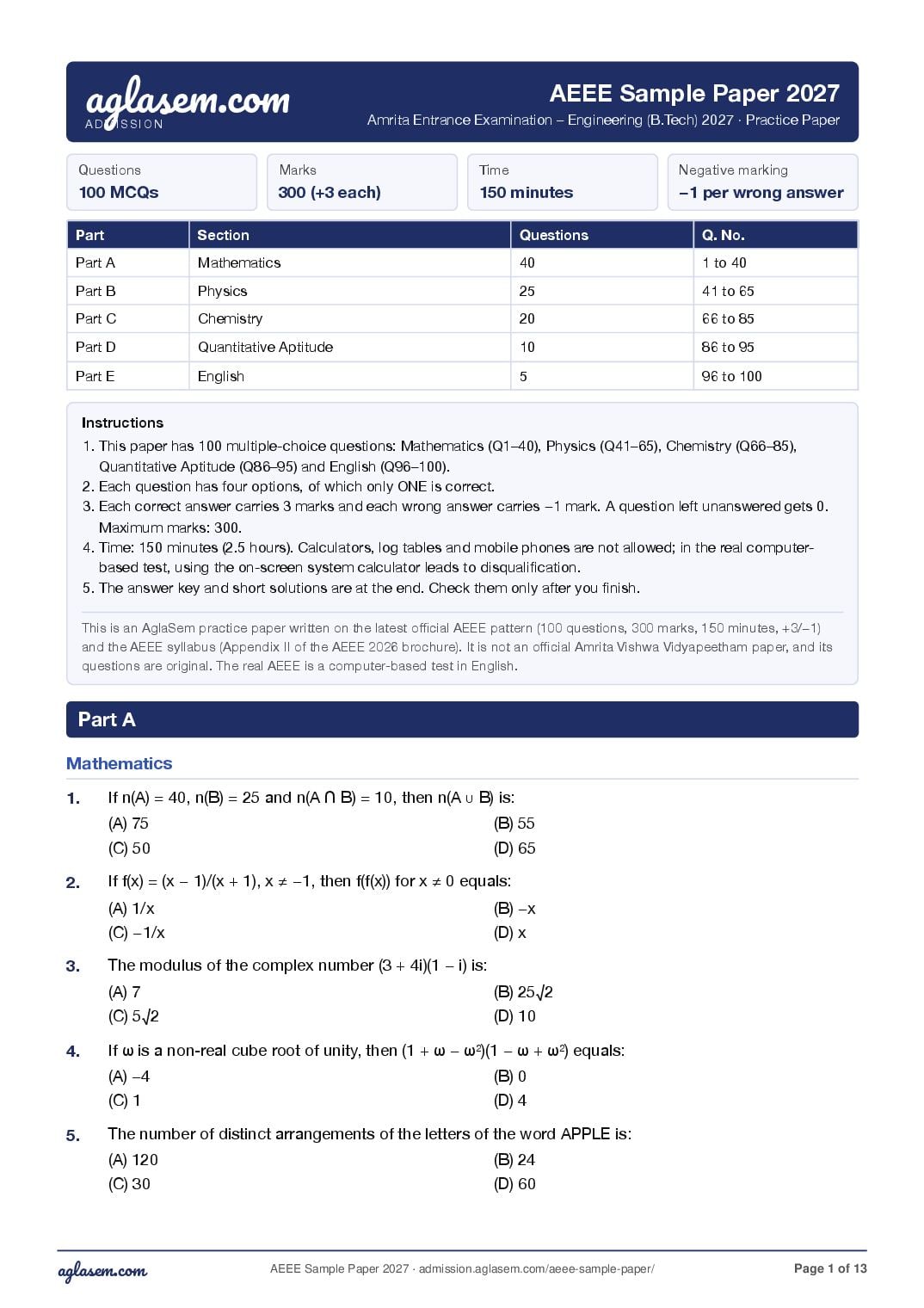
AEEE Sample Paper 2027
Amrita Entrance Examination – Engineering (B.Tech) 2027 · Practice Paper
Questions Marks Time Negative marking
100 MCQs 300 (+3 each) 150 minutes −1 per wrong answer
Part Section Questions Q. No.
Part A Mathematics 40 1 to 40
Part B Physics 25 41 to 65
Part C Chemistry 20 66 to 85
Part D Quantitative Aptitude 10 86 to 95
Part E English 5 96 to 100
Instructions
1. This paper has 100 multiple-choice questions: Mathematics (Q1–40), Physics (Q41–65), Chemistry (Q66–85),
Quantitative Aptitude (Q86–95) and English (Q96–100).
2. Each question has four options, of which only ONE is correct.
3. Each correct answer carries 3 marks and each wrong answer carries −1 mark. A question left unanswered gets 0.
Maximum marks: 300.
4. Time: 150 minutes (2.5 hours). Calculators, log tables and mobile phones are not allowed; in the real computer-
based test, using the on-screen system calculator leads to disqualification.
5. The answer key and short solutions are at the end. Check them only after you finish.
This is an AglaSem practice paper written on the latest official AEEE pattern (100 questions, 300 marks, 150 minutes, +3/−1)
and the AEEE syllabus (Appendix II of the AEEE 2026 brochure). It is not an official Amrita Vishwa Vidyapeetham paper, and its
questions are original. The real AEEE is a computer-based test in English.
Part A
Mathematics
1. If n(A) = 40, n(B) = 25 and n(A ∩ B) = 10, then n(A ∪ B) is:
(A) 75 (B) 55
(C) 50 (D) 65
2. If f(x) = (x − 1)/(x + 1), x ≠ −1, then f(f(x)) for x ≠ 0 equals:
(A) 1/x (B) −x
(C) −1/x (D) x
3. The modulus of the complex number (3 + 4i)(1 − i) is:
(A) 7 (B) 25√2
(C) 5√2 (D) 10
4. If ω is a non-real cube root of unity, then (1 + ω − ω²)(1 − ω + ω²) equals:
(A) −4 (B) 0
(C) 1 (D) 4
5. The number of distinct arrangements of the letters of the word APPLE is:
(A) 120 (B) 24
(C) 30 (D) 60
AEEE Sample Paper 2027 · admission./aeee-sample-paper/ Page 1 of 13
Page 2
number of triangles that can be formed with these points as vertices is:
(A) 112 (B) 120
(C) 116 (D) 110
7. The term independent of x in the expansion of (x² + 1/x)⁹ is:
(A) 84 (B) 72
(C) 126 (D) 36
8. The arithmetic mean and geometric mean of two positive numbers are 10 and 8 respectively. The
numbers are:
(A) 15 and 5 (B) 18 and 2
(C) 16 and 4 (D) 12 and 8
9. The value of 1² + 2² + 3² + … + 10² is:
(A) 330 (B) 385
(C) 285 (D) 505
10. If A = [[2, 3], [1, 2]], then A⁻¹ is:
(A) [[2, −3], [−1, 2]] (B) [[−2, 3], [1, −2]]
(C) [[2, 3], [1, 2]] (D) [[2, −1], [−3, 2]]
11. The solution of the system x + y + z = 6, x − y + z = 2, 2x + y − z = 1 is:
(A) x = 2, y = 1, z = 3 (B) x = 1, y = 2, z = 3
(C) x = 1, y = 3, z = 2 (D) x = 3, y = 2, z = 1
12. If α and β are the roots of 2x² − 3x − 5 = 0, then 1/α + 1/β equals:
(A) −3/5 (B) 3/5
(C) 5/3 (D) −5/3
13. The equation x² + kx + 4 = 0 has real roots if and only if:
(A) |k| ≤ 4 (B) |k| < 4
(C) k ≥ 4 only (D) |k| ≥ 4
14. The number of solutions of 2sin²x − 3sin x + 1 = 0 in the interval [0, 2π] is:
(A) 3 (B) 4
(C) 1 (D) 2
15. The value of tan⁻¹(1/2) + tan⁻¹(1/3) is:
(A) π/6 (B) π/2
(C) π/4 (D) π/3
16. In a triangle with sides 5, 7 and 8 units, the angle opposite the side of length 7 is:
(A) 45° (B) 60°
(C) 30° (D) 90°
17. From the top of a tower 60 m high, the angle of depression of a car on the level ground is 30°. The
distance of the car from the foot of the tower is:
(A) 60√3 m (B) 20√3 m
(C) 60 m (D) 30√3 m
18. The mean deviation about the mean of the data 3, 5, 7, 9, 11 is:
(A) 2.4 (B) 3.2
(C) 4 (D) 2
AEEE Sample Paper 2027 · admission./aeee-sample-paper/ Page 2 of 13
Page 3
(A) 1/9 (B) 1/6
(C) 7/36 (D) 5/36
20. Bag I has 3 red and 2 black balls; Bag II has 2 red and 3 black balls. A bag is chosen at random and a
ball drawn from it is red. The probability that it came from Bag I is:
(A) 1/2 (B) 2/5
(C) 3/5 (D) 3/10
21. The mean and variance of a binomial distribution are 4 and 3 respectively. The number of trials n is:
(A) 24 (B) 8
(C) 12 (D) 16
22. The value of lim (x → 0) (e²ˣ − 1)/x is:
(A) 2 (B) e²
(C) 1/2 (D) 1
23. For −1 < x < 1, the derivative of sin⁻¹[2x/(1 + x²)] with respect to x is:
(A) 2/(1 + x²) (B) 2/√(1 − x²)
(C) 1/(1 + x²) (D) −2/(1 + x²)
24. If x² + y² = 25, then dy/dx at the point (3, 4) is:
(A) 3/4 (B) −3/4
(C) −4/3 (D) 4/3
25. The maximum value of sin x + cos x is:
(A) 2√2 (B) √2
(C) 2 (D) 1
26. The equation of the tangent to the curve y = x² at the point (1, 1) is:
(A) y = x (B) y = 2x + 1
(C) y = −2x + 3 (D) y = 2x − 1
27. ∫ x eˣ dx equals:
(A) eˣ(x + 1) + C (B) eˣ(x − 1) + C
(C) x eˣ + C (D) eˣ(1 − x) + C
28. The value of ∫₀¹ x/(x² + 1) dx is:
(A) 2 ln 2 (B) (1/2) ln 3
(C) (1/2) ln 2 (D) ln 2
29. The area of the region bounded by the curves y = x² and y = x is:
(A) 1/2 sq. unit (B) 1/3 sq. unit
(C) 2/3 sq. unit (D) 1/6 sq. unit
30. The general solution of the differential equation dy/dx = y/x is (c an arbitrary constant):
(A) xy = c (B) y = cx²
(C) y = c + x (D) y = cx
31. The integrating factor of the differential equation dy/dx + (2/x)y = x (x > 0) is:
(A) 1/x² (B) eˣ
(C) 2x (D) x²
AEEE Sample Paper 2027 · admission./aeee-sample-paper/ Page 3 of 13
Page 4
(A) 6 sq. units (B) 18 sq. units
(C) 24 sq. units (D) 12 sq. units
33. The acute angle between the lines y = 2x + 3 and y = −3x + 1 is:
(A) 30° (B) 45°
(C) 60° (D) 90°
34. The acute angle between the pair of lines x² − 5xy + 4y² = 0 is:
(A) tan⁻¹(3/5) (B) tan⁻¹(5/3)
(C) tan⁻¹(3/4) (D) π/4
35. The equation of the circle on the line joining (1, 2) and (3, 4) as a diameter is:
(A) x² + y² + 4x + 6y + 11 = 0 (B) x² + y² − 4x − 6y + 11 = 0
(C) x² + y² − 4x − 6y − 11 = 0 (D) x² + y² − 2x − 3y + 11 = 0
36. The line y = x + c touches the circle x² + y² = 8 if c equals:
(A) ±2√2 (B) ±4
(C) ±2 (D) ±8
37. The eccentricity of the hyperbola x²/16 − y²/9 = 1 is:
(A) 5/3 (B) 5/4
(C) 4/5 (D) √7/4
38. The length of the latus rectum of the ellipse 9x² + 16y² = 144 is:
(A) 9/4 (B) 8/3
(C) 9/2 (D) 32/3
39. If a = î + ĵ, b = ĵ + k̂ and c = k̂ + î, the scalar triple product [a b c] is:
(A) −2 (B) 2
(C) 1 (D) 0
40. The perpendicular distance of the point (2, 1, −1) from the plane x − 2y + 2z = 5 is:
(A) 7/3 (B) 3/7
(C) 5/3 (D) 1
Part B
Physics
41. The SI unit of the coefficient of viscosity is:
(A) N s m⁻² (B) N m s⁻¹
(C) kg m s⁻² (D) N m⁻² s⁻¹
42. The position of a particle moving along the x-axis is x = t³ − 6t² + 9t (x in m, t in s). Its acceleration at the
instant it first comes to rest is:
(A) 0 (B) −6 m/s²
(C) 6 m/s² (D) −12 m/s²
43. A full-wave rectifier is fed with 50 Hz alternating voltage. The fundamental frequency of the ripple in its
output is:
(A) 200 Hz (B) 25 Hz
(C) 100 Hz (D) 50 Hz
AEEE Sample Paper 2027 · admission./aeee-sample-paper/ Page 4 of 13
Page 5
centripetal acceleration is:
(A) 2π² m/s² (B) 4π² m/s²
(C) 16π² m/s² (D) 8π² m/s²
45. A man of mass 60 kg stands on a weighing machine in a lift moving upward with an acceleration of 2
m/s². Taking g = 10 m/s², the machine reads:
(A) 600 N (B) 720 N
(C) 660 N (D) 480 N
46. The ratio of the wavelength of the first line of the Lyman series to that of the first line of the Balmer
series of hydrogen is:
(A) 5/27 (B) 4/9
(C) 3/4 (D) 27/5
47. A ball moving with speed v collides head-on and elastically with an identical ball at rest. After the
collision, the speeds of the first and second balls are:
(A) v/2 and v (B) v/2 and v/2
(C) 0 and v (D) v and 0
48. The inductive reactance of a coil of inductance (1/π) H in a 50 Hz AC circuit is:
(A) 50 Ω (B) 314 Ω
(C) 200 Ω (D) 100 Ω
49. A solid cylinder rolls without slipping on a horizontal surface. The fraction of its total kinetic energy that
is rotational is:
(A) 2/5 (B) 1/3
(C) 2/3 (D) 1/2
50. If g is the acceleration due to gravity on the Earth's surface, its value at a height equal to the Earth's
radius R is:
(A) g/4 (B) g/2
(C) 2g (D) g/√2
51. The radius of a satellite's circular orbit is made 4 times larger. Its period of revolution becomes:
(A) 16 times (B) 2 times
(C) 4 times (D) 8 times
52. Two wires of the same material have lengths in the ratio 1 : 2 and diameters in the ratio 2 : 1. They are
stretched by equal forces. The ratio of their extensions is:
(A) 1 : 2 (B) 1 : 8
(C) 1 : 4 (D) 8 : 1
53. Nuclear radius R = R₀A^(1/3). The ratio of the radii of the nuclei ²⁷Al and ¹²⁵Te is:
(A) 9 : 25 (B) 27 : 125
(C) 5 : 3 (D) 3 : 5
54. The length of a simple pendulum is increased by 21%. Its time period increases by:
(A) 10% (B) 42%
(C) 11% (D) 21%
AEEE Sample Paper 2027 · admission./aeee-sample-paper/ Page 5 of 13
Page 6
end, is:
(A) 85 Hz (B) 680 Hz
(C) 340 Hz (D) 170 Hz
56. If the absolute temperature of a black body is doubled, the power it radiates becomes:
(A) 4 times (B) 2 times
(C) 16 times (D) 8 times
57. For one mole of an ideal monatomic gas, the ratio Cp/Cv is:
(A) 3/2 (B) 4/3
(C) 7/5 (D) 5/3
58. A point charge q is placed at the centre of a cube. The electric flux through any one face of the cube is:
(A) q/(3ε₀) (B) q/ε₀
(C) q/(6ε₀) (D) 6q/ε₀
59. A capacitor of 10 μF is charged to a potential difference of 100 V. The energy stored in it is:
(A) 0.1 J (B) 5 J
(C) 0.5 J (D) 0.05 J
60. An object is placed 30 cm in front of a convex lens of focal length 20 cm. The image is formed at a
distance of:
(A) 12 cm (B) 60 cm
(C) 30 cm (D) 40 cm
61. A cell of emf 2 V and internal resistance 0.5 Ω is connected to an external resistance of 3.5 Ω. The
terminal voltage of the cell is:
(A) 1.5 V (B) 2 V
(C) 0.25 V (D) 1.75 V
62. A galvanometer of resistance 99 Ω gives full-scale deflection for 1 mA. To convert it into an ammeter of
range 0.1 A, the shunt needed is:
(A) 9.9 Ω (B) 0.99 Ω
(C) 10 Ω (D) 1 Ω
63. The current in a coil of self-inductance 0.5 H falls uniformly from 2 A to zero in 0.1 s. The magnitude of
the induced emf is:
(A) 1 V (B) 10 V
(C) 5 V (D) 20 V
64. Unpolarised light falls on a glass surface (refractive index √3) at the polarising (Brewster) angle. The
angle of refraction is:
(A) 90° (B) 60°
(C) 30° (D) 45°
65. The de Broglie wavelength of an electron accelerated from rest through a potential difference of 100 V is
about:
(A) 0.123 nm (B) 1.23 nm
(C) 0.0123 nm (D) 12.3 nm
AEEE Sample Paper 2027 · admission./aeee-sample-paper/ Page 6 of 13
Page 7
Chemistry
66. A compound contains 40% carbon, 6.67% hydrogen and 53.3% oxygen by mass. Its empirical formula
is:
(A) C₂H₂O (B) CH₂O
(C) CH₃O (D) CHO
67. The number of radial nodes in a 3p orbital is:
(A) 1 (B) 0
(C) 3 (D) 2
68. The bond order of the O₂⁺ ion is:
(A) 2 (B) 2.5
(C) 1.5 (D) 3
69. Which of the following alkali metal carbonates decomposes on heating to give the metal oxide and
CO₂?
(A) K₂CO₃ (B) Na₂CO₃
(C) Li₂CO₃ (D) Rb₂CO₃
70. Which of the following is an interhalogen compound?
(A) HClO₄ (B) NaCl
(C) ClF₃ (D) CCl₄
71. As a result of the lanthanoid contraction, which pair of elements has almost identical atomic radii?
(A) Cr and Mo (B) Ti and Zr
(C) Zr and Hf (D) Sc and Y
72. An element crystallises in a body-centred cubic (bcc) lattice. The number of atoms per unit cell is:
(A) 2 (B) 1
(C) 6 (D) 4
73. The number of geometrical isomers of the square planar complex [Pt(NH₃)₂Cl₂] is:
(A) 4 (B) 3
(C) 2 (D) 0
74. In the van der Waals equation, the constant 'a' is a measure of the:
(A) average kinetic energy of molecules
(B) volume occupied by the molecules
(C) rate of diffusion
(D) intermolecular attractive forces
75. The freezing point of a 0.2 molal aqueous solution of NaCl (assume complete dissociation; Kf of water =
1.86 K kg mol⁻¹) is:
(A) −0.372 °C (B) −0.186 °C
(C) −0.744 °C (D) −1.488 °C
76. Given E°(Zn²⁺/Zn) = −0.76 V, the electrode potential of a zinc electrode dipped in 0.01 M Zn²⁺ solution at
25 °C is (take 2.303RT/F = 0.059 V):
(A) −0.819 V (B) −0.701 V
(C) −0.790 V (D) −0.760 V
AEEE Sample Paper 2027 · admission./aeee-sample-paper/ Page 7 of 13
Page 8
(A) ΔH > 0 and ΔS < 0 (B) ΔH < 0 and ΔS < 0
(C) ΔH > 0 and ΔS > 0 (D) ΔH < 0 and ΔS > 0
78. The solubility of AgCl in water at 25 °C is 1 × 10⁻⁵ mol L⁻¹. Its solubility product is:
(A) 1 × 10⁻¹⁰ (B) 2 × 10⁻¹⁰
(C) 1 × 10⁻²⁵ (D) 1 × 10⁻⁵
79. When the concentration of a reactant A is doubled, the rate of reaction becomes four times. The order
of the reaction with respect to A is:
(A) 0 (B) 4
(C) 2 (D) 1
80. Which of the following species acts as an electrophile?
(A) NH₃ (B) BF₃
(C) CN⁻ (D) OH⁻
81. Natural rubber is a polymer of:
(A) chloroprene (B) styrene
(C) ethylene (D) isoprene
82. Ethyl bromide is heated with alcoholic KOH. The main organic product is:
(A) ethene (B) diethyl ether
(C) ethane (D) ethanol
83. Which of the following is the weakest base in aqueous solution?
(A) CH₃NH₂ (B) (CH₃)₃N
(C) C₆H₅NH₂ (D) (CH₃)₂NH
84. Which of the following compounds gives a positive iodoform test?
(A) ethanol (B) methanol
(C) propan-1-ol (D) benzaldehyde
85. Which of the following is a greenhouse gas?
(A) methane (B) argon
(C) oxygen (D) nitrogen
Part D
Quantitative Aptitude
86. The price of sugar rises by 25%. By what percentage must a family reduce its consumption so that its
expenditure on sugar stays the same?
(A) 20% (B) 30%
(C) 15% (D) 25%
87. If A : B = 2 : 3 and B : C = 4 : 5, then A : B : C is:
(A) 8 : 12 : 15 (B) 2 : 3 : 5
(C) 6 : 9 : 15 (D) 8 : 15 : 12
88. The cost price of 12 articles equals the selling price of 10 articles. The profit per cent is:
(A) 10% (B) 20%
(C) 25% (D) 16⅔%
AEEE Sample Paper 2027 · admission./aeee-sample-paper/ Page 8 of 13
Page 9
(A) ₹1,900 (B) ₹2,210
(C) ₹2,000 (D) ₹2,100
90. A can do a piece of work in 12 days and B can do it in 18 days. Working together, they can finish it in:
(A) 15 days (B) 7.2 days
(C) 8 days (D) 6 days
91. A train 200 m long running at 72 km/h crosses a platform 300 m long. The time taken is:
(A) 15 s (B) 20 s
(C) 25 s (D) 10 s
92. The average of five numbers is 20. If one number is removed, the average of the remaining four is 18.
The number removed is:
(A) 22 (B) 38
(C) 20 (D) 28
93. Find the next number in the series: 2, 6, 12, 20, 30, ?
(A) 40 (B) 48
(C) 36 (D) 42
94. A 40-litre mixture contains milk and water in the ratio 3 : 1. How much water must be added to make
the ratio 3 : 2?
(A) 15 litres (B) 5 litres
(C) 10 litres (D) 20 litres
95. A father is now three times as old as his son. After 12 years he will be twice as old as his son. The son's
present age is:
(A) 15 years (B) 10 years
(C) 12 years (D) 18 years
Part E
English
96. Fill in the blanks with suitable articles: ______ Ganga is ______ holy river.
(A) A, the (B) No article, a
(C) The, a (D) The, the
97. Choose the word closest in meaning to DILIGENT.
(A) intelligent (B) industrious
(C) careless (D) indifferent
98. Choose the word opposite in meaning to HOSTILE.
(A) unkind (B) aggressive
(C) friendly (D) angry
99. Fill in the blank with the correct preposition: He was accused ______ theft.
(A) for (B) of
(C) with (D) on
100. Fill in the blank: Neither the teacher nor the students ______ present in the class yesterday.
(A) were (B) has been
(C) is (D) was
AEEE Sample Paper 2027 · admission./aeee-sample-paper/ Page 9 of 13
Page 10
1 B 2 C 3 C 4 D 5 D 6 C 7 A 8 C 9 B 10 A
11 B 12 A 13 D 14 A 15 C 16 B 17 A 18 A 19 D 20 C
21 D 22 A 23 A 24 B 25 B 26 D 27 B 28 C 29 D 30 D
31 D 32 D 33 B 34 A 35 B 36 B 37 B 38 C 39 B 40 A
41 A 42 B 43 C 44 D 45 B 46 A 47 C 48 D 49 B 50 A
51 D 52 B 53 D 54 A 55 D 56 C 57 D 58 C 59 D 60 B
61 D 62 D 63 B 64 C 65 A 66 B 67 A 68 B 69 C 70 C
71 C 72 A 73 C 74 D 75 C 76 A 77 D 78 A 79 C 80 B
81 D 82 A 83 C 84 A 85 A 86 A 87 A 88 B 89 D 90 B
91 C 92 D 93 D 94 C 95 C 96 C 97 B 98 C 99 B 100 A
Solutions
Mathematics
1. (B) n(A ∪ B) = n(A) + n(B) − n(A ∩ B) = 40 + 25 − 10 = 55.
2. (C) f(f(x)) = [(x − 1)/(x + 1) − 1]/[(x − 1)/(x + 1) + 1] = [(x − 1 − x − 1)/(x + 1)]/[(x − 1 + x + 1)/(x + 1)] = −2/(2x) = −1/x.
3. (C) |z₁z₂| = |z₁||z₂| = √(9 + 16) × √(1 + 1) = 5√2.
4. (D) 1 + ω + ω² = 0, so 1 + ω = −ω² and 1 + ω² = −ω. The product is (−2ω²)(−2ω) = 4ω³ = 4.
5. (D) 5 letters with P repeated twice: 5!/2! = 120/2 = 60.
6. (C) All choices of 3 points: ¹⁰C₃ = 120. Three of the 4 collinear points do not form a triangle: ⁴C₃ = 4. Triangles = 120
− 4 = 116.
7. (A) T(r+1) = ⁹Cᵣ (x²)^(9−r) (1/x)^r = ⁹Cᵣ x^(18−3r). For x⁰, r = 6, giving ⁹C₆ = 84.
8. (C) a + b = 20 and ab = 64, so they are the roots of t² − 20t + 64 = 0, i.e. t = 16 and t = 4.
9. (B) Σn² = n(n + 1)(2n + 1)/6 = 10 × 11 × 21/6 = 385.
10. (A) |A| = 4 − 3 = 1. A⁻¹ = (1/|A|) adj A = [[2, −3], [−1, 2]].
11. (B) Subtracting the second equation from the first: 2y = 4, so y = 2. Then x + z = 4 and 2x − z = −1; adding gives 3x
= 3, so x = 1 and z = 3.
12. (A) α + β = 3/2 and αβ = −5/2, so 1/α + 1/β = (α + β)/(αβ) = (3/2)/(−5/2) = −3/5.
13. (D) Real roots need k² − 16 ≥ 0, i.e. k ≤ −4 or k ≥ 4, which is |k| ≥ 4.
14. (A) (2sin x − 1)(sin x − 1) = 0. sin x = 1 gives x = π/2; sin x = 1/2 gives x = π/6 and 5π/6. Three solutions.
15. (C) tan⁻¹a + tan⁻¹b = tan⁻¹[(a + b)/(1 − ab)] for ab < 1: (1/2 + 1/3)/(1 − 1/6) = (5/6)/(5/6) = 1, so the sum is π/4.
16. (B) cos θ = (5² + 8² − 7²)/(2 × 5 × 8) = (25 + 64 − 49)/80 = 40/80 = 1/2, so θ = 60°.
17. (A) tan 30° = 60/d, so d = 60/(1/√3) = 60√3 m.
18. (A) Mean = 35/5 = 7. Absolute deviations: 4, 2, 0, 2, 4; total 12. Mean deviation = 12/5 = 2.4.
19. (D) Favourable outcomes: (2, 6), (3, 5), (4, 4), (5, 3), (6, 2), i.e. 5 out of 36.
20. (C) By Bayes' theorem: P(I | red) = (1/2 × 3/5)/(1/2 × 3/5 + 1/2 × 2/5) = (3/10)/(5/10) = 3/5.
21. (D) np = 4 and npq = 3 give q = 3/4, so p = 1/4 and n = 4/(1/4) = 16.
22. (A) (e²ˣ − 1)/x = 2 × (e²ˣ − 1)/(2x) → 2 × 1 = 2.
23. (A) Put x = tan θ: 2x/(1 + x²) = sin 2θ, and for |x| < 1, sin⁻¹(sin 2θ) = 2θ = 2tan⁻¹x. Its derivative is 2/(1 + x²).
24. (B) 2x + 2y(dy/dx) = 0, so dy/dx = −x/y = −3/4.
25. (B) sin x + cos x = √2 sin(x + π/4), whose maximum is √2.
AEEE Sample Paper 2027 · admission./aeee-sample-paper/ Page 10 of 13
Page 11
27. (B) By parts: ∫x eˣ dx = x eˣ − ∫eˣ dx = x eˣ − eˣ + C = eˣ(x − 1) + C.
28. (C) Put u = x² + 1, du = 2x dx: (1/2)∫₁² du/u = (1/2) ln 2.
29. (D) The curves meet at x = 0 and x = 1, with x ≥ x² between them. Area = ∫₀¹ (x − x²) dx = 1/2 − 1/3 = 1/6.
30. (D) Separating variables: dy/y = dx/x, so ln y = ln x + ln c, i.e. y = cx.
31. (D) IF = e^(∫2/x dx) = e^(2 ln x) = x².
32. (D) The base from (1, 2) to (7, 2) is 6 units, and the height of (4, 6) above y = 2 is 4 units. Area = (1/2) × 6 × 4 = 12.
33. (B) tan θ = |(m₁ − m₂)/(1 + m₁m₂)| = |(2 + 3)/(1 − 6)| = 1, so θ = 45°.
34. (A) Here a = 1, 2h = −5, b = 4. tan θ = 2√(h² − ab)/|a + b| = 2√(25/4 − 4)/5 = 2 × (3/2)/5 = 3/5. (The lines are x = y and
x = 4y.)
35. (B) (x − 1)(x − 3) + (y − 2)(y − 4) = 0 gives x² − 4x + 3 + y² − 6y + 8 = 0, i.e. x² + y² − 4x − 6y + 11 = 0.
36. (B) Tangency needs the distance from the centre to the line to equal the radius: |c|/√2 = 2√2, so |c| = 4.
37. (B) e = √(1 + b²/a²) = √(1 + 9/16) = √(25/16) = 5/4.
38. (C) Dividing by 144: x²/16 + y²/9 = 1, so a = 4, b² = 9. Latus rectum = 2b²/a = 18/4 = 9/2.
39. (B) [a b c] = det of rows (1, 1, 0), (0, 1, 1), (1, 0, 1) = 1(1 − 0) − 1(0 − 1) + 0 = 2.
40. (A) Distance = |2 − 2 − 2 − 5|/√(1 + 4 + 4) = 7/3.
Physics
41. (A) From F = ηA(dv/dx), η = F/(A × dv/dx), with unit N/(m² × s⁻¹) = N s m⁻² (the pascal second).
42. (B) v = 3t² − 12t + 9 = 3(t − 1)(t − 3), so it first stops at t = 1 s. a = 6t − 12 = −6 m/s² at t = 1 s.
43. (C) A full-wave rectifier gives one output pulse for each half cycle, so the ripple frequency is 2 × 50 = 100 Hz.
44. (D) ω = 2π × 2 = 4π rad/s. a = ω²r = 16π² × 0.5 = 8π² m/s².
45. (B) N − mg = ma, so N = m(g + a) = 60 × 12 = 720 N.
46. (A) Lyman first line: 1/λ = R(1 − 1/4) = 3R/4. Balmer first line: 1/λ = R(1/4 − 1/9) = 5R/36. λ_L/λ_B = (5/36)/(3/4) =
5/27.
47. (C) For a one-dimensional elastic collision between equal masses, the velocities are exchanged: the first ball stops
and the second moves on with speed v.
48. (D) X_L = 2πfL = 2π × 50 × (1/π) = 100 Ω.
49. (B) Translational KE = (1/2)mv²; rotational KE = (1/2)(1/2 mR²)(v/R)² = (1/4)mv². Total = (3/4)mv², so the rotational
fraction is (1/4)/(3/4) = 1/3.
50. (A) g′ = g R²/(R + h)² = g R²/(2R)² = g/4.
51. (D) By Kepler's third law T² ∝ r³, so T ∝ r^(3/2) = 4^(3/2) = 8.
52. (B) Extension = FL/(AY) ∝ L/d². Ratio = (1/2) × (1/2)² = 1/8.
53. (D) R ∝ A^(1/3): 27^(1/3) : 125^(1/3) = 3 : 5.
54. (A) T ∝ √L. √1.21 = 1.1, so T increases by 10%.
55. (D) For a pipe closed at one end, f₁ = v/(4L) = 340/(4 × 0.5) = 170 Hz.
56. (C) By Stefan's law P ∝ T⁴, so 2⁴ = 16 times.
57. (D) A monatomic gas has 3 degrees of freedom: Cv = (3/2)R, Cp = (5/2)R, so γ = 5/3.
58. (C) By Gauss's law the total flux is q/ε₀. By symmetry it divides equally among the 6 faces: q/(6ε₀).
59. (D) U = (1/2)CV² = (1/2) × 10 × 10⁻⁶ × 10⁴ = 0.05 J.
60. (B) 1/v − 1/u = 1/f with u = −30 cm, f = +20 cm: 1/v = 1/20 − 1/30 = 1/60, so v = +60 cm (real image on the other
side).
61. (D) I = E/(R + r) = 2/4 = 0.5 A. Terminal voltage V = E − Ir = 2 − 0.25 = 1.75 V.
62. (D) S = I_g G/(I − I_g) = (0.001 × 99)/(0.1 − 0.001) = 0.099/0.099 = 1 Ω.
63. (B) |e| = L(ΔI/Δt) = 0.5 × (2/0.1) = 10 V.
AEEE Sample Paper 2027 · admission./aeee-sample-paper/ Page 11 of 13
Page 12
90° − 60° = 30°.
65. (A) λ = 1.227/√V nm = 1.227/10 ≈ 0.123 nm (1.23 Å).
Chemistry
66. (B) Moles: C = 40/12 = 3.33, H = 6.67/1 = 6.67, O = 53.3/16 = 3.33. Ratio 1 : 2 : 1, so CH₂O.
67. (A) Radial nodes = n − l − 1 = 3 − 1 − 1 = 1.
68. (B) O₂⁺ has 15 electrons: bonding 10, antibonding 5. Bond order = (10 − 5)/2 = 2.5.
69. (C) The small Li⁺ ion polarises the large carbonate ion, so Li₂CO₃ decomposes on heating to Li₂O and CO₂. The
carbonates of Na, K and Rb are stable to heat.
70. (C) Interhalogen compounds contain only two different halogens. ClF₃ (chlorine and fluorine) is one; the others
contain non-halogen elements.
71. (C) The poor shielding by 4f electrons makes the 5d elements nearly the same size as the 4d elements above them,
so Zr (160 pm) and Hf (159 pm) are almost identical.
72. (A) 8 corners × 1/8 + 1 body centre × 1 = 2 atoms per unit cell.
73. (C) A square planar MA₂B₂ complex has cis and trans forms: 2 geometrical isomers.
74. (D) The term a/V² corrects the pressure for the attraction between molecules; 'b' corrects for the volume of the
molecules.
75. (C) ΔTf = iKf m = 2 × 1.86 × 0.2 = 0.744 K, so the freezing point is −0.744 °C.
76. (A) For Zn²⁺ + 2e⁻ → Zn: E = E° − (0.059/2) log(1/[Zn²⁺]) = −0.76 − 0.0295 × 2 = −0.819 V.
77. (D) ΔG = ΔH − TΔS. With ΔH negative and ΔS positive, ΔG is negative at every temperature.
78. (A) AgCl ⇌ Ag⁺ + Cl⁻, so Ksp = s × s = (1 × 10⁻⁵)² = 1 × 10⁻¹⁰.
79. (C) Rate ∝ [A]ⁿ, so 2ⁿ = 4 and n = 2.
80. (B) BF₃ has an incomplete octet on boron and accepts an electron pair, so it is an electrophile (Lewis acid). NH₃,
OH⁻ and CN⁻ have lone pairs to donate and act as nucleophiles.
81. (D) Natural rubber is cis-1,4-polyisoprene (2-methylbuta-1,3-diene). Chloroprene gives the synthetic rubber
neoprene.
82. (A) Alcoholic KOH brings about dehydrohalogenation (β-elimination): CH₃CH₂Br → CH₂=CH₂ + HBr. Aqueous KOH
would give ethanol.
83. (C) In aniline the nitrogen lone pair is delocalised into the benzene ring, so it is far less available for protonation
than in the aliphatic amines.
84. (A) The iodoform test needs a CH₃CO– group or a CH₃CH(OH)– group. Ethanol (CH₃CH₂OH) is oxidised to
CH₃CHO and gives yellow CHI₃; the others lack this group.
85. (A) Methane absorbs infrared radiation and is a strong greenhouse gas. N₂, O₂ and Ar do not absorb infrared
significantly.
Quantitative Aptitude
86. (A) New price = 1.25 times. Consumption must become 1/1.25 = 0.8 times, a reduction of 20%.
87. (A) Make B the same: A : B = 8 : 12 and B : C = 12 : 15, so A : B : C = 8 : 12 : 15.
88. (B) Let CP of one article = ₹1. SP of 10 = CP of 12 = ₹12, so SP of one = ₹1.20. Profit = 20%.
89. (D) Amount = 10,000 × 1.1² = ₹12,100, so CI = ₹2,100 (₹100 more than simple interest).
90. (B) Together per day: 1/12 + 1/18 = (3 + 2)/36 = 5/36. Time = 36/5 = 7.2 days.
91. (C) 72 km/h = 20 m/s. Distance = 200 + 300 = 500 m. Time = 500/20 = 25 s.
92. (D) Total of five = 100; total of four = 72. Removed number = 100 − 72 = 28.
93. (D) The terms are 1×2, 2×3, 3×4, 4×5, 5×6, so the next is 6×7 = 42 (differences 4, 6, 8, 10, 12).
94. (C) Milk = 30 L, water = 10 L. For 3 : 2, water must be 20 L, so 10 L of water must be added.
95. (C) Let the son be x: 3x + 12 = 2(x + 12), so x = 12 years (father 36).
AEEE Sample Paper 2027 · admission./aeee-sample-paper/ Page 12 of 13
Page 13
96. (C) Names of rivers take 'the' (the Ganga); 'a holy river' is one of many, so it takes 'a'.
97. (B) Diligent means hard-working and careful. Industrious has the same meaning; indifferent and careless are nearly
opposite.
98. (C) Hostile means unfriendly or opposed. Its opposite is friendly; the other options are close to hostile in meaning.
99. (B) The verb 'accuse' takes 'of': to accuse someone of something.
100. (A) With 'neither … nor', the verb agrees with the nearer subject, 'the students' (plural); the past time needs
'were'.
AEEE Sample Paper 2027 · admission./aeee-sample-paper/ Page 13 of 13
Document Details
| Board / Org | Amrita University |
| Exam | AEEE |
| Type | Sample Paper |
| Pages | 13 |
| Language | english |
| Updated | 27 Oct 2026 |