AEEE 2026 Information Brochure
Finished viewing? Save it for later —
Download AEEE 2026 Information Brochure (PDF · 28 pages)About AEEE 2026 Information Brochure
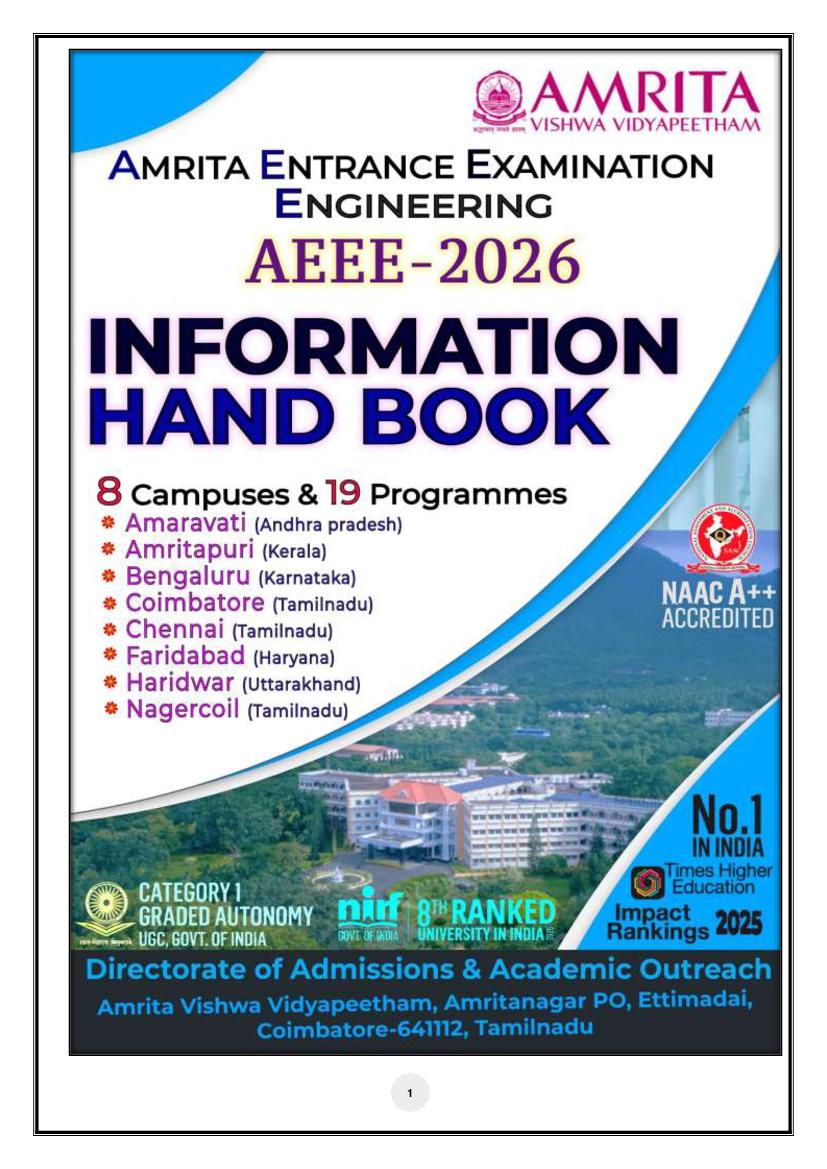
AEEE 2026 Information Brochure is available here for free download. Published by Amrita University for Amrita Engineering Entrance Examination, this brochure can be viewed online or downloaded as a PDF (28 pages). Candidates preparing for Amrita Engineering Entrance Examination can use AEEE 2026 Information Brochure to understand the exam pattern, the type of questions asked, and the overall difficulty level.
Frequently Asked Questions
How can I download AEEE 2026 Information Brochure?
Open this page and click the Download button to save AEEE 2026 Information Brochure as a PDF. It is completely free on AglaSem Docs.
Is AEEE 2026 Information Brochure free to download?
Yes. AEEE 2026 Information Brochure can be viewed online and downloaded as a PDF free of cost on AglaSem Docs.
How many pages does AEEE 2026 Information Brochure have?
AEEE 2026 Information Brochure contains 28 pages, which you can read online or download together as a single PDF.
Where can I find more Amrita Engineering Entrance Examination study material?
You can find more Amrita Engineering Entrance Examination question papers, sample papers, syllabus, and answer keys on AglaSem Docs.
AEEE 2026 Information Brochure – Text
Read the full text of this brochure below — useful to quickly search, copy and reference the content online without downloading the PDF.
📄 View text version (28 pages)
Page 1
Page 2
Table of Contents No.
ABOUT AMRITA VISHWA VIDYAPEETHAM 3
AMRITA VISHWA VIDYAPEETHAM – ENGINEERING CAMPUSES 3
B.TECH ADMISSION PROCEDURE 5
ELIGIBILITY & CRITERIA 6
CAMPUSES & BRANCHES 7
AEEE / JEE SEAT ALLOCATION for B.TECH PROGRAMS 8
ABOUT AMRITA ENTRANCE EXAMINATION ENGINEERING 2026 8
AEEE 2026 - CITIES 8
AEEE 2026 - PATTERN 8
AEEE 2026 – DATES AND SLOT TIMINGS 8
AEEE 2026 REGISTRATION/ APPLYING WITH JEE MAINS 2026 PERCENTILE 9
REGISTRATION / APPLICATION FEES: 9
AEEE 2026 REGISTRATION FORM DATA ENTRY 10
CHOOSING AEEE 2026 CITIES 13
SYLLABUS, PATTERN AND EVALUATION 14
SLOT BOOKING FOR AEEE 2026 15
ADMIT CARD 15
AEEE 2026 GUIDELINES FOR CANDIDATES 16
CODE OF CONDUCT 16
AEEE 2026 RESULTS 17
FEE STRUCTURE 17
REFUND POLICY 17
SETTLEMENT OF DISPUTES 17
JURISDICTION 17
APPENDIX I - AEEE 2026 CITIES 19
APPENDIX II - AEEE 2026 Syllabus 23
2
Page 3
Amrita Vishwa Vidyapeetham Deemed to be University is a multi-campus, multi-disciplinary
research-intensive private University educating a vibrant student population of over 30000+ by
2000+ strong faculty. Accredited with the highest possible 'A++' by NAAC and is ranked as one
of the best research Institutions in India. Amrita offers more than 350 UG, PG, and Ph.D.
programs in Engineering, Management, and Medical Sciences including Ayurveda, Life
Sciences, Physical Sciences, Agriculture Sciences, Arts & Humanities, and Social & Behavioral
Sciences.
With its extensive network of ten campuses spread across Amaravati, Amritapuri, Bengaluru,
Chennai, Coimbatore, Kochi, Mysuru, Nagercoil, Faridabad and Haridwar, Amrita University
stands as one of India’s preeminent private educational institutions. Encompassing an
expansive area of over 1200 acres, these campuses offer an impressive built-up space of more
than 100 lakh square feet.
Renowned for its commitment to academic excellence, Amrita University consistently ranks
among the top-tier private universities in the nation, solidifying its reputation as a beacon of
quality education. Amrita has emerged as the eighth ranked university in the National
Institutional Ranking Framework (NIRF) Rankings 2025 released by MHRD, Govt. of India and
has been adjudged as one of the “Top 10 Universities in India” for the eighth consecutive year.
Amrita School of Medicine, Kochi has been ranked 6th Best in Medicine in NIRF Rankings 2023.
There are 8 campuses offering B.Tech programmes in 19 branches.
AMRITA VISHWA VIDYAPEETHAM – ENGINEERING CAMPUSES
AMARAVATI CAMPUS
Nestled amidst the scenic beauty of the Krishna River and surrounded by natural wonders and
historical sites, Amaravati city embodies the principles of sustainability and liveability. We are
building one of the most buoyant centre of the research, education and technological
advancement, in the all new greenfield capital city.
Amrita Vishwa Vidyapeetham, Amaravati Campus offers programs including B.Tech, and MBA.
These programs are specifically designed to provide students with a comprehensive education
that equips them with necessary skills and knowledge to excel in their prospective careers.
AMRITAPURI CAMPUS
Situated in the serene village of Vallikavu, our campus exudes a sense of warmth and tranquility,
creating the perfect environment for intellectual growth and personal development. Our
educational institution encompasses six prestigious schools and more than 20 research centres,
catering to students passionate about various disciplines such as arts, business, humanities,
natural sciences, and social sciences. With a sprawling 80-acre expanse of land, our campus
provides ample space for learning, exploration, and recreation. The million square feet of built-
up area includes state-of-the-art academic blocks, comfortable student hostels, and a range of
modern amenities to enhance the overall campus experience.
Amrita Vishwa Vidyapeetham, Amritapuri Campus offers diverse programs in Engineering,
Management, Arts, Commerce, Biotechnology, Ayurveda and Social Sciences and Physical
Sciences. These programs are specifically designed to provide students with a comprehensive
education that equips them with necessary skills and knowledge to excel in their prospective
careers.
3
Page 4
Nestled in the heart of Bengaluru, a thriving center for research, education, and technological
advancement, stands a dynamic institution at the forefront of the tech city. The 50 acres’
campus, featuring green laws and the burgeoning trees, is well connected by road, rail and air.
The campus offers MBA, B. Tech. programs in nine disciplines and M. Tech. programs in six
disciplines. The school seeks to prepare graduates with a solution-mindset and with a high
degree of ethical standards. Departments are equipped with modern laboratories, design tools
and software packages. vision to produce quality engineers with an attitude of service, for the
benefit of the society and nation.
The Amrita School of Engineering, Bengaluru offers engineering programs in nine disciplines
and MBA. The school seeks to prepare graduates with a solution-mindset and with a high degree
of ethical standards. Recruiters from the best companies and institutes in India and abroad seek
out these students.
CHENNAI CAMPUS
The Chennai campus is a beacon for engineering aspirants and research scholars from across
the globe, offering a range of cutting-edge programs designed around a choice-based credit
system with continuous, hands-on evaluation. Here, students are mentored by a team of
experienced and highly qualified faculty, who are dedicated to equipping them with the latest
knowledge and skills to meet the demands of modern engineering.
As a thriving hub of art, technology, education, and industry, Chennai, the vibrant capital of Tamil
Nadu, stands tall as one of India’s foremost metropolitan cities, where tradition and progress go
hand in hand.
Located just 40 km from the heart of Chennai, the School of Engineering is nestled in the serene
village of Vengal, near the historic Periyapalayathamman Temple, along State Highway
providing a tranquil yet inspiring environment where the future of engineering is being shaped.
At the School of Engineering, dreams take flight, nurtured in an environment that encourages
innovation, fosters creativity, and prepares students to be leaders in the ever-evolving world of
technology.
COIMBATORE CAMPUS (HEADQUARTERS)
The beginnings of Amrita Vishwa Vidyapeetham, one of the top ranked deemed university, can
be traced back to 1994 when a School of Engineering was established in an obscure village
named Ettimadai, situated at the foothills of the Bouluvanpatty ranges of the Western Ghats in
the Coimbatore district of Tamil Nadu. During that time, there were 120 students and 13 faculty
members. Today, Amrita Vishwa Vidyapeetham has expanded to ten campuses located in six
different states of India. It has a student population of over 12,000 and a faculty strength of
nearly 1,500. The university offers more than 120 UG, PG, and doctoral programs. When Amrita
became an institution in January 2003, it was the youngest group of institutions to be conferred.
Amrita Vishwa Vidyapeetham, Coimbatore Campus offers diverse programs in Agriculture,
Engineering, Sciences, Communication, Management and Law.
FARIDABAD CAMPUS
Amrita Vishwa Vidyapeetham has launched B.Tech. and M.Tech. programmes in Artificial
Intelligence and Data Science at our Faridabad Campus, Delhi NCR. These pioneering
programmes represent a significant advancement in technology education, blending cutting-
edge AI techniques with a broad spectrum of applications across various industries. Students
will gain hands-on experience through real-world projects and access to advanced AI facilities,
preparing them to excel in diverse fields such as technology, finance, engineering, and more.
4
Page 5
and Data Science, setting the stage for breakthroughs across various sectors. Join us to be at
the forefront of technological advancement and industry transformation. Amrita Vishwa
Vidyapeetham, Faridabad Campus offers diverse programs including Nursing, MBBS, Allied
Health science courses, B.Tech and M.Tech.
NAGERCOIL CAMPUS
Located in the vibrant city of Nagercoil, Tamil Nadu, our sprawling 100-acre green campus offers
the perfect blend of natural beauty and modern infrastructure, creating an ideal environment for
academic growth and innovation. Situated in Erachakulam, Nagercoil, Amrita Vishwa
Vidyapeetham is a hub of educational excellence, inspired by Amma’s vision of holistic
education rooted in the philosophy of “Education for Life.” Here, we emphasize compassion-
driven research, nurturing not only intellectual growth but also a deep sense of responsibility
towards society and the world. Amrita’s Nagercoil campus is a testament to academic and
cultural harmony, offering a diverse array of disciplines across multiple schools and research
centres. This reflects the rich educational heritage and cultural diversity of the region, making it
a beacon for students aspiring to achieve both personal and professional success. At Amrita,
Nagercoil, we are committed to fostering an environment where students can thrive
academically, culturally, and personally, equipping them with the tools they need to become
leaders in their chosen fields.
HARIDWAR CAMPUS
Situated in the ancient and revered city of Haridwar, the campus will stand as a paragon of
academic rigor and intellectual pursuit. It will offer a comprehensive range of academic
disciplines through its various schools and research centres, reflecting the rich educational and
cultural heritage of the region, and fostering an environment where knowledge meets innovation.
Amrita Vishwa Vidyapeetham’s campus in Haridwar, nestled on the sacred banks of the Ganges,
is poised to become a landmark of educational excellence. This new campus will embody
Amma’s profound vision of “education for life” and her emphasis on compassion-driven
research, extending the university’s mission to the spiritual heartland of India.
t
B.TECH ADMISSION PROCEDURE
Admission to B.Tech programmes offered at – Amaravati, Amritapuri, Bengaluru, Chennai,
Coimbatore Faridabad, Haridwar and Nagercoil campuses for the Academic Year (AY) 2026-
2027 is through and based on the rank scored in:
Amrita Entrance Examination – Engineering (AEEE) 2026
(OR)
JEE Mains 2026 percentile
It is NOT mandatory to have both the above. AEEE 2026 will be conducted in 2 phases.
Candidates can attend any one of the phases OR both phases to secure AEEE 2026 rank.
Students desirous of joining B.Tech programme, after passing their plus two or equivalent
examination are required to attend Amrita Entrance Examination - Engineering 2026 or apply
with the JEE Mains 2026 Percentile.
Rank in AEEE 2026 is not mandatory if applied with JEE Mains 2026 Percentile. If JEE Mains
is conducted multiple times, best percentile score among the multiple scores released prior to
the Amrita Centralised Seat Allotment Process (CSAP) shall be submitted for the allotment.
Admission to B.Tech programmes offered at our various campuses of Amrita Vishwa
Vidyapeetham is fully managed by Directorate of Admissions.
5
Page 6
secure minimum marks (as specified), may also apply. However, the necessary mark sheets
and certificates to prove the eligibility is to be produced at the time of admissions.
ELIGIBILITY & CRITERIA
AGE/DATE OF BIRTH: Candidates, whose date of birth falls on or after 1st July 2005.
EDUCATIONAL QUALIFICATIONS:
“A pass in 10 + 2 (Class XII) or its equivalent examination from a recognized Board with
a minimum of 60% aggregate marks in Physics, Chemistry and Mathematics, and not less
than 50% marks in each of these three subjects (Physics, Chemistry and Mathematics)
individually”.
Nationality
The applicant for B.Tech shall be a Resident / Non-Resident Indian National / OCI / PIO
Holder.
Foreign applicants who studied/studying abroad can apply through Amrita Center for
International Programmes(https://www.amrita.edu/international).
Qualifying Examination
Candidates appearing for the AEEE-2026, in any one of the following qualifying examinations:
The final examination of the 10+2 system, conducted by any recognized Central / State Board,
such as the Central Board of Secondary Education (CBSE), Council for the Indian School
Certificate Examinations (CISCE) or any other Board accepted by Amrita as equivalent to
10+2 examination.
Intermediate or two-year Pre-University Examination conducted by a recognized Board /
University.
General Certificate Education (GCE) examination (London / Cambridge / Sri Lanka) at the
Advanced (A) level.
High School Certificate Examination of the Cambridge University or International
Baccalaureate Diploma of the International Baccalaureate Office, Geneva.
Senior Secondary School Examination conducted by the National Institute of Open Schooling
with minimum of 5 subjects as recognized by central board.
6
Page 7
Amaravati (ARV) | Amritapuri (AMP) | Bengaluru (BLR) | Chennai (CHN)
Coimbatore (CBE) | Faridabad (FDB) | Haridwar (HDR) | Nagercoil (NGL)
Admission to B.Tech Programmes ARV AMP BLR CBE CHN FDB HDR NGL
Aerospace Engineering
Artificial Intelligence (AI) And Data
Science
Artificial Intelligence and Data
Science (Medical Engineering)
Artificial Intelligence and Data
Science (Cyber Physical Systems
and Security)
Artificial Intelligence and Data
Science (Autonomous Agents &
Robotics)
Artificial Intelligence and Data
Science (Quantum Technologies)
Automation & Robotics
Engineering
Civil Engineering
Chemical Engineering
Computer Science & Engineering
Computer Science & Engineering
(AI)
Computer & Communication
Engineering
Computer Science & Engineering
(Cyber Security)
Electronics & Communication
Engineering
Electrical & Electronics
Engineering
Electronics & Computer
Engineering
Electrical & Computer Engineering
Mechanical Engineering
Robotics And Artificial
Intelligence
7
Page 8
AEEE 2026: 70 % of the seats
JEE Mains 2026: 30 % of the seats
A candidate can choose to apply either through AEEE or JEE Mains 2026 individually or
even select both. The above percentage is only a guideline and will be decided at the time
of centralized seats allotment process.
ABOUT AMRITA ENTRANCE EXAMINATION ENGINEERING 2026
Amrita Entrance Examination - Engineering 2026 (AEEE) will be conducted in Computer
Based Test (CBT) mode in various centres at selected cities. All updates will be posted on
the website https://aeee.amrita.edu.
AEEE 2026 is administered and conducted by Amrita Vishwa Vidyapeetham, Deemed to be
University for admission to its prestigious B.Tech programs offered across its various campuses.
AEEE is a national-level exam, known for its rigorous and fair assessment of candidates’
aptitude in subjects like Mathematics, Physics, Chemistry, Aptitude and English. AEEE offers
students a gateway to join one of India’s top-ranked private engineering institutions, renowned
for its high academic standards, world-class academic infrastructure, & with emphasis on
research & innovation.
By attending AEEE, candidates get the opportunity to study in a diverse and vibrant
environment, with access to scholarship seats, global exposure, and cutting-edge learning
resources, making Amrita Vishwa Vidyapeetham a preferred choice for aspiring engineers.
AEEE 2026 - CITIES
AEEE 2026 will be conducted in 2 phases in several cities in India and few cities in the middle
east. Candidates shall choose the cities from the dropdown menu during the registration
process. Visit https://aeee.amrita.edu for more details. An indicative list of cities for AEEE 2026
is appended in the end of this handbook.
AEEE 2026 - PATTERN
No. of
Duration Subjects
Questions
150 Mathematics – 40 , Physics – 25 , Chemistry – 20
100
Minutes English – 5 , Quantitative Aptitude – 10
AEEE 2026 – DATES AND SLOT TIMINGS
Date of Examination Slots & Timing
Slot 1: 09:30 AM – 12:00 Noon;
Phase I – 30th January to 1st February, 2026
Slot 2: 02:00 – 04:30 PM
Slot 1: 09:30 AM – 12:00 Noon;
Phase II – 25th April to 30th April, 2026
Slot 2: 02:00 – 04:30 PM
8
Page 9
(i) These dates are tentative. The number of days of the Examination will be changed depending
on the strength of the candidates.
(ii) Dates may get deferred -
a) Based on the government notifications
b) In case there is any other major examination scheduled on these dates and / or due to
which majority of the candidates are unable to appear for AEEE 2026.
c) Because of any other reason
(iii) It is NOT mandatory to attend both the phases of AEEE 2026.
(iv) Candidates who have appeared in Phase I of the AEEE 2026 are allowed to improve their
scores by attending Phase 2 by paying an additional fee of INR 600.
(v) Candidates who are unable to attend Phase I of the AEEE 2026 will have the provision to
attend Phase II.
(vi) Best score from both Phase I and Phase II of AEEE 2026 will be taken for AEEE 2026
Ranking.
(vii) University holds the right to defer the mode / State / City / Venue / dates / slots of the
examinations as per the situation, whatsoever, prevailing at that time.
(viii) Candidates are advised to check the registered email or visit the website
https://aeee.amrita.edu regularly for the latest updates.
AEEE 2026 REGISTRATION/ APPLYING
WITH JEE MAINS 2026 PERCENTILE
AEEE 2026 registration is fully online via the
portal https://aeee.amrita.edu The candidates
are advised to have their own personal and
valid email ID and mobile No. The candidates
are advised to retain the registered mobile
number and email-id they have used to register,
till all the admission procedures are completed
as all important updates will be informed to the
candidates through SMS / e-mail or both to the
registered mobile No. /e-mail ID.
Registration / Application Fees:
AEEE only AEEE + JEE JEE only
INR 500
INR 1300 INR 1300
Registration fee for candidates attending test abroad - USD 85 or INR 7500/-
The application fee payment is ONLY online and will not be accepted through any other means.
Application fee once paid will not be refunded (full or partial) under any circumstances. However,
excess fee paid because of payment failures will be reimbursed.
9
Page 10
section for more details on application form data. You are to fill all the details initially and
complete the payment, but the application is deemed to be completed only after the payment.
Details to be filled are:
a) Visit https://aeee.amrita.edu
b) Start by filling Name, Mobile Number, Email ID, State and City.
c) You need to verify the mobile number in this step.
AEEE 2026 REGISTRATION FORM DATA ENTRY(points to be noted) :
◆ The cost of registration form is not refundable.
◆ The name of the candidate and his/her parents’ name in the application form must exactly be
the same as registered in Class 10th Certificate. Prefix/title such as
Mr./Shri/Fr/Dr/Mrs./Smt./Col etc., must not be used.
◆ Candidates must ensure that the information (like your name, father's name, gender, date of
birth, community, Mobile number, e-mail address, photograph, and signature, choice of cities
for examination centre, etc.) provided by them in their online registration form is correct.
◆ Candidates are requested to fill in the registration Form carefully. No corrections will be
permitted once the registration form is submitted
◆ Any request for change in the particulars and uploaded scanned images at any stage will not
be considered by AMRITA under any circumstances.
◆ AMRITA will not entertain the corrections sent by the candidates through Post/ Fax/ WhatsApp/
E-mail/ Online Service request/by Hand.
◆ Multiple registrations will not be accepted and will lead to the cancellation of the
registration/admission.
10
Page 11
Page 12
changes if any.
Important Note:
You can choose two options to join B.Tech programme at Amrita.
1. By attending AEEE 2026 and securing a rank in AEEE 2026.
2. With JEE Mains 2026 Percentile.
IT IS NOT MANDATORY TO HAVE BOTH AEEE 2026 and JEE Mains 2026 percentile for
admission to B.Tech. You are free to choose the mode of admission. Even after choosing one
option, you can opt for the other one any time. After registering for AEEE 2026, you can later
opt through JEE Mains 2026 without submitting additional application and without paying
additional fees.
12
Page 13
The names of the cities where AEEE 2026 will be conducted are listed in the portal. AEEE 2026
will be conducted in a center in these cities, provided there are enough candidates. Choose three
cities listed to attend the examination. A candidate appearing for AEEE 2026 shall submit three
preferences to proceed with the registration. The preferences submitted by the candidate are
only indicative and a guide to the University for deciding the number of AEEE 2026 centers in
each city. A candidate will be allotted one out of the three preferred cities, preferably the first
preferred city. If exam cannot be conducted at the first preferred city of a candidate, for any
reason whatsoever, he / she will be allotted to second / third preference as applicable. University
will put all efforts to conduct examination at all the cities listed in the portal. If any city in the list
is cancelled due to very less registrations or for any other reason, the candidates who have opted
for that city will be allotted to another city nearest to their preference and the same will be
informed to the candidates by email.
Choose the Cities to attend AEEE 2026.
REQUESTS FOR CHANGE OF CITY
The requests for change of cities will not be entertained after the application submission. The
decision of the Admission Committee will be final in case of any such requests raised in this
regard.
13
Page 14
REGISTRATION COMPLETION
Registration is deemed to be completed only once the payment has been successful.
PAYMENT ISSUES
In the event of payment failure, try paying after few hours.
If you end up paying excess amount, the excess amount paid will be reimbursed by the
university.
Screen after the payment:
SYLLABUS, PATTERN AND EVALUATION
The questions are based on the syllabus of Class 11 & Class 12. (Refer Appendix – II in this
handbook)
The pattern of examination paper for AEEE 2026 is given in the website:
https://aeee.amrita.edu
All the questions are of Multiple-Choice type and will have four options as possible answers.
Candidates may choose the most appropriate answer which can be changed later, before
the final submission.
3 (Three) marks are awarded for each correct answer and -1 (negative one) for each wrong
answer.
14
Page 15
Subject No. of Questions Marks (3)
Mathematics 40 120
Physics 25 75
Chemistry 20 60
English 05 15
Quantitative Aptitude 10 30
TOTAL 100 300
Use of Calculator and Communication Aids
Use of electronic devices like mobile phones, calculators etc. are NOT PERMITTED for AEEE
2026. Materials like log table, book, notebook, Instruments, any kind of paper, stationery,
Textual material. (printed or written), watches with facilities of calculator, any metallic item or
electronic gadgets/devices etc. should NOT be brought into the examination hall for CBT.
Candidates are also hereby warned not to use the calculator in the computer while taking
the test. Any candidate found to have used the system calculator will be debarred from
admission.
SLOT BOOKING FOR AEEE 2026
Candidates shall choose 3 dates of their choice to attend AEEE 2026.
Date & slot allotment is an automated process. Date & slot will be allotted 7 days prior to the
first examination date. The candidates are advised to check the
website(www.aeee.amrita.edu) regularly for the latest updates
ADMIT CARD
Admit Card is issued provisionally to the candidate to attend AEEE 2026. Admit Card is
generated only to those eligible candidates who have booked their slot. Slots can be booked
only if the AEEE 2026 registration is completed in all respects. Admit Card for AEEE 2026 can
be downloaded from the portal from the date announced by the university.
1. It is mandatory to verify your Aadhaar before downloading the AEEE 2026 Admit Card.
2. Admit Card will not be sent by post.
3. The Admit Card will have details like the Name & Registration Number of the candidate, Date
of Exam, Address of the Exam Centre allotted etc. printed.
4. After downloading the admit card, ensure that the data is printed as submitted by you online
during the registration process.
5. Admit Card is an important document and must be kept safe till the completion of admission
procedure.
6. Candidate will not be permitted to appear for the AEEE 2026 without a valid Admit Card.
7. Candidate shall produce the Admit Card when demanded by the invigilator in the examination
center.
8. Candidates shall appear for AEEE 2026 at the center at their own cost on the date & slot as
printed on the Admit Card.
9. Request from a candidate for change of city allotted to him/her will NOT be entertained under
any circumstances.
10. Issue of Admit Cards does not mean acceptance of eligibility for admission.
15
Page 16
1. Candidates are required to report at the examination centre at least 1 hour prior to the
scheduled time of the examination.
2. Registration at the examination centre is mandatory.
3. It is mandatory to carry the Admit Card and Aadhaar card (preferred) to verify your identity.
The details on the Aadhaar card shall match with the details entered during the online
registration.
4. Computer to attend the examination is allotted only at the time of registration at the centre.
5. The candidates shall occupy their seats 30 minutes prior to the commencement of the
examination. Candidates are likely to miss some of the general instructions to be announced
in the lab in the event of late arrival.
6. Candidates shall occupy only their allotted seat. If any candidate is found to have changed
the seat other than the allotted one, his/her AEEE 2026 candidature will be cancelled, and no
plea would be accepted.
7. The candidate must show, on demand, the Admit Card to enter the lab.
8. The examination will start at the time mentioned in the Admit Card. In an unforeseen event
of a late commencement because of power failure or any technical reason, time will be given
as per the rules to each candidate to complete the examination.
9. Candidates arriving late will not be have any time extended to complete the examination.
10. The invigilator will check the Admit Card of the candidate to satisfy the identity of each
candidate anytime during the examination.
11. Candidates are to approach only the Invigilator in the room for any technical assistance,
first aid emergency, or for any other information during the examination.
In case a candidate, by furnishing false information, appears in more than one slot/date in a
particular phase, his/her candidature will be cancelled, and his/her result will not be declared.
Note: Link to attend sample/mock examination is published on the website for practice
purposes and to get acquainted with Computer Based Test (CBT).
CODE OF CONDUCT
The candidates are governed by the Rules and Regulations of the University regarding their
conduct during the examination. All cases of unfair means will be dealt with as per university
rules and government rules/policies/laws. Candidates shall maintain perfect silence and attend
to their exam only. Any conversation or gesture or disturbance during the examination shall be
deemed as misbehavior.
If a candidate is found using unfair means or impersonating, his/her candidature shall be
cancelled, and he/she will be liable to be debarred for taking examination either permanently or
for a specified period according to the nature of offence. The decision of the Admission
Committee is final and is binding on the candidate.
The result of the candidate(s) who indulges in unfair means / practices will be cancelled and will
not be declared. Similarly, the result of those candidates who appear from the centre other than
the one allotted to them or allow another candidate/person to write the examination on his behalf
will be cancelled. No plea will be entertained in this regard.
16
Page 17
AEEE 2026 will be conducted in two phases. It is NOT mandatory to attend both the phases.
Candidates may register for Phase 2 after attending Phase 1 if they feel to improve their scores.
The best percentile among two phases will be taken for ranking. AEEE 2026 rank will be
released for all the candidates who have appeared in Amrita Entrance Examination -
Engineering 2026 provided the candidate has not indulged in any sort of malpractice and /or
against the rules and regulations of the examination as laid by the University. Candidates will
be able to view their results in the admission portal.
FEE STRUCTURE
Refer our website: www.aeee.amrita.edu
POLICIES & RULES ON WITHDRAWAL / CANCELLATION OF ADMISSION
Procedures and rules on the withdrawal from the admission process is published
prior to the counseling process. Candidates are requested to visit the application
portal for all the admission updates.
REFUND POLICY
Refund will be made as per the norms of University Grants Commission (UGC).
Refund will be made only after the candidate has entered all the necessary details in the
portal and no dues certificate in case of those cancelling the admission after the
commencement of classes. The refund will be made through account transfer to the account
mentioned in the withdrawal request. Hence, the correct bank account details may be
provided in the withdrawal request.
Refund will be processed only after the final allotment.
SETTLEMENT OF DISPUTES
In case of any disputes in the interpretation of any of the conditions included in this handbook
or in any other matter related to B.Tech admissions 2026 covered by the Rules and Regulations
contained herein, decision of the Director of Admissions, Amrita Vishwa Vidyapeetham will be
final and binding on the candidate.
JURISDICTION
Courts situated in Coimbatore District, Tamil Nadu only will have jurisdiction over disputes, if
any, arising on the matter of application and/or admission to the courses covered in these Rules
and Regulations.
17
Page 18
ADDRESSED TO:
Directorate of Admissions
Amrita Vishwa Vidyapeetham,
Amritanagar (PO), Ettimadai,
Coimbatore – 641112, Tamilnadu.
Phone : 044 - 46276066 [Toll Free]
Email : [email protected]
18
Page 19
Sl. No. State Name City Names
1 ANANTAPURAMU (ANANTAPUR)
2 CHITTOOR
3 EAST GODAVARI
4 ELURU
5 GUNTUR (AMARAVATI)
6 KAKINADA
7 KRISHNA
8 KURNOOL
9 ANDHRA PRADESH NELLORE
10 PRAKASAM (ONGOLE)
11 SRIKAKULAM
12 TIRUPATI
13 VIJAYAWADA
14 VISAKHAPATNAM
15 VIZIANAGARAM
16 WEST GODAVARI (TADEPPALLIGUDAM)
17 YSR (CUDAPPA)
18 ASSAM GUWAHATI [GAUHATI]
19 MUZZAFARPUR
BIHAR
20 PATNA
21 CHANDIGARH CHANDIGARH
22 BILASPUR
CHATTISGARH
23 RAIPUR
24 DELHI DELHI
25 GOA GOA
26 AHMEDABAD
27 GUJARAT SURAT
28 VADODARA
29 FARIDABAD
HARYANA
30 GURUGRAM (GURGAON)
31 JAMMU AND KASHMIR JAMMU
32 DHANBAD
33 JHARKHAND JAMSHEDPUR
34 RANCHI
19
Page 20
35 BELAGAVI (BELGAUM)
36 BENGALURU (BANGALORE)
37 HUBLI
KARNATAKA
38 KALABURGI
39 MANGALORE
40 MYSURU
41 ALAPUZHA
42 ERNAKULAM
KERALA & MAHE
43 KANNUR
44 KASARGOD
45 KOLLAM
46 KOTTAYAM
47 KOZHIKODE
48 MALAPPURAM
KERALA & MAHE
49 PALAKKAD
50 PATHANAMTHITTA
51 THIRUVANANTHAPURAM
52 THRISSUR
53 BHOPAL
MADHYA PRADESH
54 INDORE
55 AURANGABAD
56 MUMBAI
MAHARASHTRA
57 NAGPUR
58 PUNE (POONA)
59 ODISHA BHUBANESHWAR
60 PUNJAB JALANDHAR [JULLUNDUR]
61 JAIPUR
62 JODHPUR
63 RAJASTHAN KOTA
64 SIKAR
65 UDAIPUR
66 CHENNAI [MADRAS]
67 COIMBATORE
68 DINDIGUL
TAMIL NADU & PUDUCHERRY
69 ERODE
70 HOSUR
71 KANCHIPURAM (KANCHEEPURAM)
20
Page 21
72 KARUR
73 MADURAI
74 NAGERCOIL
75 NAMAKKAL
76 OOTTY
77 PONDICHERY (PUDUCHERRY)
78 SALEM
79 TAMIL NADU & PUDUCHERRY THANJAVUR
80 THENI
81 THENKASI
82 THOOTHUKKUDI (THOOTHUKUDI)
83 TIRUCHIRAPALLI
84 TIRUNELVELI
85 TIRUPPUR
86 VELLORE
87 HYDERABAD
88 KARIMNAGAR
89 KHAMMAM
90 MEHBUBNAGAR (MAHABUBNAGAR)
91 TELANGANA NIZAMABAD
92 RANGAREDDY
93 SANGAREDDY (SANGAREDDI)
94 SURYAPET
95 WARANGAL
96 AGRA
97 GHAZIABAD
98 GORAKHPUR
99 KANPUR
100 UTTAR PRADESH LUCKNOW
101 MEERUT
102 NOIDA
103 PRAYAGRAJ
104 VARANASI [BENARES]
105 UTTARAKHAND DEHRADUN
106 DURGAPUR
107 WEST BENGAL KOLKATA [CALCUTTA]
108 SILIGURI
109 UNITED ARAB EMIRATES DUBAI
21
Page 22
MATHEMATICS
Unit 1: Sets, Relations and Functions: Sets and their representation: Union, intersection
and complement of sets and their algebraic properties; Power set; Relation, Type of relations,
equivalence relations, functions; one-one, into and onto functions, the composition of functions.
Unit 2: Complex Numbers: Complex numbers in the form a+ib and their representation on a
plane. Argand diagram. Algebra of complex numbers, Modulus and argument (or amplitude)
of a complex number, square root of a complex number. Cube roots of unity, triangle inequality.
Unit 3: Permutations and Combinations: Fundamental principle of counting; Permutation as
an arrangement and combination as selection, simple applications.
Unit 4: Binomial Theorem: Binomial theorem for positive integral indices. General and middle
terms in binomial expansions, simple applications.
Unit 5: Sequences and Series: Arithmetic, Geometric and Harmonic progressions. Insertion
of Arithmetic, Geometric and Harmonic means between two given numbers. Relation between
A.M., G.M. and H.M. Special series ∑n, ∑n2, ∑n3.Arithmetico-Geometric Series, Exponential
and Logarithmic Series.
Unit 6: Matrices and Determinants: Determinants and matrices of order two and three,
Properties of determinants. Evaluation of determinants. Addition and multiplication of matrices,
adjoint and inverse of matrix. Solution of simultaneous linear equations using determinants.
Unit 7: Quadratic Equations: Quadratic equations in real and complex number system and
their solutions. Relation between roots and coefficients, Nature of roots, Formation of quadratic
equations with given roots.
Unit 8: Trigonometry: Trigonometrical identities and equations. Inverse trigonometric
functions and their properties. Properties of triangles including centroid, incentre, circumcentre
and orthocentre, Solution of triangles. Heights and distances.
Unit 9: Measures Of Central Tendency and Dispersion: Calculation of Mean, Median and
Mode of grouped and ungrouped data, Calculation of standard deviation, variance and mean
deviation for grouped and ungrouped data.
Unit 10: Probability: Probability of an event, addition and multiplication theorems of probability
and their applications; Conditional probability; Bayes’ theorem, Probability distribution of a
random variate; Binomial and Poisson distributions and their properties.
Unit 11: Differential Calculus: Polynomials, rational, trigonometric, logarithmic and
exponential functions; Graphs of simple functions, Limits, Continuity; Differentiation of the
sum, difference, product and quotient of two functions; Differentiation of trigonometric, inverse
trigonometric, logarithmic, exponential, composite and implicit functions; Derivatives of order
upto two, Applications of derivatives; Maxima and Minima of functions one variable, tangents
and normals, Rolle’s and Langrage’s Mean Value Theorems.
Unit 12: Integral Calculus: Integral as an anti-derivative. Fundamental integrals involving
algebraic, trigonometric, exponential and logarithmic functions; Integration by substitution, by
22
Page 23
sum; Properties of definite integrals. Evaluation of definite integral; Determining areas of the
regions bounded by simple curves.
Unit 13: Differential Equations: Ordinary differential equations, their order and degree;
Formation of differential equation; Solutions of differential equations by the method of
separation of variables; Solution of Homogeneous and linear differential equations of first
order.
Unit 14: Co-ordinate Geometry: Review of Cartesian system of rectangular co-ordinates in a
plane, distance formula, area of triangle, condition for the collinearity of three points, slope of
a line, parallel and perpendicular lines, intercepts of a line on the coordinate axes.
Unit 15: The Straight Line and Pair of Straight Lines: Various forms of equations of a line,
intersection of lines, angles between two lines, conditions for concurrence of three lines,
distance of a point from a line. Equations of internal and external bisectors of angles between
two lines, equation of family lines passing through the point of intersection of two lines,
homogeneous equation of second degree in x and y, angle between pair of lines through the
origin, combined equation of the bisectors of the angles between a pair of lines, condition for
the general second degree equation to represent a pair of lines, point of intersections and
angles between two lines.
Unit 16: Circles and Family of Circles: Standard form of equation of a circle, general form
of the equation of a circle, its radius and centre, equation of a circle in the parametric form,
equation of a circle when the end points of a diameter are given, points of intersection of a line
and circle with the centre at the origin and condition for a line to be tangent, equation of a family
of circles through the intersection of two circles, condition for two intersecting circles to be
orthogonal.
Unit 17: Conic Sections: Sections of cones, equations of conic sections (parabola, ellipse
and hyperbola) in standard forms, conditions for y = mx+c to be a tangent and point(s) of
tangency.
Unit 18: Vector Algebra: Vector and scalars, addition of two vectors, components of a vector
in two dimensions and three-dimensional space, scalar and vector products, scalar and vector
triple product. Application of vectors to plane geometry.
Unit 19: Three-Dimensional Geometry: Distance between two points. Direction cosines of a
line joining two points. Cartesian and vector equation of a line. Coplanar and skew lines.
Shortest distance between two lines. Cartesian and vector equation of a plane. Angle between
(i) two lines (ii) two planes (iii) a line and a plane. Distance of a point from a plane.
23
Page 24
Unit 1: Units and dimensions: Units for measurement, system of units, SI, fundamental and
derived units, dimensional analysis.
Unit 2: Kinematics: Uniform and non-uniform motion, average speed and instantaneous
velocity, uniformly accelerated motion, velocity - time, position-time graph, relations for uniformly
accelerated motion, Scalars and Vectors, Vector. Addition and subtraction, zero vector, scalar
and vector products, Unit Vector, Resolution of a Vector. Relative Velocity, Motion in a plane,
Projectile Motion, Uniform Circular Motion.
Unit 3: Mechanics: Motion in one-dimension, uniform and non-uniform motion, uniformly
accelerated motion; Scalars and Vectors, resolution of Vectors, vector properties. Motion in a
plane, Projectile motion, Uniform circular motion.
Newton’s laws of motion, conservation of linear momentum, Friction; Work-Energy theorem,
kinetic energy, potential energy, conservation of energy; elastic collision in one and two
dimensions.
Center of mass of a system of particles, centre of mass of a rigid body, rotational motion and
torque, angular momentum and its conservation, moments of inertia for various geometries,
parallel and perpendicular axes theorem.
Universal law of gravitation, acceleration due to gravity, planetary motion, Kepler’s laws,
Satellites, gravitational potential and potential energy and escape velocity.
Unit 4: Solids and Fluids
Solids: Elastic properties, Hooke’s law, Young’s modulus, bulk modulus, rigidity modulus.
Liquids: Cohesion and adhesion; surface energy and surface tension; flow of fluids; Bernouli’s
theorem and applications; viscosity, Stoke’s law, terminal velocity
Unit 5: Oscillations and Waves
Oscillations: Oscillatory motion - periodic and non-periodic motion; simple harmonic motion
(SHM), angular SHM, linear harmonic oscillator – both horizontal and vertical; combination of
springs – series and parallel, simple pendulum; Expression of energy – potential energy, kinetic
energy and total energy; Graphical representation of SHM; Types of oscillations – free, damped,
maintained and forced oscillations and resonance.
Wave Motion: Properties of waves; Transverse and Longitudinal waves; Superposition of waves,
Progressive and Standing waves; Vibration of strings and air columns, beats, Doppler Effect.
Unit 6: Heat and Thermodynamics: Heat, work and temperature; Ideal gas laws; Specific heat
capacity, Thermal expansion of solids, liquids and gases, Relationship between Cp and Cv for
gases; Newton’s law of cooling, black body, Kirchoff’s law, Stafan’s law and Wein’s law,
thermodynamic equilibrium, internal energy; Zeroth, first and second law of thermodynamics,
thermodynamic processes, Carnot cycle, efficiency of heat engines, refrigerator
Unit 7: Electrostatics, Current Electricity and Magnetostatics
Electric charges and Fields: Electric Charge; Conductors and Insulators, Charging by
Induction, Basic Properties of Electric Charge, Coulomb’s Law, Forces between Multiple
Charges, Electric Field, Electric Field Lines, Electric Flux, Electric Dipole, Dipole in a Uniform
External Field, Continuous Charge Distribution, Gauss’s Law, Applications of Gauss’s Law.
24
Page 25
charge, electric dipole, system of charges. Equipotential surfaces; Potential energy of a system
of charges, potential energy in an external field, Electrostatics of conductors, Dielectric and
Polarization, Capacitors and Capacitance, parallel plate capacitor, effect of dielectric on
capacitance combination of capacitors, energy stored in a capacitor, Van de Graaff Generator.
Current Electricity: Electric current, electric currents in conductors, Ohm’s law, drift of electrons
and the origin of Resistivity, temperature dependence of resistivity, electrical energy, power,
combination of resistors, series and parallel, cells, emf, internal resistance, cells in series and in
parallel, Kirchhoff’s Rules, Wheatstone bridge, Meter bridge, potentiometer.
Heating effects of current: Electric power; concept of thermoelectricity – Seebeck effect and
thermocouple, chemical effect of current – Faraday’s laws of electrolysis.
Magnetic effects: Oersted’s experiment, BiotSavart’s law, magnetic field due to a straight wire,
circular loop and solenoid, force on a moving charge in a uniform magnetic field (Lorentz force),
forces and torques on a current carrying conductor in a magnetic field, force between current
carrying wires, moving coil galvanometer and conversion to ammeter and voltmeter.
Magneto statistics: Bar magnet, magnetic field, lines of force, torque on a bar magnet in a
magnetic field, earth’s magnetic field; para, dia, and ferro magnetism, magnetic induction and
magnetic susceptibility.
Unit 8: Electromagnetic Induction and Electromagnetic Waves
Electromagnetic Induction: Induced e. m. f: Magnetic flux, Faraday’s law, Lenz’s Law and
Conservation of Energy, self and mutual inductance.
Alternating Current: Impedance and reactance; power in AC circuits; AC voltage applied to
resistor, inductor, capacitor, LCR circuits and resonance, transformer and AC generator.
Electromagnetic Waves: Electromagnetic waves characteristics, electromagnetic spectrum
from gamma to radio waves.
Unit 9: Kinetic Theory of Gases: Equation of state of a perfect gas, work done on compressing
a gas, Kinetic theory of gases - assumptions, the concept of pressure. Kinetic energy and
temperature: RMS speed of gas molecules: Degrees of freedom. Law of equipartition of energy,
applications to specific heat capacities of gases; Mean free path. Avogadro's number.
Unit 10: Ray and Wave Optics
Ray Optics and optical instruments: Reflection and refraction of light by plain spherical
mirrors - Total Internal Reflection; optical fiber; deviation and dispersion of light by a prism; lens
formula; magnification and resolving power; microscope and telescope.
Wave Optics: Huygens principle: Wave nature of light, interference of light waves and Young’s
experiment, thin films, Newton’s rings, Diffraction – single slit, grating, Polarization and
applications.
Unit 11: Modern Physics
Dual nature of radiation and matter: De Broglie relation, Electron emission, photoelectric
effect, experimental study, Einstein’s photoelectric equation: Energy quantum of radiation;
particle nature of light, the photon, wave nature of matter.
25
Page 26
model of the hydrogen atom; the line spectra of the hydrogen atom.
Nuclei: Atomic masses and composition of nucleus; size of the nucleus; mass-energy and
nuclear binding energy; nuclear force; radioactivity; nuclear energy
Semiconductor materials, devices and simple circuits: Energy bands in solids; classification
of metals, conductors and semiconductors; intrinsic semiconductor, extrinsic semiconductor, p-
n junction, semiconductor diode, junction diode as a rectifier, junction transistor, transistor as an
amplifier.
26
Page 27
Unit 1 – Basic Chemical calculations: Density - mole concept - empirical and molecular
formula – stoichiometry - volumetry, equivalent and molecular masses, percentage composition
Unit 2 - Atomic structure & periodicity: atomic models, sub-atomic particles, orbital shapes,
Pauli’s exclusion, Hund’s rule, Aufbau principle, de-Broglie relation, Heisenberg’s uncertainty,
electronic configuration and periodic properties.
Unit 3 - Chemical bonding: Ionic bonding, lattice energy – Born-haber cycle, covalent bond -
Fajan’s Rule –VSEPR theory -- hybridization, valence bond and molecular orbital theory,
coordinate, metallic and hydrogen bonding
Unit 4 - S-block and hydrogen: Hydrogen, isotopes, liquid hydrogen as fuel, alkali metals,
oxides and hydroxides, extraction and properties of lithium, sodium and potassium. Group 2
elements and their properties.
Unit 5 - P-block elements: Boron - borax, boranes, diboranes, Carbon - allotropes, oxides,
carbides, halides and sulphides of carbon group- silicon and silicates – silicones, Nitrogen –
Fixation – compounds of nitrogen- Phosphorous – allotropes and compounds. Oxygen - oxides
and peroxide. Sulphur – its compounds - inter-halogen compounds.
Unit 6 - d and f block elements: d-block elements configuration and properties - transition
elements, chromium, copper, zinc, silver, interstitial compounds and alloys, f - block elements
and extraction, lanthanides and actinides
Unit 7 - Solid state: Solids - amorphous and crystalline, classification of crystalline - unit cell,
Miller indices - packing efficiency, unit cell dimensions, crystal structure, ionic crystals,
imperfections in solids, electric and magnetic properties.
Unit 8 - Coordination compounds: Terminology in coordination- isomerism, Werner, VBT,
CFT theories - Bio- coordination compounds.
Unit 9 - Gaseous State & Surface chemistry: Gaseous state and gas laws, deviation- van der
Waal’s constants - Joule-Thomson effect - liquefaction of gases, theory of catalysis, colloids and
emulsions.
Unit 10 - Colligative properties: Lowering of vapour pressure, Depression of freezing point,
Elevation in boiling point, Osmotic pressure, abnormality - dissociation and association
Unit 11 – Electrochemistry: Faraday’s laws - specific, equivalent and molar conductance,
Kohlraush’s law and applications- electrode potentials - EMF, electrochemical and galvanic
cells, Nernst equation, batteries, fuel cells, corrosion and its prevention.
Unit 12 -Thermodynamics: First and second law- internal energy, enthalpy, entropy, free
energy changes– specific heats at constant pressure and constant volume – enthalpy of
combustion, formation and neutralization, Kirchoff law – Hess’s law - bond energy
Unit 13 - Chemical and Ionic Equilibria: Law of chemical equilibrium, homogenous and
heterogeneous equilibrium, Le Chatlier’s principle, equilibrium constants, factors affecting- Ionic
equilibrium, ionization of acids and bases, buffer solutions, pH -solubility of sparingly soluble
salts
Unit 14 - Chemical kinetics: Order, molecularity, rate and rate constant – first and second order
27
Page 28
equation, collision theory of chemical reaction
Unit 15 - Basic Organic chemistry: Classification, functional groups, nomenclature and
isomerism, types of organic reactions, mechanism, purification, qualitative and quantitative
analysis carbocation, carbanion and free radical, electron displacement in covalent bond.
Unit 16 - Hydrocarbons & Polymers: IUPAC nomenclature, alkanes –alkynes – aromatic
hydrocarbons- nomenclature, preparation, physical and chemical property uses. Polymerization
– types, molecular mass, biodegradable and commercial polymers.
Unit 17 - Organic halogen compounds: Nature of C-X bond - preparation - properties and
reactions of alkyl and aryl halides- polyhalogen compounds - substitution and elimination –
mechanism- Grignard reagents.
Unit 18 - Stereochemistry and Organic nitrogen compounds: Preparation - properties and
uses of Aliphatic and aromatic nitro compounds --aliphatic and aromatic amines, nitriles,
Diazonium salts. – 1°, 2°, and 3° amines – distinction - Optical activity.
Unit 19 - Organic functional groups – hydroxyl, carbonyl compounds and ethers:
Nomenclature, preparation, properties and uses of alcohols, ethers, aldehydes, ketones,
aliphatic carboxylic acids, benzoic acid - salicylic acid.
Unit 20 - Biomolecules and Environmental chemistry: Carbohydrates, proteins, amino acids
- enzymes, vitamins, and nucleic acids - lipids. Pollution. - air, water and soil - industrial waste,
acid rain, greenhouse effect, global warming, Strategies to control pollution.
ENGLISH
Articles, Synonyms, Antonyms, Preposition, Verbs.
Note:
This handbook contains general information and rules regarding the Amrita Engineering Entrance Examination 2026 and other relevant details.
Candidates are required to go through the handbook carefully and acquaint themselves with the procedures relating to the admission. The
contents of the handbook are subject to modification, as may be deemed necessary, by the University. The decision of the University will be final
and binding on any issue related to the admission.
28
Document Details
| Board / Org | Amrita University |
| Exam | Amrita Engineering Entrance Examination |
| Type | Brochure |
| Pages | 28 |
| Updated | 24 Sep 2026 |