AEEE 2026 Syllabus
Finished viewing? Save it for later —
Download AEEE 2026 Syllabus (PDF · 7 pages)About AEEE 2026 Syllabus
AEEE 2026 Syllabus is available here for free download. Published by Amrita University for Amrita Engineering Entrance Examination, this syllabus can be viewed online or downloaded as a PDF (7 pages). Candidates preparing for Amrita Engineering Entrance Examination can use AEEE 2026 Syllabus to understand the exam pattern, the type of questions asked, and the overall difficulty level.
Frequently Asked Questions
How can I download AEEE 2026 Syllabus?
Open this page and click the Download button to save AEEE 2026 Syllabus as a PDF. It is completely free on AglaSem Docs.
Is AEEE 2026 Syllabus free to download?
Yes. AEEE 2026 Syllabus can be viewed online and downloaded as a PDF free of cost on AglaSem Docs.
How many pages does AEEE 2026 Syllabus have?
AEEE 2026 Syllabus contains 7 pages, which you can read online or download together as a single PDF.
Where can I find more Amrita Engineering Entrance Examination study material?
You can find more Amrita Engineering Entrance Examination question papers, sample papers, syllabus, and answer keys on AglaSem Docs.
AEEE 2026 Syllabus – Text
Read the full text of this syllabus below — useful to quickly search, copy and reference the content online without downloading the PDF.
📄 View text version (7 pages)
Page 1
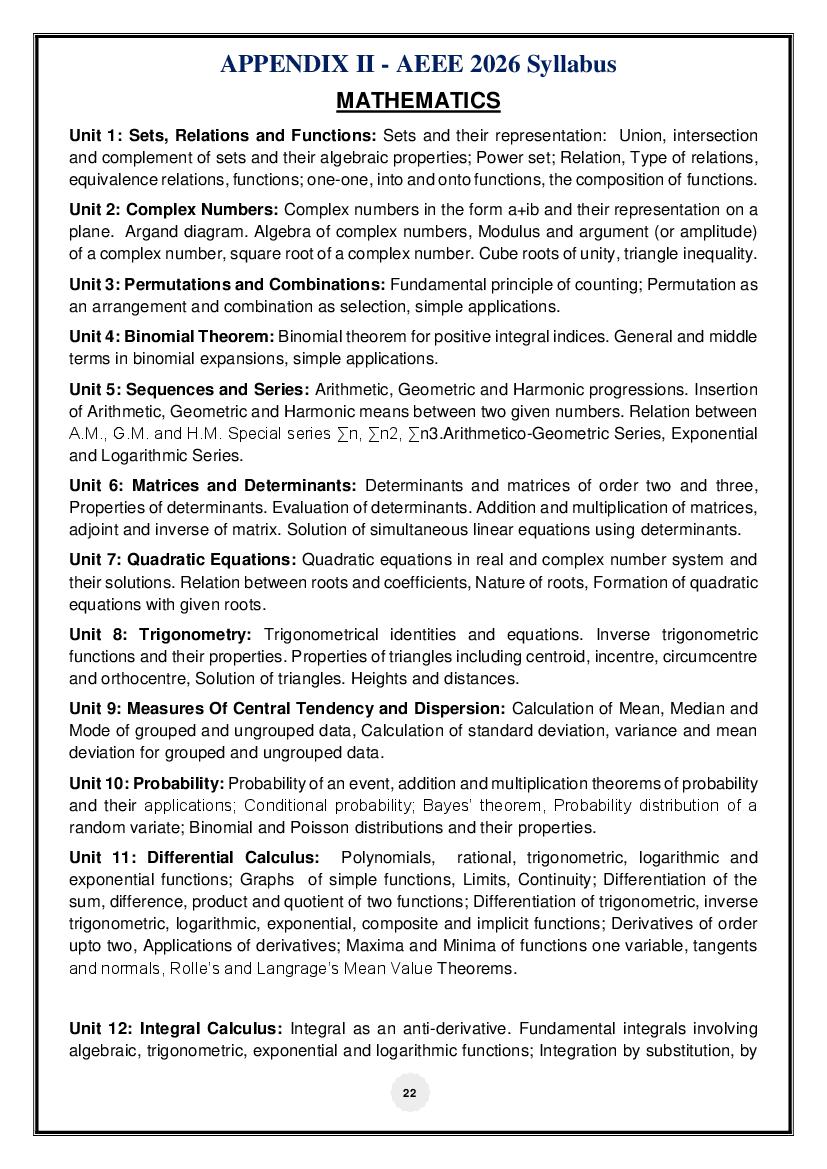
MATHEMATICS
Unit 1: Sets, Relations and Functions: Sets and their representation: Union, intersection
and complement of sets and their algebraic properties; Power set; Relation, Type of relations,
equivalence relations, functions; one-one, into and onto functions, the composition of functions.
Unit 2: Complex Numbers: Complex numbers in the form a+ib and their representation on a
plane. Argand diagram. Algebra of complex numbers, Modulus and argument (or amplitude)
of a complex number, square root of a complex number. Cube roots of unity, triangle inequality.
Unit 3: Permutations and Combinations: Fundamental principle of counting; Permutation as
an arrangement and combination as selection, simple applications.
Unit 4: Binomial Theorem: Binomial theorem for positive integral indices. General and middle
terms in binomial expansions, simple applications.
Unit 5: Sequences and Series: Arithmetic, Geometric and Harmonic progressions. Insertion
of Arithmetic, Geometric and Harmonic means between two given numbers. Relation between
A.M., G.M. and H.M. Special series ∑n, ∑n2, ∑n3.Arithmetico-Geometric Series, Exponential
and Logarithmic Series.
Unit 6: Matrices and Determinants: Determinants and matrices of order two and three,
Properties of determinants. Evaluation of determinants. Addition and multiplication of matrices,
adjoint and inverse of matrix. Solution of simultaneous linear equations using determinants.
Unit 7: Quadratic Equations: Quadratic equations in real and complex number system and
their solutions. Relation between roots and coefficients, Nature of roots, Formation of quadratic
equations with given roots.
Unit 8: Trigonometry: Trigonometrical identities and equations. Inverse trigonometric
functions and their properties. Properties of triangles including centroid, incentre, circumcentre
and orthocentre, Solution of triangles. Heights and distances.
Unit 9: Measures Of Central Tendency and Dispersion: Calculation of Mean, Median and
Mode of grouped and ungrouped data, Calculation of standard deviation, variance and mean
deviation for grouped and ungrouped data.
Unit 10: Probability: Probability of an event, addition and multiplication theorems of probability
and their applications; Conditional probability; Bayes’ theorem, Probability distribution of a
random variate; Binomial and Poisson distributions and their properties.
Unit 11: Differential Calculus: Polynomials, rational, trigonometric, logarithmic and
exponential functions; Graphs of simple functions, Limits, Continuity; Differentiation of the
sum, difference, product and quotient of two functions; Differentiation of trigonometric, inverse
trigonometric, logarithmic, exponential, composite and implicit functions; Derivatives of order
upto two, Applications of derivatives; Maxima and Minima of functions one variable, tangents
and normals, Rolle’s and Langrage’s Mean Value Theorems.
Unit 12: Integral Calculus: Integral as an anti-derivative. Fundamental integrals involving
algebraic, trigonometric, exponential and logarithmic functions; Integration by substitution, by
22
Page 2
sum; Properties of definite integrals. Evaluation of definite integral; Determining areas of the
regions bounded by simple curves.
Unit 13: Differential Equations: Ordinary differential equations, their order and degree;
Formation of differential equation; Solutions of differential equations by the method of
separation of variables; Solution of Homogeneous and linear differential equations of first
order.
Unit 14: Co-ordinate Geometry: Review of Cartesian system of rectangular co-ordinates in a
plane, distance formula, area of triangle, condition for the collinearity of three points, slope of
a line, parallel and perpendicular lines, intercepts of a line on the coordinate axes.
Unit 15: The Straight Line and Pair of Straight Lines: Various forms of equations of a line,
intersection of lines, angles between two lines, conditions for concurrence of three lines,
distance of a point from a line. Equations of internal and external bisectors of angles between
two lines, equation of family lines passing through the point of intersection of two lines,
homogeneous equation of second degree in x and y, angle between pair of lines through the
origin, combined equation of the bisectors of the angles between a pair of lines, condition for
the general second degree equation to represent a pair of lines, point of intersections and
angles between two lines.
Unit 16: Circles and Family of Circles: Standard form of equation of a circle, general form
of the equation of a circle, its radius and centre, equation of a circle in the parametric form,
equation of a circle when the end points of a diameter are given, points of intersection of a line
and circle with the centre at the origin and condition for a line to be tangent, equation of a family
of circles through the intersection of two circles, condition for two intersecting circles to be
orthogonal.
Unit 17: Conic Sections: Sections of cones, equations of conic sections (parabola, ellipse
and hyperbola) in standard forms, conditions for y = mx+c to be a tangent and point(s) of
tangency.
Unit 18: Vector Algebra: Vector and scalars, addition of two vectors, components of a vector
in two dimensions and three-dimensional space, scalar and vector products, scalar and vector
triple product. Application of vectors to plane geometry.
Unit 19: Three-Dimensional Geometry: Distance between two points. Direction cosines of a
line joining two points. Cartesian and vector equation of a line. Coplanar and skew lines.
Shortest distance between two lines. Cartesian and vector equation of a plane. Angle between
(i) two lines (ii) two planes (iii) a line and a plane. Distance of a point from a plane.
23
Page 3
Unit 1: Units and dimensions: Units for measurement, system of units, SI, fundamental and
derived units, dimensional analysis.
Unit 2: Kinematics: Uniform and non-uniform motion, average speed and instantaneous
velocity, uniformly accelerated motion, velocity - time, position-time graph, relations for uniformly
accelerated motion, Scalars and Vectors, Vector. Addition and subtraction, zero vector, scalar
and vector products, Unit Vector, Resolution of a Vector. Relative Velocity, Motion in a plane,
Projectile Motion, Uniform Circular Motion.
Unit 3: Mechanics: Motion in one-dimension, uniform and non-uniform motion, uniformly
accelerated motion; Scalars and Vectors, resolution of Vectors, vector properties. Motion in a
plane, Projectile motion, Uniform circular motion.
Newton’s laws of motion, conservation of linear momentum, Friction; Work-Energy theorem,
kinetic energy, potential energy, conservation of energy; elastic collision in one and two
dimensions.
Center of mass of a system of particles, centre of mass of a rigid body, rotational motion and
torque, angular momentum and its conservation, moments of inertia for various geometries,
parallel and perpendicular axes theorem.
Universal law of gravitation, acceleration due to gravity, planetary motion, Kepler’s laws,
Satellites, gravitational potential and potential energy and escape velocity.
Unit 4: Solids and Fluids
Solids: Elastic properties, Hooke’s law, Young’s modulus, bulk modulus, rigidity modulus.
Liquids: Cohesion and adhesion; surface energy and surface tension; flow of fluids; Bernouli’s
theorem and applications; viscosity, Stoke’s law, terminal velocity
Unit 5: Oscillations and Waves
Oscillations: Oscillatory motion - periodic and non-periodic motion; simple harmonic motion
(SHM), angular SHM, linear harmonic oscillator – both horizontal and vertical; combination of
springs – series and parallel, simple pendulum; Expression of energy – potential energy, kinetic
energy and total energy; Graphical representation of SHM; Types of oscillations – free, damped,
maintained and forced oscillations and resonance.
Wave Motion: Properties of waves; Transverse and Longitudinal waves; Superposition of waves,
Progressive and Standing waves; Vibration of strings and air columns, beats, Doppler Effect.
Unit 6: Heat and Thermodynamics: Heat, work and temperature; Ideal gas laws; Specific heat
capacity, Thermal expansion of solids, liquids and gases, Relationship between Cp and Cv for
gases; Newton’s law of cooling, black body, Kirchoff’s law, Stafan’s law and Wein’s law,
thermodynamic equilibrium, internal energy; Zeroth, first and second law of thermodynamics,
thermodynamic processes, Carnot cycle, efficiency of heat engines, refrigerator
Unit 7: Electrostatics, Current Electricity and Magnetostatics
Electric charges and Fields: Electric Charge; Conductors and Insulators, Charging by
Induction, Basic Properties of Electric Charge, Coulomb’s Law, Forces between Multiple
Charges, Electric Field, Electric Field Lines, Electric Flux, Electric Dipole, Dipole in a Uniform
External Field, Continuous Charge Distribution, Gauss’s Law, Applications of Gauss’s Law.
24
Page 4
charge, electric dipole, system of charges. Equipotential surfaces; Potential energy of a system
of charges, potential energy in an external field, Electrostatics of conductors, Dielectric and
Polarization, Capacitors and Capacitance, parallel plate capacitor, effect of dielectric on
capacitance combination of capacitors, energy stored in a capacitor, Van de Graaff Generator.
Current Electricity: Electric current, electric currents in conductors, Ohm’s law, drift of electrons
and the origin of Resistivity, temperature dependence of resistivity, electrical energy, power,
combination of resistors, series and parallel, cells, emf, internal resistance, cells in series and in
parallel, Kirchhoff’s Rules, Wheatstone bridge, Meter bridge, potentiometer.
Heating effects of current: Electric power; concept of thermoelectricity – Seebeck effect and
thermocouple, chemical effect of current – Faraday’s laws of electrolysis.
Magnetic effects: Oersted’s experiment, BiotSavart’s law, magnetic field due to a straight wire,
circular loop and solenoid, force on a moving charge in a uniform magnetic field (Lorentz force),
forces and torques on a current carrying conductor in a magnetic field, force between current
carrying wires, moving coil galvanometer and conversion to ammeter and voltmeter.
Magneto statistics: Bar magnet, magnetic field, lines of force, torque on a bar magnet in a
magnetic field, earth’s magnetic field; para, dia, and ferro magnetism, magnetic induction and
magnetic susceptibility.
Unit 8: Electromagnetic Induction and Electromagnetic Waves
Electromagnetic Induction: Induced e. m. f: Magnetic flux, Faraday’s law, Lenz’s Law and
Conservation of Energy, self and mutual inductance.
Alternating Current: Impedance and reactance; power in AC circuits; AC voltage applied to
resistor, inductor, capacitor, LCR circuits and resonance, transformer and AC generator.
Electromagnetic Waves: Electromagnetic waves characteristics, electromagnetic spectrum
from gamma to radio waves.
Unit 9: Kinetic Theory of Gases: Equation of state of a perfect gas, work done on compressing
a gas, Kinetic theory of gases - assumptions, the concept of pressure. Kinetic energy and
temperature: RMS speed of gas molecules: Degrees of freedom. Law of equipartition of energy,
applications to specific heat capacities of gases; Mean free path. Avogadro's number.
Unit 10: Ray and Wave Optics
Ray Optics and optical instruments: Reflection and refraction of light by plain spherical
mirrors - Total Internal Reflection; optical fiber; deviation and dispersion of light by a prism; lens
formula; magnification and resolving power; microscope and telescope.
Wave Optics: Huygens principle: Wave nature of light, interference of light waves and Young’s
experiment, thin films, Newton’s rings, Diffraction – single slit, grating, Polarization and
applications.
Unit 11: Modern Physics
Dual nature of radiation and matter: De Broglie relation, Electron emission, photoelectric
effect, experimental study, Einstein’s photoelectric equation: Energy quantum of radiation;
particle nature of light, the photon, wave nature of matter.
25
Page 5
model of the hydrogen atom; the line spectra of the hydrogen atom.
Nuclei: Atomic masses and composition of nucleus; size of the nucleus; mass-energy and
nuclear binding energy; nuclear force; radioactivity; nuclear energy
Semiconductor materials, devices and simple circuits: Energy bands in solids; classification
of metals, conductors and semiconductors; intrinsic semiconductor, extrinsic semiconductor, p-
n junction, semiconductor diode, junction diode as a rectifier, junction transistor, transistor as an
amplifier.
26
Page 6
Unit 1 – Basic Chemical calculations: Density - mole concept - empirical and molecular
formula – stoichiometry - volumetry, equivalent and molecular masses, percentage composition
Unit 2 - Atomic structure & periodicity: atomic models, sub-atomic particles, orbital shapes,
Pauli’s exclusion, Hund’s rule, Aufbau principle, de-Broglie relation, Heisenberg’s uncertainty,
electronic configuration and periodic properties.
Unit 3 - Chemical bonding: Ionic bonding, lattice energy – Born-haber cycle, covalent bond -
Fajan’s Rule –VSEPR theory -- hybridization, valence bond and molecular orbital theory,
coordinate, metallic and hydrogen bonding
Unit 4 - S-block and hydrogen: Hydrogen, isotopes, liquid hydrogen as fuel, alkali metals,
oxides and hydroxides, extraction and properties of lithium, sodium and potassium. Group 2
elements and their properties.
Unit 5 - P-block elements: Boron - borax, boranes, diboranes, Carbon - allotropes, oxides,
carbides, halides and sulphides of carbon group- silicon and silicates – silicones, Nitrogen –
Fixation – compounds of nitrogen- Phosphorous – allotropes and compounds. Oxygen - oxides
and peroxide. Sulphur – its compounds - inter-halogen compounds.
Unit 6 - d and f block elements: d-block elements configuration and properties - transition
elements, chromium, copper, zinc, silver, interstitial compounds and alloys, f - block elements
and extraction, lanthanides and actinides
Unit 7 - Solid state: Solids - amorphous and crystalline, classification of crystalline - unit cell,
Miller indices - packing efficiency, unit cell dimensions, crystal structure, ionic crystals,
imperfections in solids, electric and magnetic properties.
Unit 8 - Coordination compounds: Terminology in coordination- isomerism, Werner, VBT,
CFT theories - Bio- coordination compounds.
Unit 9 - Gaseous State & Surface chemistry: Gaseous state and gas laws, deviation- van der
Waal’s constants - Joule-Thomson effect - liquefaction of gases, theory of catalysis, colloids and
emulsions.
Unit 10 - Colligative properties: Lowering of vapour pressure, Depression of freezing point,
Elevation in boiling point, Osmotic pressure, abnormality - dissociation and association
Unit 11 – Electrochemistry: Faraday’s laws - specific, equivalent and molar conductance,
Kohlraush’s law and applications- electrode potentials - EMF, electrochemical and galvanic
cells, Nernst equation, batteries, fuel cells, corrosion and its prevention.
Unit 12 -Thermodynamics: First and second law- internal energy, enthalpy, entropy, free
energy changes– specific heats at constant pressure and constant volume – enthalpy of
combustion, formation and neutralization, Kirchoff law – Hess’s law - bond energy
Unit 13 - Chemical and Ionic Equilibria: Law of chemical equilibrium, homogenous and
heterogeneous equilibrium, Le Chatlier’s principle, equilibrium constants, factors affecting- Ionic
equilibrium, ionization of acids and bases, buffer solutions, pH -solubility of sparingly soluble
salts
Unit 14 - Chemical kinetics: Order, molecularity, rate and rate constant – first and second order
27
Page 7
equation, collision theory of chemical reaction
Unit 15 - Basic Organic chemistry: Classification, functional groups, nomenclature and
isomerism, types of organic reactions, mechanism, purification, qualitative and quantitative
analysis carbocation, carbanion and free radical, electron displacement in covalent bond.
Unit 16 - Hydrocarbons & Polymers: IUPAC nomenclature, alkanes –alkynes – aromatic
hydrocarbons- nomenclature, preparation, physical and chemical property uses. Polymerization
– types, molecular mass, biodegradable and commercial polymers.
Unit 17 - Organic halogen compounds: Nature of C-X bond - preparation - properties and
reactions of alkyl and aryl halides- polyhalogen compounds - substitution and elimination –
mechanism- Grignard reagents.
Unit 18 - Stereochemistry and Organic nitrogen compounds: Preparation - properties and
uses of Aliphatic and aromatic nitro compounds --aliphatic and aromatic amines, nitriles,
Diazonium salts. – 1°, 2°, and 3° amines – distinction - Optical activity.
Unit 19 - Organic functional groups – hydroxyl, carbonyl compounds and ethers:
Nomenclature, preparation, properties and uses of alcohols, ethers, aldehydes, ketones,
aliphatic carboxylic acids, benzoic acid - salicylic acid.
Unit 20 - Biomolecules and Environmental chemistry: Carbohydrates, proteins, amino acids
- enzymes, vitamins, and nucleic acids - lipids. Pollution. - air, water and soil - industrial waste,
acid rain, greenhouse effect, global warming, Strategies to control pollution.
ENGLISH
Articles, Synonyms, Antonyms, Preposition, Verbs.
Note:
This handbook contains general information and rules regarding the Amrita Engineering Entrance Examination 2026 and other relevant details.
Candidates are required to go through the handbook carefully and acquaint themselves with the procedures relating to the admission. The
contents of the handbook are subject to modification, as may be deemed necessary, by the University. The decision of the University will be final
and binding on any issue related to the admission.
28
Document Details
| Board / Org | Amrita University |
| Exam | Amrita Engineering Entrance Examination |
| Type | Syllabus |
| Pages | 7 |
| Language | english |
| Updated | 22 Jul 2026 |