CBSE Class 10 Question Paper 2025 Hindustani Music
Finished viewing? Save it for later —
Download CBSE Class 10 Question Paper 2025 Hindustani Music (PDF · 28 pages)About CBSE Class 10 Question Paper 2025 Hindustani Music
CBSE Class 10 Question Paper 2025 Hindustani Music is available here for free download. Published by CBSE for Class 10, this question paper can be viewed online or downloaded as a PDF (28 pages). Candidates preparing for Class 10 can use CBSE Class 10 Question Paper 2025 Hindustani Music to understand the exam pattern, the type of questions asked, and the overall difficulty level.
Frequently Asked Questions
How can I download CBSE Class 10 Question Paper 2025 Hindustani Music?
Open this page and click the Download button to save CBSE Class 10 Question Paper 2025 Hindustani Music as a PDF. It is completely free on AglaSem Docs.
Is CBSE Class 10 Question Paper 2025 Hindustani Music free to download?
Yes. CBSE Class 10 Question Paper 2025 Hindustani Music can be viewed online and downloaded as a PDF free of cost on AglaSem Docs.
How many pages does CBSE Class 10 Question Paper 2025 Hindustani Music have?
CBSE Class 10 Question Paper 2025 Hindustani Music contains 28 pages, which you can read online or download together as a single PDF.
Where can I find more Class 10 study material?
You can find more Class 10 question papers, sample papers, syllabus, and answer keys on AglaSem Docs.
CBSE Class 10 Question Paper 2025 Hindustani Music – Text
Read the full text of this question paper below — useful to quickly search, copy and reference the content online without downloading the PDF.
📄 View text version (28 pages)
Page 1
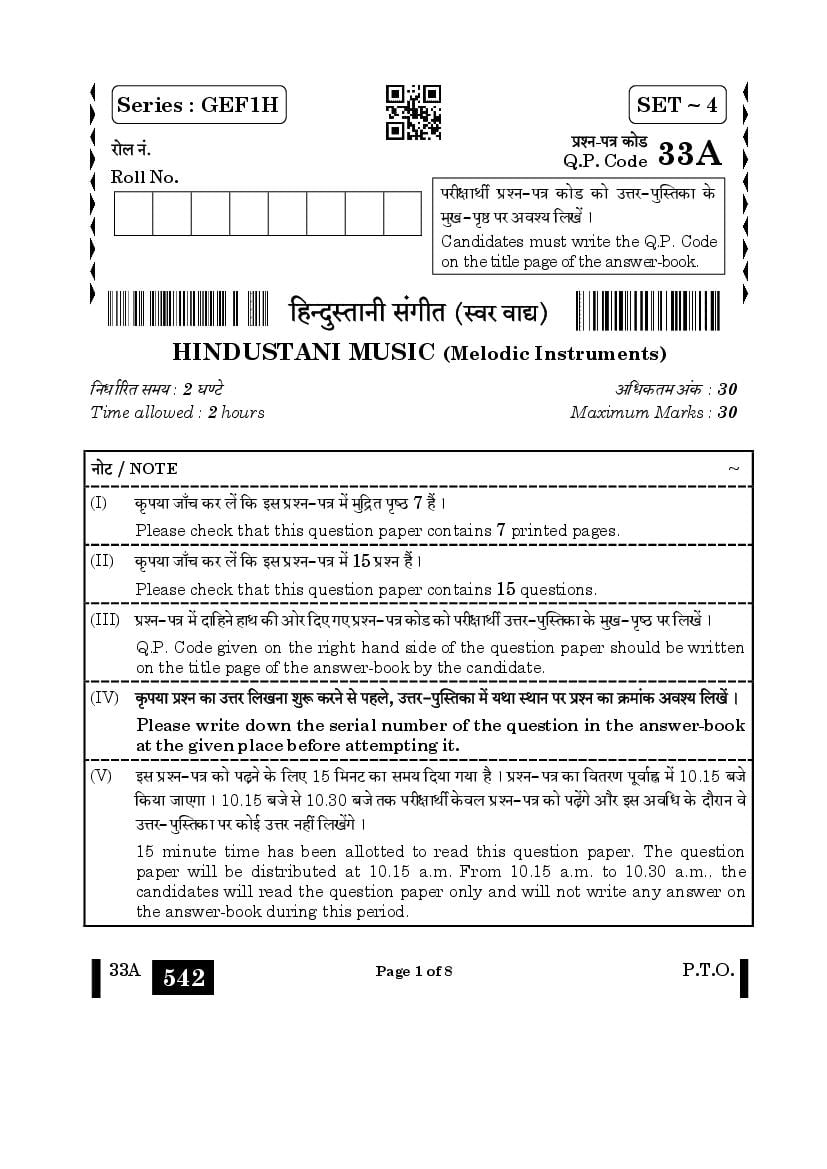
33A
-
Q.P. Code
Roll No.
- -
-
Candidates must write the Q.P. Code
on the title page of the answer-book.
HINDUSTANI MUSIC (Melodic Instruments)
: 2 : 30
Time allowed : 2 hours Maximum Marks : 30
NOTE ~
(I) - 7
Please check that this question paper contains 7 printed pages.
(II) - 15
Please check that this question paper contains 15 questions.
(III) - - - -
Q.P. Code given on the right hand side of the question paper should be written
on the title page of the answer-book by the candidate.
(IV)
Please write down the serial number of the question in the answer-book
at the given place before attempting it.
(V) - 15 - 10.15
10.15 10.30 -
-
15 minute time has been allotted to read this question paper. The question
paper will be distributed at 10.15 a.m. From 10.15 a.m. to 10.30 a.m., the
candidates will read the question paper only and will not write any answer on
the answer-book during this period.
33A P.T.O.
542 Page 1 of 8
Page 2
(i) : ( 1 )
(ii) : ( 2 )
(iii) : ( 6 )
8 1=8
1. 1
(A) (B)
(C) (D)
2. 7 ? 1
(A) (B)
(C) (D)
3. ‘-’ 1
(A) 3 – 2 (B) 2 – 3
(C) 4 – 1 (D) 3 – 1
4. : 1
I.
II.
III. ,
IV.
:
(A) I – III (B) II – III
(C) I – IV (D) II – IV
5. : 1
I. 4
II.
III. -
IV.
:
(A) I, II, III (B) II, III, IV
(C) I, III, IV (D) I, II, IV
33A Page 2 of 8
Page 3
General Instructions :
(i) Section – A : Attempt all Questions. (Each Question carry 1 Mark.)
(ii) Section – B : Attempt all Questions. (Each Question carry 2 Marks.)
(iii) Section – C : Attempt all Questions. (Each Question carry 6 Marks.)
SECTION – A 8 1=8
1. Thaat of Raga Khamaj is : 1
(A) Bhairav (B) Kalyan
(C) Khamaj (D) Kafi
2. Which Tala is of 7 Matra ? 1
(A) Tilwada (B) Keharva
(C) Dadra (D) Rupak
3. Number of ‘Tali-Khali’ in Tala Tilwada is : 1
(A) 3 – 2 (B) 2 – 3
(C) 4 – 1 (D) 3 – 1
4. Choose the correct statement : 1
I. Maseetkhani Gat is played on String Instruments.
II. 7 Swaras are used in Raga Bhupali.
III. Aalap is performed with Tala.
IV. First Matra of Rupak Tala is Khali.
Choose the correct option :
(A) I – III (B) II – III
(C) I – IV (D) II – IV
5. Choose the correct statement : 1
I. Tilwada Tala has 4 Vibhags.
II. Laya of Razakhani Gat is Drut.
III. Jaati of Raga Vrindavani Sarang is Sampurna-Sampurna.
IV. Name of Tansen’s guru was Swami Haridas.
Choose the correct option :
(A) I, II, III (B) II, III, IV
(C) I, III, IV (D) I, II, IV
33A Page 3 of 8 P.T.O.
Page 4
6. : 1
–I – II
(a) (i)
(b) (ii) O
(c) (iii)
(d) (iv)
:
(a) (b) (c) (d)
(A) (ii) (iv) (iii) (i)
(B) (i) (ii) (iii) (iv)
(C) (iv) (iii) (ii) (i)
(D) (iii) (i) (iv) (ii)
7. – I : 1
– II :
:
(A) I II
(B) I II
(C) I II
(D) I II
8. – I : 1
– II :
:
(A) I II
(B) I II
(C) I II
(D) I II
– 5 2 = 10
9. (a) 2
(b)
33A Page 4 of 8
Page 5
6. Match the followings : 1
List – I List – II
(a) Khali (i) DDD
(b) Kan (ii) O
(c) Meend (iii) G M
(d) Tigun (iv) MP
Codes :
(a) (b) (c) (d)
(A) (ii) (iv) (iii) (i)
(B) (i) (ii) (iii) (iv)
(C) (iv) (iii) (ii) (i)
(D) (iii) (i) (iv) (ii)
7. Statement – I : Tanas are performed after the composition. 1
Statement – II : Maseetkhani Gat is played in Fast Tempo.
Choose the correct option :
(A) Statement I and II both are true.
(B) Statement I and II both are false.
(C) Statement I is false and II is true.
(D) Statement I is true and II is false.
8. Statement – I : Five Swaras are used in Raga Bhupali. 1
Statement – II : Thaat of Raga Bhupali is Kalyan.
Choose the correct option :
(A) Statement I and II both are true.
(B) Statement I and II both are false.
(C) Statement I is false and II is true.
(D) Statement I is true and II is false.
SECTION – B 5 2 = 10
9. (a) Give the description of Rupak Tala, write its Tigun in Tala Notation. 2
OR
(b) Describe briefly about Tana and Meend with example.
33A Page 5 of 8 P.T.O.
Page 6
10. (a) 2
(b)
11. (a) . , , , . – 40
2
(b)
12. (a) 2
(b)
13. (a) 2
(b) .
– 2 6 = 12
14. (a) 6
(b)
15. (a) 6
(b) , ,
‘ ’ ‘’
,
______________
33A Page 6 of 8
Page 7
10. (a) Describe the salient features of Raga Khamaj. 2
OR
(b) Discuss the life sketch & contribution of Tansen.
11. (a) N. i Sa Re, Ma Re, Pa Ma Re, N
. i Sa
Identify the raga from the above phrase and elaborate it upto
40 Swaras. 2
OR
(b) Describe Tilwada Tala and write its dugun in Tala Notation.
12. (a) Give a brief description of Inayat Khan’s life. 2
OR
(b) Explain Dhrupad in detail.
13. (a) Give a brief comment on Aalap and Kan. 2
OR
(b) Throw light on the musical contribution of Pt. Omkar Nath Thakur.
SECTION – C 2 6 = 12
14. (a) Write the notation of Maseetkhani Gat with two Todas in any one
Raga from the prescribed syllabus. 6
OR
(b) Write Razakhani Gat with two Tana in Raga Khamaj or Raga
Bhupali with notation.
15. (a) Describe the style of any one present day artist who plays the same
instruments which you have opted for. 6
OR
(b) Every instrument has its own speciality. Its ‘Vadan Shaili’ is based
upon its length, breadth and the number of strings. ‘Jawari’ has a
very important place in instruments. There is a difference in the
structure of fretted and non-fretted instruments.
Based upon the above paragraph, describe the various parts of the
instrument that you have opted for, along with its tuning process in
detail.
______________
33A Page 7 of 8 P.T.O.
Page 8
33A
542 Page 8 of 8
Page 9
-
Q.P. Code 34
. - -
Roll No. -
Candidates must write the Q.P. Code
on the title page of the answer-book.
- 11
- 15
- - - -
, -
- 15 - 10.15
10.15 10.30 -
-
Please check that this question paper contains 11 printed pages.
Please check that this question paper contains 15 questions.
Q.P. Code given on the right hand side of the question paper should be written
on the title page of the answer-book by the candidate.
Please write down the serial number of the question in the answer-book
at the given place before attempting it.
15 minute time has been allotted to read this question paper. The question
paper will be distributed at 10.15 a.m. From 10.15 a.m. to 10.30 a.m., the
candidates will read the question paper only and will not write any answer on
the answer-book during this period.
( )
HINDUSTANI MUSIC (Percussion Instruments)
{ZYm©[aV g‘¶ : 2 KÊQ>o A{YH$V‘ A§H$ : 30
Time allowed : 2 hours Maximum Marks : 30
34 549 Page 1 ~ P.T.O.
Page 10
(i) - – ( 1 )
(ii) - – ( 2 )
(iii) - – ( 6 )
-
1. ? 1
(A) 3
(B) 6
(C) 5
(D) 4
2. ‘’ ? 1
(A)
(B)
(C)
(D)
3. ? 1
(A)
(B)
(C)
(D)
34 Page 2 ~
Page 11
(i) Section – A Attempt all Questions (Each Question carry 1 mark).
(ii) Section – B Attempt all Questions (Each Question carry 2 Marks).
(iii) Section – C Attempt all Questions (Each Question carry 6 Marks).
SECTION – A
1. How many division are there in Jhaptala ? 1
(A) 3
(B) 6
(C) 5
(D) 4
2. Ancient ‘Aankik’ is associated with which instrument ? 1
(A) Mridang
(B) Tabla
(C) Khanjri
(D) Tumba
3. Siddhar Khan belongs to which Gharana ? 1
(A) Banaras
(B) Punjab
(C) Ajrada
(D) Delhi
34 Page 3 ~ P.T.O.
Page 12
-I -II
(a) (i)
(b) (ii)
(c) (iii)
(d) (iv)
(a) (b) (c) (d)
(A) (i) (ii) (iii) (iv)
(B) (ii) (i) (iv) (iii)
(C) (iii) (i) (ii) (iv)
(D) (iv) (ii) (i) (iii)
5. 1
(i)
(ii)
(iii)
(iv)
(A) (ii), (iii), (iv) (B) (i), (ii), (iii)
(C) (i), (ii), (iv) (D) (i), (iii), (iv)
6. 1
(a) (b)
(c) (d)
(A) (a), (b), (c), (d) (B) (b), (a), (c), (d)
(C) (b), (a), (d), (c) (D) (c), (a), (b), (d)
34 Page 4 ~
Page 13
List – I List – II
Artist Gharana
(a) Anindo Chatterjee (i) Delhi Gharana
(b) Safat Ahmad (ii) Panse Gharana
(c) Balwant Rao (iii) Farukhabad Gharana
(d) Ghanshyam Das (iv) Nathdwara Gharana
(a) (b) (c) (d)
(A) (i) (ii) (iii) (iv)
(B) (ii) (i) (iv) (iii)
(C) (iii) (i) (ii) (iv)
(D) (iv) (ii) (i) (iii)
5. Choose the correct bols of Ektaal : 1
(i) Dhage
(ii) Gadigan
(iii) Tirkit
(iv) Tu
Choose the correct answer :
(A) (ii), (iii), (iv)
(B) (i), (ii), (iii)
(C) (i), (ii), (iv)
(D) (i), (iii), (iv)
6. Choose the correct sequence of Tabla solo of Farukhabad Gharana : 1
(a) Peshakar (b) Kayada
(c) Rela (d) Tukda
Choose the correct answer from the options given below :
(A) (a), (b), (c), (d) (B) (b), (a), (c), (d)
(C) (b), (a), (d), (c) (D) (c), (a), (b), (d)
34 Page 5 ~ P.T.O.
Page 14
-II :
(A) -I II
(B) -I II
(C) -I , II
(D) -I , II
8. -I : 1
-II :
(A) -I II
(B) -I II
(C) -I , II
(D) -I , II
–
9. (a) 2
(b)
10. (a) 2
(b)
34 Page 6 ~
Page 15
Statement – II : Pakhawaj Vadan also begins with Uthan.
Choose the correct option :
(A) Statement I and II both are correct.
(B) Statement I and II both are incorrect.
(C) Statement I is correct but II is incorrect.
(D) Statement I is incorrect but II is correct.
8. Statement – I : Sooltaal is played on Pakhawaj. 1
Statement – II : It is used with Dhrupad Gayan.
Choose the correct option :
(A) Statement I and II both are correct.
(B) Statement I and II both are incorrect.
(C) Statement I is correct but II is incorrect.
(D) Statement I is incorrect but II is correct.
SECTION – B
9. (a) Describe Simple Tukda. 2
OR
(b) Define Farmaishi Chakradar.
10. (a) Write about Delhi Gharana. 2
OR
(b) Write about Pakhawaj player Nana Panse.
34 Page 7 ~ P.T.O.
Page 16
(b) ,
12. (a) ‘ ’ 2
(b)
13. (a) , 2
(b) ,
–
14. (a) 6
(b) ,
34 Page 8 ~
Page 17
OR
(b) Describe Jhaptala and write its Changun in Tala Notation.
12. (a) Write about ‘Urdhavak Vadya’. 2
OR
(b) Explain about Alingya vadya.
13. (a) Write one Kayada, one Palta and Tihai in Teentala with Tala
Notation System. 2
OR
(b) Write one Rela, one Palta and Tihai in Aditala with Tala Notation
System.
SECTION – C
14. (a) Write one Rela, three Paltas and Tihai in chartala in Tala Notation. 6
OR
(b) Write one Kayada and two Paltas with Tihai in Ektaal.
34 Page 9 ~ P.T.O.
Page 18
, , ,
- ?
-
6
(b) ,
,
__________
34 Page 10 ~
Page 19
‘Rou’ or ‘Ravish’. Here Dhet, Tak, Dhig, Nag etc. are used very often.
What were the fundamental changes made in the playing of tabla
which gave prestige to Farukhabad Gharana ? Explain its features in
detail. 6
OR
(b) Explain the style of any one contemporary artiste who has impressed
you the most, of the instrument that you perform.
__________
34 Page 11 ~ P.T.O.
Page 20
Page 21
33
-
Q.P. Code No.
Roll No.
- -
-
Candidates must write the Q.P. Code
on the title page of the answer-book.
HINDUSTANI MUSIC (Vocal)
: 2 : 30
Time allowed : 2 hours Maximum Marks : 30
NOTE ~
(I) - 7
Please check that this question paper contains 7 printed pages.
(II) - 15
Please check that this question paper contains 15 questions.
(III) - - - -
Q.P. Code given on the right hand side of the question paper should be
written on the title page of the answer-book by the candidate.
(IV)
Please write down the serial number of the question in the answer-
book at the given place before attempting it.
(V) - 15 - 10.15
10.15 10.30 -
-
15 minute time has been allotted to read this question paper. The question
paper will be distributed at 10.15 a.m. From 10.15 a.m. to 10.30 a.m., the
candidates will read the question paper only and will not write any answer
on the answer-book during this period.
33 P.T.O.
545 Page 1 of 8
Page 22
(i) : ( 1 )
(ii) : ( 2 )
(iii) : ( 6 )
8 1=8
1. – 1
(A) - (B) -
(C) - (D) -
2. 1
(A) 2 (B) 6
(C) 4 (D) 3
3. – 1
(A) (B)
(C) (D)
4. 1
i.
ii.
iii. ,
iv. 12
(A) i iii (B) i iv
(C) ii iii (D) i ii
5. 1
i. 7
ii. ,
iii.
iv.
(A) i, ii, iii (B) i, iii, iv
(C) ii, iii, iv (D) i, ii, iv
33 Page 2 of 8
Page 23
General Instructions :
(i) Section – A : Attempt all Questions. (Each Question carry 1 Mark.)
(ii) Section – B : Attempt all Questions. (Each Question carry 2 Marks.)
(iii) Section – C : Attempt all Questions. (Each Question carry 6 Marks.)
SECTION – A 8 1=8
1. Jati of Raga Vrindavani Sarang – 1
(A) Audav-Shadav (B) Shadav-Shadav
(C) Audav-Sampurna (D) Audav-Audav
2. Number of swaras or bols in one beat (Matra) of chaugun 1
(A) 2 (B) 6
(C) 4 (D) 3
3. Raga not originating from the similar name of Thaat 1
(A) Bhairav (B) Kafi
(C) Khamaj (D) Bhupali
4. Choose the correct statement : 1
i. Chautal is played with Dhrupad.
ii. Vadi Swara of Raga Khamaj is Gandhar.
iii. Omkar Nath Thakur was a contemporary of Tansen.
iv. Tala Tilwada has 12 beats.
Choose the correct option :
(A) i & iii (B) i & iv
(C) ii & iii (D) i & ii
5. Choose the correct statement : 1
i. Tala Rupak has 7 beats and three Vibhagas.
ii. Tilwada Tala is played with Dhamar.
iii. Tarana is a type of Musical form.
iv. Khamaj is an Ashraya Raga.
Choose the correct option :
(A) i, ii, iii (B) i, iii, iv
(C) ii, iii, iv (D) i, ii, iv
33 Page 3 of 8 P.T.O.
Page 24
6. -I -II 1
-I -II
(a) (i)
(b) (ii)
(c) (iii)
(d) (iv)
(a) (b) (c) (d)
(A) (i) (ii) (iii) (iv)
(B) (ii) (i) (iii) (iv)
(C) (iii) (ii) (iv) (i)
(D) (iv) (iii) (ii) (i)
7. –I :
1
– II :
:
(A) I II
(B) I II
(C) I , II
(D) I , II
8. –I : 1
– II :
:
(A) I II
(B) I II
(C) I , II
(D) I , II
– 5 2 = 10
9. (a) 2
(b)
33 Page 4 of 8
Page 25
6. Match List-I with List-II : 1
List-I List-II
(a) Dhrupad (i) Sparsh Swar
(b) Kan (ii) Banis
(c) Sadarang (iii) Eminent Singer
(d) Slow Tempo (iv) Vilambit Khayal
Choose the correct answer from the options given below :
(a) (b) (c) (d)
(A) (i) (ii) (iii) (iv)
(B) (ii) (i) (iii) (iv)
(C) (iii) (ii) (iv) (i)
(D) (iv) (iii) (ii) (i)
7. Statement – I : Number of Swaras in one beat of Dugun is two. 1
Statement – II : Aalap is rendition of Swaras in fast tempo.
Choose the correct option :
(A) Statement I and II both are true.
(B) Statement I and II both are false.
(C) Statement I is true, but II is false.
(D) Statement I is false, but II is true.
8. Statement – I : Tana is the combination of Swaras sung in Drut laya. 1
Statement – II : Meend is the smooth glide from one note to another
note.
Choose the correct option :
(A) Statement I and II both are true.
(B) Statement I and II both are false.
(C) Statement I is true, but II is false.
(D) Statement I is false, but II is true.
SECTION – B 5 2 = 10
9. (a) Describe Aalap and its types with examples. 2
OR
(b) Write the salient features of Dhamar.
33 Page 5 of 8 P.T.O.
Page 26
10. (a) 2
(b)
, ,
11. (a) ? 2
(b)
12. (a) 50 : 2
‘ . ’
(b)
13. (a) 2
(b)
– 2 6 = 12
14. (a)
6
(b)
15. (a) , ,
6
(b)
______________
33 Page 6 of 8
Page 27
10. (a) Describe in brief the structure and method of tuning of Tanpura. 2
OR
(b) Define any two of the following :
Kan, Tarana, Meend
11. (a) What is the contribution of Pt. Omkar Nath Thakur to Indian Music ? 2
OR
(b) Describe the life sketch of Faiyaz Khan and his contribution to
music.
12. (a) Identify the Raga from the following phrases of Swaras and
elaborate it upto 50 Swaras : 2
‘Ga Re Sa D. ha Sa Re Ga’
OR
(b) Describe the salient features of Raga Dhrupad.
13. (a) Describe Tala Chautala and write its Thah and Dugun in Tala
Notation. 2
OR
(b) Describe Tala Tilwada and write its Tigun in Tala Notation.
SECTION – C 2 6 = 12
14. (a) Give the salient features of Raga Vrindavani Sarang and write its
notation of Drut Khayal along with Two Tanas. 6
OR
(b) Write the notation of Vilambit Khayal in any one prescribed raga of
your syllabus with two Tanas.
15. (a) Tana is a unique aspect of elaboration of a Raga. It is generally
played in Dugun, Tigun, Chaugun etc. laya. There are many
varieities of Tanas. In every raga few varieties of Tanas are applied
according to the nature of the Raga.
After reading the above passage describe six varieties of full Tanas
with examples in the prescribed ragas of your syllabus. 6
OR
(b) Critically analyse the style of any one vocalist of present time who
you like to listen.
______________
33 Page 7 of 8 P.T.O.
Page 28
33 545 Page 8 of 8
Document Details
| Board / Org | CBSE |
| Exam | Class 10 |
| Type | Question Paper |
| Pages | 28 |
| Updated | 24 Sep 2026 |