UGC NET Syllabus for Museology and Conservation 2020
Finished viewing? Save it for later —
Download UGC NET Syllabus for Museology and Conservation 2020 (PDF · 17 pages)About UGC NET Syllabus for Museology and Conservation 2020
UGC NET Syllabus for Museology and Conservation 2020 is available here for free download. Published by NTA for UGC National Eligibility Test, this syllabus can be viewed online or downloaded as a PDF (17 pages). Candidates preparing for UGC National Eligibility Test can use UGC NET Syllabus for Museology and Conservation 2020 to understand the exam pattern, the type of questions asked, and the overall difficulty level.
Frequently Asked Questions
How can I download UGC NET Syllabus for Museology and Conservation 2020?
Open this page and click the Download button to save UGC NET Syllabus for Museology and Conservation 2020 as a PDF. It is completely free on AglaSem Docs.
Is UGC NET Syllabus for Museology and Conservation 2020 free to download?
Yes. UGC NET Syllabus for Museology and Conservation 2020 can be viewed online and downloaded as a PDF free of cost on AglaSem Docs.
How many pages does UGC NET Syllabus for Museology and Conservation 2020 have?
UGC NET Syllabus for Museology and Conservation 2020 contains 17 pages, which you can read online or download together as a single PDF.
Where can I find more UGC National Eligibility Test study material?
You can find more UGC National Eligibility Test question papers, sample papers, syllabus, and answer keys on AglaSem Docs.
UGC NET Syllabus for Museology and Conservation 2020 – Text
Read the full text of this syllabus below — useful to quickly search, copy and reference the content online without downloading the PDF.
📄 View text version (17 pages)
Page 1
UGC NET
Syllabus · Museology
Conservation
EXAM YEAR TYPE SUBJECT
UGC NET — Syllabus Museology Conservation
Notes · Sample Papers · Previous Year Papers · Mock Tests
Page 2
. e
em las
as ag
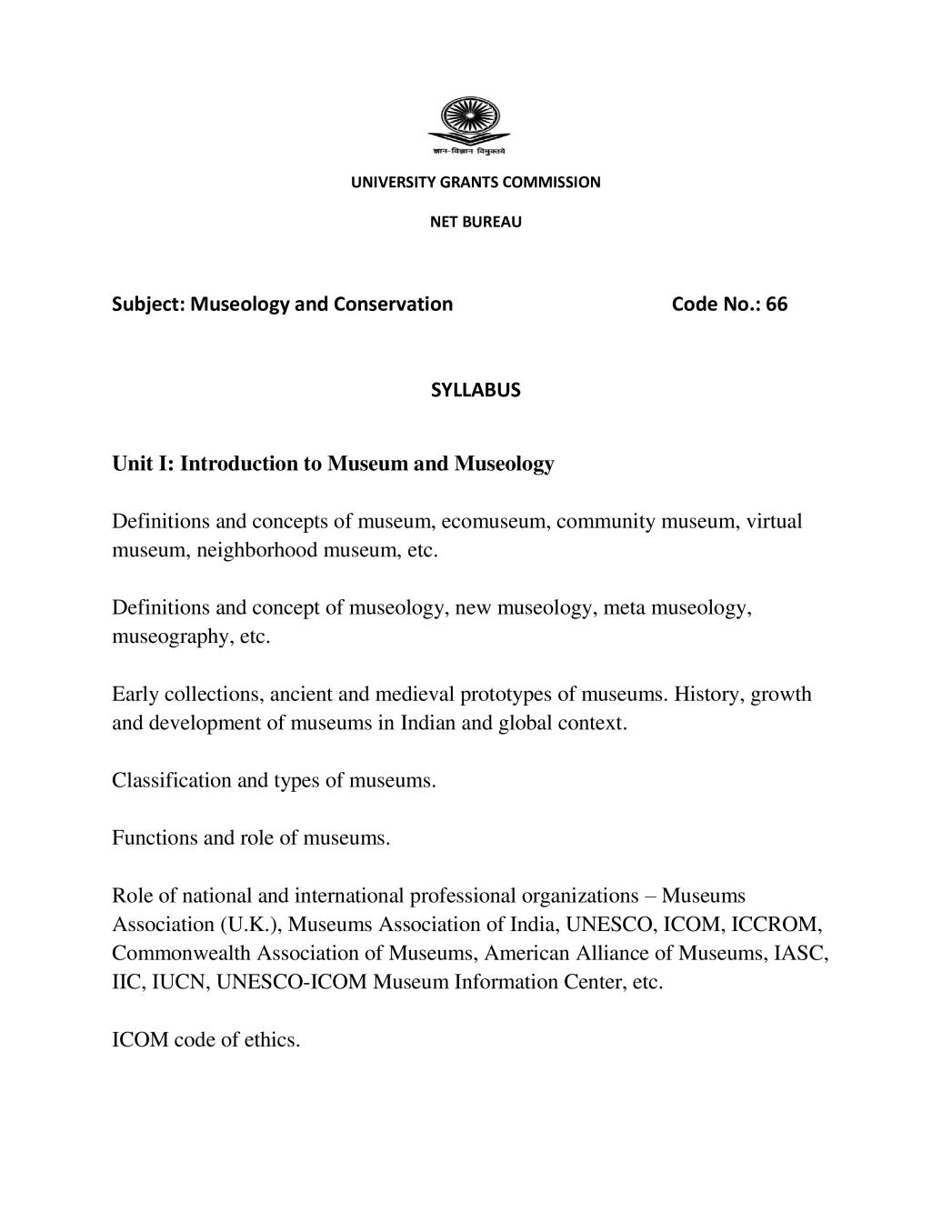
UNIVERSITY GRANTS COMMISSION
NET BUREAU
m
om Conservation . co
c. and e m
em
Subject: Museology Code No.: 66
l a s
la s a g
a g SYLLABUS
Unit I: Introduction to Museum and Museology
Definitions and concepts of museum, ecomuseum, community museum, virtual
m
c. o
museum, neighborhood museum, etc.
e mmuseology, meta museology,
a s
Definitions and concept of museology, new
l
ag
museography, etc.
Early collections, ancient and medieval prototypes of museums. History, growth
and development of museums in Indian and global context.
Classification and types of museums.
m
c. o
Functions and role of museums.
omof national and international professional organizations – Museums
c.Role e m
em Association (U.K.), Museums Association of India, UNESCO, l s
aICOM, ICCROM,
s
la Commonwealth Association of Museums, American Alliance g
a of Museums, IASC,
ag IIC, IUCN, UNESCO-ICOM Museum Information Center, etc.
ICOM code of ethics.
m . c
c. o s e m
m a
se
For more Question Papers, Sample Papers, Notes & Syllabus visit
g l Page 1 of 16
Page 3
Purposes of collecting. Scope of collections – tangible and intangible.
Ethics of collecting. Collection management policy including acquisitions,disposal,
loaning, insurance, etc.
Methods of collecting tangible and intangible heritage.
Methods of authenticating museum objects.
Collection holding areas for tangible and intangible collections – accessibility,
retrieval, storage systems and preventive conservation measures.
Collection security. Guidelines for handling, packing and transporting collections.
Unit III: Documentation and Research of Tangible and Intangible Collections
Purposes of documenting museum collections
Ethics of documentation.
Documentation policy and procedures.
Types of documents – entry, accession, classified, and movement registers; index
and catalogue cards. Digital documentation.
Numbering the objects – numbering systems, procedure of applying numbers on
objects. Barcoding.
Documentation standards – format of various types of documents. Use of standard
terminology. Concept of Object ID.
Objectives and scope of collection research. Models of collection research.
For more Question Papers, Sample Papers, Notes & Syllabus visit Page 2 of 16
Page 4
. e
em las
as ag
Unit IV: Museum Exhibitions
Museum exhibition as a communication system. Models of communication in the
context of exhibitions.
Exhibition policy.
o m
m . c
.co s e m
em a
Ethics of exhibitions.
s g l
g la on the basis of duration, location, arrangement of objects/a
a and purpose.
Types of exhibitions
specimen
Components of exhibitions – objects/ specimen, communication media, text,
exhibition furniture and accessories. Spatial and other relationships between
exhibit components.
m
co
Exhibition text – Types of labels, assessing reading and comprehensibility of text,
.
em
typography, designing and preparation of labels.
l a s
a g
Exhibition lighting – Basic considerations while using light, types of light sources,
different types of lamps, recent trends: fibre optics, track lighting, computer
controlled lighting.
Planning and designing exhibitions – stages of planning; exhibition brief; using
principles of design, ergonomics, colour, texture and light in exhibitions.
m
Orientation. Circulation of visitors. Signage. Use of multi-media.
m c. o
c. o s e m
Designing exhibition furniture, dioramas, and historical settings.
s em Evaluation – front-end analysis, formative and summative evaluation.
g l a
gla a
a
m . c
c. o s e m
m a
se
For more Question Papers, Sample Papers, Notes & Syllabus visit
g l
Page 3 of 16
Page 5
Role and potential of museums in informal, non-formal and formal education/
learning.
Museums and life long learning. Barriers to learning in museums. Education versus
interpretation.
Ethics of museum education.
Museum education policy. Theories of learning. Characteristics of learning in
museums.
Various learning activities such as guides tours, lectures, talks, storytelling,
workbooks, workshops, demonstrations, drama, role play, live interpretation,
digital methods, etc. for different target groups.
Making learning opportunities accessible to persons with disabilities.
Museum extension services – travelling and mobile exhibitions, school loan kits,
community programmes, excursions, field trips, heritage walks, etc. Extension
through digital media.
Museum publication – purpose and types.
Feedback – purposes and methods
For more Question Papers, Sample Papers, Notes & Syllabus visit Page 4 of 16
Page 6
. e
em las
as ag
Unit VI: Conservation of Collections -- Part I
Definitions of conservation – preventive, remedial and restoration. Terminology
used in conservation.
Nature and properties of material of collections – organic, inorganic and
m
om . co
c m
composite. Susceptibility of materials to different agents of decay.
m . se
s e g l a
l a a
Ethics of conservation.
g
a policy. Conservation audit.
Conservation
Causes and types of deterioration – environmental: effects of light, humidity,
temperature and pollution; biological: fungi, insects, rodents and birds; human –
carelessness, mishandling and wrong treatment; disasters: fire, flood, earthquake,
arson, etc.
o m
. c
storage, exhibitions and transit throughs–e m
Preventive conservation: significance and effectiveness, and implementation in
g la
a
Environmental control – monitoring of light and UV radiations, R.H., Temperature
and pollutants and application of control measures. Tools and equipments used in
monitoring and control.
Integrated Pest Management – identification, control and termination of pests.
m
Various fungicides, insecticides and rodenticides used in IPM.
m
Good practices of Housekeeping and Rules of handling museum objects. Tools,
c. o
c. o materials and equipments used in housekeeping and handling.
s e m
s em la
gla ag
a
m . c
c. o s e m
m a
se
For more Question Papers, Sample Papers, Notes & Syllabus visit
g l Page 5 of 16
Page 7
Methodology of remedial conservation – techniques of examination, diagnosis of
type and extent of decay, documentation and testing of probable treatments,
treatment of objects using suitable materials and method. Recommendations for
preventive care.
Materials, equipment, tools and techniques used in remedial conservation of
following materials –
i. Paper and archival materials
ii. Paintings on different substrate such as wall, canvas, paper, wood, textiles,
palmleaf etc.
iii. Textiles and costumes
iv. wood, skin material, bone, horn and ivory
v. metallic objects made of iron, copper, bronze and silver
vi. stone objects
vi. ceramic and glass
vii. Biological specimens
Health and safety issues.
For more Question Papers, Sample Papers, Notes & Syllabus visit Page 6 of 16
Page 8
. e
em las
as ag
Unit VIII: Museum Management
Concept of Management : Foundations and evolution. Essential components of
management : decision making and leadership.
m
co
Functions of management:
om .
Planning: Types of plans – Vision and mission statements, objectives, policies,
.c e m
e m a s
Procedures, rules, strategies, action plans, and contingency plans.
a s g l
l a
Planning process, MBO, Strategic planning, Use of Critical Path method
ag
and Simple Bar method in planning.
Organization Design – staff structures, job descriptions, authority and
responsibilities.
Staffing – Framing recruitment rules, methods of recruitment, training and
development of human resource. Performance appraisal.
Controlling -- process and methods of control.
Financing -- sources of fund generation, Budget and budgeting
m
. co
em
Project Management.
l a s
Prevention of harassment in work place.
a g
Museum security – Risk assessment and management. Manual, physical and
electronic security. Security procedures. Fire safety.
Disaster management – preparation, prevention, response and recovery.
m
m c. o
c. o s e m
s em la
gla ag
a
m . c
c. o s e m
m a
se
For more Question Papers, Sample Papers, Notes & Syllabus visit
g l Page 7 of 16
Page 9
Meaning and purpose of marketing and its role in museums. Marketing
terminology.
Concept and types of products. Product Life cycle and marketing strategies at
different stages. Museum as a multiproduct organization and a service.
Segmentation and target marketing – significance, bases and approaches.
Marketing Mix – Product, Price, Promotion and Place: significance, tools and
strategies.
Marketing Research – purpose, types and methods.
Marketing versus Public Relations. Definitions and significance of Public
Relations. Foundational Principles of Public relations.
Tools, tactics and strategies of Public Relations. Media relations. Public relations
campaigns.
For more Question Papers, Sample Papers, Notes & Syllabus visit Page 8 of 16
Page 10
. e
em las
as ag
Unit X: Legislation and Conventions Related to Museums and Heritage
The Indian Treasure Trove Act, 1878
The Ancient Monuments and Archaeological Sites and Remains Act, 1958
m
om . co
c m
The Antiquities and Art Treasures Act, 1972
m . se
s e g l a
l a a
The Wild Life Protection Act, 1972
g
Personsawith disabilities (Equal Opportunities, Protection of Rights and Full
Participation) Act, 1995
Right to information Act, 2005
UNESCO World Heritage Convention, 1972
o m
c
. species of Wild Flora and Fauna
e m
Convention on International Trade in Endangered
(CITES), 1973
l a s
a g
The Venice Charter, 1964
The UNESCO Convention for the Safeguarding of the Intangible Cultural
Heritage, 2003
m
m c. o
c. o s e m
s em la
gla ag
a
m . c
c. o s e m
m a
se
For more Question Papers, Sample Papers, Notes & Syllabus visit
g l Page 9 of 16
Page 11
Page 12
. e
em las
as ag
m
om . co
.c e m
e m l a s
l a s a g
ag
m
. co
s em
g l a
a
m
m c. o
c. o s e m
s em la
gla ag
a
m . c
c. o s e m
m a
se
For more Question Papers, Sample Papers, Notes & Syllabus visit
g l
Page 11 of 16
Page 13
Page 14
. e
em las
as ag
m
om . co
.c e m
e m l a s
l a s a g
ag
m
. co
s em
g l a
a
m
m c. o
c. o s e m
s em la
gla ag
a
m . c
c. o s e m
m a
se
For more Question Papers, Sample Papers, Notes & Syllabus visit
g l
Page 13 of 16
Page 15
Page 16
. e
em las
as ag
m
om . co
.c e m
e m l a s
l a s a g
ag
m
. co
s em
g l a
a
m
m c. o
c. o s e m
s em la
gla ag
a
m . c
c. o s e m
m a
se
For more Question Papers, Sample Papers, Notes & Syllabus visit
g l
Page 15 of 16
Page 17
Document Details
| Board / Org | NTA |
| Exam | UGC National Eligibility Test |
| Type | Syllabus |
| Pages | 17 |
| Updated | 15 Jul 2026 |