Goa Board Class 10 Sample Paper 2026 Piano
Finished viewing? Save it for later —
Download Goa Board Class 10 Sample Paper 2026 Piano (PDF · 13 pages)About Goa Board Class 10 Sample Paper 2026 Piano
Goa Board Class 10 Sample Paper 2026 Piano is available here for free download. Published by Goa Board for Class 10, this sample paper can be viewed online or downloaded as a PDF (13 pages). Candidates preparing for Class 10 can use Goa Board Class 10 Sample Paper 2026 Piano to understand the exam pattern, the type of questions asked, and the overall difficulty level.
Frequently Asked Questions
How can I download Goa Board Class 10 Sample Paper 2026 Piano?
Open this page and click the Download button to save Goa Board Class 10 Sample Paper 2026 Piano as a PDF. It is completely free on AglaSem Docs.
Is Goa Board Class 10 Sample Paper 2026 Piano free to download?
Yes. Goa Board Class 10 Sample Paper 2026 Piano can be viewed online and downloaded as a PDF free of cost on AglaSem Docs.
How many pages does Goa Board Class 10 Sample Paper 2026 Piano have?
Goa Board Class 10 Sample Paper 2026 Piano contains 13 pages, which you can read online or download together as a single PDF.
Where can I find more Class 10 study material?
You can find more Class 10 question papers, sample papers, syllabus, and answer keys on AglaSem Docs.
Goa Board Class 10 Sample Paper 2026 Piano – Text
Read the full text of this sample paper below — useful to quickly search, copy and reference the content online without downloading the PDF.
📄 View text version (12 pages)
Page 1
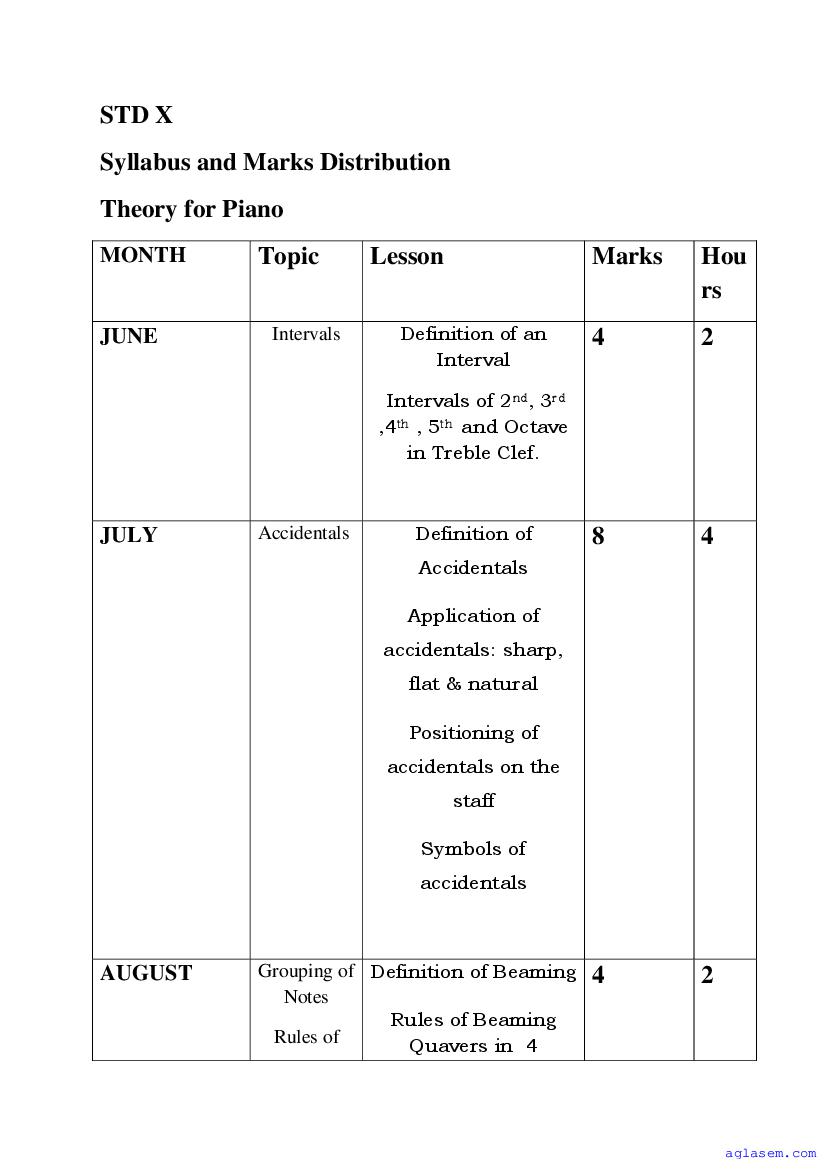
Syllabus and Marks Distribution
Theory for Piano
MONTH Topic Lesson Marks Hou
rs
JUNE Intervals Definition of an 4 2
Interval
Intervals of 2nd, 3rd
,4th , 5th and Octave
in Treble Clef.
JULY Accidentals Definition of 8 4
Accidentals
Application of
accidentals: sharp,
flat & natural
Positioning of
accidentals on the
staff
Symbols of
accidentals
AUGUST Grouping of Definition of Beaming 4 2
Notes
Rules of Beaming
Rules of Quavers in 4
Page 2
Rules of Beaming
Quavers in 3
4
SEPTEMBER Definition of a Rest 4 4
Rests Types of Rests:
Whole bar rest,
Semibreve rest,
Minim rest, crochet
rest and Quaver rest.
OCTOBER Musical Articulation marks : 8 4
Terms & accent, legato,
symbols
staccato & slur
Tempo marks &
other signs :
Andante, Moderato ,
Allegro, ritardando,
Crescendo,
Diminuendo & repeat
marks
NOVEMBER Scale Writing C major scale in 6 2
writing Treble & Bass clef
DECEMBER General Types of piano, piano 6 2
knowledge composers, brief
of the Piano explanation
Page 3
hrs
STD X
Syllabus and Marks Distribution
Practicals for Piano
Reference books:
1) JOHN W.SCHAUM -PIANO COURSE-PRE-A-THE
GREEN BOOK
2) DENES AGAY’S-LEARNING TO PLAY PIANO-
BOOK 1
MONTH Topic Lesson Marks Hours
JUNE Scale of C Scale of C 5 2
major & A major & A
minor minor-
One octave
R.H & L.H
ascending &
descending -
separate
hands
JULY Introduction 1)Deep-Sea 10 4
to pieces Diving(John
with first W.Schaum)
Page 4
Donald(John
Treble clef
W.Schaum)
– CDEF
3)Our Flag(
Bass clef –
Denes Agay)
CBAG
4)Yankee
Warm up
Doodle (
exercises/
Denes Agay)
sight
reading (Any 1)
AUGUST Introduction 1)The Ice 10 6
to pieces Cream
with first Cone(John
five notes W.Schaum)
Treble clef 2)Mr. Frog is
– CDEFG Full Of
Hops(John
Bass clef –
W.Schaum)
CBAGF
3)Snowflakes
Warm up
(Denes
exercises/
Agay)
sight
reading 4)Early
Morning
(Denes
Agay)
(Any 1)
Page 5
to Quavers Riddle(John
W.Schaum)
A Brief
Stroll(Denes
Agay)
(Any 1)
OCTOBER Scales G major 10 8
#, b F major –one
octave
NOVEMBER Short pieces Myrtle The 10 8
with one Turtle (John
Sharp & W.Schaum)
one flat
The Air-
Liner (John
W.Schaum)
(Any 1)
DECEMBER Chords Tonic chords 5 4
of C major, F
major ,G
major
60 40 hrs
marks
Page 7
1) Naming the notes on the Piano.
2) Learning note values on the piano
3) Note reading
4) Bars and tempo in practice
5) Learning to play a melody on the piano
6) Fingering – where to put all your fingers
7) Ear Training
8) Scales and Chords.
Page 8
SUB: Music (PIANO – Western)
Rubrics for Evaluation
Criteria Excellent Good Fair Needs
Improvement
1) Accuracy (20 mks) (16 mks) (12 mks ) (8 mks )
–Pulse
–Notes - Consistently Infrequent A lack of Many inaccurate
Rhythms correct errors in consistently notes, rhythms,
Fingering pulse, notes, notes, correct notes, fingerings, and
rhythms, and rhythms, rhythms, pulse. Technical
fingerings. fingerings, pulse, and passages are
pulse. A few fingerings. weak. May have
minor Student may abrupt stops.
technical rush or slow
problems. technically
difficult
passages.
2) Position - ( 10 mks) (8 mks ) (6 mks ) (4 mks )
Posture -
Finger -Wrist Consistently A few minor Often uses Little
-Hand -Arm uses correct problems incorrect understanding of
finger, wrist, with posture, correct posture,
hand, fingering, finger, wrist, finger, wrist,
posture, and wrist, hand, hand, arm hand, or arm
arm posture, and positions. positions
positions. arm
positioning.
Page 9
Proficiency -
How much of Student has Student has Student has Student has not
the piece has learned learned learned little learned the
the student entire piece partial piece. of the piece.).. piece.
learned? fully.
4) Practice/ (10 mks ) ( 8 mks ) (6 mks ) ( 4 mks )
Homework/
Efficiency Comes fully Practices at Practices Does not practice
prepared for home but not ocassionally . at home.
class. 100% Half prepared
Page 10
Section 1 ( 10 marks )
1. Interval from 1 to 8 is called __________
A. Octave
B. Unison
C. Perfect
D. Dominant
2. Symbol used to raise a note by a semitone is called___________
A. Flat
B. Sharp
C. Natural
D. None
3.The period of silence in music is called____________
A. Pause
B. Peace
C. Rest
D. Break
4.The following symbol denotes
A. Crescendo
B. Diminuendo
C. Forte
D. Piano
5.The 6th degree of C major scale is _______________
A. G
B. F#
C. E
D. A
6. Quavers beamed together amounts to __________________ numbers of beats .
A. 1
B. 3
C. 2
D. 4
Page 11
A. Moderato
B. Ritardando
C. Allegro
D. Andante
8.The typical piano has _______________ keys,
A. 70
B. 50
C. 88
D. 20
9.The full name of the piano ________________
A. pianoforte
B. Viola
C. keyboard
D. Violoncello
10. A note with coloured note head and a stem is called ________________
A. Minim
B. Semibreve
C. Crotchet
D. Rest
Section 2 (8 Marks )
1)What is an Interval ?
2) Write the 3 different symbols of accidentals .
3) What is a Beam ?
4) Name the Rest
5) Give the meaning of :
Page 12
6) Write the meaning of ‘Diminuendo ‘.
7) How many notes is a piano chord?
8) Give another name for the treble clef.
Section 3 (10 marks )
1) Name the intervals
______________. __________________
2) Beam the following quavers in fours :
3) What is Tempo in music ?
4) Explain the tempo marking of :
5) Name any 2 piano composers.
Section 4 ( 12 marks )
A) Define :
1. Semibreve rest
2. Minim rest
3. Crotchet rest
Page 13
1. G note with a sharp
2. C note with a natural
3. B note with a flat
C) Write the scale of C major in Semibreves and name the notes .
D) Write a 4 bar passage in 4/4 time signature using Semibreves ,Minims ,Crotchet and Quavers or rests .
Document Details
| Board / Org | Goa Board |
| Exam | Class 10 |
| Type | Sample Paper |
| Pages | 13 |
| Updated | 24 Sep 2026 |