NBSE Class 12 Question Paper 2021 for Chemistry
Finished viewing? Save it for later —
Download NBSE Class 12 Question Paper 2021 for Chemistry (PDF · 4 pages)About NBSE Class 12 Question Paper 2021 for Chemistry
NBSE Class 12 Question Paper 2021 for Chemistry is available here for free download. Published by Nagaland Board for Class 12, this question paper can be viewed online or downloaded as a PDF (4 pages). Candidates preparing for Class 12 can use NBSE Class 12 Question Paper 2021 for Chemistry to understand the exam pattern, the type of questions asked, and the overall difficulty level.
Frequently Asked Questions
How can I download NBSE Class 12 Question Paper 2021 for Chemistry?
Open this page and click the Download button to save NBSE Class 12 Question Paper 2021 for Chemistry as a PDF. It is completely free on AglaSem Docs.
Is NBSE Class 12 Question Paper 2021 for Chemistry free to download?
Yes. NBSE Class 12 Question Paper 2021 for Chemistry can be viewed online and downloaded as a PDF free of cost on AglaSem Docs.
How many pages does NBSE Class 12 Question Paper 2021 for Chemistry have?
NBSE Class 12 Question Paper 2021 for Chemistry contains 4 pages, which you can read online or download together as a single PDF.
Where can I find more Class 12 study material?
You can find more Class 12 question papers, sample papers, syllabus, and answer keys on AglaSem Docs.
NBSE Class 12 Question Paper 2021 for Chemistry – Text
Read the full text of this question paper below — useful to quickly search, copy and reference the content online without downloading the PDF.
📄 View text version (4 pages)
Page 1
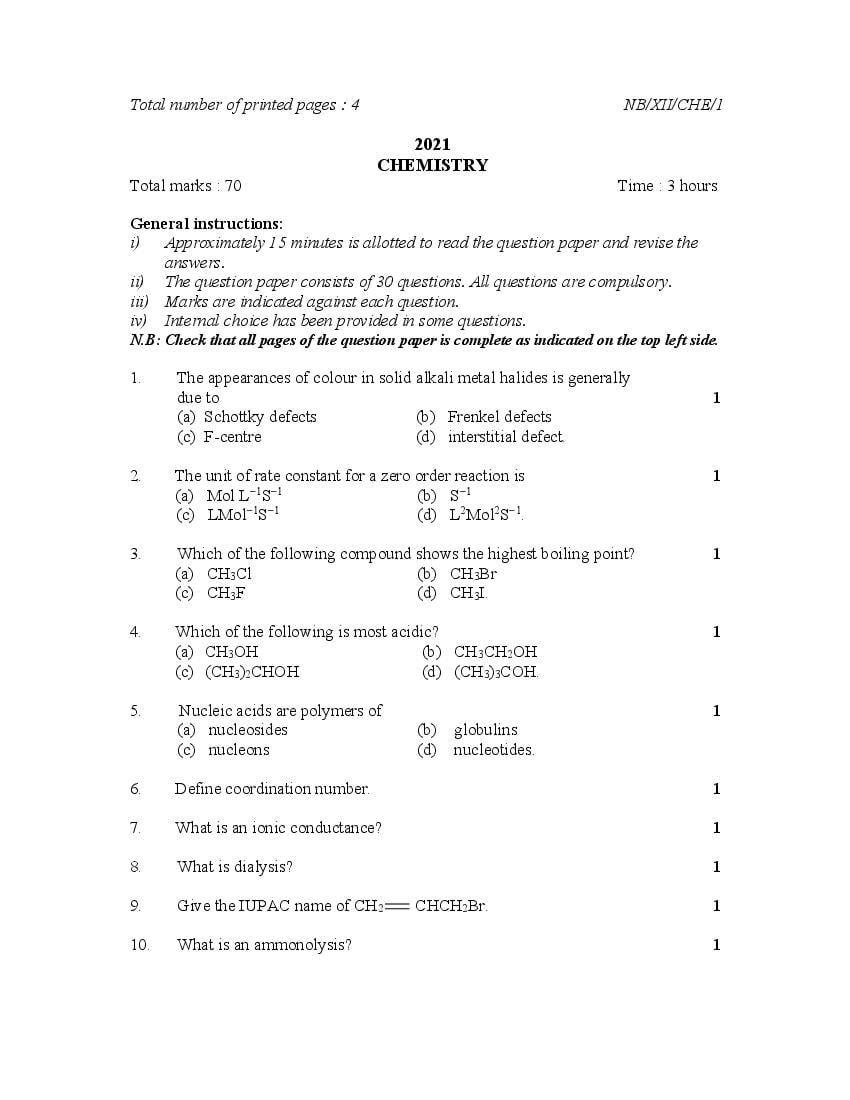
2021
CHEMISTRY
Total marks : 70 Time : 3 hours
General instructions:
i) Approximately 15 minutes is allotted to read the question paper and revise the
answers.
ii) The question paper consists of 30 questions. All questions are compulsory.
iii) Marks are indicated against each question.
iv) Internal choice has been provided in some questions.
N.B: Check that all pages of the question paper is complete as indicated on the top left side.
1. The appearances of colour in solid alkali metal halides is generally
due to 1
(a) Schottky defects (b) Frenkel defects
(c) F-centre (d) interstitial defect.
2. The unit of rate constant for a zero order reaction is 1
(a) Mol L−1S−1 (b) S−1
−1 −1
(c) LMol S (d) L2Mol2S−1.
3. Which of the following compound shows the highest boiling point? 1
(a) CH3Cl (b) CH3Br
(c) CH3F (d) CH3I.
4. Which of the following is most acidic? 1
(a) CH3OH (b) CH3CH2OH
(c) (CH3)2CHOH (d) (CH3)3COH.
5. Nucleic acids are polymers of 1
(a) nucleosides (b) globulins
(c) nucleons (d) nucleotides.
6. Define coordination number. 1
7. What is an ionic conductance? 1
8. What is dialysis? 1
9. Give the IUPAC name of CH2 CHCH2Br. 1
10. What is an ammonolysis? 1
Page 2
11. a. Why does non-ideal solutions show positive deviations and negative
deviations from Raoults law?
Or 2
b. What is hypertonic solution and hypotonic solution?
12. A first order reaction is found to have a rate constant k = 5.5 × 10⁻¹⁴S−1.
Find the half life of the reaction. 2
13. a. Give reason why zinc, cadmium and mercury are not regarded as
transition elements.
Or 2
b. Why do the transition elements exhibit higher enthalpies of
atomization?
14. Write the preparation of ether by Williamson synthesis. 2
15. Complete the following reactions: 2
(a) CH3COOH + PCl5 →?
(b) 3CH3COOH + PCl3 →?
16. a. Explain carbylamines reaction and write the reaction involved in it.
Or 2
b. What happens when
(i) primary amines reacts with nitrous acid.
(ii) aromatic amines reacts with nitrous acid.
17. Silver forms ccp lattice and X-ray studies of its crystals show that the edge
length of its unit cell is 408.6 pm. Calculate the density of silver. (Atomic
mass = 107.9u). 3
18. a. 45g of ethylene glycol (C2H6O2) is mixed with 600g of water.
Calculate (a) the freezing point depression and
(b) the freezing point of the solution.
Or 3
b. Calculate the molarity of each of the following solution:
(a) 30g of Co(NO3)2 6H2O (Atomic mass 291gmol−1) in 4.3L
of solution.
(b) 30 ml of 0.5M H2SO4 diluted in 500ml.
19. Derive the integrated rate equation for first order reaction. 3
20. a. Differentiate between dispersed phase and dispersed medium on
the basis of interaction with an example.
b. Explain the properties of colloidal solution by electrophoresis.
Page 3
21. Write the preparation of ammonia by Haber process. Give one use. 3
22. Name the element in the lanthanoids series which has +4 oxidation state.
Why do transition metal form interstitial compounds? 3
23. a. Explain the reasons why aryl halides are less reactive towards
nucleophilic substitution reaction.
b. Explain SN1 or substitution nucleophilic unimolecular reaction
in haloalkanes.
24. Why are phenols more acidic than alcohol and water? 3
25. Write Gabriel-phthalimide synthesis with the reaction involved in it. 3
26. Explain the classification of proteins on the basis of their molecular shape.
Give example. 3
27. a. On the basis of valence bond theory, predict the shape, magnetic
behaviour of [NiCl4]2−.
Or 3
b. Give the IUPAC name of K2[Cr(C2O4)3]. Predict the number of unpaired
electrons in the square planar [Pt(CN)4]2 ion.
28. a. (i) Define molar conductivity.
(ii) The cell in which the following reaction occurs:
2Fe3+ (aq) + 2I−(aq) → 2Fe3+(aq) + I2(s) has Eocell = 0.236V
at 298K. Calculate the standard Gibb’s energy and the
equilibrium constant of the cell reaction.(Anti log 7.98=
9.57×10⁻⁷).
Or 5
b. (i) What is resistivity? Give the SI unit of resistance.
(ii) Represent the cell in which the following reaction takes place:
Mg(s) + 2Ag+(0.0001M) → Mg2+(0.130M) + 2Ag(s). Calculate
its Ecell if Eocell =3.17V.
Page 4
29. a. (i) Give reasons why
(a) PH3 is basic in nature.
(b) Bond angle in PH4+ is higher than PH3.
(ii) Explain the properties of oxidation state and ionisation
enthalpy of group-16 elements.
Or 5
b. (i) What are interhalogen compounds? How are they prepared?
(ii) Draw the structure of IF7 and BrF5 and mention its type of
hybridization.
30. a. (i) What is Cannizzaro reaction? Give the reaction.
(ii) (a) CH3⸺C⸺Cl + CH3⸺Cd →
O
CH3
(b) + + CrO2Cl3 →
Or 5
b. (i) Explain Clemmensen reduction with reaction.
(ii) Would benzaldehyde be more reactive or less reactive in
nucleophilic addition reactions than propanol? Explain.
**********************