NBSE Class 12 Question Paper 2021 for Biology
Finished viewing? Save it for later —
Download NBSE Class 12 Question Paper 2021 for Biology (PDF · 3 pages)About NBSE Class 12 Question Paper 2021 for Biology
NBSE Class 12 Question Paper 2021 for Biology is available here for free download. Published by Nagaland Board for Class 12, this question paper can be viewed online or downloaded as a PDF (3 pages). Candidates preparing for Class 12 can use NBSE Class 12 Question Paper 2021 for Biology to understand the exam pattern, the type of questions asked, and the overall difficulty level.
Frequently Asked Questions
How can I download NBSE Class 12 Question Paper 2021 for Biology?
Open this page and click the Download button to save NBSE Class 12 Question Paper 2021 for Biology as a PDF. It is completely free on AglaSem Docs.
Is NBSE Class 12 Question Paper 2021 for Biology free to download?
Yes. NBSE Class 12 Question Paper 2021 for Biology can be viewed online and downloaded as a PDF free of cost on AglaSem Docs.
How many pages does NBSE Class 12 Question Paper 2021 for Biology have?
NBSE Class 12 Question Paper 2021 for Biology contains 3 pages, which you can read online or download together as a single PDF.
Where can I find more Class 12 study material?
You can find more Class 12 question papers, sample papers, syllabus, and answer keys on AglaSem Docs.
NBSE Class 12 Question Paper 2021 for Biology – Text
Read the full text of this question paper below — useful to quickly search, copy and reference the content online without downloading the PDF.
📄 View text version (3 pages)
Page 1
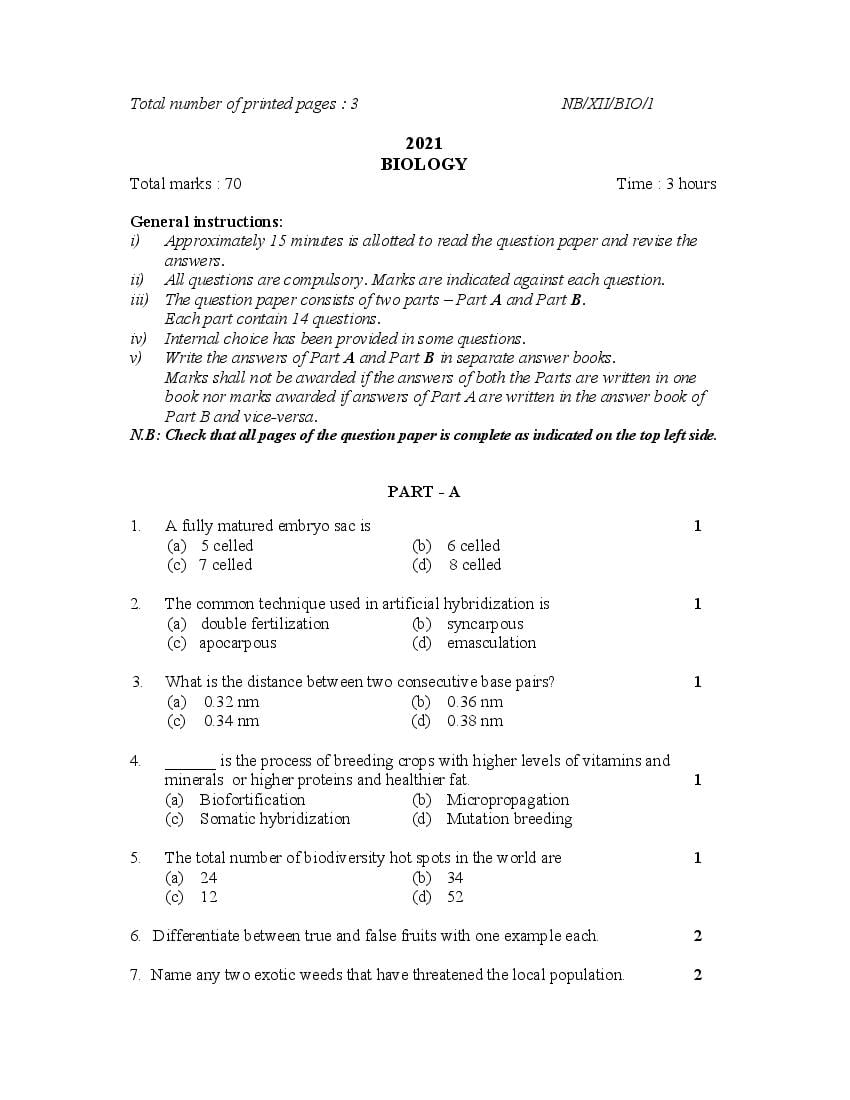
2021
BIOLOGY
Total marks : 70 Time : 3 hours
General instructions:
i) Approximately 15 minutes is allotted to read the question paper and revise the
answers.
ii) All questions are compulsory. Marks are indicated against each question.
iii) The question paper consists of two parts – Part A and Part B.
Each part contain 14 questions.
iv) Internal choice has been provided in some questions.
v) Write the answers of Part A and Part B in separate answer books.
Marks shall not be awarded if the answers of both the Parts are written in one
book nor marks awarded if answers of Part A are written in the answer book of
Part B and vice-versa.
N.B: Check that all pages of the question paper is complete as indicated on the top left side.
PART - A
1. A fully matured embryo sac is 1
(a) 5 celled (b) 6 celled
(c) 7 celled (d) 8 celled
2. The common technique used in artificial hybridization is 1
(a) double fertilization (b) syncarpous
(c) apocarpous (d) emasculation
3. What is the distance between two consecutive base pairs? 1
(a) 0.32 nm (b) 0.36 nm
(c) 0.34 nm (d) 0.38 nm
4. ______ is the process of breeding crops with higher levels of vitamins and
minerals or higher proteins and healthier fat. 1
(a) Biofortification (b) Micropropagation
(c) Somatic hybridization (d) Mutation breeding
5. The total number of biodiversity hot spots in the world are 1
(a) 24 (b) 34
(c) 12 (d) 52
6. Differentiate between true and false fruits with one example each. 2
7. Name any two exotic weeds that have threatened the local population. 2
Page 2
8. What is the difference between primary succession and secondary succession?
2
9. Draw a neat labelled diagram of a typical angiosperm ovule. 3
10. a. Write any three criteria for a molecule to act as a genetic material.
Or 3
b. Write down the salient features of the double helix structure of DNA.
11. What is mutation breeding? How are crops breed for disease resistance? 3
12. a. What is transcription? Describe the different regions of the transcriptional
unit with a schematic representation.
b. Describe transforming principle experiment performed by Frederick Griffith.
13. a. Describe the different methods of introduction of foreign DNA into host.
Or 5
b. What is Polymerase Chain Reaction? Explain the amplification of gene of
interest using PCR.
14. a. Define ecological succession. Explain the succession of plants on bare area
and in water.
b. What is a stable community? Describe four major causes of biodiversity
losses.
PART - B
1. Which hormone is responsible for the delivery of the foetus? 1
(a) Oxytocin (b) Progesterone
(c) Prolactin (d) Estrogens
2. Tubectomy is a contraceptive under 1
(a) natural method (b) barrier method
(c) IUDs (d) surgical method
3. In case of incomplete dominance, what will be the phenotypic ratio of F₂
generation? 1
(a) 3:1 (b) 1:2:1
(c) 1:1:1:1 (d) 2:2
4. The blood cholesterol lowering agent statins is produced by 1
(a) bacteria (b) algae
(c) yeast (d) virus
Page 3
5. Animals undergo inactive stage during winter. It is called 1
(a) acclimatisation (b) hibernation
(c) aestivation (d) adaptation
6. Differentiate between monohybrid and dihybrid cross. 2
7. What measures should be taken to prevent water-borne diseases? 2
8. Give the scientific name of soil bacterium which produces crystal (cry) proteins.
How are these proteins useful in agriculture? 2
9. a. Explain the haplodiploidy sex determination system in honey bee.
Or 3
b. What is pedigree analysis? What are the symbols used in such analysis?
10. What are transgenic animals? Give two benefits of transgenic animals. 3
11. What is predation? Give two significance of predation in nature. 3
12. a. What is placenta? Explain its role in embryonic development.
b. What is reproductive health? Explain in brief with an example
(i) IUDs (ii) Oral methods of birth control
13. a. What are Mendelian disorders? Explain in detail
(i) any one sex-linked recessive disease
(ii) any one autosome- linked recessive disease.
Or 5
b. What are chromosomal disorders? Explain any three chromosomal disorders .
14. a. What is drug abuse? Write two early warning signs of drug abuse. Mention
two preventive and control measures of drug abuse among adolescents.
b. What are biofertilisers? What are the main sources of biofertilisers? What is
biological N2 fixation? Name two organisms each of which fix nitrogen
asymbiotically and symbiotically.
********************************