UGC NET Syllabus for Pali 2020
Finished viewing? Save it for later —
Download UGC NET Syllabus for Pali 2020 (PDF · 8 pages)About UGC NET Syllabus for Pali 2020
UGC NET Syllabus for Pali 2020 is available here for free download. Published by NTA for UGC National Eligibility Test, this syllabus can be viewed online or downloaded as a PDF (8 pages). Candidates preparing for UGC National Eligibility Test can use UGC NET Syllabus for Pali 2020 to understand the exam pattern, the type of questions asked, and the overall difficulty level.
Frequently Asked Questions
How can I download UGC NET Syllabus for Pali 2020?
Open this page and click the Download button to save UGC NET Syllabus for Pali 2020 as a PDF. It is completely free on AglaSem Docs.
Is UGC NET Syllabus for Pali 2020 free to download?
Yes. UGC NET Syllabus for Pali 2020 can be viewed online and downloaded as a PDF free of cost on AglaSem Docs.
How many pages does UGC NET Syllabus for Pali 2020 have?
UGC NET Syllabus for Pali 2020 contains 8 pages, which you can read online or download together as a single PDF.
Where can I find more UGC National Eligibility Test study material?
You can find more UGC National Eligibility Test question papers, sample papers, syllabus, and answer keys on AglaSem Docs.
UGC NET Syllabus for Pali 2020 – Text
Read the full text of this syllabus below — useful to quickly search, copy and reference the content online without downloading the PDF.
📄 View text version (8 pages)
Page 1
UGC NET
Syllabus · Pali
EXAM YEAR TYPE SUBJECT
UGC NET — Syllabus Pali
Notes · Sample Papers · Previous Year Papers · Mock Tests
Page 2
. e
em las
as ag
m
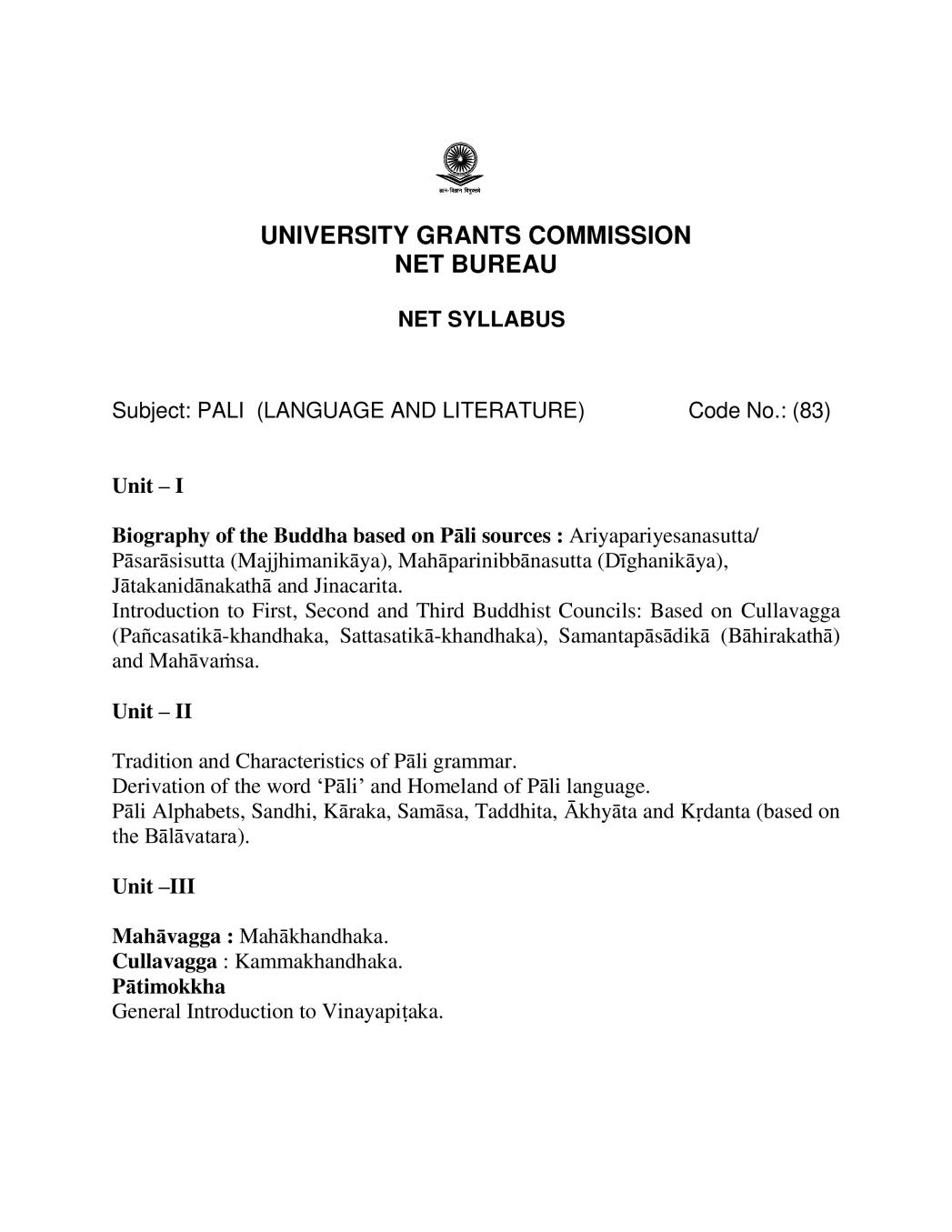
UNIVERSITY GRANTS COMMISSION
om
NET BUREAU
.c e m
e m l a s
s g
NET SYLLABUS
l a a
ag
Subject: PALI (LANGUAGE AND LITERATURE) Code No.: (83)
Unit – I
m
Biography of the Buddha based on Pāli sources : Ariyapariyesanasutta/
Pāsarāsisutta (Majjhimanikāya), Mahāparinibbānasutta (Dīghanikāya),
em
Jātakanidānakathā and Jinacarita.
a s
Introduction to First, Second and Third Buddhist Councils: Based on Cullavagga
l
a g
(Pañcasatikā-khandhaka, Sattasatikā-khandhaka), Samantapāsādikā (Bāhirakathā)
and Mahāvaṁsa.
Unit – II
Tradition and Characteristics of Pāli grammar.
Derivation of the word ‘Pāli’ and Homeland of Pāli language.
Pāli Alphabets, Sandhi, Kāraka, Samāsa, Taddhita, Ākhyāta and Kṛdanta (based on
m
c. o
the Bālāvatara).
m
c. o Unit –III
s e m
s em Mahāvagga : Mahākhandhaka. la
gla Cullavagga : Kammakhandhaka. ag
a Pātimokkha
General Introduction to Vinayapiṭaka.
m . c
c. o s e m
m a
se
g lPage 1 of 7
Page 3
Dīghanikāya : Brahmajālasutta and Kūṭadantasutta.
Majjhimanikāya : Satipaṭṭhānasutta.
Saṁyuttanikāya : Buddhavagga of Nidānavagga’s Nidānasaṁyutta.
Aṅguttaranikāya: Nīvaraṇappahāṇavagga and Akammanīyavagga of Ekakanipāta.
General Introduction to Suttapiṭaka.
Unit – V
Dhammapada : Yamakavagga, Appamādavagga and Cittavagga.
Suttanipāta : Kasibhāradvājasutta, Vāseṭṭhasutta.
Therīgāthā : Mahāpajāpati-gotamītherī and Ambapālitherī.
Jātaka : Vānarindajātaka, Sasajātaka and Javasakuṇajātaka.
General Introduction to Khuddakanikāya.
Unit – VI
Dhammasaṅgaṇī : Dukamātikā and Tikamātikā.
Abhidhammatthasaṅgaha : Citta, Cetasika, Rūpa and Nibbāna.
Introduction to Abhidhamma Literature.
Unit – VII
Milindapañha : Bāhirakathā, Lakkhaṇapañha.
General Introduction to Milindapañha.
Unit – VIII
Visuddhimagga : Sīlaniddesa.
General Introduction to Visuddhimagga.
General Introduction to Aṭṭhakathā Literature and contribution of Buddhadatta,
Buddhaghosa and Dhammapāla.
Unit – IX
General Introduction to Vaṁsa Literature.
General Introduction to Pāli Kāvya Literature.
For more Question Papers, Sample Papers, Notes & Syllabus visit Page 2 of 7
Page 4
. e
em las
as ag
Unit – X
Buddhist Philosophical Concepts: Arahata, Bodhisatta, Paccekabuddha,
Sammāsambuddha, Sīla, Samādhi, Paññā, Brahmavihāra, Ariyasacca, Ariya-
m
co
aṭṭhaṅgika-magga, Tilakkhaṇa, Paṭiccasamuppāda, Kammavāda, Bodhipakkhiya-
om .
dhamma, Nibbāna, Nīvaraṇa, Saṁyojana, Hetu and Āsava.
.c e m
e m l a s
l a s a g
ag
m
s em
g l a
a
m
m c. o
c. o s e m
s em la
gla ag
a
m . c
c. o s e m
m a
se
g lPage 3 of 7
Page 5
Page 6
. e
em las
as ag
m
om . co
.c e m
e m l a s
l a s a g
ag
m
s em
g l a
a
m
m c. o
c. o s e m
s em la
gla ag
a
m . c
c. o s e m
m a
se
g lPage 5 of 7
Page 7
Page 8
. e
em las
as ag
m
om . co
.c e m
e m l a s
l a s a g
ag
m
s em
g l a
a
m
m c. o
c. o s e m
s em la
gla ag
a
m . c
c. o s e m
m a
se
g lPage 7 of 7
Document Details
| Board / Org | NTA |
| Exam | UGC National Eligibility Test |
| Type | Syllabus |
| Pages | 8 |
| Updated | 15 Jul 2026 |