CBSE Class 10 Question Paper 2025 Introduction to Financial Markets
Finished viewing? Save it for later —
Download CBSE Class 10 Question Paper 2025 Introduction to Financial Markets (PDF · 24 pages)About CBSE Class 10 Question Paper 2025 Introduction to Financial Markets
CBSE Class 10 Question Paper 2025 Introduction to Financial Markets is available here for free download. Published by CBSE for Class 10, this question paper can be viewed online or downloaded as a PDF (24 pages). Candidates preparing for Class 10 can use CBSE Class 10 Question Paper 2025 Introduction to Financial Markets to understand the exam pattern, the type of questions asked, and the overall difficulty level.
Frequently Asked Questions
How can I download CBSE Class 10 Question Paper 2025 Introduction to Financial Markets?
Open this page and click the Download button to save CBSE Class 10 Question Paper 2025 Introduction to Financial Markets as a PDF. It is completely free on AglaSem Docs.
Is CBSE Class 10 Question Paper 2025 Introduction to Financial Markets free to download?
Yes. CBSE Class 10 Question Paper 2025 Introduction to Financial Markets can be viewed online and downloaded as a PDF free of cost on AglaSem Docs.
How many pages does CBSE Class 10 Question Paper 2025 Introduction to Financial Markets have?
CBSE Class 10 Question Paper 2025 Introduction to Financial Markets contains 24 pages, which you can read online or download together as a single PDF.
Where can I find more Class 10 study material?
You can find more Class 10 question papers, sample papers, syllabus, and answer keys on AglaSem Docs.
CBSE Class 10 Question Paper 2025 Introduction to Financial Markets – Text
Read the full text of this question paper below — useful to quickly search, copy and reference the content online without downloading the PDF.
📄 View text version (24 pages)
Page 1
. -
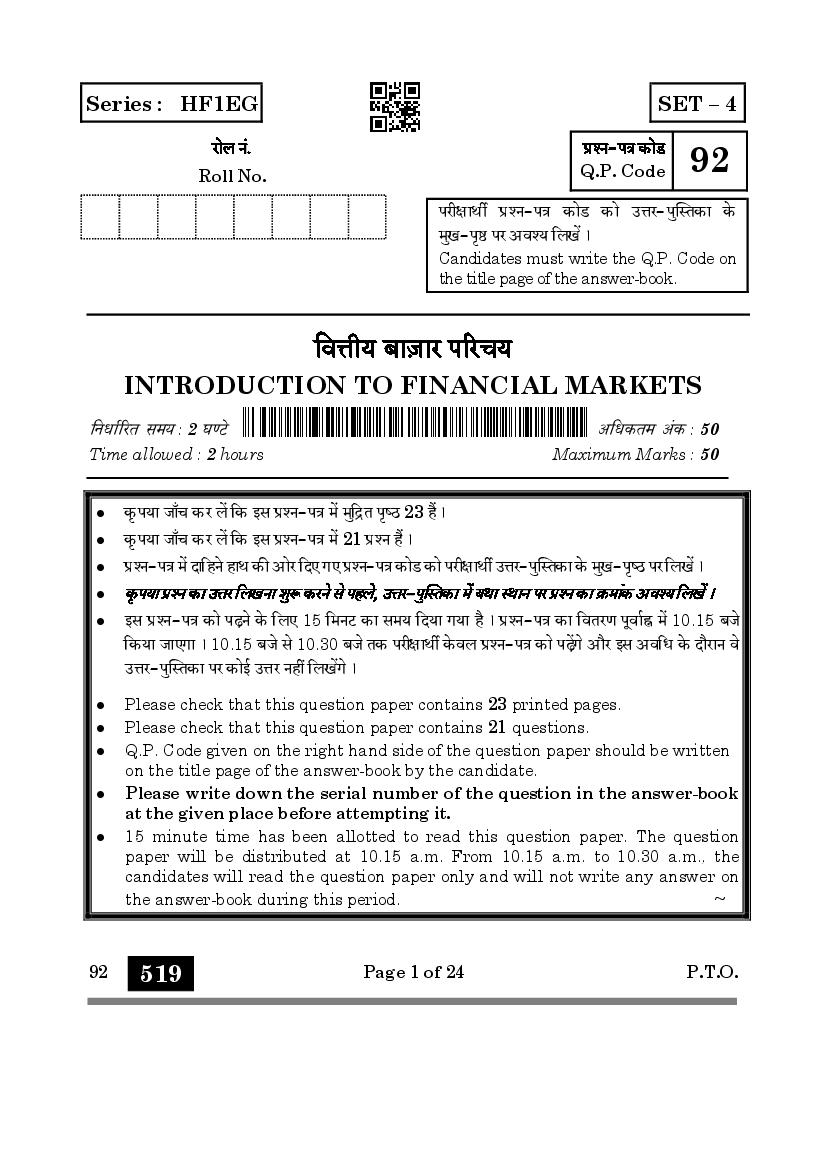
Roll No. Q.P. Code 92
- -
-
Candidates must write the Q.P. Code on
the title page of the answer-book.
INTRODUCTION TO FINANCIAL MARKETS
{ZYm©[aV g‘¶ : 2 KÊQ>o A{YH$V‘ A§H$ : 50
Time allowed : 2 hours Maximum Marks : 50
● - 23
● - 21
● - - - -
● , -
● - 15 - 10.15
10.15 10.30 -
-
● Please check that this question paper contains 23 printed pages.
● Please check that this question paper contains 21 questions.
● Q.P. Code given on the right hand side of the question paper should be written
on the title page of the answer-book by the candidate.
● Please write down the serial number of the question in the answer-book
at the given place before attempting it.
● 15 minute time has been allotted to read this question paper. The question
paper will be distributed at 10.15 a.m. From 10.15 a.m. to 10.30 a.m., the
candidates will read the question paper only and will not write any answer on
the answer-book during this period. ~
92 519 Page 1 of 24 P.T.O.
Page 2
(1)
(2) - 21 -
(3) `
(4) (5 + 16 =) 21 , () 2
(5 + 10 =) 15
(5)
(6) – (24 ) :
(i) 05
(ii)
(iii)
(iv)
(v) /
(7) – (26 ) :
(i) 16
(ii) 10
(iii)
(iv)
(v) /
–
( )
1. 6 4 41=4
(i)
(A) (B)
(C)
(D)
92 Page 2 of 24 ~
Page 3
(1) Please read the instructions carefully.
(2) This Question Paper consists of 21 questions in two sections : Section-A
& Section-B.
(3) Section-A has Objective type questions, whereas Section-B contains
Subjective type questions.
(4) Out of the given (5 + 16 =) 21 questions, a candidate has to answer
(5 + 10 =) 15 questions in the allotted (maximum) time of 2 hours.
(5) All questions of a particular section must be attempted in the correct
order.
(6) Section-A : Objective Type Questions (24 Marks) :
(i) This section has 05 questions.
(ii) It is mandatory for every student to complete all the questions as
per instructions.
(iii) There is no negative marking.
(iv) Do as per the instructions given.
(v) Marks allotted are mentioned against each question/part.
(7) Section-B : Subjective Type Questions (26 Marks) :
(i) This section has 16 questions.
(ii) A candidate has to do 10 questions.
(iii) There is no negative marking.
(iv) Do as per the instructions given.
(v) Marks allotted are mentioned against each question/part.
SECTION – A
(Objective Type Questions)
1. Answer any 4 out of the given 6 questions on Employability Skills. 41=4
(i) The means by which the information is sent :
(A) Sender (B) Feedback
(C) Message (D) Channel
92 Page 3 of 24 ~ P.T.O.
Page 4
,
(A) (B)
(C) - (D)
(iii) “ ”
_________
(A) (B)
(C) (D)
(iv) :
(A) (Home) (B) (END)
(C) (ENTER) (D) - (PAGE UP)
(v) ,
(A)
(B)
(C)
(D) ,
(vi) ?
(A)
(B)
(C)
(D)
92 Page 4 of 24 ~
Page 5
always. Prepare yourself for new changes, so that you can transition
seamlessly. Identify the skill.
(A) Time Management (B) Adaptability
(C) Self-Awareness (D) Responsibility
(iii) “I will read my entire year’s syllabus in one day and get good marks.”
It is an example of _________.
(A) Realistic goal (B) Achievable goal
(C) Unrealistic goal (D) Time bound goal
(iv) The following are navigation keys except :
(A) Home (B) END
(C) ENTER (D) PAGE UP
(v) This includes what to produce or sell, how much and where to sell.
Identify this function of entrepreneur.
(A) Making Decisions
(B) Taking Risk
(C) Divide Income
(D) Create a new method, idea or product
(vi) Which of following is not a sustainable development goal according to
United Nations ?
(A) Clean Water and Sanitation
(B) Gender Equality
(C) Population
(D) Reduced Inequalities
92 Page 5 of 24 ~ P.T.O.
Page 6
(i) ,
,
...
__________
(A) (B)
(C) (D)
(ii) ?
(A) (B)
(C) (D)
(iii) _________ , ... (IPO)
,
(A) (B)
(C) (D)
(iv) ,
, ______
(A) (B)
(C) (D)
(v) (Miller) ,
6
92 Page 6 of 24 ~
Page 7
(i) When you invest money, you earn interest on your capital. The next
year you earn interest on both your original capital and interest from
the first year. In the third year, you earn interest on your capital and
the interest on the first two years’ interest… and so on. This concept
is known as __________.
(A) The concept of Discounting (B) The concept of Compounding
(C) The concept of Simple Interest (D) The concept of Profit
(ii) Which of the following is not a security ?
(A) Shares (B) Debentures
(C) Bonds (D) Fixed Deposit Receipts
(iii) _________ is a mechanism, where during the period of which the IPO
is open, bids are collected from investors at various prices, which are
above or equal to the floor price.
(A) Fixed Price (B) Listing Price
(C) Book Building (D) Delisting Price
(iv) Companies whose potential for growth in sales and earnings are
excellent, are growing faster than other companies in the market or
other stocks in the same industry are called :
(A) Value Stock (B) Common Stock
(C) Growth Stock (D) Debt Instrument
(v) A farmer agrees to sell his produce of wheat to a Miller, 6 months
later when his crop is ready, he sells his wheat produce at a price
that is agreed upon today by both the parties. Identify the type of
contract.
92 Page 7 of 24 ~ P.T.O.
Page 8
,
(A) (B)
(C) (D)
3. 6 5 51=5
(i) ?
(A)
(B)
(C)
(D)
(ii)
, ,
-
?
(iii) ?
(A)
(B)
,
(C) ...
(D)
92 Page 8 of 24 ~
Page 9
who have the expertise, information and knowledge to make better
decisions than what a typical individual investor may be able to
make. Identify the advantage of investing in mutual fund in this
statement.
(A) Diversification (B) Liquidity
(C) Flexibility (D) Professional Management
3. Answer any 5 out of the given 6 questions. 51=5
(i) Which of the following is a long-term investment option ?
(A) Saving Bank Account
(B) Money Market or Liquid Fund
(C) Fixed Deposits with bank with less than one year tenure
(D) Post Office monthly income scheme
(ii) It is entrusted with responsibility of regulating and developing the
securities market. It formulates regulations and guidelines to govern
various market participants, such as brokers, stock exchanges and
listed companies to promote fair and transparent practices. Who is
this market participant and what is the name of this entity ?
(iii) Which of the following is not an advantage of Book Building through
NSE ?
(A) It offers a nation wide bidding facility in securities.
(B) It provides a fair, efficient and transparent method for
collecting bids using the latest electronic trading system.
(C) Costs involved in the issue are far less than those in a normal
IPO.
(D) The system increases the time taken for completion of the issue
process.
92 Page 9 of 24 ~ P.T.O.
Page 10
(A) (B)
(C) (D)
(v)
__________
(A) (B)
(C) (D)
(vi) - ?
(A) /
(B) /
(C) /
(D) /
4. 6 5 51=5
(i) ,
– __________ (//)
(ii) ,
:
(A) (B)
(C) - (D)
(iii) “
”
... (PMS) _________
(A) (B) ...
(C) .... (D) ...
92 Page 10 of 24 ~
Page 11
company returns to its shareholders from its annual profit.
(A) Dividends (B) Capital gain
(C) Profit (D) Interest
(v) Commodity derivatives market trade contracts for which the
underlying asset is __________.
(A) Index (B) Currency
(C) Stock (D) Commodity
(vi) Which of the following is the formula of Debt-Equity ?
(A) Total Debt/Total Equity
(B) Total Debt/Total Assets
(C) Net Sales/Net Fixed Assets
(D) Current Assets/Current Liability
4. Answer any 5 out of the given 6 questions. 51=5
(i) When we borrow money, we are expected to pay for using it – this is
known as __________. (Gain / Interest / Profit)
(ii) In a book building issue, the issuer is required to indicate either the
price band or a floor price in the prospectus. The actual discovered
issue price can be any price in the price band or any price above the
floor price. This issue price is referred to :
(A) Floor Price (B) Price Band
(C) Cut-off Price (D) Market Price
(iii) “Portfolio Management Services” could be offered only by
intermediaries having specific approval of _________ for PMS.
(A) SEBI (B) RBI
(C) NSDL (D) NSE
92 Page 11 of 24 ~ P.T.O.
Page 12
(A) (RBI)
(B) (NSDL)
(C) (NSE)
(D) (SEBI)
(v) ?
(vi) , (A) (R)
:
(A) :
(R) :
:
(A) (A) (R) (R), (A)
(B) (A) (R) (R), (A)
(C) (A) , (R)
(D) (A) , (R)
5. 6 5 51=5
(i) :
(A) (B)
(C) ... (D) ...
(ii) _______
(A) 15 (B) 21
(C) 30 (D) 7
92 Page 12 of 24 ~
Page 13
(A) Reserve Bank of India (RBI)
(B) National Securities Depository Limited (NSDL)
(C) National Stock Exchange (NSE)
(D) Securities Exchange Board of India (SEBI)
(v) What is a record date ?
(vi) Read the following statements Assertion (A) and Reason (R) and
choose the correct option from those given below :
Assertion (A) : Equity shareholders are supposed to be the owners
of the company.
Reason (R) : Equity shareholders have a right to vote in the Annual
General Meeting for passing any resolution.
Options :
(A) Both (A) and (R) are true and (R) is the correct explanation of
(A).
(B) Both (A) and (R) are true, but (R) is not the correct explanation
of (A).
(C) (A) is true, but (R) is false.
(D) (A) is false, but (R) is true.
5. Answer any 5 out of the given 6 questions. 51=5
(i) It is like a bank wherein the securities are deposited in electronic
form :
(A) Demat Account (B) Depository
(C) RBI (D) NSE
(ii) The draft offer Document is available on the SEBI website for public
comments for a period of ________ from the filling of draft offer
document with SEBI.
(A) 15 days (B) 21 Days
(C) 30 Days (D) 7 Days
92 Page 13 of 24 ~ P.T.O.
Page 14
(A) ,
(B) ,
(C) ,
(D) ,
(iv)
,
(A) (B)
(C) (D)
(v) -I : ,
-II :
(A) -I , -II
(B) -I , -II
(C) -I -II
(D) -I -II
(vi) ___________
(A)
(B)
(C)
(D)
92 Page 14 of 24 ~
Page 15
(A) Equity market, Debt markets
(B) Equity market, Commodity markets
(C) Debt markets, Commodity markets
(D) Currency market, Equity markets
(iv) It keeps the client informed of corporate actions taken or to be taken
by the issue of securities, having a bearing on the benefits or rights
accruing to the client.
(A) Depository Participant (B) Bank
(C) Financial Institution (D) Custodian
(v) Statement-I : On account of non-delivery of securities by the trading
member on the pay-in day, the securities are put up for auction
by the exchange.
Statement-II : The exchange purchases the requisite quantity in
auction market and gives them to the buying trading member.
(A) Statement-I is true, but Statement-II is false.
(B) Statement-I is false; but Statement-II is true.
(C) Both Statement-I and Statement-II are false.
(D) Both Statement-I and Statement-II are true.
(vi) ___________ is the sum of present values of all the cash inflows of
this annuity.
(A) Present value of a single cash flow
(B) Future value of an annuity
(C) The present value of annuity
(D) The future value of a net cash flow
92 Page 15 of 24 ~ P.T.O.
Page 16
( )
5 3 20-30
32=6
6.
7.
,
, 3-4 -
, ,
8. “” “” ?
9.
,
92 Page 16 of 24 ~
Page 17
(Subjective Type Questions)
Answer any 3 out of the given 5 questions on Employability Skills.
Answer each question in 20-30 words. 32=6
6. List the four types of barriers of communication.
7. Ravi and his best friend, Shiv have been practicing for annual school
dance competition. They both are performing solo. On the day of the
competition, Shiv won. Ravi felt extremely sad and dejected. He shouted
at Shiv unnecessarily, cried and also did not talk to his parents for 3-4
hours. On the contrary, if Ravi would have been emotionally intelligent,
he would have accepted defeat gracefully and done better in the next
competition. Being emotionally intelligent enhances your chances of
success and a balanced life. Suggest some points to manage emotional
intelligence.
8. What do you mean by “files” and “folders” in computer system ?
9. Ramya and Ramu both own plant shop. Ramu sits at his shop every day.
When customers come, he sells plants to them. Ramya walks around and
brings customers to her shop. She also sells seeds and flowers with her
plants. Ramya is working hard to grow her business. She has also added a
different idea to her business. Explain the roles of Ramya and Ramu.
92 Page 17 of 24 ~ P.T.O.
Page 18
(cup) ‘’
‘’
6 4 20-30 42=8
11. ()
/
?
12. ‘’ ?
13. (DPs) ,
- , -
?
14. “ ” , ‘’
92 Page 18 of 24 ~
Page 19
Bareilly where they introduced clay pot ‘Kulhads’ to replace plastic and
paper cup and to bring back taste of tradition. Mention two advantages of
using ‘Kulhads’ by Railways.
Answer any 4 out of the given 6 questions in 20-30 words each. 42=8
11. Most companies are usually started privately by their promoter(s). The
promoters’ capital / and the borrowings from banks and financial
institutions may not be sufficient for setting up or running the business
over a long-term. In context of this statement, explain why do companies
require to issue shares to the public ?
12. What does maturity of a ‘Bond’ refer to ?
13. Depository Participants (DPs) open investor accounts, in which they hold
the securities that they have bought in dematerialised form. Brokers and
Banks offer DP services to investors. DPs help investors receive and
deliver securities when they trade in them. While the securities when
they trade in them. While the investor level accounts in securities are
held and maintained by the DP the company level accounts of securities
issued is held and maintained by the depository. Who can be depository
participants ? Mention two depositories in India.
14. “Nifty is barometer of the Indian markets.” In the light of this statement
define ‘Nifty’.
92 Page 19 of 24 ~ P.T.O.
Page 20
(`) (`)
:
,
16. ?
5 3 50-80 3 4 = 12
17.
, ,
:
(a) ‘’
(b) ,
(GDRs), (ADRs)
, ,
?
92 Page 20 of 24 ~
Page 21
Liabilities Amount Assets Amount
(`) (`)
Shareholders Funds : Fixed Assets
Reserves and Surplus Investments
Secured Loans Current Assets, Loan and Advances
Unsecured Loans Miscellaneous expenditure
Current Liabilities &
Provisions
List two ‘applications of funds’ and two sources of funds.
16. What do mean by Current Ratio ? Also write the formula of Current Ratio.
Answer any 3 out of the given 5 questions in 50-80 words each. 3 4 = 12
17. Foreign capital issuance is the process by which a foreign entity raises
capital through the issuances of securities in a foreign market. This can
be done through a variety of securities, including stocks, bonds and other
financial instruments. Indian companies are permitted to raise foreign
currency resources through two main sources :
(a) Issue of foreign currency convertible bonds more commonly known as
‘Euro’ issues; and
(b) Issue of ordinary shares through depositories receipts namely Global
Depository Receipts (GDRs), American Depository Receipts (ADRs),
to foreign investors i.e. to the institutional investors or individual
investors. In the context of this para, what are foreign currency
convertible bonds, Global Depository Receipts (GDRs) and American
Depository Receipts ?
92 Page 21 of 24 ~ P.T.O.
Page 22
-
, ?
?
19.
20. :
(a) 2
(b) 2
21. :
(a) ` 10,000
(b) ` 10,000
?
____________
92 Page 22 of 24 ~
Page 23
facilitates the transaction between traders of financial instruments and
targeted buyers. A stock exchange in India adheres to set of rules and
regulations directed by Securities and Exchange Board of India or SEBI.
The said authorised body functions to protect the interest of investors and
aims to promote the stock market of India. In the view of this para, what
do you mean by stock exchange ? What are the roles of stock exchange in
securities market ?
19. Explain the various types of risk in investing in mutual fund.
20. Explain the following :
(a) The function of clearing corporation 2
(b) Types of return received by investor in equities 2
21. Suppose you are given two options :
(a) Receive ` 10,000 now or
(b) Receive ` 10,000 after three years
Which of options you prefer to choose ? Explain with the help of the time
value of money concept.
____________
92 Page 23 of 24 ~ P.T.O.
Page 24
Document Details
| Board / Org | CBSE |
| Exam | Class 10 |
| Type | Question Paper |
| Pages | 24 |
| Updated | 24 Sep 2026 |