UGC NET Syllabus for Yoga 2020
Finished viewing? Save it for later —
Download UGC NET Syllabus for Yoga 2020 (PDF · 18 pages)About UGC NET Syllabus for Yoga 2020
UGC NET Syllabus for Yoga 2020 is available here for free download. Published by NTA for UGC National Eligibility Test, this syllabus can be viewed online or downloaded as a PDF (18 pages). Candidates preparing for UGC National Eligibility Test can use UGC NET Syllabus for Yoga 2020 to understand the exam pattern, the type of questions asked, and the overall difficulty level.
Frequently Asked Questions
How can I download UGC NET Syllabus for Yoga 2020?
Open this page and click the Download button to save UGC NET Syllabus for Yoga 2020 as a PDF. It is completely free on AglaSem Docs.
Is UGC NET Syllabus for Yoga 2020 free to download?
Yes. UGC NET Syllabus for Yoga 2020 can be viewed online and downloaded as a PDF free of cost on AglaSem Docs.
How many pages does UGC NET Syllabus for Yoga 2020 have?
UGC NET Syllabus for Yoga 2020 contains 18 pages, which you can read online or download together as a single PDF.
Where can I find more UGC National Eligibility Test study material?
You can find more UGC National Eligibility Test question papers, sample papers, syllabus, and answer keys on AglaSem Docs.
UGC NET Syllabus for Yoga 2020 – Text
Read the full text of this syllabus below — useful to quickly search, copy and reference the content online without downloading the PDF.
📄 View text version (18 pages)
Page 1
UGC NET
Syllabus · Yoga
EXAM YEAR TYPE SUBJECT
UGC NET — Syllabus Yoga
Notes · Sample Papers · Previous Year Papers · Mock Tests
Page 2
. e
em las
as ag
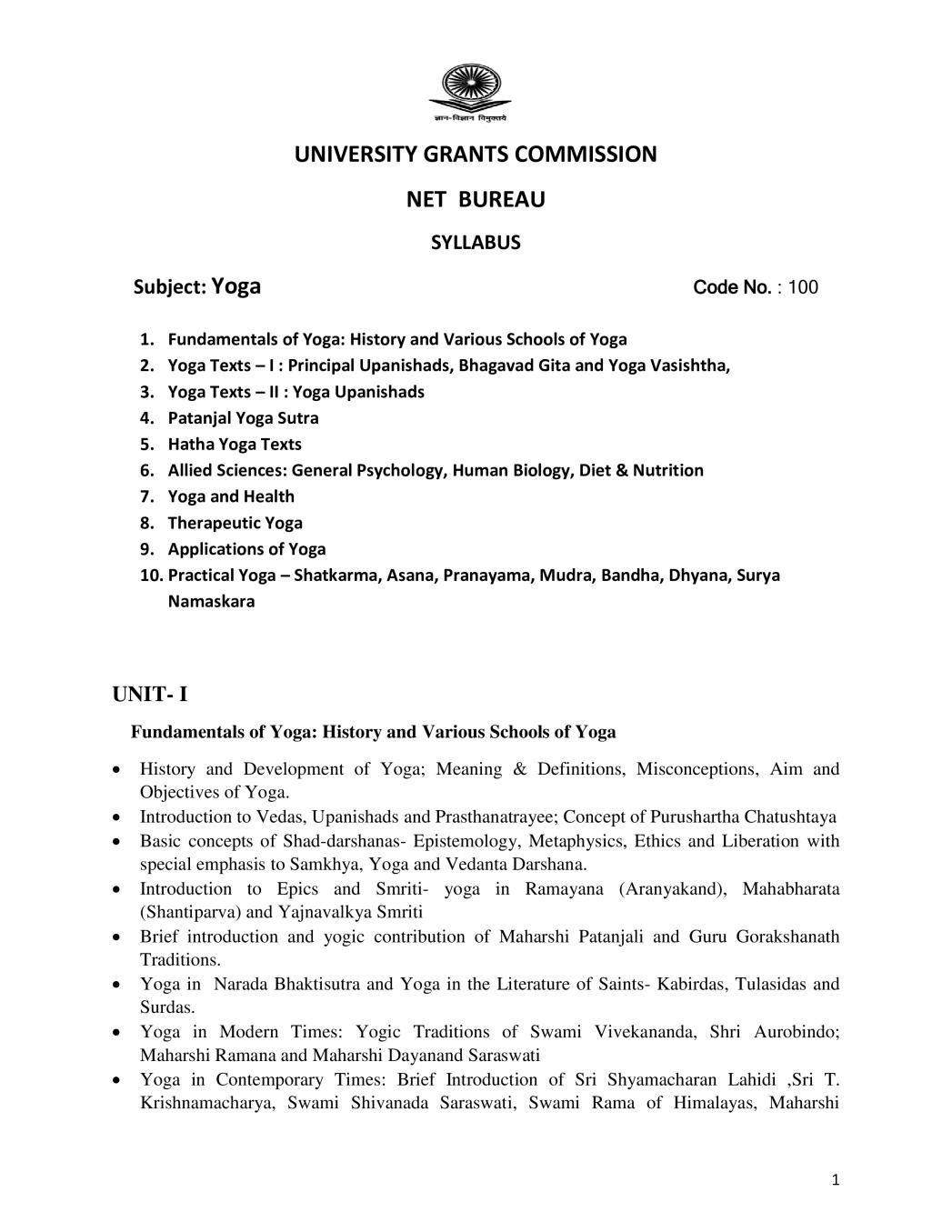
UNIVERSITY GRANTS COMMISSION
NET BUREAU
m
co
SYLLABUS
Subject: Yoga
.c om Code No. : 100
e m .
e m l a s
l a s
1. Fundamentals of Yoga: History and Various Schools of Yoga
a g
ag
2. Yoga Texts – I : Principal Upanishads, Bhagavad Gita and Yoga Vasishtha,
3. Yoga Texts – II : Yoga Upanishads
4. Patanjal Yoga Sutra
5. Hatha Yoga Texts
6. Allied Sciences: General Psychology, Human Biology, Diet & Nutrition
7. Yoga and Health
8. Therapeutic Yoga
m
co
9. Applications of Yoga
.
10. Practical Yoga – Shatkarma, Asana, Pranayama, Mudra, Bandha, Dhyana, Surya
Namaskara
s em
g l a
a
UNIT- I
Fundamentals of Yoga: History and Various Schools of Yoga
History and Development of Yoga; Meaning & Definitions, Misconceptions, Aim and
Objectives of Yoga.
m
Introduction to Vedas, Upanishads and Prasthanatrayee; Concept of Purushartha Chatushtaya
c. o
m
Basic concepts of Shad-darshanas- Epistemology, Metaphysics, Ethics and Liberation with
c. o m
special emphasis to Samkhya, Yoga and Vedanta Darshana.
s e
em
la
Introduction to Epics and Smriti- yoga in Ramayana (Aranyakand), Mahabharata
las ag
(Shantiparva) and Yajnavalkya Smriti
g
Brief introduction and yogic contribution of Maharshi Patanjali and Guru Gorakshanath
a
Traditions.
Yoga in Narada Bhaktisutra and Yoga in the Literature of Saints- Kabirdas, Tulasidas and
Surdas.
Yoga in Modern Times: Yogic Traditions of Swami Vivekananda, Shri Aurobindo;
Maharshi Ramana and Maharshi Dayanand Saraswati
Yoga in Contemporary Times: Brief Introduction of Sri Shyamacharan Lahidi ,Sri T.
Krishnamacharya, Swami Shivanada Saraswati, Swami Rama of Himalayas, Maharshi
m . c
c. o s e m
m a
se l
1
For more Question Papers, Sample Papers, Notes & Syllabus visit
g Page 1 of 17
Page 3
promotion of Yoga.
Introduction to Jnanayoga, Bhaktiyoga, Karmayoga, Rajayoga, Hathayoga and Mantra Yoga
Elements of Yoga in Jainism and Buddhism.
UNIT- II
Yogic Texts- I: Principal Upanishads, BhagavadGita, Yoga Vasishtha
Principal Upanishads
Brief Introduction of Ten Principal Upanishads.
Ishavasyopanishad:Concept of Karmanishta; Concept of Vidya and Avidya; Knowledge of
Brahman; Atma Bhava.
KenaUpanishad: Self and the Mind; Intuitive realization of the truth; Moral of Yaksha
Upakhyana.
KathaUpanishad: Definition of Yoga; Nature of Soul; Importance of Self Realization.
Prashna Upanishad: Concept of Prana and rayi (creation); Panchapranas; The six main
questions;
Mundaka Upanishad: Two approaches to Brahma- Vidya- Para and Apara; The greatness of
Brahmavidya; Worthlessness of Selfish-karma; Tapas and Gurubhakti; The origin of creation,
the ultimate aim of Meditation- Brahmanubhuti.
Mandukya Upanishad: Four States of Consciousness and their relation to syllables in Omkara.
Aitareya Upanishad: Concept of Atma, Universe and Brahman.
Taittiriya Upanishad: Concept of Pancha Kosha; Summary of Shiksha Valli, AnandaValli,
Bhriguvalli.
Chhandogya Upanishad: Om (udgitha) Meditation; Shandilyavidya.
Brihadaranyaka Upanishad: Concept of Atman and Jnana Yoga; Union of Atman and
Paramatman
Bhagavad Gita
General Introduction to Bhagavad Gita, Definitions of Yoga, their relevance & Scope; Essentials
of Bhagavad Gita - meanings of the terms Atmaswarupa, Stithaprajna, Sankhya Yoga (Chpt.II),
Karma Yoga (Chpt.III ), Samnyasa Yoga and Karma Swarupa (Sakama and Nishkama)
Samnyasa, Dhyana Yogas (Chpt. VI); Types of Bhakta(Chpt. VII) Nature of Bhakti (Chpt.XII),
Means and End of Bhakti-Yoga; The Trigunas and nature of Prakriti; Three Kinds of Faith. Food
for Yoga-Sadhaka, Classification of food (Chpt.XIV & XVII) Daivasura-Sampad-Vibhaga Yoga
(Chpt.XVI);Moksa-SamnyasaYoga (Chpt. XVIII)
2
For more Question Papers, Sample Papers, Notes & Syllabus visit Page 2 of 17
Page 4
. e
em las
as Yoga Vasishtha:
ag
Salient features of Yoga Vashitha, Concept of Adhis and Vyadhis; Psychosomatic Ailments; The
four Dwarpaals to Freedom; How Sukha is attained in the Highest State of Bliss; Practices to
overcome the Impediments of Yoga; Development of Satvaguna; Eightlimbs of Meditation;
Jnana Saptabhumika.
m
co
UNIT- III
.c om
Yogic texts- II: Yoga Upanishads:
e m .
em l a s
s g
a
Swetaswataropanishad: (Chapter II) Techniques and Importance of Dhyanyoga,
l a
ag
suitable place for Dhyana, sequence of pranayama & its importance, Prior symptoms of
Yogasiddhis, Importance of Yogasiddhis , Tattvajna, (ChapterVI) Nature of God,
techniques for Realization, Attainment of liberation.
Yogakundali Upanishad: Methods of Pranayama Siddhi, Types of Pranayama, means
of Self -realization.
Yogachudamadi Upanishad: The description of the six limbs of yoga, their results and
sequence
Trishikhibrahmanopanishad: description of Ashtangayoga, Karmayoga and
m
Jnanayoga.
co
.
Yogatattva Upnishad: Mantrayoga, Layayoga, Hathyoga, Rajayoga and their stages,
em
diet and Dincharya, primary symptoms of yoga siddhis and precautions.
s
a
Dhyanbindoopanishad: importance of Dhyanayoga, Nature of Pranav, Techniques of
g l
Pranav meditation, Shadangyoga, Atmadarshan through Nadanusandhan.
a
Nadabindoopanishad: Hansavidya : description of various limbs of Omkar, 12 matras
of omkar and its results of their application with Pranas, Types of nadas, nature of
nadanusandhan sadhana, state of Manolaya.
Yogarajopnishad: Mantrayoga, Layayoga, Hathayoga, Rajayoga, nine chakras,
procedures of Dhyana and its results.
UNIT- IV
o m
om PAADA : Yoga, meaning & Nature of yoga; Concept of Chitta, c
.Chitta-Bhumis,
Patanjala Yoga Sutra:
c.Chitta-Vrittis, m
etools, Concept of
m s
SAMADHI
s e Bhavapratyaya & Upaypratayaya, Sadhan Panchak, Chitta-Vikshepas g l a (Antaraya), Ektattva
Chitta-Vrittinirodhopaya, Abhyasa and Vairagya as the
gla Abhyasa,Chitta-prasadanam. Types and nature of Samadhi:a Adhyatmaprasada and
a Ritambharaprajna; Samprajnata, Asamprajnata, Sabeeja & Nirbeeja Samadhi, Difference
between Samapattis and Samadhi; Concept of Ishwara and attributes of Ishwara, Process of
Ishwarapranidhana.
SADHANA PAADA: Concept of Kriya Yoga , theory of Kleshas ; Concept of Karmashaya and
Karmvipaka, Nature of dhukha, Concept of Chaturvyuhavada, Drishyanirupanam,
m . c
c. o s e m
m a
se l
3
For more Question Papers, Sample Papers, Notes & Syllabus visit
g Page 3 of 17
Page 5
Niyama; Concept of Vitarka & Mahavrata; Asana, Pranayama, Pratyahara and their siddhis.
VIBHUTI PAADA: Introduction of Dharana, Dhyana and Samadhi, Nature of Sanyama;
Concept of Chitta samskara, Parinamatraya and vibhutis.
KAIVALYA PAADA: Five means of Siddhis, concept of Nirman Chitta, Importance of siddhis
achieved through Samadhi, Four types of Karmas; Concept of Vasana; Dharmamegh Samadhi
and its result, Viveka Khyati Nirupanam, Kaivalya Nirvachana.
UNIT-V
Hatha Yoga texts
• Introduction to Hatha Yoga and Hatha Yoga Texts. Yoga Beeja, Goraksha Samhita,
Vashishtha Samhita, Shiva Samhita, Siddhasiddhantapaddhati, Hatha Pradeepika, Gheranda
Samhita and Hatha Ratnavali. Aim & objectives,misconceptions about Hathayoga, prerequisites
of Hathayoga (dasha yama and dasha niyama),Sadhaka and Badhaka tattvas in Hathayoga;
Concept of Ghata, Ghatashuddhi, Concept and importance of Shodhana kriyas in Hathayoga;
Importance of Shodhana kriyas in health and disease; Concept of Matha, Mitaahara, Rules &
Regulations to be followed by Hatha Yoga Sadhakas;
• Asanas in Hatha Texts: Definition, pre requisites and special features of Yoga-asana; Asanas
in Hatha Pradeepika, Hatha Ratnavali, Shiv Samhita, Vasishtha Samhita,Gheranda Samhita-
benefits, precautions and contra indications of different Asanas;
• Pranayama in Hatha Texts: - Concept of Prana and Pranayama; Pranayama-its phases and
stages; Prerequisites of Pranayama in Hathayoga Sadhana; Pranayama in Hatha Pradeepika,
Gheranda Samhita; Shiv Samhita, Vashishtha Samhita-benefits, precautions and contra
indications of different Pranayama.
• Bandha, Mudra and other practices: Concept and definition of Bandha and Mudras in Hatha
Pradeepika, Hatha Ratnavali and Gheranda Samhita; Shiv Samhita, Vashishtha Samhita-
benefits, precautions and contra indications. Concept, definition, benefits and Techniques of
Pratyahara, Dhyana in Gheranda Samhita; Concept and benefits of Nada and Nadanusandhana
in Hatha Pradeepika, Four (stages) Avasthas of Nadanusandhana; Relationship between Hatha
Yoga and Raja Yoga; Goal of Hatha Yoga. Relevance of Hatha Yoga in contemporary times.
UNIT-VI
General Psychology
● Introduction to Altered States of Consciousness
Sleep: Stages of Sleep, Sleep Disorders;
● Behavioural Psychology: Psychology as a Science of Behaviour; Psychological basis of
behaviour;
4
For more Question Papers, Sample Papers, Notes & Syllabus visit Page 4 of 17
Page 6
. e
em las
as ●
ag
Personality: Nature and Types of Personality; Determinants of Personality: Heredity
and Environment; Facets and Stages of Personality Development;
● Cognitive Psychology: Sensation, Perception, Attention, Memory, Learning :- Their
definitions and types,
Mental Health; Causes and Consequences of Mental Conflicts and Frustrations;
m
Introduction to Common mental disorders: Insomnia, Depression, Stress, Anxiety disorders
om . co
c m
Introduction to Human Anatomy and Physiology
m . se
●
s e
Introduction to cell, tissue, organs and systems; Basic cell physiology-Cell-
g l a
g l aIntroduction, Cell Organelles, Cell membrane, Movement of the substances and water
a
● a
through the cell membrane, Bioelectric potentials.
Musculoskeletal systems: Skeleton - names of all bones, joints and muscles, cartilage,
tendon and ligaments, types of bone, joints and their functions; spine, muscles and
their functions; Skeletal muscles - Properties of skeletal muscles, Muscular contraction
and relaxation, Neuromuscular junction, Sarcotubular system, Smooth muscle-
mechanism of contraction
● Digestive and excretory system: Anatomy of digestive system, excretory system
m
co
(component organs) and their functions; Gastro intestinal system- General structure of
.
em
alimentary canal, Gastric secretion, Pancreatic secretion, Gastric motility-digestive
a s
peristalsis Gastrointestinal hormones.
●
g l
Renal physiology- Structure of kidney, Nephrons, Juxtra glomerular filtrate,
a
Reabsorption, Secretion-mechanism of secretion, Concentrating and diluting
mechanism of urine, Dialysis
● Nervous system and glands: Structure and properties of neurons, subdivisions of
nervous system and their functions, types of glands (endocrine and exocrine glands),
important endocrine and exocrine glands and types of hormones their functions.
● Sensory nervous system, Motor nervous system, Higher functions of the nervous
m
system, Synapse, Reflexes Cerebrospinal fluid, Blood brain and blood CSF barrier
c. o
●
m
Cardiovascular and respiratory system: Components of cardiovascular and respiratory
c. o e m
system; functions of cardiovascular and respiratory system; Circulatory system-
em la s
Functional anatomy of the heart, Properties of cardiac muscles, Conducting system of
las ag
the heart, Pressure changes during cardiac cycles, Capillary circulation, Arterial and
ag venous blood pressure; Respiratory system-Mechanism of breathing, Ventilation,
Regulation of respiration, Transport of gases, Hypoxia, Artificial ventilation, Non
respiratory functions of the lungs
● Immune system: Component organs of immune system, Functions of immune system;
Endocrinology-Endocrine glands, hormones, their functions;
● Reproductive system: Anatomy of male and female reproductive systems
m . c
c. o s e m
m a
se l
5
For more Question Papers, Sample Papers, Notes & Syllabus visit
g Page 5 of 17
Page 7
● Basic concepts and components of food and nutrition Understanding Nutrition, Basic
Terminology in Relation to Nutrition Requirement, Human Nutritional Requirements;
Concept of food, Acceptance of Food, Functions of Food; Components of Food & their
Classification; Macro Nutrients –Sources, Functions and Effects on the Body; Micro
Nutrients - Sources, Functions and Effects on the Body; Fat Soluble Nutrients - Sources,
Functions and Effects on the Body; Water soluble Nutrients - Sources, Functions and
Effects on the Body; Significance of Carbohydrate, Proteins, Lipids, Vitamins, Minerals
and water, Excessive and deficiency diseases of nutrients in the body; Antioxidants and
their Role;
● Yogic concept of diet and its relevance in the management of lifestyle
● Nutrients, proximate principles of diet, balanced diet concept; Carbohydrates, proteins,
fats – sources, nutritive values, importance; Minerals-calcium, iron, phosphorus etc.
Vitamins – sources, roles, requirements
● Food groups.
Cereals & Millets –Selection, Preparation and Nutritive Value; Pulses, Nuts and Oil
Seeds- Selection, Preparation and Nutritive Value; Milk and Milk Products- Selection,
Preparation and Nutritive Value; Vegetables and Fruits- Selection, Preparation and
Nutritive Value, Fats, Oils and Sugar, Jaggery, Honey, sprouts- Selection, Preparation and
Nutritive Value
● Food and metabolism. Energy- Basic Concepts, Definition and Components of Energy
Requirement, Energy Imbalance Concept of Metabolism, Anabolism, Catabolism, Calorie
Requirement-BMR, SDA, Physical Activity; Metabolism of Carbohydrates, Lipids and
Protein; Factors Affecting Energy; Requirement and Expenditure, Factors affecting BMR.
UNIT-VII
Yoga and Health
● Definition & Importance of Health According to WHO; Dimensions of Health: Physical,
Mental, Social and Spiritual;
● Concepts of Trigunas, Pancha-mahabhutas, Pancha-prana and their role in Health and
Healing; Concept of Pancha-koshas & Shat-chakra and their role in Health and Healing;
● Role of Yoga in preventive health care – Yoga as a way of life, Heyamdukhamanagatam;
Potential causes of Ill-health: Tapatrayas and Kleshas, Physical and Physiological
manifestation of Disease: Vyadhi, Alasya, Angamejayatva and Ssvasa-prashvasa.
● Mental and Emotional ill Health: Styana, Samshaya, Pramada, Avirati, Bhranti-darsana,
Alabdha-bhumikatva, Anavasthitatva, Duhkha and Daurmanasya
6
For more Question Papers, Sample Papers, Notes & Syllabus visit Page 6 of 17
Page 8
. e
em las
as ag
● Yogic Diet - General Introduction of Ahara; Concept of Mitahara; Classification in Yogic
diet according to traditional Yoga texts; Diet according to the body constitution (Prakriti)
– Vata, Pitta and Kapha as also Gunas.
Concepts of Diet: Pathya and Apathya according to Gheranda Samhita,
Hathapradeepikaand Bhagavad Gita; Importance of Yogic Diet in Yog Sadhana and its
role in healthy living; Diet according to the body constitution ( Prakriti) – Vata, Pitta and
m
Kapha as also Gunas.
om
● Yogic Principles of Healthy Living: Ahara, Vihara, Achara and Vichara; Role of Yogic
. co
.c e m
m s
Positive Attitudes (Maitri, Karuna, Mudita and Upeksha) for Healthy Living, Concept of
s e g l a
a
Bhavas and Bhavanas with its relevance in Health and well-being
l a
ag
UNIT-VIII
Therapeutic Yoga –
Yogic Practice - Management of the diseases through suitable yogic practices - Yogic
diet, Yama and Niyama, Shatkarma, Asanas, Pranayama; Meditation; changes in lifestyle
according to yogic scriptures.
Integrated Approach of Yoga therapy for the following Common Ailments:
m
. co
Respiratory disorders - Allergic Rhinitis & Sinusitis: Chronic Bronchitis, Bronchial
s em
asthama
g l a
Cardiovascular disorders: Hypertension, Angina pectoris, Cardiac asthma:
● a
Endocrinal and Metabolic Disorder - Diabetes Mellitus, Hypo and Hyper- Thyroidism;
Obesity: Metabolic Syndrome
● Obstetrics and Gynecological Disorders, Menstrual Disorders: Dysmenorrhea,
Menopause and peri-menopausal syndrome: Yoga for Pregnancy and Childbirth, Ante-
natal care, Post-natal care.
●
m
Gastrointestinal Disorders: Gastritis, Indigestion, Peptic Ulcers, Constipation,
m co
Disorders: Back Pain, Intervertebral disc prolapse .(IVDP) Lumbar
Diarrhoea, Irritable Bowel Syndrome, colitis, Piles.
c. o● Muscular-Skeletal s e m
s em ● Neurological Disorders: Migraine, Tension-headache, Epilepsygla
Spondylosys, Cervical Spondylosis, , Arthritis
gla a
a ● Psychiatric Disorders: Neurosis, Anxiety disorders, Phobias, Depression.
m . c
c. o s e m
m a
se l
7
For more Question Papers, Sample Papers, Notes & Syllabus visit
g Page 7 of 17
Page 9
Applications of Yoga
Applied Philosophy: Yoga as Applied philosophy; Meaning, definition and nature of
consciousness as described in Vedas,, Upanishads, Bhagwad Gita, Yogasutra and
Yogavashishtha; Spiritual and scientific approach to human consciousness. Yogic
Method of elevation of human consciousness: Bhaktiyoga, Jnanyoga, Karmayoga,
Mantrayoga, Ashtangayoga, Hathayoga.
● Yoga in Education: Salient features of Yoga Education, Factors of Yoga Education;
Teacher, Student and Teaching, Value based education- Meaning and definition, types of
values.
● Teaching Methodology in Yoga: Teaching and Learning: Concepts and Relationship
between the two; Principles of Teaching: Meaning and scope of Teaching methods and
factors influencing them; Teaching techniques- Individual, group and mass
● Essentials of Good Lesson Plan: concepts, needs, planning of teaching Yoga
(Shodhanakriya, Asana, Mudra, Pranayama & Meditation)
● Models of Lesson Plan; need for a lesson plan and content plan; Eight Step method of
Introduction as developed in Kaivalyadhama.
● Evaluation methods of an ideal Yoga class; Methods of customizing Yoga class to meet
individual needs. The student will have demonstrations and training in the above
mentioned aspects of teaching methods.
● Yoga classroom: Essential features, Area, Sitting arrangement in Yoga class, Student’s
approach to the teacher: Pranipaata; Pariprashna; Seva; (BG 4.34)
UNIT-X
Practical Yoga
Yogic Practices – Shatkarma, Asana, Pranayama, Mudra, Bandha, Dhyana, Surya
Namaskara (Techniques, Salient Features, Benefits)
● Shatkarmas: Vamandhauti, Vastradhauti, Dandadhauti, Laghoo and Poorna
sankhaprakshalana, Neti (Sutra and Jala), Kapalbhati(Vaatkrama,Vyutakrama &
Sheetkarma), Agnisara, Nauli, Tratak
● Suryanamaskar- Suryanamaskar must be practiced traditionally
● Asanas (yogic postures) Standing Postures-Ardhakatichakrasana, Padahastasana,
Ardhachakrasana, Trikonasana, Parivrittatrikonasana, Parsvakonasana, Veerasana.
● Sitting postures-Paschimottanasana, Suptavajrasana, Ardhamatsyendrasana,
Vakrasana, Baddhakonasana, Merudandasana, Akarnadhanurasana, Gomukhasana,
● Prone postures- Bhujangasana, Shalabhasana, Dhanurasana, Urdhvamukhosvanasana,
Makarasana,
8
For more Question Papers, Sample Papers, Notes & Syllabus visit Page 8 of 17
Page 10
. e
em las
as ag
● Supine postures- Halasana, Chakrasana, Sarvangasana, Matsyasana, Shavasana,
Setubandhasana,
● Balancing postures- Vrikshasana, Garudasana, Namaskarasana, Tittibhasana,
Natrajasana
● Pranayama: Breath awareness, Sectional breathing, Nadishuddhi, Suryabhedan, , Ujjai ,
Sitali, Sitkari, Bhastrika, Bhramari, Bahyavritti, Abhyantarvritti, Stambhavritti Pranayama
m
co
● Practices leading to Meditation: Pranav and Soham Japa, Yoga Nidra, Antarmauna,
.c om
Ajapa Jap, Practices leading to Breath Meditation, Practices leading to Om Meditation,
e m .
m
e Mudras: Mula Bandha, Jalandhara Bandha, Uddiyana Bandha, Maha a s
Practices leading to Vipassana Meditation, Practices leading to Preksha Meditation
● Bandhassand l
l a a g
ag
Bandha, Yoga Mudra, Maha Mudra, Shanmukhi Mudra, Tadagi Mudra, VipareetKarni
Mudra
● Contemporary Yogic Practices – Yogic Sukshma Vyayama (Swami Dheerandra
Brahmchari), Cyclic Meditation (S-VYASA); Mind Sound Resonance Technique (S-
VYASA); Transcendental Meditation (Maharshi Mahesh Yogi); Yoga Nidra (BSY); Savita Ki
Dhyan Dharana (DSVV).
m
. co
s em
g l a
a
m
m c. o
c. o s e m
s em la
gla ag
a
m . c
c. o s e m
m a
se l
9
For more Question Papers, Sample Papers, Notes & Syllabus visit
g
Page 9 of 17
Page 11
Page 12
. e
em las
as ag
m
om . co
.c e m
e m l a s
l a s a g
ag
m
. co
s em
g l a
a
m
m c. o
c. o s e m
s em la
gla ag
a
m . c
c. o s e m
m a
se
For more Question Papers, Sample Papers, Notes & Syllabus visit
g l
Page 11 of 17
Page 13
Page 14
. e
em las
as ag
m
om . co
.c e m
e m l a s
l a s a g
ag
m
. co
s em
g l a
a
m
m c. o
c. o s e m
s em la
gla ag
a
m . c
c. o s e m
m a
se
For more Question Papers, Sample Papers, Notes & Syllabus visit
g l
Page 13 of 17
Page 15
Page 16
. e
em las
as ag
m
om . co
.c e m
e m l a s
l a s a g
ag
m
. co
s em
g l a
a
m
m c. o
c. o s e m
s em la
gla ag
a
m . c
c. o s e m
m a
se
For more Question Papers, Sample Papers, Notes & Syllabus visit
g l
Page 15 of 17
Page 17
Page 18
. e
em las
as ag
m
om . co
.c e m
e m l a s
l a s a g
ag
m
. co
s em
g l a
a
m
m c. o
c. o s e m
s em la
gla ag
a
m . c
c. o s e m
m a
se
For more Question Papers, Sample Papers, Notes & Syllabus visit
g l
Page 17 of 17
Document Details
| Board / Org | NTA |
| Exam | UGC National Eligibility Test |
| Type | Syllabus |
| Pages | 18 |
| Updated | 15 Jul 2026 |