Goa Board Class 10 Sample Paper 2026 Science (E)
Finished viewing? Save it for later —
Download Goa Board Class 10 Sample Paper 2026 Science (E) (PDF · 31 pages)About Goa Board Class 10 Sample Paper 2026 Science (E)
Goa Board Class 10 Sample Paper 2026 Science (E) is available here for free download. Published by Goa Board for Class 10, this sample paper can be viewed online or downloaded as a PDF (31 pages). Candidates preparing for Class 10 can use Goa Board Class 10 Sample Paper 2026 Science (E) to understand the exam pattern, the type of questions asked, and the overall difficulty level.
Frequently Asked Questions
How can I download Goa Board Class 10 Sample Paper 2026 Science (E)?
Open this page and click the Download button to save Goa Board Class 10 Sample Paper 2026 Science (E) as a PDF. It is completely free on AglaSem Docs.
Is Goa Board Class 10 Sample Paper 2026 Science (E) free to download?
Yes. Goa Board Class 10 Sample Paper 2026 Science (E) can be viewed online and downloaded as a PDF free of cost on AglaSem Docs.
How many pages does Goa Board Class 10 Sample Paper 2026 Science (E) have?
Goa Board Class 10 Sample Paper 2026 Science (E) contains 31 pages, which you can read online or download together as a single PDF.
Where can I find more Class 10 study material?
You can find more Class 10 question papers, sample papers, syllabus, and answer keys on AglaSem Docs.
Goa Board Class 10 Sample Paper 2026 Science (E) – Text
Read the full text of this sample paper below — useful to quickly search, copy and reference the content online without downloading the PDF.
📄 View text version (27 pages)
Page 1
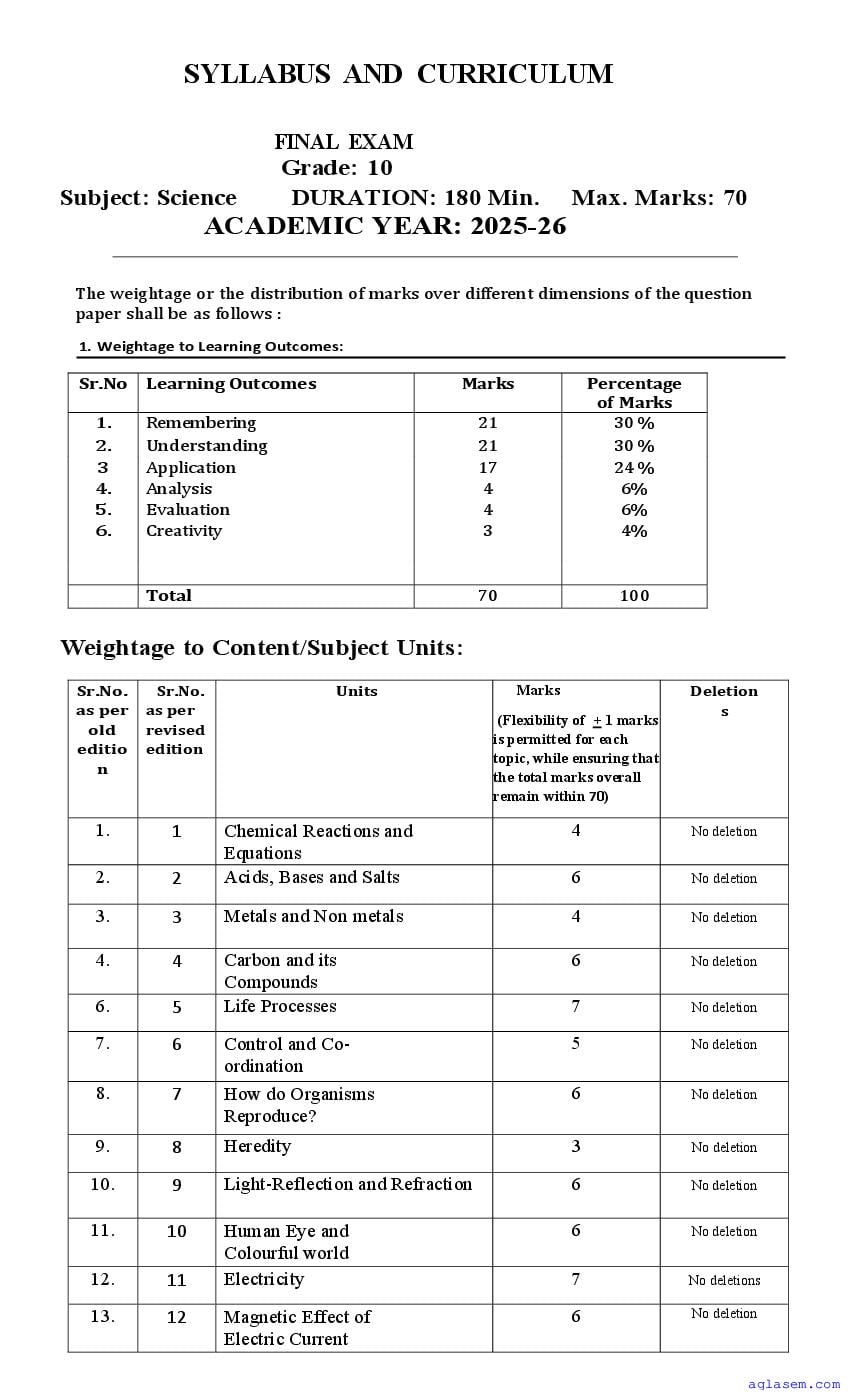
FINAL EXAM
Grade: 10
Subject: Science DURATION: 180 Min. Max. Marks: 70
ACADEMIC YEAR: 2025-26
The weightage or the distribution of marks over different dimensions of the question
paper shall be as follows :
1. Weightage to Learning Outcomes:
Sr.No Learning Outcomes Marks Percentage
of Marks
1. Remembering 21 30 %
2. Understanding 21 30 %
3 Application 17 24 %
4. Analysis 4 6%
5. Evaluation 4 6%
6. Creativity 3 4%
Total 70 100
Weightage to Content/Subject Units:
Sr.No. Sr.No. Units Marks Deletion
as per as per s
(Flexibility of + 1 marks
old revised
is permitted for each
editio edition
topic, while ensuring that
n
the total marks overall
remain within 70)
1. 1 Chemical Reactions and 4 No deletion
Equations
2. 2 Acids, Bases and Salts 6 No deletion
3. 3 Metals and Non metals 4 No deletion
4. 4 Carbon and its 6 No deletion
Compounds
6. 5 Life Processes 7 No deletion
7. 6 Control and Co- 5 No deletion
ordination
8. 7 How do Organisms 6 No deletion
Reproduce?
9. 8 Heredity 3 No deletion
10. 9 Light-Reflection and Refraction 6 No deletion
11. 10 Human Eye and 6 No deletion
Colourful world
12. 11 Electricity 7 No deletions
13. 12 Magnetic Effect of 6 No deletion
Electric Current
Page 2
Total 70
Page 3
Sr.No. Form of Questions Marks for Number of Total
each question questions Marks
1. Long Answer Type (LA) 4 3 12
2. Short Answer Type (SA-II) 3 4 12
3. Short Answer Type (SA-I) 2 14 28
4. Very Short Answer Type (VSA) 1 18 18
Total 39 70
4.The expected time for different types of question would be as
follows:
S.No. Form of Questions Approx. time Number of Approx. time
for each questions for each form
Question in (n) of Questions
mins (t) in mins (n x t)
1 Long Answer Type (LA) 12 03 36
2 Short Answer Type (SA-II) 7.5 04 30
3 Short Answer Type (SA-I) 5 14 60
4 Very Short Answer Type (VSA) 3 18 54
Total 150
As the total time is calculated on the basis of the number of questions
required to be answered and the length of their anticipated answers, it
would, therefore, be advisable for the candidates to budget their time
properly by cutting out the superfluous words and be within the expected
time limits.
5.Scheme of Options
(There will be no overall choice, However, there is an internal choice in
somequestions.)
6.Weightage to Difficulty level of questions:
S.No. Estimated difficulty level of question Percentage
1 Easy 20%
2 Average 60%
3 Difficult 20%
A question may vary in difficulty level from individual to individual, As
such, the assessment in respect of each question will be made by the paper
setter on the basis of general anticipation from the group as a whole taking
the examination. This provision is only to make the paper balanced in its
Page 4
7.Number of Main Questions:
It has been decided to introduce serial wise question number and to do
away with sub-question among the questions.
Revised pattern of assessment /grading in science for Grade 10
with effect from the academic year 2025-26:
First First Innovative Test Final Practical’s Total
Mid Term Assignment/Project Board
Test (Internal Marks) Exam
marks marks marks marks marks marks
20 70 10 70 20 100
Final Board Exam:
Theory 70 marks + practical’s 20 marks + Innovative Test (Internal
Marks)10 marks
Internal marks, to be sent to the Goa Board, are solely based on an
innovative test. This may include activity-based assessments, project
work, case studies, or paper presentations.
Distribution of Practical marks in science for Grade 10
examination:
Max. Marks: 20 marks Duration: 1Hour
Long experiment: 10 marks
Short experiment: 5 marks
Journal: 5 marks
Page 5
Diagrams for evaluation ( 6 marks) will be included under the
‘Remembering’ (Learning Outcome).
(ANNEXURE—1)
Ch. Name of Chapter Title of Diagrams Fig. No.
No
1 Chemical reactions and -------------------------
equations
2 Acids, Bases and Salts ------------------------
3 Metals and nonmetals Electrolytic refining of 3.12
copper
4 Carbon and its compounds A molecule of hydrogen 4.1
Single bond between two 4.2
hydrogen atoms
Double bond between two 4.3
oxygen atoms
Triple bond between two 4.4
nitrogen atoms
Electron dot structure of 4.5
methane
Electron structure of ethane 4.6
(b) (c)
Electron dot structure of 4.7
ethane
Complete molecule for two 4.8 (b)
structures of C4H10
Structure of cyclohexane 4.9
Structure of benzene 4.10
Formation of micelle 4.12
5 Periodic classification of -------------------------
elements
6 Life process Open and closed stomata 6.3
(a) (b)
Nutrition in amoeba 6.5
Human elementary canal 6.6
Excretory system in human 6.13
beings
7 Control and coordination Structure of neuron 7.1 (a)
Page 6
8 How do organisms reproduce? Binary fission in amoeba 8.1
Budding in hydra 8.4
Leaf of Bryophyllum with 8.5
buds
Spore formation in 8.6
Rhizopus
Longitudinal section of 8.7
flower
Germination of pollen on 8.8
stigma
Germination 8.9
Human – female 8.11
reproductive system
9 Hereditary and evolution ---------------------------
10 Light –reflection and refraction Concave and convex mirror 10.2
(a) (b)
Ray diagram for the image 10.7
formation by a concave (a to f)
mirror
Note: (an alternate diagram
for 10.7 (f) is given below
the table
Formation of image by a 10.8
convex mirror
Converging action of 10.12
convex lens and diverging (a) (b)
action of concave lens
The position, size and the 10.16
nature of the image formed (a to f)
by convex lens for various
positions of the object
Nature, position and size of 10.17
the image formed by a (a) (b)
concave lens
11 The human eye and the The myopic eye and the 11.2
colourful world correction for myopia with (b) (c)
concave lens
The hypermetropic eye and 10.3
correction for (b) (C)
hypermetropia
Page 7
a glass prism
12 Electricity A schematic diagram of an 12.1
electric circuit and the Table
symbols of some commonly 12.1
used components in circuit
diagrams
Electric diagram for 12.2
studying ohms law
Resistors in series 12. 6
Resistors in parallel 12.7
13 Magnetic effect of electric ----------------------------
current
14 Sources of energy ----------------------------
15 Our environment -----------------------------
16 Management of natural ---------------------------
resources
Concave Mirror Ray Diagram :
When object is placed between F and P
Page 8
(not for drawing)
ANNEXURE –2
Ch. Name of the chapter Title of the diagram Fig.
No. no.
1 Chemical reactions and Electrolysis of water 1.6
equations
2 Acids, Bases and Salts ---------------------------
3 Metals and nonmetals Action of steam on metal 3.3
4 Carbon and its compounds ---------------------------
5 Periodic classification of ----------------------------
elements
6 Life processes Human respiratory system 6.9
Structural view of human 6.10
heart
Schematic representation of 6.11
transport and exchange of
oxygen and carbon dioxide
7 Control and coordination Reflex arc 7.2
Endocrine glands in human 7.7
beings (a) (b)
8 How do organism reproduce? Regeneration in planaria 8.3
Human – male reproductive 8.10
system
9 Heredity and Evolution ---------------------------
10 Light Refraction of light through a 10.10
rectangular glass slab
11 The human eye and colourful Human eye 11.1
world
12 Electricity -------------------
13 Magnetic effect of electric Field lines around a magnet 13.4
current
A simple electric circuit in 13.5
which a straight copper wire (a)(b)
is placed
Page 9
circles indicating field lines (a)
Flemings left hand rule 13.13
Current is induced in coil 2 13.17
when current in coil 1 is
changed
Flemings right hand rule 13.18
14 Sources of energy Schematic diagram of a 14.4
biogas plant
A solar cooker 14.6
15 Our environment Food chain 15.1(a)
(b)(c)
Trophic levels 15.2
Food web 15.3
Diagram showing flow of 15.4
energy in an ecosystem
16 Management of natural Traditional water harvesting 16.3
resources system
Page 14
CG-1 Explores the world of matter, C-1.1 Describes classification of
its interactions, and properties at the elements in the Periodic Table, and
atomic level. explains how compounds (including
carbon compounds) are formed based
on atomic structure (Bohr's model)
and properties (valency)
C-1.2 Investigates the nature and
properties of chemical substances
(distillation, crystallisation,
chromatography, centrifugation, types
and properties of mixtures, solutions,
colloids, and suspensions)
Page 15
chemical interactions and changes
using symbols and chemical
equations (acid and base, metal, and
non-metal, reversible, and
irreversible)
CG-2 Explores the physical world C-2.1 Applies Newton's laws to
around them, and understands explain the effect of forces (change in
scientific principles and laws based state of motion - displacement and
on observations and analysis. direction, velocity and acceleration,
uniform circular motion, acceleration
due to gravity) and analyses graphical
and mathematical representations of
motion in one dimension
C-2.2 Explains the relationship
between mass and weight using
universal law of gravitation and
connect it to laws of motion
C-2.3 Manipulates the position of
object and properties of lenses (focus,
centre of curvature) to observe image
characteristics and correspondence
with a ray diagram, and extends this
understanding to a combination of
lenses (telescope, microscope)
C-2.4 Manipulates and analyses
different characteristics of the circuit
(current, voltage, resistance) and
mathematises their relationship
(Ohm's law), and applies it to
everyday usage (electricity bill, short
circuit, safety measures)
C-2.5 Defines work in scientific
terms, and represents the relationship
between potential and kinetic energy
(conservation of energy) in
mathematical expressions
C-2.6 Demonstrates the principle of
mechanical advantage by constructing
simple machines (system of levers
and pulleys)
C-2.7 Describes the origin and
properties of sound (wavelength,
Page 16
in what we hear as it propagates
through different instruments
CG-3 Explores the structure and C-3.1 Explains the role of cellular
function of the living world at the components (nucleus, mitochondria,
cellular level endoplasmic reticulum, vacuoles,
chloroplast, cell wall), including the
semi-permeability of cell membrane
in making cell the structural basis of
living organisms and functional basis
of life processes
C-3.2 Analyses similarities and
differences in the life processes
involved in nutrition (photosynthesis
in plants; absorption of nutrients in
fungi; digestion in animals), transport
(transport of water in plants;
circulation in animals), exchange of
materials (respiration and excretion),
and reproduction
C-3-3 Describes mechanisms of
heredity (in terms of DNA, genes,
chromosomes) and variation (as
changes in the sequence of DNA)
CG-4 Explores interconnectedness C-4.1 Applies the knowledge of
between organisms and their cellular diversity in organisms along
environment with the ecological role organisms
play (autotrophic/heterotrophic
nutrition) to classify them into five-
kingdoms
C-4.2 Illustrates different levels of
organisations of living organisms
(from molecules to organisms)
C-4.3 Analyses different levels of
biological organisation from
organisms to ecosystems and biomes
along with interactions that take place
at each level
C-4.4 Analyses patterns of
inheritance of traits in terms of
Mendel's laws and its consequences at
a population level (using models
and/or simulations)
Page 17
biological evolution demonstrating
the consequences of the process of
natural selection in terms of changes -
in allele frequency in population,
structure, and function of organisms
CG-5 Draws linkages between C-5.1 Explores how literature and the
scientific knowledge and knowledge arts have influenced Science
across other curricular areas C-5.2 Examines a case study related
to the use of Science in human life
from the perspective of Social
Sciences and ethics (e.g., Marie
Curie, Jenner, treatment of patients
with mental illness, the story of the
atomic bomb, green revolution and
GMOs, conservation of biodiversity)
C-5.3 Applies scientific principles to
explain phenomena in other subjects
(sound pitch, octave, and amplitude in
music; use of muscles in dance form
and sports)
CG-6 Understands and appreciates C-6.1 Knows and explains the
the contribution of India through significant contributions of India to
history and the present times to the all matters (concepts, explanations,
overall field of Science, including the methods) that are studied within the
disciplines that constitute it curriculum in an integrated manner
CG-7 Develops awareness of the C-7.1 States concepts that represent
most current discoveries, ideas, and the most current understanding of the
frontiers in all areas of scientific matter being studied - ranging from
knowledge in order to appreciate that mere familiarity to conceptual
Science is ever evolving, and that understanding of the matter as
there are still many unanswered appropriate to the developmental
questions stage of the students
C-7.2 States questions related to
matters in the curriculum for which
current scientific understanding is
well-recognised to be inadequate
CG-8 C-8.1 Develops accurate and
Explores the nature of Science by appropriate models (including
doing Science geometric, mathematical, graphical)
to represent real-life events and
phenomena using scientific principles
Page 18
variables and predict results
C-8.2 Designs and implements a plan
for scientific inquiry (formulates
hypotheses, makes predictions,
identifies variables, accurately uses
scientific instruments, --in represents
data primary and secondary multiple
modes, draws inferences based on
data and understanding of scientific
concepts, theories, laws, and
principles, communicates findings
using scientific terminology)
Learning Outcomes : GRADE 10 SUB : SCIENCE
Learning Outcomes — Learning Outcomes (LOs) are
granular milestones of learning and usually progress in
a sequence leading to the attainment of a Competency.
These LOs enable Teachers to plan their content,
pedagogy, and assessments towards achieving specific
Competencies.
The learner-
LO1: differentiates materials, objects, organisms, phenomena, and
processes, based on, properties and characteristics, such as, autotrophic and
heterotrophic nutrition, biodegradable and non-biodegradable substances,
various types of reactions, strong and weak acids and bases, acidic, basic, and
neutral salts using different indicators, real and virtual images, etc.
LO2: classifies materials, objects, organisms, phenomena, and processes,
based on properties and characteristics, such as, metals and non-metals, acid
and bases on the basis of their physical and chemical properties.
LO3: plans and conducts investigations and experiments to arrive at and
verify the facts, principles, phenomena, or to seek answers to queries on
their own, such as, investigate conditions necessary for rusting, tests the
conductivity of various solutions, compares the foaming capacity of different
Page 19
law, etc. Do variegated leaves perform photosynthesis? Which gas is evolved
during fermentation? Why does the shoot of a plant moves towards light?
LO4: related processes and phenomena with causes and effects, such as,
hormones with their functions, tooth decay with pH of saliva, growth of plants
with pH of the soil, survival of aquatic life with pH of water, blue colour of sky
with scattering of light, deflection of compass needle due to magnetic effect of
electric current, etc.
LO5: explains processes and phenomena, such as, nutrition in human beings
and plants, transportation in plants and animals, extraction of metals from ores,
placement of elements in modern periodic table, displacement of metals from
their salt solutions on the basis of reactivity series, working of electric motor
and generator, twinkling of stars, advanced sunrise and delayed sunset,
formation of rainbow, etc.
LO6: draws labelled diagrams, flow charts, concept maps, and graphs, such
as, digestive, respiratory, circulatory, excretory, and reproductive systems,
electrolysis of water, electron dot structure of atoms and molecules, flow chart
for extraction of metals from ores, ray diagrams, magnetic field lines, etc.
LO7: analyses and interprets data, graphs, and figures, such as, melting and
boiling points of substances to differentiate between covalent and ionic
compounds, pH of solutions to predict the nature of substances, V-I graphs, ray
diagrams, etc.
LO8: calculates using the data given, such as, number of atoms in reactants
and products to balance a chemical equation, resistance of a system of resistors,
power of a lens, electric power, etc.
LO9: uses scientific conventions to represent units of various quantities,
symbols, formulae, and equations, such as, balanced chemical equation by
using symbols and physical states of substances, sign convention in optics, SI
units, etc.
LO10: handles tools and apparatus properly: laboratory measures handles
tools and laboratory apparatus properly; measures physical quantities
using appropriate apparatus, instruments, and devices, such as, pH of
substances using pH paper, electric current and potential difference using
ammeter and voltmeter, etc.
Page 20
if all herbivores are removed from an ecosystem? What will happen if all non-
renewable sources of energy are exhausted?
LO12: applies scientific concepts in daily life and solving problems, such as,
suggest precautions to prevent sexually transmitted infections, uses appropriate
electrical plugs (5/15A) for different electrical devices, uses vegetative
propagation to develop saplings in gardens, performs exercise to keep in good
health, avoids using appliances responsible for ozone layer depletion, applies
concept of decomposition reaction of baking soda to make spongy cakes, etc.
LO13: derives formulae, equations, and laws, such as, equivalent resistance
of resistors in series and parallel, etc.
LO14: draws conclusion, such as, traits or features are inherited through genes
present on chromosomes, a new species originates through evolutionary
processes, water is made up of hydrogen and oxygen, properties of elements
vary periodically along the groups and periods in periodic table, potential
difference across a metal conductor is proportional to the electric current
flowing through it, etc.
LO15: takes initiative to know about scientific discoveries and inventions,
such as, Mendel's contribution in understanding the concept of inheritance,
Dobereiner for discovering triads of elements, Mendeleev for the development
of the periodic table of elements, Oersted's discovery that electricity and
magnetism are related, discovery of relation between potential difference across
a metal conductor and the electric current flowing through it by Ohm, etc.
LO16: exhibits creativity in designing models using eco-friendly resources,
such as, working model of respiratory, digestive, and excretory systems, soda
acid fire extinguisher, periodic table, micelles formation, formation of diamond,
graphite, and Buckminsterfullerene, human eye, electric motor and generator,
etc.
LO17: exhibits values of honesty, objectivity, rational thinking, and
freedom from myth and superstitious beliefs while taking decisions, respect
for life, etc., such as, reports and records experimental data accurately, says no
to consumption of alcohol and drugs, sensitises others about its effect on
physical and mental health, sensitises for blood and organ donations,
understands the consequences of pre-natal sex determination, etc.
LO18: communicates the findings and conclusions effectively, such as, those
derived from experiments, activities, and projects orally and in written form
using appropriate figures, tables, graphs, and digital forms, etc.
Page 21
dependency and inter-relationship in the biotic and abiotic factors of
environment, such as, appreciates and promotes segregation of biodegradable
and non-biodegradable wastes, minimises the use of plastics, takes appropriate
steps to promote sustainable management of resources in day-to-day life,
advocates use of fuels which produce less pollutants, uses energy efficient
electric devices, uses fossil fuels judiciously, etc.
GRADE :10 SUBJECT : SCIENCE
Suggested Pedagogical Processes
The learners may be provided with opportunities individually or in
groups and encouraged to-
PP1: recognise the difference between reactions, such as, exothermic and
endothermic, oxidation and reduction, etc.
PP2: observe to understand the difference in the temperatures in both the
reactions using laboratory thermometer.
PP3: investigate the ways of segregation of waste material on the basis of their
degradation property. They may be encouraged to practice the segregation of
waste before disposal at home, school, and public places.
PP4: explore the relationship between two physical quantities, such as,
between potential difference across a conductor and electric current flowing
through it; design, conduct, and share the findings of an activity
PP5: find out 'why' and 'how' of processes or phenomena, such as,
transportation in plants and animals, extraction of metals from ores, with
the help of activities, experiments, and demonstration. The learners may be
encouraged to discuss, relate, conclude and explain processes or phenomena to
their peers using interdisciplinary approach.
PP6: observe diagrams, such as that of digestive system and the names given
to various organs. The learners may be motivated to make poster of the
digestive system for displaying in school. They may also be provided
opportunities to use ICT tools for drawing.
PP7: collect wide variety of graphs from newspapers, magazines, ог the
internet, with a view to understand the information contained therein. The
learners may be facilitated to draw a graph, such as V-I graph for analysing the
Page 22
through it.
PP8: study how chemical equations are balanced using simple
mathematical skills. Discussion may be conducted on the significance of
balancing of chemical equations.
PP9: get familiar with New Cartesian Sign Convention using illustrated
cards and may be given ample opportunities to apply the sign convention in
various situations of reflection by spherical mirrors.
PP10: perform a role-play on ecosystem in a hypothetical situation, such as,
what will happen if all herbivores suddenly vanish from earth. This may be
followed by a discussion about how the loss of biodiversity disrupts the food
chain hereby adversely affecting the energy flow in an ecosystem.
PP11: derive equations, formulae, laws, etc. For example, the derivation for
formula of the equivalent resistance of resistors in series (or parallel). They
should be encouraged to practice the derivation till they are confident.
PP12: study the features inherited through genes, such as, attached or free
earlobes. They may be encouraged to observe and compare the earlobes of
their friends with the earlobes of their parents and grandparents to arrive at
the conclusion that characters or traits are inherited in offsprings from their
parents.
PP13: collect print and non-print materials by exploring the library and
the internet about scientists and their findings to appreciate how concepts
evolved with time. They may be motivated to share their findings by preparing
posters and performing role plays or skits.
PP14: encourage learners to visit science museums, biodiversity parks,
aviaries, zoological parks, botanical gardens, fisheries, poultry farms,
factories, etc.
PP15: collect eco-friendly, commonly available materials to design and
develop technological devices and innovative exibits, such as, electric motor,
soda acid fire extinguisher, respiratory system, etc. They may be motivated to
display their exhibits or models in science exhibitions, science club, classrooms,
during parent-teacher meet and to respond to the queries raised during
interaction.
PP16: visit classrooms, laboratories, library, toilets, playground, etc., to
identify places where wastage of electricity and water may be occurring.
Discussion may be held on importance of natural resources and their
Page 23
to-day life. The learners may also organise a sensitisation programme on such
issues.
PP17: share their findings of the activities, projects, and experiments, such
as, extraction of metals from ores, working of electric motor and generator,
formation of rainbow, etc., in oral and written forms. Report writing may be
facilitated to share their findings by using appropriate technical terms, figures,
tables, graphs, etc. They may be encouraged to draw conclusions on the basis of
their observations.
Page 24
Grade : X TIME: 3 HRS
SUB: SCIENCE QUESTION PAPER YEAR: 2025-26 MARKS:70
__________________________________________________________________
General Instructions
Read the following instructions carefully and follow them:
i. There are 39 questions under sections A, B, C, and D in the question
paper. All questions are compulsory.
ii. Question No. 1 to 18 (Sec A) are multiple choice questions carrying one
mark each.
iii. Question No 19 to 32 (Sec.B ) are short answer type question, carrying 2
marks each
iv. Question No. 33 to 36 (Sec. C) are short answer type questions carrying 3
marks each.
v. Question No.37 to 39(sec D) are long answer type questions, carrying 4
marks each.
vi. There is no overall choice in the question paper. However, an internal
choice has been provided for 3 questions of 2 marks, 2 questions of 3 marks
and one question of 4 marks. Only one of the choices in such questions has
to be attempted.
vii. In addition to this, separate instructions are given for each question
wherever necessary.
Section A
Select the correct alternative given below each statement and complete the
statement
1. The reaction in which heat energy is absorbed is known as ----------------
-
• an exothermic reaction
• a decomposition reaction
• an oxidation reaction
• an endothermic reaction
2. When a 4 V battery is connected across an unknown resistor there is a current
of 100 mA in the circuit. The value of the resistance of the resistor is :----------
• 0.4 ohm
• 4 ohm
• 40 ohm
• 400 ohm
Page 25
inhalation?
• Nostrils -→ larynx ---→ Pharynx -→ trachea --→ lungs
• Nostrils -→ trachea --→ pharynx --→ larynx --→ alveoli
• Larynx -→ nostrils --→ pharynx --→ lungs
• Nostrils -→ pharynx --→ larynx --→ trachea --→ alveoli
4. Which of the following prepares our body for the action in emergency
situation?
• Testosterone
• Growth hormone
• Adrenaline
• Insulin K
5. In the following diagram, what are the functions of parts A, B and C
sequentially?
• A: makes egg , B: transfers egg to uterus , C: nourishes the foetus
• A: nourishes the foetus , B: makes egg, C: transfers egg to uterus
• A: transfers egg to uterus ,B: makes egg , C: nourishes the foetus
• A: nourishes the foetus, B: transfers egg to uterus , C: makes egg
6 . Consider the following statements in connection with the electrolytic refining
of copper
(i) A is pure copper and its cathode
(ii) B is pure copper and its anode
(iii) A is anode and B is cathode but both are pure copper
(iv) Anode B is impure copper whereas cathode A is pure copper
Page 26
• (i) and (ii) only
• (ii) and (iii) only
• (i) and (iv) only
• (ii) and ( iv) only
7. At the time of short circuit, the current in the circuit -----------------
• decreases
• remains constant
• increases abruptly
• becomes zero
8. Calcium Oxide reacts vigorously with water releasing large amount of heat to
produce _______.
• Calcium hydride
• Calcium hydroxide
• Calcium carbonate
• Calcium bicarbonate
9. A person cannot see distinctly objects kept beyond 2m. This defect can be
corrected using a lens of power :
• +0. 2 D
• -0.5 D
• -0.2 D
• +0.5 D
10. You have three solutions X,Y and Z. The pH of solution ‘X’ is 6, ‘Y’ is 7 and
‘Z’ is 8. The solution having more hydrogen ion concentration is _------
• X
• Y
• Z
• X and Y
11) A sexually transmitted disease caused by bacteria is ___
• Warts
• Gonorrhoea
• Pneumonia
• HIV- AIDS
Page 27
• it helps to conserve water.
• it increases crop yield
• it regulates temperature
• it reduces soil erosion.
13. To relieve pain and irritation caused due to indigestion, we consume
__________.
antiseptics
antibiotics
antagonists
antacids
14. In a food chain the energy available for transfer at different trophic levels is in
the form of ------------------
• Heat energy
• Light energy
• Mechanical energy
• Chemical energy
15. Mg 2+ has _________
• 12 protons and 10 electrons.
• 10 protons and 12 electrons.
• 12 protons and 2 electrons.
• 2 Protons and 10 electrons
16. Rasika calculated magnification of an image formed by a spherical mirror . At
the end she added a negative sign to the value. This indicates the image
formed is
• real and erect
• virtual and inverted
• virtual and erect
• real and inverted
•
Directions: Question numbers 17 and 18 are Assertion – Reasoning based
questions: These consists of of two statements – Assertion (A) and Reason (R)
Answer these questions selecting the appropriate options given below:
• Both A and R are true and R is the correct explanation of A.
• Both A and R are true and R is not the correct explanation of A .
• A is true but R is false.
• A is false but R is true.
Page 28
from their mother.
Reason (R) : Women have XX sex chromosome.
18. Assertion(A) : Sodium oxide is an amphoteric oxide .
Reason ( R) : Metal oxides which react with both acids as well as bases are
known as amphoteric oxide .
SECTION B
19. xPb (NO₃)₂ → 2PbO + yNO₂ + O₂
In order to balance the above chemical equation write the value of the coefficient
x and y. Identify and name the type of chemical reaction
20. Look at the diagram given below and answer the following question.
What coloured lights are installed at the top of the above towers and why?
Raj is an aeroplane pilot and he uses spectacles of power - O.5 D. What will be
the distance of far point of his eye?
21. Draw a ray diagram to show the image formation when an object is placed
between F and C of a Concave mirror.
22. Why are heating elements of electric toasters and electric irons made of alloy
rather than pure metals ?. Write the relation between ampere and coulomb
23. State the advantages of alternating current over direct current.
Mention the frequency of AC supply in India along with its unit.
24. How does pH value of mouth influence tooth decay? State one preventive
measure.
25. Draw the electron dot structure of methane.
CH3OH and C4 H9OH are considered as alcohols. Justify
26. Swimming pools are disinfected using chemical treatment. Name the
compound used and write its chemical formula.
27. Refer the given diagram and answer the following questions.
Page 29
labelled as ‘C ’
28. Raja was scared when he suddenly saw a snake while watering the plants.
What hormonal responses would occur in his body and why?
29. If one bacterium divides into two, and the resultant two divides again into
four, there are only minor differences between them. Why?
Write two examples of inherited traits in human beings.
30. Name the substances that bring about chemical coordination in plants.
A plant kept in shade, bends slowly towards the sunlight. Identify this
movement.
OR
30. Write one function of testosterone hormone. Rani is detected with high
blood sugar level. Identify the hormone that regulates this condition .
31. Identify the most reactive and least reactive element from those given below
Sodium, Silver, Copper, Zinc, Iron, Lead
In electrolytic refining of Copper what is the anode made of?
OR
31. From the metals given below, identify 2 metals that are found in the native as
well as in the combined state.
Copper, Potassium, Silver, Calcium ,Aluminium
How are metal carbonate ores converted into oxides?
32. For the given group of organisms construct a food chain:
Frog, Grass, Insect, Snake.
Write a point of difference between food chain and food web.
OR
32. Arrange the given group of organisms in ascending order of trophic levels.
Fish, Algae, Crocodile, Crane
. Write a point of difference between producers and decomposers
Page 30
33.(i) Draw a neat diagram of human excretory system. Label left renal vein and
Urinary bladder.
(ii) State scientific reason why the urge to urinate can be controlled.
34. A student sitting far from the black board cannot see the words written on it
clearly.
(i) State the defect the student is suffering from .
(ii) How can the above defect be corrected?
(iii) If the far point is less than 80 cm and near point is more than 25 cm. State
any one cause of this refractive defect of vision.
35.(i) List two characteristics of an image formed by the convex lens.
(ii) State one use of the convex lens.
(iii) When a ray of light from air enters a water body, which direction will it
bend with respect to the normal?
OR
35 (i) List two characteristics of an image formed by the Concave lens.
(ii) State one use of the Concave lens.
(iii) What happens when a ray of light travels from one medium to another
having equal refractive indices.
36. Ravi fixes a white sheet of paper on a drawing board. He places a bar magnet
in the centre and sprinkles some iron filings uniformly around the bar magnet .
Then Ravi taps gently and observes that iron filings arrange themselves in a
certain pattern.
(i) Why do iron filings arrange themselves in a certain pattern?
(ii) State two properties of magnetic field
lines.
(iii) Why are magnetic field lines crowded towards the pole of a magnet?
OR
36 (i) Two circular coils A and B are placed close to each other . If the current in
the coil A is changed, will some current be induced in the coil B? Justify
(ii) How is the type of current that we receive in domestic circuit different from
the one that runs a clock?
(iii) The commercial motors use an electromagnet in place of permanent
magnet. Why?
Page 31
37.(i) A 40 W bulb is rated at 220 V . If 5 such bulbs are lit for 5 hours, calculate
the electrical energy.
(ii) Two resistors of 4 ohm and 6 ohm are connected in parallel to a cell , an
ammeter, a switch and a voltmeter in the circuit. Draw a labelled diagram
showing the above arrangement. Show the direction of flow of current in the
above circuit
OR
37.(i) A 100 W lamp and a 200 W lamp are connected to a 220 V electric main
supply. Calculate the current drawn by the lamps when connected in series
and in parallel.
(ii) Draw circuit diagram to show series combination of three resistors with a
battery, an ammeter, a switch and a voltmeter. Show the direction of flow of
current in the above circuit
38. A scooter mechanic finds it difficult to clean his oily hands with soap and
water at his work place whereas the same soap resulted in better cleaning ac
tion at his home
(i) Analyse the cause for effective cleaning of his hands at home
(ii) Suggest a suitable cleansing agent to be used at his work place.
(iii) Why does water alone not clean greasy stains on cloth?
(iv)How do soap micelles help in cleaning clothes?
39. (i) Write one point of distinction between mode of reproduction in rose and
bryophyllum plants.
(ii) Why are flowers of papaya and cucumber called as unisexual ?
(iii) State the important role played by pollen tube in flowering plants .
(iv) Why are spores of rhizopus covered with thick walls?
Document Details
| Board / Org | Goa Board |
| Exam | Class 10 |
| Type | Sample Paper |
| Pages | 31 |
| Updated | 24 Sep 2026 |