Goa Board Class 12 Question Paper June 2019 Economics
Finished viewing? Save it for later —
Download Goa Board Class 12 Question Paper June 2019 Economics (PDF · 10 pages)About Goa Board Class 12 Question Paper June 2019 Economics
Goa Board Class 12 Question Paper June 2019 Economics is available here for free download. Published by Goa Board for Class 12, this question paper can be viewed online or downloaded as a PDF (10 pages). Candidates preparing for Class 12 can use Goa Board Class 12 Question Paper June 2019 Economics to understand the exam pattern, the type of questions asked, and the overall difficulty level.
Frequently Asked Questions
How can I download Goa Board Class 12 Question Paper June 2019 Economics?
Open this page and click the Download button to save Goa Board Class 12 Question Paper June 2019 Economics as a PDF. It is completely free on AglaSem Docs.
Is Goa Board Class 12 Question Paper June 2019 Economics free to download?
Yes. Goa Board Class 12 Question Paper June 2019 Economics can be viewed online and downloaded as a PDF free of cost on AglaSem Docs.
How many pages does Goa Board Class 12 Question Paper June 2019 Economics have?
Goa Board Class 12 Question Paper June 2019 Economics contains 10 pages, which you can read online or download together as a single PDF.
Where can I find more Class 12 study material?
You can find more Class 12 question papers, sample papers, syllabus, and answer keys on AglaSem Docs.
Goa Board Class 12 Question Paper June 2019 Economics – Text
Read the full text of this question paper below — useful to quickly search, copy and reference the content online without downloading the PDF.
📄 View text version (10 pages)
Page 1
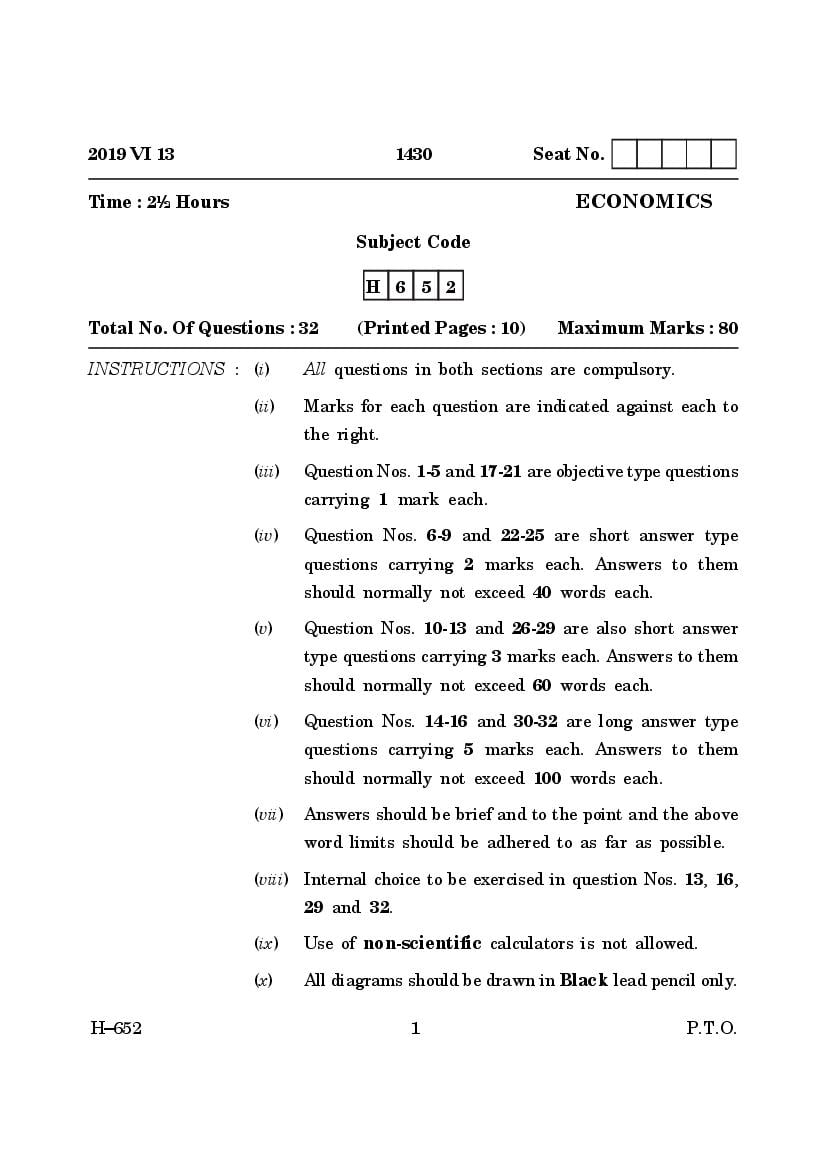
Time : 2½ Hours ECONOMICS
Subject Code
H 6 5 2
Total No. Of Questions : 32 (Printed Pages : 10) Maximum Marks : 80
INSTRUCTIONS : (i) All questions in both sections are compulsory.
(ii) Marks for each question are indicated against each to
the right.
(iii) Question Nos. 1-5 and 17-21 are objective type questions
carrying 1 mark each.
(iv) Question Nos. 6-9 and 22-25 are short answer type
questions carrying 2 marks each. Answers to them
should normally not exceed 40 words each.
(v) Question Nos. 10-13 and 26-29 are also short answer
type questions carrying 3 marks each. Answers to them
should normally not exceed 60 words each.
(vi) Question Nos. 14-16 and 30-32 are long answer type
questions carrying 5 marks each. Answers to them
should normally not exceed 100 words each.
(vii) Answers should be brief and to the point and the above
word limits should be adhered to as far as possible.
(viii) Internal choice to be exercised in question Nos. 13, 16,
29 and 32.
(ix) Use of non-scientific calculators is not allowed.
(x) All diagrams should be drawn in Black lead pencil only.
H–652 1 P.T.O.
Page 2
1. The problem of scarcity arises because our resources are ................... . 1
• Sufficient
• Unlimited
• Limited
• Vast
2. If a 40% fall in price is accompanied by a 20% extension in demand, the
elasticity of demand is ...................... . 1
• 2
• 0.5
• 0.2
• 5
3. When a larger quantity of the commodity is supplied at the same price, it
is called ..................... . 1
• Increase in supply
• Decrease in supply
• Extension of supply
• Contraction of supply
H–652 2
Page 3
change in factor input, it is called .................... . 1
• Positive returns to scale
• Increasing returns to scale
• Constant returns to scale
• Decreasing returns to scale
5. The form of market in which a large number of sellers sell a homogeneous
product at an uniform price is ..................... . 1
• Oligopoly
• Perfect competition
• Monopoly
• Monopolistic competition
6. A consumer with a budget of ` 20 wants to buy two goods that are equally
priced at ` 5 per unit. 2
List 4 examples of consumption bundles that the consumer can buy.
7. The table given below, shows the expenditure incurred by firm A on production
in the current year. Calculate the following : 2
(i) Variable cost of the firm
H–652 3 P.T.O.
Page 4
Items Expenditure (in `)
Payment towards daily wages 1,50,000
Payment for purchasing rawmaterial 3,00,000
Cost of machinery 5,00,000
8. Identify the market structure for the following : 2
(i) Railway transport in India
(ii) Auto industry in India
9. Explain two features of monopolistic competition. 2
10. Define the following concepts : 3
(i) Giffen goods
(ii) Demand curve
(iii) Perfectly inelastic demand
11. Identify the nature of the goods in the following situations : 3
(i) When the price of good ‘A’ increases the demand for good ‘B’ also
increases.
(ii) When the income of the consumer decreases, the demand for commodity
‘X’ also decreases.
(iii) When there is an increase in the price of cars, the demand for petrol
decreases.
H–652 4
Page 5
(i) Production function
(ii) Marginal revenue
(iii) Average product
13. State and explain the law of variable proportions with the help of a neat,
labelled diagram. 3
Or
State and explain the law of supply with the help of a neat, labelled
diagram.
14. State and explain the law of Diminishing Marginal Utility with the help of
a schedule and a neat labelled diagram. 5
15. Explain expansion and contraction of demand with the help of neat labelled
diagrams. 5
16. State and explain with the help of neat labelled diagrams the effect on the
equilibrium price when : 5
(i) Demand increases and supply remains constant
(ii) Demand decreases and supply remains constant
H–652 5 P.T.O.
Page 6
State and explain with the help of neat labelled diagrams the effect on the
equilibrium price when :
(i) Supply increases and demand remains constant
(ii) Supply decreases and demand remains constant
Section B
17. If the income is ` 100 lakhs and if consumption is ` 60 lakhs, then APC
will be .................. . 1
• 0.6
• 6
• 1.6
• 0.8
18. The expenditure incurred by households on the purchase of goods and services
at different levels of income during a year is called ................. . 1
• Private consumption expenditure
• Private investment expenditure
• Net export expenditure
• Government expenditure
H–652 6
Page 7
Government of the financial year is known as .................... . 1
• Expenditure
• Account
• Income estimates
• Budget
20. The price of one currency in terms of another is known as .................. . 1
• Balance of payment
• Foreign exchange rate
• Devaluation
• Interest rate
21. The function of the foreign exchange market that protects buyers and
sellers in the International trade from variations in the exchange rate is
called .................... . 1
• The transfer function
• The credit function
• The hedging function
• The borrowing function
H–652 7 P.T.O.
Page 8
increases by ` 4,000 crores. What is the value of multiplier ? 2
23. If the following changes are introduced by the Reserve Bank of India state
how it will affect the money supply in the economy.
(i) Rise in CRR.
(ii) Purchase of securities by the RBI in the open market.
(iii) Increase in the margin requirement from 40% to 60%.
(iv) A reduction in the statutory liquidity ratio.
24. From the information given below calculate primary deficit ................... . 2
(i) Fiscal deficit ` 10,000
(ii) Interest payment ` 2,000
(iii) Revenue receipt ` 5,000
25. Define the following : 2
(i) Direct Tax
(ii) Escheat
26. What is meant by the following : 3
(i) Personal disposable income
(ii) Gross domestic product at factor cost
(iii) Externalities
H–652 8
Page 9
(i) Services exported
(ii) Foreign direct investment
(iii) Unilateral transfers
(iv) Long term loan
(v) The sale and purchase of gold
(vi) The import of goods
28. Define the following concepts : 3
(i) Transactions motive
(ii) Precautionary motive
(iii) Speculative motive
29. State and explain the savings function with the hlep of a neat labelled
diagram. 3
Or
State and explain the consumption function with the help of a neat labelled
diagram.
H–652 9 P.T.O.
Page 10
measures to correct excess and deficient demand. 5
31. Explain any five functions of the Central Bank. 5
32. Explain the Income Method of Estimating National Income. 5
Or
Explain the expenditure method of estimating National Income.
H–652 10
Document Details
| Board / Org | Goa Board |
| Exam | Class 12 |
| Type | Question Paper |
| Pages | 10 |
| Updated | 22 Jul 2026 |