Goa Board Class 10 Sample Paper 2026 Social Science (E)
Finished viewing? Save it for later —
Download Goa Board Class 10 Sample Paper 2026 Social Science (E) (PDF · 28 pages)About Goa Board Class 10 Sample Paper 2026 Social Science (E)
Goa Board Class 10 Sample Paper 2026 Social Science (E) is available here for free download. Published by Goa Board for Class 10, this sample paper can be viewed online or downloaded as a PDF (28 pages). Candidates preparing for Class 10 can use Goa Board Class 10 Sample Paper 2026 Social Science (E) to understand the exam pattern, the type of questions asked, and the overall difficulty level.
Frequently Asked Questions
How can I download Goa Board Class 10 Sample Paper 2026 Social Science (E)?
Open this page and click the Download button to save Goa Board Class 10 Sample Paper 2026 Social Science (E) as a PDF. It is completely free on AglaSem Docs.
Is Goa Board Class 10 Sample Paper 2026 Social Science (E) free to download?
Yes. Goa Board Class 10 Sample Paper 2026 Social Science (E) can be viewed online and downloaded as a PDF free of cost on AglaSem Docs.
How many pages does Goa Board Class 10 Sample Paper 2026 Social Science (E) have?
Goa Board Class 10 Sample Paper 2026 Social Science (E) contains 28 pages, which you can read online or download together as a single PDF.
Where can I find more Class 10 study material?
You can find more Class 10 question papers, sample papers, syllabus, and answer keys on AglaSem Docs.
Goa Board Class 10 Sample Paper 2026 Social Science (E) – Text
Read the full text of this sample paper below — useful to quickly search, copy and reference the content online without downloading the PDF.
📄 View text version (26 pages)
Page 1
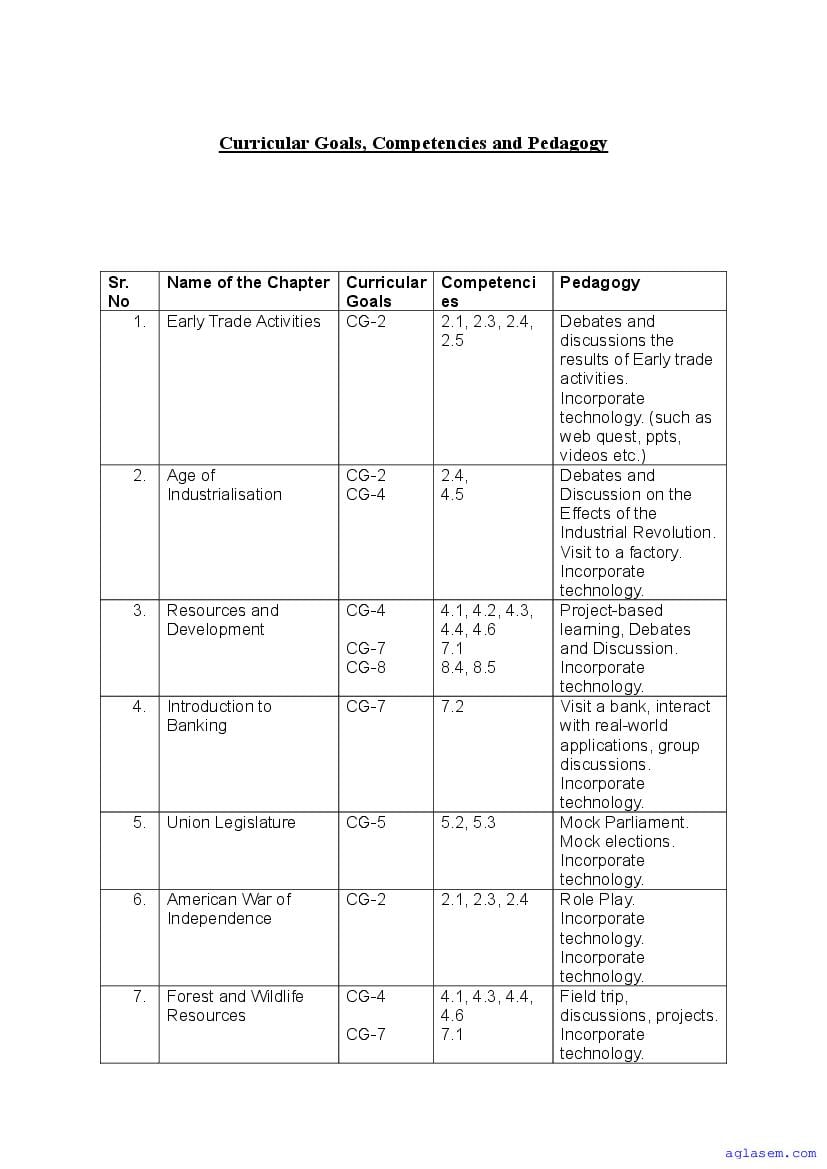
Sr. Name of the Chapter Curricular Competenci Pedagogy
No Goals es
1. Early Trade Activities CG-2 2.1, 2.3, 2.4, Debates and
2.5 discussions the
results of Early trade
activities.
Incorporate
technology. (such as
web quest, ppts,
videos etc.)
2. Age of CG-2 2.4, Debates and
Industrialisation CG-4 4.5 Discussion on the
Effects of the
Industrial Revolution.
Visit to a factory.
Incorporate
technology.
3. Resources and CG-4 4.1, 4.2, 4.3, Project-based
Development 4.4, 4.6 learning, Debates
CG-7 7.1 and Discussion.
CG-8 8.4, 8.5 Incorporate
technology.
4. Introduction to CG-7 7.2 Visit a bank, interact
Banking with real-world
applications, group
discussions.
Incorporate
technology.
5. Union Legislature CG-5 5.2, 5.3 Mock Parliament.
Mock elections.
Incorporate
technology.
6. American War of CG-2 2.1, 2.3, 2.4 Role Play.
Independence Incorporate
technology.
Incorporate
technology.
7. Forest and Wildlife CG-4 4.1, 4.3, 4.4, Field trip,
Resources 4.6 discussions, projects.
CG-7 7.1 Incorporate
technology.
Page 2
Nationalism in India discussion on the
methods and phases
of Freedom Struggle.
Incorporate
technology.
9. Judiciary CG-5 5.2 Visit to a lower or
high court.
Discussion and
Debates. Incorporate
technology.
10. Waters Resources CG-4 4.1, 4.3, 4.4, Experiential learning
4.5, 4.6 and field trips.
Interactive lectures
with visual aids.
11. Poverty and CG-8 8.1 Collaborative
Unemployment Learning.
Incorporate
technology.
12. Goa’s Struggle for CG-3 3.2 Interaction with a
Freedom freedom fighter or a
person who
witnessed the
Portuguese rule.
comparative study of
pre-liberation and
post-liberation Goa.
Incorporate
technology such as
web quest.
13. State Legislature CG-5 5.2, 5.3 Visit the Goa State
Assembly and write a
report on assembly
sessions. Interaction
with elected
representatives.
Incorporate
technology such as
web quest.
14. Agriculture CG-4 4.3, 4.4, 4.5, Debates, Discussion,
4.6 Project-based
CG-7 7.1 learning. Preparing
charts and collages.
Incorporate
technology.
15. Urban Local CG-5 5.5 Visit to a
Government municipality and
interact with the
Chairperson and
Page 3
and Discussion on
the functions of the
Municipality.
Incorporate
technology such as
web quest
16. Right of Consumers CG-4 4.4, 4.5 Use of case study.
CG-5 5.5 Problem solving,
debates, preparation
of charts.
17. The French CG-2 2.1, 2.3, 2.4, Comparative
Revolution 2.5 analysis of the
French society's
estate system with
that of the Indian
system. Incorporate
technology.
18. State Executive CG-5 5.2, 5.3 Visit to the Raj
Bhavan. Discussion
and Debates.
Incorporate
technology such as
web quest
19. Minerals and Energy CG-4 4.1, 4.2, 4.3, Skill-based learning.
Resources 4.4, 4.5, 4.6 Debates and
CG-7 7.1 Discussion. Visit a
CG-8 8.5 geography
laboratory, field trip.
Incorporate
technology.
20. Manufacturing G-4 4.1, 4.4, 4.5, Discussion and
Industries 4.6 Debates, visit to an
G-7 7.1 industry. Problem
G-8 8.5 based learning.
Incorporate
21. Panchayati Raj CG-5 5.5 Visit to a village
System in India panchayat.
Discussion on
developmental
activities taken by
Panchayats.
Interaction with
Sarpanch or a
Panchayat member.
Incorporate
technology such as
web quest.
22. Transport and CG-4 4.3, 4.5, 4.6 Case study. Project-
Communication CG-7 7.1 based learning.
Page 4
infrastructural
development.
Incorporate
technology.
Page 5
Early Trade Activities
Learning Objectives
❖ To understand the factors that led to the geographical discoveries.
❖ To acquire knowledge of various explorers and their explorations.
❖ To analyse the effects of geographical discoveries.
Learning Outcome
❖ Explain factors that led to the geographical explorations.
❖ Identify explorers and the places discovered by them.
❖ Assess the impact of geographical exploration on Asia, Africa and America.
Age of Industrialisation
Learning Objectives
❖ To understand the factors that led to the Industrial Revolution in England.
❖ To acquire knowledge of inventors and their inventions.
❖ To analyse the effects of the Industrial Revolution on India and England in
particular and the world in general.
Learning Outcomes
❖ Discuss the factors leading the industrial revolution.
❖ Compares domestic system and factory system.
❖ Identify the inventors and their inventions.
❖ Critically examine the effects of the Industrial Revolution on workers, children,
continents of Asia and Africa and the environment.
RESOURCES AND DEVELOPMENT
Learning Objectives
❖ To understand the value of resources and the need for their judicious utilisation
and conservation.
❖ To understand the salient features of various soils.
❖ To understand the soil types of Goa.
Learning Outcomes
❖ Define important terms such as resource, biotic and abiotic resources, renewable
and non-renewable resources, environmental protection and environmental
sustainability.
❖ Identify different types of resources, soils etc.
Page 6
❖ Assess the impact of conservation of natural resources on the life of people in any
area in view of sustainable development.
❖ Suggest measures to conserve natural and sustainable development.
INTRODUCTION TO BANKING
Learning Objectives
❖ The student will learn the concept of banking.
❖ The student will learn the types of banks, banking systems, banking services and
the new technologies used in banking transactions.
Learning Outcomes
❖ Identify various bank accounts.
❖ Identify various types of bank instruments used for banking transactions.
❖ Have knowledge of the use of new technologies in the banking system.
❖ Have knowledge of the various types of banks.
❖ Know how to open a bank account and operate it through an assignment.
Union Legislature
Learning Objectives
❖ To comprehend the parliamentary system of India.
❖ To understand the legislative procedure involved in law making.
❖ Analyze various devices that control executives.
Learning Outcomes
❖ Discuss the role of the President in the Parliamentary system.
❖ Comprehends the stages involving passing an ordinary and money bill.
❖ Critically evaluate the parliamentary devices to control executive
Union Executive
Learning Objectives
❖ To understand the role of the President, Prime Minister, and the Council of
Ministers in the Union Executive.
❖ To analyze the powers and functions of the President, Prime Minister and the
Council of Ministers.
❖ To compare the powers of the President, Prime Minister, and Council of Ministers.
Learning Outcomes
❖ Explains functions of the President, Prime Ministers, and the Council of Ministers.
Page 7
Council of Ministers.
The American War of Independence
Learning Objectives
❖ To understand the relationship between the colonies and England.
❖ To analyse the policy of taxation followed by England towards its colonies.
❖ To analyse the significance of the American Revolution.
Learning Outcomes
❖ Explains the relationship between the colonies and England.
❖ Critically analyse the taxation policy of England towards its colonies.
❖ Evaluate the significance of the American Revolution.
FOREST AND WILDLIFE RESOURCES
Learning Objectives
❖ To understand the importance of forest and wildlife in our environment.
❖ To develop a concern towards depletion of resources.
❖ To compare conservation methods by various communities.
❖ To develop knowledge on the types of forest and wild life of Goa.
Learning Outcomes
❖ Explain the types of forests and their economic importance.
❖ Reason out the causes of forest depletion.
❖ Classify endangered and critically endangered species of organisms.
❖ Suggest measures of wildlife conservation and land diversity of India and Goa.
WATER RESOURCES
Learning Objective:
❖ To understand the importance of water as a resource.
❖ To conscientize students on the causes of water scarcity.
❖ To compare and contrast advantages and disadvantages of multi- purpose
projects.
❖ To develop knowledge of various techniques of rainwater harvesting in India and
Goa
Page 8
❖ Explain the distribution of water, its scarcity and conservation.
❖ Appreciate traditional methods of water conservation in India.
❖ Compare multipurpose-projects and associated problems.
❖ Compare and contrast the irrigation projects in Goa.
Emergence of Nationalism in India
Learning Objectives
❖ To acquire knowledge of various phases in India’s freedom Movement
❖ To understand the contribution of freedom fighters and association to India’s
freedom struggle.
❖ To analyze the nature of British rule in India
Learning Outcomes
❖ Explain the role of freedom fighters in India’s freedom movement.
❖ Discuss the significance of various movements launched by Mahatma Gandhi.
❖ Critically examines the nature of British rule in India.
Judiciary
Learning Objectives
❖ To acquire knowledge of the organization of the judicial system in India.
❖ To understand the jurisdiction of different levels of courts.
❖ To comprehend the importance of the independence of the judiciary.
Learning Outcome
❖ Explain the various levels of the judiciary.
❖ Explain the powers and functions of various courts in India.
❖ Explain what makes the Indian judiciary independent.
POVERTY AND UNEMPLOYMENT
Learning Objectives
❖ To find the extent of poverty in India, the types of poverty, the causes and its
remedial measures.
❖ To understand concepts, types, causes of unemployment and remedial measures
to curb unemployment.
Learning Outcomes
❖ Understand the extent of poverty in India, its types, analyse the causes of poverty
and be able to suggest measures for it alleviation.
Page 9
❖ Identify the types of unemployment.
❖ Reason out the causes and analyse the measures of unemployment.
Lesson Goa’s Struggle for Freedom
Learning Objectives
❖ To value the contribution of various freedom fighters and organizations in Goa’s
struggle for freedom.
❖ To understand the nature of the Portuguese rule on Goa.
Learning Outcomes
❖ Discuss the contribution of freedom fighters and organizations to Goa’s struggle
for freedom.
❖ Appreciate the sacrifices of the freedom fighters
❖ Critically examine the impact of the Portuguese rule on Goa
State Legislature
Learning Objectives
❖ To understand the composition of State legislature.
❖ To comprehend the functions of the governor and State legislature.
❖ To acquire knowledge of the background of the Goa State Assembly.
Learning Outcome
❖ Discuss the composition of the State Legislature.
❖ Discuss the governor’s powers and compare them between those exercised on
the advice of the Council of Ministers and his discretionary powers.
❖ Acquire knowledge about the background of the legislature in Goa.
AGRICULTURE
Learning Objectives
❖ To identify various types of farming and discuss various farming methods.
❖ To develop a correlation between major crops, Soils and climatic requirements.
❖ To acquire knowledge of various reforms to modernise agriculture.
❖ To identify various farming techniques practised in Goa.
Learning Outcomes
❖ Describe the various types of agricultural practices.
❖ Differentiate cropping patterns in India and Goa.
Page 10
❖ Suggest methods for improvement of agriculture in India and Goa.
Urban Local government
Learning Objectives
❖ To understand the organization of the urban local government in Goa.
❖ To compare the functions of a municipality and the municipal corporation in Goa.
Learning Outcomes
❖ Discuss the organizational structure of the municipality and municipal corporation
in Goa.
❖ Differentiate between the obligatory and discretionary functions.
RIGHTS OF CONSUMERS
Learning Objectives
❖ To know who is a consumer, what are his/her rights, his/her responsibilities.
❖ How he/she can be protected against fraudulent goods and services.
Learning Outcomes
❖ Know his/her rights and responsibilities as a consumer.
❖ Know the government system to protect his/her rights and receive relief.
The French Revolution
Learning Objectives
❖ To understand the nature of the French Society.
❖ To analyse the role of the French monarch in the French Revolution.
❖ To discuss the factors leading to the French Revolution
❖ Identify the main events of the French Revolution.
❖ To assess the significance of the French Revolution
Learning Outcome
❖ Critically analyse the nature of French society.
❖ Examine the various factors leading to the French society.
❖ Discuss the significance of the French Revolution.
State Executive
Page 11
❖ To understand the various functions of the Governor.
❖ To understand the role of the Chief Minister.
❖ To acquire knowledge of the functions of the Council of Ministers.
Learning Outcome
❖ Discuss the functions of the Governor.
❖ Evaluate the role of the Council of Ministers.
❖ Examine the functions of the Chief Minister.
MINERAL AND ENERGY RESOURCES
Learning Objectives
❖ To acquire knowledge about the availability of various minerals founds in India and
Goa.
❖ To comprehend characteristics and uses of minerals.
❖ To promote use of non-conventional resources.
❖ To analyse the judicious need for conservation of mineral and energy resources.
Learning Outcomes
❖ Explain the need for mineral and energy resources of India and Goa.
❖ Critically appreciate environmental mining activity. problems associated with
mining activity.
❖ Suggest measures to conserve minerals and reduce pollution.
MANUFACTURING INDUSTRIES
Learning Objectives
❖ To discuss the importance of industries with respect to national economy.
❖ To acquire knowledge of various industries in Goa and India.
❖ To comprehend the consequences of Industrial pollution.
Learning Outcomes
❖ Explain the need for manufacturing industries.
❖ Comprehend the factors influencing the location of manufacturing industries.
❖ Reason out the distribution of the major manufacturing industries in India and Goa.
❖ Differentiate between polluting and non-polluting industries and its effects on
environment.
❖ Suggest measures to reduce industrial pollution.
Page 12
Learning Objectives
❖ To understand the various means of transport and communication.
❖ To comprehend how transport, communication and trade has brought the world
closer.
❖ To analyze the benefits to tourism for India and Goa.
Learning Outcomes
❖ Comprehend various modes of transport and means of communication in India
and Goa.
❖ Suggest measures for the development of tourism in India and Goa.
Panchayati Raj System in India
Learning Objectives
❖ To comprehend the background of the local self-government in Goa.
❖ To understand the organization of the local government in Goa.
❖ To understand the functions of Panchayats and Zila Panchayats in Goa.
Learning Outcomes
❖ Explain the background of the local self-government in Goa.
❖ Discuss the organization of Panchayati Raj in Goa.
❖ Examine the functions of Panchayats and Zila Panchayats.
Page 13
Objectives Remembering Understanding Application
Forms of Questions E/LA SA VSA O E/LA SA VSA O E/LA
Content/ Subunits
H1. Early trade activities 2(1) 2(2)
H2. Age of Industrialisation 3(1)
G 1. Resources and development 2(1)
Eco 8. Introduction to Banking 2(1)
Pol Sc10. Union Legislature 3(1)
Pol Sc11. Union Executive
H4. American war of Independence 1(1) 2(1)
G 2. Forest resources 1(1)
G 3. Water resources
H 8. Emergence of nationalism in India 2(1) 1(1) 1(1)
Pol Sc 12. Judiciary
Eco 9. Poverty & unemployment
H 9. Goa’s struggle for freedom 2(2) 2(2)
Pol Sc 13. State legislature
G 4. Agriculture 4(2) 1(1)
Pol Sc 15. Urban local government 1(1) 1(1)
Eco 10. Rights of consumers
H 5. French revolution 1(1)
Pol Sc 14. State executive 2(1)
G 5. Mineral & energy resource 1(1) 2(1) 1(1)
G 6. Manufacturing industries 1(1)
Pol Sc 16. Panchayati Raj system in India 2(1)
G 7. Transport & communication 1(1) 2(1)
Geography of Goa 1(1)
TOTAL 25 19 10
Note - Figures in bracket indicate the number of questions, while figures outside the bracket, indicate marks.
Page 14
SA VSA O E/LA SA VSA O E/LA SA VSA O E/LA SA VSA O
4
3
2(1) 4
2
3
2(1) 2
3
2(1) 3
2(1) 1(1) 3
2(1) 6
2(1) 2
2(1) 2
2(1) 6
2(1) 2
5
2
1(1) 1
2(1) 3
2
1(1) 5
1(1) 2(1) 4
2
3(1) 6
1(1) 1(1) 2(1) 5
10 14 10 2 80
the bracket, indicate marks.
Page 15
SUB: SOCIAL-SCIENCE
MARKS: 20
YEAR: 2025-26
C. INTERNAL ASSESSMENT
INSTRUCTIONS:
I. Two innovative activities, along with the rubrics, are given below.
II. The student will select any one topic for the activities.
III. Each activity carries a maximum of 20 marks.
IV. (A list of suggested innovative activities is also provided.
V. Students can select innovative activity from the suggested list,
but the teacher needs to prepare rubrics according to the level of
the students
1. ‘Tourism’ promotes National Integration.
The student will visit and collect pictures of various tourist places in Goa.
The student will provide the geographic location of these places – digital or
political (on the outline map of Goa).
The student will record the economic impact of this industry on the locals.
The student will provide the historical background of these places.
Criteria Excellent Very good Good Satisfactory
(4 mks) (3 mks) (2 mks) (1 mks)
1. Sources - Variety of sources -Well referred to -Few sources used to -Only e-source and
information used like Books, e- with more than two like books and e- insufficient research.
of tourist source, visits to places sources. sources. -Visuals used are limited
spots and of work, etc. -Visuals are well -Effective use of and not entirely related.
photos. -Very appropriate selected and laid visual aids. Shows
(max. 4 visuals used in a out. some variety
mks) creative manner.
2 .Provides -Precisely mark the -Marks the location -Labels the location -Fails to mark the location
geographical location with no error. correctly with minor with major errors. accurately.
location on -Work is neat, clear, errors. -Work is somewhat -Work is unclear and
the map of and well organised. -Work is clear with clear but lacks -disorganised.
Goa. minor errors. neatness.
(4 mks)
3.Report the -Interact with local -Interacts with local Interacts with just a No proof of interaction, and
Economic businessmen and businessmen but couple of local records
impact on organise the misses the businessmen with
1
Page 16
mks) detailed manner. information.
4.Provides a -Includes more than -Includes four -Includes three facts. -Includes only two facts.
historical four facts. facts. -Attempts to be -Little or no attempt at
background -Extremely creative in -Very creatively creative in creativity.
of the place. organization. organised. organization.
(4 mks)
5.Presentatio -Demonstrate full -Has some -Not confidant -Very poor knowledge
n (4mks) knowledge of the knowledge of content. of content.
content. content. -Some effort. -Little effort.
-Shows a great deal of -Shows a lot of -Good use of visual -Satisfactory use of
effort deal of efforts. effort. aids. Visualaids.
-Very effective use of -Effective use of
visual aids. visual aids.
2.Goan Architecture
Excellent (5) Very Good (4) Good (3) Satisfactory (2)
-Demonstrates -Shows a clear -Provides a -Lacks the
deep understanding of general understanding to
understanding the historical overview in a provide a
of the historical importance and limited manner. satisfactory
importance and records in a background.
highlights the satisfactory manner.
key points
Accurately Doesn’t describe all Makes a brief Fails to identify and
identifies and key features in a note of a few recognise the key
describes the detailed manner. features. features of the
unique features monument.
of the
monument
In-depth Misses some Provides basic Provides very
knowledge of minute details of information. limited information.
the material construction.
used in
construction.
- Variety of -Well referred to -Well referred to -Only e-source and
sources used with more than two with more than insufficient
like Books, e- sources. two sources. research.
source, visits to -Visuals are well -Visuals are -Visuals used are
places of work, selected and laid well selected limited
etc. out. and laid out. and not entirely
-Very related.
appropriate
visuals used in
a creative
manner.
-Demonstrate -Has some -Not confidant -Very poor
full knowledge knowledge of content. knowledge of
2
Page 17
-Shows a great -Shows a lot of -Good use of -Little effort.
deal of effort effort. visual aids. -Satisfactory use of
deal of efforts. -Effective use of Visual aids.
Very effective visual ai
use of visual
aids.
Suggested List of Innovative Activities
*Note – The innovative activities should compulsorily have a historical
and geographic component to them.
1. Gender equality (historical background, need for equality, role of social
reformers, social norms, statistical data from different states)
2. Sustainable development (consumerism, data on domestic and personal
consumables, effects of industrialisation on society, challenges for
sustainable development)
3. Role of media in democracy (role of media in freedom struggle, various
means of media communication, influence of media on Indian economy)
4. Consumer Rights (history of consumer movement in the world and India,
significance of the movement, consumer awareness and education, one
detailed case study)
5. Field Trip to local farm/farmers market/ agriculture research centre/ local
industries/dam/water treatment plant.
______________________________________________________________
3
Page 18
DISTRIBUTION
MONTH CHAPTER NO. TOPICS MARKS PERIODS HOURS
APRIL H.1 EARLY TRADE ACTIVITIES 04 07 4.6
G.1 RESOURCES AND DEVELOPMENT 04 08 5.3
INTERNAL ASSESMENT AND 20 03 2.0
ORIENTATION
JUNE H.2 AGE OF INDUSTRIALISATION 03 07 4.6
ECO.8 INTRODUCTION TO BANKING 02 03 2.0
POL.SCI .10 UNION LEGISLATURE 03 06 4.0
POL.SCI. 11 UNION EXECUTIVE 02 04 2.6
JULY H.4 AMERICAN WAR OF 03 05 3.3
INDEPENDENCE
G.2 FOREST AND WILDLIFE 03 09 6.0
G.3 WATER RESOURCES 03 10 6.6
AUGUST H.8 EMERGENCE OF NATIONALISM IN 06 07 4.6
INDIA
POL.SCI.12 JUDICIARY 02 05 3.3
ECO. 9 POVERTY AND UNEMPLOYMENT 02 06 4.0
POL
SEPTEMBER H.9 GOA FREEDON STRUGGLE 06 05 3.3
POL.SCI.13 STATE LEGISLATURE 02 04 2.6
G4 AGRICULTURE 05 09 6.0
OCTOBER POL.SCI.15 URBAN LOCAL GOVERNMENT 02 02 1.2
ECO.10 RIGHTS OF CONSUMERS 01 02 1.2
NOVEMBER H.5 THE FRENCH REVOLUTION 03 04 2.4
POL.SCI. 14 STATE EXECUTIVE 02 05 3.2
G.5 MINERAL AND ENERGY RESOURCES 04+01* 05 3.2
G.6 MANUFACTURING INDUSTRIES 03+01* 04 2.4
DECEMBER POL.SCI.16 PANCHAYATI RAJ IN INDIA 02 06 4.0
G.7 TRANSPORT AND 05+01* 06 4.0
COMMUNICATION
GEOGRAPHY 05
OF GOA
Page 19
Chapter 5, fig. 5.9, Nuclear Power Plant.
Chapter 6, fig. 6.9, Technology Parks of India.
Chapter 7, fig.7.10, Major Sea Ports
Units not for Evaluation
Chapter 3-Post Industrialization Age (Whole)
Chapter 6- Unification of Germany (Whole)
Chapter 7- Unification of Italy (Whole)
Sub-topics from the following chapters in Social Science I are not for
evaluation
1) Chapter 2- Age of Industrialization
• Colonization of Asia and Africa
2) Chapter 11- Union Executive
• Other powers and functions of the Prime Minister (i-vii)
3) Chapter 12- Judiciary
• Name of the writs to be mentioned. However, the explanation of the writs is not for
evaluation.
• Independence of Judiciary (only provisions are eliminated- i-vii)
• Subordinate jurisdiction (Civil Courts, Criminal and Revenue Courts)
4) Chapter 13- State Legislature
• Powers and functions of the State Legislature (from legislative powers till constituent
functions deleted)
5) Chapter 15- Urban Local Government
• General Introduction • Horizontal Distribution of Power • Vertical Division of Power •
Organization of local bodies • Urban local government • 74th Constitutional Amendment Act
6) Chapter 16- Panchayati Raj System in India
• Democratic Decentralization of Panchayati Raj: Evolution
• The New Panchayati Raj System: 73rd Amendment and After
• Salient Features of the 73rd Constitutional Amendment Act
• Powers, Authority, and Responsibility of Panchayats
• Powers to impose taxes and funds of Panchayats
• Fees charged by Panchayats (i---xii)
Page 20
Chapter 10-Union Legislature
• Legislative powers of the President.
Chapter 11- Union Executive
• Powers and the Functions of the President Chapter 14- State Executive
• Discretionary powers of the Governor
Chapter 16- Urban Local Government
• Obligatory functions of the Municipality
• Discretionary functions of the Municipality
The following subtopics from the Social Science –II Geography & Economics
Std X (Third Edition: May,2024) are not for Evaluation
Chapter 1- Resources & Development
• Pg. no.3 World Efforts towards protection of Environment.
• Pg. no.5 Table 1-Land utilization
Chapter 2- Forest & Wildlife Resources
• Pg no.18 Do You know (Forest types in India)
• Pg no.19 Biodiversity in India
• Pg no.22 Do You know Biodiversity in India
• Pg no.27 Do You know (in Quepem taluka----Goa Karnataka border)
Chapter 6- Manufacturing Industries
• Pg no.73 Physical factors and Socio-Economic Factors
• Pg.no.79. Chemical and Fertilizer Industries.
• Pg.no.80 Cement and automobile Industries
• Pg.no.82 Table 1-Classified lists of industries causing different types of pollution.
• Pg.no.85 Industrial Policy of Goa
Page 21
MODEL QUESTION PAPER
STD: X
MARKS ALLOTED: 80 TIME: 3 Hrs
GENERAL INSTRUCTIONS:
(i) This question paper has 57 questions in all. All questions are compulsory.
(ii) Marks are indicated against the question.
(iii) There is no overall choice. However, internal choice has been provided for question nos.48
and 49.
(iv) In addition to these, separate instructions are given wherever necessary.
Choose the correct alternative from those given below each statement: (20)
1. To develop the shipping industry, imperialist countries passed the__________.
trading acts
navigation acts
stamp act
Townshend act
2. The battle that was a turning point in the American War of Independence was
________.
Bunker Hill
Saratoga
Yorktown
Lexington
3. Assertion (A): The silk route was used by the Arab merchants to carry out trade
activities with China.
Reason (R): It was a major trade route for the exchange of goods like silk, spices
and precious stones.
Both A and R are true, and R is the correct explanation of A.
Both A and R are true, but R is not the correct explanation of A.
A is true, but R is False.
A is false, but R is true.
4. Sir Stafford Crips arrived in India in March 1942 to_______________.
support Indians in the Quit India Movement
carry negotiations with Indian leaders
convince Gandhiji to support the British in the war
give complete independence to India
5. The revolutionaries in Bengal looted the Chittagong armoires under
Bhagat Singh
Chandrashekhar Azad
Khudiram Bose
Surya Sen
6. Who was the first Goan woman to be arrested for raising the slogan „Jai Hind‟?
Vatsala Kirtani
Sudhatai Joshi
Berta Menezes
Sindhutai Deshpande
Page 22
Goa Action Committee
National Congress Goa
Goa Vimochan Samiti
Goa Congress Committee
8. Administrative head of the Municipal administration is________________.
Mayor
Secretary
Director
Chief Officer
9. Municipality can be dissolved by the state government if__________.
it fails to perform obligatory functions
it fails to perform optional functions
it fails to perform both obligatory and optional functions
it fails to maintain law and order
10.“The French empire was going through a financial crisis” due to_____.
I. participation in the Seven Years War.
II. the lavish lifestyle of her rulers.
III. interference of Marie Antonette.
IV. exemption given to the first two estates.
10. Which of the above statements are correct?
I, II, III are correct and IV is wrong
I, II, IV are correct and III is wrong
All the above four are correct
Only III is correct.
11. Which of the following is an ill- effect of genetic engineering?
Modification of the quality of crops.
Protection from pest attacks.
Declining use of fertilizers.
Effects on human health.
12. Which of the following is the chief crop of India?
Oilseeds
Pulses
Maize
Rice
13. Industries owned by producers, suppliers and workers is known as _______ sector
industry.
Private
Public
Joint
Co-operative
14. The main cause of mangrove destruction in Mumbai is_________.
expansion of agriculture
developmental projects
urbanisation
Page 23
15. The food crop that helps fix nitrogen from the air into the soil is __________.
millets
oilseeds
wheat
pulses
16. Assertion (A): minerals are considered are indispensable part of our lives.
Reason ( R): Minerals are used as raw materials for industries and in the construction of
infrastructure.
Both A and R are true, and R is the correct explanation of A.
Both A and R are true, but R is not the correct explanation of A.
A is True, but R is False.
A is false, but R is True.
17. SAIL is classified as a public sector industry because it is owned by__________.
individual
government
individual and government
producers, suppliers and workers.
18. A consumer was sold medicine which had expired. State the Right by which he can
be protected
Right to safety
Right to be informed
Right to redress
Right to consumer education.
19. Identify the correct term for shifting cultivation in Goa.
Puran
Awadhi
Kumeri
Jhum
20. Choose the multipurpose project in the state of Andhra Pradesh
Damodar valley
Kosi River
Hirakud
Nagarjuna Sagar
The words in Column ‘B’ bear a particular relationship with those in Column A.
Write in Column ‘D’ the words bearing a similar relationship to those in Column ‘C’. (2)
A B C D
21. Jayprakash Narayan Quit India Movement Khan Abdul 21. ----------
Gaffar Khan
22. 1789 National Assembly 1795 22. -----------
Identify the following personalities with the help of the clues given below: (2)
23. (A) He believed the ultimate power rests with the people.
(B) His work became the „Bible of the Revolutionaries‟.
Page 24
British hear‟.
(B) He founded an association named Navjawan Bharat Sabha.
Give a geographical term for each of the following: (2)
25. Cultivation of a single crop on a large as an industrial raw material.
26. A collective term used for jowar, bajra and ragi as a category of crops.
Complete the analogy: (2)
27. Project Tiger: protection of wildlife; Chipko Andolan : _________
28. In-situ conservation: National parks; Ex-situ conservation - _____________
Answer the following questions in two sentences each: (38 )
29. Write any two limitations of the land routes.
30. Why is the Declaration drafted by Thomas Jefferson considered the noblest document
in world history?
31. „Mahatma Gandhi called off the Non-Cooperation Movement in 1922‟. Justify.
32. List any two activities taken up by Gomantakiya Tarun Sangh during Goa‟s struggle for
freedom.
33. Analyse the effects of Salazar‟s dictatorship on Goa.
34. Write any two financial powers of the State Assembly.
35. The Governor has discretionary powers. Illustrate with the help of an example.
36. Analyse the role of the Cabinet Committees in the smooth functioning of the government.
37. Why are Block Development Officers appointed in every Block of the State?
38. The Constitution has provided immunities to the judges of the Supreme
Court of India. Discuss.
39. What are the steps involved in resource planning in India?
40. Investigate factors that cause soil erosion in hilly areas and in reservoirs of dams.
41. Describe the features of a savings bank account.
42. Why is natural gas an efficient source of energy.
43. Assess the use of mass communication in today‟s fast-paced world.
44. Compare the traditional water conservation systems of „Khadins‟ and „Tankas‟.
45. Distinguish between Frictional and Structural unemployment.
46. How has the hypersaline ecosystem benefitted the people of Goa?
47. Mr Arun Naik plans to set up an industry in a remote area. How will his manufacturing
unit benefit the economy of the village?
Answer any one of the following questions in 3 sentences each: (3)
48. Explain how scientific and technological knowledge helped England become the leading
country in the Industrial Revolution.
OR
48. Explain the effects of the Industrial Revolution on the Indian economy.
49. „Rail transport in India needs to be improved‟. Justify (3)
OR
49. Assess the various features of trade.
Read the following extract and answer the questions set below:
“Every sitting of either House begins with the Question Hour, which is available for asking
and answering questions. Asking the questions is an inherent parliamentary right of all the
members, irrespective of their party affiliations.”
Page 25
51. What type of questions are asked between 12 noon to 1 pm? (1)
52. How can the opposition bring about the collapse of the government? (1)
„The wildlife sanctuaries and reserved forests are found in the western ghats of India‟.
53. Name any one scheme implemented by the Forest department under the forestry
scheme for conservation of forests. (1)
54. What is the significance of the sacred grove in Goa? (1)
On the given outline map of India, mark the following:
55. A nuclear power plant in Uttar Pradesh. (1)
56. A technology park in the state of West Bengal. (1)
57. A seaport in Goa. (1)
THE END
Page 28
Document Details
| Board / Org | Goa Board |
| Exam | Class 10 |
| Type | Sample Paper |
| Pages | 28 |
| Updated | 24 Sep 2026 |