Uttarakhand Board Class 9 Syllabus 2027 Additional Subjects
Finished viewing? Save it for later —
Download Uttarakhand Board Class 9 Syllabus 2027 Additional Subjects (PDF · 12 pages)About Uttarakhand Board Class 9 Syllabus 2027 Additional Subjects
Uttarakhand Board Class 9 Syllabus 2027 Additional Subjects is available here for free download. Published by Uttarakhand Board for Class 9, this syllabus can be viewed online or downloaded as a PDF (12 pages). Candidates preparing for Class 9 can use Uttarakhand Board Class 9 Syllabus 2027 Additional Subjects to understand the exam pattern, the type of questions asked, and the overall difficulty level.
Frequently Asked Questions
How can I download Uttarakhand Board Class 9 Syllabus 2027 Additional Subjects?
Open this page and click the Download button to save Uttarakhand Board Class 9 Syllabus 2027 Additional Subjects as a PDF. It is completely free on AglaSem Docs.
Is Uttarakhand Board Class 9 Syllabus 2027 Additional Subjects free to download?
Yes. Uttarakhand Board Class 9 Syllabus 2027 Additional Subjects can be viewed online and downloaded as a PDF free of cost on AglaSem Docs.
How many pages does Uttarakhand Board Class 9 Syllabus 2027 Additional Subjects have?
Uttarakhand Board Class 9 Syllabus 2027 Additional Subjects contains 12 pages, which you can read online or download together as a single PDF.
Where can I find more Class 9 study material?
You can find more Class 9 question papers, sample papers, syllabus, and answer keys on AglaSem Docs.
Uttarakhand Board Class 9 Syllabus 2027 Additional Subjects – Text
Read the full text of this syllabus below — useful to quickly search, copy and reference the content online without downloading the PDF.
📄 View text version (13 pages)
Page 1
Uttarakhand Board
Class 9 Syllabus 2027
Additional Subjects
EXAM YEAR TYPE
Uttarakhand Class 9 2027 Syllabus
Notes · Sample Papers · Previous Year Papers · Mock Tests
Page 2
.co s e m
s em 2026-2027 ag l a
a
ADDITIONAL SUBJECTS (IX & X)
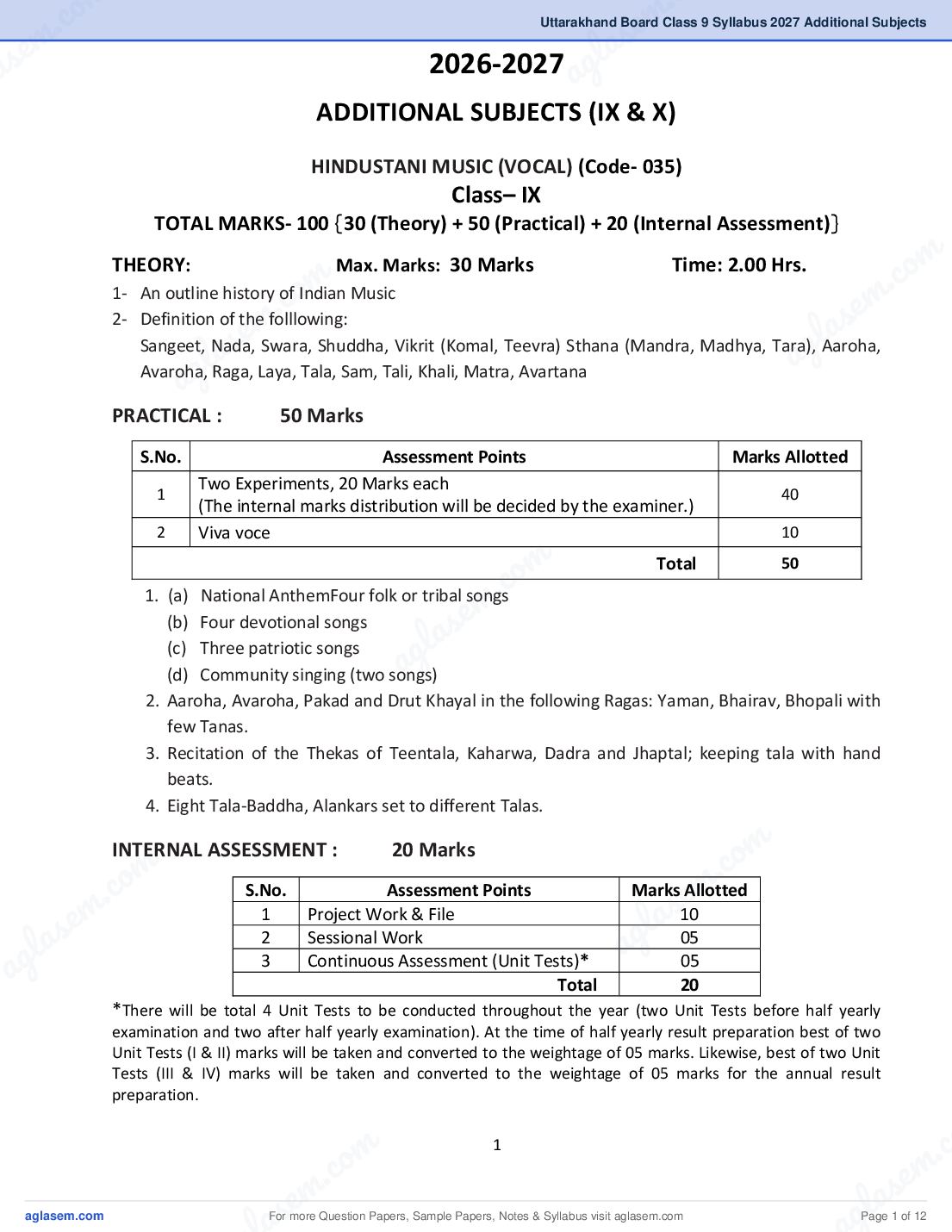
HINDUSTANI MUSIC (VOCAL) (Code- 035)
Class– IX
TOTAL MARKS- 100 ¿ 30 (Theory) + 50 (Practical) + 20 (Internal Assessment)À
THEORY: Max. Marks: 30 Marks o
Time: 2.00 Hrs. m
1- An outline history of o m . c
c em
Indian Music
.
2- Definition of themfolllowing: s
s a
e Swara, Shuddha, Vikrit (Komal, Teevra) Sthana (Mandra, Madhya, Tara),glAaroha,
g a Laya, Tala, Sam, Tali, Khali, Matra, Avartana
Sangeet, Nada,
lRaga, a
a
Avaroha,
PRACTICAL : 50 Marks
S.No. Assessment Points Marks Allotted
Two Experiments, 20 Marks each
1 40
(The internal marks distribution will be decided by the examiner.)
2 Viva voce 10
o m Total 50
. c
m
1. (a) National AnthemFour folk or tribal songs
e
(b) Four devotional songs
l as
(c) Three patriotic songs
ag
(d) Community singing (two songs)
2. Aaroha, Avaroha, Pakad and Drut Khayal in the following Ragas: Yaman, Bhairav, Bhopali with
few Tanas.
3. Recitation of the Thekas of Teentala, Kaharwa, Dadra and Jhaptal; keeping tala with hand
beats.
4. Eight Tala-Baddha, Alankars set to different Talas.
m
.co
INTERNAL ASSESSMENT : 20 Marks
m
m .co S.No. Assessment Points
e m
Marks Allotted
s
s e 1 Project Work & File
g la 10
g la 2 Sessional Work
a 05
a 3 Continuous Assessment (Unit Tests)*
Total
05
20
*There will be total 4 Unit Tests to be conducted throughout the year (two Unit Tests before half yearly
examination and two after half yearly examination). At the time of half yearly result preparation best of two
Unit Tests (I & II) marks will be taken and converted to the weightage of 05 marks. Likewise, best of two Unit
Tests (III & IV) marks will be taken and converted to the weightage of 05 marks for the annual result
preparation.
om
1
. c
. c e m
m as
se
For more Question Papers, Sample Papers, Notes & Syllabus visit
gl
Page 1 of 12
Page 3
HINDUSTANI MUSIC (MELODIC INSTRUMENTS) (036)
Class– IX
TOTAL MARKS- 100 ¿ 30 (Theory) + 50 (Practical) + 20 (Internal Assessment)À
THEORY: Max. Marks: 30 Marks Time: 2.00 Hrs.
1- An outline history of Indian Music
2- Definition of the following:
Sangeet, Nada, Swara, Shuddha, Vikrit (Komal, Teevra) Sthana (Mandra, Madhya, Tara), Aaroha,
Avaroha, Raga, Laya, Tala, Sama, Tali, Khali, Matras, Avartana.
PRACTICAL : 50 Marks
S.No. Assessment Points Marks Allotted
Two Experiments, 20 Marks each
1 40
(The internal marks distribution will be decided by the examiner.)
2 Viva voce 10
Total 50
1. Proficiency in any one of the following instruments :
(i) Sitar (ii) Sarod (iii) Violin (iv) Dilruba or Esraj (v) Flute (vi) Mandolin (vii) Guitar
2. (a) The tune of National Anthem.
(b) Four light Dhuns and four folk dhuns of different regions.
3. Aaroha, Avaroha, Pakad and Drut gat in the following Ragas; Yaman, Bhairav, Bhopali with
few Todas.
4. The recitation of Thekas of Teen Taal, Keharwa, Dadra and Jhaptal, taal keeping with hand
beats.
INTERNAL ASSESSMENT : 20 Marks
S.No. Assessment Points Marks Allotted
1 Project Work & File 10
2 Sessional Work 05
3 Continuous Assessment (Unit Tests)* 05
Total 20
*There will be total 4 Unit Tests to be conducted throughout the year (two Unit Tests before half yearly
examination and two after half yearly examination). At the time of half yearly result preparation best of two
Unit Tests (I & II) marks will be taken and converted to the weightage of 05 marks. Likewise, best of two Unit
Tests (III & IV) marks will be taken and converted to the weightage of 05 marks for the annual result
preparation.
3
For more Question Papers, Sample Papers, Notes & Syllabus visit Page 2 of 12
Page 4
.co s e m
s em g l a
a a
2026-2027
HINDUSTANI MUSIC (PERCUSSION-INSTRUMENTS) (037)
Class– IX
TOTAL MARKS- 100 ¿ 30 (Theory) + 50 (Practical) + 20 (Internal Assessment)À
THEORY: Max. Marks: 30 Marks o
Time: 2.00 Hrs. m
m
o Music . c
1- An outline history ofcIndian
2- Definition of them
. s em
s g l a Tali
eSwara, Shuddha, Vikrit (Komal, Teevra) Raga, Laya, Tala, Matra, Vibhag, Sama,
following:
a Tigun, Chaugun.
Sangeet, Nada,
g lDugun, a
a
Avartana,
PRACTICAL : 50 Marks
S.No. Assessment Points Marks Allotted
Three Experiments, 15 Marks each
1 45
(The internal marks distribution will be decided by the examiner.)
2 Viva voce 05
c om
m.
Total 50
s e
To acquire efficiency in playing on the opted percussion instrument (Tabla or Pakhawaj) with
special reference to accompaniment. g l a
a
1- Ability to recite with hand beats and to play on the instruments the Theka of Teen Taal,
Kaharwa, Dadra, with simple elaborations.
2- Accompaniment with solo performance.
INTERNAL ASSESSMENT : 20 Marks
S.No. Assessment Points Marks Allotted
m
.co
1 Project Work & File 10
m
.co m
2 Sessional Work 05
s e
em
3 Continuous Assessment (Unit Tests)* 05
s Total
g l a 20
g la *There will be total 4 Unit Tests to be conducted throughout the yeara(two Unit Tests before half yearly
a examination and two after half yearly examination). At the time of half yearly result preparation best of two
Unit Tests (I & II) marks will be taken and converted to the weightage of 05 marks. Likewise, best of two Unit
Tests (III & IV) marks will be taken and converted to the weightage of 05 marks for the annual result
preparation.
om
5
. c
. c e m
m as
se
For more Question Papers, Sample Papers, Notes & Syllabus visit
gl
Page 3 of 12
Page 5
PAINTING (041)
Class – IX
TOTAL MARKS- 100 ¿ 30 (Theory) + 50 (Practical) + 20 (Internal Assessment)À
THEORY Max. Marks: 30 Time: 3:00 Hrs.
UNIT- I : Fundamentals of Visual Arts (The Elements) 10 Marks
UNIT-II : Methods and Materials of Painting 10 Marks
Understanding and appropriate use of:
(i) Tools,
(ii) Painting Materials - Poster Colours, Water Colours, Oil Pastels and Pencils.
UNIT-III: Story of Indian Art 10 Marks
A. Appreciation of Indian Art covering selected paintings, sculptures and
architectural glimpses-
a) Paintings:
(i) Ulizard’s Dance (Bhimbethaka)
b) Sculptures:
(i) Yaksha–Yakshi at R.B.I. New Delhi (done by Ramkinker Vaij)
c) Architecture:
(i) Sun Temple (Konark, Odisha)
B. Indian Folk Art- Paintings
(Floor decoration) Alpana, Rangoli and Mandana.
PRACTICAL: Max. Marks: 50 Time: 3:00 Hrs.
Still Life
(a) Accurate drawing with proper composition of objects. 15 Marks
(b) Compositional arrangement with due emphasis on the subject-matter. 15 Marks
(c) Treatment of medium with an appropriate colour scheme in still life. 10 Marks
(d) Originality, creativity and overall expression. 10 Marks
INTERNAL ASSESSMENT : Max. Marks: 20
(i) Portfolio- Portfolio will consist of 10 best works of sketches, still life and painting
compositions done during the year. 15 Marks
(ii) Continuous Assessment (Unit Test) 05 Marks
(There will be total 4 Unit Tests to be conducted throughout the year (two Unit Tests before half
yearly examination and two after half yearly examination). At the time of half yearly result
preparation best of two Unit Tests (I & II) marks will be taken and converted to the weightage of 05
marks. Likewise, best of two Unit Tests (III & IV) marks will be taken and converted to the weightage
of 05 marks for the annual result preparation.)
7
For more Question Papers, Sample Papers, Notes & Syllabus visit Page 4 of 12
Page 6
.co s e m
s em 2026-2027 g l a
a a
ELEMENTS OF BUSINESS (042)
TOTAL MARKS- 100 ¿ 70 (Theory) + 30 (Practical)À
Class – IX
THEORY: Max. Marks- 70 Marks Time: 3:00 Hrs.
I. Introductory : Meaning scope of business 10 Marks
ii. Channels of distribution: Type and functions of wholesaler and retailer 10 Marks
m
co
III Course of Business Transaction: Buying and selling of goods. methods of approaching customer
. c om
enquiries and quotations price list tenders estimates and firm offers general terms of sale quality
e m .
e m
price packing delivery transfer of ownership and payments preparing of invoice Debit note and
l as
s
credit note.
l a 14 Marks
ag
ag
IV. Mercantile Agents: Kinds of agents and their function. Commission agents factor and broker. Del
Credere agents . bought note and sold note preparation of Accounts Sales. 10 Marks
V. Warehousing and storekeeping : Meaning purpose functions and kinds 08 Marks
VI. Transportation of goods: rail road sea and air transport comparative merits 10 Marks
VII. Insurance: General Principles of Insurance Elementary exposure 08 Marks
PRACTICAL: 30 Marks
S.No. Assessment Points Marks Allotted
om
1 One subject-related Project/Chart 20
2 Viva voce
. c 05
3 Continuous Assessment (Unit Tests)
e m 05
l as Total 30
ag Class – X
THEORY: Max. Marks- 70 Marks Time: 3:00 Hrs.
I. Office Routine: Different departments of Business Establishments. Handing in ward and outward
mail. Filing and indexing methods, Copying and duplicating methods. 14 Marks
II. Business correspondence Essential from of good business letter. Writing of simple business
letters of enquiry quotations order reference advice and complaints. 14 Marks
III. Banks Functions of a Bank Kinds of accounts and their operation bank drafts traveler’s cheques.
m
mPost office Saving Bank. 14 Marks
.co
m .co
IV. Negotiable instruments: Nature, Kinds of cheques endorsement, crossing, dishonoring of a
s e m
s e cheque. 14 Marks
g la
g la a
V. Bills of Exchange: Kinds, parties, negotiation, endorsing, dishonoring, Promissory notes and
a Hundies. 14 Marks
PRACTICAL: 30 Marks
S.No. Assessment Points Marks Allotted
1 One subject-related Project/Chart 20
2 Viva voce 05
3 Continuous Assessment (Unit Tests) 05
Total 30
m 9
. c
c. o s e m
s em
For more Question Papers, Sample Papers, Notes & Syllabus visit
gl a
Page 5 of 12
Page 7
ELEMENTS OF BOOK–KEEPING AND ACCOUNTANCY (043)
TOTAL MARKS- 100 ¿ 70 (Theory) + 30 (Project)À
Class – IX
THEORY: 70 Marks Time: 3:00 Hrs.
I. Introduction: Need for Book-keeping objectives and advantages of books-keeping. 08 Marks
II. Basic concepts: Dual aspect of transactions and the accounting equation, Effect of transaction on
Accounting equations, Business entity concept. 09 Marks
III. Nature of Accounts and Rules for debit and credit : classifications of accounts. Rules for debit and
credit, Preparation of vouchers and supporting documents. 09 Marks
IV. Journal: Need for journal; journal entries; subsidiary books. 10 Marks
V. Ledger: Definition and importance; relation between journal and ledger; Meaning of posting,
guiding rules for posting transactions, balancing of accounts. 12 Marks
VI. Recording and posting of cash transactions; Necessity of cash book, types of cash books, petty
cash books and imprest system, journal proper. 10 Marks
VII Trial balance: Purpose, methods and limitations. 12 Marks
PROJECT: 30 Marks
S.No. PROJECT WORK MARKS
Project-I
Prepare a pictorial/verbal dictionary of accounting terms OR
1 Prepare subsidiary books OR 15
Diagrammatic presentation of principles of accounting (OR any other topic
related to the course content)
Project –II
Preparation of a Cash Book of;
2 i. Your pocket money 10
ii. Help your parent to maintain one month cash statement (OR any other topic
related to the course content)
Continuous Assessment (Unit Test)
(There will be total 4 Unit Tests to be conducted throughout the year (two Unit Tests
before half yearly examination and two after half yearly examination). At the time of
3 half yearly result preparation best of two Unit Tests (I & II) marks will be taken and 05
converted to the weightage of 05 marks. Likewise, best of two Unit Tests (III & IV)
marks will be taken and converted to the weightage of 05 marks for the annual result
preparation.)
Total 30
10
For more Question Papers, Sample Papers, Notes & Syllabus visit Page 6 of 12
Page 8
.co s e m
s em 2026-2027 g l a
a a
TYPEWRITING ENGLISH OR HINDI (044)
TOTAL MARKS- 100 ¿ 25 (Theory) + 75 (Practical)À
Class – IX
THEORY: 25 Marks Time: 2:00 Hrs.
Knowledge of Key Board.
Methods and Principles of Typewriting.
m
Touch system of Typewriting.
om . co
c
Knowledge about mechanization of the Typewriter- Its different parts
. e m
m
Maintenance of Typewriter.
e l as
PRACTICAL:l a s ag
g 75 Marks
1- SpeedaTest (15 words per minute)
Time : 1:00 Hrs.
Marks: 30, Time: 10 Minutes
(A simple passage of about 150 words in English or 120 words in Hindi. The same passage to be
repeated if finished before time)
2- Accuracy Test Marks: 40, Time: 40 Minutes
(A simple passage of about 400 words in English or Hindi @ 10 w.p.m.)
3- Continuous Assessment (Unit Test) Marks: 05
Class.c–oX
m
e m
THEORY: 25 Marks
l a s Time: 2:00 Hrs.
ag of letters and tabulation- margin setting, centering,
Functions of important parts of typewriter.
Elementary knowledge about display
headings, Subheadings.
Knowledge of cutting stencils and use of correcting fluid.
Simple proof correction symbols
Standard abbreviations
Speed development exercises.
PRACTICAL: 75 Marks Time : 1:00 Hrs.
m
m
1- Running Matter- A speed and Accuracy Test Marks: 30, Time 10 minutes
.co
m .co e
(A passage of 300 words @ 30 w.p.m. in English and 250 words @ 25 w.p.m. in Hindi. The same
s
m
s e passage to be repeated if finished before time)
g la
g la 2- Tabulation Test
a
Marks: 40, Time 40 minutes
a (A Tabular statements having not more than 3-4 rows columns horizontally and vertically. The
same is applicable for Hindi Typewriting also) OR
Letter Typing Marks: 40, Time 40 minutes
(Typing a simple latter in English or in Hindi of around 200 words)
3- Continuous Assessment (Unit Test) Marks: 05
Note- 10 minutes time is allowed in between for adjustments of typewriters and starting of the
above job (s).
om
12
. c
. c e m
m as
se
For more Question Papers, Sample Papers, Notes & Syllabus visit
gl
Page 7 of 12
Page 9
INFORMATION TECHNOLOGY (046)
TOTAL MARKS- 100 ¿ 50 (Theory) + 50 (Practical)À
Class – IX
THEORY: 50 Marks Time: 2:30 Hrs.
1- IT Basics 15 Marks
2- IT Tools 35 Marks
MS-Windows
MS-Office
MS-Word
MS-Power Point
MS-Excel
Unit 1: IT BASICS
Convergence of Technologies:
Computer System:
Characteristics of a computer, Basic applications of a computer, Components of a computer
system-Central processing Unit (CPU), Visual Display Unit (VDU), Keyboard;
Concept of Memory:
Primary and Secondary Memory, RAM and ROM, Units of Memory-Byte, Kilobyte, Megabyte,
Gigabyte, Terabyte Input/output Devices:
Mouse, Joy Stick, Scanner, Microphone, OCR, MICR, Light pen, Bar code Reader, Digital Camera,
Printer, Speaker, Plotter.
Storage Devices :
Computer languages :
Machine Language, Assembly Language and High level Languages, Role of Assembler and Compiler.
Types of software:
System, utility and Application software with examples
Communication Technology :
Need for networking, LAN, MAN, and WAN
Data Communication Device : Modem,
Introduction to Internet.
Content:
Data, Information and multimedia;
UNIT 2 : IT TOOLS
MS-Windows:
Basic concept of an Operating system and its functions.
Introduction of Windows : Using Mouse and moving icons on the screen, My Computer, Recycle Bin,
Task Bar, Start-menu and menu selection, running an application, Setting system date and time;
Windows Explorer to view files, folders and directories, creating and renaming of files and folder,
Opening and Closing of Windows, Minimize, Restore and Maximize forms of windows, Basic
components of a Window: Desktop, Frame, Title Bar, Menu Bar, Status Bar, Scroll Bars (Horizontal
and Vertical), Using right button of the Mouse, Creating Shortcut, Basic Windows Accessories:
Notepad, Paint, Calculator, WordPad, using Clipboard;
13
For more Question Papers, Sample Papers, Notes & Syllabus visit Page 8 of 12
Page 10
.co s e m
s em l a
ag
MS-OFFICE
a MS Word:
Introduction to a Word Processor, Creating and Saving a document, Editing and Formatting a
Document; Text Style (B, I.U.), Font Type Size, changing color, alignment of text; Formatting
paragraphs with line or paragraph spacing; adding headers and footers numbering pages, using
grammar and spell check utilities, using subscript and superscript, inserting symbols, Print Preview,
printing a document. Inserting Word Art, Clipart and Pictures, Page Setting, Bullets and Numbering,
Borders and Shading, Format Painter, Find and Replace, Inserting Tables: Inserting, deleting-rows and
columns, merging cells, splitting cells, using auto format: Mail Merge
m
MS Power Point:
om
Introduction to Presentation Graphics, Understanding the concept of Slide Shows, Basic elements of . co
. c e m
a slide, Different types of Slide Layouts, Creating and saving a Presentation, Different views of a slide:
em l as
l as
Normal view, Slide Sorter view and Slide Show, Editing and Formatting a slide: Adding Titles,
Subtitles, Text Background, Watermark ; Headers and Footers, Numbering Slides; Inserting pictures ag
ag
from files, Animating pictures and Text with Sound Effects, Timing Text box, Pictures and Slides,
Rehearse Timings, ungrouping and Grouping pictures from Clipart.
MS Excel:
Introduction to Spreadsheets, Concept of Worksheets and workbooks, Creating and Saving a
worksheet, Working with a spreadsheet: entering numbers, text, date/time, series using Auto Fill,
Editing and formatting a worksheet including changing colour, size, font, alignment of text, Inserting
or Deleting cells, rows and columns, Formulae-Entering a formula in a cell, using operators (+, -, *.)
(in formulae, Relative referencing, Absolute referencing and mixed referencing, Printing a worksheet.
m
Use Simple Statistical functions: SUM(), AVERAGE(), MAX(), MIN(), IF(), (without compound
.co
statements); inserting tables in worksheet, Embedding Charts of various types: Line, Pie, Scatter, Bar
m
and Area in a worksheet.
s e
l a
PRACTICAL: 50 Marks
ag Time: 4:00 Hrs.
S. No. PRACTICAL WORK MARKS Examination Duration
Hands on Experience (4 Exercises)
1- Windows operating System 07 Marks 4 Hours
1 2- MS Word 06 Marks 25
3- MS Excel 06 Marks
4- MS PowerPoint 06 Marks
2 IT Application Report File 15 m
m 3 Viva Voce 05 .co
m .co 4 Continuous Assessment (Unit Test) 05
s e m
s e TOTAL 50
g la
g la a
Students are suggested to work on the following areas using MS-Word, MS-PowerPoint and MS Excel
a on topics implementing the tools covered in the course.
Domains :
Documentation: Presentation : Analysis Reporting :
Informal letter School Magazine Cricket Record
Formal letter Environment and Pollution Weather Report
Report Writing Product Advertisement School/Class Result
Greeting card Any topic specific from text book
Poster making (any subject)
om
14
. c
. c e m
m as
se
For more Question Papers, Sample Papers, Notes & Syllabus visit
gl Page 9 of 12
Page 11
Design of a Practical Question Paper
Instructions on the basis of syllabus, distribution of marks and conduction of practical
examination have been provided. The examiner is advised to set the question paper according to the
prescribed curriculum and distribution of marks.
I. Windows Operating System 07 Marks
II. MS Word 06 Marks
III. MS Excel 06 Marks
IV. MS PowerPoint 06 Marks
I. WINDOWS operating system:*
To test some of the following basic system operations on file/folder(s):
Create
Rename
Copy/Cut/Paste
Delete
Commands related to Notepad/WordPad/Paint
Using Clipboard
II. MS Word:*
A Paragraph in MS Word incorporating some of the tools given below to be tested during the
examination -
Editing and Formatting text and paragraph.
Page and Paragraph Setup
Inserting pictures and WordArt
III. MS Power Point:*
A Power Point presentation with 2/3 slides using some of the tools given below to be tested
during the examination:
Editing and formatting slides
Inserting pictures and sounds
Animating pictures and text with sound effects
IV. MS Excel:*
A problem in spreadsheet related to some of the tools given below to be tested during the
examination (Printouts of the documents(s) should be attached with the answer sheet):
Formatting cells and data
Functions & Formulae (Relative, absolute and Mixed reference)
Charts
2. IT Application Report File 15 Marks
Students are supposed to make a IT Application Report File Containing Real life assignments/
presentations using MS Word, MS PowerPoint and MS Excel on at least 15 topics from the
domain:
At least 5 documents of MS Word
At least 5 presentations of MS Power Point
At least 5 spreadsheets of MS Excel with graphs
3. VIVA VOCE 05 Marks
4. Continuous Assessment (Unit Test) 05 Marks
(There will be total 4 Unit Tests to be conducted throughout the year (two Unit Tests before half yearly examination
and two after half yearly examination). At the time of half yearly result preparation best of two Unit Tests (I & II)
marks will be taken and converted to the weightage of 05 marks. Likewise, best of two Unit Tests (III & IV) marks will
be taken and converted to the weightage of 05 marks for the annual result preparation.)
15
For more Question Papers, Sample Papers, Notes & Syllabus visit Page 10 of 12
Page 12
.co s e m
s em 2026-2027 g l a
a a
d`f’k foKku (050)
TOTAL MARKS- 100 ¿ 50 (Theory) + 50 (Practical)À
Class – IX
THEORY: 50 Marks Time: 3:00 Hrs.
bdkbZ 1& tyok;q foKku 10 vad
bdkbZ 2& e`nk;sa 12 vad
m
bdkbZ 3& flapkbZ m
o
,oa ty fudkl 10 vad . co
bdkbZ 4& [kkn.c rFkk moZjd 12 vad e m
m as
lased’kZ.k
bdkbZ 5& 06 vad
ag l
g
bdkbZ 1& atyok;q foKku
d& mRrjk[k.M rFkk Hkkjr esa ekSle vkSj _rq,saA
[k& Qlyksa ij vuqdwy rFkk izfrdwy ekSle dk izHkkoA
x& o’kkZ] mlesa okf’kZd rFkk _rqxr ifjorZuA
?k& o’kkZ ds forj.k dk Qlyksa rFkk d`f’k fØ;kvksa ij izHkkoA
bdkbZ 2& e`nk;sa
d& e`nk fuekZ.k] e`nk laxBu ,oa feV~Bh ds HkkSfrd xq.kA
m
.co
[k& eq[; e`nkvksa dk laf{kIr ifjp;A
m
x& e`nk tSls inkFkZ] izkfIr ds Jksr] Hkwfe esa forj.k ,oa laj{k.kA
e
?k& e`nk vijnu] izdkj ,oa gkfu;kWaA
l as
ag
³& Hkwfe laj{k.k ds lkekU; mik;A
bdkbZ 3& flapkbZ ,oa ty fudkl
d& flpkbaZ] ifjHkk’kk] vko”;drk ,oa egRo] flapkbZ ds JksrA
[k& Qlyksa dh tyekax] izHkkfor djus okys dkjd Eykfu fcUnq
x& e`nk ueh laj{k.k dh vko”;drk ,oa mik;A
?k& ty fudkl] vko”;drk ,oa fof/k;kWaA
³& ikSa/kksa ds fy, ty dk egRoA
p& mRrjk[k.M ds fy, mi;qDr flapkbZ ds lk/ku ,oa fof/k;kWA
m
m
bdkbZ 4& [kkn ,oa moZjd
.co
m .co d& [kkn] egRo ,oa oxhZdj.kA
s e m
s e [k& ikS/kksa dh o`f) ds fy, vko”;d iks’kd rRo ,oa muds izHkkoA
g la
g la x& xkscj dh [kkn] dEiksLV [kkn] oehZ dEiksLV ,oa gjh [kknA
a
a ?k& vtSfod [kkn ¼moZjd½] oxhZdj.k ,oa izdkjA
³& vtSfod [kkn dk Hkwfe ,oa Qlyksa ij izHkko] iz;ksx fof/k;kWa] tSfod ,oa vtSfod [kknksa esa
vUrjA
bdkbZ 5&d’kZ.k
d& Hkw&ifj’dj.k] mn~ns”;] mi;ksfxrk ,oa izdkjA
[k& tqrkbZ fof/k;kWa] Hkwifj’dj.k dh vk/kqfud fopkj/kkjkA
x& mRrjk[k.M esa iz;ksx fd;s tkus okys ;U=&cukoV ,oa dk;ZA
om
19
. c
. c e m
m as
se
For more Question Papers, Sample Papers, Notes & Syllabus visit
gl
Page 11 of 12
Page 13
Ø0la0 Ikz;ksxkRed dk;Z@ewY;kadu fcUnq vad
1 fofHkUUk izdkj dh tSfod ,oa vtSfod [kknksa dh igpku ,oa iz;ksx fof/k 08
2 moZjd feJ.k cukus ds fy;s ifjdyu dh lkekU; tkudkjh 06
3 fofHkUUk izdkj ds d`f"k ;U=ksa dh igpku ,oa lkekU; mi;ksx 06
ekSleh [kjirokj] moZjdksa] Qly lqj{kk lEcU/kh jlk;uksa] e`nk lq/kkjdksa dh igpku
4 10
,oa iz;ksx
5 Nk=ksa }kjk o"kZHkj ds izk;ksfxd dk;ksZa dk vfHkys[k rS;kj djuk ¼fjdkMZ Qkby½ 10
6 ekSf[kd ijh{kk 05
7 lrr ewY;kadu ¼bdkbZ ijh{kk½* 05
dqy ;ksx 50
*l= esa dqy 04 bdkbZ ijh{kk;sa gksaxh ¼02 bdkbZ ijh{kk;sa v)Zokf’kZd ijh{kk ls iwoZ rFkk 02 v)Zokf’kZd ijh{kk ds mijkUr½A v)Zokf’kZd
ijh{kk ds ijh{kkQy fuekZ.k gsrq izFke nks bdkbZ ijh{kkvksa ¼izFke o f}rh;½ esa ls vf/kd izkIrkad okyh bdkbZ ijh{kk ds vad fy;s
tk;saxs rFkk bu vadksa dks 05 ds Hkkjkad esa ifjofrZr fd;k tk;sxkA blh izdkj okf’kZd ijh{kk ds ijh{kkQy fuekZ.k gsrq vfUre nks
bdkbZ ijh{kkvksa ¼r`rh; o prqFkZ½ esa ls vf/kd izkIrkad okyh bdkbZ ijh{kk ds vad ysdj bu vadksa dks 05 ds Hkkjkad esa ifjofrZr fd;k
tk;sxkA
2026-2027
d`f’k foKku (050)
TOTAL MARKS- 100 ¿ 50 (Theory) + 50 (Practical)À
Class – X
THEORY: 50 Marks Time: 3:00 Hrs.
bdkbZ 1& Qly pØ ,oa [ksrh ds çdkj 05 vad
bdkbZ 2& QlyksRiknu 12 vad
bdkbZ 3& ckxokuh 05 vad
bdkbZ 4& QyksRiknu 08 vad
bdkbZ 5& iq’iksRiknu 08 vad
bdkbZ 6& i”kqikyu ,oa nqX/kksRiknu 12 vad
bdkbZ 1& Qly pdz ,oa [ksrh ds izdkj
d& Qlyksa dk oxhZdj.kA
[k& Qly pØA
x& “kq’d [ksrhA
?k& fn;kjk [ksrhA
M-& fefJr [ksrh ,oa cgqQlyh [ksrhA
20
For more Question Papers, Sample Papers, Notes & Syllabus visit Page 12 of 12
Document Details
| Board / Org | Uttarakhand Board |
| Exam | Class 9 |
| Type | Syllabus |
| Pages | 12 |
| Updated | 04 Nov 2026 |