AILET 2023 Question Paper Ph.D
Finished viewing? Save it for later —
Download AILET 2023 Question Paper Ph.D (PDF · 16 pages)About AILET 2023 Question Paper Ph.D
AILET 2023 Question Paper Ph.D is available here for free download. Published by NLUs for All India Law Entrance Test, this question paper can be viewed online or downloaded as a PDF (16 pages). Candidates preparing for All India Law Entrance Test can use AILET 2023 Question Paper Ph.D to understand the exam pattern, the type of questions asked, and the overall difficulty level.
Frequently Asked Questions
How can I download AILET 2023 Question Paper Ph.D?
Open this page and click the Download button to save AILET 2023 Question Paper Ph.D as a PDF. It is completely free on AglaSem Docs.
Is AILET 2023 Question Paper Ph.D free to download?
Yes. AILET 2023 Question Paper Ph.D can be viewed online and downloaded as a PDF free of cost on AglaSem Docs.
How many pages does AILET 2023 Question Paper Ph.D have?
AILET 2023 Question Paper Ph.D contains 16 pages, which you can read online or download together as a single PDF.
Where can I find more All India Law Entrance Test study material?
You can find more All India Law Entrance Test question papers, sample papers, syllabus, and answer keys on AglaSem Docs.
AILET 2023 Question Paper Ph.D – Text
Read the full text of this question paper below — useful to quickly search, copy and reference the content online without downloading the PDF.
📄 View text version (16 pages)
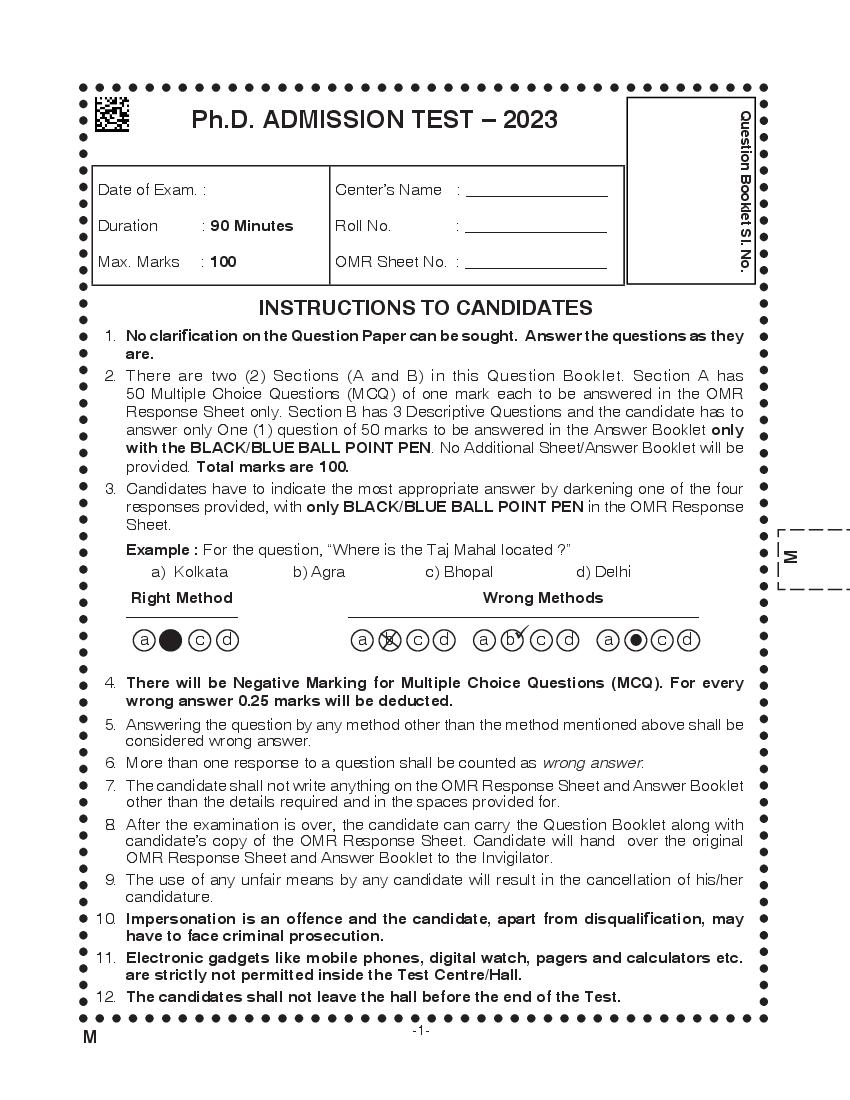
Page 1
Question Booklet Sl. No.
Date of Exam. : Center’s Name : ________________
Duration : 90 Minutes Roll No. : ________________
Max. Marks : 100 OMR Sheet No. : ________________
INSTRUCTIONS TO CANDIDATES
1. No clarification on the Question paper can be sought. Answer the questions as they
are.
2. There are two (2) Sections (A and B) in this Question Booklet. Section A has
50 Multiple Choice Questions (MCQ) of one mark each to be answered in the OMR
Response Sheet only. Section B has 3 Descriptive Questions and the candidate has to
answer only One (1) question of 50 marks to be answered in the Answer Booklet only
with the BLACK/BLUE BALL POINT PEN. No Additional Sheet/Answer Booklet will be
provided. Total marks are 100.
3. Candidates have to indicate the most appropriate answer by darkening one of the four
responses provided, with only BLACK/BLUE BALL POINT PEN in the OMR Response
sheet.
Example : For the question, “Where is the Taj Mahal located ?”
M
a) Kolkata b) Agra c) Bhopal d) Delhi
Right Method Wrong Methods
——————— ——————————————————————
a b c d a b c d a b c d a b c d
4. There will be Negative Marking for Multiple Choice Questions (MCQ). For every
wrong answer 0.25 marks will be deducted.
5. Answering the question by any method other than the method mentioned above shall be
considered wrong answer.
6. More than one response to a question shall be counted as wrong answer.
7. The candidate shall not write anything on the OMR Response Sheet and Answer Booklet
other than the details required and in the spaces provided for.
8. After the examination is over, the candidate can carry the Question Booklet along with
candidate’s copy of the OMR Response Sheet. Candidate will hand over the original
OMR Response Sheet and Answer Booklet to the invigilator.
9. The use of any unfair means by any candidate will result in the cancellation of his/her
candidature.
10. Impersonation is an offence and the candidate, apart from disqualification, may
have to face criminal prosecution.
11. Electronic gadgets like mobile phones, digital watch, pagers and calculators etc.
are strictly not permitted inside the Test Centre/Hall.
12. The candidates shall not leave the hall before the end of the Test.
-1-
M
Page 2
i te
W r
Not
Do
M -2-
Page 3
Multiple Choice Questions: 50 questions of 1 mark each.
1. Which of the following condition must be satisfied for invoking Section 210 of the
Code of Criminal Procedure, 1973, in a case?
a) There must be a complaint pending for inquiry or trial
b) Investigation by the police must be in progress
c) Both a) and b) are correct
d) None of the above
Assertion (A) : The rule making power of the Supreme Court is not subject to any law
2.
made by the Parliament of India.
Reason (R) : Only an impartial and independent judiciary can protect the right of the
individual without fear or favour.
a) (A) is true but (R) is false. b) Both (A) and (R) are true.
c) Both (A) and (R) are false. d) (A) is false but (R) is true.
3. Roscoe Pound’s theory identifies the proper goal of a legal system as the satisfaction
of demands, desires, and claims. The demands, desires, and claims are called as
a) Interests b) Rights
c) Duties d) None of the above
4. Which of the following is not correct regarding a person arrested with or without warrant
by a police officer or under a warrant by a private person?
a) Search can be made only by the police officer arresting him
b) Search may be made by the private person arresting him
c) Private person can neither arrest nor search any person
d) Private person can arrest and search any person
5. “What cannot be done directly, cannot be done indirectly”– this statement epitomises
the doctrine of
a) Colourable legislation b) Pith and substance
c) Harmonious construction d) Doctrine of Eclipse
-3- M
Page 4
of the second-class, power to try summarily any offence.” Which of the following is not
correct regarding the powers of such Magistrate to try summarily an offence ?
a) Can try offences punishable only with fine
b) Can try offences punishable with imprisonment for a term not exceeding six months
with fine
c) Can try offences punishable with imprisonment for a term not exceeding six months
without fine
d) Cannot pass a sentence of less than six months
7. When a person is accused of committing more than one offence of the same kind,
either against the same person or not, he may be charged with and tried at one trial if
the said offences were committed within the space of
a) Six months b) Eight months
c) Ten months d) Twelve months
8. The Supreme Court in which of the following case held that “though the right to
pursue higher education has not been spelt out as a fundamental right under
Part III of the Constitution, it bears emphasis that access to professional education is
not a governmental largesse, and that the State has an affirmative obligation to facilitate
access to education at all levels.”
a) Seema Kumari v. Union of India, (2014)
b) Dr. Jaishri Laxmanrao Patil v. The Chief Minister, (2021)
c) Jayamma v. State of Karnataka, (2021)
d) Farzana Batool v. Union of India, (2021)
9. In which case, it was held by the Supreme Court that an anticipatory bail cannot be
limited or restricted to a fixed period ?
a) Siddharam Satlingappa Mhetre v. State of Maharashtra, (2011)
b) Abdulsamad Shaikh v. State of Maharashtra, (1996)
c) Sushila Agarwal v. State of NCT of Delhi, (2020)
d) P. Chidambaram v. Directorate of Enforcement, (2019)
10. ‘Z’ attempts to horsewhip ‘A’, not in such a manner as to cause grievous hurt to ‘A’.
‘A’ draws out a pistol but ‘Z’ continues the assault. ‘A’ believing in good faith that he
can not save himself by any other means, shoots ‘Z’ dead. ‘A’ is liable for
a) Murder
b) Culpable homicide not amounting murder under exception 2 of section 300
c) Culpable homicide not amounting murder under exception 1 of section 300
d) Not liable since the act was done in exercise of right of private defence
M -4-
Page 5
a) Both require mens rea as an element
b) Both do not require mens rea as an element
c) Only waging of war requires mens rea as an element
d) Only Sedition requires mens rea as an element
12. ‘Morals are more dynamic, more revolutionary, more mobile, more directed towards
the future ... than is the law. The latter is more attached to traditional practices than
to acts of innovation, more dependent on intellectual representations and the balance
of forces than is morality. Yet, ..., there have been cases where “an advanced law”
has overcome current morality so that law has become a factor in moral change.’ This
exception happens in which of the following circumstance ?
a) Modernity b) Attainment of age of scientific temper
c) Revolutions d) None of the above
13. Right of private defence against the act of Public Servant is available if
a) The act does not cause reasonable apprehension of grievous hurt
b) The public servant is acting in good faith under colour of his office
c) The act of public servant is not strictly justifiable by law though done in good faith
d) The person does not know or has reason to believe that the act is being done by a
public servant
14. To fix the liability on the basis of ‘Common Object’, which condition is not required to
be satisfied ?
a) Prior concert or meeting of minds
b) Offence was committed in prosecution of the common object of the assembly
c) Members of the assembly knew that there is a likelihood of its commission
d) Membership of that assembly at the time of commission of that offence
15. “... From a critical legal studies point of view, there is no ‘rule of law’ in the singular.
Rather, there are versions of the rule of law, each serving different ideological goals –
a ‘rule of law with liberal characteristics,’ a ‘rule of law with Chinese characteristics,’
and so on through one’s preferred list of ideological projects.” Such an argument stems
from which of core positions of CLS ?
a) Indeterminacy thesis b) Non neutrality of law
c) Law as an institution of subordination d) None of the above
-5- M
Page 6
a) Independent thought v. Union of India (2018)
b) Navtej Singh Johar v. Union of India (2018)
c) Bharwada Bhogin Bhai Hirji Bhai v. State of Gujarat (1983)
d) Rao Harnarayan v. State (1958)
17. What was the principle laid down by the Supreme Court in A. K. Kriaipak v. Union of
India (1969) ?
a) Rule of Law is embedded in Article 14 of the Constitution of India.
b) Judicial Review is a part of basic structure of the Constitution.
c) Principles of Natural Justice are applicable to administrative proceedings.
d) Post decisional hearing would be sufficient for the observance of principles of natural
justice.
18. A boy of 17 years marries a girl of 15 years. Under Hindu Marriage Act, 1955 the
marriage is
a) Void b) Voidable at the option of either party
c) Valid but punishable d) Void-ab-initio
19. In which of the following cases, a child could not be a ‘Hindu’ under the Hindu Marriage
Act, 1955 ?
I. Only one parent is a Hindu and the child was brought up as a Hindu.
II. If after the birth of a child, both the parents convert to Buddhism.
III. Only one parent is a Jain and the child was not brought up as a Jain.
IV. If after the birth of a child both the parents convert to Muslim religion and in the
exercise of parental right the child is also converted to Muslim religion.
Codes :
a) I, II and IV b) III and IV c) II and I d) I, II and III
20. Which of the following is not an exception to the principles of natural justice ?
a) Impracticability b) Legislative action
c) Rule against dictation d) Statutory necessity
M -6-
Page 7
number.” In this context which of the following statement is incorrect ?
i. An act can increase happiness for the greatest number of people but still fail to
maximize the net good in the world if the smaller number of people whose happiness
is not increased much more than the greater number gains.
ii. The principle of utility would allow sacrifices of the smaller number to the greater
number.
a) Statement i is correct b) Statement ii is correct
c) Both statements are correct d) Both statements are wrong
22. Coparcenary property of a Hindu :
a) Devolves by succession b) Devolves by survivorship
c) Can be partitioned d) Cannot be partitioned
23. A prompt dower is payable :
a) at the time of marriage itself
b) on a fixed date
c) when demanded by the wife
d) partly at the time of marriage and partly at fixed date
24. Which of the following statement/statements is/are correct ?
A. Fundamental Rights are not absolute. They are subject to reasonable
restrictions.
B. Freedom of press is implicit in Article 19 of the Constitution.
C. Socially and Economically backward classes of persons are entitled to get benefit
under clause (4) of the Article 15 of the Constitution.
D. ‘Equal Protection of laws’ under Article 14 of the Constitution is based upon English
Law.
Codes :
a) Only A and B are correct b) A,B and C are correct
c) C and D are correct d) A,B,C and D all are correct
25. Identify from below given options the most rational choices parties in the original position
will choose according to Rawls.
a) Utility for oneself as it may serves ones benefit
b) Utility for the majority as the probability of one to fall in the majority is more
c) Equal basic rights and liberties needed to secure the fundamental interests of free
and equal citizens
d) The veil of ignorance to ensure impartiality of judgment
-7- M
Page 8
a) It does not confer any title or interest on the transferee in the property in his
possession.
b) The transferor or anyone claiming under him will be able to evict the transferee
from the property.
c) Section is silent on nature of transferee’s rights.
d) Right of the transferee regarding the property in possession are non-existent.
27. A transfers some money to B on the condition that he shall marry with the consent of
C, D and E. E dies and B marries with the consent of C and D. Has B fulfilled the
condition ?
a) There was no condition
b) Condition ended by the death of E
c) No, B has not fulfilled the condition
d) Yes, B has fulfilled the condition as the condition precedent was substantially
complied with
28. Mortgage by deposit of title deeds requires the following :
a) A debt
b) Deposit of title deeds
c) Debt to be secured by deposit of title deeds
d) All the above
29. Identify from the following statements, the correct scope of an unjust law according to
Finnis in the context of the following adapted argument of Finnis. ‘The focal meaning is
of an authoritative common ordering of a community, aimed at facilitating the realisation
of the common good.’
i. Much of the unjust law will not be law in its focal sense
ii. Unjust law will at best be an imperfect or fringe instance of law in its focal
meaning
iii. At worst unjust law will be a mere corruption of law in that focal sense
a) Only i and ii b) Only ii
c) Only i and iii d) All the statements are correct
M -8-
Page 9
of a legal system ?
i. Efficacy
ii. Institutional character
iii. Sources
a) All the three b) None of the three
c) Only i d) Only i and ii
31. Following is not the difference between the lease and the agreement to lease :
a) A lease creates a right in rem, agreement does not
b) A lease operates as a transfer, agreement does not
c) A lease establishes the relationship of landlord and tenant, agreement does not
d) None of the above
32. Which types of cases cannot be dealt with by the Lok Adalat ?
a) Matrimonial matters b) Compoundable offences
c) Non-compoundable offences d) Motor Accident claims
33. UN Convention on International Settlement Agreements Resulting from Mediation
(Singapore Convention) shall apply when :
i. there exists a mediated written agreement between parties;
ii. at least two parties to the settlement agreement have their places of business in
different States;
iii. settlement agreements concluded to resolve a dispute arising from transactions
engaged in by one of the parties (a consumer) for personal, family or household
purposes;
iv. the State in which the parties to the settlement agreement have their places of
business is different from either the State in which a substantial part of the obligations
under the settlement agreement is performed; or the State with which the subject
matter of the settlement agreement is most closely connected;
Select the correct combination
a) i, ii, iv b) i, iii, iv c) ii, iii, iv d) i, ii, iii
-9- M
Page 10
a) The successor state replaces the predecessor state in the latter’s international
obligations
b) Obligatory norms of international law must faithfully be adhered to
c) Prompt and adequate compensation must be paid for states for harm caused by its
acts or omission
d) Agreements must be carried out in good faith
35. Identify to which of the legal theories the following statements can be most appropriately
alluded to.
“One of the main functions of law is obscure power relationships. Thus, the legal form
will refer to the right to freely enter into contracts but in the absence of equality of
bargaining power, this freedom is illusory.”
a) Critical legal studies b) Critical race theory
c) Marxian legal thought d) Social contract theory
36. State responsibility under international law requires the following to be fulfilled :
i. There exists an international legal obligation in force as between two particular
States
ii. There has occurred an act or omission which violates that obligation and which is
imputable to the State responsible
iii. Loss or damage has resulted from the unlawful act or omission
Choose the correct option
a) All three b) Only i and ii c) Only ii and iii d) None of them
37. The following is not true about the Board of directors of a company :
a) Board may contribute to bona fide charitable and other funds
b) Board may contribute any amount for the political contributions
c) Board may contribute any amount for the national defence fund
d) None of the above
M -10-
Page 11
activities of society. If so, which of the following statements would be correct.
i. There is a living law underlying the formal rules of legal system and the task of the
judge is to integrate both
ii. In heterogenous and pluralistic societies there will invariably be more than one living
law
a) Only i is correct b) Both i and ii are correct
c) Only ii is correct d) Neither is correct
39. The following statements are related to s. 56 of the Contract Act, 1872 :
a) contracting parties must not be in default
b) impossibility may be in law or in fact
c) s. 56 does not leave the matter to the discretion of the court
d) all the above
40. Period of fifteen days of police custody should be counted from
a) Day of arrest
b) First day of production before Magistrate
c) From any day requested by the police during 60/90 days of custody limit under
section 167
d) None of the above
41. While referring to natural rights, one of the jurist referred to them as “simple nonsense,”
with “natural and imprescriptible rights, rhetorical nonsense – nonsense upon stilts”.
Who among the following is that jurist ?
a) Bentham b) Austin
c) Hart d) None of the above
-11- M
Page 12
a) Any person guilty of fraud of an amount of at least 10 lakhs or one percent of the
turnover of a company, whichever is lower, will be liable under s. 447 of Companies
Act, 2013.
b) Serious fraud investigation office investigates frauds relating to partnerships.
c) Chief financial officer does not fall under the category of whole time key managerial
personnel.
d) All the above are true.
43. ‘Doctrine of Cyprus’ is related with
a) Marriage b) Mehar c) Waqf d) Hiba
44. Revocation of a proposal may not be made by the following :
a) by communication of notice of revocation
b) by lapse of time
c) by death or insanity of the proposer
d) by failure of proposer to fulfil a condition precedent
45. The provisions of the IBC, 2016 are applicable to:
a) any company incorporated under the Companies Act, 2013 or under any previous
company law and any other company governed by any special Act for the time being
in force, except in so far as the said provisions are inconsistent with the provisions
of such special Act
b) any Limited Liability Partnership incorporated under the Limited Liability Partnership
Act, 2008
c) partnership firms and individuals
d) all the above
M -12-
Page 13
a) suit for damages b) injunction restraining publication
c) consent d) a) and b) are correct
47. The Consumer Protection Act, 2019 provides for the following :
a) product and product liability b) deficiency in service
c) e-commerce d) all the above
48. Following is true about relationship of partnership :
a) it arises from contract and not by status
b) members of HUF carrying on business are partners
c) it arises from status and not by contract
d) none of the above
49. Acknowledgement of a debt by a principal debtor binds the guarantor in all respects if
he had given an express consent :
a) The above statement is true
b) The above statement is not true
c) A debt cannot be acknowledged by a principal debtor
d) None of the above
50. “It cannot be concluded from the mere fact of the control exercised by a State over its
territory and waters that state necessarily knew, or ought to have known, of any unlawful
act perpetrated therein, nor yet that it necessarily knew, or should have known, the
authors. The fact, by itself and apart from other circumstances, neither involves prima
facie responsibility nor shift the burden of proof.” The above endorsement of fault theory
of state responsibility was delivered by the ICJ in which of the following cases ?
a) LFH Neer and Pauline Neer v. United Mexican States (1926)
b) Nicaragua v. United States, (1984)
c) United Kingdom v. Albania, (1949)
d) Hungary v. Slovakia, (1997)
-13- M
Page 14
Attempt any one question. The question carries 50 marks.
1. Drones are Unmanned Aerial Vehicles (UAVs) that are controlled either by a pilot on
the ground or with the help of technology. The drones, which were earlier used only
for applications such as surveillance, emergency response, geo-spatial mapping etc.,
are fast emerging as serious participants in the commercial delivery market.
In India, Ministry of Civil Aviation has notified The Drone Rules in August 2021. Later,
in October 2021, ICMR-led pilot project used drones for delivering COVID vaccines to
remote locations in the northeast. However, commercial use of drones for e-commerce
deliveries has not really picked up in the past one year. It points to hesitancy of
stakeholders in deployment of drones.
You have been assigned the task of conducting an exploratory study to understand
and address the issues and concerns of e-commerce vendors, regulatory authorities,
and consumers. Suggest a suitable research design, data collection and analysis plan
for your study.
2. Unified Payments Interface (UPI) is a system that powers multiple bank accounts into a
single mobile application merging several banking features, seamless fund transfers and
merchant payments under one umbrella. It also supports Peer-to-Peer collect requests
which can be easily scheduled and paid as required. After a slow start in April 2016,
UPI has gained wide acceptance over the years, and in India we clocked more than
7.3 billion UPI transactions with a value of over Rs. 12.11 lakh crores for the month of
October 2022.
You are required to present a comprehensive research plan to identify the factors that
have contributed to the spectacular success of UPI in India. Your plan must include
a detailed examination of the role of financial regulations and demographics of our
country.
3. An apparel factory caught fire during the evening in which 12 people perished. An
enquiry was set under the chairmanship of a retired judge to find reasons of the fire
and identification of the people who would be directly or indirectly responsible for the
mishap. Propose a research design to find the causes of the fire and the guilty people
for punishment according to law.
M -14-
Page 15
-15- M
Page 16
M -16-
Document Details
| Board / Org | NLUs |
| Exam | All India Law Entrance Test |
| Type | Question Paper |
| Pages | 16 |
| Updated | 22 Jul 2026 |