PSEB 11th Class Syllabus 2023 Environment Education
Finished viewing? Save it for later —
Download PSEB 11th Class Syllabus 2023 Environment Education (PDF · 3 pages)About PSEB 11th Class Syllabus 2023 Environment Education
PSEB 11th Class Syllabus 2023 Environment Education is available here for free download. Published by Punjab Board for Class 11, this syllabus can be viewed online or downloaded as a PDF (3 pages). Candidates preparing for Class 11 can use PSEB 11th Class Syllabus 2023 Environment Education to understand the exam pattern, the type of questions asked, and the overall difficulty level.
Frequently Asked Questions
How can I download PSEB 11th Class Syllabus 2023 Environment Education?
Open this page and click the Download button to save PSEB 11th Class Syllabus 2023 Environment Education as a PDF. It is completely free on AglaSem Docs.
Is PSEB 11th Class Syllabus 2023 Environment Education free to download?
Yes. PSEB 11th Class Syllabus 2023 Environment Education can be viewed online and downloaded as a PDF free of cost on AglaSem Docs.
How many pages does PSEB 11th Class Syllabus 2023 Environment Education have?
PSEB 11th Class Syllabus 2023 Environment Education contains 3 pages, which you can read online or download together as a single PDF.
Where can I find more Class 11 study material?
You can find more Class 11 question papers, sample papers, syllabus, and answer keys on AglaSem Docs.
PSEB 11th Class Syllabus 2023 Environment Education – Text
Read the full text of this syllabus below — useful to quickly search, copy and reference the content online without downloading the PDF.
📄 View text version (3 pages)
Page 1
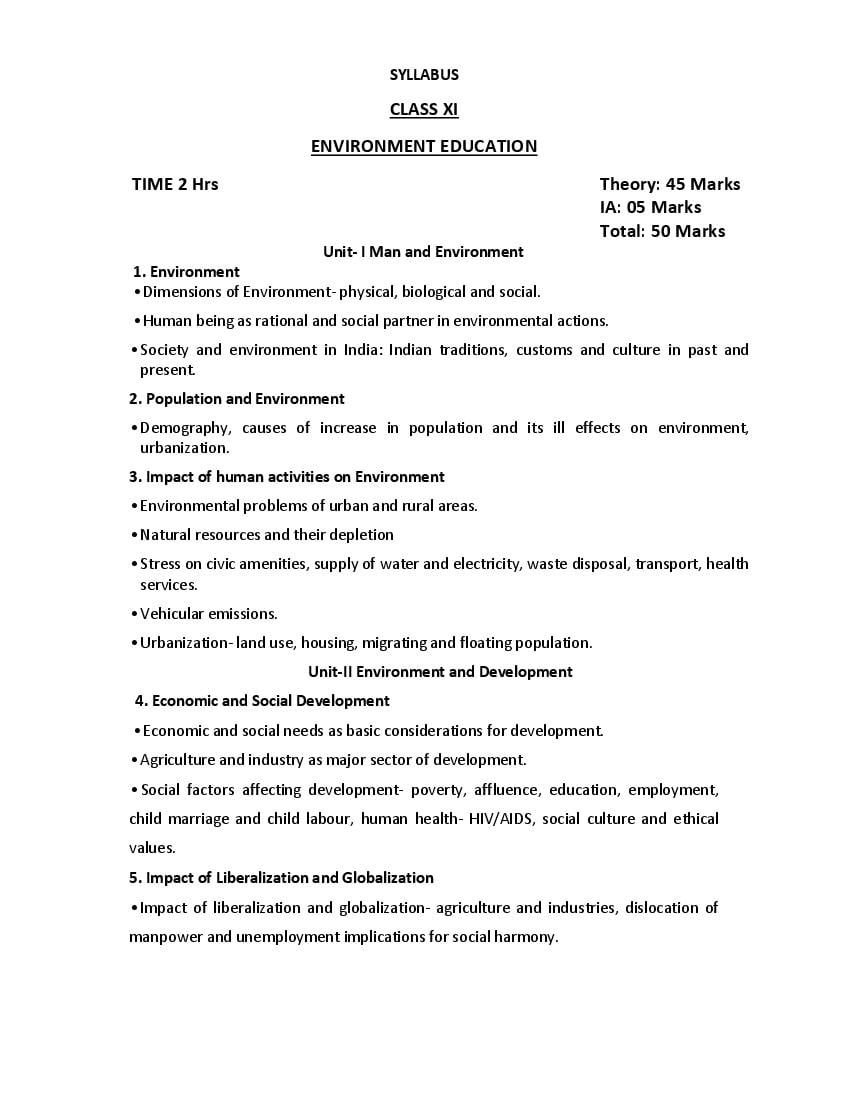
CLASS XI
ENVIRONMENT EDUCATION
TIME 2 Hrs Theory: 45 Marks
IA: 05 Marks
Total: 50 Marks
Unit- I Man and Environment
1. Environment
• Dimensions of Environment- physical, biological and social.
• Human being as rational and social partner in environmental actions.
• Society and environment in India: Indian traditions, customs and culture in past and
present.
2. Population and Environment
• Demography, causes of increase in population and its ill effects on environment,
urbanization.
3. Impact of human activities on Environment
• Environmental problems of urban and rural areas.
• Natural resources and their depletion
• Stress on civic amenities, supply of water and electricity, waste disposal, transport, health
services.
• Vehicular emissions.
• Urbanization- land use, housing, migrating and floating population.
Unit-II Environment and Development
4. Economic and Social Development
• Economic and social needs as basic considerations for development.
• Agriculture and industry as major sector of development.
• Social factors affecting development- poverty, affluence, education, employment,
child marriage and child labour, human health- HIV/AIDS, social culture and ethical
values.
5. Impact of Liberalization and Globalization
• Impact of liberalization and globalization- agriculture and industries, dislocation of
manpower and unemployment implications for social harmony.
Page 2
• Role of society in development and environment- public awareness through
education, eco- clubs, population education programmes and campaigns, public
participation in decision making.
Unit-III Environmental Pollution and Global Issues
7. Environmental Pollution
• Air water (fresh and marine), soil pollution- sources and consequences.
• Noise and radiation pollution- sources and consequences.
• Solid, liquid and gaseous pollution.
8. Pollution and Diseases
• Handling of hazardous material, process and management of hazardous wastes.
• Pollution related diseases.
• Strategies for reducing pollution and improving the environment.
9. Global Issues and Improvement of Environment
• Ozone Layer depletion and its effects.
• Greenhouse effect, global warming, climate changes and their effects on human
society, agriculture plants and animals.
10. Disaster
• Disaster- natural (earthquakes, droughts, floods, cyclones, landslides) and man
made (technological and industrial), their impact on the environment, prevention,
control and mitigation.
Unit- IV Energy
11. Energy Consumption
• Changing global pattern of energy consumption -from ancient to modern times.
• Energy consumption as a measure of quality of life.
• Rising demand for energy gap between demand and supply (Indian context.)
12. Conventional Sources of Energy
• Conventional energy sources- fossil and firewood, potential (India context) and
limitations of each source, methods of harnessing energy and environment
consequences of their use.
13. Non- conventional Source of Energy
Page 3
wind, ocean, hydel, geothermal, nuclear),potential( Indian context) and limitations of
each source, methods of harnessing and their environmental consequences, need to
promote non- conventional energy sources.
• 14. Conservation of Energy
• Conservation of energy sources- efficiency in production, transportation and utilization of
energy.
• Future sources of energy- hydrogen, alcohol, fuel cells.
Unit V Safe work Environment and Occupational
Hazards 15. Safe Work Environment
• Safe work environment- adequate light, ventilation, cleanliness, good housekeeping.
16. Safety Laws, Accidents and First- Aid
• Safety awareness management- safety precautions- home and work (laboratory,
workshop, work site), safe handling of equipment and material.
• Occupational hazards- physical, chemical, mechanical, electrical, biological,
radiational and psychological.
• Accidents and major hazards in industries and occupations- fire, explosion, toxic release.
• First aid measures.
• Laws and regulations related to occupational health and safety.
17*. Drugs- ill Effects Part-I
• Importance of health, Drug-addiction, symptoms (Material upload on website)
• Drugs of abuse and their health consequences, academic and occupational
consequences, consequences for family, social, legal and criminal consequences.
• Prevention of Drug, Government initiatives, the narcotic drug and psychotropic
substances act-1985, offences and penalties.
* Chapter 17 is added in the syllabus as a compulsory topic, Matter is available on the
Board’s website www.pseb.ac.in.