Goa Board Class 11 Sample Paper 2026 Co-operation
Finished viewing? Save it for later —
Download Goa Board Class 11 Sample Paper 2026 Co-operation (PDF · 18 pages)About Goa Board Class 11 Sample Paper 2026 Co-operation
Goa Board Class 11 Sample Paper 2026 Co-operation is available here for free download. Published by Goa Board for Class 11, this sample paper can be viewed online or downloaded as a PDF (18 pages). Candidates preparing for Class 11 can use Goa Board Class 11 Sample Paper 2026 Co-operation to understand the exam pattern, the type of questions asked, and the overall difficulty level.
Frequently Asked Questions
How can I download Goa Board Class 11 Sample Paper 2026 Co-operation?
Open this page and click the Download button to save Goa Board Class 11 Sample Paper 2026 Co-operation as a PDF. It is completely free on AglaSem Docs.
Is Goa Board Class 11 Sample Paper 2026 Co-operation free to download?
Yes. Goa Board Class 11 Sample Paper 2026 Co-operation can be viewed online and downloaded as a PDF free of cost on AglaSem Docs.
How many pages does Goa Board Class 11 Sample Paper 2026 Co-operation have?
Goa Board Class 11 Sample Paper 2026 Co-operation contains 18 pages, which you can read online or download together as a single PDF.
Where can I find more Class 11 study material?
You can find more Class 11 question papers, sample papers, syllabus, and answer keys on AglaSem Docs.
Goa Board Class 11 Sample Paper 2026 Co-operation – Text
Read the full text of this sample paper below — useful to quickly search, copy and reference the content online without downloading the PDF.
📄 View text version (18 pages)
Page 1
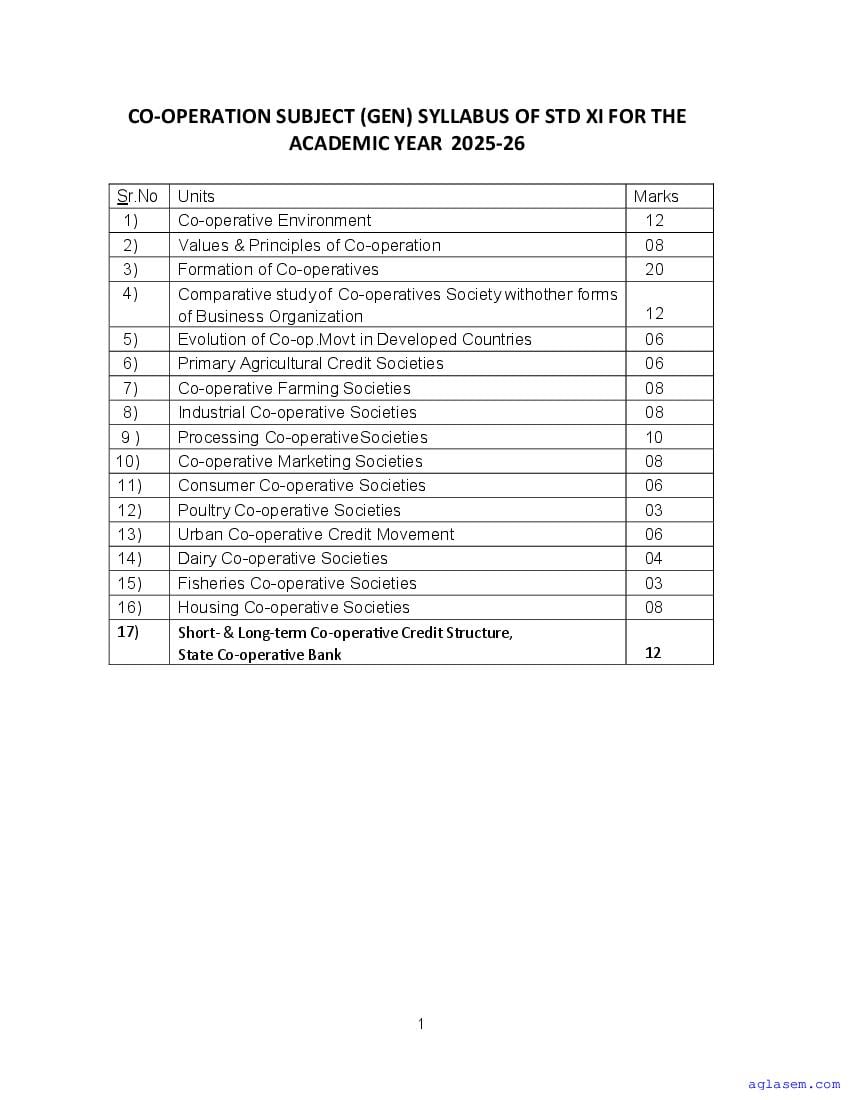
ACADEMIC YEAR 2025-26
Sr.No Units Marks
1) Co-operative Environment 12
2) Values & Principles of Co-operation 08
3) Formation of Co-operatives 20
4) Comparative study of Co-operatives Society withother forms
of Business Organization 12
5) Evolution of Co-op.Movt in Developed Countries 06
6) Primary Agricultural Credit Societies 06
7) Co-operative Farming Societies 08
8) Industrial Co-operative Societies 08
9) Processing Co-operative Societies 10
10) Co-operative Marketing Societies 08
11) Consumer Co-operative Societies 06
12) Poultry Co-operative Societies 03
13) Urban Co-operative Credit Movement 06
14) Dairy Co-operative Societies 04
15) Fisheries Co-operative Societies 03
16) Housing Co-operative Societies 08
17) Short- & Long-term Co-operative Credit Structure,
State Co-operative Bank 12
1
Page 2
WEIGHTAGE TO CONTENT AREAS FOR THE ACADEMIC YEAR 2025-26
Sr.No. Units Marks
1) Co-operative Environment 12
2) Values & Principles of Co-operation 08
Total Marks 20
MID TERM EXAM / FIRST INTERNAL EXAM FOR STANDARD XI
QUESTIONWISE DISTRIBUTION OF MARKS FOR THE ACEDEMIC YEAR 2025-26
SR. CONTENT AREA. V.S.A S.A S.A L.A TOTAL
NO MCQ) I II MARKS
1. Co-operative Environment 1(4) 2(2) 4(1)* 12
2. Values and Principles of Co-operation 1(1) 2(2) 3(1) 08
TOTAL MARKS 5(5) 8(4) 3(1) 4(1) 20
NOTE:
1. (*) indicates internal choice in the questions.
2. Figures inside the brackets indicate no. of questions
3. Figures outside the bracket indicate no. of marks
4. The above blueprint is a sample and the original may differ, keeping in the content area
and marks same by the paper setter.
2
Page 3
STD: XI MARKS: 20
DURATION : 60 MIN
INSTRUCTIONS:
1. All questions are compulsory.
2. Question No.1 to 5 are MCQ’s of 1 mark each are to be answered in 1 word or phrase.
3. Question No.6 to 9 are to be answered in about 30 words and are of 2 marks each.
4. Question No.10 is to be answered in about 60 words and is of 3 marks each.
5. Question No.11is to be answered in about 100 words and is of 4 marks each.
6. Internal choice has been provided in Question No.11
1. The main motto of a Co-operative society is _______________.
• Earning profits
• Making Losses
• Free business
• Rendering services
2. A Co-operative Organization is an undertaking established to safeguard the
interest of its __________________.
• Political party
• Employees
• Members
• Religious group
3. The Co-operative societies eradicate unlawful practices called as _____________.
• Virtues
• Slackness
• Malpractices
• Diligence
4. The Consumer Co-operative society provides quality goods at low prices due to
elimination of ____________________.
• Entrance fees
• Middlemen’s Commission
• Warehouse rent
• Transportation charges
5. Which of the following Principles of Co-operation emphasis that it does not
promote the interest of any political party or religion? ___________.
• Member’s Economic participation
• Democratic member control
• Autonomy and Independence
• Concern for Community
3
Page 4
7. State any two points on the need for Co-operatives.
8. Explain “Equity” as one of the important values of Co-operation.
9. Write a short note on the principle “Voluntary Association.”
10. “The Co-operative society follows Democratic member Control.” Explain this
statement.
11. Explain the objectives of Co-operative Organizations in India (4 pts)
OR
Explain the problems faced by the Co-operative Organizations in recent times.
(4 pts)
*****************&&&&&&&&&&&&&***************
4
Page 5
SR.NO TOPICS MARKS
1. Sole Trading and Partnership 20
2. Formation of a Co-operative Society
3. Farming Co-operative Society
4. Marketing Co-operative Society
5. Consumer Co-operative Society
6. Housing Co-operative Society
20
GUIDELINES FOR INTERNAL ASSESSMENT EVALUATION:
The evaluation of the students could be based on any one of the following work done on
the above mentioned topics.
1) Video Presentation
2) Cross word
3) Puzzle
4) Quiz
5) Written presentation of a case study
6) Project
7) Group Assignment
NOTE: A teacher is permitted to use her or his discretion to evaluate the students in
any other innovative form other than those mentioned above.
First Terminal Examination Portion for the Academic Year 2025-26
MARKS WEIGHTAGE TO CONTENT AREA
Sr.No Units Marks
1) Co-operative Environment 12
2) Values & Principles of Co-operation 08
3) Formation of Co-operatives 20
4) Comparative study of Co-operatives Society withother forms
of Business Organization 12
5) Evolution of Co-op.Movt in Developed Countries 06
6) Primary Agricultural Credit Societies 06
7) Co-operative Farming Societies 08
8) Industrial Co-operative Societies 08
TOTAL MARKS 80
5
Page 6
BETIM, GOA.
BLUE PRINT FIRST TERM EXAMINATION 2025 – 2026
STD: XI SUBJECT:CO-OPERATION
MAXIMUM MARKS: 80 DURATION 3 HRS
Objectives Knowledge Understanding Application Analysis Evaluation Total
Units VSA SA SA LA VSA SA SA LA VSA SA SA LA VSA SA SA LA VSA SA SA LA
I II I II I II I II I II
Co-op 1(1) 2(1) 3(1) -- 1(2) -- -- 4(1) -- --- -- -- - --- -- -- -- -- -- -- 12
environment
Values & -- -- -- -- 1(1) --- -- --- --- --- 3(1) --- --- -- -- 4(1) -- -- --- -- 08
principles of *
co-op
Formation 1(1) --- 3(1) --- 1(3) 2(1) 3(1) 4(1) --- --- --- 4(1) -- -- -- --- -- -- -- -- 20
of co-
operatives
Comparative 1(2) 2(1) -- -- 1(1) 2(1) -- -- --- 2(1) 3(1) --- -- -- -- -- -- -- -- -- 12
study of co-
op
Evaluation 1(3) -- -- -- 1(1) 2(1) --- --- -- --- -- --- -- -- -- -- -- -- -- -- 06
of co-op
Primary 1(3) -- -- --- --- 3(1) --- --- --- -- -- -- -- -- -- -- --- -- 06
Agricultural
credit
societies
Co-operative 1(1) 2(1) -- --- 2(1) -- -- --- 3(1)* --- -- -- -- --- -- -- -- -- 08
Farming
societies
Industrial 1(1) --- -- -- -- --- --- -- 3(1) --- -- -- -- -- -- --- -- 4(1) 08
Co-operative *
societies
12 06 6 -- 08 08 06 08 -- 2 12 04 -- -- -- 04 -- -- ---- 04 80
(12) (3) (2) (8) (4) (2) (2) (1) (4) (1) (1) (1) (41)
NOTE:
➢ Figures outside the bracket indicates marks allotted.
➢ Figures inside the bracket indicates numbers of questions.
➢ (*) indicates internal choice in the questions.
➢ The above blueprint is a sample and may differ keeping in mind contents, marks and
internal choice topics same by the paper setter.
6
Page 7
SUBJECT: CO-OPERATION
STD: XI Duration 3 hours
Total No of questions: 41 Maximum marks: 80
--------------------------------------------------------------------------------------------------------------------------
INSTRUCTIONS:
1) All questions are compulsory.
2) Question Nos 1 to 20 are MCQ’s and are of 1 mark each.
3) Question Nos 21 to 28 are to be answered in about 30 words and are of 2 marks each.
4) Question Nos 29 to 36 are to be answered in about 60 words and are of 3 marks each.
5) Question Nos 37 to 41 are to be answered in about 100 words and are of 4 marks each.
6) Internal choice is to be exercised in question No 35, 38 and 41.
___________________________________________________________________________
1). The purpose of a Co-operatives is __________________.
• Earning Profits
• Promoting Monopoly
• Protecting its members
• Exploiting its Stakeholders
2). A Co-operative store becomes inactive because of ________________
• Organizational objectives
• Guaranteed marketing of goods
• Poor location of the store
• High competition
3). The feature of Co-operatives that help to reduce economic disparity between rich and poor is
________________.
• Self-help and mutual help
• Equitable Distribution of Wealth
• Service Motto
• Democratic
4). Which of the following is a core value of Co-operative Societies?
• Profit maximisation
• Competition
• Self-help through mutual help
• Centralised control
5). A person who takes initiative in formation of Co-operative Society is called ________________
• Registrar
7
Page 8
• Chief Promoter
• Member
6) The preliminary preparation for a formation of a co-operative society is undertaken in
_____________
• Promotion stage
• Registration stage
• Organising stage
• Formation stage
7). You are the Registrar of Co-operative Society. You have noticed that only two copies of
proposed Bye-laws are attached with application for registration. As a Registrar, what should
you do?
• Forward the application as it is
• Ask the applicant to notarize the existing copies
• Demand four duly signed copies of bye-laws
• Ignore the missing copies
8). The inequality that creates, if a Co-operative society allows only capital contributors to make
decisions is __________________.
• Equality In voting rights
• Inequality In surplus distribution
• Inequality In membership approval
• Inequality In consumer satisfaction
9). The minimum number of persons required to form a co-operative society is _______________
• Two
• Seven
• Ten
• Twenty
10) The liability of a sole trader in sole trading concern is________________.
• Limited
• Collective
• Unlimited
8
Page 9
11). A group of local farmers want to form an organization with an objective of mutual benefit
rather than profit. Which of the following form of organization suits their objectives best?
• Joint Stock Company
• Partnership Business
• Sole Proprietorship
• Co-operative society
12). The stage of co-operative movement in which there was rapid expansion of co-operative
societies is _____________
• The First Stage
• The Second Stage
• The Third Stage
• The Fourth Stage
13). The Act that was passed mainly to form Credit co-operative Societies in India
was_________________
• Act 1904
• Act 1912
• Act 1960
• Act 1982
14). The committee which pointed out the weaknesses of the Primary Agriculture Credit Societies
was _____________________
• National Agricultural Board
• All India Rural Credit Review Committee
• NABARD Advisory Council
• Co-operative Development Authority
15). A measure suggested to ensure proper working of the primary agriculture societies is
___________________
• Reduce the number of members
• Delay Loan Repayments
• Ensure effective supervision and regular audit
• Encourage interference of political parties
16). What should be done to strengthen the owned funds of Primary Agriculture Credit societies?
9
Page 10
• Reduce the interest rate
• Encourage villagers to invest more
• Avoid loan disbursement
17). Dr. Otto Schiller describes co-operative farming as _____________
• A compulsory method enforced by the state
• A financial partnership for export of goods
• A system where land is cultivated jointly
• An individualistic form of farming
18) One of the major objectives of co-operative farming is to __________
• Promote private ownership
• Reduce agricultural production
• Consolidate small land holdings
• Distribute land among wealthy landowners
19) What is Co-operative Farming mainly about?
• Forced farming
• Private land sales
• Pooling land and resources
• Farming for export only
20) When was the National Federation of Industrial Co-operative registered?
• May 1965
• March 1966
• May 1967
• March 1968
21) State any four social benefits of Co-operation.
22) What are Bye-laws?
23) Distinguish between Sole Trading Concern and Co-operative society.
24) State any four features of Partnership business.
10
Page 11
than the profit motive of a Joint stock company? Explain the statement by giving two suitable
reasons.
26) Write short note on the Fourth stage of a co-operative movement.
27) State any four features of Co-operative farming society.
28) Write short note on Apex Federation.
29) Explain the importance of Co-operation. (any three points)
30) Co-operative society must be neutral from political and religious thoughts. Comment.
31) Explain any three objectives on which formation of co-operative society is based
32) State any six conditions of formation of a Co-operative society.
33) “For self-employment Sole trading concern is the best option”. Justify the statement by giving
six reasons.
34) Explain any three the functions performed by Primary Agriculture Credit Societies.
35) “Co-operative Farming Societies are faced by some challenges”. Justify the statement
OR
“Co-operative Farming Societies plays a very important role to improve agricultural yield in
India”. Justify the statement.
36) Critically examine the role of industrial co-operative societies in overcoming the problem of
raw materials.
37) Explain the limitations of Co-operation. (any four)
38) “The co-operative societies can function effectively only when Co-operative principles are
applied in its day to day working”. Justify the statement with reference to any four co-operative
principles to be followed by its members.
OR
“Mr. Ramesh wants to improve his financial position by joining a co-operative society but has a
fear of refusal of membership’’. justify this statement with reference to any four co-operative
values to be practiced by its members.
39) Summarise the documents which the promoter has to submit for the registration of a Co-
operative Society.
40) Identify the stages in formation of a co-operative society.
41) “The industrial co-operative societies need to improve its services to its members”. Evaluate this
11
Page 12
OR
“Industrial Co-operative Societies are crucial for fostering economic growth and social
development of its members”. Evaluate the statement. (any eight points)
****************************&&&&&&&&&&&&&**********************
Second Terminal Examination Portion for the Academic
Year 2025-26
MARKS WEIGHTAGE TO CONTENT AREA
Sr.No. Units Marks
CORE CONTENT (Formation of a Co-op.Society) 20
1) Processing Co-operative Societies 10
2) Co-operative Marketing Societies 08
3) Consumer Co-operative Societies 06
4) Poultry Co-operative Societies 03
5) Urban Co-operative Credit Movement 06
6) Dairy Co-operative Societies 04
7) Fisheries Co-operative Societies 03
8) Housing Co-operative Societies 08
9) Short- & Long-term Co-operative Credit Structure,
State Co-operative Bank 12
TOTAL MARKS 80
12
Page 13
BLUE PRINT SECOND TERM EXAMINATION 2025 – 2026
STD: XI SUBJECT:CO-OPERATION
MAXIMUM MARKS: 80 DURATION 3 HRS.
Objectives Knowledge Understanding Application Analysis Evaluation Total
Content area VS SA SA L VS SA SA L V S SA LA V S S LA VS SA S LA
A I II A A I II A S A II S A A A I A
A I A I II II
Formation of a 1(3) 3(1) 1(3) 2(2) 3(1) 4(1) 20
co-op. society
Processing co- 1(2) 2(2) 4(1)* 10
op. society
Marketing co- 1(2) 2(1) 4(1) 08
op. society
Consumer co- 1(2) 4(1) 06
op. society
Poultry co-op 3(1) 03
society
Urban co-op. 3(1) 1(1) 2(1) 06
society
Dairy co-op. 1(1) 3(1) 04
society
Fisheries co- 1(1) 2(1) 03
op.society
Housing co-op. 1(2) 2(1) 4(1)* 08
society
Short- and 1(3) 3(1) 3(2)* 12
long-term credit
structure, state
co-op bank
Total 12 6(3) 6(2) 8(8) 10(5) 12(4) 6(2) 12(3) 4 (1) 4 (1) 80(41)
(12)
➢ Figures outside the bracket indicates marks allotted.
➢ Figures inside the bracket indicates numbers of questions.
➢ (*) indicates internal choice in the questions.
➢ The above blueprint is a sample and may differ keeping in mind contents, marks and
internal choice topics same by the paper setter.
13
Page 14
SUBJECT: CO-OPERATION
STD: XI Duration 3 hours
Total No of questions: 41 Maximum marks: 80
--------------------------------------------------------------------------------------------------------------------------
INSTRUCTIONS:
1) All questions are compulsory.
2) Question Nos 1 to 20 are MCQ’s and are of 1 mark each.
3) Question Nos 21 to 28 are to be answered in about 30 words and are of 2 marks each.
4) Question Nos 29 to 36 are to be answered in about 60 words and are of 3 marks each.
5) Question Nos 37 to 41 are to be answered in about 100 words and are of 4 marks each.
6) Internal choice is to be exercised in question No 35, 38 and 41.
Q1. The first stage in a formation of a Co-operative Society is _________________.
• Registration
• Capital raising
• Promotion
• Application
Q2. The formation of a Co-operative society is based on the principle of __________________.
• Capitalism
• Democracy
• Socialism
• Individualism
Q3. The Bye –laws of a Co-operative society is approved by the ___________________.
• Secretary
• Treasurer
• Registrar
• Director
Q4. The person who is inspired by an idea to start a Co-operative society is known as ________.
• Chief Promoter
• Registrar
• Treasurer
• Promoter
Q5. Name the authority who registers the Co-operative Society ____________.
• Registrar
• Chairman
14
Page 15
• Secretary
Q6. In case of formation of a co-operative bank before filing an application for registration the
permission is required to obtain from _______________.
• R.B.I.
• N.A.B.A.R.D.
• S.B.I.
• State Co-operative Bank
Q7. The organization structure of Processing co-operative society in most of the state except
Goa is _______________.
• Two tier
• Tree tier
• Four tier
• Five tier
Q8. Before reaching the final consumers, the agriculture commodities need to be _________.
• Advertised
• Packed
• Processed
• Standardized
Q9. Name the voluntary association established by its members to market farm products
of its members ____________________.
• Consumers co-operative society
• Housing co-operative society
• Marketing co-operative society
• Farming co-operative society
Q10. The objective of Marketing co-operative society is ___________________.
• To strengthen the bargaining capacity of the farmer
• To provide consumer goods to the members at reasonable price
• To provide housing facilities to its members
• To provide services to fishermen
Q11. A voluntary association of consumers, organized to satisfy their requirements of
consumer goods and services is ____________.
• Housing co-operative society
• Marketing co-operative society
• Consumer co-operative society
• Dairy co-operative society
15
Page 16
• National Credit Co-operative Federation
• National Consumer Co-operative Federation
• National Co-operative Contingency Fund
• National Co-operatives Corporation Federation
Q13. Name the credit co-operative society registered under the State Co-operative
Societies Act in urban or semi urban area ______________.
• Dairy co-operative society
• Urban co-operative bank
• Consumer co-operative society
• Housing co-operative society
Q14. The association of milk producers formed to help the members to increase
production of milk ___________.
• Marketing co-operative society
• Consumer co-operative society
• Dairy co-operative society
• Housing co-operative society
Q15. The association of fishermen operating in a particular area to provide economic
assistance and services to the fishermen is _____________________.
• Marketing co-operative society
• Consumer co-operative society
• Fisheries co-operative society
• Housing co-operative society
Q16. The association of persons of middle- and lower-income group formed to satisfy
their housing needs is ___________________.
• Dairy co-operative society
• Housing co-operative society
• Fishermen co-operative society
• Marketing co-operative society
Q17. The housing co-operative society in which the entire property is owned and managed
by the society is _________________.
• Co-venture co-operatives
• All way housing co-operatives
• Flat ownership co-operatives
• None of the above
Q18. The Central Co-operative banks are established at ____________.
16
Page 17
• State level
• District level
• Village level
Q19. The bank which is the leader of co-operative movement at the state level ___________.
• R.B.I.
• N.A.B.A.R.D.
• State Co-operative Bank
• Central Co-operative Bank
Q20. The Primary Co-operative Agriculture and Rural Development Banks function at _________.
• National level
• State level
• Taluka level
• Village level
Q21. Mention any four pre-requisites to fulfill for successful functioning of co-operative society.
Q22. List any four objectives of formation of co-operative society.
Q23. Mention any four objectives of Processing co-operative society in India.
Q24. List any four problems faced by Processing co-operative society in India.
Q25. State any four advantages of Primary co-operative Marketing societies.
Q26. Explain the role played by Urban co-operative banks in India.
Q27. State any four problems of Fisheries co-operative society in India.
Q28. Mention any four advantages of Housing co-operative society in India.
Q29. State any six contents of Bye laws of a co-operative society.
Q30. Describe in brief the procedure to register a Multi -state co-operative society.
Q31. State the various services provided by Poultry co-operative society to its members.
Q32. Explain any three defects of Urban co-operative credit societies and Urban Co-operative banks
Q33. State any six problems faced by Dairy co-operatives societies in India.
Q34. Highlight any six functions of State Co-operative Agricultural and Rural Development Banks.
Q35. “The main objective of central co-operative bank is to meet the credit needs of member
societies.” In view of this statement, state any six objectives of Central co-operative
banks in India.
OR
Q35. “The State Co-operative bank is a leader of co-operative movement in the state.” In view of
17
Page 18
in India.
Q36. “The Central co-operative banks are facing number of difficulties in their functioning.”
With respect to this statement, explain any four defects found in working of Central
co-operative bank.
Q37. The preliminary steps that are necessary in setting up the co-operative organization
are undertaken in promotion stage. Explain the promotion stage involved in the formation
of a co-operative society.
Q38. “The agricultural commodities must be processed, before they reach the final
consumers.” In view of this statement, analyze the role played by Processing
co-operative society to get better price to the producer for their produce.
OR
Q38. “The processing co-operative society is unable to provide various services required by
members.” In view of this statement, analyze the various defects found in functioning of
processing co-operative society.
Q39. “A Co-operative Marketing Society is an association of cultivators formed to market
their produce more profitably than through private trade”. With respect to this
statement, evaluate the need for Co-operative Marketing in India.
Q40. “The consumer co-operative movement is successful in India.” In view of this statement,
explain any four causes of poor performance of Consumer co-operative societies in India.
Q41. “The Housing Co-operative societies are facing several problems and difficulties in
India.” In view of this statement, explain any four difficulties faced by the Housing
Co-operative societies in India.
OR
Q41. The Housing Co-operative societies need to improve their services to members. Give any
eight suggestions for improvement in the working of Housing Co-operative societies
in India.
************************$$$$$$$$$$$$$$$$$$$$$$********************************
18