PSEB 11th Class Syllabus 2023 Home Science
Finished viewing? Save it for later —
Download PSEB 11th Class Syllabus 2023 Home Science (PDF · 4 pages)About PSEB 11th Class Syllabus 2023 Home Science
PSEB 11th Class Syllabus 2023 Home Science is available here for free download. Published by Punjab Board for Class 11, this syllabus can be viewed online or downloaded as a PDF (4 pages). Candidates preparing for Class 11 can use PSEB 11th Class Syllabus 2023 Home Science to understand the exam pattern, the type of questions asked, and the overall difficulty level.
Frequently Asked Questions
How can I download PSEB 11th Class Syllabus 2023 Home Science?
Open this page and click the Download button to save PSEB 11th Class Syllabus 2023 Home Science as a PDF. It is completely free on AglaSem Docs.
Is PSEB 11th Class Syllabus 2023 Home Science free to download?
Yes. PSEB 11th Class Syllabus 2023 Home Science can be viewed online and downloaded as a PDF free of cost on AglaSem Docs.
How many pages does PSEB 11th Class Syllabus 2023 Home Science have?
PSEB 11th Class Syllabus 2023 Home Science contains 4 pages, which you can read online or download together as a single PDF.
Where can I find more Class 11 study material?
You can find more Class 11 question papers, sample papers, syllabus, and answer keys on AglaSem Docs.
PSEB 11th Class Syllabus 2023 Home Science – Text
Read the full text of this syllabus below — useful to quickly search, copy and reference the content online without downloading the PDF.
📄 View text version (4 pages)
Page 1
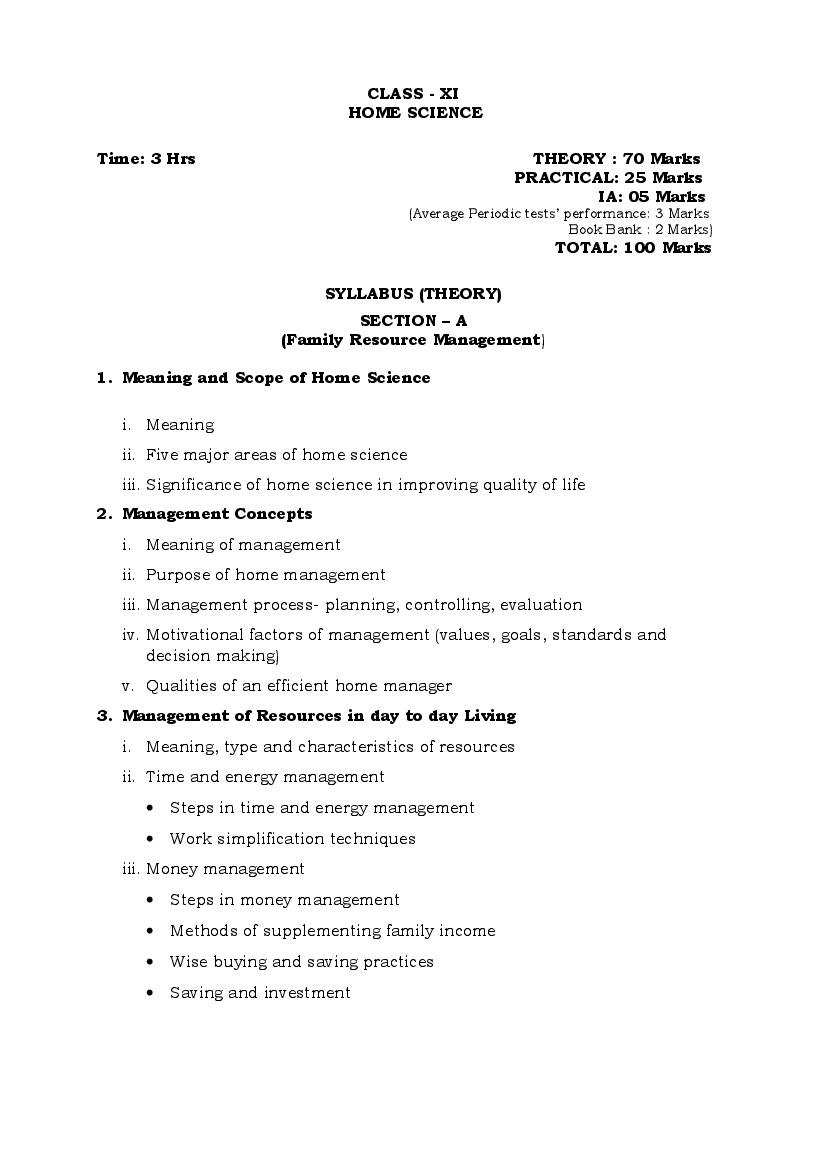
HOME SCIENCE
Time: 3 Hrs THEORY : 70 Marks
PRACTICAL: 25 Marks
IA: 05 Marks
(Average Periodic tests’ performance: 3 Marks
Book Bank : 2 Marks)
TOTAL: 100 Marks
SYLLABUS (THEORY)
SECTION – A
(Family Resource Management)
1. Meaning and Scope of Home Science
i. Meaning
ii. Five major areas of home science
iii. Significance of home science in improving quality of life
2. Management Concepts
i. Meaning of management
ii. Purpose of home management
iii. Management process- planning, controlling, evaluation
iv. Motivational factors of management (values, goals, standards and
decision making)
v. Qualities of an efficient home manager
3. Management of Resources in day to day Living
i. Meaning, type and characteristics of resources
ii. Time and energy management
• Steps in time and energy management
• Work simplification techniques
iii. Money management
• Steps in money management
• Methods of supplementing family income
• Wise buying and saving practices
• Saving and investment
Page 2
i. General principles for cleaning and cleaning schedule
ii. Cleaning tools and cleansing materials
iii. Cleaning of different metals/materials used in household
iv. Eco friendly substitutes for cleaning household items and surfaces
5. Interior decoration and Space Management
i. Importance and objectives of interior decoration
ii. Use of art principles in home decoration
iii. Spaces managements through use of colour, light, accessories and
furniture
6. Consumer Protection & Education
i. Need and importance for consumer education
ii. Consumer problems related to purchase of household items
iii. Consumer aids- labels, standardization marks, labels, advertisements
iv. Consumer’s rights and responsibilities
v. Consumer Protection Act, 1986 and seeking redressal for grievances.
SECTION – B
(Apparel and Textile Science)
1. Fibre Science
i. Classification of fibres
ii. Sources, characteristics and suitability for use of cotton, wool, silk and
nylon
2. Fabric Construction and Finishes
i. Yarns-
a. Simple
b. Novelty
ii. Weaving-
a. Basic weave mechanism
b. Plain, twill, satin and sateen weaves
iii. Knitting, knotting, crocheting, braiding, felting and bonding
iv. Purpose and classification of finishes
Page 3
calendaring, scouring
3. Dyeing and Printing
i. Purpose and types
ii. Plain dyeing
iii. Tie and dye
iv. Batik, block, stencil and spray printing
4. Elements and Principles of Design and their Impact
5. Selection, Care, Maintenance and Storage of Clothes
i. Factors influencing selection of apparel
ii. Check points before buying readymade garments
iii. Care labels on fabric and readymade garaments.
iv. Soaps and detergents
v. Stain Removal
vi. Care and storage
SYLLABUS (PRACTICAL)
SECTION – A (Family Resource Management)
1. Organisation and Evaluation of work centers
2. Preparation of family budget
3. Opening and Operating a bank account
4. Identification of food adulterants through simple tests
5. Cleanning of Household articles/Surfaces
6. Flower arrangement
7. Tables setting and table etiquettes
8. Floor decoration
9. Critical analysis of labels
10. Practical experience of seeking redressal under consumer Act, 1986
SECTION – B (Apparel and Textile Science)
1. To identify different fibres by burning test
2. Preparation of paper samples for plain, twill, satin and sateen weaves.
Page 4
of knit and purl stitch.
4. Preparation of two samples of crocheting
5. Preparation of five samples of tie and dye
6. Preparation of two samples of batik in at least three different colours
7. Preparation of two samples of block printing in at least two different
colours
8. Preparation of one sample of spray printing
9. Preparation of one sample of stencil printing
10. Stain removal – ball pen, blood, grease, tea, curry