Class 9 Sample Paper 2022 English Term 1
Finished viewing? Save it for later —
Download Class 9 Sample Paper 2022 English Term 1 (PDF · 15 pages)About Class 9 Sample Paper 2022 English Term 1
Class 9 Sample Paper 2022 English Term 1 is available here for free download. Published by AglaSem for Class 9, this sample paper can be viewed online or downloaded as a PDF (15 pages). Candidates preparing for Class 9 can use Class 9 Sample Paper 2022 English Term 1 to understand the exam pattern, the type of questions asked, and the overall difficulty level.
Frequently Asked Questions
How can I download Class 9 Sample Paper 2022 English Term 1?
Open this page and click the Download button to save Class 9 Sample Paper 2022 English Term 1 as a PDF. It is completely free on AglaSem Docs.
Is Class 9 Sample Paper 2022 English Term 1 free to download?
Yes. Class 9 Sample Paper 2022 English Term 1 can be viewed online and downloaded as a PDF free of cost on AglaSem Docs.
How many pages does Class 9 Sample Paper 2022 English Term 1 have?
Class 9 Sample Paper 2022 English Term 1 contains 15 pages, which you can read online or download together as a single PDF.
Where can I find more Class 9 study material?
You can find more Class 9 question papers, sample papers, syllabus, and answer keys on AglaSem Docs.
Class 9 Sample Paper 2022 English Term 1 – Text
Read the full text of this sample paper below — useful to quickly search, copy and reference the content online without downloading the PDF.
📄 View text version (14 pages)
Page 1
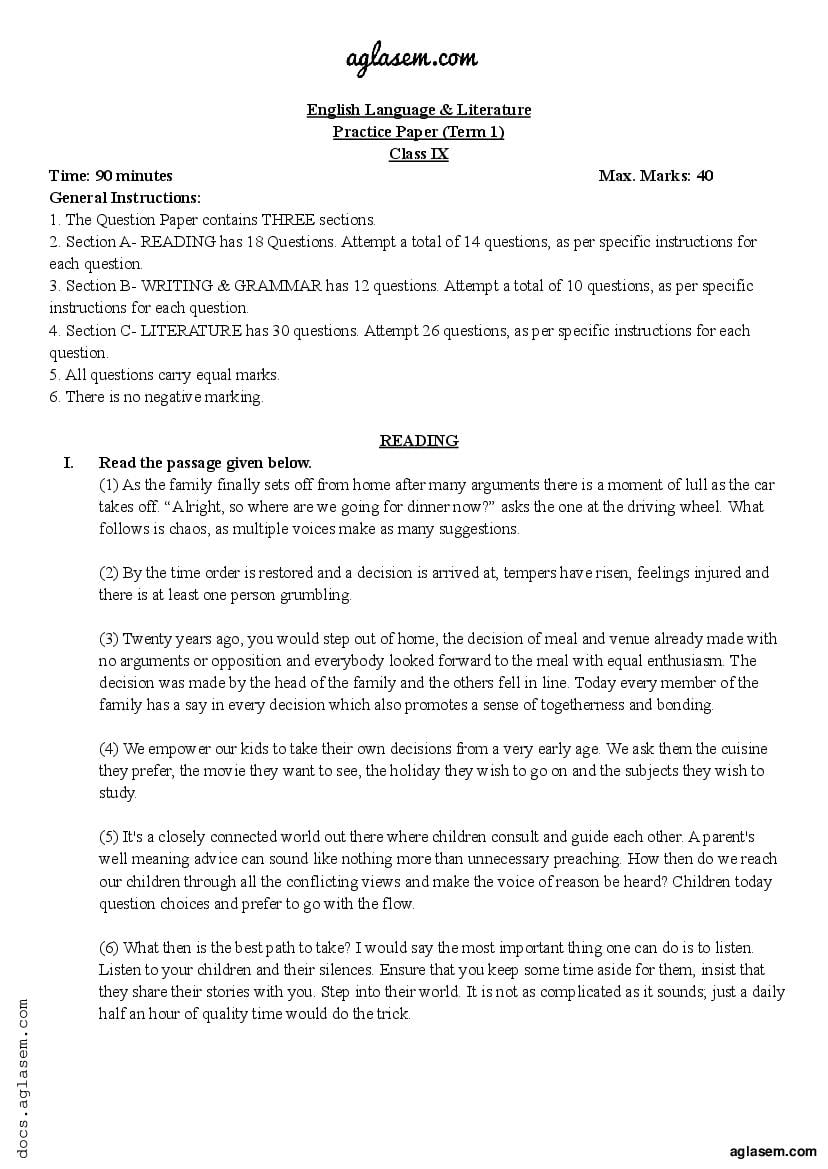
Practice Paper (Term 1)
Class IX
Time: 90 minutes Max. Marks: 40
General Instructions:
1. The Question Paper contains THREE sections.
2. Section A- READING has 18 Questions. Attempt a total of 14 questions, as per specific instructions for
each question.
3. Section B- WRITING & GRAMMAR has 12 questions. Attempt a total of 10 questions, as per specific
instructions for each question.
4. Section C- LITERATURE has 30 questions. Attempt 26 questions, as per specific instructions for each
question.
5. All questions carry equal marks.
6. There is no negative marking.
READING
I. Read the passage given below.
(1) As the family finally sets off from home after many arguments there is a moment of lull as the car
takes off. “Alright, so where are we going for dinner now?” asks the one at the driving wheel. What
follows is chaos, as multiple voices make as many suggestions.
(2) By the time order is restored and a decision is arrived at, tempers have risen, feelings injured and
there is at least one person grumbling.
(3) Twenty years ago, you would step out of home, the decision of meal and venue already made with
no arguments or opposition and everybody looked forward to the meal with equal enthusiasm. The
decision was made by the head of the family and the others fell in line. Today every member of the
family has a say in every decision which also promotes a sense of togetherness and bonding.
(4) We empower our kids to take their own decisions from a very early age. We ask them the cuisine
they prefer, the movie they want to see, the holiday they wish to go on and the subjects they wish to
study.
(5) It's a closely connected world out there where children consult and guide each other. A parent's
well meaning advice can sound like nothing more than unnecessary preaching. How then do we reach
our children through all the conflicting views and make the voice of reason be heard? Children today
question choices and prefer to go with the flow.
(6) What then is the best path to take? I would say the most important thing one can do is to listen.
Listen to your children and their silences. Ensure that you keep some time aside for them, insist that
they share their stories with you. Step into their world. It is not as complicated as it sounds; just a daily
half an hour of quality time would do the trick.
Page 2
choosing the correct option.
Q1. According to the passage, who said, “so, where are we going for dinner now?”
A. Narrator
B. One at the steering
C. One of the passengers
D. One of the guests
Q2. Twenty years ago, according to the passage, decisions were ___________ .
A. Unanimous, with no argument
B. Made by the children
C. Taken by the head of the family
D. Not taken by elders
Q3. In modern times, children are _______ to make their own decisions from a very early age.
A. Forbidden
B. Trained
C. Not given permission
D. Allowed
Q4. Generally, a parent’s advice is often taken as _________ by the children.
A. Dictatorship
B. Unnecessary preaching
C. Obligation
D. distraction
Q5. These days, children want to ________ .
A. Rule their own life
B. Go with the flow
C. Be looked after by others
D. Live their life under the guidance of everyone
Q6. The message conveyed by this passage is that parents should __________.
A. Give children some space.
B. Listen to each need of theirs
C. Let them solve their problems by helping them from the back
D. All of these
Q7. After arriving at a decision almost everyone is _________ in the family mentioned above.
A. Happy
B. Excited
C. Hurt
D. Elated
Q8. The synonyms of ‘hurt’ given in para 2 is ___________.
A. Injured
B. Restored
C. Arrived
D. Decision
Q9. The word which means the same as ‘a style or method of cooking’ in para 4 is ___________.
Page 3
B. Cuisine
C. Epicure
D. Connoisseur
Q 10. The word ‘agreeable’ has the antonym ___________.
A. Connected
B. Conflicting
C. Preaching
D. Prefer
II. Read the passage given below and answer the questions that follow:
Keep your watch accurate. For some people, moving up the time on their watch will help them get up earlier.
For others, they will remember that the time on the watch is wrong and will disregard it altogether. It may be
helpful to set your watch just two minutes ahead instead of five or ten.
Keep a clock, phone, computer or anything that displays time in each room of your house. One of the easiest
ways to run late is simply by not realising that the time is passing as quickly as it is.
Set all your clocks and watches to the same time. Don’t be an optimist. Things usually take longer than what
you’d expect, even without major delays. If you have a dinner appointment at 7:30 p.m., don’t think you can
work till 7 p.m., then take a bath, get dressed and reach on time. Realistically, calculate the time you will take
at each step and then add 10 minutes more to allow for unexpected delays, or you cannot get to your job in
time.
Wake up when you are supposed to wake up. Don’t hit the snooze button, keep on lying in bed, and watch TV
at the very start of your day. Maybe try even setting your clock 10 minutes earlier than you need. If you have
difficulty with this, move your alarm clock to somewhere away from your bed; that way, you have to get up to
turn it off. Commit yourself to being 15 minutes early for everything. If you have to reach your place of work
at 8:00, don’t even tell yourself this. Just tell yourself (and everyone else who listens- but don’t annoy them or
make them think that they are late or early!) “I have to be at work at 7.45”. If you do this, you will be on time
even with little unforeseen delays. You will be on time even with a traffic jam.
Page 4
correct option.
Q11. It is good to commit yourself _______ for everything.
A. to be late
B. to delay
C. to being 15 minutes early
D. to search to the last moment
Q12. To be punctual we should _________.
A. hit the snooze button of the alarm clock
B. get up at the right time
C. start watching TV in the morning
D. keep on lying in bed
Q13. It is a good habit to ___________.
A. reach your work place in time
B. calculate the time before starting any work
C. keep lying in bed after the alarm clock buzzes
D. both (A) and (B)
Q14. According to the passage the watch should be set ________ ahead.
A. five minutes
B. ten minutes
C. two minutes
D. fifteen minutes
Q15. The writer suggests to keep the watch ________.
A. ahead of time
B. accurate
C. inaccurate
Page 5
Q16. According to the passage/chart, students should get up _________.
A. before 5 a.m.
B. after 5 a.m.
C. between 5 a.m. to 6 a.m.
D. at 7 a.m.
Q17. Proper time ________ helps everyone lead a stress free life.
A. organisation
B. management
C. planner
D. devotion
Q18. Which one of the following is NOT a time - management tip?
A. Prioritize your work.
B. Set a time limit.
C. Remove important tasks from 'to - do' list.
D. Plan ahead
GRAMMAR AND WRITING
GRAMMAR
III. Answer any five out of the six questions by selecting the most appropriate option for each
Q19. She __________ visit her grandparents’ house during holidays.
A. dare to
B. ought to
C. can
D. might
Q20. Joey __________ from vacation just now.
A has returned
B had returned
C had been returning
D returns
Q21. ___________ exam copies are still unchecked.
Page 6
B. Few
C. Little
D. Much
Q22. She said, “Bring a glass of water, please.”
A. She commands me to bring a glass of water.
B. She requested me to bring a glass of water.
C. She asked me to brought a glass of water.
D. She ordered me to bring her a glass of water.
Q23. She said to him, “It is good to see you!”
A. She exclaimed that it was good to see him.
B. She exclaimed that she was happy to see him.
C. She exclaimed that it is good to see him.
D. She exclaimed that it was good to see me.
Q24. Many a man ___________ suffered during partition.
A. have
B. has
C. were
D. is
Page 7
IV Answer any five out of the six questions given,
Q25. What does Descriptive writing do?
A. Appeal to senses.
B. Give details.
C. Provide descriptions.
D. All the above.
Q26. Choose the most effective description from the four options.
A. I remember the old market clearly - it was always crowded with customers and traders bargaining. I
used to watch the action from a distance. Sometimes I would get an orange from the trader.
B. I remember the old market clearly - it was always crowded with customers and traders bargaining. The
market was near to my school.
C. I remember the old market clearly - it was always crowded with customers and traders bargaining. I
used to watch the action from a distance. Sometimes I would get an orange from the trader who was
dealing in fruits and I used to suck the sweet, tangy flesh.
D. I remember the old market clearly - it was always crowded with customers and traders bargaining. I
used to watch the action from a distance.
Q27. What is the reason to write a descriptive essay?
A. To allow the reader to grasp the writer's idea through the reader's sense of sight, smell, taste, sound and
touch.
B. To inform the reader about technical features.
C. To provide the reader with scientific details.
D. To appeal to the reader's liking for numbers.
Q28. Short story is based on:
A. Single theme
B. Multiple theme
C. Both a and b
D. None of these
Q29 The Crucial Part of a Short Story is
A. Beginning
B. Climax
C. Ending
D. Plot
Q30 Theme of the short story may be?
Page 8
B. Negative
C. Neutral
D. All of these
LITERATURE
This section has sub-sections - V, VI, VII, VIII & IX. There are a total of 30 questions in this section.
Attempt any 26 questions from the sub- sections V to IX
V. Read the given extract to attempt the questions that follow:
He also felt a special interest in a fellow student, Mileva Maric, whom he found to be a “clever creature.” This
young Serb had come to Switzerland because the University in Zurich was one of the few in Europe where
women could get degrees. Einstein saw in her an ally against the “philistines”— those people in his family and
at the university with whom he was constantly at odds. The couple fell in love. Letters survive in which they
put their affection into words, mixing science with tenderness. Wrote Einstein: “How happy and proud I shall
be when we both have brought our work on relativity to a victorious conclusion.” In 1900, at the age of 21,
Albert Einstein was a university graduate and unemployed. He worked as a teaching assistant, gave private
lessons and finally secured a job in 1902 as a technical expert in the patent office in Bern. While he was
supposed to be assessing other people’s inventions, Einstein was actually developing his own ideas in secret.
He is said to have jokingly called his desk drawer at work the “bureau of theoretical physics.”
(A Truly Beautiful Mind)
Q31. Select the most appropriate option for (1) and (2)
(1) Mileva Maric didn't come to the University of Zurich
(2) It was the only University which gave degree to women
A. 1 is true but 2 is false.
B. 1 is false but 2 is true.
C. Both (1) and (2) are false.
D. Both (1) and (2) are true.
Q32. . Where did not Einstein decide to study after finishing school?
I. Basel
II. Zurich
III. Switzerland
IV. Frankfurt
Which of the options given above is/are correct:
A. II only
Page 9
C. III, I and IV only
D. All the above.
Q33. Why did Mileva Maric come to the University at Zurich?
A. It was the only university which gave degrees to women.
B. It was a good university.
C. It was near her city.
D. She liked the place.
Q34. When Einstein said,“How happy and proud I shall be when we both have brought our work on relativity
to a victorious conclusion.”, in it "Victorious" means____________
A. Defeated
B. Triumphant
C. Unsuccessful
D. Failing
Q35. When did Einstein secure a job?
A. 1901
B. 1903
C. 1902
D. 1904
VI. Read the given extract to attempt the questions that follow:
He passed by the cathedral tower, where the white marble angels were sculptured. He passed by the palace and
heard the sound of dancing. A beautiful girl came out on the balcony with her lover. “I hope my dress will be
ready in time for the State ball,” she said. “I have ordered flowers to be embroidered on it, but the
seamstresses are so lazy.”
(The Happy Prince)
Q36. “I have ordered flowers to be embroidered on it, but the seamstresses are so lazy.”
Who is the speaker of the above mentioned dialogue!
A. The writer himself
B. The Happy Prince
C. The Little Swallow
D. The loveliest maid of honour of the queen.
Q37. . Where did he hear the sound of dancing?
I. Palace
Page 10
III. Mansion
IV. Royal
Which of the options given above is/are correct:
A. III and II only
B. I only
C. I, III and II only
D. IV only.
Q38. Who has her dress? Why?
A. The Swallow had her dress, the seamstress gave it to the Swallow.
B. The seamstress has her dress because the maid of honour had ordered her to embroider flowers on it.
C. The Little match girl had her dress, the happy prince gave it to her.
D. None
Q39. Where did a beautiful girl come out with her lover?
A. Veranda
B. Garden
C. Balcony
D. Terrace
Q40. Who is NOT lazy when it comes to ordering flowers to be embroidered on my dress?
I. Dressmakers
II. Embroiderers
III. Tailors
IV. Seamstresses
Which of the options given above is/are correct:
A. IV only
B. IV, II and I only
C. II, I and III only.
D. All the above.
VII. Read the given extract to attempt the questions that follow:
Every tinkle on the shingles
Page 11
And a thousand dreamy fancies
Into busy being start,
And a thousand recollections
Weave their air-threads into woof,
As I listen to the patter
Of the rain upon the roof.
(Rain on the Roof)
Q41. Who are darling dreamers in the poem?
A. Children who miss their mothers
B. Mothers
C. Hard working mothers
D. Poet’s memories
Q42. What tinkles on the shingles?
A. Rain drops
B. Hailstones
C. Brass - bell
D. Silver bangles
Q43. What makes an echo in the poet’s mind?
A. His poverty
B. His success
C. The music of pattering
D. None of these
Q44. Where is rain making a noise?
A. In the room
B. On the roof
C. In the gardens
D. In the lanes
Q45. Trace a word from the extract that means ‘memories’
A. Shingles
B. Recollections
Page 12
D. Patter
VIII. Read the given extract to attempt the questions that follow:
The sound of the shehnai began to be considered auspicious. And for this reason it is still played in temples
and is an indispensable component of any North Indian wedding. In the past, the shehnai was part of the
naubat or traditional ensemble of nine instruments found at royal courts. Till recently it was used only in
temples and weddings. The credit for bringing this instrument onto the classical stage goes to Ustad Bismillah
Khan.
As a five-year old, Bismillah Khan played gilli-danda near a pond in the ancient estate of Dumraon in Bihar.
He would regularly go to the nearby Bihariji temple to sing the Bhojpuri ‘Chaita’, at the end of which he
would earn a big laddu weighing 1.25 kg, a prize given by the local Maharaja. This happened 80 years ago,
and the little boy has travelled far to earn the highest civilian award in India — the Bharat Ratna.
(The Sound of Music)
Q46. Where was the Shehnai traditionally played ?
A. In temples
B. In wedding ceremonies
C. Auspicious ceremonies
D. All of the above
Q47. What aspect of the shehnai began to be considered auspicious?
A. Loud
B. Audio
C. Sound
D. None
Q48. What is the highest civilian award in india?
I. Bharat Ratna
II. Padma Bhushan
III. Gallantry Award
IV. None
Which of the options given above is/are correct:
A. IV and II only
B. I only
C. I, IV and II only
Page 13
Q49. Who changed the perception of the Shehnai ?
A. Tansen
B. Evelyn
C. Bismillah Khan
D. All of the above
Q50. In the past, the shehnai was part of the naubat or traditional ensemble of _____________ _ instruments
found at the royal court.
A. Nine
B. ten
C. eight
D. six
IX. Attempt the question
Q51. Who did the Happy Prince send his second sapphire for ?
A. For the poor match girl.
B. For the poor seamstresses.
C. For the poor playwright.
D. For the Mayor of the city.
Q52. In which standard, Abdul was, when the new teacher with a conservative mind had come to his class ?
A. 4th standard
B. 5th standard
C. 7th standard
D. 6th standard
Q53. What type of look did the ticket collector give to the grandfather?
A. Happy and triumphant
B. Sad and Ugly
C. Sarcastic and ironical
D. Expressionless
Q54. In the poem "A Legend of The Northland", why can't people sleep through the winter nights in
Northland ?
A. Because the nights are too short there.
B. Because the nights are too long there.
Page 14
D. Because there is no night there.
Q55. Why was Kezia afraid of her father?
A. He used to speak rudely to her and always found faults in her.
B. She thought that he was a hard - hearted man.
C. Once he beat her for tearing his papers
D. All of the above
Q56. What is Tommy referring to as a waste?
A. New book
B. Old book
C. Telebook
D. Workbook
Q57. What did the grandfather tell the narrator about his trip afterwards?
A. The funny incidents at pension office
B. The mischiefs of Toto
C. The first flight of the grandfather
D. All of these
Q58. What did St. Peter ask for from the little women?
A. A single cake
B. A dozen cakes
C. A loaf of bread
D. Something to eat
Q59. What did the school headmaster say about Einstein?
A. He would be genius
B. He is great
C. He can’t be a success at anything
D. None of these
Q60. In " The Little Girl", who made hue and cry in the house ?
A. Kezia's father.
B. Kezia's mother.
C. Kezia's grandmother.
D. None of these.
Document Details
| Board / Org | Aglasem |
| Exam | Class 9 |
| Type | Sample Paper |
| Pages | 15 |
| Updated | 22 Jul 2026 |