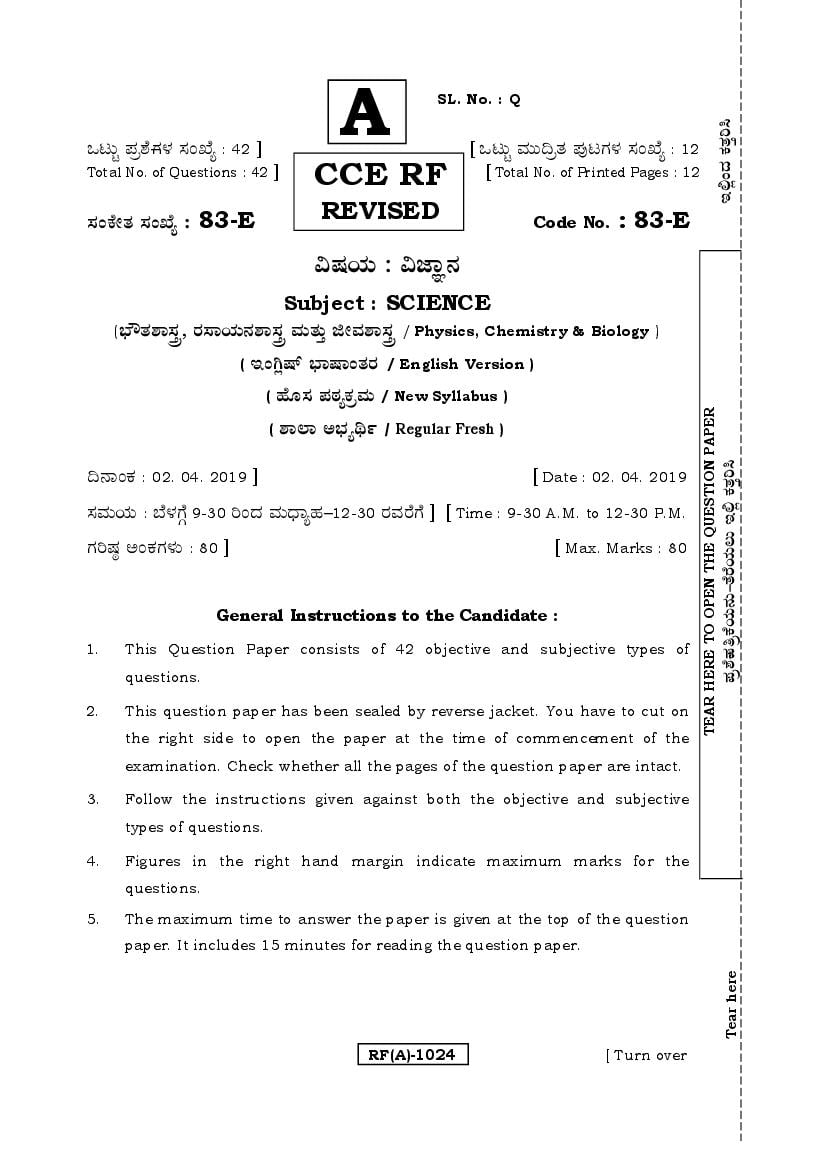
Karnataka SSLC Question Paper April 2019 Science English Medium
Finished viewing? Save it for later —
Download Karnataka SSLC Question Paper April 2019 Science English Medium (PDF · 12 pages)About Karnataka SSLC Question Paper April 2019 Science English Medium
Karnataka SSLC Question Paper April 2019 Science English Medium is available here for free download. Published by Karnataka Board for Class 10, this question paper can be viewed online or downloaded as a PDF (12 pages). Candidates preparing for Class 10 can use Karnataka SSLC Question Paper April 2019 Science English Medium to understand the exam pattern, the type of questions asked, and the overall difficulty level.
Frequently Asked Questions
How can I download Karnataka SSLC Question Paper April 2019 Science English Medium?
Open this page and click the Download button to save Karnataka SSLC Question Paper April 2019 Science English Medium as a PDF. It is completely free on AglaSem Docs.
Is Karnataka SSLC Question Paper April 2019 Science English Medium free to download?
Yes. Karnataka SSLC Question Paper April 2019 Science English Medium can be viewed online and downloaded as a PDF free of cost on AglaSem Docs.
How many pages does Karnataka SSLC Question Paper April 2019 Science English Medium have?
Karnataka SSLC Question Paper April 2019 Science English Medium contains 12 pages, which you can read online or download together as a single PDF.
Where can I find more Class 10 study material?
You can find more Class 10 question papers, sample papers, syllabus, and answer keys on AglaSem Docs.
Karnataka SSLC Question Paper April 2019 Science English Medium – Text
Read the full text of this question paper below — useful to quickly search, copy and reference the content online without downloading the PDF.
📄 View text version (12 pages)
Page 1
BΔ«M•⁄ O⁄}⁄°¬“
Jlflo Æ⁄√ÀÊ-V⁄◊⁄ —⁄MSÊ¿ : 42 ] [ Jlflo »⁄flfl¶√}⁄ Æ⁄‚¥lV⁄◊⁄ —⁄MSÊ¿ : 12
Total No. of Questions : 42 ]
CCE RF [ Total No. of Printed Pages : 12
—⁄MOÊfi}⁄ —⁄MSÊ¿ : 83-E REVISED Code No. : 83-E
…Œ⁄æ⁄fl : …e¤k´⁄
Subject : SCIENCE
( ∫Ë}⁄À¤—⁄°, ¡⁄—¤æ⁄fl´⁄À¤—⁄° »⁄fl}⁄fl° ffi»⁄À¤—⁄° / Physics, Chemistry & Biology )
( BMW«ŒÈ ∫¤Œ¤M}⁄¡⁄ / English Version )
( ‘ʇ—⁄ Æ⁄p⁄¿O⁄√»⁄fl / New Syllabus )
TEAR HERE TO OPEN THE QUESTION PAPER
( À¤≈¤ @∫⁄¥¿£% / Regular Fresh )
Æ⁄√ÀÊ-Æ⁄~√OÊæ⁄fl´⁄fl-}Ê¡Êæ⁄flƒfl BΔ« O⁄}⁄°¬“
¶´¤MO⁄ : 02. 04. 2019 ] [ Date : 02. 04. 2019
—⁄»⁄flæ⁄fl : ∑Ê◊⁄VÊX 9-30 ¬M•⁄ »⁄fl®¤¿‘⁄-12-30 ¡⁄»⁄¡ÊVÊ ] [ Time : 9-30 A.M. to 12-30 P.M.
V⁄¬Œ⁄r @MO⁄V⁄◊⁄fl : 80 ] [ Max. Marks : 80
General Instructions to the Candidate :
1. This Question Paper consists of 42 objective and subjective types of
questions.
2. This question paper has been sealed by reverse jacket. You have to cut on
the right side to open the paper at the time of commencement of the
examination. Check whether all the pages of the question paper are intact.
3. Follow the instructions given against both the objective and subjective
types of questions.
4. Figures in the right hand margin indicate maximum marks for the
questions.
5. The maximum time to answer the paper is given at the top of the question
paper. It includes 15 minutes for reading the question paper.
Tear here
RF(A)-1024 [ Turn over
Page 2
Four alternatives are given for each of the following questions / incomplete
statements. Only one of them is correct or most appropriate. Choose the correct
alternative and write the complete answer along with its letter of alphabet.
10 × 1 = 10
1. The change that occurs in the eye to see the distant objects clearly is
(A) focal length of the eye lens decreases
(B) curvature of the eye lens increases
(C) focal length of the eye lens increases
(D) ciliary muscles of the eye contract
2. The functional groups present in propanol and propanal respectively are
(A) — OH and — CHO
(B) — OH and — COOH
(C) — CHO and — COOH
(D) — CHO and — CO
3. The correct path of the movement of nerve impulses in the following diagram is
(A) Q → S → R → P
(B) P → Q → R → S
(C) S → R → Q → P
(D) P → R → S → Q
RF(A)-1024
Page 3
4. The resistance of a conductor is 27 Ω . If it is cut into three equal parts and
connected in parallel, then its total resistance is
(A) 6Ω (B) 3Ω
(C) 9Ω (D) 27 Ω
5. The chemical equation that represents neutralization reaction among the
following is
(A) BaCl 2 + H 2 SO 4 → BaSO 4 + 2HCl
(B) MnO 2 + 4 HCl → MnCl 2 + 2H 2 O + Cl 2
(C) 2 NaOH + H 2 SO 4 → Na 2 SO 4 + 2H 2 O
(D) AgNO 3 + HCl → AgCl + HNO 3
6. By constructing Khadin check-dams in level terrains,
(A) underground water level decreases
(B) underground water level increases
(C) vegetation in the nearby areas are destroyed due to excess moisture
(D) underground water gets polluted
7. To obtain a diminished image of an object from a concave mirror, position of the
object should be
( F = principal focus, C = centre of curvature, P = pole )
(A) between C and F (B) beyond C
(C) between P and F (D) at F
RF(A)-1024 [ Turn over
Page 4
8. The electronic configuration of element X is 2, 8, 8, 1 and the electronic
configuration of element Y is 2, 8, 7. Then the type of bond formed between these
two elements is
(A) covalent bond
(B) hydrogen bond
(C) metallic bond
(D) ionic bond
9. Part of the flower that develops into fruit and part of the seed that develops into
root respectively are
(A) ovary and plumule
(B) plumule and radicle
(C) ovary and radicle
(D) ovary and ovule
10. A pure dominant pea plant producing round — yellow seeds is crossed with pure
recessive pea plant producing wrinkled — green seeds. The number of plants
bearing round — green seeds in the F 1 generation of Mendel’s experiment is
(A) 0 (B) 1
(C) 3 (D) 9
RF(A)-1024
Page 5
11. The functions of hormones are given in Column-A and the names of the
hormones are given in Column-B. Match them and write the answer along with
its letters : 4×1=4
Column - A Column - B
(A) Prepares the body to deal (i) Growth hormone
with the situation
(B) Regulates metabolism for (ii) Testosterone
body growth
(C) Regulates blood sugar levels (iii) Adrenaline
(D) Regulates the growth and (iv) Progesterone
development of the body
(v) Insulin
(vi) Thyroxine
(vii) Oestrogen
Answer the following questions. 7×1=7
12. Name the acid present in the stinging hair of nettle leaves.
13. What are fossils ?
14. Convex mirror is commonly used as rear-view mirror in vehicles. Why ?
15. What is roasting in metallurgy ?
RF(A)-1024 [ Turn over
Page 6
16. Observe the given figure. Name the eye defect indicated in the figure and also
mention the lens used to correct this defect.
17. What is Tyndall effect ?
18. Under what condition lactic acid is produced in the muscle cells ?
Answer the following questions. 16 × 2 = 32
19. Draw the diagram of an electric circuit in which the resistors R 1 , R 2 and R 3
are connected in parallel including an ammeter and a voltmeter and mark the
direction of the current.
20. Name the brown fumes liberated when lead nitrate is heated. Write the balanced
chemical equation for this reaction.
21. Explain the process of translocation of food materials in plants.
OR
Explain the process of digestion in the small intestine of man.
22. Draw the diagram of a simple electric motor. Label the following parts :
(i) Split rings (ii) Brushes.
23. What are structural isomers ? Name the first member of alkanes that shows
structural isomerism.
RF(A)-1024
Page 7
24. Draw the diagram showing the longitudinal section of a flower.
Label the following parts :
(i) Style (ii) Anther.
25. Draw the diagram of arrangement of apparatus used to show the reaction of zinc
granules with dilute sulphuric acid and testing hydrogen gas by burning.
Label the following parts.
(i) Soap solution
(ii) Delivery tube.
26. It is advantageous to connect electric devices in parallel instead of connecting
them in series. Why ?
OR
According to Joule’s law of heating, mention the factors on which heat produced
in a resistor depends. According to this law write the formula used to calculate
the heat produced.
27. List the disadvantages of using fossil fuels.
OR
List the advantages of ‘reduce’ and ‘reuse’ to save environment.
28. The focal length of a concave lens is 30 cm. At what distance should the object
be placed from the lens so that it forms an image at 20 cm from the lens ?
29. Draw the diagram of the apparatus used in the electrolysis of water. Label the
following parts.
(i) Graphite rod
(ii) Cathode.
RF(A)-1024 [ Turn over
Page 8
30. Growth of thread like structures along with the gradual spoilage of tomato can be
observed when a cut tomato is kept aside for four days. Interpret the causes for
this change.
31. An electric refrigerator rated 400 W is used for 8 hours a day. An electric iron
box rated 750 W is used for 2 hours a day. Calculate the cost of using these
appliances for 30 days, if the cost of 1 kWh is Rs. 3/-.
32. There is no change in the colour of red litmus and blue litmus paper when
introduced into an aqueous solution of sodium chloride. After passing direct
current through the same solution, red litmus changes to blue colour. Which
product is responsible for this change ? Mention any two uses of this product.
33. A food chain in a polluted aquatic ecosystem is given. Observe it and answer the
following questions.
Fresh water → Algae → Fishes → Birds.
(i) Which organisms are disturbed more due to biomagnification ? Why ?
(ii) This ecosystem will be destroyed gradually due to biomagnification. Why ?
OR
A student places a piece of cucumber, a glass piece, a banana peel and a plastic
pen in a pit and closes it. What changes can be observed in these materials after
a month ? Give scientific reason for these changes.
RF(A)-1024
Page 9
34. What is dispersion of light ? Mention the colour that bends the least and the
colour that bends the most when light undergoes dispersion through a prism.
OR
Mention any four phenomena that can be observed due to atmospheric refraction
of light on the earth.
Answer the following questions. 5 × 3 = 15
35. Draw the ray diagrams for the image formation in a convex lens when an object
is placed
(i) at focus F 1
(ii) beyond 2F 1 .
36. (i) Write the differences between saturated and unsaturated hydrocarbons.
(ii) Write the molecular formula and structural formula of an alkene having
five carbon atoms.
OR
(i) Carbon atom does not form C 4 − anion and C 4 + cation. Why ?
(ii) How can ethanol be converted into ethanoic acid ?
37. Draw the diagram showing the sectional view of the human heart. Label the
following parts.
(i) Aorta
(ii) Chamber of the heart that receives deoxygenated blood.
RF(A)-1024 [ Turn over
Page 10
38. (i) Name the major constituent of biogas. Write the properties of biogas which
make it a good fuel.
(ii) Name the two devices that work using heat energy of the sun.
OR
(i) Write the advantages of solar cells.
(ii) Write any two hazards of nuclear power generation.
39. Observe the given table and answer the following question :
Elements A B C D E
Atomic number 11 4 2 7 19
Identify the two elements that belong to the same period and the two elements
that belong to the same group. Give reason for your conclusion.
Answer the following questions. 3 × 4 = 12
40. (i) How does overload and short-circuit occur in an electric circuit ? Explain.
What is the function of fuse during this situation ?
(ii) Mention two properties of magnetic field lines.
41. Give reason :
(i) Ionic compounds in solid state do not conduct electricity, whereas in
molten state are good conductors of electricity.
(ii) Silver articles when exposed to air gradually turn blackish.
(iii) Chemical reaction does not take place when copper is added to iron
sulphate solution.
OR
RF(A)-1024
Page 11
Give reason :
(i) “Alloys of iron are more useful when compared to pure iron.”
(ii) Copper loses its brown layer gradually when exposed to air.
(iii) Aluminium oxide is called amphoteric oxide.
42. (i) Write the differences between homologous organs and analogous organs.
(ii) Write the differences between the sex chromosomes of man and sex
chromosomes of woman.
(iii) Sex of a child is determined by the father. How ?
RF(A)-1024 [ Turn over
Page 12
RF(A)-1024
Document Details
| Board / Org | Karnataka Board |
| Exam | Class 10 |
| Type | Question Paper |
| Pages | 12 |
| Updated | 09 Jun 2026 |