HBSE Class 12 Syllabus 2023 Physics
Finished viewing? Save it for later —
Download HBSE Class 12 Syllabus 2023 Physics (PDF · 7 pages)About HBSE Class 12 Syllabus 2023 Physics
HBSE Class 12 Syllabus 2023 Physics is available here for free download. Published by Haryana Board for Class 12, this syllabus can be viewed online or downloaded as a PDF (7 pages). Candidates preparing for Class 12 can use HBSE Class 12 Syllabus 2023 Physics to understand the exam pattern, the type of questions asked, and the overall difficulty level.
Frequently Asked Questions
How can I download HBSE Class 12 Syllabus 2023 Physics?
Open this page and click the Download button to save HBSE Class 12 Syllabus 2023 Physics as a PDF. It is completely free on AglaSem Docs.
Is HBSE Class 12 Syllabus 2023 Physics free to download?
Yes. HBSE Class 12 Syllabus 2023 Physics can be viewed online and downloaded as a PDF free of cost on AglaSem Docs.
How many pages does HBSE Class 12 Syllabus 2023 Physics have?
HBSE Class 12 Syllabus 2023 Physics contains 7 pages, which you can read online or download together as a single PDF.
Where can I find more Class 12 study material?
You can find more Class 12 question papers, sample papers, syllabus, and answer keys on AglaSem Docs.
HBSE Class 12 Syllabus 2023 Physics – Text
Read the full text of this syllabus below — useful to quickly search, copy and reference the content online without downloading the PDF.
📄 View text version (7 pages)
Page 1
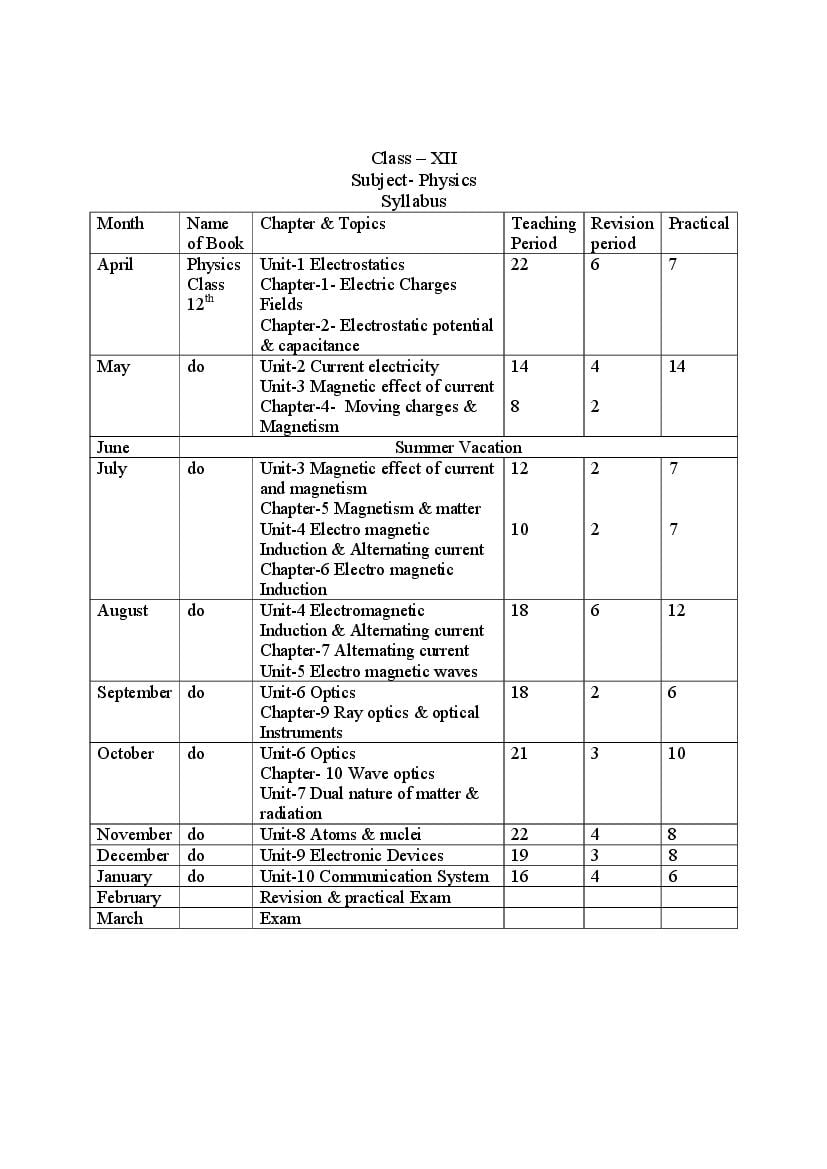
Subject- Physics
Syllabus
Month Name Chapter & Topics Teaching Revision Practical
of Book Period period
April Physics Unit-1 Electrostatics 22 6 7
Class Chapter-1- Electric Charges
12th Fields
Chapter-2- Electrostatic potential
& capacitance
May do Unit-2 Current electricity 14 4 14
Unit-3 Magnetic effect of current
Chapter-4- Moving charges & 8 2
Magnetism
June Summer Vacation
July do Unit-3 Magnetic effect of current 12 2 7
and magnetism
Chapter-5 Magnetism & matter
Unit-4 Electro magnetic 10 2 7
Induction & Alternating current
Chapter-6 Electro magnetic
Induction
August do Unit-4 Electromagnetic 18 6 12
Induction & Alternating current
Chapter-7 Alternating current
Unit-5 Electro magnetic waves
September do Unit-6 Optics 18 2 6
Chapter-9 Ray optics & optical
Instruments
October do Unit-6 Optics 21 3 10
Chapter- 10 Wave optics
Unit-7 Dual nature of matter &
radiation
November do Unit-8 Atoms & nuclei 22 4 8
December do Unit-9 Electronic Devices 19 3 8
January do Unit-10 Communication System 16 4 6
February Revision & practical Exam
March Exam
Page 2
Subject-Physics
Syllabus
Unit :I : Electrostatics:
Chapter No.-One April
Electric Charges and Fields:
Electric charge, conductors and insulators, Charging by conduction and
induction, Basic properties of electric charges coulomb’s Law-force between two
point charges, forces between multiple charges , dielectric Constant, Superposition
principle, Electric field, Electric field due to point charge, Electric field due to
system of charges, Electric field lines and their general properties, Electric flux ,
Electric dipole, Field of an electric dipole on axial and equatorial line , Dipole in a
uniform External field, Continuous Charge distribution, Torque on a dipole in
Uniform Electric field, Potential Energy of dipole in Electric field.. Gauss’s of
Law, and its application to find field due to infinitely long straight wire uniformly
charged thin spherical Shell, field due to two parallel uniformly charged
planesheets.
Chapter No.-Two April
Electrostatic potential and capacitance:
Electrostatic potential, potential due to a point charge, Potential due to an electric
dipole and system of charges Equipotential of surfaces, Relation between field and
potential, Potential Energy of system of two point charges in an external field,
conductors, Electrostatic shielding, Dielectrics and polarization, Capacitors and
Capacitance, The Parallel plate Capacitor, Effect of dielectrics on capacitance ,
Combination of Capacitors in series and in parallel, Energy stored in a capacitor,
grouping of capacitors.
Unit :II : Current Electricity:
Chapter No.-Three May
Page 3
Electric Current, Flow of electric charge in a metallic conductor, Drift velocity,
Mobility and their relation with Electric Current Ohm’s Law, current density,
electrical resistance, resistivity and conductivity. VI characteristics, limitations of
Ohm’s Law, carbon resistors, colour code for carbon resistors, Temperature
dependence of resistivity, Electrical energy and power, Combination of resistors-
Series and parallel, EMF, Internal resistance of a cell, potential Difference of a
cell, Combination of cells in series and parallel, Kirchhoff’s Rules. Wheatstone
Bridge, meter Bridge.
Potentiometer: Principle and its applications to measure potential difference and
for comparing EMF of two cells, measurement of internal resistance of a cell.
June Summer Vacation
Unit :III : Magnetic Effects of Current and Magnetism: July
Chapter No.-Four
Moving Charges and Magnetism:
Magnetic force; Sources and field, oersted’s experiments; concept of Magnetic
field, Lorentz force
Magnetic field due to a current Element, Biot- Savart Law and its application to
current carrying circular loop on its axis. Ampere’s circuital Law and its
application to infinitely long straight wire. The Solenoid and the toroid.
Force on moving charge in uniform magnetic and electric fields, cyclotron,
Force on a current carrying conductor in a uniform magnetic field, force between
two parallel currents carrying conductors. Definition of ampere. Torque
experienced by a current loop in uniform magnetic field. Magnetic dipole, current
loop as a magnetic dipole, Magnetic moment of a revolving electron. The moving
coil Galvanometer- its current sensitivity, and conversion to ammeter and
voltmeter.
Page 4
Magnetism and Matter:
The bar magnet, magnetic field lines, magnetic field intensity due to a magnetic
dipole(bar magnet) along its axis and perpendicular to its axis . Torque on a
magnetic dipole(bas magnet) in a uniform magnetic field, Bar magnet as an
equivalent solenoid.
Earth” magnetic field, magnetic elements of earth
Dia-para and ferro magnetic substances, with example, permanent magnets and
electromagnets and factors affecting their strengths.
Unit : IV : Electromagnetic Induction and Alternating Currents:
Chapter No.-Six August
Electromagnetic Induction:
Electromagnetic Induction, Magnetic flux, Faraday” Law of electromagnetic
induction, Lenz’s Law and conservation of energy, Motional Electromotive force,
Eddy currents, -Self and mutual Induction- Self inductance of a long solenoid,
A.C. Generator .
Chapter No.-Seven
Alternating Current:
Alternating currents, peak and r.m.s. value of alternating current voltage, reactance
and impedance, LC oscillation (qualitalive treatment only), LCR series circuit,
phasor-Diagram solution, Resonance. Power in AC circuits , watt less current.
Transformer, Energy losses in the transformers.
Unit : V : Electromagnetic waves:
Chapter No.-Eight August
Electromagnetic waves:
Page 5
Characteristics of EMW, Transverse Nature of EMW(qualitative Ideas only)
Electromagnetic Spectrum,(Radio waves, Microwaves, infrared visible,
ultraviolet, X-rays, gamma rays). including elementary facts about their uses.
Unit : VI : Optics: September
Chapter No.-Nine
Ray optics and optical instruments:
Ray optics: Reflection of light by spherical mirrors, Mirror formula, refraction of
light, lateral shift of a ray refraction through a glass slab, real and apparant depth,
Advance Sunrise and delayed sun set due to atmospheric refraction, Total internal
reflection, and its applications, Optical fibre, Mirage, Totally reflecting prism,
Brilliancy of diamond, Refraction at convex spherical surfaces. Lenses, Refraction
by a lens, Power of a lens, Combination of thin lenses and mirror in contact, lens
formula lens maker’s formula.
Refraction and Dispersion of light through a prism, plattering of light- blue colour
of sky and reddish appear of the sun at sunrise and sunset. Some Natural
phenomena due to sunlight- The rainbow.
Optical instruments:- Microscopes and Astronomical telescopes(reflecting and
refracting ) and their magnifying powers.
Chapter No.-Ten October
Wave optics:
Wave front and Huygen’s principle, refraction and reflection of plane waves at a
plane surface using Huygens principle. Proof of law of reflection and refraction
using Huygen’s principle. Interference of light waves. Young’s double slit
experiment and expression for fringe width, Coherent Sources and sustained
Interference of light. Diffraction, Diffraction due to a Single Slit width of Central
maxima, resolving power of microscopes and telescopes. Polarisation, plane
polasrised light. Brewster’s law, Uses of plane Polarised light & polaroids.
Unit :VII : Dual Nature of Radiation and Matter:
Page 6
Dual Nature of Radiation and Matter:
Dual Nature of radiation, photoelectric effect, Hertz, Hallwoch’s and Lenard’s
sobservatin’s effect of intensity of light on photo current, Effect of potential on
photoelectric current, effect of frequency of incident radiation on stopping
potential. Einstein’s Photoelectric equation- particle Nature of light, photon Matter
waves- Wave nature of particle , de Broglic relation, Davisson- Germer
experiment( experimental details, should be omitted, only conclusion should be
explained)
Unit : VIII : Atoms and nuclei:
Chapter No.-Twelve
Atoms:
Alpha- particle Scattering experiment. Rutherford’s Model of atom, Drawbacks of
Rutherford’s Model. Bohr’s Model of hydrogen atom- postulates, Bohar radius,
Total Energy of electron in nth orbit. Energy levels of hydrogen atom The line
spectra of hydrogen atom.
Chapter No.-Thirteen
Nuclei:
Atomic masses & composition of Nucleus, Size of nucleus isotopes, isobars
isotones Mass energy relation, Nuclear Binding Energy and Mass Defect. Binding
Energy and Mass Defect. Binding Energy Curve, Radioactivity. Law of
radioactive decay, Alpha, Beta & Gamma particles/rays and their properties,
Nuclear fission and fusion.
Unit : IX : Electronic Devices:
Chapter No.-Fourteen
Semiconductor Electronics, Materials, Devices & Simple Circuits:
Page 7
Instrinsic & Extrinsic Semiconductor, Semiconductor diode-I-V Characteristics in
Forward and reverse bias. Diode as full wave & half wave rectifier Special
purpose p-n junction diodes- Zener Diode and their Characterstics, Zener Diode as
a Voltage regulator, LED, Photodiode, Solar Cell
Junction Transistor, Transistor Action, Characterstics of a transistor , transistor as
an amplifier( C.E. Configuration) basic Idea of analog & digital signal, logic
gates(OR,AND,NOT, NAND, NOR)
Unit : X : Communication System:
Chapter No.-Fifteen
Communication Systems:
Elements of a Communication System(Block Diagram only) Bandwidth of Signals
(Speech, TV and digital Data), Band width of transmission medium, Propagation
of Electromagnetic waves in the atmosphere, Sky and Space wave propagation.
Satellite Communication, Need for modulation, Amplitude modulation, Basic
Ideas of internet, mobile telephony and global positioning system(GPS)
Document Details
| Board / Org | Haryana Board |
| Exam | Class 12 |
| Type | Syllabus |
| Pages | 7 |
| Updated | 22 Jul 2026 |