Goa Board Class 12 Sample Paper 2026 Biology
Finished viewing? Save it for later —
Download Goa Board Class 12 Sample Paper 2026 Biology (PDF · 34 pages)About Goa Board Class 12 Sample Paper 2026 Biology
Goa Board Class 12 Sample Paper 2026 Biology is available here for free download. Published by Goa Board for Class 12, this sample paper can be viewed online or downloaded as a PDF (34 pages). Candidates preparing for Class 12 can use Goa Board Class 12 Sample Paper 2026 Biology to understand the exam pattern, the type of questions asked, and the overall difficulty level.
Frequently Asked Questions
How can I download Goa Board Class 12 Sample Paper 2026 Biology?
Open this page and click the Download button to save Goa Board Class 12 Sample Paper 2026 Biology as a PDF. It is completely free on AglaSem Docs.
Is Goa Board Class 12 Sample Paper 2026 Biology free to download?
Yes. Goa Board Class 12 Sample Paper 2026 Biology can be viewed online and downloaded as a PDF free of cost on AglaSem Docs.
How many pages does Goa Board Class 12 Sample Paper 2026 Biology have?
Goa Board Class 12 Sample Paper 2026 Biology contains 34 pages, which you can read online or download together as a single PDF.
Where can I find more Class 12 study material?
You can find more Class 12 question papers, sample papers, syllabus, and answer keys on AglaSem Docs.
Goa Board Class 12 Sample Paper 2026 Biology – Text
Read the full text of this sample paper below — useful to quickly search, copy and reference the content online without downloading the PDF.
📄 View text version (31 pages)
Page 1
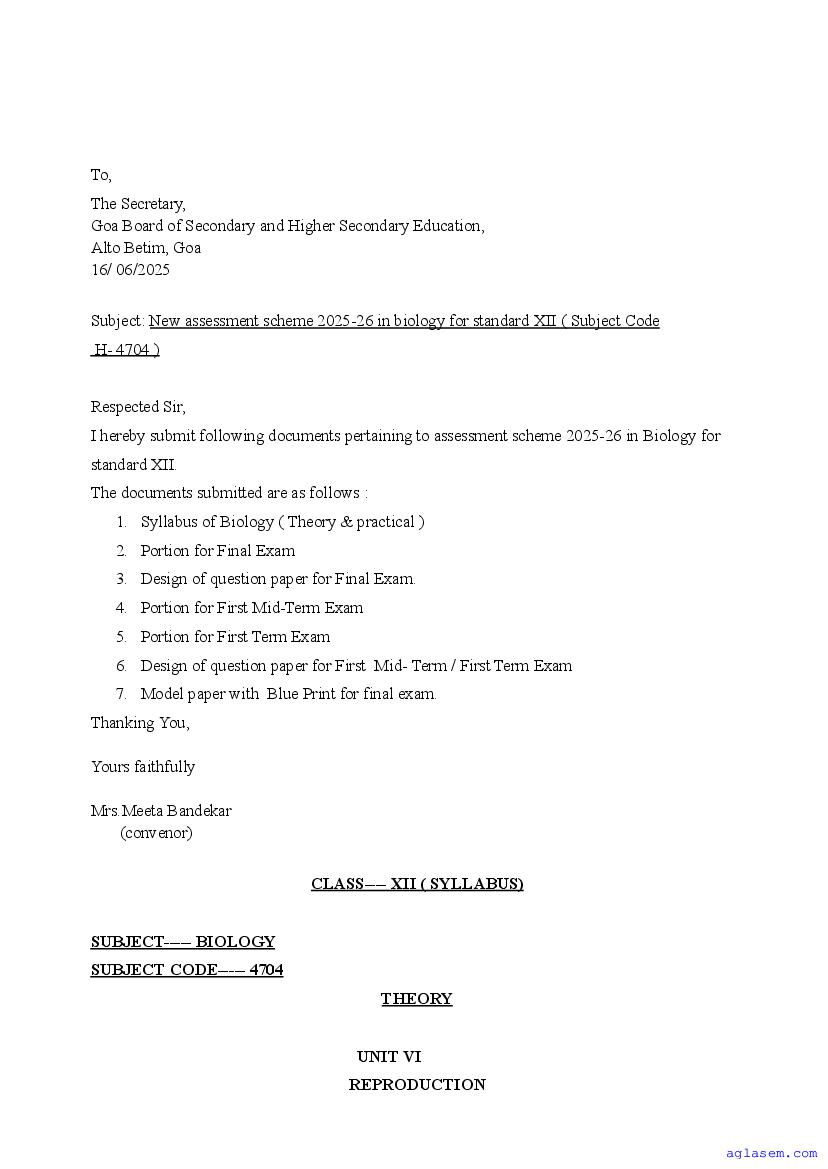
The Secretary,
Goa Board of Secondary and Higher Secondary Education,
Alto Betim, Goa
16/ 06/2025
Subject: New assessment scheme 2025-26 in biology for standard XII ( Subject Code
H- 4704 )
Respected Sir,
I hereby submit following documents pertaining to assessment scheme 2025-26 in Biology for
standard XII.
The documents submitted are as follows :
1. Syllabus of Biology ( Theory & practical )
2. Portion for Final Exam
3. Design of question paper for Final Exam.
4. Portion for First Mid-Term Exam
5. Portion for First Term Exam
6. Design of question paper for First Mid- Term / First Term Exam
7. Model paper with Blue Print for final exam.
Thanking You,
Yours faithfully
Mrs.Meeta Bandekar
(convenor)
CLASS---- XII ( SYLLABUS)
SUBJECT----- BIOLOGY
SUBJECT CODE----- 4704
THEORY
UNIT VI
REPRODUCTION
Page 2
Flower- A Fascinating Organ of Angiosperms ,Pre-Fertilization : structure and Events ,Double
Fertilization , Post- Fertilization events : structure and Events ,
Apomixis and Polyembryony;
Chapter-3: Human Reproduction
The male reptiductive system, The female reproductive system, Gametogenesis, Menstrual cycle,
Fertilisation and Implantation, Pregnancy and Embryonic development, Parturition and Lactation.
Chapter-4: Reproductive Health
Reoroductive Health- Problems and Strategies, Population explosion and Birth control, Medical
termination Of Pregnancy( MTP), Sexually Transmitted Diseases( STDs), Infertility.
Unit-VII
GENETICS
Chapter-5: Principles of Inheritance and Variation
Mendel’s Laws of Inheritance, Inheritance of One Gene, Inheritance of Two Genes, Polygenic
Inheritance, Pleiotrophy
Sex Determination , Mutation , Genetic Disorders.
Chapter-6: Molecular Basis of Inheritance
The DNA, The Search for Genetic Material, RNA World, Replication, Transcription, Genetic
Code, Translation, Regulation of Gene Expression, Human Genome Project, DNA Fingerprinting
Unit-VIII
BIOLOGY IN HUMAN WELFARE
Chapter-8: Human Health and Diseases
Common Diseases in Humans, Immunity, AIDS, Cancer, Drugs and Alcohol Abuse,
Chapter-10: Microbes in Human Welfare
Microbes in Household Products, Microbes in Industrial Products, Microbes in Sewage
Treatment, Microbes in Production of Biogas, Microbes as Biocontrol Agents, Microbes as
biofertilisers
Unit-IX
Page 3
Chapter-11: Biotechnology - Principles and Processes
Principles of biotechnology, Tools of Recombinant DNA Technology, Processes of Recombinant
DNA Technology.
Chapter-12: Biotechnology and its Applications
Biotechnological Applications in Agriculture, Biotechnological Applications in Medicine,
Transgenic Animals, Ethical Issues
Unit-X
ECOLOGY
Chapter-13: Organisms and Populations
Organism and its Environment, Populations
Chapter-14: Ecosystem
Ecosystem – Structure and Function, Productivity, Decomposition, Energy Flow, Ecological
Pyramids, Ecological Succession, Nutrient Cycling, Ecosystem services.
Chapter-15: Biodiversity and its Conservation
Biodiversity, Biodiversity conservation
Note:
1. Refer to the latest edition of NCERT Biology text book.
2. There is no deletion of any subtopic under the main topics mentioned in each chapter.
Mrs. Meeta Bandekar
(Convenor)
Syllabus of Biology Practical – ClassXII
List of Experiments :
Section A – Physiology Experiment
1. To determine the pH and water holding capacity of garden or paddy field soil.
2. To detect presence of phosphate, nitrate and sulphate salts in paddy field soil.
3. To study B.O.D. of the given sample of pond water.
Page 4
5. To study the effect of different pH on the action of salivary amylase on starch.
Section B – Preparation of temporary stained slide
1. Onion root tip for mitosis
2. Onion/Rheo anther for meiosis.
Section C – Identification/Spotting
1. Adaptations in insect pollinated flower (Ocimum/Leucas/Salvia)
2. Adaptations in wind pollinated flower (Maize/Grass)
3. Study of T.S. of Testis (Any vertebrate)
4. Study of T.S. of Ovary (Any vertebrate)
5. Study of V.S. of Blastula (Any vertebrate)
6. Prepared pedigree chart of inability to roll the tongue.
7. Prepared pedigree chart of Widow’s peak.
8. Identification of organisms and symptoms of disease caused.
● Ascaris
● Entamoeba
● Plasmodium
9. Adaptation of plant to dry condition (Suitable specimen to be given)
10.Adaptation of plant to aquatic condition (Suitable specimen to be given)
11.Adaptation of animal to dry condition (Suitable specimen/chart/model to be given)
12.Adaptation of animal to aquatic condition (Suitable specimen to be given)
Mrs. Meeta Bandekar
( Convenor )
Page 5
ALTO – BETIM 403521
TERMWISE PORTION IN BIOLOGY
ASSESSMENT SCHEME FOR THE ACADEMIC YEAR 2024l5-26.
STD: XII
PORTION FOR FINAL EXAM
Sr No. Units Marks
1. REPRODUCTION 19
Chapter 2: Sexual Reproduction in Flowering plants 7
Chapter 3: Human Reproduction 8
Chapter 4: Reproductive Health 4
2. GENETICS 14
Chapter 5: Principles of Inheritance and Variations 6
Chapter 6: Molecular Basis of Inheritance 8
3. BIOLOGY IN HUMAN WELFARE 12
Chapter 8: Human Health and Diseases 8
Chapter 10: Microbes in Human Welfare 4
4. BIOTECHNOLOGY 11
Chapter 11: Biotechnology: Principles and Processes 7
Chapter 12: Biotechnology and its Applications 4
5. ECOLOGY 14
Chapter 13: Organisms and populations 6
Chapter 14 : Ecosystem 4
Chapter 15: Biodiversity and Conservation 4
TOTAL 70
Page 6
ALTO – BETIM 403521
DESIGN OF THE QUESTION PAPER FOR FINAL EXAM (2025-26)
CLASS: XII
TIME: 3 Hours SUBJECT: BIOLOGY Max. Marks: 70
The weightage of the distribution of marks over different dimensions of the question paper shall
be as follows:
1. Weightage to learning outcomes:
Sr Learning Outcomes Marks Percentage of
No. Marks
1. Knowledge 28 40 %
2. Understanding 21 30 %
3. Application 14 20 %
4. Skill 07 10%
TOTAL 70 100%
2, Weightage to Content / Subject units
Sr No. Unit Marks
1. Reproduction 19
2. Genetics 14
3. Biology in Human Welfare 12
4. Biotechnology and its applications 11
5. Ecology 14
TOTAL 70
Page 7
Sr Form of Questions Marks for No. of Total
No. each Questions Marks
Questions
1. Long Answer types 05 03 15
(LA)
2. Short Answer Type (SA 03 06 18
– I)
3. Short Answer Type (SA 02 12 24
– II)
4. Very Short Answer 01 13 13
Type (VSA/ MCQ) (08MCQ+5VSA)
TOTAL 34 70
4. Expected Time for different types of question would be as follows
Sr No. Forms of Questions Approx. Time No. of Approx. Time
for each Questions for each form of
Question in mins (n) Questions in
(t) mins (n x t)
1. Long Answer types 14 min 03 03 x 14 min =42
(LA)
2. Short Answer Type 07min 06 06 x 07 min = 42
(SA – I)
3. Short Answer Type 05 min 12 12 x 5 min = 60
(SA – II)
4. Very Short Answer 02 min 13 13 x 2min = 26
Type (VSA)
TOTAL 34 170min
As the total time calculated on the basis of number of questions required to be answered and the
length of their anticipated answers, it would therefore, be advisable for the candidates to budget their
Page 8
Page 9
Sr Estimated Difficulty Level of Marks Percentage
No Questions
.
1. Easy 21 30 %
2. Average 35 50 %
3. Difficulty 14 20 %
Total 70 100 %
The question may vary in difficulty level from individual to individual. As such, the
assessment in respect of each question will be made by paper setter, on the basis of general
anticipation from the group as a whole , taking the examination. This provision is only to
make the paper balanced in weightage , rather than to determine the pattern of marking at
any stage.
● The theory paper will be of 70 marks and 3 hours duration.
● The questions shall be from all the units.
● The question paper shall have four(4) Sections A,B,C and D
Section A has 13 questions of 01 mark each.
Section B has 12 questions of 02 marks each.
Section C has 06 questions of 03 marks each.
Section D has 03 questions of 05 marks each.
● The total number of questions will be 34.
● All questions will be compulsory.
● There is no overall choice, however an internal choice is provided in two questions of
Section B , one question of Section C and two questions of Section D.
Meeta Bandekar
( Convenor)
Page 10
ALTO – BETIM 403521
PORTION IN BIOLOGY ASSESSMENT SCHEME
FOR THE ACADEMIC YEAR 2025-26
STD: XII
PORTION FOR FIRST MID TERM EXAMINATION
Sr No. Units Marks
1. Reproduction
Chapter 2 :Sexual Reproduction in Flowering 5
Plants
Chapter 3 : Human Reproduction 5
Chapter 4 :Reproductive Health 4
2. Genetics
Chapter 5 : Principles of Inheritance and variation 6
TOTAL 20
Page 11
Sr No. Units Marks
1. Reproduction
Chapter 2 :Sexual Reproduction in Flowering 09
Plants
Chapter 3 : Human Reproduction 09
Chapter 4 :Reproductive Health 07
2. Genetics
Chapter 5 : Principles of Inheritance and variation 10
Chapter 6 : Molecular Basis of Inheritance 10
3. Biology In Human Welfare
Chapter 10 : Microbes in Human Welfare 07
4. Ecology
Chapter 14 : Ecosystem 08
TOTAL 60
Page 12
EDUCATION
ALTO – BETIM 403521
DESIGN OF THE QUESTION PAPER
FIRST MID TERM EXAMINATION (2025-26)
STD: XII
TIME: 1 hr SUBJECT: BIOLOGY MAX. MARKS: 20
The weightage of the distribution of marks over different dimensions of the question paper shall
be as follows:
1. Weightage to learning outcomes
Sr Learning Outcomes Marks Percentage of
No. Marks
1. Knowledge 07 35 %
2. Understanding 06 30 %
3. Application 05 25 %
4. Skill 02 10 %
TOTAL 20 100 %
2. Weightage to content/ subject units ( First Mid Term Examination)
Sr No. Units Marks
1. Reproduction
Sexual Reproduction in Flowering Plants 5
Human Reproduction 5
Reproductive Health 4
2. Genetics and Evolution
Principles of Inheritance and variation 6
TOTAL 20
Page 13
Sr Form of Questions Marks for each No. of Total
No. Questions Questions Marks
1. Long Answer types (LA) --- --- ---
2. Short Answer Type (SA – I) 03 02 06
3. Short Answer Type (SA – II) 02 05 10
4. Very Short Answer Type (VSA) 01 04 04
TOTAL 11 20
4. Expected Time for different types of question would be as follows :
Sr Forms of Questions Approx. No. of Approx. Time
No. Time for Questions for each form
each (n) of Questions
Question in in mins (n x t)
mins (t)
1. Long Answer types (LA) --- --- ---
2. Short Answer Type (SA – I) 10 min 02 2 x 10 min =
20
3. Short Answer Type (SA – II) 05 min 05 5 x 5 min = 25
4. Very Short Answer Type 02 min 04 4 x 2min = 8
(VSA)
TOTAL 53 min
As the total time is calculated on the basis of the number of questions required to be answered
and the length of their anticipated answers. It would, therefore be advisable for the candidates to
budget their time properly by cutting out the superfluous words and be within the expected time
limits.
Scheme of options
(There will be no overall choice. However, there is an internal choice in 01 sub questions of 02
marks category and 01 sub-questions of 03 marks category)
Page 14
Sr No. Estimated Difficulty Level of Questions Percentage
1. Easy 30 %
2. Average 50 %
3. Difficulty 20 %
TOTAL 100 %
● Question paper will have three sections A, B, C.
● Section A will have 04 questions of 01 mark.
● Section B will have 05 questions of 02 marks.
● Section C will have 02 questions of 03 marks.
● Question shall be from all the chapters specified above.
● Total number of questions will be 11.
Meeta Bandekar
( Convenor)
Page 15
EDUCATION
ALTO – BETIM 403521
DESIGN OF THE QUESTION PAPER
FIRST TERM EXAMINATION (2025-26)
STD: XII
TIME: 2hrs 30 mins SUBJECT: BIOLOGY MAX. MARKS: 60
The weightage of the distribution of marks over different dimensions of the question paper shall
be as follows:
1. Weightage to learning outcomes
Sr Learning Outcomes Marks Percentage
No. of
Marks
1. Knowledge 18 30%
2. Understanding 21 35%
3. Application 15 25 %
4. Skill 06 10 %
Total 60 100 %
2. Weightage to forms of questions:
S Form of Questions Marks for No. of Total
r each Questio Marks
N Questions ns
o.
1 Long Answer types 05 02 10
. (LA)
2 Short Answer Type 03 05 15
. (SA– I)
3 Short Answer Type 02 11 22
. (SA– II)
4 Very Short Answer 01 13 13
. Type (VSA)
TOTAL 31 60
Page 16
Sr No. Forms of Approx. Time No. of Approx. Time
Questions for each Questio for each form
Question in ns (n) of Questions
mins in
(t) mins (n x t)
1. Long Answer 0 2 x14min= 28
types 14mi 2
(LA) n
2. Short Answer 07 0 5 x 07min =
Type min 5 35
(SA – I)
3. Short Answer 05 1 11 x 05min =
Type min 1 55
(SA – II)
4. Very Short Answer 02 1 13 x 02min =
Type (VSA) min 3 26
TOTAL 3 144 mins
1
As the total time is calculated on the basis of the number of questions required
to be answered and the length of their anticipated answers. It would, therefore
be advisable for the candidates to budget their time properly by cutting out the
superfluous words and be within the expected time limits.
Scheme of options
(There will be no overall choice. However, there is an internal choice in 01 sub
question of 05 marks, 03 marks & 02 marks category)
4. Weightage to difficulty level of Questions
Sr No. Estimated Difficulty Level of Percenta
Questions ge
1. Easy 30 %
2. Average 50 %
3. Difficulty 20 %
Total 100%
Question paper will have three sections A, B, C, D.
a. Section A will have 13 questions of 01 mark. (7 MCQ questions)
b. Section B will have 11 questions of 02 marks. (1 internal choice)
c. Section C will have 05 questions of 03 marks. (1 internal choice)
d. Section D will have 02 questions of 05 marks. (1 internal choice)
e. Question shall be from all the chapters specified above.
f. Total number of questions will be 31.
Page 17
( Convenor)
Page 18
EDUCATION
ALTO – BETIM 403521
DESIGN OF THE QUESTION PAPER
FIRST TERM EXAMINATION (2025-26)
STD: XII
TIME: 2hrs SUBJECT: BIOLOGY PRACTICAL MAX. MARKS: 20
Q1. Physiology Experiment --------- 6mks
Q.2 Temporary mounting--------------- 4mks
Q.3 Identification ------------------------ 6mks
Q.4 Journal / Viva ------------------------4mks
(Only those experiments may be included for the practical exam whichever are completed during
the first term)
Page 19
Objectives Knowledge (40%) Understanding (30%) Application (20%) Skill (10%) Tot
al
Content area V.S.A S.A I S.A L.A V.S.A S.A I S.A L.A V.S.A S.A I S.A L.A5 V.S.A S.A I S.AII L.A
/Marks 1 2 II 5 1 2 II 5 1 2 II 1 2 3 5
3 3 3
Sexual 1(5) 1(2) 07
reproduction in *
flowering plants
2)Human 1(1) 1(3) 1(1) 1(3) 08
reproduction
3)Reproductive 2(1) 1(2) 04
health
4) Principles of 1(3) 1(1) 1(2)* 06
inheritance and
variation
5)Molecular 1(2)* 1(3) 1(1) 1(2) 08
basis of
inheritance
6)Human health 1(5) 1(2) 1(1) 08
and disease *
7)Microbes in 1(1) 1(2) 1(1) 04
human welfare
8)Biotechnology 1(5) 1(2) 07
principles and
processes
9)Biotechnology 1(2) 1(2) 04
and its
application
10)Organisms 1(1) 1(3) 1(2) 06
and population
11)Ecosystem 1(3) 1(1) 04
12)Biodiversity 1(1) 1(2) 1(1) 04
and
conservation.
total 28 21 14 07 70
Blue print of the Model question paper
Std: XII
Sub: Biology
2025-26
Choice (*)
NOTE: Figures within the bracket indicate number of questions and figures outside the
bracket indicate marks.
Biology Model Paper-2025-26
Std : XII Time : 3 Hours Maximum marks : 70
Page 20
(i) All questions are compulsory.
(ii) Draw diagrams in lead pencil only.
(iii) The question paper consists of four (4) Sections A, B, C and D.
● Section A has 13 questions of 01 mark each.
● Section B has 12 questions of 02 marks each.
● Section C has 06 questions of 03 marks each.
● Section D has 03 questions of 05 marks each.
(iv) The total number of questions is 34.
(v) There is no overall choice, however an internal choice is provided in two questions of
Section B, one question of Section C and two questions of Section D.
(vi) Multiple choice questions should be attempted only once, if attempted more than once
it will not be evaluated. Choose the correct option and rewrite on the
Biology Model Paper 2025-26
Std: XII Time: 3 Hours Max marks: 70
INSTRUCTIONS
i) All questions are compulsory.
ii) Draw diagrams in lead pencil only.
iii) The question paper consists of four (4) sections A, B, C and D.
● Section A has 13 questions of 01 mark each.
● Section B has 12 questions of 02 marks each.
● Section C has 06 questions of 03 marks each.
● Section D has 03 questions of 05 marks each.
iv) The total number of questions is 34.
v) There is no overall choice, however an internal choice is provided in two
questions of Section B, one question of Section C and two questions of Section D.
vi) Multiple choice questions should be attempted only once, if attempted more than
once it will not be evaluated. Choose the correct option and rewrite on the answer
sheet
Section A (01 mark each)
1. Nirankarachi Rai in Sattari taluka of Goa is an area which is last refuge to ecologically
sensitive Myristica swamp forests. This area is venerated and protected by local people for
hundreds of years. Such protected areas are called as ___________.
● National Parks
● Biodiversity Parks
● Sacred Groves
Page 21
2. Recombination frequency between genes a and b is 1.5; a and c is 0.2; a and d is 0.1. The
sequence of these linked genes on a chromosome is therefore ___________.
● a, b, c, d
● a, c, b, d
● a, d, b, c
● a, d, c, b
3. In the 28 day human ovarian cycle, ovulation occurs on _________.
● Day 01
● Day 06
● Day 14
● Day 28
4. The large holes formed in ‘Swiss cheese’ is due to the action of ___________.
● Propionibacterium sharmanii
● Saccharomyces cerevisiae
● Clostridium butylicum
● Aspergillus niger
5. Mrs. X, a pregnant woman had prolonged labour pain, in order to hasten the child birth, the
doctor administered a hormone that can ___________.
● Increase the smooth muscles contractions
● Increase the metabolic rate
● Release glucose in the blood
● Stimulate the ovary
6. Barrier method of contraception includes all except __________.
● Condom
● Lippes loop
● Cervical Cap
● Diaphragm
7. Which of the following is a curable sexually transmitted disease?
● Gonorrhoea
● Hepatitis-B
● Genital herpes
● HIV infection
8. E coli completes process of replication in 18 min. Due to a mutation the process of replication
was completed in 36 min. What will be the rate of polymerization?
● 1000
● 2000
● 1800
● 3600
Page 22
kernel if placed in a similar environmental condition.
10.What are biodiversity hotspots?
11.Name the type of association where, one species benefits and the other is unaffected.
12.After selecting an organ donor, Mohan had a kidney transplant, but his body showed signs of
rejection. Name the type of immune response that is triggered.
13.Define- Biochemical oxygen demand (BOD).
Section B (02 marks each)
14.Draw a neat diagram showing Watson and Crick model for semiconservative DNA
replication.
15.Suman observed two remarkable features while studying honey bee chromosomes.
1. All bees did not show same number of chromosomes.
2. Females could produce offspring without males.
What could be the reason for each of these two observations?
OR
In a cross between two birds, amongst the progenies produced, some were with long
feathers, some with medium size feathers and a few with short feathers.
1. What type of feathers did the parent birds have?
2. Give reason for obtaining three different phenotypes in the progeny.
16.How ex-situ conservation today is advanced beyond keeping threatened species in closed
enclosures?
17.Describe the structure of a Nucleosome.
OR
Describe the role of repressor and inducer in lac operon.
18.The cysts of the brine shrimp Artemia were allowed to hatch into adult stage by maintaining
the optimum temperature in the hatching tanks. After hatching, 200 adult Artemia were
observed in the tank. Within a few hours 25 out of the 200 shrimps died due to fluctuating
temperature. Calculate the death rate of the Artemia population.
19. Mention the advantages of using Rhizobium and Mycorrhiza in agriculture.
20. Draw a neat diagram of sectional view of human ovary.
21. State any four uses of genetically modified plants.
22. Draw a neat diagrammatic representation of the mature embryo sac.
Page 23
24. The contraceptive methods of using CuT and LNG-20 can be only for females. Give reasons
and
Justify.
25. The DNA cannot pass on its own through host cell membrane, unless forced into it. Explain
one
method each used to make an animal cell and plant cell competent to take up DNA.
Section C (03 marks each)
26. Distinguish between Transcription in Prokaryotes and in Eukaryotes. (3 points of difference)
27. How are Xerophytes adapted to the environment?
28. Explain the events occurring in the body leading to the immunodeficiency syndrome in
human beings.
29. Write in detail the types, cause and inheritance of thalassemia in humans.
30. Name three types of ecological pyramids. What are the three limitations of these ecological
pyramids of any ecosystem?
OR
Name the three reservoirs of carbon in nature. What are the three different ways in which carbon
is released in the atmosphere during carbon cycling?
31. Explain the development of spermatozoa from spermatogonia till its release from human
testis.
Section D (05 marks each)
32. State the primary and secondary lymphoid organs and tissues in the human body and give
their role in the immune system.
OR
State the various causes of cancer and the treatment.
33. Describe in detail the structure of a pollen grain. Write a short note megasporogenesis.
OR
Describe in detail the structure of an ovule. Write a short note on microsporogenesis.
34. Explain the convention of naming, the kinds and the functioning of restriction enzymes.⁹
—-----------××××××××××—----------
Page 24
Answer Key
Std: XII Time: 3 Hours Max marks: 70
Section A (01 mark each)
1. Sacred groves
2. a,d,c,b
3. Day 14
4. Propionibacterium sharmanii
5. Increase the smooth muscles contractions
6. Lippes loop
7. Gonorrhoea
8. 1000
9. 1. Coconut fibre is rich in lignin, a complex and resistant compound that slows down
microbial activity.
2.Coconut kernel contains more nitrogen and water-soluble substances like sugars, which
enhance microbial growth and speed up decomposition.
10.Biodiversity hotspots are regions with high levels of species richness and high degree of
endemism.
11.Commensalism.
12.Cell-mediated immune response.
13.The amount of the oxygen that would be consumed if all the organic matter in one litre
of water were oxidised by bacteria.
Page 25
14.Fig 6.6 Biology NCERT XII textbook.
15.Following are the reasons for the two observations in honey bees.
1. All bees did not show same number of chromosomes because there are diploid
females with 32 chromosomes and haploid males with 16 chromosomes. -1m
2. Females could produce offsprings without males by the process of parthenogenesis
where the unfertilised eggs developed into sons/male
OR
1. The parent birds have medium sized feathers. 1mk
2. The reason for obtaining three phenotypes in progeny is due to incomplete dominance
where one allele was not completely dominant over the other.
-1mk
16.1. Gametes of threatened species can be preserved in viable and fertile conditions for a
long period using cryopreservation. 2. Plants can be propagated using tissue culture. 3.
Seeds of commercially important plants can be kept in seed banks. 4. Eggs can be
fertilized by in vitro fertilization.
4 points – 2mks
17.In eukaryotes histones are organized to form a unit of 8 molecules called histone
octamer. The negatively charged DNA of 200 base pairs is wrapped around positively
charged histone octamer to form a Nucleosome.
2 points - 1mk
OR
Role of repressor- Repressor of Lac operon is synthesized from i-gene it binds to the
operator region of operon and prevents RNA polymerase from transcribing the lac
operon.- 1mk
Role of inducer- inducer of lac operon such as lactose or allolactose interacts with the
repressor resulting in inactivation of the repressor this results in transcription of the lac
operon.- 1mk
18.Total number of Artemia = 200 . Number of Artemia died = 25
Death rate = No. of Dead Artemia/Total No. X 100. Death rate = 25/200 X 100 =12.5% .
19.Role of Rhizobium: These arebacteriathat fix atmospheric nitrogen into organic forms,
which is used by the plant as
a nutrient.
- 1mk.
- Role of mycorrhiza: They absorb phosphorus from the soil and passes it to the plant.
They create resistance against root borne pathogens, tolerance to salinity and drought.
- Any1 point 1mk
20.Fig 3.7, Biology NCERT XII textbook
21.1. Genetically modified plants can be bred for resistance to fungal, bacterial, or viral
diseases, reducing the need for fungicides and improving crop yield. 2.Genetically
Page 26
helping combat malnutrition .
3.Genetically modified plants can resist insect pests, reducing crop loss and minimizing
the use of harmful chemical pesticides.
4.Genetically modified plants are often engineered to tolerate environmental stresses
like drought, salinity, and extreme temperatures, leading to increased agricultural
productivity.
- 4 points 2mks
22. Fig 2.8 (c), Biology NCERT XII text book - 2mks
23. Eli Lilly synthesized DNA sequences for the A and B chains of human insulin and
inserted them into plasmids of E. coli bacteria using recombinant DNA technology.
-1mk
The A and B chains were produced separately in different bacterial cultures, extracted,
and then chemically combined by forming disulfide bonds to create functional, mature
human insulin. 1mk
24. CuT and LNG-20 are Intra Uterine Devices (IUDs). The uterus is a female reproductive
organ. 1 mk
CuT releases Cu ions that suppress sperm motility and the fertilizing capacity of the
sperms. ½ mk
LNG-20 releases hormones that make uterus unsuitable for implantation and the cervix
hostile to the sperms. ½ mk
25. Animal cell – Microinjection - recombinant DNA is directly injected into the nucleus
of the animal cell. - 1mk
Plant cell - biolistics or gene gun – cells are bombarded with high-velocity micro-particles
of gold or tungsten coated with DNA. - 1mk
Section C (03 marks each)
26. 3 Points 1mk each
In prokaryotes In Eukaryotes
1.Transcription and 1. Transcription occurs in
translation are the nucleus after which
(coupled) occur RNA is transported to the
simultaneously in the ribosome where translation
cytosol as nuclear takes place.
membrane is absent.
2. RNA polymerase I
2. A single RNA transcribes r-RNA, RNA
polymerase Polymerase II transcribes
transcribes t-RNA, m-RNA and RNA
m-RNA and r-RNA. polymerase III transcribes
t- RNA.
Page 27
introns and exons which introns are
differentiated. removed and exons are
joined.
4.No capping and
tailing involved. 4. Capping and tailing
required.
27. The Xerophytes have leaves with a thick cuticle.
The leaves are reduced to Spines to reduce transpiration
They have sunken stomata.
CAM pathway for photosynthesis
The stem is green in colour and performs the function of Photosynthesis.
Any 3 points 1 mk each.
28. 1. When the virus enters into the macrophage, the RNA genome of the virus
replicates to form viral DNA with the help of the enzyme Reverse transcriptase.
2. The viral DNA gets incorporated into the host cell’s DNA and directs the infected cells
to produce virus particles.
3.They act like a HIV factory
4.The HIV enters into the helper T-Lymphocytes and produce progeny viruses.
5.These in turn attack the helper T-Lymphocytes, this leads to a progressive decrease of T
lymphocytes and the person starts suffering from infections that could have been
otherwise overcome.
6.The person becomes immuno-deficient that he is unable to protect himself against
these infections.
Each point ½ mk each – 3mks
29. Types of Thalassemia: It can be of types a^ Thalassemia and a' Thalassemia/ alpha
and beta thalassemia. - ½ mk
Inheritance: It is transmitted from parents to the child when both the partners are
unaffected carriers for the gene i.e. heterozygous condition. - ½ mk
Cause: Production of a' chain is controlled by two closely linked genes HBA1 & HBA2
on chromosome 16 of each parent and it is observed due to mutation or deletion of one or
more of these genes & due to this there is less production of a' chain. - 1 mk
While a^ Thalassemia is controlled by a single gene HBB on chromosome 11 of each
parent and occurs due to mutation of one or both the genes resulting into less production
of a^ chain. 1 mk
30. Three types of ecological pyramids are; Pyramid of number - ½ mk
Pyramid of biomass - ½ mk
Pyramid of energy - ½ mk
Limitations of these ecological pyramids are as follows:It does not take into account the
same species belonging to two or more trophic levels ½ mk
It assumes a simple food chain something that almost never exists in nature. It doesn't
accommodate a food web ½ mk
Page 28
½ mark.
Each point ½ mk – 3mk
OR
The three reservoirs of carbon are –
Dry weight of organism ½ mk
Carbon dissolved in oceans ½ mk
Fossil fuels ½ mk
Carbon is released during carbon cycling in the following ways
A considerable amount of carbon returns to the atmosphere as CO2 through respiratory
activities of the producers and consumers.
Decomposers contribute substantially to CO2 pool by their processing of waste materisls
and dead organic matter of land or oceans.
Burning of wood, forest fire and combustion of organic matter, fossil fuel are additional
sources for releasing CO2 in the atmosphere.
Volcanic activity also releases CO2 in the atmosphere.
Any 3 points ½ mk each.
31. The spermatogonia present on the inside wall of seminiferous tubules multiply by
mitotic division and increase in numbers.
Some of the spermatogonia (46 chromosomes) called primary spermatocyte periodically
undergo meiosis.
A primary spermatocyte completes the first meiotic division leading to formation of two
equal haploid cells, secondary spermatocytes (23 chromosomes)
The secondary spermatocytes undergo the second meiotic division to produce four equal
haploid spermatids.
The spermatids are transformed in to spermatozoa (spermiogenesis)
After spermiogenesis, sperm heads become embedded in the sertoli cells and are finally
released from the seminiferous tubules (spermiation).
Each point ½ mk each – 3mks
Section D (5 marks each)
32. Lymphoid organs are the sites where the origin, maturation and proliferation of
lymphocytes occur.
The primary lymphoid organs are bone marrow and thymus, where immature
lymphocytes differentiate into antigen sensitive lymphocyte. - 1 mk
After they mature, they migrate to secondary lymphoid organs eg the spleen, lymph
nodes, tonsils, Peyer’s patches in the small intestines and the appendix.
The secondary lymphoid organs provide the sites for interaction of lymphocytes with the
antigen which then proliferate to become effector cells. - 1mk
The bone marrow is the main lymphoid organ where all blood cells including
lymphocytes are produced.
Thymus is a lobed organ located close to the heart and beneath the Breastbone. The
organ is large at birth but starts reducing in size with age and by the time the individual
attains puberty it reduces in size. Both the Bone marrow and the thymus provide micro
-environments for the development and maturation of T- lymphocytes. - 1mk
Page 29
filter of the blood, it traps blood borne microorganisms, it is a large reservoir of
erythrocytes.
Lymph nodes present in the human body, they are small solid structures located at
various points in the lymphatic system, they also serve to trap the microorganisms or
other antigens which get into the lymph and tissue fluid. The Antigens trapped in the
lymph nodes are responsible for the activation of lymphocytes to destroy the pathogens,
thus triggering the immune response.
- 1mk
The lymphoid tissues located in the Respiratory, Digestive and the urinogenital
tracts called the Mucosal-associated lymphoid tissue MALT, constitutes 50% of the
lymphoid tissue in the human body. - 1mk
Total 5mks
OR
Causes of cancer –.Transformation of normal cells into cancerous neoclassical cells may
be induced by Physical, Chemical or Biological agents, called Carcinogens.
1.Ionizing radiations like X-rays and gamma rays and non -ionizing radiations like the UV
cause DNA damage leading to neoplastic transformation.- ½ mk
2.The chemical Carcinogens present in tobacco smoke have been identified as a major
cause of lung cancer.-½ mk
3.Cancer causing viruses have genes called cellular oncogenes(c-onc) or proto oncogenes
have been identified in normal cells which, when activated under certain conditions,
could lead to oncogenic transformation of cells. -½ mk
Treatment –
1.Surgery- ½ mk
2.Radiation therapy. Radiation therapy involves removal of the tumor cells by irradiating
them lethally, to protect normal tissues surrounding the tumor mass.-1 mk
3 Immunotherapy :Cancer is also treated with alfa interferon, which activates their
immune system and helps destroying the tumor lethally.-- 1 mk
4.Chemotherapeutic drugs are used to kill cancerous cells- ½ mk.
5. Most cancers are treated by the combination of surgery, radiotherapy and
chemotherapy. -½ mk
Total – 5 mks
33. Structure of pollen grain
Pollen grains are generally spherical or oval. They measure about 25–50 micrometers in
diameter.
Pollen wall has 2 layers a) Exine (Outer Wall)- Made of a tough substance called
sporopollenin, which is one of the most resistant organic materials known. Exine exhibits
a fascinating array of patterns and designs. Contains germ pores that are thin areas
where sporopollenin is absent.
b) Intine (inner wall)- thin and continuous layer made of cellulose and pectin. Lies
beneath the exine and surrounds the cytoplasm.
c)The cytoplasm is enclosed by a plasma membrane. A mature pollen grain contains two
cells, Vegetative cell: Large, with abundant food reserve and a large irregular nucleus. It
forms the pollen tube.
Page 30
It later divides mitotically to form two male gametes.
Megasporogenesis
-Megasporogenesis is the process of formation of megaspores from the megaspore
mother cell (MMC) inside the ovule of a flowering plant.
-A single MMC develops in the micropylar region of the nucellus.
-The MMC undergoes meiotic division to produce four megaspores, out of these four,
usually only one megaspore remains functional, while the other three degenerate.
-The functional megaspore gives rise to the female gametophyte (embryo sac) by mitotic
divisions.
½ mk for each point - 5mks
OR
Structure of Ovule
-The ovule is a small structure attached to the placenta by means of stalk called funicle.
-The body of the ovule fuses with funicle in the region called hilum. Hilum acts as the
junction between ovule and funicle.
-Each ovule has one or two protective envelopes called integuments which encircle the
nucellus except at the tip where a small opening called the micropyle is organised.
-Opposite the micropylar end, is the chalaza, representing the basal part of the ovule.
-Enclosed within the integuments is a mass of cells called the nucellus. Cells of the
nucellus have abundant reserve food materials. Located in the nucellus is the embryo sac
or female gametophyte.
-An ovule generally has a single embryo sac formed from a megaspore.
Microsporogenesis
-Microsporogenesis is the process of formation of microspores from pollen mother cells
through meiosis.
-Sporogenous tissue is located at the center of each microsporangium in a young anther.
-Each cell of this tissue functions as a Pollen Mother Cell (PMC) or microspore mother
cell. As the anther develops the PMC undergoes meiotic division, resulting in the
formation of a microspore tetrad..
-These microspores are initially attached together but later separate as the anther
matures and dehydrates. Each haploid microspore develops into a pollen grain, which is
the male gametophyte.
-½ mk for each point – 5mks
34. Convention of naming is the first letter of the name comes from the genus and the
second two letter come from the species of the prokaryotic cell from which they are
isolated.
Roman numbers following the names indicate the order in which the enzymes were
isolated from that strain of bacteria. Eg. EcoRI 1mk
Restriction enzymes belong to a larger class of enzymes called nucleases and are of two
kinds; exonucleases and endonucleases. Exonucleases remove nucleotide from the ends
of the DNA and endonucleases make cuts at specific positions within the DNA. 1mk
Each restriction enzyme functions by inspecting the length of a DNA sequence.
Once it finds its specific recognition sequence, it will bind to the DNA and cut each of the
two strands of the double helix at specific points in the sugar – phosphate backbones.
Page 31
DNA. 1½ mks
Restriction enzymes cut the strand of DNA a little away from the centre of the
palindrome sites, but between the same two bases on the opposite strands.This leaves
single stranded portions at the ends, overhanging stretches called sticky ends. The sticky
ends facilitate the action of the enzyme DNA ligase 1½ mks
1+1+1½+1½ = 5mks
Document Details
| Board / Org | Goa Board |
| Exam | Class 12 |
| Type | Sample Paper |
| Pages | 34 |
| Updated | 24 Sep 2026 |