Goa Board Class 12 Sample Paper 2026 Co-operation (CWSN)
Finished viewing? Save it for later —
Download Goa Board Class 12 Sample Paper 2026 Co-operation (CWSN) (PDF · 13 pages)About Goa Board Class 12 Sample Paper 2026 Co-operation (CWSN)
Goa Board Class 12 Sample Paper 2026 Co-operation (CWSN) is available here for free download. Published by Goa Board for Class 12, this sample paper can be viewed online or downloaded as a PDF (13 pages). Candidates preparing for Class 12 can use Goa Board Class 12 Sample Paper 2026 Co-operation (CWSN) to understand the exam pattern, the type of questions asked, and the overall difficulty level.
Frequently Asked Questions
How can I download Goa Board Class 12 Sample Paper 2026 Co-operation (CWSN)?
Open this page and click the Download button to save Goa Board Class 12 Sample Paper 2026 Co-operation (CWSN) as a PDF. It is completely free on AglaSem Docs.
Is Goa Board Class 12 Sample Paper 2026 Co-operation (CWSN) free to download?
Yes. Goa Board Class 12 Sample Paper 2026 Co-operation (CWSN) can be viewed online and downloaded as a PDF free of cost on AglaSem Docs.
How many pages does Goa Board Class 12 Sample Paper 2026 Co-operation (CWSN) have?
Goa Board Class 12 Sample Paper 2026 Co-operation (CWSN) contains 13 pages, which you can read online or download together as a single PDF.
Where can I find more Class 12 study material?
You can find more Class 12 question papers, sample papers, syllabus, and answer keys on AglaSem Docs.
Goa Board Class 12 Sample Paper 2026 Co-operation (CWSN) – Text
Read the full text of this sample paper below — useful to quickly search, copy and reference the content online without downloading the PDF.
📄 View text version (13 pages)
Page 1
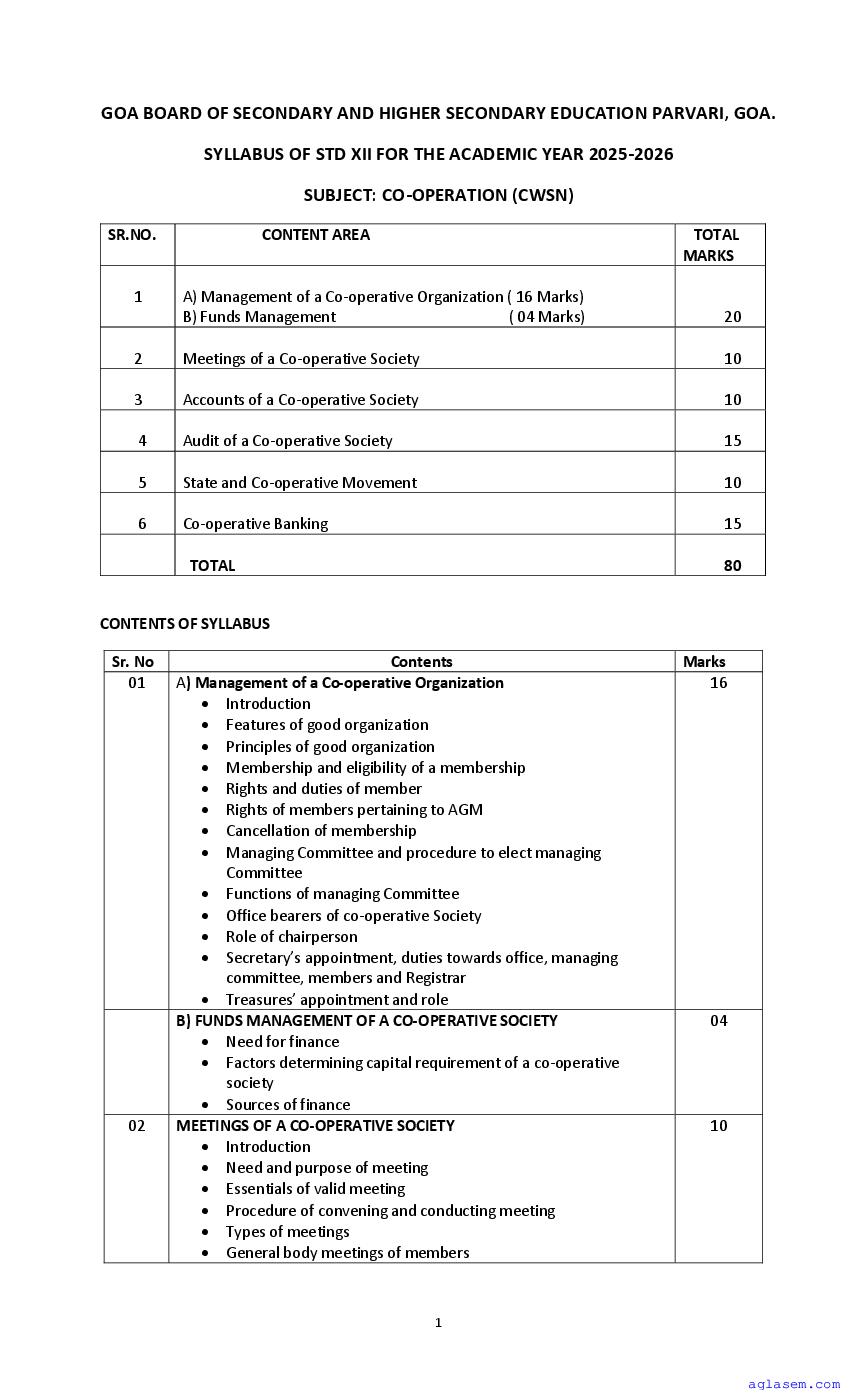
SYLLABUS OF STD XII FOR THE ACADEMIC YEAR 2025-2026
SUBJECT: CO-OPERATION (CWSN)
SR.NO. CONTENT AREA TOTAL
MARKS
1 A) Management of a Co-operative Organization ( 16 Marks)
B) Funds Management ( 04 Marks) 20
2 Meetings of a Co-operative Society 10
3 Accounts of a Co-operative Society 10
4 Audit of a Co-operative Society 15
5 State and Co-operative Movement 10
6 Co-operative Banking 15
TOTAL 80
CONTENTS OF SYLLABUS
Sr. No Contents Marks
01 A) Management of a Co-operative Organization 16
• Introduction
• Features of good organization
• Principles of good organization
• Membership and eligibility of a membership
• Rights and duties of member
• Rights of members pertaining to AGM
• Cancellation of membership
• Managing Committee and procedure to elect managing
Committee
• Functions of managing Committee
• Office bearers of co-operative Society
• Role of chairperson
• Secretary’s appointment, duties towards office, managing
committee, members and Registrar
• Treasures’ appointment and role
B) FUNDS MANAGEMENT OF A CO-OPERATIVE SOCIETY 04
• Need for finance
• Factors determining capital requirement of a co-operative
society
• Sources of finance
02 MEETINGS OF A CO-OPERATIVE SOCIETY 10
• Introduction
• Need and purpose of meeting
• Essentials of valid meeting
• Procedure of convening and conducting meeting
• Types of meetings
• General body meetings of members
1
Page 2
transacted
• Annual General Meeting business transacted
• Special General Meeting
• Managing Committee Meeting business transacted
• Meetings of committee of managing committee or Board
• Powers and duties of chairperson related to meeting
• Duties of secretary towards the conduct of AGM
03 ACCOUNTS OF A CO-OPERATIVE SOCIETY 10
• Introduction
• Need and importance of accounts
• Books of accounts of co-operative society
• Statutory books
• Non-statutory books
• Study of important statutory books
• Register of Members
• Register of shares
• Register of Debentures
• Minutes books
• Stock Register
• Property register
• Finalization of accounts of a co-operative society
• Contents of final accounts
• Statutory requirements for publication of final accounts
• Guidelines for Appropriation of profit earned by a co-operative
society
04 AUDIT OF A CO-OPERATIVE SOCIETY 15
• Introduction to audit
• Objects of audit
• Advantages of audit
• Types of audit
• Annual audit
• Interim audit
• Continuous audit
• Internal audit
• Qualification of an auditor
• Rights of auditor
• Preparation of the audit
• Audit Programme and its contents
• Audit note book and its contents
• Audit Memorandum and its contents
• Audit classification
• Rectification of errors or defects in accounts
• Weakness of audit system
05 STATE AND CO-OPERATIVE MOVEMENT 10
• Introduction
• Constitutional status of co-operatives
• Government contribution at time of distress
• Co-operative Department in Goa (only to provide knowledge to
students not to be evaluated for exams)
• Functions of co-operative department
• Statutory and developmental functions
• Role of Registrar of Co-operative Societies
• Powers of Registrar of Co-operative societies
• Reports and returns to be submitted to the Registrar
2
Page 3
• Need and nature
• Special features of Co-operative Banking
• Role of co-operative bank in supply of credit to agricultural
sector
• Importance of agricultural economy
• Financial need of agricultural sector
• Sources of credit to agricultural sector individual and
institutional sources
• Distinguish between co-operative banks and commercial banks,
agricultural credit societies and non- agricultural credit societies
• Defects in working of co-operative banks
• Suggestions for betterment of co-operative banks
Total 80
INTERNAL EVALUATION FOR CO-OPERATION (CWSN) SUBJECT:
MID TERM EXAMINATION 2025-26
SUBJECT: CO-OPERATION(CWSN) MAX.MARKS: 20
STD :XII DURATION : 90 MIN
MARKS WEIGHTAGE TO CONTENT AREA
SR.NO NAME OF THE UNIT TENTATIVE MARKS
TIME TO BE
HELD
1. A) Management of a Co-operative society - 08 Mks JULY/AUG 12
B) Funds Management -04 Mks
2. Meetings of a Co-operative society 08
TOTAL 20
MID TERM EXAMINATION - 2025-26
STANDARD XII SUBJECT: CO-OPERATION(CWSN)
QUESTIONWISE DISTRIBUTION OF MARKS
SR.NO. NAME OF THE UNIT V.S.A-I V.S.A-II S.A -I S.A-II TOTAL
MCQ
1. (A)Management of a 1(4) 1(2) ___ 2(1)* 08
Co-op. Organization
(B) Funds Management 1(3) -------- 1(1) _____ 04
2. Meetings of a Co-op. 1(3) 1(3) 1(2) _____ 08
TOTAL 10 (10) 5(5) 3(3) 2(1) 20
NOTE:
1) (*)Indicates internal choice in the question.
2) Figures inside the bracket indicate no. of question.
3
Page 4
4) A teacher is permitted to make a choice in V.S.A-II as True or False/ Fill in the blanks/Name
the following.
5) The above blueprint is a sample and the original may differ, keeping the content area and
marks same by the paper setter. The internal choice questions must be as per Topics/Units
mentioned above.
6) It is at the teacher’s discretion to include more number of topics/units for mid term
examination and accordingly change the weightage to content area.
FIRST TERMINAL EXAMINATION 2025-26
SUBJECT: CO-OPERATION(CWSN) MAX.MARKS:40
STD: XII DURATION : 2 Hrs
MARKS WEIGHTAGE TO CONTENT AREA
SR.NO NAME OF THE UNIT MARKS
1. A) Management of a Co-operative Organization (08 Marks)
B) Funds Management (04 Marks) 12
2. Meetings of a Co-operative Society 08
3. Accounts of a Co-operative Society 10
4. Audit of a Co-operative Society 10
TOTAL 40
FIRST TERMINAL EXAMINATION - 2025-26
STANDARD XII SUBJECT: CO-OPERATION(CWSN)
QUESTIONWISE DISTRIBUTION OF MARKS
SR.NO. NAME OF THE UNIT V.S.A-I V.S.A-II S.A -I S.A-II TOTAL
MCQ
1. (A)Management of a 1(4) 1(2) ___ 2(1)* 08
Co-op. Organization
(B) Funds Management 1(2) ----- 1(2) ------- 04
2. Meetings of a Co-
operative Society 1(5) 1(3) ------- ------- 08
3. Accounts of a Co-
operative Society 1(5) 1(2) 1(3) -------- 10
4. Audit of a Co-op.Society 1(4) 1(3) 1(1) 2(1)* 10
TOTAL 20 (20) 10 (10) 6 (6) 4(2) 40
NOTE:
1) (*) indicates internal choice in the question.
2) Figures inside the bracket indicate no. of question.
3) Figures outside the bracket indicate no. of marks.
4) A teacher is permitted to make a choice in V.S.A-II as True or False/ Fill in the blanks/Name
the following.
5) The above blueprint is a sample and the original may differ, keeping the content area and
marks same by the paper setter. The internal choice questions must be as per Topics/Units
mentioned above.
6) It is at the teacher’s discretion to include more number of topics/units for First term
examination and accordingly change the weightage to content area.
4
Page 5
Weightage for Assignment/Project will be as given below:
1. Introduction of topic 2 Marks
2. Presentation PPT/Handwritten 3 Marks
3. Content covered 8 Marks
4. Summary /Conclusion 2 Marks
5. Viva 5 Marks
TOTAL 20 Marks
NOTE:
The evaluation of the student is based on the following information presented
on any ONE of the below mentioned topics. Also, a teacher is permitted to ask
students to collect further more relevant information on the below mentioned
topics.
1) Visit to Primary credit Co-operative Societies or Urban Co-operative
Banks.
Guidelines/Criteria
a) Collect Information on the different sources of finance.
b) Find out how the funds collected from different Sources are utilized.
c) Future prospects of the society/Bank for the community development.
2) Visit a co-operative society and collect information on the role of the
office bearer.
Guidelines/Criteria
a) Find out the names of the office bearers of society.
b) Appointment and Tenure of the office bearers.
c) Role and responsibilities of office bearers.
3) Types of loan Sanctioned for the development of the agricultural Sector.
Guidelines / Criteria.
a) Different types of loans provided to the farmers.
b) The Procedure followed for sanctioning of loans.
c) Any special Schemes for farmers to develop the agricultural sector.
d) Interest rate on Loans
4) Collect Information on Bye-laws and its amendments.
Guidelines / Criteria.
a) Objectives of Bye-laws of the society.
b) Preparation of Bye-laws.
c) The Procedure for amendments of Bye-laws.
d) Information on the Contents of Bye-laws.
5
Page 6
Society and write a report on his role.
Guidelines/Criteria:
a) Highlight the role and Functions
b) Registration Process of a co-operative society.
c) Role in organizing training Programmes.
d) Co-operative week observed in Goa.
6) Statutory and non- statutory Books maintained by a Co-operative society.
Guidelines/ Criteria
a) Importance of maintaining Books of Accounts in a Co-operative Society.
b) Information on types of Statutory and Non- statutory Books.
c) Consequences of Non-Maintaining of Statutory Books.
d) Collect specimen copies of Vouchers, Financial Statement of the society etc.
7) Case Study of any Co-operative Society on its audit.
Guidelines/ Criteria: -
a) Information on objectives of Audit and Types of Audit of a Co-operative
Society.
b) Role of Auditor in a Co-operative Society
c) Advantages of Auditing.
d) Collect a specimen copy of Audit Report and interpret its financial status.
8) interview by the student with any member of a Co-operative Society
Guidelines/ criteria: -
a) Brief background of co-operative society in which he has taken
membership.
b) Reason to become a member of the said society, amount of entrance fee
and annual subscription.
c) Rights and duties of members, election in the society, schemes for
members and reasons for cancellation of membership.
d) Social commitments of said society.
(Pls. note : Teachers are also permitted to choose any other similar topics.)
6
Page 7
SUBJECT: CO-OPERATION (CWSN)
STANDARD XII
MAX. MARKS 80 DURATION 3 ½ hrs.
QUESTIONWISE DISTRIBUTION OF MARKS:
MCQ’s FILL IN TRUE Name
SR. NAME OF THE UNIT THE OR the S.A-I S.A-II TOTAL
NO. BLANKS FALSE following
1. A) Management 1(3) 1(3) 1(3) 1(3) 1(2) 2(1)
of a Co-op.Org.
(16 Mks)
B) Funds Mangt. 1(2) 1(1) 1(1) _____ _____ _____
(04 Mks) 20
2. Meetings of a Co-
op. Society 1(3) 1(2) 1(1) 1(1) 1(1) 2(1) 10
3. Accounts of a Co-
op. Society 1(3) 1(1) ------ 1(2) 1(2) 2(1)* 10
4. Audit of a Co-op.
Society 1(3) 1(3) 1(3) 1(2) 1(2) 2(1) 15
5. State and Co-op.
Movement 1(3) 1(2) 1(3) 1(1) 1(1) ------- 10
6. Co-operative
Banking 1(3) 1(3) 1(4) 1(1) 1(2) 2(1)* 15
TOTAL 20(20) 15(15) 15(15) 10(10) 10 (10) 10 (05) 80
NOTE:
1) (*) Indicates internal choice in the question.
2) Figures inside the bracket indicate no. of questions.
3) Figures outside the bracket indicate no. of marks.
4) The above blueprint is a sample and the original may differ, keeping the content area and
marks same by the paper setter.
5) The internal choice questions must be as per Topics/Units mentioned in the above blue
print. Kindly refer to the Final examination model question paper 2023-24
7
Page 8
ACADEMIC YEAR 2025 -26
SUBJECT: CO-OPERATION (CWSN)
STANDARD: XII
Max marks 80 Duration 3 ½ hrs.
INSTRUCTIONS:
1. All questions are compulsory
2. Answers are to be written in the space, provided below each question.
3. Question no. 01 to 20 are MCQ’s of 01 mark each.
4. Question No 21 to 35 are fill in the blanks of 01 mark each.
5. Question No 36 to 50 are true or false statement of 01 mark each.
6. Question No 51 to 60 are name the following of 01 mark each.
7. Question No 61 to 70 are answer in one sentence of 01 mark each.
8. Question No 71 to 75 are of answer in two sentences of 02 mark each.
9. Internal choice has been provided in question no 73 and 75.
Select the correct alternative from the options given below:
01. Member of a co-operative society is also called as _______________
• Administrator
• Registrar
• Employee
• Owner
02. Distribution of work according to the skills of person means ____________
• Co-ordination
• Division of labour
• Continuity
• Flexibility
03. The authority who is in charge and the main trustee of the affairs of the co-operative society
is _________________
• Secretary
• Chairperson
• Treasurer
• Registrar
04. Which of the following is referred as a king-pin of business of a co-operative society?
• Machinery
• Raw materials
• Finance
• Manpower
05. Finance which maintains general solvency and credit of a co-operative society is _________
• Entrance fees
• Grants and subsidies
• Deposits
• Internal finance
8
Page 9
• First General Meeting
• Managing Committee Meeting
• Annual General Meeting
• Special General Meeting
07. The authority empowered to control and guide the discussion during the meeting of a co-
operative society is ___________________
• Members
• Secretary
• Chairperson
• Registrar
08. The notice of General Body Meeting of a co-operative society should be given to all the
members before _______________________
• 14 days
• 10 days
• 07 days
• 08 days
09. The book in which decisions taken by the managing committee are recorded is called
______________________
• Audit note book
• Minutes book
• Ledger book
• Cash book
10. Which of the following register mentions the reasons for ceasing of membership
_______________________
• Stock register
• Debenture register
• Member’s register
• Property register
11. The statutory book which shows the amount of debentures held is _____________________
• Stock register
• Debenture register
• Share register
• Property register
12. The scheme of audit work carried out by an auditor is _____________
• Audit Programme
• Audit note book
• Audit preparation
• Audit memorandum
13. The audit which is conducted before completion of the final audit is __________________
• Interim audit
• Continuous audit
• Annual audit
• Statutory audit
14. The report submitted by an auditor to the society and the Registrar after conducting an
audit is ____________________
• Annual report
• Annual returns
• Audit memorandum
• Project report
9
Page 10
______________________
• 1901
• 1904
• 1912
• 1914
16. The authority appointed as head of Co-operative Department is ___________________
• Manger
• Member
• Nominee
• Registrar
17. The Commission set up in the year 1928 to find out the needs of agriculture in India is
_______________
• Maclagan Commission
• Royal commission
• Nicholson Commission
• Fayol’s Commission
18. Repayment period for the long-term finance provided by the co-operative banks for
agricultural sector is ____________________
• 2 to 25 years
• 3 to 25 years
• 4 to 25 years
• 5 to 25 years
19. The main objective of co-operative bank is ____________________
• To make profit
• To provide service
• To control business sector
• To control employees
20. The working and management of co-operative banks should be essentially ____________
• Un organized and Non-co-operative
• Ineffective and Inefficient
• Efficient and impartial
• Inefficient and Partial
Select the correct answer from the bracket given below and fill in the blanks
(Dividend, Board of Directors, Auditing, Motion, Statutory Audit, 1969, Secretary,
Reserve Bank of India, State, Agenda, 1904, Treasurer, Entrance fees ,
Managing Committee, Auditor, )
21. The office Bearer who examines the legality of expenditure made during the functioning of
the society is ____________________
22. The authority appointed to look after the correspondence of a co-operative society is
___________________
23. The authority empowered to appoint office bearer of a co-operative society is ___________
24. The finance collected at the time of admission of a member of a co-operative society is
___________________
25. A statement of items to be discussed at the meeting is called _______________________
26. The proposal placed before a meeting for discussion and decision is called
___________________
10
Page 11
_____________________
28. A system which is mainly conducted to prevent errors and frauds is _________________
29. The person who audits the account of the society is called as ______________________
30. Audit class is given to a co-operative society on completion of ____________________
31. The Co-operative Societies Act that stressed on formation of only credit societies was passed
in the year _____________
32. The recommendations for improvement of co-operative movement were made at the
conference by co-operative ministers in the year _____________________
33. The State Co-operative Bank is called as an apex bank at the ____________________ level.
34. The Central Apex Institution that provides finance to other co-operative Banks is
______________________
35. The members of co-operative bank elect their representatives for management of society is
called as ____________________________
State whether the following statements are true or false.
36. A member of a co-operative society can appoint a proxy.
37. The State Government or the Central Government can also become the member of a co-
operative society.
38. If the membership fee of a member is not paid in time than his membership stands
cancelled.
39. A society cannot collect deposits from family of its own members and from general public.
40. The casting vote is exercised by the Secretary in the meeting.
41. The Annual Audit is also known as a statutory Audit.
42. The Rural Banking Inquiry Committee was set up in the year 1945.
43. The Internal Audit Department of a co-operative society is headed by the Chief Internal
Auditor.
44. The Agricultural Credit Co-operative Societies are spread in rural areas.
45. The auditor has right to give vote in the meeting of a co-operative society.
46. The factors responsible for distress of a co-operative were pointed out by Dr. E.M Hough.
47. The Co-operative Department provides co-operative education and training to the members
of a co-operative society.
48. Loan taken from the money lenders is an example of Institutional level source of credit
finance available to agricultural sector.
49. Non-agricultural Credit Societies are fully dependent on Government finance as the
members cannot raise their funds.
50. The Registrar does not allow to make change in the existing name of the bank.
Name the following: -
51. The principle which allows an organization to accept business and technical changes easily
and economically.
52. The elected representatives of the shareholders exercising managerial and statutory
powers.
53. The process of identifying and grouping the work to be performed.
54. The authority who can call the First General Meeting of a co-operative society.
55. The Statutory book of account maintained by the co-operative society to record the goods
brought and sold.
56. The statement of account which shows the financial position of the co-operative society on
a particular date.
57. An audit which involves more detailed examination of accounts at frequent intervals.
11
Page 12
their Annual General Meeting.
59. The authority appointed by the State Government to regulate the working of co-operative
societies in the state.
60. The Act under which the Commercial Banks are governed in India.
Answer the following questions in one sentence/point each: -
61. Mention any one of the functions carried out by the managing committee.
62. State any one duty of the secretary of a co-operative society towards the office.
63. State any one item of the business to be transacted at the Annual General Meeting.
64. Mention one reason why a co-operative society maintain books of accounts?
65. State any one contents of register of shares.
66. Mention any one the objective of auditing.
67. State the meaning of audit note book
68. Mention any one point on the supervisory role exercised by the Registrar of Co-operative
Societies.
69. Write one example institutional level sources of credit available to agricultural sector.
70. Distinguish between Co-operative Bank and Commercial Bank. (one Point)
Answer the following questions in two sentence/points each.
71. Mention any two reasons for cancellation of membership of a member of a co-operative
society.
72. What are the main purposes of holding meeting of a co-operative society. (any two points)
73. State the meaning of any contents of final accounts.
OR
State the meaning of statutory and non-statutory books of accounts.
74. Specify any two advantages of auditing.
75. State any two defects found in working of the co-operative banks in India.
OR
State any two suggestions to improve the working of co-operative banks in India.
---------------------------------------**********************-------------------------------------------
ANSWER KEY OF MODEL PAPER
MCQ’S 39 False
1 Owner 40 False
2 Division of labour 41 True
3 Chairperson 42 False
4 Finance 43 True
5 Internal finance 44 True
6 Annual General Meeting 45 False
7 Chairperson 46 True
8 14 days 47 True
9 Minutes book 48 False
10 Member’s register 49 False
11 Debenture register 50 False
12 Audit Programme Name the following
13 Interim audit 51 Principle of flexibility
14 Audit memorandum 52 Managing committee
15 1912 53 Organization
16 Registrar 54 Chief promoter
17 Royal Commission 55 Stock register
18 5 to 25 years 56 Balance sheet
12
Page 13
20 Efficient and impartial 58 Annual audit
59 Registrar
Fill in the blanks 60 Banking Regulation Act 1949
21 Treasurer
22 Secretary SA -I
23 Managing committee 61 Refer T.B page no 09
24 Entrance fees 62 Refer T.B page no 14
25 Agenda 63 Refer T.B page no 27
26 Motion 64 Refer T.B page no 31
27 Dividend 65 Refer T.B page no 34
28 Auditing 66 Refer T.B page no 41
29 Auditor 67 Refer T.B page no 47
30 Statutory audit 68 Refer T.B page no 65
31 1904 69 Refer T.B page no 115
32 1969 70 Refer T.B page no 120
33 State
34 Reserve Bank of India
35 Board of Directors 71 Refer T.B page no 07
72 Refer T.B page no 21
True or false 73 Refer T.B. page no 37 or 32
36 False 74 Refer T.B page no 43
37 True 75 Refer T.B page no 122 or 123
38 True
13
Document Details
| Board / Org | Goa Board |
| Exam | Class 12 |
| Type | Sample Paper |
| Pages | 13 |
| Updated | 24 Sep 2026 |