Goa Board Class 12 Sample Paper 2026 Political Science
Finished viewing? Save it for later —
Download Goa Board Class 12 Sample Paper 2026 Political Science (PDF · 34 pages)About Goa Board Class 12 Sample Paper 2026 Political Science
Goa Board Class 12 Sample Paper 2026 Political Science is available here for free download. Published by Goa Board for Class 12, this sample paper can be viewed online or downloaded as a PDF (34 pages). Candidates preparing for Class 12 can use Goa Board Class 12 Sample Paper 2026 Political Science to understand the exam pattern, the type of questions asked, and the overall difficulty level.
Frequently Asked Questions
How can I download Goa Board Class 12 Sample Paper 2026 Political Science?
Open this page and click the Download button to save Goa Board Class 12 Sample Paper 2026 Political Science as a PDF. It is completely free on AglaSem Docs.
Is Goa Board Class 12 Sample Paper 2026 Political Science free to download?
Yes. Goa Board Class 12 Sample Paper 2026 Political Science can be viewed online and downloaded as a PDF free of cost on AglaSem Docs.
How many pages does Goa Board Class 12 Sample Paper 2026 Political Science have?
Goa Board Class 12 Sample Paper 2026 Political Science contains 34 pages, which you can read online or download together as a single PDF.
Where can I find more Class 12 study material?
You can find more Class 12 question papers, sample papers, syllabus, and answer keys on AglaSem Docs.
Goa Board Class 12 Sample Paper 2026 Political Science – Text
Read the full text of this sample paper below — useful to quickly search, copy and reference the content online without downloading the PDF.
📄 View text version (34 pages)
Page 1
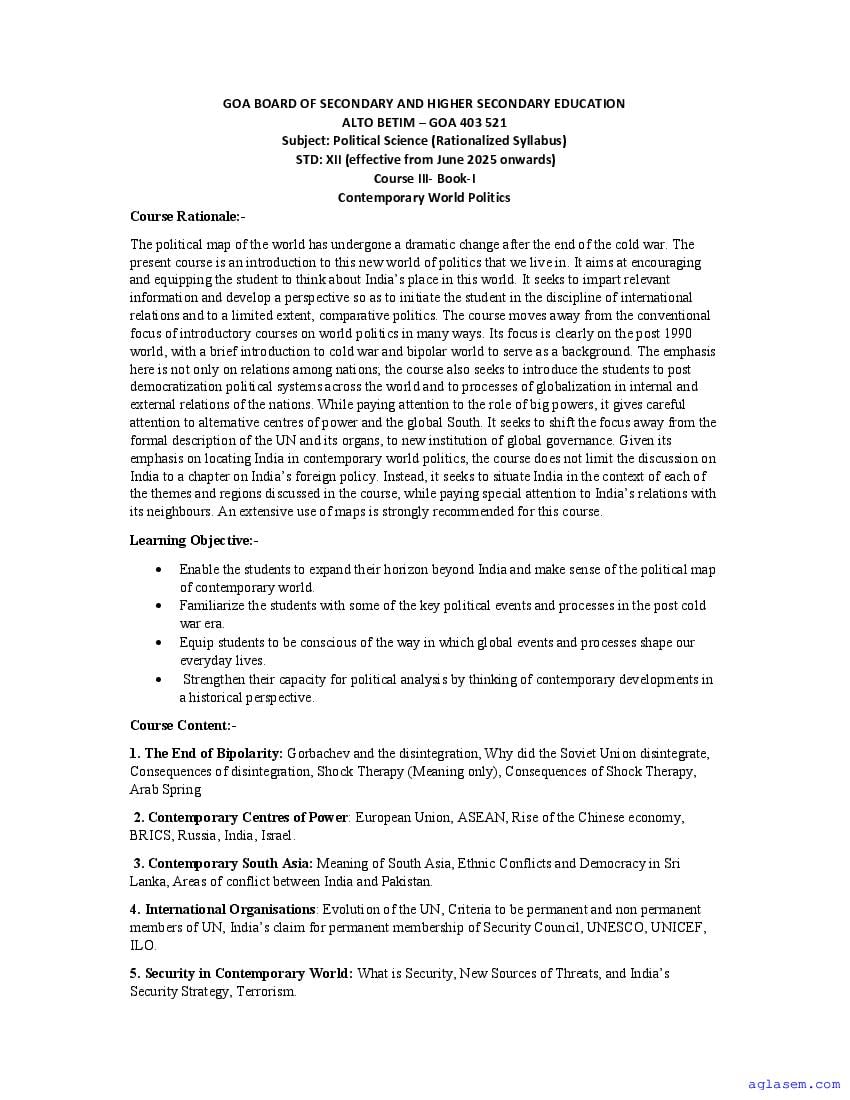
ALTO BETIM – GOA 403 521
Subject: Political Science (Rationalized Syllabus)
STD: XII (effective from June 2025 onwards)
Course III- Book-I
Contemporary World Politics
Course Rationale:-
The political map of the world has undergone a dramatic change after the end of the cold war. The
present course is an introduction to this new world of politics that we live in. It aims at encouraging
and equipping the student to think about India’s place in this world. It seeks to impart relevant
information and develop a perspective so as to initiate the student in the discipline of international
relations and to a limited extent, comparative politics. The course moves away from the conventional
focus of introductory courses on world politics in many ways. Its focus is clearly on the post 1990
world, with a brief introduction to cold war and bipolar world to serve as a background. The emphasis
here is not only on relations among nations; the course also seeks to introduce the students to post
democratization political systems across the world and to processes of globalization in internal and
external relations of the nations. While paying attention to the role of big powers, it gives careful
attention to alternative centres of power and the global South. It seeks to shift the focus away from the
formal description of the UN and its organs, to new institution of global governance. Given its
emphasis on locating India in contemporary world politics, the course does not limit the discussion on
India to a chapter on India’s foreign policy. Instead, it seeks to situate India in the context of each of
the themes and regions discussed in the course, while paying special attention to India’s relations with
its neighbours. An extensive use of maps is strongly recommended for this course.
Learning Objective:-
Enable the students to expand their horizon beyond India and make sense of the political map
of contemporary world.
Familiarize the students with some of the key political events and processes in the post cold
war era.
Equip students to be conscious of the way in which global events and processes shape our
everyday lives.
Strengthen their capacity for political analysis by thinking of contemporary developments in
a historical perspective.
Course Content:-
1. The End of Bipolarity: Gorbachev and the disintegration, Why did the Soviet Union disintegrate,
Consequences of disintegration, Shock Therapy (Meaning only), Consequences of Shock Therapy,
Arab Spring
2. Contemporary Centres of Power: European Union, ASEAN, Rise of the Chinese economy,
BRICS, Russia, India, Israel.
3. Contemporary South Asia: Meaning of South Asia, Ethnic Conflicts and Democracy in Sri
Lanka, Areas of conflict between India and Pakistan.
4. International Organisations: Evolution of the UN, Criteria to be permanent and non permanent
members of UN, India’s claim for permanent membership of Security Council, UNESCO, UNICEF,
ILO.
5. Security in Contemporary World: What is Security, New Sources of Threats, and India’s
Security Strategy, Terrorism.
Page 2
environmental issues / Steps taken by Indian government to protect Environment, Resource
Geopolitics, The indigenous peoples and their Rights. (Only India)
7. Globalization: Concept of Globalization, Causes of Globalization, Political Consequences,
Economic Consequences, Cultural Consequences.
Course IV Book-II: Politics in India since Independence
CourseRationale:-
It is a common experience that the younger generation of citizens does not know very much about the
first and formative fifty years in the history of independent India. They often know more about India
of 1920s and 1940s than they do about any decade in post independence period including even the
1990s. This course seeks to fill this lacuna with a view to providing the students with information and
perspective that would help them in their further study of Political Science and their role as a citizen.
That is why there is a focus on political history; other dimensions are brought in only to the extent
they impinge on political history. In doing so, the course seeks to incorporate the lessons learnt from
the discipline of history: that history must not become a mere chronicle of dates and events, that it
should be integrated into an analytical narrative, that the history of politics must not become a narrow
history of national political events and personalities and that history writing must not take place from
a narrow partisan angle. The syllabus has to be illustrative rather than comprehensive; the idea is to
identify some major developments in any period and then illustrate it with some events and
personalities at the national level as well as in a select state or region. It is suggested that some of the
recent political developments should be handled in general terms avoiding reference to persons active
in today’s politics.
Learning Objectives:-
Enable students to be familiar with some of the key political events and figures in the post-
independence period
Develop skills of political analysis through events and processes of recent history
Develop their capacity to link macro processes with micro situations and their own life
Encourage the students to take a historical perspective of making sense of the contemporary
India.
Course Contents:-
1. Nation Building and its Problems: Three Challenges, Process of Partition, Consequences of
Partition, Integration of Princely States (Hyderabad, Manipur), Patel and National Integration.
2. Era of One- Party Dominance: Challenges of building democracy (difficulties faced by Election
Commission), Congress Dominance in the First Three General Elections, Emergence of Opposition
Parties.
3. Politics of Planned Development: Planning, Five Year Plans, Green Revolution, NITI Aayog,
National Development Council(NDC)
4. India’s External Relations: Nehru’s Role, Afro Asian Unity, The Chinese Invasion of 1962,
Bangladesh War 1971, India’s Nuclear Policy.
5. Challenges to and Restoration of Congress System: The Fourth General Elections 1967, Split in
the Congress, The Presidential Elections 1969, The 1971 Election and Restoration of Congress(The
contest, the outcome and after).
Page 3
Prakash Narayan, Ram Manohar Lohia and Socialism, Deendayal Upadhyaya and integral Humanism,
Democratic Upsurges.
7. Regional Aspirations and Conflicts: Punjab, The North East States (Assam), lessons from
regional aspirations, The Kashmir issue.
8. Recent Issues and Challenges: Political Rise of the OBC’s: Mandal implemented, political
fallouts, NDA III & IV, Issues of Development and Governance
Course Content: First Formative Test
1. The End of Bipolarity: Gorbachev and the disintegration, Why did the Soviet Union disintegrate,
Consequences of disintegration, Shock Therapy (Meaning only), Consequences of Shock Therapy,
Arab Spring
2. Contemporary Centres of Power: European Union, ASEAN, Rise of the Chinese economy,
BRICS, Russia, India, Israel.
3. Contemporary South Asia: Meaning of South Asia, Ethnic Conflicts and Democracy in Sri
Lanka, Areas of conflict between India and Pakistan.
4. International Organisations: Evolution of the UN, Criteria to be permanent and non permanent
members of UN, India’s claim for permanent membership of Security Council, UNESCO, UNICEF,
ILO.
5. Security in Contemporary World: What is Security, New Sources of Threats, and India’s
Security Strategy, Terrorism.
6. Environment & Natural Resources: Environmental Concerns in Global Politics, India’s stand on
environmental issues / Steps taken by Indian government to protect Environment, Resource
Geopolitics, The indigenous peoples and their Rights. (Only India)
Blue print
Unit Unit Knowledge Understanding Application Total no. of
No
qs. & marks
MCQ SAI SAII LA VS SAI SAII L VSA SAI SAII LA
A A
BOOK I
1 End of 1(1) 11(4) 2(5)
Bipolarity
2 Contemporary 2(1) 6(2) 2(3)
centres of
power
3 Contemporary 3(1) 10(3)* 2(4)
South Asia
4 International 4(1) 7(2) 2(3)
organization
5 Security in 8(2) 1(2)
Contemporary
World
6 Environment & 5(1) 9(2) 2(3)
Natural
Resources
Total 05=25% 11=55% 04=20% 11(20)
NOTE: 1. Figures outside the brackets indicates the question no. and figure within the bracket
indicates marks allotted to the question. 2. * in a particular cell indicates internal option.
Page 4
GOA BOARD OF SECONDARY AND HIGHER SECONDARY EDUCATION
ALTO BETIM – GOA 403 521
Std: XII
Subject: Political Science Time Duration: 1 Hour
Date: ____August ________ First Formative Test Max Marks: 20
___________________________________________________________________________
Instructions:
1. All questions are compulsory.
2. The question paper consists of 11 questions.
3. Question nos. 1to 5 are MCQ and carry one mark each. Question nos. 6 to 9 are to be answered in
40 words each and carry 2 marks each. Question no. 10 is to be answered in 60 words any carry 3
marks. Question no. 11 is to be answered in 100 words and 4 marks.
4. There is no overall choice in the paper. However, internal choice is provided in question no. 10 of
3 marks.
___________________________________________________________________________
1. The roots of Arab Spring are located in ______________.
• Greece
• Tunisia
• Afghnistan
• Pakistan
2. BRICS was founded in 2006 in _________.
• Brazil
• China
• India
• Russia
3. In 1987, the Government of Indian sent the Indian Peace Keeping Force (IPKF) to_______.
• Bangladesh
• Nepal
• Sri Lanka
• Bhutan
4. The headquarters of the International Labour Organization is in _______________.
• Japan
• Geneva
• Brazil
• Russian Federation
5. In India the description Indigenous People is applied to ________________.
• Scheduled Tribes
• Other Backward Classes
• Scheduled Castes
• Minorities
6. Explain any two causes for the rise of the Chinese economy?
Page 5
8. Explain any two new sources of threat.
9. Discuss any two steps taken by the Government of India to protect environment.
10. Analyse the areas of conflict between India and Pakistan.
OR
Explain the ethnic conflict in Sri Lanka.
11. Examine the consequences of disintegration of Soviet Russia.
_________________________________END__________________________________
First Term Exam
Course Content:-
1. The End of Bipolarity: Gorbachev and the disintegration, Why did the Soviet Union disintegrate,
Consequences of disintegration, Shock Therapy (Meaning only), Consequences of Shock Therapy,
Arab Spring
2. Contemporary Centres of Power: European Union, ASEAN, Rise of the Chinese economy,
BRICS, Russia, India, Israel.
3. Contemporary South Asia: Meaning of South Asia, Ethnic Conflicts and Democracy in Sri
Lanka, Areas of conflict between India and Pakistan.
4. International Organisations: Evolution of the UN, Criteria to be permanent and non permanent
members of UN, India’s claim for permanent membership of Security Council, UNESCO, UNICEF,
ILO.
5. Security in Contemporary World: What is Security, New Sources of Threats, and India’s
Security Strategy, Terrorism.
6. Environment & Natural Resources: Environmental Concerns in Global Politics, India’s stand on
environmental issues / Steps taken by Indian government to protect Environment, Resource
Geopolitics, The indigenous peoples and their Rights. (Only India)
7. Globalization: Concept of Globalization, Causes of Globalization, Political Consequences,
Economic Consequences, Cultural Consequences.
1. Nation Building and its Problems: Three Challenges, Process of Partition, Consequences of
Partition, Patel and National Integration.
2. Era of One- Party Dominance: Challenges of building democracy (difficulties faced by Election
Commission), Congress Dominance in the First Three General Elections, Emergence of Opposition
Parties.
3. Politics of Planned Development: Planning, Five Year Plans, Green Revolution, NITI Aayog,
National Development Council(NDC)
4. India’s External Relations: Nehru’s Role, Afro Asian Unity, The Chinese Invasion of 1962,
Bangladesh War 1971, India’s Nuclear Policy.
5. Challenges to and Restoration of Congress System: The Fourth General Elections 1967, Split in
the Congress, The Presidential Elections 1969, The 1971 Election and Restoration of Congress(The
contest, the outcome and after).
Page 6
Unit Unit Knowledge Understanding Application Total no. of
No
qs. & marks
MCQ SAI SAII LA VS SAI SAII LA VS SAI SAI LA
A A I
BOOK I
1 End of 1(1) 36(4)* 4(7)
Bipolarity 2(1)
3(1)
2 Contemporary 4(1) 21(2) 30(3) 4(7)
centres of 5(1)
power
3 Contemporary 6(1) 37(4) 38(4) 4(10)
South Asia 7(1)
4 International 8(1) 22(2) 31(3) 4(7)
organization 9(1)
5 Security in 23(2) 32(3) 2(5)
Contemporary
World
6 Environment & 10(1) 24(2) 33(3) 4(7)
Natural 11(1)
Resources
7 Globalisation 12(1) 25(2) 39(4) 3(7)
BOOK II
8 Challenges to 13(1) 26(2) 40(4) 5(9)
nation building 14(1)
15(1)
9 Era of one party 16(1) 34(3) 2(4)
dominance
10 Politics of 17(1) 27(2) 35(3)* 3(6)
Planned
Development
11 India’s external 18(1) 41(4)* 4(7)
relations 19(1)
20(1)
12 Challenges to 28(2) 2(4)
and Restoration 29(2)
to Congress
system
Total 20=25% 44=55% 16=20% 41(80)
NOTE: 1. Figures outside the brackets indicates the question no. and figure within the bracket
indicates marks allotted to the question. 2. * in a particular cell indicates internal option.
Page 7
ALTO BETIM, GOA – 403521
MODEL QUESTION PAPER (2024 onwards)
FIRST TERM EXAMINATION
STD :- XII Duration:- 3 hrs
Max Marks:- 80 SUB: POLITICAL SCIENCE
INSTRUCTIONS:
1. All questions are compulsory.
2. The question paper consists of 41 questions.
3. Question number 1 to 20 is MCQ and carries 01 mark each.
4. Question number 21 to 29 carry 2 marks each and should be answered in 40 words each.
5. Question number 30 to 35 carry 3 marks each and should be answered in 60 words each.
6. Question number 36 to 41 carry 4 marks each and should be answered in 100 words each.
7. There is no overall choice in the paper. However, internal choice is provided in Question number
35 of 3 marks and question number 36 and 41 of 4 marks.
_________________________________________________________________________
1. In 1985, reforms were introduced by _________________.
Nikita Khrushchev
Viktor Chernomyrdin
Boris Yeltsin
Mikhail Gorbachev
2. In Egypt, the leader who collapsed as a result of the massive democratic protests was
______________.
Gamal Abdel Nasser
Hosni Mubarak 1
Anwar Sadat
Mohamed Morsi
3. The first elected President of the Russian Federation after disintegration of USSR was ___.
Dimtry Medvedev
Viktor Chernomyrdin
Boris Yeltsin
Alexander Rutskoy
4. ASEAN was established in 1967 by Indonesia, Malaysia, the Philippines, Singapore and____.
Bhutan
Taiwan
Thailand
Maldives
5. A milestone of Indian economy in the field of science and technology is a scheme called
______________.
Make in Calcutta
Make in Mumbai
Page 8
Make in India
6. In 1987, the Government of Indian sent the Indian Peace Keeping Force (IPKF) to_______.
Bangladesh
Nepal
Sri Lanka
Bhutan
7. In 1998, India conducted nuclear explosion in __________.
Chagai Hills
Pokhran
Lop Nur
Semipalatinsk
8. One of the permanent members of the UN Security Council is _______________.
Japan
Germany
Brazil
Russian Federation
9. The UN was founded as a successor to the ________________.
League of Nations
ILO
IMO
WFP
10. The world’s single largest producer of oil is _______.
Iraq
Iran
Saudi Arabia
Kuwait
11. One of the countries that were exempted from the requirement of Kyoto Protocol was
________.
USA
India
Britain
France
12. Greater economic flow among different countries of the world is _____________.
Political globalization
Cultural globalization
Economic globalization
Social globalization
13. The leader who faced key challenges of integration from Hyderabad, Junagarh and Kashmir was .
Page 9
Jawaharlal Nehru
V.Krishna Menon
Dr. Rajendra Prasad
14. The undisputed leader of the North Western frontier province, Khan Abdul Gaffar Khan was
known as ______.
Frontier Gandhi
Mahatma Gandhi
Bapu
Lokmanya
15. The Home Minister of India who was known as the ‘Iron man of India’ was _______.
Sardar Vallabhbhai Patel
Lal Bahadur Shastri
Jawaharlal Nehru
Morarji Desai
16. After the first general elections in India, the Prime Minister was __________.
Dr. Rajendra Prasad
Sardar Vallabhbhai Patel
Jawaharlal Nehru
Dr. Radha Krishnan
17. The Second Five Year Plan was drafted by a team of economists and planners under the
leadership of ___________.
Rajendra Prasad
P.C. Mahalonobis
K.N. Raj
Jawaharlal Nehru
18. The Tibetan spiritual leader who crossed over to India is ___________.
Dalai Lama
Mao Ze Dong
Xi Jinping
Deng Xiaoping
19. In 1955 the Afro-Asian conference was held in the Indonesian City of _____________.
Medan
Jakarta
Medan
Bandung
20. In the late 1940’s a nuclear programme in India was initiated under the guidance of ________.
Dr. C. V. Raman
Dr. Krishna Murthy
Page 10
Dr. Radhakrishnan
21. Explain the economic influence of the European Union.
22. Explain the main task of UNICEF.
23. Explain the meaning of Terrorism.
24. Explain any two issues of environmental concerns in global politics.
25. Discuss the political consequences of globalisation.
26. Explain any two challenges that independent India faced in nation building.
27. Explain any functions of the National Development Council.
28. Explain the outcome of the fourth general elections in India.
29. Discuss the issues that led to the formal split of the Indian National Congress in 1969.
30. Explain the political influence of the European Union.
31. Why does India claim for permanent membership of the UN Security Council?
32. Explain the components of Indian security strategy.
33. Discuss the steps taken by the Government of India to protect environment.
34. Explain the emergence of opposition parties in India.
35. Explain the key areas of the First Five Year Plan.
OR
Explain the key areas of the Second Five Year Plan
36. Examine the causes for the disintegration of the Soviet Union.
OR
Examine the consequences of Shock Therapy.
37. Discuss the areas of conflict between India and Pakistan.
38. Analyse the ethnic conflicts in Srilanka.
39. Explain the cultural consequences of globalization.
40. Examine the consequences of partition of India during 1947.
41. Examine the impact of Chinese invasion of 1962 on India.
OR
Examine India’s Nuclear Policy.
Page 11
Std XII (from June 2024 onwards.)
Objective:- To test the student’s ability to organize, describe, narrate, report, explain, persuade or
argue, present ideas coherently, present relevant arguments and use correct style and format.
Selection of the Topic:- The topic selected should be very specific so that it is manageable for the
student. The topics chosen should allow the students to draw on their experiences, reading and
must stimulate their imagination.
Length:- The essay / article should not exceed 350 to 400 words.
Presentation:- The assignment should be written by the student’s own handwriting on foolscap
paper, punched and submitted in a simple file. They must be instructed not to waste money on
colour print outs and decorative materials as the focus of the assignment would be on the relevance
of content, organisation originality etc. However, pictures, drawings would be welcomed if the
assignment requires it. Assignments could also be in the form of posters/ collage/ skit/ street
play/visits etc. Details such as student’s name, roll no, date, class are to be mentioned in the top
right hand corner of the cover. The title of the assignment is to be written in capital letters in the
centre of the corner.
Reference:- Reference material should be within the reach of the student and very easily obtained in
the library, newspaper, magazines and internet. Internet time should not exceed three to four hours.
The teacher should emphasize that the assignment has to be the student’s own work and not copied
from some books or downloaded from the internet.
Scoring Guide
Score of 20
An assignment in this category demonstrates clear and consistent mastery.
A typical Assignment should be-
Effectively and insightfully, develop a point of view on the issue and demonstrates
outstanding critical thinking, using clearly appropriate examples, reasons, and other
evidence to support its position.
Is well organized and clearly focused, demonstrating clear coherence and smooth
progression of ideas.
Exhibits skilful use of language, using a varied, accurate, and apt vocabulary.
Suggested Assignments/ Projects (Any one from the below topics for 20 marks to be selected by
student. In case of field work/ trip, report should be written as a part of the project. Students are
also free to make a video or reel of maximum 5 minutes, PPT, Posters, Models, Skit, Role play,
Interview, street play, collage, drawing, painting, etc.)
(Choose any One)
a) Threats- Covid 19/Poverty/Human Rights violation
b) Socio – economic and cultural dimensions of globalisation
c) Tour/field trip to Legislative assembly with report/reel/video/ppt
Page 12
e) New threats to human security with reference to terrorism
f) Integration of princely states
g) Green revolution
h) India’s Nuclear Policies
i) Emergency of 1975
j) Separatism- a threat to India’s unity and intergrity
The Criteria forthe evaluation of the Assignment / Projects should be based on the following
parameters:
Sr no. Criteria Marks
1 Content 04
2 Innovation O2
3 Skills 03
4 Reference material 02
5 Presentation 05
6 Viva/Group Discussion 04
Total 20
N.B.:The Teacher is free to suggest additional Assignments / Projects or even accept Assignments /
Projects suggested by the students, related to the syllabus of the subject. Suggested Assignments/
Projects should be of similar nature as proposed by the Board of Studies in Political Science
Blue print Final Board Examination (2025 onwards)
Unit Unit Knowledge Understanding Application Total no. of
No
qs. & marks
MCQ SAI SAII LA VS SAI SAII LA VS SAI SAI LA
A A I
BOOK I
1 End of 1(1) 36(4)* 3(6)
Bipolarity 2(1)
2 Contemporary 3(1) 37(4) 3(6)
centres of 4(1)
power
3 Contemporary 5(1) 38(4) 3(6)
South Asia 6(1)
4 International 7(1) 21(2) 30(3) 3(6)
organization
5 Security in 8(1) 22(2) 31(3) 3(6)
Contemporary
World
6 Environment & 9(1) 32(3) 4(6)
Natural 10(1)
Resources 11(1)
7 Globalisation 12(1) 33(3) 2(4)
BOOK II
1 Challenges to 13(1) 39(4)* 3(6)
nation building 14(1)
2 Era of one party 23(2) 2(4)
dominance 24(2)
Page 13
Planned 16(1) 26(2)
Development
4 India’s external 17(1) 40(4) 3(6)
relations 18(1)
5 Challenges to 27(2) 2(4)
and Restoration 28(2)
to Congress
system
6 Crisis of 19(1) 34(3) 3(5)
Democratic 20(1)
Order
7 Regional 29(2) 35(3)* 2(5)
Aspirations
8 Recent 41(4) 1(4)
Developments
in Politics
Total 20=25% 44=55% 16=20% 41(80)
NOTE: 1. Figures outside the brackets indicates the question no. and figure within the bracket
indicates marks allotted to the question. 2. * in a particular cell indicates internal option.
Model Question Paper- from March 2024 onwards
GOA BOARD OF SECONDARY AND HIGHER SECONDARY EDUCATION
ALTO BETIM – GOA 403 521
Std: XII Subject: Political Science Time Duration: 3 Hours
Date: ____FEBRUARY ________ Max Marks: 80
___________________________________________________________________________
Instructions:
1. All questions are compulsory.
2. The question paper consists of 41 questions.
3. Question no. 1 to 20 are MCQ and carry 1 mark each.
4. Question no. 21 to 29 carry 2 marks each and should be answered in 40 words each.
5. Question no. 30 to 35 carry 3 mark each and should be answered in 60 wards each.
6. Question no. 36 to 41 carry 4 marks each and should be answered in 100 wards each.
7. There is no overall choice in the paper. However, internal choice is provided in question no. 35 of
3 marks and 36 and 39 of 4 marks.
____________________________________________________________________
1. In Egypt, the leader who collapsed as a result of the massive democratic protests was
______________.
Gamal Abdel Nasser
Hosni Mubarak 1
Anwar Sadat
Mohamed Morsi
2. The first elected President of the Russian Federation after disintegration of the USSR was
______________.
Dimtry Medvedev
Page 14
Boris Yeltsin
Alexander Rutskoy
3. The 11th conference of the BRICS in Brazil was chaired by Brazilian President _________.
Cyril Ramaphosa
Luiz Inacio Lula da Silva
Jair Bolsonaro
Ram Nath Kovind
4. The currency of European Union is ____________________.
Pound Sterling
Euro
Swiss Franc
Danish Krone
5. In 1987, the Government of India sent the Indian Peace keeping Force (IPKF) to ______________.
Bangladesh
Pakistan
Nepal
Sri Lanka
6. In 1960s with the help of the World Bank, India and Pakistan signed the _______.
Ganga Water Treaty
Brahmaputra Water Treaty
Indus Water Treaty
Godavari Water Treaty
7. The headquarters of UNESCO is in __________.
Paris
Rome
New York
Berlin
8. Migration, business, tourism and military operations are the root causes of rapid spread
of__________ .
Terrorism
Global poverty
Human rights violation
Health epidemics
9. The Rio Summit held in June 1992 recommended a list of development practices called
_________.
Limits to growth
Agenda 21
Rio practices
Page 15
10. In India the description Indigenous People is applied to ________________.
Scheduled Tribes
Other Backward Classes
Scheduled Castes
Minorities
11. One of the countries that were exempted from the requirement of Kyoto Protocol was
________.
USA
India
Britain
France
12. Greater economic flow among different countries of the world is _____________.
Political globalization
Cultural globalization
Economic globalization
Social globalization
13. The Home Minister of India who was known as the ‘Iron man of India’ was _______.
Sardar Vallabhbhai Patel
Lal Bahadur Shastri
Jawaharlal Nehru
Morarji Desai
14. The leader who is popularly characterised as NCR in Indian political history is _______.
Sardar Vallabhbhai Patel
Jawaharlal Nehru
B.R. Ambedkar
Rajendra Prasad
15. The most significant and successful of the land reforms was the abolition of colonial system of
______________.
Sahukari
Kingship
Mukhiyagiri
Zamindari
16. The Second Five Year Plan was drafted by a team of economists and planners under the
leadership of ___________.
Rajendra Prasad
P.C. Mahalonobis
K.N. Raj
Jawaharlal Nehru
Page 16
Dr. C. V. Raman
Dr. Krishna Murthy
Dr. Homi Bhabha Jehangir
Dr. Radhakrishnan
18. Israeli embassy was opened in India in the year ________.
1991
1992
1993
1994
19. The election petition declaring Indira Gandhi’s election to the Lok Sabha as invalid was filled by
___________.
Jayaprakash Narayan
Ram Manohar Lohia
Jagmohan Lal Sinha
Raj Narain
20. The philosophy presented by Pandit Deendayal Upadhyaya is called ___________.
'Integral Humanism'
‘Progressivism’
‘Constructivism’
‘Stoicism’
21. Explain India’s claim to become a permanent member to UN Security Council.
22. Explain the components of Indian security strategy.
23. Explain the difficulties faced by the Election Commission during the first general elections.
24. Explain the emergence of opposition parties in India.
25. Explain the land reforms carried out in India after Independence.
26. How does NITI Aayog act as a think tank of the Union Government?
27. Explain the outcome of the fourth general elections in India.
28. Discuss the issues that led to the formal split of the Indian National Congress in 1969.
29. Explain the main provisions of Rajiv- Longowal Accord.
30. Explain the position of the UN in the unipolar world.
31. Explain the meaning of terrorism.
32. Explain the steps taken by the Government of India to safeguard environment.
33. Discuss the political consequences of globalisation.
Page 17
35. Explain the Movement against outsiders in Assam.
OR
Explain how Article 370 and Article 35A led to complications in Kashmir issue.
36. Analyse the consequences of Shock Therapy.
OR
Analyse the causes for the disintegration of the Soviet Union.
37. Examine the political and diplomatic influence of the European Union.
38. Analyse the areas of conflict between India and Pakistan.
39. Explain the difficulties faced in the process of partition of India.
OR
Explain the consequences of partition of India during 1947.
40. Analyse the causes of Chinese invasion of 1962.
41. Why is NDA III & IV called ‘Surplus majority coalition’?
__________________________________________________________________________
Course Content:
Mid Term test (CWSN)
1. The End of Bipolarity: Gorbachev and the disintegration, Why did the Soviet Union disintegrate,
Consequences of disintegration, Shock Therapy (Meaning only), Consequences of Shock Therapy.
Arab Spring
2. Contemporary Centres of Power: European Union, ASEAN, Rise of the Chinese economy, BRICS,
Russia, India, Israel.
5. Security in Contemporary World: What is Security, New Sources of Threats, and India’s Security
Strategy, Terrorism.
Page 18
Unit Units Knowledge Qs & marks Total
No.
Fill in The MCQ Match True Or One Two
blanks The false Sentence Sentence
pairs
1 The End of 1(2) 1(2) 1(1) 1(1) 1(2) 08
Bipolarity
I(1-2) II(1-2) III(1) IV(1) V(1-2)
2 Contemporary 1(3) 1(1) 1(1) 1(1) 06
Centres of Power
II(3-5) III(2) IV(2) V(3)
5 Security in 1(1) 1(2) 1(1) 2(1)* 06
Contemporary
World I(3) II(6-7) III(3) VI(1)*
Total 03 07 03 02 03 02 20
NOTE: 1. In every cell first row figures outside the brackets indicates the marks allotted and inside
bracket number of questions
2. Second row figures outside the bracket is main question and inside the bracket sub questions. 3. *
in a particular cell shows option given.
GOA BOARD OF SECONDARY AND HIGHER SECONDARY EDUCATION
ALTO – BETIM GOA
MODEL QUESTION PAPER
1ST FORMATIVE EXAM (CWSN)
DURATION: 90 minutes STD: XII MAX. MARKS: 20
___________________________________________________________________________
INSTRUCTIONS:
1. All questions are compulsory
2. Marks are indicated against each question.
3. There is no overall choice. However internal choice is provided for question no. and VI
__________________________________________________________________________
I. Fill in the blanks by choosing correct alternative from those given in bracket (1x3=3)
(Ruble, Health epidemics, Mikhail Gorbachev)
1. In 1985, General Secretary of the Communist party of Soviet Russia was _______.
2. The currency of Russia is ______.
3. Migration, business, tourism and military operations are the root causes of rapid spread
of__________ .
II. Choose the most appropriate alternative give below every statement. (1x7=7)
1. The model of transition, influenced by the World Bank and the IMF, came to be known
as_____________.
NATO
CENTO
Shock therapy
Page 19
2. The last President of USSR was ________________.
Nikita Khrushchev
Mikhail Gorbachev
Boris Yeltsin
Leonid Brezhnev
3. The 11th conference of the BRICS in Brazil was chaired by Brazilian President _________.
Cyril Ramaphosa
Luiz Inacio Lula da Silva
Jair Bolsonaro
Ram Nath Kovind
4. The currency of European Union is ____________________.
Pound Sterling
Euro
Swiss Franc
Danish Krone
5. A milestone of Indian economy in the field of science and technology is a scheme called
______________.
Make in Calcutta
Make in Mumbai
Make in Delhi
Make in India
6. Migration, business, tourism and military operations are the root causes of rapid spread
of__________ .
Terrorism
Global poverty
Human rights violation
Health epidemics
7. A systematic use of brutal violence that creates an atmosphere of fear in society is called
________.
Terrorism
Anarchy
Health epidemics
Human rights violation
III. Match the items in column A with the appropriate item in column B and rewrite (1x3=3)
COLUMN A COLUMN B
1 Ruble A Jewish – Zionist nation
2 Israel B Threat
Page 20
IV. State whether the following statements are true or false (1x2=2)
1. Belarus, Ukraine and Russia disbanded under the leadership of Boris Yeltsin. _______
2. Georgia emerged as the strong successor to USSR. ________
V. Answer the following question in one sentence each. (1X3=3)
1. Which party ruled the Soviet Union for over 70 years?
2. Who was the last President of USSR?
3. What does the term BRICS refer to?
VI. Answer any one question in about two sentences (2X1=2)
1. What are the components of Indian security strategy? (Any 2)
OR
What is terrorism?
_______________________________END________________________________________
Course Content (CWSN):- First Term
1. The End of Bipolarity: Gorbachev and the disintegration, Why did the Soviet Union disintegrate,
Consequences of disintegration, Shock Therapy (Meaning only), Consequences of Shock Therapy.
2. Contemporary Centres of Power: European Union, ASEAN, Rise of the Chinese economy, BRICS,
Russia, India, Israel.
5. Security in Contemporary World: What is Security, New Sources of Threats, and India’s Security
Strategy, Terrorism.
4. Environment & Natural Resources: Environmental Concerns in Global Politics, India’s stand on
environmental issues / Steps taken by Indian government to protect Environment, Resource
Geopolitics, The indigenous peoples and their Rights.(only India)
1. Challenges of Nation Building: Three Challenges, Process of Partition, Consequences of Partition,
Patel and National Integration.
2. Politics of Planned Development: Planning, Five Year Plans, Green Revolution, NITI Aayog,
National Development Council(NDC)
Page 21
Blue print
Unit Units Knowledge Qs & marks Total
No.
Fill in The MCQ Match True Or One Two
blanks The false Sentence Sentence
pairs
BOOK I
1 The End of 1(1) 1(3) 1(1) 1(1) 1(1) 07
Bipolarity I(1) II(1-3) III(1) IV(1) V(1)
2 Contemporary 1(1) 1(3) 1(1) 1(1) 06
Centres of Power I(2) II(4-6) III(2) IV(2)
5 Security in 1(1) 1(3) 1(1) 1(1) 06
Contemporary I(3) II(7-9) III(3) V(2)
World
6 Environment and 1(1) 1(3) 1(1) 1(1) 1(1) 07
natural resources I(4) II(10-12) III(4) IV(3) V(3)
BOOK II
1 Challenges of nation 1(1) 1(4) 1(1) 2(1)* 08
building I(5) II(13-16) IV(4) VI(1)
3 Politics of planned 1(4) 1(1) 1(1) 06
development II(17-20) III(5) IV(5)
Total 05 20 05 05 03 02 40
NOTE: 1. In every cell first row figures outside the brackets indicates the marks allotted and inside bracket
number of questions
2. Second row figures outside the bracket is main question and inside the bracket sub questions. 3. * in a
particular cell shows option given.
GOA BOARD OF SECONDARY AND HIGHER SECONDARY EDUCATION
ALTO – BETIM GOA
MODEL QUESTION PAPER
FIRST TERMINASL EXAM (CWSN)
STD: XII DURATION: 2 HOURS
SUB: POLITICAL SCIENCE MAX. MARKS: 40
__________________________________________________________________________INSTRUCT
IONS:
1. All questions are compulsory
2. Marks are indicated against each question.
3. There is no overall choice. However internal choice is provided for question no. and VI
________________________________________________________________________
Q.I. Fill in the blank with the correct alternative from those given in the bracket: (1X 5= 5 Marks)
(Euro, Sardar Vallabhbhai Patel, Agenda 21, Health epidemics, Boris Yeltsin,)
1. The person to emerge as a national hero in the Russian Republic was ___________.
2. The currency of European Union is ____________________.
3. Migration, business, tourism and military operations are the root causes of rapid spread
of__________ .
Page 22
5. The leader who is popularly characterised as NCR in Indian political history is _______.
Q.II. Choose the correct alternative from those given below and fill in the blank:(1X 20=20 Marks)
1. The roots of Arab Spring are located in ______________.
Greece
Tunisia
Afghanistan
Pakistan
2. In 1985, reforms were introduced by _________________.
Nikita Khrushchev
Viktor Chernomyrdin
Boris Yeltsin
Mikhail Gorbachev
3. In Egypt, the leader who collapsed as a result of the massive democratic protests was
______________.
Gamal Abdel Nasser
Hosni Mubarak 1
Anwar Sadat
Mohamed Morsi
4. BRICS was founded in 2006 in _________.
Brazil
China
India
Russia
5. ASEAN was established in 1967 by Indonesia, Malaysia, the Philippines, Singapore and____.
Bhutan
Taiwan
Thailand
Maldives
6. A milestone of Indian economy in the field of science and technology is a scheme called
______________.
Make in Calcutta
Make in Mumbai
Make in Delhi
Make in India
7. Migration, business, tourism and military operations are the root causes of rapid spread
of__________ .
Terrorism
Global poverty
Page 23
Health epidemics
8. Poverty in the South has also led to large-scale _______.
Migration
Terrorism
Health epidemics
Violation of Human rights
9. The first component of India’s security strategy was _________.
To strengthen international norms and institutions
To meet security challenges within the country
To strengthen its military capabilities
To develop its economy
10. One of the countries that were exempted from the requirement of Kyoto Protocol was
________.
USA
India
Britain
France
11. In India the description Indigenous People is applied to ________________.
Scheduled Tribes
Other Backward Classes
Scheduled Castes
Minorities
12. The world’s single largest producer of oil is _______.
Iraq
Iran
Saudi Arabia
Kuwait
13. The Home Minister of India who was known as the ‘Iron man of India’ was _______.
Sardar Vallabhbhai Patel
Lal Bahadur Shastri
Jawaharlal Nehru
Morarji Desai
14. The leader who is popularly characterised as NCR in Indian political history is _______.
Sardar Vallabhbhai Patel
Jawaharlal Nehru
B.R. Ambedkar
Rajendra Prasad
Page 24
theory was popularly known as _______.
Mahatma
Frontier Gandhi
Iron Man of India
Maharaja
16. Punjab and Bengal were the two provinces divided on the basis of _______.
Religion
Caste
Language
Culture
17. The idea of the Planning Commission in India was drawn from ___________.
China
USA
Soviet Russia
France
18. The chairperson of the planning commission is always the _________.
Governor
Prime Minister
President
Finance Minister
19. The Second Five Year Plan stressed on ______________.
Small industries
Heavy industries
Cottage industries
Agrarian industries
20. The Second Five Year Plan was drafted by a team of economists and planners under the
leadership of ___________.
Rajendra Prasad
P.C. Mahalonobis
K.N. Raj
Jawaharlal Nehru
Q.III. Match the items in column A with the appropriate item in column B and rewrite (1x5=5
Marks)
COLUMN A COLUMN B
1 Mikhail Gorbachev A Russia
2 Soviet seat in the UN B Global problem
3 Terrorism C Scheduled Tribes
4 Indigenous people D Use of high yielding seeds, pesticides, etc
Page 25
Q.IV. State whether the following statements are true or false (1X 5= 5 Marks)
1. The party that ruled over Soviet Union for over 70 years was the Democratic Party._________
2. Israel has emerged as one of the most powerful nations in the 21st century world in terms of
science and technology, defence, intelligence besides economy.______
3. The Energy Conservation Act was passed in 2001. __________ .
4. During the process of Independence Punjab and Bengal were divided on the basis of language.
_________.
5. The First Five Year Plan was drafted by P.C. Mahalanobis. _____.
Q.V. Answer the following questions in one sentence each (1X 3= 3 Marks)
1. Who was the last President of Soviet Russia?
2. Mention any one new source of threat.
3. Mention any one step taken by the government of India to save environment.
Q. VI. Answer the following questions in 2 sentences :(2X1= 2 Marks)
1. State the consequences of partition of India?
OR
State the problems faced by the Election Commission during the first general elections.
Course Content :- (HSSCE) BOARD EXAM
Book I
1. The End of Bipolarity: Gorbachev and the disintegration, Why did the Soviet Union disintegrate,
Consequences of disintegration, Shock Therapy (Meaning only), Consequences of Shock Therapy.
2. Contemporary Centres of Power: European Union, ASEAN, Rise of the Chinese economy, BRICS,
Russia, India, Israel
5. Security in Contemporary World: What is Security, New Sources of Threats, and India’s Security
Strategy, Terrorism.
4. Environment & Natural Resources: Environmental Concerns in Global Politics, India’s stand on
environmental issues / Steps taken by Indian government to protect Environment, Resource
Geopolitics, The indigenous peoples and their Rights.(only India)
Book II
Page 26
Patel and National Integration.
2. Politics of Planned Development: Planning, Five Year Plans, Green Revolution, NITI Aayog,
National Development Council(NDC)
3. Crisis of the Democratic Order: Declaration of Emergency, Lessons from Emergencies, Jaya
Prakash Narayan, Ram Manohar Lohia and Socialism, Deendayal Upadhyaya and integral Humanism,
Democratic Upsurges.
4. Regional Aspirations and Conflicts: Punjab, lessons from regional aspirations, The Kashmir issue.
Political Science (CWSN) Class XII Final Exam Blue Print 2025 0nwards
Blue print
Unit Units Knowledge Qs & marks Total
No.
Fill in The MCQ Match True Or One Two
blanks The false Sentence Sentence
pairs
BOOK I
1 The End of 1(1) 1(6) 1(1) 1(1) 1(1) 10
Bipolarity I(1) II(1-6) III(1) IV(1) V(1)
2 Contemporary 1(1) 1(4) 1(2) 1(1) 2(1) 10
Centres of Power I(2) II(7-10) III(2-3) IV(2) VI(1)*
5 Security in 1(1) 1(5) 1(2) 1(1) 1(1) 10
Contemporary I(3) II(11- III(4-5) IV(3) V(2)
World 15)
6 Environment and 1(2) 1(4) 1(1) 1(2) 1(1) 10
natural resources I(4-5) II(16-19) III(6) IV(4-5) V(3)
BOOK II
1 Challenges of nation 1(1) 1(6) 1(1) 2(1)* 10
building I(6) II(20-25) III(7) VI(1)
3 Politics of planned 1(1) 1(5) 1(1) 1(2) 1(1) 10
development I(7) II(26-30) III(8) IV(6-7) V(4)
6 Crisis of Democratic 1(1) 1(6) 1(1) 1(1) 1(1) 10
Order I(8) II(31-36) III(9) IV(8) V(5)
7 Regional Aspirations 1(2) 1(4) 1(1) 1(2) 1(1) 10
I(9-10) II(37-40) III(10) IV(9-10) V(6)
Total 10 40 10 10 06 04 80
NOTE: 1. In every cell first row figures outside the brackets indicates the marks allotted and inside bracket
number of questions
2. Second row figures outside the bracket is main question and inside the bracket sub questions. 3. * in a
particular cell shows option given.
Page 27
ALTO – BETIM GOA
MODEL QUESTION PAPER (2026 onwards)
GOA BOARD FINAL EXAM
Sub: Political Science (CWSN)
STD: XII DURATION: 3hrs
MAX.MARKS: 80
___________________________________________________________________________
INSTRUCTIONS:
1. All questions are compulsory
2. Marks are indicated against each question.
3. There is no overall choice. However, internal choice is provided for question no. VI.
___________________________________________________________________________
Q.I. Fill in the blanks by choosing correct alternatives from those given in the bracket. (1x10=10)
(Electricity Act, Laldenga, Fakhurudin Ali Ahmed, India, threats, Anandpur Sahib resolution, Bombay
Plan, Thailand, Frontier Gandhi, Ruble)
1. The Russian currency is ______.
2. ASEAN was established in 1967 by Indonesia, Malaysia, the Philippines, Singapore and____.
3. Security implies freedom from _________.
4. In 2003, the Indian government participated in global efforts in encouraging the use of renewable
energy under the _______.
5The country that was exempted from the requirement of the Kyoto Protocol was ________.
6. The undisputed leader of the north western frontier province, Khan Abdul Gaffar Khan was known
as ___________.
7. The state had to take major initiative in Industrial and economic investment under the ______.
8. During the political emergency in 1975 the President of India was _________.
9. The Resolution that asserted regional autonomy and wanted to redefine centre-state relationship
in the country was ________.
10. In 1986 a peace agreement was signed between Rajiv Gandhi and _______.
Q.II. Select the most appropriate alternative from the options given below/multiple choice
questions(1x40=40)
1. The sole superpower after the disintegration of USSR was ______.
Norway
UK
US
China
2. The economic and political reforms were introduced in USSR by _____________.
Mikhail Gorbachev
Boris Yeltsin
Fidel Castro
Joseph Stalin
Page 28
Russia
USA
Germany
Italy
4. The roots of Arab Spring are located in ______________.
Greece
Tunisia
Afghanistan
Pakistan
5. The model of transition, influenced by the World Bank and the IMF, came to be known
as_____________.
NATO
CENTO
Shock therapy
Cuban missile crisis
6. The last President of USSR was ________________.
Nikita Khrushchev
Mikhail Gorbachev
Boris Yeltsin
Leonid Brezhnev
7. BRICS was founded in 2006 in _________.
Brazil
China
India
Russia
8. ASEAN was established in 1967 by Indonesia, Malaysia, the Philippines, Singapore and____.
Bhutan
Taiwan
Thailand
Maldives
9. A milestone of Indian economy in the field of science and technology is a scheme called
______________.
Make in Calcutta
Make in Mumbai
Make in Delhi
Make in India
Page 29
__________.
Nuclear power
Super power
Scientific Power
Technological power
11. A systematic use of brutal violence that creates an atmosphere of fear in society is called
________.
Terrorism
Anarchy
Health epidemics
Human rights violation
12. Human security is about the protection of people more than the protection of _______.
Religion
Castes
States
Border
13. Migration, business, tourism and military operations are the root causes of rapid spread
of__________ .
Terrorism
Global poverty
Human rights violation
Health epidemics
14. We have to strengthen our military capabilities because India has been involved in wars with its
neighbours like Pakistan and _______.
China
Burma
Afghanistan
Nepal
15. Human Rights are classified into political, economic and social right and the right of
_______.
Peoples Culture
Environment
Civil rights
Colonized people or ethnic and indigenous minorities.
16. India signed and ratified the 1997 Kyoto Protocol in __________ .
August 2002
July 2006
August 2000
August 2005
Page 30
Scheduled Castes
Minorities
Scheduled Tribes
Other backward classes
18. The Rio Summit recommended a list of development practices called _____.
Global Commons
Rio Practices
Agenda21
Developmental Practices
19. The Earth Summit held in Rio de Janerio, Brazil in June 1992 focussed on ___________.
Environmental issues
Political issues
Social issues
Domestic issues
20. The two of the Muslim majority provinces who had very large areas of non-Muslims in majority
were Punjab and ---------------.
Bengal
Lahore
Amritsar
Kolkata
21. First Indian state to hold an election based on universal Adult franchise was ________.
Meghalaya
Telangana
Hyderabad
Manipur
22. Khan Abdul Gaffar Khan was popularly known as ______.
Frontier Gandhi
Iron man of India
Father of the Nation
Bapu
23. The Maharaja of Manipur who signed the instrument of accession with the Indian government
to grant internal autonomy to Manipur was _______.
Hari Singh
Khuiyoi Tompok
Naothingkong
Bodh Chandra Singh
24. The first part of India to hold an election based on Universal adult franchise was ________.
Page 31
Hyderabad
Punjab
Kashmir
25. The basic principle of the formation of states was _______.
Linguistic
Religious
Caste
Size
26. The chairman of the planning commission is always the _____.
Prime minister
Home minister
Defence minister
Chief minister
27. The most significant and successful of land reforms was the abolition of colonial system of_____.
Zamindari
Sahukari
Mukhiyagiri
Kingship
28. The Second Five Year Plan was drafted by a team of economist and planners under the
leadership of________.
K. N. Raj
Pt . Nehru
P.C. Mahalonobis
Rajendra Prasad
29. The second five year plan stressed on ________.
Heavy industries
Agriculture
Cottage industries
Small scale industries
30. The First Five Year Plan tried to get India’s economy out of ______.
Cycle of poverty
Religious discrimination
Interstate conflicts
Increasing prices
31. The person projected by the opposition parties as an alternative to Indira Gandhi was ________.
Morarji Desai
Jayaprakash Narayan
Chaudhary Charan Singh
Page 32
32. The election petition for the dismissal of Indira Gandhi was filed by ___________.
Raj Narain
Charu Majumdar
Atal Bihari Vajpayee
Jagjivan Ram
33. The students protest in Bihar was joined by ___________.
K. kamraj
Ram Manohar Lohia
Jayaprakash Narayan
Indira Gandhi
34. Jayaprakash Narayan was associated with ________.
Total shut down
Total gherao
Total bandh
Total revolution
35. The students of Bihar protested against the government for rising prices, food scarcity,
unemployment and ______.
Corruption
Pandemic
Political share
Reservation
36. In Gujarat the students protests were led by ______.
Moraji Dessai
Jayaprakash Narayan
Bhupendra Pate
Sardar Vallabhbhai Patel
37. In June 1984, the government of India carried an Operation in the Golden Temple with a code
name ______.
Operation Blue Star
Operation Vijay
Operation Punjab
Operation Tabbai
38. The Punjab Accord is an agreement signed between Rajiv Gandhi and ______.
Guru Nanak
Sant Longowal
Taranjit Singh Sandhu
Vijay Singla
Page 33
31st October, 1982
31st October, 1983
31st October, 1984
31st October, 1985
40. The secessionist movement in Nagaland was led by ______.
Angami Zaphu Phizo
Haipou Jadonang
Rani Gaidinliu
Vizol Koso
Q.III. Match the items in column A with the appropriate item in column B and rewrite (1x10=10)
COLUMN A COLUMN B
1 Warsaw A Permanent members of European Union
2 England and France B Military pact
3 Deng Xiao Ping C India
4 Global security D Nizam
5 Non traditional notion of security E Global south
6 Poor and developing countries F Tillers were made owners of land
7 Ruler of Hyderabad G Censorship
8 Land reforms H Seven sisters
9 Blank spaces I Open Door Policy
10 North-East Region J Global warming
Q.IV. State whether the following statements are true or false (1X10=10)
1. The last President of USSR was Mikhail Gorbachev. __________
2. Under the leadership of Mao Ze Dong the Chinese economy was based on the US model.________
3. Security relates only to extremely dangerous threats. _________
4. To address the relationship between economic development and environmental management
was the anxious concern of global north. _____________
5. Sustainable development means combining economic growth with ecological responsibility. ____
6. The Bombay plan wanted the state to take major initiatives in industrial and economic
investment.___________
7. Through land reforms more and more land was brought under zamindari system.___________
8. In 1975 emergency was imposed in India on ground internal aggression. ____________
9. Nagaland was created in 1950. ______
10. In 1966 the MNF started an armed struggle for independence __________
Page 34
1. When did a coup take place in USSR?
2. Mention any one new source of threat.
3. How many States attended the Earth Summit of 1992?
4. Mention any one feature of the First Five Year Plan.
5. Name the Kannada writer who returned the Padma Bhushan award in 1975.
6. Mention any one provision of Punjab Accord.
VI. Answer the following questions in two sentences each (2X2=4)
1. Mention any two objectives of ASEAN.
OR
What made China to come out of its economic stagnation?
2. State any two the challenges faced by independent India in nation building.
OR
State the problems of partition of India in 1947.
_____________________________________________________________
Document Details
| Board / Org | Goa Board |
| Exam | Class 12 |
| Type | Sample Paper |
| Pages | 34 |
| Updated | 24 Sep 2026 |