Uttarakhand Board Class 11 Syllabus 2025
Finished viewing? Save it for later —
Download Uttarakhand Board Class 11 Syllabus 2025 (PDF · 140 pages)About Uttarakhand Board Class 11 Syllabus 2025
Uttarakhand Board Class 11 Syllabus 2025 is available here for free download. Published by Uttarakhand Board for Class 12, this syllabus can be viewed online or downloaded as a PDF (140 pages). Candidates preparing for Class 12 can use Uttarakhand Board Class 11 Syllabus 2025 to understand the exam pattern, the type of questions asked, and the overall difficulty level.
Frequently Asked Questions
How can I download Uttarakhand Board Class 11 Syllabus 2025?
Open this page and click the Download button to save Uttarakhand Board Class 11 Syllabus 2025 as a PDF. It is completely free on AglaSem Docs.
Is Uttarakhand Board Class 11 Syllabus 2025 free to download?
Yes. Uttarakhand Board Class 11 Syllabus 2025 can be viewed online and downloaded as a PDF free of cost on AglaSem Docs.
How many pages does Uttarakhand Board Class 11 Syllabus 2025 have?
Uttarakhand Board Class 11 Syllabus 2025 contains 140 pages, which you can read online or download together as a single PDF.
Where can I find more Class 12 study material?
You can find more Class 12 question papers, sample papers, syllabus, and answer keys on AglaSem Docs.
Uttarakhand Board Class 11 Syllabus 2025 – Text
Read the full text of this syllabus below — useful to quickly search, copy and reference the content online without downloading the PDF.
📄 View text version (138 pages)
Page 1
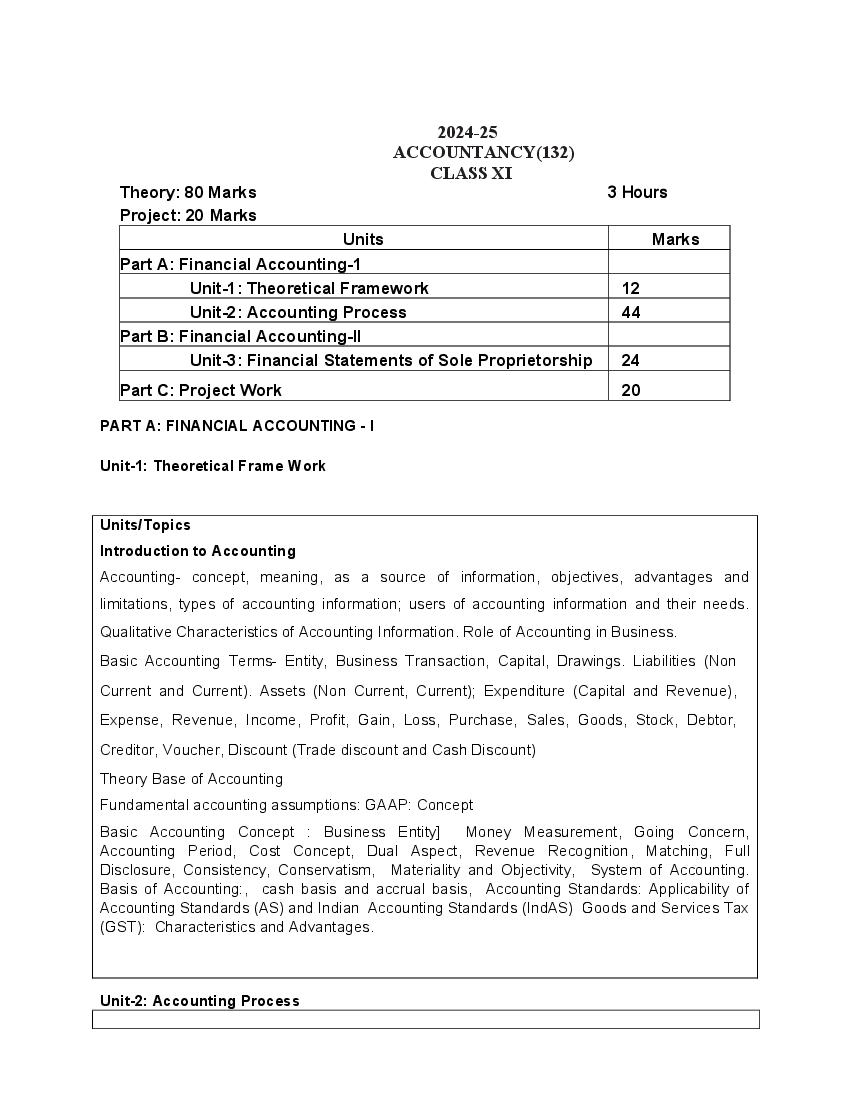
ACCOUNTANCY(132)
CLASS XI
Theory: 80 Marks 3 Hours
Project: 20 Marks
Units Marks
Part A: Financial Accounting-1
Unit-1: Theoretical Framework 12
Unit-2: Accounting Process 44
Part B: Financial Accounting-II
Unit-3: Financial Statements of Sole Proprietorship 24
Part C: Project Work 20
PART A: FINANCIAL ACCOUNTING - I
Unit-1: Theoretical Frame Work
Units/Topics
Introduction to Accounting
Accounting- concept, meaning, as a source of information, objectives, advantages and
limitations, types of accounting information; users of accounting information and their needs.
Qualitative Characteristics of Accounting Information. Role of Accounting in Business.
Basic Accounting Terms- Entity, Business Transaction, Capital, Drawings. Liabilities (Non
Current and Current). Assets (Non Current, Current); Expenditure (Capital and Revenue),
Expense, Revenue, Income, Profit, Gain, Loss, Purchase, Sales, Goods, Stock, Debtor,
Creditor, Voucher, Discount (Trade discount and Cash Discount)
Theory Base of Accounting
Fundamental accounting assumptions: GAAP: Concept
Basic Accounting Concept : Business Entity] Money Measurement, Going Concern,
Accounting Period, Cost Concept, Dual Aspect, Revenue Recognition , Matching, Full
Disclosure, Consistency, Conservatism, Materiality and Objectivity, System of Accounting.
Basis of Accounting:, cash basis and accrual basis, Accounting Standards: Applicability of
Accounting Standards (AS) and Indian Accounting Standards (IndAS) Goods and Services Tax
(GST): Characteristics and Advantages.
Unit-2: Accounting Process
Page 2
Vouchers, Preparation of Vouchers, Accounting Equation Approach: Meaning and Analysis,
Meaning and Analysis, Rules of Debit and Credit. Recording of Transactions: Books of Original
Entry- Journal Special Purpose books: Cash Book: Simple, cash book with bank column and
petty cashbook Purchases book Sales book, Sales book, Purchases return book, Sales return
book
Journal proper
Note: Including trade discount, freight and cartage expenses for simple GST calculation.
Ledger: Format, Posting from journal and subsidiary books, Balancing of accounts
Bank Reconciliation Statement: Need and preparation, Bank Reconciliation Statement
Depreciation, Provisions and Reserves
Depreciation: Meaning, Features, Need, Causes, factors ,Other similar terms: Depletion and
Amortisation
Methods of Depreciation:
i. Straight Line Method (SLM)
ii. Written Down Value Method (WDV) Note: Excluding change of method
Method of recoding depreciation
i. Charging to asset account
ii. Creating provision for depreciation/accumulated depreciation account
Treatment of disposal of asset
Provisions, Reserves, Difference Between Provisions and Reserves
Types of Reserves:
i. Revenue reserve
ii. Capital reserve
iii. General reserve
iv.Specific reserve
v. Secret Reserve
Difference between capital and revenue reserve
Trial balance and Rectification of Errors
Trial balance: objectives, meaning and preparation
(Scope: Trial balance with balance method only)
Errors: classification-errors of omission, commission, principles, and compensating;
their effect on Trial Balance.
Detection and rectification of errors;
(i) Errors which do not affect trial balance
(ii) Errors which affect trial balance preparation of suspense account.
PART B: FINANCIAL ACCOUNTING – II
Financial Statements
Page 3
Expenditure; Deferred Revenue expenditure. Opening journal entry. Trading and Profit and Loss
Account: Gross Profit, Operating profit and Net profit. Preparation. Balance Sheet: need,
grouping and marshalling of assets and liabilities. Preparation. Adjustments in preparation of
financial statements with respect to closing stock, outstanding expenses, prepaid expenses,
accrued income, income received in advance, depreciation, bad debts, provision for doubtful
debts, provision for discount on debtors, Abnormal loss, Goods taken for personal use/staff
welfare, interest on capital and managers commission. Preparation of Trading and Profit and
Loss account and Balance Sheet of a sole proprietorship with adjustments.
Incomplete Records
Features, reasons and limitations.
Ascertainment of Profit/Loss by Statement of Affairs method. (excluding conversion method)
Part C: Project Work (Any One)
1. Collection of source documents, preparation of vouchers, recording of transactions with the
help of vouchers.
2. Preparation of Bank Reconciliation Statement with the given cash book and the pass book
with twenty to twenty-five transactions.
3. Comprehensive project of any sole proprietorship business. This may state with journal
entries and their ledgering, preparation of Trial balance. Trading and Profit and Loss Account
and Balance Sheet. Expenses, incomes and profit (loss), assets and liabilities are to be
depicted using pie chart / bar diagram. This may include simple GST related transactions.
PROJECT WORK
It is suggested to undertake this project after completing the unit on preparation of financial statements. The
student(s) will be allowed to select any business of their choice or develop the transaction of imaginary
business. The project is to run through the chapters and make the project an interesting process. The amounts
should emerge as more realistic and closer to reality.
Specific Guidelines for Teachers
Give a list of options to the students to select a business form. You can add to the given list:
1. A beauty parlour 10. Men's wear 19. A coffee shop
2. Men's saloon 11. Ladies wear 20. A music shop
3. A tailoring shop 12. Kiddies wear 21. A juice shop
4. A canteen 13. A Saree shop 22. A school canteen
5. A cake shop 14. Artificial jewellery shop 23. An ice cream parlour
Page 4
7. A chocolate shop 16. A sweet shop 25. A flower shop
8. A dry cleaner 17. A grocery shop
9. A stationery shop 18. A shoe shop
After selection, advise the student(s) to visit a shop in the locality (this will help them to settle on a realistic
amounts different items. The student(s) would be able to see the things as they need to invest in furniture,
decor, lights, machines, computers etc.
A suggested list of different item is given below.
1. Rent 19. Wages and Salary
2. Advance rent [approximately three months] 20. Newspaper and magazines
3. Electricity deposit 21. Petty expenses
4. Electricity bill 22. Tea expenses
5. Electricity fitting 23. Packaging expenses
6. Water bill 24. Transport
7. Water connection security deposit 25. Delivery cycle or a vehicle purchased
8. Water fittings 26. Registration
9. Telephone bill 27. Insurance
10. Telephone security deposit 28. Auditors fee
11. Telephone instrument 29. Repairs & Maintenance
12. Furniture 30. Depreciations
13. Computers 31. Air conditioners
14. Internet connection 32. Fans and lights
15. Stationery 33. Interior decorations
16. Advertisements 34. Refrigerators
17. Glow sign 35. Purchase and sales
18. Rates and Taxes
At this stage, performas of bulk of originality and ledger may be provided to the students and they may be
asked to complete the same.
In the next step the students are expected to prepare the trial balance and the financial statements.
Evaluation Scheme of Project
Project work / Internal Assessmet
1-Project Work Marks
a) Relevance of the topic 3
b) Knowledge content /Research Work 3
c) Presentation Technique 3
d) Viva based on project 6
2- Continuous assessment (Unit Test) 5
Total 20
Page 5
d`f"k&'kL; foKku ¼134½
d{kk&11
izFke iz'u&i=
¼'kL; foKku&lk/kkj.k Qlysa] feV~Vh rFkk [kkn½
lS)kfUrd
iw.kkZad% 50 vad le;& 3 ?k.Vs
;wfuV 1 20 vad
QkeZ dh lk/kkj.k Qlysa&xsgw]a /kku]] eDdk] lks;kchu] ljlks]a vjgj] eVj] dikl] Tokj] cktjk]
ewx
a Qyh] lw;Zeq[kh] rEckd]puk] cjlhe] vkyw vkSj xés dk fuEu 'kh"kZdksa ds vUrxZr v/;;u&
laLrqr iztkfr;ka] muds eq[; xq.k] izns'k ds mi;qDr {ks=] cksus dk le;] cht nj] cksus dh fof/k] [kkn
nsuk] flapkbZ djuk] Qly j{kk mi;qZDr Qlyksa ds [kj&irokj muds fu;a=.k] eq[; dhV ,oa jksxksa ds
y{k.k rFkk fuokj.k] Qly dkVuk] eM+kbZ] mit rFkk budk chtksRiknuA
;wfuV 2 05 vad
fefV~V;ka&fefV~V;ksa dh mRifRr] fefV~V;ksa dk oxhZdj.k&ctjhyh] cyqbZ] nkseV] flYV rFkk fpduh
feV~Vh] feV~Vh ds HkkSfrd xq.k] feV~Vh dh jpuk ij HkkSfrd ,oa jklk;fud dkjdksa dk izHkko] Hkwfe
laj{k.k dh fofHkUu fof/k;ksa ds ewy fl)kUrA
;wfuV 3 15 vad
[kkn rFkk [kkn nsuk] ikS/ks dh o`f) ds fy;s vko';d iks"kd rRo] [ksr dh eq[; Qlyksa }kjk feV~Vh
ls yh tkus okyh ukbVªkstu] QklQksjl rFkk iksVk'k dh ek=k] [kkn nsus dh vko';drk] tSo rFkk
vtSo [kknas] Qlyksa rFkk fefV~V;ksa ij muds izHkko lEcU/kh vUrj] [kkn rFkk moZjdksa ds ds Mkyus dh
fof/k;ka] xkscj dh [kkn rFkk dEIkksLV [kkn dk laj{k.k gjh [kkn dh Qlysa vkSj muds mi;ksaxA
fuEu [kknksa dk v/;;u] moZjdksa ,oa muds iz;ksx fof/k;ka&
xkscj dh [kkn] dEiksLV vj.Mh dh [kyh] ewaxQyh dh [kyh] ;wfj;k] veksfu;e lYQsV] lqij QkLQsV]
jkd QkLQsV] iksVSf'k;e lYQsV] E;wjsV vkQ iksVk'k] fefJr [kkn] MkbZ veksfu;k QkLQsV rFkk tSfod
[kknsa&cehZdYpj Cyw xzhu ,Yxh] jkbZtksfo;e dYpjA
;wfuV&4 10 vad
¼1½ i;kZoj.k dh lkekU; tkudkjh
¼2½ i;kZoj.k izn"w k.k dk tyok;q] e`nk vkSj vk/kqfud d`f"k ij izHkko]
i;kZoj.k izn"w k.k fu;a=.k ds mik;A
¼3½ vk/kqfud d`f’k dk Ik;kZoj.k ij izHkko&
¼v½ vf/kd mit iznku djus okyh fdLeksa dk izHkko
¼c½ ugj }kjk flpkbZ vkSj tyØkfUr ¼okVj ykWfxax½
¼l½ moZjdksa ,oa Qly lqj{kk jlk;u ds iz;ksx dk i;kZoj.k ij izHkkoA
¼4½ ugj }kjk flpkbZ vkSj tyØkfUr ¼okVj ykWfxax½
¼5½ Hkwfe iz;ksx tula[;k ncko]ouksa dh {kh.krk] pkjkxkgksa ,oa Qlyksa dk i;kZoj.k ij izHkkoA
¼6½ izn’w k.k fu;a=.k ds mik;
Page 6
vad dh x.kuk&fofHké Qlyksa ds fy;s vko';d N. P. K.ds vk/kkj ij fofHké [kknksa ,oa moZjdksa dh
ek=k dk fu/kkZj.k&
mu Qlyksa dk tks lS)kfUrd ds vUrxZr nh gS mxuk vkSj ns[kHkky] fuEu fØ;kvksa dk vH;kl&
¼d½ gy] dYVhosVj] gSjks] ikVk rFkk jksyj ls [ksr rS;kj djukA
¼[k½ gkFk rFkk lhM fMªy ls cht cksukA
¼x½ flapkbZA
¼?k½ gkFk rFkk cSy pkfyr ;a=ksa ls fujkbZ rFkk xqM+kbZA
¼³½ cSy pkfyr vkStkjksa ls feV~Vh p<+kukA
¼p½ eM+kbZ] vkslkbZ rFkk pkjk dkVukA
¼N½ fefV~V;ksa] chtksa] [kj&irokjksa] [kknksa rFkk moZjdksa dh igpkuA
¼t½ fofHké fof/k;ksa ls [kkn rFkk moZjd nsukA
¼>½ Qlyksa dh mRiknu ykxr dh x.kukA
¼´½ Nk= jktdh; QkeksZa rFkk fdlkuksa dh tksrksa dk v/;;u djus Hkze.kkFkZ tk;sx
a sA
¼V½ QkeZ ij fd;s x;s dk;Z rFkk Hkze.k LFkkuksa ds v/;;u dk vfHkys[k j[kk tk;sxkA
iqLrds&
a dksbZ iqLrd fu/kkZfjr ;k laLrqr ugha dh x;h gSA v/;kid ds ijke'kZ ls ikB~;Øe ds vuq:i
mi;qDr iqLrd dk p;u dj ysaA
iz;ksxkRed
vf/kdre vad % 50 U;wure mRrh.kkZd
a % 17 le; % 03 ?kaVk
External Examiner
1- cht “kS¸;k dk fuekZ.k 10 vad
2- cht] [kkn] [kjirokj];a=] Qlyksa dh igpku 10 vad
3- ekSf[kd ijh{kk 05 vad
Internal Examiner
4- vkafdd iz”uksa }kjk [kkn] ifjdyu ,oa
14 vad
vk;&O;;
5- l=h; dk;Z 06 vad
10 lrr ewY;kdu ¼bdkbZ ijh{kk½ 05 vad
;ksx 50 vad
O;fDrxr ijh{kkfFkZ;ksa dh iz;ksxkRed ijh{kk&
O;fDrxr ijh{kkfFkZ;ksa dh iz;ksxkRed ijh{kk gsrq tks fo|ky; iz;ksxkRed ijh{kk dsUnz fu/kkZfjr fd;s
tk;saxs mu fo|ky;ksa ds lEcfU/kr fo"k;ksa ds v/;kid }kjk vkUrfjd ijh{kd :i esa O;fDrxr
ijh{kkfFkZ;ksa dks ipkl izfr'kr vad iznku fd;s tk;saxs] 'ks"k ipkl izfr'kr vad oká ijh{kd }kjk ns;
gksaxsA
&&&&&&&&&&&&&&&&&&&&&&&&&&&&&&&&&&&&&&&&&&&&&&&&&&&&&&&&&&
Page 7
d`f"k&ouLifr foKku ¼135½
d{kk&11
lS)kfUrd
iw.kkZad&50 le; 3 ?k.Vs
bdkbZ&1 15 vad
1&ouLifr ikni vaxksa dh oká vkdkfjdh&ewy LrEHk vkSj i.kZ] muds dk;Z vkSj :ikUrjA
2&iq’i dh lajpuk rFkk muds fofHkUu Hkkxksa dk dk;Z] iq’iØe ds fofHkUu izk:i
3&ijkx.k&ijkx.k dk izk:fid v/;;u fof/k rFkk fØ;kfof/kA
4&fu"kspu&fØ;k fof/k dk v/;;u ,oa f}fu’kspu dk egRoA
5&Qy ds izk:i] muds dk;Z rFkk izdh.kZuA
6&cht dh lajpuk rFkk vadqj.k¼,d cht i=h rFkk f}cht i=h chtksa dk izkjfEHkd vadqj.k½ cht ds
izk:i] dk;Z vkSj izdh.kZuA cht vadqj.k dks izHkkfor djus okys dkjdA
bdkbZ&2 10 vad
vUr% vkdkfjdh&ouLifr dksf'kdk lajpuk] dksf'kdk ds vUroZLrq] dks’kdh; foHkktu ^^lw=h; foHkktu
¼ekbVksfll½ rFkk dksf”kdk foHkktu ¼fe;kfll½] dksf”kdkvkas dk mRkd ds :i esa laxBurFkk fofHké
Årdksa ds dk;ZA ,d chti=h vkSj f}cht&i=h ewy] LrEHk rFkk i.kZ dh vkUrfjd vkdkfjdh f}cht
i=h LrEHk vkSj ewy esa f}rh; o`f} ¼Secondary Growth) .
bdkbZ&3 10 vad
1&ikni 'kjhj fØ;k ¼dsoy izkjfEHkd v/;;u½A
¼d½ ty dk ikS/kksa }kjk vUrxzg.k ewy dh lajpuk
¼[k½ ok"iksRltZu rFkk ewyh; nkc] mldk dk;Z vkSj egRoA
¼x½ dkoZu Lokaxhdj.k ]ja/kzksa dh lajpuk vkSj dk;Z] dkcZu Lokaxhdj.k dh n{k dk;Z fØ;k esa lgk;d
dkjdA
¼?k½ ikS/ks&[kk| inkFkksZa dk laxgz ,oa LFkkukUrj.kA
¼M-½ “olu ds izk:i vkSj dk;ZA
bdkbZ&4 08 vad
oxhZdj.k ouLifr foKku vkSj ouLifr txr dk izkjfEHkd ifjp; tgka rd lEHko gks lds {ks=h;
m|ku ds lkekU; ikS/kksa ds okuLifrd ¼y{k.kksa dk v/;;u½ xzsfeuh] ØwlhQsjh] ysxeq uslh] dqdqjfonslh
lksySuslh] ekYcslh A
bdkbZ&5 07 vad
lw{e tSfodh dk izkjfEHkd v/;;u&
¼d½ ok;jlA
¼[k½ Cyw xzhu ,YxhA
¼x½ QatkbZA
¼?k½ oSDVhfj;kA
¼M-½ tUrq ¼lw{e½
Page 8
1&izkFkfed vaxksa ds oká vdkfjdh dk v/;;u djus ds fy;s uoksn~fHkn~ dk ijh{k.kA
2&ewy] LrEHk rFkk i.kZ ds fofHké izk:iksa ds Hkkxksa vkSj :ikUrjksa dk v/;;uA
3&lw{en'khZ dk iz;ksxA
4&izk:fid ,d cht&i=h rFkk f}cht&i=h] ewy vkSj LrEHk dk vfHkjatu vH;kl ds lkFk eqDrgLr
dkV ¼dfVax½A
5&chtksa dk v/;;u oká rFkk vkUrfjd] fofHké izdkj ds vadqj.kA
6&Qyksa rFkk chtksa dk ijh{k.k vkSj vfHkKkuA vkfFkZd ,oa d`f"k egRoA
7&ikni 'kjhj fØ;k ds ok"iksRltZu] dkcZu Lokaxhdj.k izdk'k la'ys"k.k rFkk 'olu ls lEcfU/kr
lk/kkj.k iz;ksxksa ds izn'kZuA
8&iq"iksa vkSj muds Hkkxksa dk ijh{k.k] foPNsnu vkSj o.kZuA
9&ikB~; fo"k; esa fn;s gq;s Qwyksa ds lkekU; {ks=h; m|ku ds ikS/kksa vkSj vkIr`.k ds oká okuLifrd
y{k.kksa dk v/;;u
vkSj vfHkKkuA
10&iknd laxzg(Plant Herbarium)A
iqLrds& a
v/;kid ds ijke'kZ ls ikB~;Øe ds vuq:i mi;qDr iqLrd dk p;u dj ysAa
vf/kdre vad % 50 U;wure mRrh.kkZd
a % 17 le; % 03 ?kaVk
External Examiner
1- tM+ ;k rus dh vuqizLFk dkV dkVuk 10 vad
2- LikWV igpku ¼10 LikWV½ 10 vad
3- ekSf[kd ijh{kk 05 vad
Internal Examiner
4- iq’Ik ,oa ikS/ks dh igpku 08 vad
5- ikni “kjhj fØ;k dk ijh{k.k 04 vad
6- l=h; dk;Z 08 vad
7- lrr ewY;kdu¼bdkbZ ijh{kk½ 05 vad
;ksx 50 vad
O;fDrxr ijh{kkfFkZ;ksa dh iz;ksxkRed ijh{kk&
O;fDrxr ijh{kkfFkZ;ksa dh iz;ksxkRed ijh{kk gsrq tks fo|ky; iz;ksxkRed ijh{kk dsUnz fu/kkZfjr fd;s
tk;sax]s mu fo|ky;ksa ds lEcfU/kr fo"k;ksa ds v/;kid }kjk vkUrfjd ijh{kd :i esa O;fDrxr
ijh{kkfFkZ;ksa dks ipkl izfr'kr vad iznku fd;s tk;saxs] 'ks"k ipkl izfr'kr vad oká ijh{kd }kjk ns;
gksaxsA
Page 9
d`f"k&HkkSfrdh ,oa tyok;q foKku ¼136½
lS)kfUrd
le;& 3 ?k.Vs 50 vad
bdkbZ&1&lkekU; ek=d] ekiu] foek] foek ds mi;ksx] ofuZ;j rFkk lw{e ekih iSekus] cyksa dk
laxBu vkSj fo?kVu cy]lekUrj cy] cy ;qXe] cy dk ?kw.k]Z cy lkE;oLFkk A
10 vad
bdkbZ&2&osx rFkk Roj.k] laosx] xfr ds fu;e] xq#Rok/khu xfr] xq#Roktfur Roj.k] o`Ùkh; xfr]
vidsUnzh; rFkk vfHkdsUnzh; cyA mixzg dk d{kh; osx] iyk;u osx] nzoksa ij nkc] Bksl nzo dk
vkisf{kd ?kuRo]fuDYlu gkbMªksehVj] dksf'kRo rFkk cy] ruko] ok;q e.Myh; nkc] ok;qnkcekih] ?kuRo
cksryA 10 vad
bdkbZ&3 ?k"kZ.k vkSj muds fu;eksa ds ljy mnkgj.k] ljy e'khusa tSls f?kjh rFkk mÙkksyd] lk/kkj.k
iEiksa dk dk;Z pkyu] Å"ek] laokgdrkZ] vkisf{kd Å"ek] fefV~V;ksa dsfo'ks"k lanHkZ esaA dk;Z 'kfDr rFkk
ÅtkZ] Å"ek rFkk rki laogu] lapkyu rFkk fofdj.k Å"ek pkydrk xq.kkad] Å"ek ds dkj.k feV~Vh esa
HkkSfrd ifjorZu] xqIr Å"ek ,oa dk;Z esa lEcU/k] vkSlkad] visf{kd vknzZrk vkSj bldk fuokj.k es?k]
dqgjk] dqglk] ikyk] fge]vksyk vkfn dh jpuk ekSle iwokZuqeku ij izkjfEHkd fopkj Å"ek vkSj dk;Z
ls lEcU/kA 10 vad
bdkbZ&4&izdk'k lapj.k ds fu;e] le rFkk xksyh ryksa ls ijkorZu rFkk orZu rky ¼ysUl½ ] lw{en'khZ
vojDr] ijkcSxuh rFkk n`'; fofdj.k ij izkjfEHkd fopkj]O;fDrdj.k ,oa /kzqo.k dh laf{kIr tkudkjh]
/ofu osx vko`fÙk rjax nS/;Z esa lEcU/k] vuqizLFk] vuqnS/;Z rjax dh ifjHkk"kk] vko`fÙk rjax] nS/;Z esa
lEcU/k] vuqizLFk] vuqnS/;Z rjax dh ifjHkk"kk] vko`fÙk vkorZdky esa lEcU/kA
10 vad
bdkbZ&5& fo|qr izkFkfed rFkk lapk;d lsy] fo|qr]~ /kkjk] oksYVrk vkSj izfrjks/k ]izkFkfed rFkk
lapkyd lsy ]fo|qr ~ 'kfDr] 'kfDr dh ;kaf=d ,oa fo|qr ~ ekidksa ds lEcU/k] fo|qr~ ek=d] fo|qr~ ds
mi;ksxA OghV LVksu lsrq dk fl)kUr] ehVjlsrq] iksLV vkfQl ckDl] foHkoekih dk laf{kIr v/;;uA
10 vad
iz;ksxkRed
yECkkbZ {ks=Qy lfgr vk;ru rFkk ?kuRo dk 'kq) fu/kkZj.k] dSyhilZ] isapekih] rqyk rFkk oxhZd`r&i=
dk iz;ksx] lekUrj prqHkqZt dk fu;e dk lR;kiu] mÙkksyd ds fl)kUr dk lR;kiu] nzoksa dk
vkisf{kd ?kuRo fudkyuk] ?kuRo cksry dk iz;ksx] ;FkkFkZ rFkk vkHkklh ?kuRoksa dk fudkyuk ,oa
feV~Vh dk ja/kzkodk'k] Cok;y ok;qnkc ekih ¼cSjksehVj½ i<+us dk vH;klA fofHké rkiekid ds xBu dk
vH;kl] fof'k"V Å"ek fudkyuk] xqIr Å"ek fudkyuk] vkslkad rFkk vkisf{kd vknzZrk fudkyukA
izdk'k dk ijkorZu rFkk orZu niZ.k ds rkyksa ¼ysUlksa½ dk ukH;karj ¼Qksdl nwjh½ fudkyuk] orZukad
fudkyukA
lk/kkj.k lsy cukuk] oksYVkekih rFkk vekih dh fof/k ,oa ehVj lsrq ls izfrjks/k dh eki Js.kh rFkk
eki lekUrj Øe esa ySEiksa dk tksM+uk iksLV vkfQl] ckDl vkfQl }kjk fn;s x;s vKkr izfrjks/k dk
eku Kkr djukA
laLrqr iqLrdsa&
fo"k; v/;kid ds ijke'kZ ls ikB~;Øe ds vuq:Ik mi;qDr iqLrd dk p;u dj ysAa
Page 10
vf/kdre vad % 50 U;wure mRrh.kkZad % 17 le; % 03 ?kaVk
External Examiner
1- ,d izeq[k iz;ksx 20 vad
2- ekSf[kd ijh{kk 05 vad
Internal Examiner
3- ,d lgk;d iz;ksx 15 vad
4- l=h; dk;Z 05 vad
5- lrr ewY;kdu ¼bdkbZ ijh{kk½ 05 vad
;ksx 50 vad
O;fDrxr ijh{kkfFkZ;ksa dh iz;ksxkRed ijh{kk&
O;fDrxr ijh{kkfFkZ;ksa dh iz;ksxkRed ijh{kk gsrq tks fo|ky; iz;ksxkRed ijh{kk dsUnz fu/kkZfjr fd;s
tk;sax]s mu fo|ky;ksa ds lEcfU/kr fo"k;ksa ds v/;kid@iz/kkukpk;Z }kjk vkUrfjd ijh{kd :i esa
O;fDrxr ijh{kkfFkZ;ksa dks ipkl izfr'kr vad iznku fd;s tk;saxs] 'ks"k ipkl izfr'kr vad oká ijh{kd
}kjk ns; gksaxsA
Page 11
d`f"k vfHk;U=.k ¼137½
d{kk&11
lS)kfUrd
le; % 3 ?k.Vs iw.kkZd
a % 50
bdkbZ&1 05 vad
d`f"k ;U=ksa dks cukus esa iz;ksx gksus okys yksgk ¼<yok yksgk] e`nq bLikr] mPp dkcZu;qDr bLikr½]
¼lk[kw] 'kh'ke] vke] ccwy½ IykfLVd rFkk fVu ds izdkj dk v/;;uA
bdkbZ&2 04 vad
gy&gyksa ds fofHké izdkj ;Fkk&ns'kh gy] esLVu gy] ds;j gy] lkok'k gy] okgokg gy] ;w0ih0
ua0&1 rFkk ;w0ih0 ua0&2 gy] foDVªh gy] iztk gy&budh cukoV fofHké Hkkx ,oa muds dk;Z jpuk
esa iz;ksx gksus okyh lkexzh] pkSM+kbZ] xgjkbZ de vf/kd djuk] [kM+h rFkk iM+h f>jh muds dk;Z] dk;Z
djrs le; vko';d leUtu ,oa lko/kkfu;ka] fofHké gykas dk rqyukRed v/;;u] izpyu esa
O;kogkfjd ck/kk;sAa
bdkbZ&3
¼v½ vU; d`f"k ;U=&dYVhosVj] gks] gSjks] [kqjpjh ¼LØij½ ikVk] cht rFkk moZjd] fMªy] Lizs;j] MLVj]
f=Qkyh] cypfyr dVkbZ ;U=] dEckbu e“khu] “kfDr pkfyr Fkzslj] vkslkbZ ia[kk ds fofHkUu Hkkx ,oa
muds dk;Z] VªSDVj&mlds iz;ksx] VªSDVj pkyu esa vkus okyh lkekU; leL;k;sa vkSj mudk fuokj.kA
03 vad
¼c½ gLr pkfyr rFkk 'kfDr pfyr dqV~Vh dkVus dh e'khu] cSy pkfyr rFkk 'kfDr pkfyr xék]
dksYgw] cSy pkfyr vkyw [kksnd ;U= ds dk;Z izeq[k Hkkx ,oa muds iz;ksx esa lko/kkfu;ka ,oa
j[k&j[kkoA
03 vad
bdkbZ&4
^Mk;ueksehVj] mldh cukoV vkSj iz;ksx fof/k rFkk f[kapko ij izHkko Mkyus okys dkjdA 'kfDr
p;u ds f[kapko ds izHkko dk egRo rFkk v'o lkeF;Z vkSj ml ij vk/kkfjr vkafdd x.kuk dk
v/;;uA** 10 vad
bdkbZ&5&
¼v½ ty mRiknd ¼okVj fy¶Vj½] lsUVhª ¶;wxy iEi] Vjokbu iEi] lcefLkZoy ¼tyIyouh;½ iEi dh
cukoV] dk;Z fof/k] ty fu"dklu dh ek=k izfrfnu flafpr {ks=Qy #dkoV ,oa funku] lko/kkfu;ka
rFkk j[k&j[kkoA 08 vad
¼c½ ,d flfy.Mj Mhty batu ,oa fo|qr eksVj dh cukoV] “kfDr mRiUu djus dh dk;Z fof/k
lk/kkj.k O;o/kku rFkk funku] batu eksVj dk p;u] j[k&j[kko rFkk lko/kkfu;kaA
¼l½ d`f’k eas rkykc] dqavk] uydwi dk egRo] fuekZ.k fof/k] dek.M {ks= ,oa j[k&j[kkoA 07 vad
Page 12
¼v½ d"kZ.k ds mn~ns';] fof/k izdkj] le; rFkk jklk;fud ,oa HkkSfrd izHkkoA
¼c½ tqrkbZ dh fof/k;ka] xq.k&nks"k rFkk izHkko] vUr% d`f"k dh vko';drk] fofHké Qlyksa esa vUr%]
d`f"k gsrq iz;ksT; d`f"k ;U=ksa ds uke] jklk;fud ,oa HkkSfrd izHkko rFkk d`f"k ;U=ks ij vk/kkfjr
vkafdd
x.kukA
bdkbZ&7
iV~Vk f?kjh vkSj xs;j }kjk 'kfDr izs"k.k dh fof/k] lhek;s]a lko/kkfu;ka rFkk j[k&j[kkoA pky ,oa eki
Kkr djus lEcU/kh lkekU; iz'uksa dh x.kukA
05 vad
iz;ksxkRed 50 vad
¼1½ dk;Z'kkyk ds fofHké vkStkjksa dk ifjp;] mi;ksx] lgh iz;ksx fof/k rFkk j[k&j[kko dk O;kogkfjd
Kku izkIr djuk
,oa ukekafdr fp= cukukA
¼2½ vkafdd x.kuk] f[kapko] v'o lkeF;Z] tqrkbZ ,oa 'kfDr izs"k.k ij vk/kkfjrA
¼3½ dk;Z'kkyk esa dk;Z&
¼d½ dk"B f'kYi& dqnky] ;a= ds csaV cukuk rFkk fQV djukA
¼[k½ lk/kkj.k ykSg'kkyk dk;Z&'khry yksgs ds Åij dk;Z]
¼x½ xje yksgs ls fofHké vkdkj cukuk] /kkj /kjuk rFkk yksgs ds nks Hkkxksa dks tksM+uk] d`f"k ;a=ksa dks
ihV dj iSuk
djukA
¼?k½ lksYMj ¼>kyu½ ds }kjk fVu ds fofHké vkdkjksa tSls dhi dks tksM+ukA
¼³½ fo|qr~ vFkok xSl osfYMax ls yksgs ds VqdM+s dks tksM+ukA
¼4½ ¼v½ fofHké izdkj ds gy] gSjks] dYVhosVj] gks] dqV~Vh dkVus dh e'khu] xék dksYgw] MLVj] Lizs;j]
Fkzslj] dVkbZ ;a=
¼jhij½] vkslkbZ ia[kk] cht rFkk moZjd fMªy dh cukoV rFkk fofHké Hkkxksa dk O;ogkfjd Kku izkIr
djuk vkSj ukekafdr fp=
cukukA
¼c½ Mhty batu] fo|qr~ eksVj rFkk lsUVªh¶;wxy iEi dh cukoV] fofHké Hkkx rFkk dk;Z fof/k dk
O;kogkfjd v/;;u
vkSj ukekafdr fp= cukukA
¼5½ mi;qZDr Øe&2 ¼v½ ij mfYyf[kr ;a=ksa dks [kksyuk] cka/kuk rFkk mudk leUtu djukA
¼c½ Mhty batu@fo|qr~ eksVj ls pkfyr lsUVªh¶;wxy iEi }kjk dqavk] rkykc o uydwi ls ikuh
mBkuk] tylzko vkSj
flafpr {ks= dk ekiu rFkk ykxr dh x.kuk djukA
¼6½ esLVu gy] 'kkokl gy] dYVhosVj] gSjks] xék dksYgw] dqV~Vh dkVus dk ;a=] ikoj Fkzslj] dqVkbZ
;a= ls Lo;a dk;Z djukA
Page 13
gksjhtsUVy lsD'ku½ dk
ekiuA
laLrqr iqLrds& a
fo"k; v/;kid ds ijke'kZ ls ikB~;Øe ds vuq:Ik iqLrd dk p;u dj ysaA
iz;ksxkRed ijh{kk
vf/kdre vad % 50 U;wure mRrh.kkZad % 17 le; % 04 ?kaVk
External Examiner
1- dk;Z”kkyk dk vH;kl 04 vad
2- ;a=ksa dk lek;kstu 05 vad
3- vfHk;Urk ifjdyu ¼H P o ,fj;k ifjdyu½ 10 vad
5- ekSf[kd ijh{kk 06 vad
Internal Examiner
6- oLrq igpku 10 vad
7- l=h; dk;Z 10 vad
8- lrr ewY;kdu¼bdkbZ ijh{kk½ 05 vad
;ksx 50 vad
O;fDrxr ijh{kkfFkZ;ksa dh iz;ksxkRed ijh{kk&
O;fDrxr ijh{kkfFkZ;ksa dh iz;ksxkRed ijh{kk gsrq tks fo|ky; iz;ksxkRed ijh{kk dsUnz fu/kkZfjr fd;s
tk;sax]s mu fo|ky;ksa ds lEcfU/kr fo"k;ksa ds v/;kid }kjk vkUrfjd ijh{kd :i esa O;fDrxr
ijh{kkfFkZ;ksa dks ipkl izfr'kr vad iznku fd;s tk;saxs] 'ks"k ipkl izfr'kr vad oká ijh{kd }kjk ns;
gksaxsA
Page 14
d`f"k&xf.kr rFkk izkjfEHkd lkaf[;dh ¼138½
d{kk&11
lS)kfUrd
le; 3 ?k.Vs iw.kZad% 50 vad
1&chtxf.kr&?kkrkad fl)kUr] y?kq xq.kdksa dk O;ogkfjd Kku] fooj.k] lekUrj] xq.kksÙkj] gjkRed
Jsf.k;ksa ] Øe lap; rFkk lap; ij ljy iz'uA 05 vad
2&f=dks.kfefr&o`Ùkh; Qyuksa dh ifjHkk"kk rFkk muds dks.kksa 00] 300] 450] 900] 1800 ds o`Ùkh; Qyuksa
ds eki dks 90+$ B] 180+ +B rFkk fdlh Hkh fpUg vkSj eki ds dks.k ds fy, foRrh; QyuA
nks dks.kksa ds ;ksx vkSj vUrj ds T;k] dksT;k vkSj LiaT;k ds f=dks.kferh; vuqikr] T;k vkSj dksT;k
ds xq.kuQyksa dk ;ksx vkSj vUrj ds :i esa O;Dr djukA
05 vad
3&Bksl T;kfefr&vk;rkdkj] Bksl xksyk] csyu] 'kadq ds vk;ru vkSj i`"B dks Kkr djus esa lw=ksa dk
iz;ksxA
10 vad
4&funsZ'kkad T;kfefr&dkÙkh; funs'Z kkad] nks fcUnqvksa ds chp dh nwjh ,oa mUgsa fn;s gq;s vuqikr esa
foHkkftrdjus okys fpUg ds funsZ'kkad] f=Hkqtksa ds {ks=Qy ljy js[kkvksa ,oa o`Rrksa ;k muds lehdj.kksa
ls vkys[ku rFkk bu ij iz'uA 10 vad
5&lkaf[;dh&vkadM+ksa dk laxzg] oxhZdj.k rFkk lkfj.khdj.k ckjEckjrk caVu] dsUnzh; eki] lekUrj
ek/;]ekf/;dk] cgqyd] ek/;] fopyu rFkk ekud fopyuA 20 vad
laLrqr iqLrds&
a
fo"k; v/;kid ds ijke'kZ ls ikB~;Øe ds vuq:Ik iqLrd dk p;u dj ysaA
&&&&&&&&&&&&&&&&&&&&&&&&&&&&&&&&&&&&&&&&&&&&&&&&&&&&&&&&&
Page 15
CLASS: XI
2024-2025
3 Hours Maximum Marks- 80
Section A Reading 10 Marks
Section B Grammar 15 Marks
Section C Literature 45 Marks
Section D Creative Writing 10 Marks
Internal Assessment 20 Marks
PRESCRIBED BOOKS:
1. SahityaCharcha: Bangla ‘ka’: Class XI Published by PaschimbangaUchchaMadhyamikSikshaSansad.
2. Uchchataro Bangla Byakoron (Nabom o Dashomshreni)
Bamondeb Chakraborty (Published by AkashyayMalancha)
NB: All text and grammar books will be of the latest editions only.
1
Page 16
SYLLABUS
Class -XI (2024 -2025)
PART- A Multiple Choice Questions(MCQ)
PART- B (Subjective Questions)
MARKS DISTRIBUTION:
TOPICS MARKS
* Reading Comprehension (Unseen Passage)-MCQ 10
• Grammar 05
• Literature (Textbook & Supplementary Reader) 10
● Grammar 10
● Literature( Text book & 35
Supplementary Reader
• Creative Writing 10
TOTAL 80
SECTION DETA ILS OF TOPICS/ CHAPTERS WEIGHTAG E
(MARKS)
Comprehension: Two unseen passages
SECTION – A Reading of around 200 words each. 10
Multiple Choice Questions from given
passage each of 01 mark
Fifth question (01 mark-VSA)
should be grammar based (Sandhi,
Synonyms,Antonyms and Sadhu –
Chalit )
SECTION- B 1. Bachyo (Voice) Poribarton 15
Grammar
2. Ukti(Narration) Poribarton
3. Bangla Shabdobhandar (Tatsama
,Tadbhaba , Deshi and Bideshi)
Prose: -
45
SECTION – C 1. Telenapota Abishkar -
Literature
Premendra Mitra
2. DakaterMaa - Satinath Bhadhuri
3. Galileo – Satyendranath Basu
4. Kortar Bhoot – Rabindra Nath
Thakur
Poetry: -
1. Nun - Joy Goswami
2. Barir Kache Arshinagar – Lalon
phokir
3. Dweepantorer Bondinee – Kazi
Nazrul Islam
2
Page 17
Panikar
5. Supplementary Reader: -
6. 'Guru'(sampurno)–
RabindraNath Thakur
1. Dialogue Writing (Minimum 5
pair of dialogues)
2. Summary Writing from a prose 10
SECTION - D passage of 100 - 200 words
Creative Writing
Any one of the following Project Work is
to be undertaken in Class XI and another
one will be chosen in Class XII .
1. Translation: Students are to
translate a story written in
Project English or Hindi or in any Indian 04+3=07
language to Bengali within 1000
(File+ Viva) words.
2. Interview: An interview of any
distinguished personality can be
taken by the students.
3. Dramatization: Students can
transform a story written in any
of the India languages into
drama within 1000 - 2000 words.
4. Self-Composed Story: Students
can write a story on any special
incident or day they
experienced in their life.
5. Project on any Field Trip
ASL SPEAKING 04
LISTENING 04
Continuous Assessment 05
(Unit Test)
TOTAL 100
Prescribed Books:
1. SahityaCharcha: Bangla ‘ka’: Class XI Published by PaschimbangaUchchaMadhyamikSikshaSansad.
2. Ucchatara Bangla Byakoron (Nabam&Dashamshreni)- Bamon Deb Chakraborty
(Published by AkashyayMalancha)
3
Page 18
BUSINESS STUDIES(133)
CLASS XI
One Paper 3 Hours 80 Marks
Units Marks
Part A: Foundations of Business
1. Nature and Purpose of Business 06
2. Forms of Business Organisations 10
3. Private, Public and Global Enterprises 08
4. Business Services 06
5. Emerging Modes of Business 05
6. Social Responsibility of Business and Business Ethics 05
Total 40
Part B : Finance and Trade
7. Sources of business finance
20
8. Small Business
9. Internal Trade
10 International Business 20
Total 40
Part C : Project Work 20
A Part: Foundations of Business
Unit 1: Nature and Purpose of Business
History of Trade and Commerce in India: Indigenous Banking System, Rise of
Intermediaries, Transport, Trading Communities: Merchant Corporations, Major Trade
Centres, Major Imports and Exports, Position of Indian Sub-Continent in the World
Economy.
Business – meaning and characteristics.
Business, profession and employment – Concept
Objectives of business
Classification of business activities - Industry and Commerce
Industry-types: primary, secondary, tertiary Meaning and subgroups
Commerce-trade: (types-internal, external; wholesale and retail) and auxiliaries to trade;
(banking, insurance, transportation, warehousing, communication, and advertising) –
meaning
Business risk-Concept
Page 19
Sole Proprietorship-Concept, merits and limitations, Partnership-Concept, types, merits and
limitation of partnership, registration of a partnership firm, partnership deed. Types of
partners, Hindu Undivided Family Business: Concept, Cooperative Societies-Concept,
merits, and limitations., Company - Concept, merits and limitations; Types: Private, Public
and One Person Company – Concept, Formation of company - stages, important
documents to be used in formation of a company, Choice of form of business organization
Unit 3: Public, Private & Global Enterprises
Private Sector and Public Sector- Concept, Forms of public sector enterprises:
Departmental Undertakings, Statutory Corporations and Government Company, Global
Enterprises – Feature Joint venture
Public private partnership – concept
Unit 4: Business Services
Business services – meaning and types. Banking: Types of bank accounts -
savings, current, recurring, fixed deposit and multiple option deposit account, Banking
services with particular reference to Bank Draft, Bank Overdraft, Cash credit.
E-Banking: meaning, types of digital payments, Insurance – Principles. Types – life, health,
fire and marine insurance – concept, Postal Service - Mail, Registered Post,
Parcel, Speed Post, Courier - meaning
Unit 5: Emerging Modes of Business
E - business: concept, scope and benefits
Unit 6: Social Responsibility of Business and Business Ethics
Concept of social responsibility, Case for social responsibility;
Responsibility towards owners, investors, employees, consumers, government and
community, Role of Business in Environmental protection , Business ethics: concept and
elements.
Part B: Finance and Trade
Unit 7: Sources of Business Finance: Concept of business finance, Owners’
funds- equity shares, preferences share, retained earnings, Borrowed funds: debentures
and bonds, loan from financial institution and commercial banks, public deposits, trade
credit, Inter Corporate Deposits (ICD)
Unit 8: Small Business and Enterprises: Entrepreneurship Development
(ED): Concept, Characteristics and Need. Process of Entrepreneurship Development:
Start-up India Scheme, ways to fund, start-up. Intellectual Property Rights and
Entrepreneurship, Small scale enterprise as defined by MSMED Act 2006 (Micro, Small and
Medium Enterprise Development Act), Role of small business in India with special reference
to rural areas, Government schemes and agencies for small scale industries: National Small
Industries Corporation (NSIC) and District Industrial Centre (DIC) with special reference to
rural, backward areas.
Unit 9: Internal Trade: Internal trade - meaning and types services rendered by a
wholesaler and a retailer, Types of retail-trade-Itinerant and small scale fixed shops
retailers, Large scale retailers-Departmental stores, chain stores – concept, GST (Goods
and Services Tax): Concept and key-features
Unit 10: International Trade: International trade: concept and benefits, Export trade –
Meaning and procedure, Import Trade - Meaning and procedure, Documents involved in
International Trade; indent, letter of credit, shipping order, shipping bills, mate’s receipt
(DA/DP), World Trade Organization (WTO) meaning and objectives.
Page 20
Suggestive/Illustrative Projects
Any one of the following:-
(i) Find out from local sample business unit (s) the various objectives they pursue.
(ii) Problems of setting up and running business units.
(iii) Enquiry into the ethics of running business through questionnaires.
(iv) Survey of quality of bank services in the local branch office.
(v) Study of postal and courier mail services.
(vi) Availability and use of agency services, advertising, packaging,
investments in savings schemes, etc.
(vii) Survey of the popularity of credit cards issued by different banks.
(viii) Study the profile of a sole trader/partnership commenting on the nature and
working of business.
(ix) Study of a Joint Hindu family business.
(x) Study of the working of any cooperative society.
(xi) Study of a small business unit regarding source of finance.
(xii) Study of nature of small traders (like hawkers and pedlars in a specific locality)
with reference to types of goods, capital investment, turnover.
(xiii) Study of weekly bazaar in a locality.
(xiv) Study of franchise retail store.
(xv) Study of export/import procedure of any article.
(xvi) Problems of women entrepreneurs in business.
(xvii) Survey of waste/garbage disposal by a business enterprise
(xviii) Study of pavement trade.
(xix) Prepare a scrapbook and collect articles on the changing role of public sector
and any other topics related to the syllabus.
Assessment of Project Work:
Topics Marks
Project
1 Initiative, cooperativeness and participation 2 Marks
2 Creativity in presentation 2 Marks
3 Content, observation and research work 4 Marks
4 Analysis of situations 4 Marks
5 Viva 3 Marks
Total Marks of Project 15 Marks
6 Continuous Assessment (Unit Test) 5 Marks
Total 20 Marks
Page 21
Carnatic Music (Percussion Instrumental )
Code:119
Class XI
One Theory Paper 3 Hours Marks: 30
A. History and theory of Indian Music
1. (a) Brief history of Karnatak music with special reference to laya
and percussion silappadikaram, Natya, Sastra Tala Deepikai.
(b) Short life- sketch and contributions of the following:
Purandar Dasa, and the trinity Tyagaraja Dikshitar & Syamasastry.
(c) Unique contribution of the following luminaries Nayayana Swamy
Appa, Mamunidya Pillai, Dadshinamurti Pillai & Alagunambi Pillai.
2. Defination and explanation :
Nada, Sruti, Svara, Laya, Raga, Tala, Jati, Suladi, Sapta, Talas
Karani, Vettu Thattu, Hechchu, Tangu Mohra and Korvai.
3. The candidate should be able to write in notation the percussion
korvais in Adi & Rupaks Talas.
4. Knowledge of the construction of the chosen percussion instrument.
5. Basic knowledge of the construction and Technique of Ghatam. The
candidate should be able to describe the kanjira and Tavali.
6. Basic knowledge about other percussion instruments. Its construction and
technique .
One Practical Paper Marks: 70
1. Ability to play the following talas with
elaboration Adi and Rupkam
Talas powering at least two nadais
2. Thekas and Moharas in different talas with Timanams and Korvais
3. Tuning of the instrument.
4. Ability to render orally the sollukattus of the various patterns in Adi,
Rupaka and Chapu Talas :
5. Continuous Assessment (Unit Test)
Page 22
Carnatik Music(Vocal)
(Code: 117)
CLASS XI
Time : 3 Hours
One Theory paper Marks :30
A. History and Theory of Indian Music
1. (a) Brief history of Carnatic music with special reference of Silappadikaram,
Natyasastra, Sangita
Ratnakara and Chaturdandi Prakasika.
(b) Life-sketch and contributions of the following composers-Purandaradasa,
Tyagaraja, Muthuswamy Dikshitar, Syama Sastri and Bhadrachala Ramdas.
Jayadeva of Narayana Tirtha, Swati Tirumal.
(c) Study of the lakshanas of musical forms: Varnam, kriti, lakshanagitam and
padam, Pada Varnam, Daru, Svarajati, Geetam
2. Definition and explanation of the following terms:
Nada, sruti, svara, jaati, raga, tala, jati, yati, Dhatu, Matu
3. Candidate should be able to write in notation of the compositions in the prescribed
ragas.
4. Brief lakshanas of the ragas prescribed.
5. Brief Introduction to Manodharma Sangitam
One Practical Paper Marks: 70
1. Ragas prescribed:
2. Varnams (atleast 5) in Aditala in two degrees of speed.
Bhairavi, Sankarabharanam, Kharaharapriya, Kalyani, Kambhoji, Mohanam, Bilahari,
Madhyamavati,
Page 23
main talas Adi, Rupakam and Chapu.
4. Brief alapana of the ragas prescribed.
5. Kalpana Svaras in Adi and Rupaka talas rendered in Vilamba and Madhyama kalas.
Page 24
Carnatic Music (Melodic Instrumental)
Code-118
Class XI
One Theory Paper 3 Hours Marks: 30
A. History and theory of Indian Music
1. (a) Brief history of Karnatak music with special reference to silappadikaram
natya sastra, sangita Ratnakara, Savra Mela, Kalanidhi and Chaturdandi
Prakasika.
(b) Short life- sketch and contributions of the following:
Purandara Dasa, Syamasatry, Tyagaraja, Muthuswamy Dikshitar and Tansen.
(c) Brief history and evolution of the musical forms Kirtana and kirti, Varnams,
Geetams & Svarajati.
2. Definition and explanation of the following:
Nands, Sruti, Svara. Jaati, Raga, Tala Jaati, Yati, suladi, Sapta Talas, Nadai,
Arohana, Avarohana.
3. Candidates should be able to write in notation the compositions in the prescribed ragas.
4. Description of the ragas prescribed for Practical.
5. Talas Prescribed : Suladi Sapta talas with their Jaagi and Gati bhedas
One Practical Paper Marks: 70
B. Practical Activites
1. Ragas Prescribed :
Mayamalavagowla Sankarabharan Kharaharapriy Kalyani, Harikamob
m, Madhyarmavati, am, a, ji,
Arabhi.
2. Varnams (atleast four) in Adi tala in two degree of speed.
3. At least one authentic compositions traditionally rendered in each of the prescribed
ragas, covering the man Talas Adi, Rupakam and Chapu.
4. Brief alapana of the ragas prescribed.
5. Kalpana svaras in Adi, and Rupaka talas in Vilamba and Madhyama kalas.
Technicalities of playing svara and sahitya portions.
6. The candidate should be able to produce all the gamakas pertaining to instrumental
music.
7. Continuous assessment (Unit Test)
Page 25
CHEMISTRY(130)
Class XI (Theory)
Time: 3 Hours Total Marks 70
S.No UNIT Marks
1 Some Basic Concepts of Chemistry 7
2 Structure of Atom 9
3 Classification of Elements and Periodicity in 6
Properties
4 Chemical Bonding and Molecular Structure 7
5 Chemical Thermodynamics 9
6 Equilibrium 7
7 Redox Reactions 4
8 Organic Chemistry: Some basic Principles and 11
Techniques
9 Hydrocarbons 10
TOTAL 70
Unit I: Some Basic Concepts of Chemistry
General Introduction: Importance and scope of Chemistry.
Nature of matter, laws of chemical combination, Dalton's atomic theory: concept of
elements, atoms and molecules.
Atomic and molecular masses, mole concept and molar mass, percentage
composition, empirical and molecular formula, chemical reactions, stoichiometry and
calculations based on stoichiometry.
Unit II: Structure of Atom
Discovery of Electron, Proton and Neutron, atomic number, isotopes and isobars.
Thomson's model and its limitations. Rutherford's model and its limitations, Bohr's
model and its limitations, concept of shells and subshells, dual nature of matter and
light, de Broglie's relationship, Heisenberg uncertainty principle, concept of orbitals,
quantum numbers, shapes of s, p and d orbitals, rules for filling electrons in orbitals -
Aufbau principle, Pauli's exclusion principle and Hund's rule, electronic configuration
of atoms, stability of half-filled and completely filled orbitals.
Page 26
Significance of classification, brief history of the development of periodic table, modern
periodic law and the present form of periodic table, periodic trends in properties of
elements -atomic radii, ionic radii, inert gas radii, Ionization enthalpy, electron gain
enthalpy, electronegativity, valency. Nomenclature of elements with atomic number
greater than 100.
Unit IV: Chemical Bonding and Molecular Structure
Valence electrons, ionic bond, covalent bond, bond parameters, Lewis structure, polar
character of covalent bond, covalent character of ionic bond, valence bond theory,
resonance, geometry of covalent molecules, VSEPR theory, concept of hybridization,
involving s, p and d orbitals and shapes of some simple molecules, molecular orbital
theory of homonuclear diatomic molecules(qualitative idea only), Hydrogen bond.
Unit V: Chemical Thermodynamics
Concepts of System and types of systems, surroundings, work, heat, energy, extensive
and intensive properties, state functions.
First law of thermodynamics -internal energy and enthalpy, heat capacity and specific
heat, measurement of U and H, Hess's law of constant heat summation, enthalpy of
bond dissociation, combustion, formation, atomization, sublimation, phase transition,
ionization, solution and dilution. Second law of Thermodynamics (brief introduction)
Introduction of entropy as a state function, Gibb's energy change for spontaneous and
non-spontaneous processes, criteria for equilibrium.
Third law of thermodynamics (brief introduction).
Unit VI: Equilibrium
Equilibrium in physical and chemical processes, dynamic nature of equilibrium, law of
mass action, equilibrium constant, factors affecting equilibrium - Le Chatelier's
principle, ionic equilibrium- ionization of acids and bases, strong and weak electrolytes,
degree of ionization, ionization of poly basic acids, acid strength, concept of pH,
hydrolysis of salts (elementary idea), buffer solution, Henderson Equation, solubility
product, common ion effect (with illustrative examples).
Unit VII: Redox Reactions
Concept of oxidation and reduction, redox reactions, oxidation number, balancing redox
reactions, in terms of loss and gain of electrons and change in oxidation number,
applications of redox reactions.
Unit VIII: Organic Chemistry -Some Basic Principles and Techniques
General introduction, methods of purification, qualitative and quantitative analysis,
classification and IUPAC nomenclature of organic compounds. Electronic displacements
in a covalent bond: inductive effect, electromeric effect, resonance and hyper
conjugation. Homolytic and heterolytic fission of a covalent bond: free radicals,
carbocations, carbanions, electrophiles and nucleophiles, types of organic reactions.
Page 27
Classification of Hydrocarbons
Aliphatic Hydrocarbons:
Alkanes - Nomenclature, isomerism, conformation (ethane only), physical properties,
chemical reactions including free radical mechanism of halogenation, combustion and
pyrolysis.
Alkenes - Nomenclature, structure of double bond (ethene), geometrical isomerism,
physical properties, methods of preparation, chemical reactions: addition of hydrogen,
halogen, water, hydrogen halides (Markovnikov's addition and peroxide effect),
ozonolysis, oxidation, mechanism of electrophilic addition.
Alkynes - Nomenclature, structure of triple bond (ethyne), physical properties, methods
of preparation, chemical reactions: acidic character of alkynes, addition reaction of -
hydrogen, halogens, hydrogen halides and water.
Aromatic Hydrocarbons:
Introduction, IUPAC nomenclature, benzene: resonance, aromaticity, chemical
properties: mechanism of electrophilic substitution. Nitration, sulphonation, halogenation,
Friedel Craft's alkylation and acylation, directive influence of functional group in
monosubstituted benzene. Carcinogenicity and toxicity.
PRACTICALS
Evaluation Scheme for Examination Marks
Volumetric Analysis 06
Salt Analysis 06
Content Based Experiment 05
Project Work 04
Class record and viva 04
Continuous Assessment (Unit Test) 05
Total 30
PRACTICAL SYLLABUS
Micro-chemical methods are available for several of the practical experiments, wherever
possible such techniques should be used.
A. Basic Laboratory Techniques
1. Cutting glass tube and glass rod
2. Bending a glass tube
3. Drawing out a glass jet
4. Boring a cork
Page 28
1. Determination of melting point of an organic compound.
2. Determination of boiling point of an organic compound.
3. Crystallization of impure sample of any one of the following: Alum, Copper Sulphate,
Benzoic Acid.
C. Experiments based on pH
a) Any one of the following experiments:
• Determination of pH of some solutions obtained from fruit juices, solution of
known and varied concentrations of acids, bases and salts using pH paper or
universal indicator.
• Comparing the pH of solutions of strong and weak acids of same concentration.
Study the pH change in the titration of a strong base using universal
indicator.
b) Study the pH change by common-ion in case of weak acids and weak bases.
D. Chemical Equilibrium
One of the following experiments:
a) Study the shift in equilibrium between ferric ions and thiocyanate ions by
increasing/decreasing the concentration of either of the ions.
2+
b) Study the shift in equilibrium between [Co(H2O)6] and chloride ions by changing the
concentration of either of the ions.
E. Quantitative Estimation
i. Using a mechanical balance/electronic balance. ii.
iii. Determination of strength of a given solution of Sodium hydroxide by titrating it against
standard solution of Oxalic acid.
iv. Preparation of standard solution of Sodium carbonate.
v. Determination of strength of a given solution of hydrochloric acid by titrating it against
standard Sodium Carbonate solution.
F. Qualitative Analysis
a) Determination of one anion and one cation in a given salt Cations-
2+ 2+ 3+ 3+ 3+ 2+ 2+ 2+ 2+ 2+ 2+ 2+
Pb , Cu , As , Al , Fe , Mn , Ni , Zn , Co , Ca , Sr , Ba ,
2+ +
Mg , NH4
2- 2- - 2- 2- - 3- -
Anions – CO3 , S , NO2 , SO3 -, SO4 , NO3 , Cl- , Br-, I-, PO4 , , CH3COO (Note:
-
Insoluble salts excluded)
b) Detection of -Nitrogen, Sulphur, Chlorine in organic compounds.
c) PROJECTS
Scientific investigations involving laboratory testing and collecting information from other
sources.
A few suggested Projects
• Checking the bacterial contamination in drinking water by testing sulphide ion
• Study of the methods of purification of water
Page 29
regional variation in drinking water and study of causes of presence of these ions
above permissible limit (if any).
• Investigation of the foaming capacity of different washing soaps and the effect of
addition of Sodium carbonate on it
• Study the acidity of different samples of tea leaves.
• Determination of the rate of evaporation of different liquids Study the effect of
acids and bases on the tensile strength of fibers.
• Study of acidity of fruit and vegetable juices.
Note: Any other investigatory project, which involves about 10 periods of work, can be chosen with
the approval of the teacher.
Prescribed Books:
1. Chemistry Part – I, Class-XI, Published by NCERT.
2. Chemistry Part – II, Class-XI, Published by NCERT.
Page 30
Computer Science
Class -XI
Code No: 144
Unit No. Unit Name Marks
I Computer Systems and Organisation 10
II Computational Thinking and 45
Programming -1
III Society, Law, and Ethics 15
Total 70
Unit wise Syllabus
Unit I: Computer Systems and Organisation
● Basic computer organisation: Introduction to Computer System, hardware, software, input
device, output device, CPU, memory (primary, cache and secondary), units of memory (
bit, byte, KB, MB, GB, TB, PB)
● Types of software: System software ( Operating systems, system utilities, device drivers),
programming tools and language translators ( assembler, compiler, and interpreter),
application software
● Operating System(OS): functions of the operating system, OS user interface
● Boolean logic: NOT, AND, OR, NAND, NOR, XOR, NOT, truth tables and De Morgan’s
laws, Logic circuits
● Number System: Binary, Octal, Decimal and Hexadecimal number system; conversion
between number systems
● Encoding Schemes: ASCII, ISCII, and Unicode (UTF8, UTF32)
Unit II: Computational Thinking and Programming - I
● Introduction to Problem-solving: Steps for Problem-solving (Analyzing the problem,
developing an algorithm, coding, testing, and debugging), representation of algorithms
using flowchart and pseudocode, decomposition
● Familiarization with the basics of Python programming: Introduction to Python, Features
of Python, executing a simple “hello world" program, execution modes: interactive mode
and script mode, Python character set, Python tokens( keyword, identifier, literal, operator,
punctuator), variables, concept of l-value and r-value, use of comments
● Knowledge of data types: Number(integer, floating point, complex), boolean,
sequence(string, list, tuple), None, Mapping(dictionary), mutable and immutable data
types.
● Operators: arithmetic operators, relational operators, logical operators, assignment
operators, augmented assignment operators, identity operators (is, is not), membership
operators (in not in)
Page 31
expression, evaluation of an expression, type-conversion (explicit and implicit conversion),
accepting data as input from the console and displaying output.
● Errors- syntax errors, logical errors, and run-time errors
● Flow of Control: introduction, use of indentation, sequential flow, conditional and iterative
flow
● Conditional statements: if, if-else, if-elif-else, flowcharts, simple programs: e.g.: absolute
value, sort 3 numbers and divisibility of a number.
● Iterative Statement: for loop, range(), while loop, flowcharts, break and continue
statements, nested loops, suggested programs: generating pattern, summation of series,
finding the factorial of a positive number, etc.
● Strings: introduction, string operations (concatenation, repetition, membership and slicing),
traversing a string using loops, built-in functions/methods–len(), capitalize(), title(), lower(),
upper(), count(), find(), index(), endswith(), startswith(), isalnum(), isalpha(), isdigit(),
islower(), isupper(), isspace(),lstrip(), rstrip(), strip(), replace(), join(), partition(), split()
● Lists: introduction, indexing, list operations (concatenation, repetition, membership and
slicing), traversing a list using loops, built-in functions/methods–len(), list(), append(),
extend(), insert(), count(), index(), remove(), pop(), reverse(), sort(), sorted(), min(), max(),
sum(); nested lists, suggested programs: finding the maximum, minimum, mean of numeric
values stored in a list; linear search on list of numbers and counting the frequency of
elements in a list.
● Tuples: introduction, indexing, tuple operations (concatenation, repetition, membership
and slicing); built-in functions/methods – len(), tuple(), count(), index(), sorted(), min(),
max(), sum(); tuple assignment, nested tuple; suggested programs: finding the minimum,
maximum, mean of values stored in a tuple; linear search on a tuple of numbers, counting
the frequency of elements in a tuple.
● Dictionary: introduction, accessing items in a dictionary using keys, mutability of a
dictionary (adding a new term, modifying an existing item), traversing a dictionary, built-in
functions/methods – len(), dict(), keys(), values(), items(), get(), update(), del(), del, clear(),
fromkeys(), copy(), pop(), popitem(), setdefault(), max(), min(), sorted(); Suggested
programs: count the number of times a character appears in a given string using a
dictionary, create a dictionary with names of employees, their salary and access them.
● Introduction to Python modules: Importing module using ‘import <module>’ and using from
statement, importing math module (pi, e, sqrt(), ceil(), floor(), pow(), fabs(), sin(), cos(),
tan()); random module (random(), randint(), randrange()), statistics module (mean(),
median(), mode()).
Unit III: Society, Law and Ethics
● Digital Footprints
● Digital Society and Netizen: net etiquettes, communication etiquettes, social media
étiquettes
● Data Protection: Intellectual property rights (copyright, patent , trademark), violation of
IPR(plagiarism, copyright infringement, trademark infringement), open source software and
licensing (Creative Commons, GPL and Apache)
● Cyber Crime: definition, hacking, eavesdropping, phishing and fraud emails, ransomware,
cyber trolls, cyber bullying
Page 32
● Malware: viruses, trojans, adware
● E-waste management: proper disposal of used electronic gadgets.
● Information Technology Act (IT Act)
● Technology and society: Gender and disability issues while teaching and using computers
Practical
S.No. Unit Name Marks (Total=30)
1. Lab Test (12 marks)
Python program (60% logic + 20% documentation + 20% 12
code quality)
2. Report File + Viva (08 marks)
Report file: Minimum 20 Python programs 5
Viva voce 3
3. Project (that uses most of the concepts that have been 5
learnt)
6. Continuous Assessment (Unit Test) 5
Suggested Practical List
Python Programming
● Input a welcome message and display it.
● Input two numbers and display the larger / smaller number.
● Input three numbers and display the largest / smallest number.
● Generate the following patterns using nested loops:
Pattern-1 Pattern-2 Pattern-3
* 12345 A
** 1234 AB
*** 123 ABC
**** 12 ABCD
***** 1 ABCDE
● Write a program to input the value of x and n and print the sum of the following series:
⮚ 1 + 𝑥 + 𝑥2 + 𝑥3 + 𝑥4 + ⋯ 𝑥𝑛
⮚ 1 − 𝑥 + 𝑥2 − 𝑥3 + 𝑥4 − ⋯ 𝑥𝑛
𝑥2 𝑥3 𝑥4 𝑥𝑛
⮚ 𝑥 + 2 + 3 + 4 + ⋯𝑛
⮚ 𝑥2 𝑥3 𝑥4 𝑥𝑛
𝑥 + 2 ! + 3 ! + 4 ! + ⋯ 𝑛!
Page 33
palindrome. ● Input a number and check if the number is a prime or composite
number.
● Display the terms of a Fibonacci series.
● Compute the greatest common divisor and least common multiple of two integers.
● Count and display the number of vowels, consonants, uppercase, lowercase
characters in string.
● Input a string and determine whether it is a palindrome or not; convert the case of
characters in a string.
● Find the largest/smallest number in a list/tuple
● Input a list of numbers and swap elements at the even location with the elements at
the odd location.
● Input a list/tuple of elements, search for a given element in the list/tuple.
● Create a dictionary with the roll number, name and marks of n students in a class and
display the names of students who have marks above 75.
Suggested Reading Material
● NCERT Textbook for Computer Science (Class XI)
Page 34
DRAWING & PAINTING (120)
CLASS XI (THEORY)
One Paper Time:3 Hours 30 Marks
Unitwise Weightage
Units Marks
History of Indian Art
1. Art of Indus Valley 05
2. Buddhist, Jain & Hindu Art 10
Temple Sculpture. Broznes and Artistic aspects of Indo- Islamic
3. Architecture 15
Unit 1: Art of Indus Valley
(2500 B.C. to 1500 B.C.)
(1) Introduction
(i) Period and Location.
(ii) Extension: In about 1500 miles
(a) Harappa & Mohenjo-daro (Now in Pakistan)
(b) Ropar, Lothal, Rangpur, Alamgirpur, Kali Bangan,
Banawali and Dhaula Veera (in India)
(2) Study of following Sculptures and Terracottas:
(i) Dancing girl
(Mohenjo-daro)
Bronze, 10.5 x 5 x
2.5 cm. Circa 2500
B.C.
(Collection: National Museum, New Delhi).
(ii) Male Torso (Harappa)
Red lime Stone, 9.2 x
5.8 x 3 cms. Circa 2500
B.C.
(Collection: National Museum, New Delhi).
(iii) Mother Goddess (Mohenjo-daro) terracotta, 22 x 8 x 5 cm.
Circa 2500 B.C.
(Collection: National Museum New Delhi).
Page 35
(i) Bull (Mohenjo-daro)
Stone (Steatite), 2.5 x
2.5 x 1.4 cm. Circa 2500
B.C.
(Collection: National Museum, New Delhi).
(4) Study of following :
Decoration on earthen wares:
(i) Painted earthen-ware (Jar)
Mohenjo-daro (Collection:
National Museum, New Delhi).
Unit 2: Buddhist, Jain and Hindu Art
(3rd century B.C. to 8th century A.D.)
(1) General Introduction to Art, during Mauryan, Shunga,
Kushana & Gupta period:
(2) Study of following Sculptures:
(i) Lion Capital from Sarnath (Mauryan period)
Polished sand stone,Circa 3rd Century B.C.
(Collection: Sarnath Musseum, U.P.)
(ii) Chauri Bearer from Didar Ganj (Mauryan period)
Polished sand stone
Circa 3rd Century B.C.
(Collection: Patna Museum, Bihar)
(iii) Bodhisattva head from Taxila
(Gandhara period) Stone, 27.5 x 20 x
15c.m. Circa 2nd Century A.D.
(Collection: National Museum, New Delhi)
(iv) Seated Buddha from Katra Tila Mathura-
(Kushan Period) Red-spotted Sand Stone,
Circa 3rd Century AD. Stone
(v) (Collection: Mathura Museum)
(vi) Seated Buddha from Sarnath
(Gupta period) Stone
Circa 5th century AD
(Collection: Sarnath Museum U.P.)
(vii) Jain Tirathankara
(Gupta period) Stone
Circa 5th Century A.D.
(Collection : State Museum, Lucknow U.P.)
Page 36
Location, period, No. of caves, Chaitya and Vihara, Paintings and
Sculptures, subjectmatter and technique etc.
(4) Study of Following
Painting & Sculpture:
(i) Padmapani Bodhisattva (Ajanta
Cave No. I) Mural Painting
Circa 5th Century A.D.
(ii) Mara Vijay (Ajanta Cave
No. 26) Sculpture in
stone.
Circa 5th Century A.D.
Unit 3: Temples Sculpture, Bronzes and Indo-Islamic Architecture
Artistic aspects of Indian Temples
(6th Century A.D. to 13th Century A.D.)
(1) Introduction to Temple Sculpture
(6th Century A.D. to 13th Century A.D.)
(2) Study of following Temple-Sculptures;
(i) Descent of Ganga (Pallava period, Mahabalipuram
Tamilnadu), Granite rock Circa 7th Century A.D.
(ii) Ravana shaking Mount Kailash (Rashtrakuta period, Ellora,
Maharashtra) Stone 8th Century A.D. ,
(iii) Trimurti (Elephanta,
Maharashtra) Stone
Circa 9th Century A.D.
(iv) Lakshmi Narayana (Kandariya Mahadev Temple)
(Chandela period, Khajuraho, M.P.)Stone
Circa 10th Century A.D.
(v) Cymbal Player, Sun Temple (Ganga Dynesty,
Konark, Orissa) Stone.
Circa 13th Century A.D.
(vi) Mother & Child (Vimal-Shah Temple, Solanki Dynesty,
Dilwara, Mount Abu, Rajasthan) White marble.
Circa 13th Century A.D.
(3) Bronzes :
(i) Introduction to Indian Bronzes
(ii) Method of casting (solid and hollow)
(4) Study of following south Indian Bronzes:
(i) Nataraj (Thanjavur Distt., Tamilnadu)
Chola period (12th Century A.D.)
(Collection: National Museum, New Delhi.) I
(ii) Devi (Uma)
Chola Period ( 11th Century A.D.)
(Collection: National Museum, New Delhi.)
(5) Artistic Aspects of the Indo-Islamic Architecture
(i) Introduction
(6) Study of following architectures:
(i) Qutab Minar, Delhi
(ii) Taj Mahal, Agra
(iii) Gol Gumbaj of Bijapur.
Page 37
One Paper Time: 6 Hours 70 Marks
Unitwise Weightage
Units Marks
1. Nature and Object Study 25
2. Painting Composition 25
3. Sessional Work 15
4. Continuous Assessment (Unit Test) 05
Unit 1: Nature and Object Study
Study of two or three natural and geometric forms in pencil with light and
shade from
a fixed point of view. Natural forms life plants, vegetables, fruits and
flowers etc., are
to be used.Geometrical forms of objects like cubes, cones, prisms,
cylinders and sphere should be used.
(25 Marks)
Unit 2: Painting Composition
(i) Simple exercises of basic design in variation of linear geometric
and Rhythmetic shapes in primary and secondary colours to
understand designs as organized visual arrangements.
(15 Marks)
(ii) Sketches from Life and Nature (10 Marks)
Unit 3 : Sessional Work
(a) Five selected Nature and object study exercises drawings in
any media done during the session including minimum of two still
life exercise. (10 Marks)
(b) Two selected works of paintings done during the year (05 Marks)
These selected works prepared during the course by the
candidates and certified by the school authorities as the work
done in the school will be placed before the examiners for
assessment.
Unit 4: Continuous Assessment (05 Marks)
Page 38
ECONOMICS(112)
CLASS XI
(lS}kfUrd)
Time: 3 Hours Marks:80
Units
Marks
Part A: Satistics for Economics
1 Introduction 05
2 Collection. Organisation and Presentation of Data 10
3 Statistical Tools and Interpretation 25
Total 40
Part B: Indian Economic Development
Development Policies and Experience (1947-90)
4 12
Economic Reforms since 1991
5 Current Challenges facing Indian Economy 20
6 Development experience of India-A comparison with neighbours 08
Total 40
Grand Total 80
Part A: Statistics for Economics
Unit 1: Introduction
What is Economics?
Meaning, scope, functions and importance of statistics in Economics
Unit 2: Collection, Organisation and Presentation of data
Collection of data - sources of data - primary and secondary; how basic data iscollected with
concepts of Sampling; methods of collecting data; some importantsources of secondary data: Census of
India and National Sample Survey Organisation.
Organisation of Data: Meaning and types of variables; Frequency Distribution.
Page 39
(i) Geometric forms (bar diagrams and pie diagrams), (ii) Frequency diagrams (histogram,
polygon and Ogive) and (iii) Arithmetic line graphs (time series graph).
Unit 3: Statistical Tools and Interpretation
For all the numerical problems and solutions, the appropriate economic interpretation may be attempted.
This means, the students need to solve the problems and provide interpretation forthe results derived.
Measures of Central Tendency- Arithmetic mean, Median and Mode
Correlation – meaning and properties, scatter diagram; measures of correlation - Karl Pearson's
method (two variables ungrouped data) Spearman's rank correlation (Non-Repeated Ranks and
Repeated Ranks).
Introduction to Index Numbers - meaning, types - Wholesale Price Index, Consumer Price
Index and index of industrial production, uses of index numbers; Inflation and Index Numbers,
Simple Aggregative Method.
Part B:Indian Economic Development
Unit 4: Development Experience (1947-90) and Economic Reforms since 1991:
A brief introduction of the state of Indian economy on the eve of independence.Indian
economic system and common goals of Five Year Plans.
Main features, problems and policies of agriculture (institutional aspects and newagricultural
strategy), industry (IPR 1956; SSI – role & importance) and foreign trade.
Economic Reforms since 1991:
Features and appraisals of liberalisation, globalisation and privatisation (LPG policy);Concepts
of demonetization and GST
Unit 5: Current challenges facing Indian Economy
Human Capital Formation: How people become resource; Role of human capital ineconomic
development; Growth of Education Sector in India
Rural development: Key issues - credit and marketing - role of cooperatives; agricultural
diversification; alternative farming - organic farming
Employment: Growth and changes in work force participation rate in formal and informal
sectors; problems and policies
2
Page 40
Environment, including global warming
Unit 6: Development Experience of India:
A comparison with neighbours Ìndia and Pakistan
India and China
Issues: economic growth, population, sectoral development and other Human Development
Indicators
Part C: Project in Economics
v)Zokf’kZd o okf’kZd ijh{kk gsrq çkstsDV dk vad foHkktu fuEuor~ gS&
Topics Marks
1-Project Work
a) Relevance of the topic 3
b) Knowledge content /Research Work 3
c) Presentation Technique 3
d) Viva based on project 6
2- Continuous assessment (Unit Test) 5
Total 20
egRoiw.kZ funsZ”k&
1- çR;sd fo|kFkhZ çkstsDV dk;Z vfuok;Z :Ik ls iwjk djuk gksxkA
2- çkstsDV esa fp=ksa rFkk xzkQ ds vykok yxHkx 3500 ls 4000 “kCn gksus pkfg,A
3- çkstsDV gLrfyf[kr] ekSfyd ,oa LofufeZr gksuk pkfg,A
4- çkstsDV fuekZ.k gsrq fo’k; v/;kid }kjk iw.kZ lg;ksx rFkk funs”Z ku çnku fd;k tk;sxkA
5- çkstsDV ds dqN fo’k;okj mnkgj.k fuEuor gks ldrs gS& a
SuggestiveListof Projects:
ClassXI
EffectonPPCduetovariousgovernment InvisibleHand(Adam Smith)
policies
OpportunityCostasanEconomicTool EffectofPriceChangeonaSubstituteGood
(taking real life situations) (takingpricesfromreallifevisitinglocal market)
EffectonequilibriumPricesinLocalMarket EffectofPriceChangeonaComplementary Good
(taking real life situation or recent news) (taking prices from real life visiting
localmarket)
SolarEnergy,aCostEffectiveComparison with BumperProduction-BoonorBaneforthe
Conventional Energy Sources Farmer
Any other newspaper article and its Anyothertopic
evaluationonbasisofeconomicprinciples
3
Page 41
Education(124)
Class – XI
Theory Paper
Lke;& 3 ?k.Vk iw.kkZd
a &80
[k.M ¼v½ f”k{kk fl}kUr&
1- bdkbZ 1& izLrkouk &f”k{kk dk vFkZ] izpfyr] ladqfyr] oSKkfud ,oa O;kid vFkZ] f”k{kk dk
egRo] vko”;drk ,oa mi;ksfxrk] f”k{kk dk Lo:i&vkSipkfjd ,oa vukSipkfjd]A 12 vad
2- bdkbZ 2& f”k{kk dk mn~ns”;& ¼d½ O;fDrxr&lkekftd ¼[k½ O;kolkf;d orZeku
ifjfLFkfr;ksa ds lUnHkZ esa Hkkjr esa f”k{kk ds mn~ns”;A 08 vad
3- bdkbZ 3& f”k{kk ds vfHkdj.k& LFkkuh; laLFkk,a] jkT;] ?kj] fo|ky;] leqnk;A 10 vad
4 bdkbZ 4& f”k{kk iz.kkfy;k¡& ek.Vsljh fd.MjxkMZu] MkYVu] izkstsDV,oa csfld f”k{kk iz.kkyhA
10 vad
[k.M ¼c½ f”k{kk euksfoKku
5- bdkbZ 5& f”k{kk euksfoKku& vFkZ] {ks=] egRo] mi;ksfxrkA 10 vad
6 bdkbZ 6& ckyd dk fodkl& ¼d½ izkjfEHkd ckY;dky& “kkjhfjd ,oa ekufld 11 vad
fodkl] Hkk’kk ] laosxkRed ,oa lkekftd fodklA
¼[k½ iwoZ fd”kksjkoLFkk& “kkjhfjd] ekufld] laosxkRed ,oa lkekftd
fodklA
7 bdkbZ 7& vf/kxe& vFkZ] lh[kus dh izfØ;k] lh[kus ds fu;e] lh[kus ds fl}kUr 11 vad
,oa =qfV] lw>] vf/kxe& lEc) izR;korZu ,oa vuqdj.k dk fl}kURkA
8- bdkbZ 8 & O;fDRkxr Hksn&vFkZ] “kkjhfjd] ekufld ,oa O;fDrxr HksnAizfRkHkk”kkyh ,oa fiNM+s
ckydA 08 vad
Page 42
Topics Marks
1-Project Work
a) Relevance of the topic 3
b) Knowledge content /Research Work 3
c) Presentation Technique 3
d) Viva based on project 6
2- Continuous assessment (Unit Test) 5
Total 20
Page 43
ENGLISH(103)
Class XI
Time : 3 Hours
Theory One Paper Marks : 80
Section A – 26 Marks
Reading Skills
Reading Comprehension through Unseen Passages (10+8=18 Marks)
1. One unseen passage to assess comprehension, interpretation, analysis, inference and
vocabulary. The passage may be factual, descriptive or literary.
2. One unseen case-based factual passage with verbal/visual inputs like statistical data, charts
etc.to assess comprehension, interpretation, analysis, inference and evaluation.
Note: The combined word limit for both the passages will be 600-750.
Only Multiple Choice Questions will be asked .
3. Note Making and Summarization based on a passage of approximately 200-250 words.
i. Note Making: 5 Marks
○ Title: 1
○ Numbering and indenting: 1
○ Key/glossary: 1
○ Notes: 2
ii. Summary (up to 50 words): 3 Marks
○ Content: 2
○ Expression: 1
Section B – 23 Marks
Grammar and Creative Writing Skills
II. Grammar 7 Marks
4. Questions on Gap filling (Tenses, Clauses)
5. Questions on re-ordering/transformation of sentences (MCQ Type)
Page 44
6. Short writing task – Classified Advertisements, up to 50 words. One out of the two given
questions to be answered (3 Marks: Format : 1 / Content : 1 / Expression : 1)
7. Short writing task –Poster up to 50 words. One out of the two given questions to be
answered.(3 marks:Format : 1 / Content : 1 / Expression :1)
8. Long Writing task: Speech in 120-150 words based on verbal / visual cues related to
contemporary / age-appropriate topic. One out of the two given questions to be answered. (5
Marks: Format: 1 / Content: 2 / Expression: 2)
9. Long Writing Task: Debate based on visual/verbal inputs in 120-150 words, thematically
related to contemporary, topical issues. One out of the two given questions to be answered. (5
Marks: Format: 1 / Content: 2 / Expression: 2)
Section C – 31 Marks
Literature Text Book and Supplementary Reading Text
This section will have variety of assessment items including Multiple Choice Questions,
Objective Type Questions, Short Answer Type Questions and Long Answer Type Questions
to assess comprehension, interpretation, analysis, evaluation and extrapolation beyond the
text.
10. One Poetry extract out of two, from the book Hornbill, to assess comprehension,
interpretation, analysis, inference and appreciation .(3x1=3 Marks)
11. One Prose extract out of two, from the book Hornbill, to assess comprehension,
interpretation, analysis, evaluation and appreciation. (3x1=3 Marks)
12. One prose extract out of two, from the book Snapshots, to assess comprehension,
interpretation, analysis, inference and appreciation. (4x1=4 Marks)
13. Two Short answer type questions (one from Prose and one from Poetry, from the
bookHornbill), out of four, to be answered in 40-50 words. Questions should elicitinferential
responses through critical thinking. (3x2=6 Marks)
14. One Short answer type question, from the book Snapshots, to be answered in 40- 50 words.
Questions should elicit inferential responses through critical thinking.One outof two
questions to be done.
(3x1=3 Marks)
15. One Long answer type question, from Prose/Poetry of Hornbill, to be answered in 120-
150 words. Questions can be based on incident / theme / passage / extract / event, as
reference points to assess extrapolation beyond and across the text. Thequestion will elicit
analytical and evaluative response from the student. Any one outof two questions to be
done. (1x6=6 Marks)
16. One Long answer type question, based on the chapters from the book Snapshots, to be
answered in 120-150 words, to assess global comprehension and extrapolation beyond the
text. Questions to provide analytical and evaluativeresponses, using incidents, events,
themes, as reference points. Any one out of twoquestions to be done.
(1x6=6Marks)
Page 45
S. N. Topic Marks
1. Listening Skills 4
2. Speaking Skills 4
3. Project Work
a) Project Report/Script/Essay etc. 4
b) Viva based on Project 3
4. Continuous Assessment (Unit Test) 5
Total 20
Classes XI-XII
Assessment of Listening and Speaking Skills:
i. Activities:
● Subject teachers must refer to books prescribed in the syllabus.
● In addition to the above, teachers may plan their own activities
and create their own material for assessing the listening and
speaking skills.
ii. Parameters for Assessment: The listening and speaking skills are to
be assessed on the following parameters:
a. Interactive competence (Initiation & turn taking, relevance to the topic)
b. Fluency (cohesion, coherence and speed of delivery)
c. Pronunciation
d. Language (grammar and vocabulary)
Page 46
The Project can be inter-disciplinary in theme. The ideas/issues highlighted in the
chapters/ poems/ drama given the prescribed books can also be developed in the form of
a project. Students can also take up any relevant and age-appropriate theme.
Such topics may be taken up that provide students with opportunities
for listening and speaking. Some suggestions are as follows:
a) Interview-Based research:
Example:
Students can choose a topic on which to do their research/ interview, e.g. a
student can choose the topic : “ Evolving food tastes in my neighbourhood”
or “Corona pandemic and the fallout on families.” Read the available
literature.
The student then conducts interviews with a few neighbours on the topic. For
an interview, with the help of the teacher, student will frame questions based
on the preliminary research/background.
The student will then write an essay/ write up / report etc. up to 1000 words on
his/her research and submit it. He / She will then take a viva on the research
project. The project can be done in individually or in pairs/ groups
a) Students listen to podcasts/ interviews/radio or TV documentary on a
topic and prepare a report countering or agreeing with the speakers. Write an
800 - 1000 words report and submit. Take a viva on the report.
b) Students create their own video/ Audio, after writing a script. Before they
decide a format, the following elements can be taken into consideration:
● Theme/topic of the audio / video. Would the child like to pick a current issue or
something artistic like theatre?
● What are the elements that need to be part of the script?
● Will the video/audio have an interview with one or more guests?
● Would they prefer to improvise while chatting with guests, or work from a script?
● What would be the duration?
● How would they present the script/report to the teacher, e.g. Can it be in the form
of a narrative?
Page 47
This will be a project which will be done as a team. It will involve
planning, preparation and presentation. In short, various language skills will
be utilised. There will be researching, discussion, writing the script,
auditioning and ultimately producing the play. The project will end with a
presentation and subsequently a viva. Teachers will be able to assess the
st
core language skills of the students and help them grow as 21 century
critical thinkers.
Project-Portfolio/Project Report
The Project-Portfolio/Project Report is a compilation of the work that the
students produce during the process of working on their ALS Project.
The Project-Portfolio may include the following:
● Cover page, with title of project, school details/details of students.
● Statement of purpose/objectives/goals
● Certificate of completion under the guidance of the teacher.
● Students Action Plan for the completion of assigned tasks.
● Materials such as scripts for the theatre/role play, questionnaires for interview,
written assignments, essays, survey-reports and other material evidence of
learning progress and academic accomplishment.
● The 800-1000 words essay/Script/Report.
● Student/group reflections.
● If possible, Photographs that capture the positive learning experiences of the
student(s).
● List of resources
The following points must be kept for consideration while assessing the project
portfolios:
● Quality of content of the project
● Accuracy of information
● Adherence to the specified timeline
● Content in respect of (spellings, grammar ,punctuation)
● Clarity of thoughts and ideas
● Creativity
● Contributions by group members
● Knowledge and experience gained
Prescribed Books
1. Hornbill: English Reader published by National Council of Education Research and
Training, New Delhi
• The Portrait of a Lady (Prose)
• A Photograph (Poem)
• “We’re Not Afraid to Die… if We Can be Together
Page 48
• The Laburnum Top (Poem)
The Voice of the Rain (Poem)
• Childhood (Poem) TheAdventure
• Silk Road (Prose) Father to Son
2. Snapshots: Supplementary Reader published by National Council of Education
Research and Training, New Delhi
• The Summer of the Beautiful White Horse (Prose)
• The Address (Prose)
• Mother’s Day (Play)
• Birth ( Prose)
• The Tale of Melon City
Page 49
GEOGRAPHY(111)
CLASS XIth
3
H
o
u
r
One Theory Paper s 70 Marks
Unitwise Marks Distribution
Part A. Fundamentals of Physical Geography 35 (Marks)
Unit-1: Geography as a discipline 03
Unit-2: The Earth 09
Unit-3: Landforms 06
Unit-4: Climate 08
Unit-5: Water (Oceans) 04
Unit-6: Life on the Earth (To be tested through internal
assessments in the form of project and presentation) -
Map Work 05
Part B. India- Physical Environment 35 (Marks)
Unit-7: Introduction 05
Unit-8: Physiography 13
Unit-9: Climate, vegetation and soil 12
Unit-10: Natural hazards and Disasters:Causes Consequences and --
Management
Map Work 05
Page 50
Part A. Fundamentals of Physical Geography 35 (Marks)
Unit-1: Geography as a discipline 03
Unit-2: The Earth 09
The Origin and Evaluation of Earth
Interior of the Earth
Distribution of Oceans and Continents
Unit-3: Landforms 06
Geographic Processes
Landform and their Evolution
Unit-4: Climate 08
Composition and Structure of Atmosphere
Solar Radiation, Heat balance and Temperature
Atmospheric Circulations and Weather Systems
Water in the Atmosphere
World Climate and Climate Change ( To be tested
through internal assessments in the form of project
and Presentation)
Unit-5: Water (Oceans) 04
Water(Oceans)
Movements of Ocean Water
Unit-6: Life on the Earth
Biodiversity and Conservation (To be tested
through internal assessments in the form of project
and presentation)
Map Work 05
Part B. India- Physical Environment 35 (Marks)
Unit-7: Introduction 05
India Location
Unit-8: Physiography 13
Structure and Physiography
Drainage System
Unit-9: Climate, vegetation and soil 12
Climate
Natural Vegetation
Unit-10: Natural hazards and Disasters:Causes Consequences --
Page 51
assessments in the form of project and presentation)
Map Work 05
Part C. Practical Work 30 (Marks)
Practical Work
CLASS XIth PRACTICAL
Chapter Chapter Name Weightage
No.
1 Introduction to Maps 03
2 Map Scale 03
3 Map Projections 03
4 Latitude Longitude and Time 04
4 Topographical Maps 04
5 Introduction to Remote Sensing 03
Viva Voice 02
Practical File 03
Continuous Assessment (Unit Test) 05
Total 30
Map Items for locating and labeling on outline political world map
Chapter Name Map Work
Political Map of all Continents of the world.
Distribution of
oceans and Major Oceans of the world: Indian Ocean, Pacific Ocean, Atlantic Ocean, Arctic Ocean,
continents Southern Ocean
Major lithospheric plates and Minor lithospheric plates, Ring of fire (Pacific Ocean), Mid-
Atlantic Ridge.
Atmospheric
Major Hot Deserts of the world:
Circulations and
weather Systems Mojave Desert- Nevada, US
Patagonian Desert- Argentina
Sahara- Africa
Gobi Desert- Mongolia, Asia
Thar desert- India
Page 52
Major Seas
Water(Oceans)
Black sea
Baltic sea
Caspian Sea
Mediterranean Sea
North Sea
Red sea
Bay of Fundy (Canada)-Famous for the highest tides in the world
OCEAN CURRENTS-Cold currents
Movements of
Ocean Water Humboldt c.
California c.
Falkland c.
Canaries c.
West Australian c.
Oyashio c.
Labrador c.
Warm currents
Alaska c.
Brazilian c.
Aughlas c.
Kuroshio c.
Gulf stream c.
Ecological hotspots
Biodiversity and
Conservation Eastern Himalaya, India
Western ghats, India
Indonesia, Asia
Eastern Madagascar, Africa
Upper Guinean forests, Africa
Atlantic forest, Brazil
Tropical Andes
Page 53
India
Chapter No and Name Map Work
India-Location Latitudinal extent of India
Longitudinal extent of India
Standard Meridian of India
Important Latitude passing through India (Tropic of Cancer)
Southern Most point of main land of India
Structure and
Physiography Mountains: Karakoram Range, Garo- Khasi- Jaintia hills, Aravalli Range, Vindhyan
Range, Satpura Range, Western ghats & Eastern ghats
Peaks: K2, Kanchenjunga, Nandadevi, Nanga Parvat, Namcha Barwa and Anaimud
Passes: Shipkila, Nathula, Palghat, Bhor ghat and Thal ghat
Plateaus: Malwa, Chhotnagpur, Meghalaya and Deccan Plateau.
Coastal Plains: Saurashtra, Konkan, North and South Kanara, Malabar, Coromandel and
Northern Circars
Islands: Andaman & Nicobar Islands and Lakshadweep Islands
Drainage System
Rivers: Brahmaputra, Indus, Satluj, Ganga, Yamuna, Chambal, Damodar Mahanadi, Krishna,
Kaveri, Godavari, Narmada, Tapti and Luni
Lakes: (Identification)Wular, Sambhar, Chilika, Kolleru, Pulicat & Vembanad
Straits, Bays , Gulfs: Palk Strait, Rann of Kachch, Gulf of Kachch, Gulf of Mannar & Gulf of
Khambat
Area with highest temperature in India
Climate
Area with lowest temperature in India
Area with highest rainfall in India
Area with lowest rainfall in India
Natural Vegetation (Identification on an outline map of India) Tropical evergreen, Tropical deciduous, Tropical thorn,
Montane and Littoral/ Swamp forests. Wildlife reserves: (locating and labeling)
National Parks: Corbett, Kaziranga, Ranthambore. Shivpuri, Simlipal
Bird Sanctuaries: Keoladev Ghana and Ranganathitto
Wild life Sanctuaries: Periyar, Rajaji, Mudumalai, Dachigam,
Guidelines for Internal Assessment/Geography Practical
1. A Practical file must be prepared by students covering all the topics prescribed in
practical syllabus
2. The file should be completely handwritten with a cover page, index page and
acknowledgment.
3. All practical works should be drawn neatly with appropriate headings, scale, index etc.
Data can be taken from the NCERT text book.
Page 54
5. A written exam of 20 marks will be conducted based on prescribed practical syllabus.
6. Viva will be conducted based on practical syllabus only.
Written Exam -20 Marks
Practical file- 03 Marks
Viva- 02 Marks
Continuous Assessment (Unit Test)- 05 Marks
Prescribed Books:
1. Fundamentals of Physical Geography, Class XI, Published by NCERT
2. India, Physical Environment, Class XI, Published by NCERT
3. Practical Work in Geography Part I, Class XI, Published by NCERT
Note:
1. The above textbooks are also available in Hindi medium.
2. Kindly refer to the latest editions of all NCERT Textbooks.
Page 55
(2024-25)
Geology(127)
Theory Paper
Lke;& 3 ?k.Vk iw.kkZad& 70
Unit- I HkkSfrd Hkw foKku 05
1- ifjp;
2- HkwxHkZ foKku dk {ks=
Unit- II 10
3& Ik`Foh dh mRifRr
ySiykl dh ifjdYiuk
thUl ,oa tSQjh dh ifjdYiuk
,-lh- cSuthZ dh ifjdYiuk
4& i`Foh dh vk;q % vk/kqfud fof/k }kjk vk;q Kkr djuk
5& i`Foh dh vkUrfjd lajpuk dk izkjfEHkd Kku
Unit- III 15
6& fgeknh& Hkw&oSKkfud dk;Z mRrjk[k.M ds izeq[k fgeun raFkk ize[q k Hkw&vkd`fr;ka
7& unh& voLFkk,a rFkk muds Hkw&oSKkfud dk;Z] mRrjk[k.M dh izeq[k ufn;kaA
8& Tokykeq[kh& ifjHkk’kk] dkj.k ,oa izdkj
9& HkwdEi& ifjHkk’kk] HkwdEi ukius dh fof/k] dkj.k] Hkkjr esa HkwdEih; {ks=] mRrjk[k.M dh laf{kIr
HkwdEih; fLFkfrA
10& ok;q& Hkw&oSKkfud dk;Z
Unit- IV 20
11& Hkaz”k & ifjHkk’kk] oxhZdj.k rFkk igpkuA
12& oyu & ifjHkk’k] oxhZdj.k rFkk igpkuA
13& fo’ke foU;kl & ifjHkk’kk] oxhZdj.k rFkk igpkuA
14& ifjHkk’kk& dBksjrk] vkisf{kd ?kuRo] ped] pki>hy
Lka{ksi esa fVIi.kh& ufr] LVªkbd] iad fonj fly rFkk Mkbd
Unit- V [kfut foKku 10
15& [kfutkas dh ifjHkk’kk
16& [kfutksa ds HkkSfrd xq.k
17& [kfutksa ds jklk;fud xq.k
18& [kfutksa dk o.kZu& ¼d½ ck;ksVkbV ¼[k½ eLdksokbV ¼x½ VkYd ¼?k½ DokVZt
Page 56
¼B½ pkYdksikbjkbV ¼M½ vkSyhohu eksg dk dBksjrk Ldsy
Unit- VI fØLVy foKku 10
1- fØLVy dh ifjHkk’kk
2- fØLVy ds ckgjh y{k.k % :i] fdukjk] dks.k rFkk fLFkfrA
3- laf{kIr fVIi.kh % 1- vUr% [kafMr Qyd
2- lefefr dsUnz
3- lekUkkUrj ‘kVQyd
HkwxHkZ foKku iz;ksxkRed
Lke; 3 /k.Vs iw.kZka d% 30 vad
1& fn, x;s [kfut dk vkisf{kd /kuRo Kkr djuk 08
2& fn, x;s [kfutksa ds HkkSfrd xq.k rFkk jklk;fud la/kVu Kkr djuk 08
3& ekSf[kd 05
4& l=h; dk;Z 04
5& lrr ewY;kadu 05
Page 57
2024-25
Class XI
Practical: 70 Marks
Time: 20-25 Minutes for each candidate
Note:- Examiners are requested to ask the questions directly related to the syllabus.
Distribution of Marks
Sr. No. Value Points Marks
1 Choice Raga (Vilambit & Drut Khyal) any one of the 15
Following
Bihagi
Bhimpalasi
Bhairavi
2 Examiner’s Choice Ragas 10
3 1 Dhrupad with Dugun in any one of the prescribed 12
Ragas
4 Devotional Song. 05
5 Ability to recognize the prescribed ragas from the 08
phrases of swarasrendend by the examiner
6 Recitation of Thekas of prescribed Talas with Thah, 05+05=10
Dugun,Chaugun:
Teentala
Ektala
Chautala
7 Practical File 05
8 Continuous Assessment 05
Page 58
2024-25
Class XI
Theory Maximum Marks:30 Time : 3 Hrs.
Note:- Questions to be set with internal choice covering the entire syllabus
S.No. Unit Marks
Unit-1
1.1 Brief of the following- Nada, Shruti, Swar,
Saptak, Thaat, Jati, Laya, Tala
1.2 Brief study of the following: Margi- Desi, Raga,
6
Unit-2
2.1 Brief History of the following Dhrupad, Khayal 6
and Tarana
Unit-3
3.1 Brief study of Musical Elements in Natya 6
Shastra
3.2 Life sketch and contribution of Tansen, V.N.
Bhatkhande and V.D.Paluskar
Unit-4
4.1 Description of Prescribed Talas along with
Tala Notation with Thah, Dugun and
Chaugun
Teentala 6
Ektala
Chautala
4.2 Knowledge of the Structure of Tanpura
Unit-5
5.1 Critical study of Prescribed Ragas along with
Recognizing Ragas from phrases of Swaras
and elaborating them excluding Raga
Jaunpuri 6
5.2 Writing in natation the compositions of
Prescribed Ragas Bihag
Bhimpalasi
Bhairavi
Page 60
fgUnh ¼101½
lS)kfUrd
d{kk & 11
le; & 3 ?kaVs iw.kkZd
a ¼56$24½¾80+
¼d½ vifBr cks/k ¼x|ka”k cks/k½ 08
¼[k½ jpukRed ys[ku ¼dkedkth fgUnh vkSj jpukRed ys[ku½ 17
¼x½ ikB~;&iqLrd % vkjksg Hkkx&1 22
iwjd iqLrd % forku Hkkx&1 09
¼?k½ laLd`r ifBr cks/k 12
¼M+½ laLd`r ikB~;&iqLrd ij vk/kkfjr iz”uksRrj 08
¼p½ laLd`r okD; jpuk @O;kdj.k 04
¼d½& vifBr cks/k % 08 vad
1- x|ka”k cks/k% ¼x|ka”k ij vk/kkfjr cks/k] iz;ksx] jpukarj.k] “kh’kZd vkfn
ij y?kqRrjkRed iz”u 08
¼[k½& jpukRed ys[ku % ¼dkedkth fganh vkSj jpukRed ys[ku½ 17 vad
jpukRed ys[ku ij nks iz”u
2- fuca/k 08
3- dk;kZy;h i= 04
fu/kkZfjr iqLrd ^vfHkO;fDr vkSj ek/;e^ ds vk/kkj ij tulapkj dh fo/kkvksa ij nks iz”u
4- fizaV ek/;e ¼lekpkj vkSj lEikndh;½
fjiksVZ@vkys[k 05
¼x½ & vkjksg ¼dkO;&Hkkx&14 vad] x|&Hkkx&08 vad½ 22 vad
Page 61
5- nks dkO;ka”kksa esa ls fdlh ,d ij vFkZxzg.k ds rhu iz”u ¼2$2$2½ 06
6- ,d dkO;ka”k ds lkSn;Zcks/k ij nks iz”u ¼2$2½ 04
7- dfork dh fo’k; oLrq ij vk/kkfjr nks y?kqRrjkRed iz”u ¼2$2½ 04
¼x|&Hkkx½
8- nks esa ls ,d x|ka”k ij vk/kkjfr vFkZxzg.k lEcfU/kr nks iz”u ¼2$2½ 04
9- ikBksa dh fo’k; oLrq ij vk/kkfjr pkj esa ls nks cks/kkRed iz”u ¼2$2½ 04
forku Hkkx % 1 09 vad
10- ikBksa dh fo’k; oLrq ij vk/kkjfr ik¡p esa ls rhu y?kqRrjkRed iz”u ¼3$3$3½ 09
[k.M ?k- & laLd`r ifBr cks/k 12 vad
1- laLd`r ikB~;iqLrd ds iznRRk x|ka”k ij vk/kkfjr i¡kp y?kwRrjh; iz”uksa esa ls rhu iz”uksa ds mRrj
¼2$2$2+½ 06
ikB~;iqLrd ds iznRr “yksd ij vk/kkfjr pkj y?kqRrjh; iz”uksa esa ls rhu iz”uksa ds mRrj
¼2$2$2½ 06
[k.M M -& laLd`r ikB~;&iqLrd ij vk/kkfjr iz”uksRrj 08 vad
ikB~;iqLrdksa ds ikBksa ij vk/kkfjr vkB y?kqRrjh; iz”uksa esa ls pkj iz”uksa ds
laLd`r esa iw.kZ okD;ksa esa mRrj ¼2$2$2$2 ½ 08
[k.M p& laLd`r okD; jpuk @O;kdj.k 04 vad
lqcUr frM-Ur vO;; vkfn ls lEcfU/kr N% inksa esa ls nks inksa dks ysdj
laLd`r esa nks okD;ksa dh jpuk djukA 2
gy ¼O;atu½ lfU/k& Lrks%”pquk”pq% ‘Vquk’Vq%] eksbuqLokj% 2
uksV& iz”ui= esa 20 izfr”kr iz”u oLrqfu’B iz”uksa ds :Ik esa gkasxs A
Page 62
dz0l0 ewY;kadu fcUnq Vad
1- Jo.k dkS”ky 4
2- Okkpu dkS”ky 4
3- Ikfj;kstuk dk;Z
d½ fo’k; oLrq 3
[k½ Hkk’kk ,oa izLrqfr 2
x½ “kks/k ,oa ekSfydrk 2
4 Lkrr ewY;kadu ¼bdkbZ ijh{kk½ 5
;ksx 20
fu/kkZfjr iqLrdsa %
1- vkjksg Hkkx & 1
2- forku Hkkx & 1
3- vfHkO;fDr vkSj ek/;e
4- laLd`r ikB~;&iqLrd&izcksf/kuh Hkkx & 1
okrkZyki dh n{krk,¡%
okrkZyki dh n{krkvksa dk ewY;kadu fujarjrk ds vk/kkj ij ijh{kk ds le; gksxkA
Jo.k ¼lquuk½ fVIi.kh dk ewY;kadu %
ijh{kd fdlh izklafxd fo’k; ij ,d vuqPNsn dk Li’V okpu djsxkA vuqPNsn] rF;kRed ;k
lq>kokRed gks ldrk gSA vuqPNsn YkxHkx 250 “kCnksa dk gksuk pkfg,A ijh{kd@v/;kid dks
lqurs&lqurs ijh{kkFkhZ vyx dkxt ij fn;s gq, Jo.k&cks/k ds vH;klksa dks gy dj ldsx
a sA
okpu ¼cksyuk½ dk EkwY;kadu %
1- fp=ksa ds Øe ij vk/kkfjr o.kZu % bl Hkkx esa vis{kk dh tk;sxh fd fooj.kkRed Hkk’kk dk iz;ksx
djsAa
2- fdlh fp= dk o.kZu % fp= yksxksa ;k LFkkuksa ds gks ldrs gSaA
Page 63
izR;kLej.k dj ldsA
4- dksbZ dgkuh lquuk ;k fdlh ?kVuk dk o.kZu djukA
fVIIk.kh%
ijh{k.k ls iwoZ ijh{kkFkhZ dks dqN rS;kjh ds fy, le; fn;k tk,A
fooj.kkRed Hkk’kk esa orZeku dky esa iz;ksx vko”;d gSA
fu/kkZfjr fo’k; ijh{kkFkhZ ds vuqHko&txr ds gksa tSls&
dksbZ pqVdqyk ;k gkL; izlax lqukukA
gky esa i<h+ iqLrd ;k ns[ks flusek dh dgkuh lqukukA
tc ijh{kkFkhZ cksyuk vkjEHk dj ns arks ijh{kd de ls de gLr{ksi djsaA
dkS”kyksa ds varj.k dk ewY;kadu
¼bl ckr dk fu”p; djuk fd D;k fo|kFkhZ esa Jo.k vkSj okpu dh fuEufyf[kr ;ksX;rk,¡ gSaA½
Jo.k ¼lquuk½ okpu ¼cksyuk½
fo|kFkhZ esa & fo|kFkhZ esa &
1- ifjfpr lanHkksZa esa iz;qDr “kCnksa vkSj inksa 1- dsoy vyx&vyx “kCnksa vkSj inks d a s
dks le>us dh lkekU; ;ksX;rk gS fdUrq iz;ksx dh ;ksX;rk iznf”kZr djrk gS fdUrq
og lqlca ) vk”k; dks ugha le> ikrkA ,d lqlca ) Lrj ij ugha cksy ldrkA
2- NksVs lEc) dFkuksa dks ifjfpr lanHkksZa esa 2- ifjfpr lanHkksZa dks dsoy NksVs lac)
le>us dh ;ksX;rk gSA dFkuksa dk lhfer “kq)rk ls iz;ksx djrk
gSA
3- ifjfpr ;k vifjfpr nksuksa lanHkksZa esa 3- vis{kkd`r nh?kZ Hkk’k.k esa vf/kd tfVy
dfFkr lwpuk dks Li’V le>us dh dFkuksa ds iz;ksx dh ;ksX;rk iznf”kZr
;ksX;rk gSA djrk gS] vHkh Hkh dqN v”kqf);ka djrk gS
ftlls izs’k.k esa :dkoV vkrh gSA
4- vifjfpr fLFkfr;ksa esa fopkjksa dks rkfdZd
4- nh?kZ dFkuksa dh J`[kyk dks i;kZIr “kq)rk <ax ls laxfBr dj /kkjk izokg :i esa
ls le>us vkSj fu’d’kZ fudky ldus dh izLrqr djrk gS ftuls izs’k.k esa :dkoV
;ksX;rk gSA ugha vkrhA
5- mn~ns”; vkSj Jksr ds fy, mi;qDr “kSyh
5- tfVy dFkuksa ds fopkj&fcUnqvksa dks dks viuk ldrk gS] dsoy ekewyh
le>us dh ;ksX;rk iznf”kZr djus dh xyfr;k¡ djrk gSA
Page 64
w lquus
dh dq”kyrk iznf”kZr djrk gSA
ifj;kstuk dk;Z
ifj;kstuk 'kCn ^;kstuk^ esa ifj milxZ yxus ls cuk gSA
ifj dk vFkZ gS iw.kZr% vFkkZRk% ,slh ;kstuk tks vius vki esa iw.kZ gksa ifj;kstuk dgykrh gSA fdlh fo'ks"k
y{; dh çkfIr gsrq tks ;kstuk cukà vkSj dk;kZfUor dh tkrh gS mls ifj;kstuk dgrs gSAa ;g fdlh
leL;k ds funku ;k fdlh fo"k; ds rF;ksa dks çdkf'kr djus ds fy, rS;kj dh xà ,d iw.kZ fopkj
;kstuk gksrh gSA
jk"Vªh; ikBîp;kZ dh :ijs[kk] jk"Vªh; f'k{kk uhfr 2020 }kjk vuqHkokRed vfèkxe] vkuaniw.kZ vfèkxe dh
ckr dgh xà gSA mPprj ekè;fed Lrj ij f'k{kkÆFk;ksa ds fy, Çgnh dk vè;;u ,d l`tukRed]]
lkfgfR;d] lkaL—frd vkSj fofHkUu ç;qfä;ksa dh Hkk"kk ds :i esa ç;ksx djus vkSj djokus ds fy,
ifj;kstuk dk;Z vR;ar egRoiw.kZ o ykHknk;d fl) gksrk gSA
ifj;kstuk dk egÙo
O;fäxr Lrj ij [kkst] dk;Zokgh vkSj X;kjgoÈ ckjgoÈ d{kk ds nkSjku vÆtr Kku] vksj
dkS'kyA fopkjksa vkfn ij Çpru dk mi;ksxA
lS)kafrd fuekZ.kksa vkSj rdks± dk mi;ksx djds okLrfod nqfu;k dh ifj–';ksa dk fo'ys"k.k vkSj
ewY;kadu
,d Lora= vkSj foLrkfjr dk;Z dk fuekZ.k djus ds fy, egRoiw.kZ] vkSj jpukRed Çpru
dkS'ky vkSj {kerkvksa ds vuqç;ksx dk çn'kZu
mu fo"k;ksa ij dk;Z djus dk volj ftues f'k{kkÆFk;ksa dh #fp gSA
u, Kku dh vksj vxzlj
[kksth ço`fÙk esa o`f)
Hkk"kk Kku le`) ,oa O;kogkfjd
leL;k lekèkku dh {kerk dk fodkl
ifj;kstuk dk;Z fuèkkZfjr djrs le; è;ku nsus ;ksX; ckrsa
ifj;kstuk dk;Z f'k{kkÆFk;ksa esa ;ksX;rk vkèkkfjr {kerk dks è;ku esa j[kdj fn, tk,a ftlls fo"k;
ds lkFk tqMr+ s gq, mlds O;kogkfjd i{k dks le> ldsA orZeku le; esa mldh çklafxdrk ij
Hkh è;ku fn;k tk,A
l= ds çkjaHk esa gh f'k{kkÆFk;ksa dks fo"k; pquus dk volj feys rkfd mls 'kksèk rS;kjh vkSj ys[ku
ds fy, i;kZIr le; fey lds
Page 65
ftlls f'k{kkFkÊ] mlds vFkZ egÙo o çfØ;k dks Hkyh Hkkafr le>us esa l{ke gks ldsa
Çgnh Hkk"kk vkSj lkfgR; ls tqMs+a fofoèk fo"k;ks]a foèkkvksa] lkfgR;dkjks]a ledkyhu ys[ku ]Hkk"kk ds
rduhdh i{k] çHkko vuqç;ksx ]lkfgR; ds lkekftd lanHkks± ,oa thou ewY; lacèa kh çHkkoksa vkfn
ij ifj;kstuk dk;Z fn, tkus pkfg,A
f'k{kkFkÊ dks mldh #fp ds vuqlkj fo"k; dk p;u djuh dh NwV nh tkuh pkfg, rFkk vè;kid
@vè;kfidk dks ekxZn'kZd ds :i esa mldh lgk;rk djuh pkfg,
ifj;kstuk dk;Z djrs le; fuEufyf[kr vkèkkj dks viuk;k tk ldrk gS
1- çek.ki=
2- vkHkkj Kkiu
3- fo"k; lwph
4- mís';
5- leL;k dk o.kZu
6- ifjdYiuk
7- çfØ;k
8- çLrqrhdj.k
9- vè;k; dk ifj.kke
10- vè;;u dh lhek,a
11- L=ksr
12- vè;kid dh fVIi.kh
ifj;kstuk dk;Z esa 'kksèk ds nkSjku lfEefyr fd, x, fp=ksa vkSj lanHkks± ds fo"k; esa mfpr
tkudkjh nh tkuh pkfg, mudh lzksr dks vo'; vafdr djuk pkfg,A
fp=ks js[kkfp=] foKkiu] xzkQ] fo"k; ls lacfa èkr vk¡dM+]s lekpkj dh drjusa ,df=r dh tkuh
pkfg,A
çek.kLo:i lfEefyr fd, x, vkadM+]s ] fp=]foKkiu vkfn ds lzksr vafdr djus ds lkFk lkFk
lekpkj i= if=dkvksa ds uke ,oa fnukad Hkh fy[kuk pkfg,A
lkfgR;d dks'k] lanHkZ xzFa k 'kCndks'kA vkfn dh lgk;rk ysuh pkfg,A
ifj;kstuk dk;kZy; f'k{kkÆFk;ksa ds fy, vusd lEHkkouk,a gSaA muds O;fäxr fopkj rFkk mudh
dYiuk dh foLr`r lalkj dks vkokt+ lfEefyr fd;ktk,A
ifj;kstuk dk;Z ds dqN fos"k; lq>kokRed :i esa fn, tk jgs gSa
Çgnh dfork esa ç—fr fp=.k ¼ikB m"kk cxqyksa ds ia[k dfork½
fofHkUu dfo;ksa dh dforkvksa dk rqyukRed vè;;u
ledkyhu fo"k; ^th&20 vkSj Hkkjr^
vkfn
Page 66
iqLrd dk uke& vkjksg Hkkx&1
v/;k; l0 ikB dk uke
Xk| [k.M
1- izsepUnz& ued dk njksxk
2- d`’.kk lkscrh& fe;k ulh#n~nhu
4- ckyeqdqUn xqIr& fonkbZ laHkk’k.k
5- “ks[kj tks”kh&xyrk yksgk
6- eUuw Hk.Mkjh&jtuh
7- d`”upanj&tkequ dk isM+
8- Tkokgjyky usg:& Hkkjr ekrk
dkO; [k.M
1- dchj& ge rkS ,d ,d dfj tkuk
2- Ekhjk&esjs rks fxj/kj xksiky] nwljks u dksbZ
3- Hkokuh izlkn feJ&?kj dh ;kn
5 nq’;Ur dqekj & xty
6 vDdegknsoh& 1- gs Hkw[k er epy
2- gs esjs twgh ds Qwy tSls bZ”oj
7 vorkj flag ik”k&lcls [krjukd
8- fueZyk iqrqy& vkvks feydj cpk;sa
Page 67
iqLrd dk uke& forku Hkkx&1
v/;k; l0 ikB dk uke
1- jktLFkku dh jtr cwna &vuqie feJ
2- vkyks vk/kkaWfj&csch gkynkj
3- Hkkjrh; dyk,a
4- Yks[kdksa ds ckjs esa
d{kk &11 fo’k;& fgUnh
iqLrd dk uke& laLd`r izcksf/kuh izFke% Hkkx%
ikBkuqdze% ikBL; uke
ljLorh oUnuk
izFke% ikB% Hkkstua dq#
f}rh;% ikB% uhfropukfu
Rk`rh;% ikB% iz”uksRrj&fookn%
prqFkZ ikB% Ikzk.kH;% laLd`fr% Js’Bk%
Ikape% ikB% Okf.kxoS|;ks% okrkZyki%
‘k’B% ikB% mRrjk[k.M lq’kek%
lIre% ikB% HkwdEi fofHkf’kdk
v’Ve% ikB% fnO; /kue~
uksV& fgUnh Hkk’kk ds iz”ui= esa 20 izfr”kr iz”u ¼16 iz”u½oLrqfu’B izdkj ds iwNs tk;sxs
ftuesa ls vk/ks iz”u ¼8 iz”u½ cgqfodYih; izdkj ds gksx
a sA
Page 68
2024-25
Class – XI
Practical 70 Marks
Time: 20-25 Minutes for each candidate
1. Examiners are requested to ask the questions directly related to the syllabus.
Distribution of Marks
Sr.No. Value Points Marks
1. Parts and tuning of Instrument and questions regarding 04
Instrument
2. Alap, Jor, jhala with meend in any one choice Raga from 08
the prescribed Ragas:
Bihag
Bhimpalasi
Bhairavi
3. Choice Raga (MasitKhani Gat and Razakhani Gat 16
4. Razakhani Gats with Todas and Jhala of Examiner’s 12
Choice
5. Identifying the Ragas 05+05=10
6. Reciting the Thekas of Prescribed Talas with hand beats 05+05=10
in Thah, digun,Chaugun, Teental, Chautala,Ektala
7. Practical file 05
8 Continuous Assessment 05
Page 69
2024-25
Class – XI
Theory Time: 3 Hrs Marks:30
No. Units Marks
Units 1
1.1 Brief study of the following
Nada, Shruti, Swara, Saptak ,Thaat, jati, Laya, 6
Tala.
1.2 Brief study of the
following Margi- Desi,
Raga, Gat.
Unit 2
6
2.1 Brief History of the following
Dhrupad, Mastikhani and Razakhni Gat
Unit 3
3.1 Brief study of Musical Elements in Natya 6
Shastra
3.2 Life sketch and Contibution of
Tansen, V.N. Bhatkhande and V.D
Paluskar
Unit 4
4.1 Description of Prescribed Talas along with
Tala Notation- in Thah, Dugun and Chaugan 6
prescribed Talas:
Teentala
Ektala
Chautala
4.2 Knowledge of the Structure of the Instrument
opted for.
Page 70
5.1 Critical study of Prescribed Ragas along
with Recognizing Ragas from phrases of
Swaras and elaborating them. Excluding
Rag Jaunpuri.
5.2 Writing in Notation the Compositions of 6
Prescribed Ragas:
Bihag `
Bhim
Palasi
Bhairavi
Page 71
2024-25
Class XI
Practical Marks:70
Time: 20-25 Minutes for each candidate
Examiner will refer to the distribution of marks while examining the
candidate for practical examination.
Distribution of Marks
Sr. No. Value Points Marks
1. Solo Performance with Peshkar,Uthan , Kayda, Rela, Tukra, 10
Chakradar Paran.in Teentala or Aditala
2. Talas of examiner’s choice from the prescribed syllabus 10
Teentala/ Aditala/ Jhaptala/ Sultala
3. Ability to perform Kayada or Rela ,ChakradarTukra / Paran 10
,Stuti Paran/ Farmaishi Chakradar in Jhaptala or Sultala
4. Adalaya Kayada / Rela with Palta in Teentala / Aditala 10
5. Damadr and bedamdar Tihai in prescribed Talas 10
6. Accompaniment of Eklata of chautala in different layas. 07
7. Reciting of Tala and Composition with hand boats in different 08
layas.
8. Continuous Assessment(Unit Test) 05
Page 72
CLASS – XI
2024-25
Theory: 30 Marks
Time: 03 hours
1. Questions to be set with internal choice covering the entire syllabus unit wise
2. Candidate has to attempt at least one question from each unit.
Distribution of Marks
Units- Marks
Unit 1- 6 Marks
1.1 Description of the Talas prescribed for Class XI.
1.2 Description of the following: Kala ,Laya Sangeet
Unit 2- 6 Marks
2.1 Brief knowledge of Natyashastra with special reference
to Awanaddh Vadya.
Unit 3- 6 Marks
3.1 Short life sketch of Kudau Singh, Nana Panse,
Unit 4- 6 Marks
4.1 Brief knowledge on Banaras Gharana
4.2 Salient feature of Kudau Singh Gharana of Pakhawaj
Unit 5- 6 Marks
5.1 Ability to write in notation of the prescribed
Talas and compositions in Thah (Barabar),
Dugun, Chaugunlaya.
5.2 Ability to do Tala Notation of compositions in
prescribed Talas.
Prescribed Talas: Teentala or Adi Tala
Jhaptala or Sul tala.
Page 74
HISTORY(110)
CLASS XI
Maximum Marks: 80 Time: 3 Hours Marks:80
Section Title Theme No. Theme Title Marks
Reading of World History Introduction of world History
Introduction Timeline I (6 MYA TO 1 BCE)
I
EARLY SOCIETIES 1 Writing and City Life 10
Introduction Timeline II (C. 100 BCE TO 1300 CE)
II
2 An Empire Across Three Continents 10
EMPIRES
3 Nomadic Empires 10
Introduction Timeline III (C. 1300 TO 1700)
III 4 The Three Orders 10
CHANGING TRADITIONS
5 Changing Cultural Traditions 10
IV Introduction Timeline IV (C. 1700 TO 2000)
TOWARDS 6 Displacing Indigenous Peoples 10
MODERNIZATION 7 Paths to Modernisation 15
Map Map work of the related Themes 05
Theory Total 80
Project work 20
TOTAL 100
Page 75
Section Theme
Timeline I
(6 MYA TO 1 BCE)
Theme 1
Writing and City Life
Focus: Iraq, 3rd millennium BCE
a. Growth of towns
b. Nature of earlyurban societies
I - EARLY c. Historians’ Debateon uses of writing.
SOCIETIES
Timeline II (C.100 BCE TO 1300 CE)
Theme 2
II EMPIRES
An Empire across Three Continents
Theme 3
NOMADIC EMPIRES
Timeline III (C. 1300 TO 1700)
Theme 4
III The Three Orders
CHANGING TRADITIONS Theme 5
Changing Cultural Traditions
IV
TOWARDS MODERNISA TION Timeline IV (C. 1700 TO 2000)
Page 76
Displacing Indigenous People
Theme 7
Paths to Modernization
Page 77
PROJECT WORK
PROJECT WORK MM-20
OBJECTIVES
Project work will help students:
To develop skill to gather data from a variety of sources, investigate diverse viewpoints and arrive at logical deductions.
To develop skill to comprehend, analyse, interpret, evaluate historical evidence, and understand the limitation of historical
evidence.
To develop 21st century managerial skills of co-ordination, self-direction, and time management.
To learn to work on diverse cultures, races, religions, and lifestyles.
To learn through constructivism-a theory based on observation and scientific study.
To inculcate a spirit of inquiry and research.
To communicate data in the most appropriate form using a variety of techniques.
To provide greater opportunity for interaction and exploration.
To understand contemporary issues in context to our past.
To develop a global perspective and an international outlook.
To grow into caring, sensitive individuals capable of making informed, intelligent, and independent choices.
To develop lasting interest in history discipline.
GUIDELINES TO TEACHERS
The teachers must ensure that the project work assigned to the students individually/ In-groups and discussed at different
stages right from assigning topic, draft review to finalization.
Students should be facilitated in terms of providing relevant materials, suggesting websites, obtaining of required
permission for archives, historical sites, etc.
The teachers must ensure that the students submit original work.
Project report should be Handwritten only. (Eco-friendly materials can be used by students)
The following steps are suggested:
Teacher should design and prepare a list of 15-20 projects and should give an option to a student to choose a project as per his/her
interest.
The project must be done individually / In-groups.
The topic should be assigned after discussion with the students in the class to avoid repetition and should then be discussed at every
stage of submission of the draft/final project work.
The teacher should play the role of a facilitator and should closely supervise the process of project completion, and should guide the
children by providing necessary inputs, resources etc. to enrich the subject content.
Page 78
The Project Work needs to enhance cognitive, affective, and psychomotor domains in the learners. It will include self-assessment
and peer assessment, and progress of the child in project-based and inquiry-based learning. Art integrated Activities, experiments,
models, quizzes, role plays, group work, portfolios, etc., along with teacher assessment. (NEP-2020)
The Project work can culminate in the form of Power Point Presentation/Exhibition/Skit/albums/files/song and dance or culture show
/story telling/debate/panel discussion, paper presentation and whichever is suitable to visually impaired candidates.
Students can use primary sources available in city archives, Primary sources can also include newspaper cuttings, photographs, film
footage and recorded written/speeches. Secondary sources may also be used after proper authentication.
Evaluation will be done by Internal examiner .
FEW SUGGESTIVE TOPICS FOR PROJECTS - CLASS XI
1. Facets of the Industrialization in sixteenth- eighteenth centuries.
2. Crusades: causes; rationale; events; outcomes; Holy Alliance
3. Ancient History in depth: Mesopotamia
4. Greek Philosophy and City States
5. Contributions of Roman Civilization
6. The spirit of Renaissance: Manifestation in art; Literature; Sculpture; Influence on Trading Community; Social
Fabric; Philosophy; Political Values; Rational Thinking; Existentialism
7. Aspects of Development -South American States /Central American States
8. Different schools of thoughts- Realism: Humanism: Romanticism
9. Piecing together the past of Genghis Khan
10. Myriad Realms of Slavery in ancient, medieval, and modern world
11. History of Aborigines – America /Australia
12. Facets of Modernization – China /Japan/Korea
Page 79
HOME SCIENCE (113)
CLASS XI
Theory
Time: 3 Hrs. Theory: 70 Marks
No. Units Marks
1. Introduction to Home Science 02
2. Understanding oneself: Adolescence 20
3. Understanding Family, Community and Society 15
4. Childhood 15
5. Adulthood 18
Total 70
Practical 30
Grand Total 100
Page 80
What is Home Science
Areas of Home Science
Home Science is important for both boys and girls
Career options of Home Science
UNIT II: UNDERSTANDING ONESELF: ADOLESCENCE
Unit II focus on the stage of adolescence – the stage of life to which you belong at
present. This unit deals with understanding your own self in terms of your
personal and social identity, your nutritional and health requirements,
management of basic resources of time and space, fabrics around you, and your
communication skills. The last chapter of the unit situates the adolescent in the
context of the family and larger society, thereby linking it to the next unit that
deals with the individual in relation to her/his family, school, community and
society.
CHAPTER: UNDERSTANDING THE SELF
What is Self?
Personal dimension
Social dimension
Self- concept
Self esteem
What is Identity?
Personal identity
Social identity
Self during Infancy: characteristics
Self during early childhood: characteristics
Self during middle childhood: characteristics
Self during adolescence: characteristics
Identity development
Identity crisis
Page 81
Influences on identity
Developing a sense of self and identity
Influences on formation of identity
Biological and physical changes
Socio-cultural context
Emotional changes
Cognitive changes
CHAPTER: FOOD, NUTRITION, HEALTH AND FITNESS
Introduction
Definition of
Food
Nutrition
Nutrients
Balanced diet
Definition
RDA
Health and Fitness
Using Basic food Groups for planning Balanced Diets
Food guide pyramid.
Vegetarian food Guide
Dietary patterns in Adolescence
Irregular meals and skipping meals
Snacking
Fast foods
Dieting
Modifying diet related behaviour
Diet journal
Exercise
Substance use and abuse
Healthy eating habits
Snacks
Drinking water
Factors influencing eating behaviour
Eating disorders at adolescence
Page 82
CHAPTER: MANAGEMENT OF RESOURCES
Introduction
Classification of resources
Human /non-human resources
Individual / shared resources
Natural / community resources
Human and non-human resources
Human resources
o Knowledge
o Motivation/ interest
o Skills/ strength/ aptitude
o Time
o Energy
Non-human resources
o Money
o Material resources
Individual and shared resources
Individual resources
shared resources
Natural and community resources
Natural resources
community resources
Characteristics of resources
Utility
Accessibility
Interchangeability
Manageable
Managing Resources
Management process
Planning
Steps in planning
Organising
Implementing
Controlling
Evaluation
Page 83
Definition of yarns, fibres, textile products, finishing.
Introduction to fibre properties
Classification of textile fibres
Filament/staple fibres
Natural/Manufactured (manmade) fibres
Types of Natural Fibres
Cellulosic fibres
Protein fibres
Mineral fibres
Natural rubber
Types of Manufactured Fibres
Regenerated cellulosic fibres
Modified cellulosic fibres
Protein fibres
Non-cellulosic fibres
Mineral fibres
Some Important fibres and their properties
Cotton
Linen
Wool
Silk
Rayon
Nylon
Polyester
Acrylic
Elastomeric fibres
Yarns
Yarn processing
Cleaning
Making into a sliver
Attenuating, drawing out and twisting
Yarn terminology
Yarn number
Yarn twist
Yarn and thread
Fabric production
Weaving
Page 84
Braiding
Nets
Laces
Textile Finishing
Finishing with colour
Printing
CHAPTER-MEDIA COMMUNICATION TECHNOLOGY
Communication and Communication Technology
What is Communication
Classification of communication
How does communication takes place
What is media
Media classification and functions
What is communication technology
Classification of communication technologies
Modern communication technologies
UNIT III: UNDERSTANDING FAMILY, COMMUNITY AND SOCIETY
The chapters in Unit II were all addressed to you for the understanding of self and
of the factors that influence your decision making. Let us now move on to
understanding the family, the community and the society that you are a part of.In
the first section- the focus will be on relationships and interactions with
significant others, i.e. those important to you in these contexts. The second
section- will discuss concerns and needs, such as those of health, work,
resources, education and textile tradition in the adolescent‟s diverse social
contexts.
CHAPTER: CONCERNS AND NEEDS IN DIVERSE CONTEXTS
A. NUTRITION, HEALTH AND HYGIENE
Health and its Dimensions
Social health
Mental health
Physical health
Health care Indicators of Health
Nutrition and Health
Importance of nutrients
Factors affecting nutritional well being
Food and nutrient security
Care for the vulnerable
Good health for all
Page 85
Nutritional Problems and their consequences
Malnutrition
Under nutrition
Over nutrition
Hygiene and Sanitation
Personal Hygiene
Environmental Hygiene
Food Hygiene
Water safety-Qualities of potable water, methods of water
purification(Boiling, chlorine, storage and electric filter ,RO)
B. RESOURCES AVAILABILITY AND MANAGEMENT
Time Management
Definition of time plan
How good is your time management (Activity)?
Steps in making time plan
Tips for effective time management
Tools in time management---Peak load period, Work curve, Rest
/break periods, Work simplification
Space Management
Space and the home
Principles of space planning
UNIT IV: CHILDHOOD
The theme of this unit is „Childhood‟. You may wonder why did the book address
the adolescent years first and childhood later. Well, it is because if you as an
adolescent understand issues about yourself first, it would be easierto grasp the
issues that are concerned with the stage of childhood, and later with adulthood.
In this unit you will be studying about children‟s growth and development, critical
concerns about their health and nutrition, education and clothing. As we would
like children with disabilities to be an inclusive part of our society, the chapters
provide us important information on their needs and ways to meet them.
CHAPTER: SURVIVAL GROWTH AND DEVELOPMENT
The meaning of survival
Growth and development
Areas of development
Physical development
Motor development
Cognitive development
Sensory development
Language development
Page 86
Emotional development
Good Nutrition
Stages in development
Neonate
o Reflexes
o Sensory capabilities
Development across stages from infancy to adolescence
Physical and motor development
Language development
Socio –emotional development
Cognitive development
o Mental processes involved in thinking
o Stages of cognitive development
Sensory motor stage
Pre-operational stage
Concrete operational stage
Formal operational stage
CHAPTER: NUTRITION, HEALTH AND WELL-BEING
Introduction
Nutrition, Health and Well-being during infancy (birth – 12 months)
Dietary requirements of infants
Breast feeding
o Benefits of breast feeding
Feeding the low birth weight infants
Complementary foods
Guidelines for complementary feeding
Immunization
Common health and nutrition problems in infants and young
children
Nutrition, Health and well-being of preschool children (1-6 years)
Nutritional needs of preschool children
Guidelines for healthy eating for preschoolers
Planning balanced meals for preschool children
Some examples of low-cost snacks
Feeding children with specific needs
Immunization
Nutrition, Health and well-being of school-age children (7-12 years)
Nutritional requirements of school children
Planning diets for school-age children
Factors that influence diet intake of preschool-age and school-
age children
Page 87
Health and nutrition issues of school age children
CHAPTER: OUR APPAREL
Clothing functions and the selection of clothes
Modesty
Protection
Status and prestige
Adornment
Factors affecting selection of clothing in India
Age
Climate and season
Occasion
Fashion
Income
Understanding children‟s basic clothing needs
Comfort
Safety
Self help
Appearance
Allowance for growth
Easy care
Fabrics
Clothing requirements at different childhood stages
Infancy (birth to six months)
Creeping age (6 months to one year)
Toddlerhood (1-2 years)
Preschool age (2-6 years)
Elementary school years (5-11 years)
Adolescents (11-19 years)
Clothes for children with special needs
Page 88
With the advent of adulthood, the adolescent passes through the portal of what
may be termed as the “real world”. One enters the world of higher education,
work and marriage, and gets involved in establishing one‟s own family. Hence
responsibilities of the individual increases manifold. In this unit you will learn
about the major factors that play a role in determining the quality of adult life,
these being health and wellness, financial planning and management,
maintenance of fabrics and apparel that one uses personally as well as in the
home, and appreciation of different perspectives in communication. The unit
concludes with the chapter on individual responsibilities and rights, not only for
one‟s own self, but also in relation to the family and larger society.
CHAPTER: HEALTH AND WELLNESS
Importance of health and fitness
Healthy & Unhealthy diet
BMI
Do‟s and Don‟ts for health promoting diets
Fitness
Importance of exercise and physical activities in adulthood
Wellness
Qualities of a person who is rated high on wellness
Dimensions of wellness
Social aspect
Physical aspect
Intellectual aspect
Occupational aspect
Emotional aspect
Spiritual aspect
Environmental aspect
Financial aspect
Stress and coping with stress
Simple techniques to cope with stress
Relaxation
Talking with friends/family
Reading
Spirituality
Music
Hobby
Yoga
Page 89
Financial management
Financial planning
Management
Money and its importance
Family Income
Money income
Real income: Direct and Indirect income
Psychic income
Income management
Budget
Steps in making budget
Advantages of planning family budgets
Control in money management
Checking to see how well the plan is progressing
o Mental and mechanical check
o Records and accounts
Adjusting wherever necessary
Evaluation
Savings
Investment
Principles underlying sound investments
Safety to the principle amount
Reasonable rate of interest
Liquidity
Recognition of effect of world conditions
Easy accessibility and convenience
Investing in needed commodities
Tax efficiency
After investment service
Time period
Capacity
Savings and investment avenues
Post office
Banks
Page 90
NSC
Mutual funds
Provident funds
Chit fund
Life insurance and medical insurance
Pension scheme
Gold, house, land
Others (new schemes)
Credit
Need of credit
4C‟s of credit: character, capacity, capital means, collateral,
CHAPTER: CARE AND MAINTENANCE OF FABRICS
Mending
Laundering
Stain removal
o Vegetable stains
o Animal stains
o Oil stains
o Mineral stains
o Dye bleeding
Techniques of stain removal
o Scraping
o Dipping
o Sponging
o Drop method
Reagent for stain removal
Common stains and method of removing
Removal of dirt: the cleaning process
Soaps and detergents
Methods of washing: friction, kneading & squeezing, suction, washing by
machine
Finishing
Blues and optical brighteners
Starches and stiffening agents
Ironing
Dry cleaning
Page 91
Factors affecting fabric care
Yarn structure
Fabric construction
Colour and finishes
Care label
NOTE:
Wherever required latest data/figures to be used.
Latest RDA’s to be used.
Page 92
1. Understanding oneself with reference to:
a) Physical development in terms of age, height, weight, hip and chest
circumference.
b) Sexual maturity (Age at menarche, Development of breasts: girls).
Growth of beard, change in voice: boys)
2. Observe developmental norms: (Physical, Motor, Language and social -
emotional) birth to three years.
3. List and discuss 4-5 areas of agreement and disagreement with
a) Mother
b) Father
c) Siblings/ Friends
d) Teacher
4. a) Record own diet for a day
b) Evaluate qualitatively for adequacy
5. Preparation of different healthy snacks for an adolescent suitable in her/his
context.
6. a) Record one day‟s activities relating to time use and work
b) Prepare a time plan for yourself
7. Plan a budget for a given situation/purpose.
8. a) Record the fabrics and apparel used in a day
b) Categorize them according to functionality
9. Relationship of fibre properties to their usage:
a) Thermal property and flammability
b) Moisture absorbency and comfort
10. (a) Analyze label of any one garment with respect to: Clarity, fiber
content,size andcare instructions.
(b) Prepare one care label of any garment.
(c) Analyze two different fabric samples for color fastness.
Page 93
1. Observe developmental norms: (Physical, Motor, Language and social
emotional) birth to three years.
5 marks
OR
List and discuss 4-5 areas of agreement and disagreement with
a) Mother
b) Father
c) Siblings/ Friends
d) Teacher
2. Preparation of healthy snacks for an adolescent. 5 marks
3. Plan a budget for a given situation/purpose. 3 marks
4. Prepare a time plan for yourself. 3 marks
5. Relationship of fibre properties to their usage: 4 marks
a) Thermal property and flammability
b) Moisture absorbency and comfort
OR
Prepare one care label of any garment.
6. File 3 marks
7. Viva 2 marks
8. Continuous Assessment (Unit Test) 5 marks
Prescribed textbook: Human Ecology and Family Sciences (For class XI): Part I and
Part II
Page 94
MATHEMATICS
(128)
Class XI
One Paper
Three Hours Max Marks: 80
No. Units Marks
I. Sets and Functions 23
II. Algebra 25
III. Coordinate Geometry 12
IV. Calculus 08
V. Statistics and Probability 12
Total 80
Internal Assessment 20
Unit-I: Sets and Functions
1. Sets
Sets and their representations, Empty set, Finite and Infinite sets, Equal sets, Subsets, Subsets
of a set of real numbers especially intervals (with notations). Universal set. Venn diagrams. Union
and Intersection of sets. Difference of sets. Complement of a set. Properties of Complement.
2. Relations & Functions
Ordered pairs. Cartesian product of sets. Number of elements in the Cartesian product of two
finite sets. Cartesian product of the set of reals with itself (upto R x R x R).Definition of relation,
pictorial diagrams, domain, co-domain and range of a relation. Function as a special type of
relation. Pictorial representation of a function, domain, co-domain and range of a function. Real
valued functions, domain and range of these functions, constant, identity, polynomial, rational,
modulus, signum, exponential, logarithmic and greatest integer functions, with their graphs. Sum,
difference, product and quotients of functions.
3. Trigonometric Functions
Positive and negative angles. Measuring angles in radians and in degrees and conversion from
one measure to another. Definition of trigonometric functions with the help of unit circle. Truth of
Page 95
trigonometric functions and their graphs. Expressing sin (x±y) and cos (x±y) in terms of sinx, siny,
cosx & cosy and their simple applications. Deducing identities like the following:
Unit-II: Algebra
1. Complex Numbers and Quadratic Equations
Need for complex numbers, especially√−1, to be motivated by inability to solve some of the
quadratic equations. Algebraic properties of complex numbers. Argand plane
2. Linear Inequalities
Linear inequalities. Algebraic solutions of linear inequalities in one variable and their
representation on the number line.
3. Permutations and Combinations
Fundamental principle of counting. Factorial n. (n!) Permutations and combinations, derivation of
n n
Formulae for Pr and Cr and their connections, simple applications.
4. Binomial Theorem
Historical perspective, statement and proof of the binomial theorem for positive integral indices.
Pascal’s triangle, simple applications.
5. Sequence and Series
Page 96
G.P., sum of n terms of a G.P., infinite G.P. and its sum, geometric mean (G.M.), relation
between A.M. and G.M.
Unit-III: Coordinate Geometry
1. Straight Lines
Brief recall of two dimensional geometry from earlier classes. Slope of a line and angle between
two lines. Various forms of equations of a line: parallel to axis, point -slope form, slope-intercept
form, two-point form, intercept form, Distance of a point from a line.
2. Conic Sections
Sections of a cone: circles, ellipse, parabola, hyperbola, a point, a straight line and a pair of
intersecting lines as a degenerated case of a conic section. Standard equations and simple
properties of parabola, ellipse and hyperbola. Standard equation of a circle.
3. Introduction to Three-dimensional Geometry
Coordinate axes and coordinate planes in three dimensions. Coordinates of a point. Distance
between two points.
Unit-IV: Calculus
1. Limits and Derivatives
Derivative introduced as rate of change both as that of distance function and geometrically. Intuitive
idea of limit. Limits of polynomials and rational functions trigonometric, exponential and logarithmic
functions. Definition of derivative relate it to scope of tangent of the curve, derivative of sum,
difference, product and quotient of functions. Derivatives of polynomial and trigonometric functions.
Unit-V Statistics and Probability
1. Statistics
Measures of Dispersion: Range, Mean deviation, variance and standard deviation of
ungrouped/grouped data.
Page 97
Events; occurrence of events, ‘not’, ‘and’ and ‘or’ events, exhaustive events, mutually exclusive
events, Axiomatic (set theoretic) probability, connections with other theories of earlier classes.
Probability of an event, probability of ‘not’, ‘and’ and ‘or’ events.
Internal Assessment
Class XI Marks:20
S. No. Topic Marks
1 Activities Performed Throughout 05
the Year (10 Activities)
2 Record of Activities 05
3 Activity performed during year- 03
end test
4 Viva based on activities 02
5 Continuous Assessment 05
Total 20
Page 98
Class – XI
Military Science(126)
Time: 3 Hours Marks:70
PART- I
Unit- 1 lSU; foKku&ifjp; 05
1- lSU; foKku % ifjp;] ifjHkk’kk] {ks= rFkk egRo
2- lSU; foKku dk vU; fo’k;ksa ls lEcU/k
¼v½ jktuhfr”kkL= ¼c½ Hkwxksy ¼l½ bfrgkl ¼n½ vFkZ”kkL= ¼o½ euksfoKku
PART- II
Unit- 2 jk’Vªh; lqj{kk 05
3- jk’Vªh; lqj{kk % ifjHkk’kk rFkk {ks=
4- jk’Vªh; lqj{kk ds rRo
5- Hkkjr dh lqj{kk esa HkkSxksfyd rRo
Unit- 3 Hkkjr rFkk mlds iM+kslh 10
6- Hkkjr&ikd lEcU/k
7- Hkkjr&phu lEcU/k
8- Hkkjr&usiky lEcU/k
9- Hkkjr&ckaXykns”k lEcU/k
10- Hkkjr&Jhyadk lEcU/k
PART- III
Unit- 4 lSU; euksfoKku 05
11& eukscy
12& vuq”kklu
13& usrR` o
14& ny&Hkkouk
15& ekuo izcU/k
Unit- 5 ukxfjd lqj{kk 05
16& ukxfjd lqj{kk % ifjHkk’kk] {ks=] egRo
17& ukxfjd lqj{kk ds mik;
18& ukxfjd lqj{kk laxBu
Page 99
Unit- 6 oSfnddkyhu rFkk egkdkO; dkyhu lSU; laxBu 05
19& oSfnddkyhu lSU; i)fr
20& egkdkO;dkyhu lSU; i)fr
Unit- 7 10
21&>sye dk ;q) ¼326 bZ-iw-½
22& ekS;Zdkyhu lSU; i)fr
23& dkSfVY; dk ;q) n”kZu
Unit- 8 fgUnwdkyhu lSU; i)fr 05
24& xqIr lkezkT; dh lSU; i)fr
25& g’kZdkyhu lSU; i)fr
Unit- 9 eqxydkyhu lSU; i)fr 10
26& ikuhir dk izFke laxzke ¼1526 bZ-½
Unit- 10 jktiwr lSU; i)fr 10
27& gYnh?kkVh dk ;q) ¼1576 bZ-½
Practical :30 Marks
S. N. Topic Internal Examiner
1- fjdkMZ Qkby 4
2 Ekkufp= v/;;u 2
3 Ekkufp= ds izdkj 3
4 Lkakdsfrd fpUg 5
5 Ekkid iznf”kZr djus dh fof/k;ka 6
6 ekSf[kd ijh{kk 5
7 Lkrr ewY;kadu ¼ bdkbZ ijh{kk ½ 5
;ksx 30
Page 100
PHYSICS(129)
Class XI (Theory)
Time: 3 hrs. Max Marks: 70
Marks
Unit–I Physical World and Measurement
Chapter–1: Units and Measurements
Unit-II Kinematics
Chapter–2: Motion in a Straight Line 23
Chapter–3: Motion in a Plane
Unit–III Laws of Motion
Chapter–4: Laws of Motion
Unit–IV Work, Energy and Power
Chapter–5: Work, Energy and Power
Unit–V Motion of System of Particles and Rigid
Body 17
Chapter–6: System of Particles and
Rotational Motion
Unit-VI Gravitation
Chapter–7: Gravitation
Unit–VII Properties of Bulk Matter
Chapter–8: Mechanical Properties of Solids
Chapter–9: Mechanical Properties of Fluids
Chapter–10: Thermal Properties of Matter
20
Unit–VIII Thermodynamics
Chapter–11: Thermodynamics
Behaviour of Perfect Gases and Kinetic
Unit–IX Theory of Gases
Chapter–12: Kinetic Theory
Unit–X Oscillations and Waves
10
Chapter–13: Oscillations
Chapter–14: Waves
Total 70
Page 101
Chapter–1: Units and Measurements
Need for measurement: Units of measurement; systems of units; SI units,
fundamental and derived units. significant figures. Dimensions of physical
quantities, dimensional analysis and its applications.
Unit II: Kinematics
Chapter–2: Motion in a Straight Line
Frame of reference, Motion in a straight line, Elementary concepts of
differentiation and integration for describing motion, uniform and non-
uniform motion, and instantaneous velocity, uniformly accelerated motion,
velocity - time and position-time graphs. Relations for uniformly accelerated
motion (graphical treatment).
Chapter–3: Motion in a Plane
Scalar and vector quantities; position and displacement vectors, general
vectors and their notations; equality of vectors, multiplication of vectors by a
real number; addition and subtraction of vectors, Unit vector; resolution of a
vector in a plane, rectangular components, Scalar and Vector product of
vectors.
Motion in a plane, cases of uniform velocity and uniform acceleration-
projectile motion, uniform circular motion.
Unit III: Laws of Motion
Chapter–4: Laws of Motion
Intuitive concept of force, Inertia, Newton's first law of motion; momentum
and Newton's second law of motion; impulse; Newton's third law of motion.
Law of conservation of linear momentum and its applications.
Page 102
friction, lubrication.
Dynamics of uniform circular motion: Centripetal force, examples of circular
motion (vehicle on a level circular road, vehicle on a banked road).
Unit IV: Work, Energy and Power
Chapter–5: Work, Energy and Power
Work done by a constant force and a variable force; kinetic energy, work-
energy theorem, power.
Notion of potential energy, potential energy of a spring, conservative forces:
non-conservative forces, motion in a vertical circle; elastic and inelastic
collisions in one and two dimensions.
Unit V: Motion of System of Particles and Rigid Body
Chapter–6: System of Particles and Rotational Motion
Centre of mass of a two-particle system, momentum conservation and
Centre of mass motion. Centre of mass of a rigid body; centre of mass of a
uniform rod.
Moment of a force, torque, angular momentum, law of conservation
of angular momentum and its applications.
Equilibrium of rigid bodies, rigid body rotation and equations of rotational
motion, comparison of linear and rotational motions.
Moment of inertia, radius of gyration, values of moments of inertia for simple
geometrical objects (no derivation).
Unit VI: Gravitation
Chapter–7: Gravitation
Kepler's laws of planetary motion, universal law of gravitation.
Acceleration due to gravity and its variation with altitude and depth.
Gravitational potential energy and gravitational potential, escape speed,
orbital velocity of a satellite.
Unit VII: Properties of Bulk Matter
Chapter–8: Mechanical Properties of Solids
Elasticity, Stress-strain relationship, Hooke's law, Young’s modulus, bulk
modulus, shear modulus of rigidity (qualitative idea only), Poisson's
ratio; elastic energy.
Chapter–9: Mechanical Properties of Fluids
Pressure due to a fluid column; Pascal's law and its applications (hydraulic
lift and hydraulic brakes), effect of gravity on fluid pressure.
Viscosity, Stokes' law, terminal velocity, streamline and turbulent flow, critical
Page 103
Surface energy and surface tension, angle of contact, excess of pressure
across a curved surface, application of surface tension ideas to drops,
bubbles and capillary rise.
Chapter–10: Thermal Properties of Matter
Heat, temperature, thermal expansion; thermal expansion of solids, liquids
and gases, anomalous expansion of water; specific heat capacity; Cp, Cv -
calorimetry; change of state - latent heat capacity.
Heat transfer-conduction, convection and radiation, thermal conductivity,
qualitative ideas of Blackbody radiation, Wein's displacement Law, Stefan's
law .
Unit VIII: Thermodynamics
Chapter–11: Thermodynamics
Thermal equilibrium and definition of temperature, zeroth law of
thermodynamics, heat, work and internal energy. First law of
thermodynamics,
Second law of thermodynamics: gaseous state of matter, change of condition
of gaseous state -isothermal, adiabatic, reversible, irreversible, and cyclic
processes.
Unit IX:Behavior of Perfect Gases and Kinetic Theory of Gases
Chapter–12: Kinetic Theory
Equation of state of a perfect gas, work done in compressing a gas.
Kinetic theory of gases - assumptions, concept of pressure. Kinetic
interpretation of temperature; rms speed of gas molecules; degrees of
freedom, law of equi-partition of energy (statement only) and application to
specific heat capacities of gases; concept of mean free path, Avogadro's
number.
Unit X: Oscillations and Waves
Chapter–13: Oscillations
Periodic motion - time period, frequency, displacement as a function of time,
periodic functions and their applications.
Simple harmonic motion (S.H.M) and its equations of motion; phase; oscillations
of a loaded spring- restoring force and force constant; energy in S.H.M.
Kinetic and potential energies; simple pendulum derivation of expression for its
time period.
Chapter–14: Waves
Wave motion: Transverse and longitudinal waves, speed of travelling wave,
displacement relation for a progressive wave, principle of superposition of
waves, reflection of waves, standing waves in strings and organ pipes,
fundamental mode and harmonics, Beats.
Page 104
The record, to be submitted by the students, at the time of their annual examination,
has to include:
• Record of at least 8 Experiments [with 4 from each section], to be performed by
the students.
• Record of at least 6 Activities [with 3 each from section A and section B], to be
performed by the students.
• Report of the project carried out by the students.
EVALUATION SCHEME
Time :3 hours Max. Marks: 30
Topic Marks
Two experiments one from each section 5+5
Practical record (experiment and activities) 4
One activity from any section 3
Investigatory Project 3
Viva on experiments, activities and project 5
Continuous Assessment (Unit Test) 5
Total 30
SECTION–A
Experiments
1. To measure diameter of a small spherical/cylindrical body and to measure internal
diameter and depth of a given beaker/calorimeter using Vernier Callipers and
hence find its volume.
2. To measure diameter of a given wire and thickness of a given sheet using screw
gauge.
Page 105
4. To determine radius of curvature of a given spherical surface by a spherometer.
5. To determine the mass of two different objects using a beam balance.
6. To find the weight of a given body using parallelogram law of vectors.
7. Using a simple pendulum, plot its L-T graph and use it to find the effective length of
second's pendulum.
8. To study variation of time period of a simple pendulum of a given length by taking
bobs of same size but different masses and interpret the result.
9. To study the relationship between force of limiting friction and normal reaction and
to find the co- efficient of friction between a block and a horizontal surface.
10. To find the downward force, along an inclined plane, acting on a roller due to
gravitational pull of the earth and study its relationship with the angle of inclination
θ by plotting graph between force and Sinθ.
Activities
1. To make a paper scale of given least count, e.g., 0.2cm, 0.5 cm.
2. To determine mass of a given body using a metre scale by principle of moments.
3. To plot a graph for a given set of data, with proper choice of scales and error bars.
4. To measure the force of limiting friction for rolling of a roller on a horizontal plane.
5. To study the variation in range of a projectile with angle of projection.
6. To study the conservation of energy of a ball rolling down on an inclined plane
(using a double inclined plane).
7. To study dissipation of energy of a simple pendulum by plotting a graph between
square of amplitude and time.
Page 106
Experiments
1. To determine Young's modulus of elasticity of the material of a given wire.
2. To find the force constant of a helical spring by plotting a graph between load and
extension.
3. To study the variation in volume with pressure for a sample of air at constant
temperature by plotting graphs between P and V, and between P and 1/V.
4. To determine the surface tension of water by capillary rise method.
5. To determine the coefficient of viscosity of a given viscous liquid by measuring
terminal velocity of a given spherical body.
6. To study the relationship between the temperature of a hot body and time by
plotting a cooling curve.
7. To determine specific heat capacity of a given solid by method of mixtures.
8. To study the relation between frequency and length of a given wire under constant
tension using sonometer.
9. To study the relation between the length of a given wire and tension for constant
frequency using sonometer.
10. To find the speed of sound in air at room temperature using a resonance tube by
two resonance positions.
Activities
1. To observe change of state and plot a cooling curve for molten wax.
2. To observe and explain the effect of heating on a bi-metallic strip.
3. To note the change in level of liquid in a container on heating and interpret the
observations.
4. To study the effect of detergent on surface tension of water by observing capillary
rise.
5. To study the factors affecting the rate of loss of heat of a liquid.
6. To study the effect of load on depression of a suitably clamped metre scale loaded
at (i) its end (ii) in the middle.
7. To observe the decrease in pressure with increase in velocity of a fluid.
Page 107
POLITICAL SCIENCE(121)
CLASS XI
COURSE STRUCTURE
Chapter No. Chapter Name Marks Allotted
1 Constitution: Why and How? 8
2 Rights in the Indian Constitution
3 Election and Representation 6
4 Executive
5 Legislature 12
6 Judiciary
7 Federalism 6
8 Local Governments 4
9 Constitution as a Living Document
10 The Philosophy of the Constitution 4
Marks allotted to Indian Constitution at Work 40
1 Political Theory: An Introduction 4
2 Freedom
3 Equality 12
4 Social Justice 6
5 Rights 4
6 Citizenship
7 Nationalism 8
8 Secularism 6
40
Marks allotted for Political Theory
Total 80
Page 108
COURSE CONTENT
Chapter No. and Name
1
Constitution: Why and How?
a) Why do we need a Constitution?
Constitution allows coordination and assurance
Specification of decision- making powers
Limitations on the powers of government
Aspirations and goals of a society
Fundamental identity of a people
b) The authority of a Constitution
Mode of promulgation
The substantive provisions of a constitution
Balanced institutional
Design
c) How was the Indian Constitution made?
Composition of the Constituent Assembly
Procedures
Inheritance of the nationalist movement
Institutional arrangements
d) Provisions adapted fromConstitutions of differentcountries
Page 109
a) The importance of rights
Bill of Rights
b) Fundamental rights in theIndian Constitution
Right to Equality
Right to Freedom
Right against Exploitation
Right to Freedom ofReligion
Cultural and EducationalRights
Right to ConstitutionalRemedies
c) Directive principles of statepolicy
what do the directiveprinciples contain?
d) Relationship between fundamental rights anddirective principles
3 Election and Representation
a) Elections and democracy
b) Election system in India
First Past the Post System
Proportional Representation
c) Why did India adopt theFPTP system?
d) Reservation ofconstituencies
e) Free and fair elections
Universal franchise andright to contest
Independent ElectionCommission
f) Electoral Reforms
Page 110
a) What is an executive?
b) What are the differenttypes of executives?
c) Parliamentary executive inIndia
Power and position ofPresident
Discretionary Powers ofthe President
d) Prime Minister and Councilof ministers
e) Permanent Executive:Bureaucracy
5. Legislature
a) Why do we need aparliament?
b) Why do we need two houses of parliament?
Rajya Sabha
Lok Sabha
c) What does the parliamentdo?
Powers of Rajya Sabha
Special Powers of RajyaSabha
d) How does the parliamentmake laws?
e) How does the parliamentcontrol the executive?
f) What do the committees ofparliament do?
g) How does the parliamentregulate itself?
Page 111
a) Why do we need an independent judiciary?
Independence ofJudiciary
Appointment of Judges
Removal of Judges
b) Structure of the Judiciary
c) Jurisdiction of supremeCourt
Original Jurisdiction
Writ Jurisdiction
Appellate Jurisdiction
Advisory Jurisdiction
d) Judicial Activism
e) Judiciary and Rights
f) Judiciary and Parliament
7 Federalism
a) What is Federalism?
b) Federalism in the IndianConstitution
Division of Powers
c) Federalism with a strongcentral government
d) Conflicts in India’s federalsystem
Centre-State Relations
Demands for Autonomy
Role of Governors andPresident’s Rule
Demands for New States
Interstate Conflicts
e) Special provisions
Jammu and Kashmir
Page 112
Local Governments
a) Why local governments?
b) Growth of Local Government in India
Local Governments inIndependent India
c) 73rd and 74thamendments
d) 73rd Amendment
Three Tier Structure
Elections
Reservations
Transfer of Subjects
State Election Commissioners
State Finance Commission
f) 74th Amendment
g) Implementation of 73rdand 74th Amendments
9 Constitution as a LivingDocument
a) Are constitutions static?
b) How to amend theconstitution?
c) Why have there been somany amendments?
d) Contents of amendmentsmade so far
Differing Interpretations
Amendments throughPolitical Consensus
Controversial Amendments
e) Basic structure andevolution of the constitution
f) Constitution as a LivingDocument
Contribution of theJudiciary
Maturity of the PoliticalLeadership
Page 113
a) What is meant byphilosophy of theconstitution?
Constitution as Means of Democratic Transformation
b) Why do we need to go back to the ConstituentAssembly?
c) What is the politicalphilosophy of our constitution?
Individual freedom
Social Justice
Respect for diversity andminority rights
Secularism
Universal franchise
Federalism
National identity
d) Procedural Achievements
e) Criticisms
f) Limitations
Political Theory
1 Political Theory: An Introduction
a) What is politics?
b) What do we study inpolitical theory?
c) Putting Political theory intopractice
d) Why should we studypolitical theory?
2 Freedom
a) The Ideal of freedom
Page 114
c) The Harm Principle
d) Negative and Positiveliberty
3 Equality
a) Why does equality matter?
● Equality of opportunities
● Natural and SocialInequalities
b) Three dimensions ofequality
c) Feminism, Socialism
d) How can we promoteequality?
4 Social Justice
a) What is Justice?
● Equal Treatment forEquals
● Proportionate Justice
● Recognition of SpecialNeeds
b) Just distribution
c) John Rawls Theory ofJustice
d) Pursuing Social Justice
e) Free Markets versus StateIntervention
5 Rights
a) What are Rights?
b) Where do rights comefrom?
c) Legal rights and the state
d) Kinds of rights
e) Rights and responsibilities
Page 115
a) Introduction
b) Full and equal membership
c) Equal Rights
d) Citizen and Nation
e) Universal Citizenship
f) Global Citizenship
7 Nationalism
a) Introducing Nationalism
b) Nations and Nationalism
● Shared Beliefs
● History
● Shared National Identity
c) National self-determination
d) Nationalism and Pluralism
8 Secularism
a) What is Secularism?
● Inter-religious Domination
● Intra-religious Domination
b) Secular State
c) The western model ofsecularism
d) The Indian model of Secularism
e) Criticisms of Indiansecularism
● Western Import
● Minoritism
● Interventionist
● Vote Bank Politics
Page 116
1. Indian Constitution at Work, Class XI, Published by NCERT
2. Political Theory, Class XI, Published by NCERT
Page 117
GUIDELINES FOR
PROJECT WORK
Project Work: 20 Marks
Objectives of project work:
To enable learners to probe deeper, initiate action and reflect on knowledge and skills acquired during the course of class
XI and XII
To analyze and evaluate real world scenarios using social constructivism, a theory based on observation and scientific
study
To become independent and empowered to choose their topic and gather data from a variety of source, investigate varied
viewpoints acquired during the course XI-XII and arrive at logical deductions.
To enquire into, and reflect on, issues independently /in collaboration with others and identify the limitations
To develop 21st century skills of communication, cooperation, coordination, critical thinking, creativity and collaboration
to produce an extended and independent work.
Role of the teacher:
A teacher should:
help each learner select the topic based on recently published extracts from the news media, government policies, RBI
bulletin, NITI Aayog reports, IMF/World Bank reports etc., after detailed discussions and deliberations of the topic.
play the role of a facilitator to support and monitor the project work of the learner through periodic discussions.
guide the research work in terms of sources for the relevant data
ensure that students understand the relevance and usage of primary evidence and other sources in their projects ensure
Page 118
appropriate references used in doing the research work
educate learner about plagiarism and the importance of quoting the source of the information to ensure authenticity of
research work
Project overview:
The Project work will be implemented for 20 Marks.
The evaluation for 20 marks project work should be done by the internal examiner.
The project can be individual/pair/group of 4-5 each. The Project can be made on any of the topics given in the syllabus
of a particular class or any contemporary issues.
The project work can be culminated in the form of films, albums, songs, storytelling, debate, Role Play, Skit, Presentation,
Model, Field Survey, Mock Drills/Mock Event etc.
The teacher should give enough time for preparation of the Project Work. The topics for Project Work taken up by the
student must be discussed by the teacher in classroom.
Students can use primary sources available in city archives, Primary sources can also include newspaper cuttings,
photographs, film footage and recorded written/speeches. Secondary sources may also be used after proper
authentication.
At the end of the stipulated term, each learner will present the research work in the Project File to Internal
examiner.
The questions should be asked from the Research Work/ Project File of the learner.
The Internal Examiner should ensure that the study submitted by the learner is his/her original work.
In case of any doubt, authenticity should be checked and verified.
Page 119
SL.NO. COMPONENTS MARKS ALLOTTED
1. INTRODUCTION/OVERVIEW 2
2. VARIETY OF CONTENTS 3
3. PRESENTATION 3
4. CONCLUSION 1
5. BIBLIOGRAPHY 1
6. VIVA-VOCE 5
7. CONTINUOUS ASSESSMENT 5
(UNIT TEST)
TOTAL 20
Class XII: In class XIIth One Project Will be Assigned that will be assessed at the end of the year.
Class XI: In class XIth Two Projects Will be Assigned. First Project will be assessed in Half Yearly Examination and Second will
be Assessed in Annual Examination.
Page 120
CLASS XI
1. Making of the Constitution.
2. Elections in India.
3. Working of the Indian Judiciary System.
4. Social Justice: Are ethics followed in Indian Politics
5. Human Rights Act and its gratification in India.
6. Political impact on Indian Legislation.
CLASSXII
1. NAM- 1961 to present times.
2. Division of Germany with special focus on the construction and dismantling of the Berlin Wall.
3. CIS-Central Asian Republics
4. Disintegration of USSR with special focus on Gorbachev.
5. Arab Spring
6. Cover the negative as well as positive aspects of relationship between India and the following countries.
Focus on any one of the following (current updates should be highlighted):
a) Relationship between India and Russia
b) Relationship between India and China
c) Relationship between India and Pakistan
d) Relationship between India and Bangladesh
7.ASEAN
Page 121
9. BRICS
10. SAARC
11. India’s Nuclear Policy
12. United Nations with focus on India’s candidature in Security Council.
13. UN Agencies – UNICEF, UNESCO, WHO
14. Pandemics: Covid 19- Its global impact (focus on worldwide cooperation and preparedness along with controversies
(please collect newspaper clippings for the same)
15. Partition of India-Theory behind it and its legacy
16. Comparison between NITI AAYOG and Planning Commission and their contribution in India’s Development.
17. Election 2019- Rise of BJP and Downfall of Congress (1989-2019).
18. Emergency – A blot on Indian Democracy
19. NDA III and NDA IV – Social and Economic welfare programmes.
Page 122
PSYCHOLOGY(122)
CLASS XI
3 Hours
Theory Paper Marks:70
Units Topics Marks
I What is Psychology? 11
II Methods of Enquiry in Psychology 13
IV Human Development 11
V Sensory, Attentional and Perceptual 08
Processes
VI Learning 09
VII Human Memory 08
VIII Thinking 05
IX Motivation and Emotion 05
Total 70
COURSE STRUCTURE
Unit I What is Psychology?
The topics in this unit are:
1. Introduction
2. What is Psychology?
Psychology as a Discipline
Psychology as a Natural Science
Psychology as a Social Science
3. Understanding Mind and Behaviour
4. Popular Notions about the Discipline of Psychology
5. Evolution of Psychology
6. Development of Psychology in India
7. Branches of Psychology
8. Psychology and Other Disciplines
9. Psychology in Everyday Life
Unit II Methods of Enquiry in Psychology
Page 123
1. Introduction
2. Goals of Psychological Enquiry
Steps in Conducting Scientific Research
Alternative Paradigms of Research
3. Nature of Psychological Data
4. Some Important Methods in Psychology
Observational Method
Experimental Method
Correlational Research
Survey Research
Psychological Testing
Case Study
5. Analysis of Data
Quantitative Method
Qualitative Method
6. Limitations of Psychological Enquiry
7. Ethical Issues
Unit IV Human Development
The topics in this unit are:
1. Introduction
2. Meaning of Development
Life-Span Perspective on Development
3. Factors Influencing Development
4. Context of Development
5. Overview of Developmental Stages
Prenatal Stage
Infancy
Childhood
Challenges of Adolescence
Adulthood and Old Age
Unit V Sensory, Attentional and Perceptual Processes
The topics in this unit are:
1. Introduction
2. Knowing the world
3. Nature and varieties of Stimulus
4. Sense Modalities
Page 124
5. Attentional Processes
Selective Attention
Sustained Attention
6. Perceptual Processes
Unit VI Learning
The topics in this unit are:
1. Introduction
2. Nature of Learning
3. Paradigms of Learning
4. Classical Conditioning
Determinants of Classical Conditioning
5. Operant/Instrumental Conditioning
Determinants of Operant Conditioning
Key Learning Processes
6. Observational Learning
7. Cognitive Learning
8. Verbal Learning
9. Skill Learning
10. Factors Facilitating Learning
11. Learning Disabilities
Unit VII Human Memory
The topics in this unit are:
1. Introduction
2. Nature of memory
3. Information Processing Approach : The Stage Model
4. Memory Systems : Sensory, Short-term and Long-
term Memories
5. Levels of Processing
6. Types of Long-term Memory
Declarative and Procedural; Episodic and
Semantic
7. Nature and Causes of Forgetting
Page 125
Retrieval Failure
8. Enhancing Memory
Mnemonics using Images and Organisation
Unit VIII Thinking
The topics in this unit are:
1. Introduction
2. Nature of Thinking
Building Blocks of Thought
3. The Processes of Thinking
4. Problem Solving
5. Reasoning
6. Decision-making
7. Nature and Process of Creative Thinking
Nature of Creative Thinking
Process of Creative Thinking
8. Thought and Language
9. Development of Language and Language Use
Unit IX Motivation and Emotion
The topics in this unit are:
1. Introduction
2. Nature of Motivation
3. Types of Motives
Biological Motives
Psychosocial Motives
4. Maslow’s Hierarchy of Needs
5. Nature of Emotions
6. Expression of Emotions
Culture and Emotional Expression
Culture and Emotional Labelling
7. Managing Negative Emotions
8. Enhancing Positive Emotions
Practical (Projects, experiments, small studies, etc.) 30 marks
The students shall be required to undertake one project and conduct
two experiments. The project would involve the use of different
methods of enquiry like observation, survey, interview, questionnaire,
small studies related to the topics covered in the course (e.g. Human
Page 126
Thinking). Experiments could focus on cause-and-effect relationship.
Practical Examination
Topics Marks
Practical(Experiments) file 04
Project File 04
Viva Vioce(Project and experiments) 05
One experiment (04marks for conduct of 12
experiment and 08 marks for reporting)
Continuous Assessment (Unit Test) 05
Total 30
Page 127
PUNJABI (107)
Class XI
One Paper 3 Hours Marks: 80
Unit/Areas of Learning Marks
A. Advanced Reading Skills 08
B. Effective Writing Skills 15
C. Prosody and Rhetoric 17
D. Literature 40
LANGUAGE Marks
Section A : Advanced Reading Skills 08
One unseen passage of about 150 words followed by 4-5 questions to test
comprehension and inferring meanings. A suggestive heading may be asked
and vocabulary may be tested.
Question should be of MCQ types.
Section B : Effective Writing Skills 15
1. Report Writing for Newspaper (100-125 Words) 06
2. Writing a long composition such as Essay, Article or Speech (150-200 Words) 09
Section C : 17
Variety of questions as listed below will be included involving the application of grammar items-
1- Translation from English to Punjabi 03
2- Office Vocabulary (With very short answers) 03
3- Vocabulary related to various topics (With very short answers ) 03
4- Sentences Related to Banks, Railways, Posts, Insurance Services and Computers
(With very short answers ) 02
5- Idioms ( Making sentences expressing meaning)
(Based on the Idioms given in text book) 03
6- Advertisements / Invitations 03
Section D : Punjabi Folk Literature (Based on Text Book) 40
1- Folk Song (Suhaag, Ghori,Sitthani, Tappa) ( MCQ based) 05
2- Folk Songs( Baliya, Dhola, Mahiya, Ridda) ( MCQ based) 05
Page 128
4- Short Answers on Legends and Love Stories (Choice Based) 20
Internal Assessment 20 Marks
S. N. Topic Marks
1. Listening Skills 4
2. Speaking Skills 4
3. Project Work
a) Project Report/Script/Essay etc. 4
b) Viva based on Project 3
4. Continuous Assessment(Unit Test) 5
Total 20
Any one of the following Project Work is to be undertaken -
1. Translation: Students are to translate a story written in English or Hindi or in
any Indian language to Punjabi within 1000 words.
2. Interview : An interview of any distinguished persona lity can be taken by the
students.
3. Dramatization : Students can transform a story written in any of the India
languages into drama in Punjabi language within 1000 -2000 words.
4. Survey: students will conduct a survey or their own school or on any
neighboring school to reveal the facts , history, configuration of the student 's
and teacher’s ethnic identity etc. of the school under survey.
5. Self Composed Story: Students can write a story on any special incident or day
they experienced in their life.
Prescribed Text Book:- Compulsory Punjabi 11( ykteh&d{kk 11), Published by Punjab
School Education Board
Web Link of Book: https://www.pseb.ac.in/books?catid=2
Page 129
laLd`re~ ¼105½
vof/k% gksjk=;e~ iw.kkZadk%- 80
okf’kZdewY;kaduk; fufeZrs ç'ui=s pRokjks Hkkxk% Hkfo";fUr &
^d^ Hkkx% vifBrkocks/kue~ 10 vadk%
^[k^ Hkkx% jpukReddk;Ze~ 15 vad
+ k%
^x^ Hkkx% vuqiz;qäO;kdj.ke~ 20 vadk%
^?k Hkkx% 35 vadk%
(i) ifBrkocks/kue~ ¼25 vadk%½
(ii) laLd`r&lkfgR;sfrgklL; lkekU;ifjp;e~¼ 10 vadk%½
^d^ Hkkx%
vifBrkocks/kue~ ¼10½
1- ,d% vifBr% x|ka”k% 10
80&100 “kCnifjfer% x|ka”k%] ljydFkk
,dinsu iw.kZokDÓsu p vocks/kukReda dk;ZEk~
¼2$4½
Lkeqfpr”kh’kZdys[kue~ ¼1½
vuqPNsnk/kkfjra Hkkf’kda dk;Ze~ ¼3½
Hkkf’kddk;kZ; rÙokfu&
okDÓs’kqdrZ̀ &fdz;kinp;ue~
fo”ks’k.k & fo”ks’; p;ue~
Ik;kZ;& foyksein & p;ue~
loZukeLFkkus laKkiz;ksx%
^[k^ Hkkx%
jpukReddk;Ze~ ¼15½
2- vkSipkfjde~ vukSipkfjda i=e~@izkFkZuki=e~ 5
¼eat’w kk;k% lgk;r;k fjDrLFkkuiwfrZa d`Rok iw.kZ i=a ys[kuh;e~½
Page 130
4- okrkZykis ,di{kiwj.ke~ 5
5
^x^ Hkkx%
vuqiz;qäO;kdj.ke~ ¼20½
5- lfU/k% &ikBÓiqLrds iz;qDrinkuka lfU/kfoPNsn% 3
lfU/kdj.ka pA
LojlfU/k%
nh?kZ%] xq.k%] o`f)%] ;.k~] v;kfn%A
O;¥atulfU/k%
“pqRoe~] ‘VqRoe~] t”Roe~] vuqLokj%] ijlo.kZ%A
folxZlfU/k%
lRoe~] mRoe~] #Roe~] yksi%
6- izR;;k% ¼izd`fr&izR;;&la;kstua fo;kstua ~p½ 3
DŸok] Y;i~] rqequ] rO;r~] vuh;j~] ä] äorq A
7- “kCn:ikf.k& foHkDR;uqlkja okD;iz;ksx%A
vtUrk%&jek] dfo] ifr] efr] unh] f”k”kq] /ksuq] 3
e/kq] o/kw] fir`] ekr`&lekukUrjiz;ksxk”p
gyUrk% & jktu~] xPNu~] Hkor~] vkReu~] fo}l~]
okp~ lekukUrjiz;ksxk”pA
lokZukekfu& loZ] ;r~] rr~] fde~] bne~] ¼f=’kq
fyaxs’kq½
8- iapydkjs’kq v/kksfyf[kr/kkrwuka okDÓs’kq iz;ksx%A 3
ijLeSifnu%
Hkw] d`] ik] LFkk] n`”k~] vl~] dFk~] Hk{k~] ?kzk] dzq/k~]
gu~] Jq] dzh] xzg~
vkReusifnu%
yHk~] lso~] eqn~] ;kp~A
9- dkjd&miinfoHkfDRkiz;ksx% 3
10- lkekU;a okP;&ifjorZue~ ¼yV~&y`V~&ydkj;ks%½ 2
11- v”kqf)&la”kks/kue~ ¼ fyax&opu&foHkfä&dkyk/kkfjre~½ 3s
^?k Hkkx%^
ifBrkocks/kue~ ¼25½
Page 131
iz”uizdkjk% & ,dinsu iw.kZokDÓsu p iz”uksRrjkf.k
Hkkf’kddk;Ze&
~ okDÓs’kqdrZ̀ &fdz;kinp;ue~
fo”ks’k.k & fo”ks’; p;ue~
Ik;kZ;& foyksein & p;ue~
loZukeLFkkus laKkiz;ksx%
13- i|ka”ke~ vf/kd`R; vocks/kukReda dk;Ze~
iz”uizdkjk% & ,dinsu iw.kZokDÓsu p iz”uksRrjkf.k 5
Hkkf’kddk;Ze&
~ i|ka”ksdrZ̀ &fdz;kinp;ue~
fo”ks’k.k & fo”ks’; p;ue~
Ik;kZ;& foyksein & p;ue~
loZukeLFkkus laKkiz;ksx%
14- ukVÓka”ke~ vf/kd`R; vocks/kukReda dk;Ze~ 5
iz”uizdkjk% & ,dinsu iw.kZokDÓsu p iz”uksRrjkf.k
Hkkf’kddk;Ze&
~ okDÓs’kqdrZ̀ &fdz;kinp;ue~
fo”ks’k.k & fo”ks’; p;ue~
Ik;kZ;& foyksein & p;ue~
loZukeLFkkus laKkiz;ksx%
15- HkkokFksZ fjDrLFkkuiwfrZ% iznRrs HkkokFkZ =;s “kq)HkkokFkZ 3
p;ue~~
16- iznRrs’kq vUo;s’kq fjDrLFkkuiwfrZ% 3
17- iznRRk okDÓka”kkuka lkFkZda la;kstue~A 2
18- iznRRk iafDr’kq izlaxkuqlkja inkuke~ vFkZys[kue~A 2
^?k Hkkx%^
(ii) ~lLa d`r&lkfgR;sfrgklL; lkekU;% ifjp;% ¼10½
19- laLd`rHkk’kk;k% mn~Hko% fodkl”p 3
20- oSfndlkfgR;e~ ¼osnk%] ckzg~e.k&vkj.;dkfu] mifu’kn%] 4
osnkaxkfu½ ¼1$1$1$1½
21- jksek;.ke~~] egkHkkjre~] iqjk.kkfu p ¼1$1$1½ 3
Page 132
^d^ Hkkx%
vifBrkocks/kue~
1- ,d% vifBr% x|ka”k% vfr&y?kwŸkjkRedkS 1x2=2
80&100 “kCnifjfer% iw.kZokDÓkRedk 2x2=4
“kh’kZde~ ¼y?kwŸkjkRed%½ 1x1=1
Hkkf’kddk;Ze~ ¼cgqfodYikRedk%½ 1x3=3
^[k^ Hkkx%
jpukReddk;Ze~
2- Ik=e~ fucU/kkRed% (1/2)x10=5
3- Yk?kqdFkkiwfrZ% fucU/kkRed% (1/2)x10=5
4- okrkZykis ,di{kiwj.ke~ fucU/kkRed% 1x5=5
^x^ Hkkx%
vuqiz;qäO;kdj.ke~
5 lfU/k% y?kwŸkjkRedk% 1x3=3
6 izR;;k% y?kwŸkjkRedk% 1x3=3
7 “kCn:ikf.k y?kwŸkjkRedk% 1x3=3
8 /kkrq:ikf.k y?kwŸkjkRedk% 1x3=3
9 dkjd&miinfoHkfDriz;ksx% y?kwŸkjkRedk% 1x3=3
10 okP;ifjorZue~ cgqfodYikRedk% 1x2=2
11 v”kqf)&la”kks/kue~ cgqfodYikRedk% 1x3=3
^?k Hkkx%^
¼i½ifBrkocks/kue~
12- Xk|ka”k% vfr&y?kwŸkjkRedkS 1/2x2=1
iw.kZokDÓkRedkS 1x2=2
y?kwŸkjkRedkS¼Hkkf’kddk;Ze~ ½ 1x2=2
13- Ik|ka”k% vfr&y?kwŸkjkRedkS 1/2x2=1
iw.kZokDÓkRedkS 1x2=2
y?kwŸkjkRed%¼Hkkf’kddk;Ze~ ½ 1x2=2
14- ukVÓka”k% vfr&y?kwŸkjkRedkS 1/2x2=1
iw.kZokDÓkRedkS 1x2=2
y?kwŸkjkRedkS¼Hkkf’kddk;Ze~ ½ 1x2=2
15- HkkokFkZys[kue~@”kq)HkkokFkZp;ue~ fucU/kkRed% 1x3=3
16- vUo;% fucU/kkRed% 1x3=3
17- okDÓka”kkuka lkFkZda la;kstue~ y?kwŸkjkRedk% 1/2x4=2
18- izlaxkuqlkja inkuke~ y?kwŸkjkRedk% 1/2x4=2
Page 133
19- laLd`rHkk’kk;k% mn~Hko% y?kwŸkjkRedk% 1x3=3
fodkl”p
20- oSfndlkfgR;e~ y?kwŸkjkRedk% 1x4=4
21 jkek;.ke~] egkHkkjre~ iqjk.kkfu y?kwŸkjkRedk% 1x3=3
p
lEiw.kZ Hkkj% 80
पा iq तकम्& HkkLorh izFkekss [k.M% ¼पा पु तकम् ½] रा. शS. अनु. पz. पfर0 ारा
izdkf”kतम् ।
/;krO;% &Ikz”ui=s∙fLeu~ foa”kfrizfr”kriz”ukfu oLrqfu’B :is.k Hkfo’;fUrA
d{kk &11 fo’k;& laLd`r
iqLrd dk uke& HkkLorh izFkeks Hkkx%
v/;k; l0 ikB dk uke
1- dq”kyiz”kklue~
2- lwfDrlq/kk
3- _rqp;kZ
4- Okhj% loZneu%
5- “kqd”kkodksnUr%
6- HkO;% lR;kxzgkJe%
7- Lkaxhrkuqjkxh lqCc..k%
8- oL=fodz;%
9- ;n~Hkwrfgra rRlR;e~
10- l es fiz;%
11- vFk f”k{kka izo{;kfe
Page 134
dz0 ewY;kadu fcUnq vad
l0
1- Jo.k dkS”ky 4
2- Okkpu dkS”ky 4
3- Ikfj;kstuk dk;Z
v&fo’k; oLrq 3
Ck&Hkk’kk ,oa izLrqfr 2
Lk&“kks/k ,oa ekSfydrk 2
4 Lkrr ewY;kadu 5
;ksx 20
Page 135
SOCIOLOGY (123)
Class XI
One Theory Paper Time: 3 Hours
Units
Marks
A Introducing Sociology
1. Sociology, Society and its relationship 10
with other Social Science disciplines
2. Terms, concepts and their use 10
in Sociology
3. Understanding Social Institutions 12
4. Culture and Socialization 12
Total 44
B Understanding Society
5. Social Change and Social order in Rural 12
and Urban Society
6. Introducing Western Sociologists 12
7.. Indian Sociologists 12
Total
Total 80
Project Work 20
A. INTRODUCING SOCIOLOGY
Unit 1 Sociology, Society and its Relationship with other Social
Sciences
Introducing Society: Individuals and collectivities.
Pluralities and Inequalities among societies.
Introducing Sociology: Emergence. Nature and Scope.
Relationship with other Social Science disciplines
Unit 2 Terms, Concepts and their use in Sociology
Social Groups and Society
Social Stratification
Status and Role
Society & Social Control
Unit 3 Understanding Social Institutions
Family, Marriage and Kinship
Work & Economic Life
Political Institutions
Religion as a Social Institution
Page 136
Unit 4 Culture and Socialization
Defining Culture
Dimensions of Culture
Socialization
Agencies of Socialisation &Sociology
B.UNDERSTANDING SOCIETY
Unit 5 Social Change and Social Order in Rural and Urban
Society
Social Change: Types, Causes and Consequences
Social Order: Domination, Authority and Law Contensation, Crime and
Violence
Concepts: Village Town and City
Social Order and Social Change in Rural and Urban Areas
Unit 6 Introducing Western Sociologists
The Context of Sociology
The Context of Sociology
Karl Marx on Class Conflict
Emile Durkheim : Division of Labour in society
Max Weber: Interpretive Sociology, Ideal Type Bureaucracy
Unit 7 Indian Sociologists
G.S. Ghurye on Caste and Race
D.P. Mukherjee on Tradition and Change
A.R. Desai on the State
M.N. Srinivas on the Village
PROJECT WORK
Max. Marks: 20
A. Project undertaken during the academic year at school level 12 Marks
1. Introduction -2 Marks
2. Statement of Purpose – 2 Marks
3. Research Question – 2 Marks
4. Methodology – 2 Marks
5. Data Analysis – 2 Marks
6. Conclusion – 2 Marks
B. Viva – based on the project work 03 Marks
C. Continuous Assessment (Unit Test) 05 Marks
Page 137
URDU (106)
CLASS XI
Section Content Marks
Section A: Comprehension and Writing 45
1. Reading 05
Comprehension of an unseen passage (factual) of about 05
150 words followed by five questions.
2. Writing 25
(a) Paragraph Writing 10
(b) General Study of newspapers, magazines and 10
periodicals in the language with the object of
writing
(i) Letter Writing: (Personal, Formal and
Professional (Internal choice)
(ii) Advertisements 5
3. Grammar 15
(a) Knowledge of Part of Speech: 10
(i) Ism ki Qismein: Marafa, Nakra
(ii) Zameer ki Qismein: Mutakallim, Hazer, Ghaeb
(iii) Sifat ki Qismein: Zaati, Nisbati, Adabi, Miqdari
(b) Completion of sentences with suitable words, phrases 05
and idiomatic phrases
Section B: Nai Awaaz, text book of ‘Urdu’ for 35
class XI published by NCERT (2011)
1. Prose 20
(i) One extract from the prescribed book followed by 07
short answer type questions for comprehension.
(ii) One essay type question (100 words) on 05
content/theme of the prescribed book.
(internal choice) (General or Value Based)
(iii) Four short answer type questions on the prescribed 08
book.
2. Poetry 15
(i) One out of two extracts from the prescribed book 05
followed by short answer type questions for
comprehension.
(ii) An essay type question (100 words) on theme/ 05
content or a Value Based Question (Long
answer type) (General or Value based)
Page 138
characters/ events/ evaluative nature
Total 80
Internal Assessment
Section C: 20
Grand Total 100
04
Note:-20 percent questions from Reading Comprehension (Unseen Passage), Grammar and Literature(
Text book &Supplementary Reader ) wil be of Objective types and 8 questions among them will be of MCQ
type.
Prescribed Books:
1. NAI AWAAZ, text book of ‘Urdu ’ for class XI published by NCERT (2011)
Note: Following topics has been deleted: (1) Robot (Mazmoon), (2) Khane khana ki Faiyazi (Mazmoon), (3)
Khawahish (Nazm)- Afsar Merathi , (4) Kalyug, Nazeer Akbarabadi (Nazm).
2. DHANAK:
Note: Following topics has been deleted: (1) Ghazal (Mir Dard) (2) (Ghazal) Mushafi, (3) (Ghazal) Nasikh, (4)
(Ghazal) Zauque, (5) Shuae ummid (Nazm) Iqbal, (6) Desh Singaar- Nazir Banarasi, (7) Sare Raah Guzare (Nazm)
Akhtarul Iman, (8) Rubaiyat (Hali).
3. Urdu Qawaid, Published by NCERT, New Delhi
Internal Assessment 20 Marks
S. N. Topic Marks
1. Listening Skills 4
2. Speaking Skills 4
3. Project Work
a) Project Report/Script/Essay etc. 4
b) Viva based on Project 3
4. Continuous Assessment (Unit Test) 5
Total 20
DETAILS OF LISTENING & SPEAKING SKILLS
Page 139
1. To comprehend the explain content.
2. To do discussions on topics taken from the textbooks.
3. To listen to News bulletins and to develop the ability to discuss informally on wide ranging
issues like current, National and International affairs, sports, business and any other relevant
issue.
4. Formal group discussions and their reporting.
5. Development of art of formal public speaking.
6. Listening of lectures and talks and to extract relevant and useful information and to do
presentations.
7. To listen to business news and to be able to extract relevant important information.
SPEAKING (SUGGESTVIE ACTIVITES)
1. Organization of Debates.
2. Poem recitation
3. Group Discussions – Any relevant topic
4. Programme Anchoring
5. To present any event
6. Story Telling
7. Story Completion
8. Role Play
9. Reporting
10. Picture Narration – Students are asked to tell the story taking place in the sequential pictures
by paying attention to the criteria provided by the teacher as a Rubric.
11. Picture Description – A single picture may be given to student/ group of student’s and they
may ask to describe the picture.
12. Organization of a Seminar.
13. Presentation of a book review/ a play a short story or any other given by the teacher to be
followed by a Q & A session.
14. Poetry Reading and reciting to be followed by interpretative tasks based on literary analysis
of the content.
15. Critical review of a film or a play.
Note:
1. Teacher’s may develop their own rubrics to assess the performance of student objectively. 2.
It is recommended that listening & speaking skills should be regularly practiced in the class.
GUIDELINES FOR ASSESSMENT IN LISTENING & SPEAKING SKILLS
Parameters for Assessment – The listening & speaking skills are to be assessed on the
following parameters:
i) Interactive competence (Institution & turn taking relevance to the topic)
ii) Fluency (cohesion, coherence and speed of delivery)
iii) Pronunciation
iv) Language (accuracy & vocabulary)
Note:
1. The practice of listening & speaking skills should be done throughout the academic year. 2.
The final assessment of the skills is to be done as per the convenience and schedule of the
school.
3. The record of the activities conducted and the marks given must be kept for three months
after the declaration of result for any random checking by the Board (No recording of the
speaking skill is to be done).
SOME SUGGESTIVE PROJECTS
1. Review of any prescribed textbook
Page 140
3. History of Urdu literature
4. Nationalism
5. Freedom struggle of India
6. Secularism
7. Environmental projection
8. Rivers of India
9. Mountains of India
10. Seasons and their Impact on life
11. Our Soldiers
12. Our Freedom Fighters (any one may be given)
13. Our Villages
14. Farmers of India
15. Biography & contribution of any author of the prescribed text book
16. Global Warming
17. Industrialization
18. Role of technology in today’s life
19. Role of multimedia in Education
20. Condition of Education in India
21. Inclusive Education
22. Population Explosion
23. Co-operative learning
24. Importance of Skill development
25. Importance of Sports in life
26. Importance of Science and Technology in life
27. Cyber Safety
28. Merits and demerits of advertisement
29. Importance of Newspaper and Magazines
30. Swachh Bharat Abhiyan
Note: Emphasis may be given on the use of computer in the preparation and presentation of
project.
Document Details
| Board / Org | Uttarakhand Board |
| Exam | Class 12 |
| Type | Syllabus |
| Pages | 140 |
| Updated | 22 Jul 2026 |