Telangana Class 12 Syllabus 2024 Geography
Finished viewing? Save it for later —
Download Telangana Class 12 Syllabus 2024 Geography (PDF · 3 pages)About Telangana Class 12 Syllabus 2024 Geography
Telangana Class 12 Syllabus 2024 Geography is available here for free download. Published by Telangana Board for Class 12, this syllabus can be viewed online or downloaded as a PDF (3 pages). Candidates preparing for Class 12 can use Telangana Class 12 Syllabus 2024 Geography to understand the exam pattern, the type of questions asked, and the overall difficulty level.
Frequently Asked Questions
How can I download Telangana Class 12 Syllabus 2024 Geography?
Open this page and click the Download button to save Telangana Class 12 Syllabus 2024 Geography as a PDF. It is completely free on AglaSem Docs.
Is Telangana Class 12 Syllabus 2024 Geography free to download?
Yes. Telangana Class 12 Syllabus 2024 Geography can be viewed online and downloaded as a PDF free of cost on AglaSem Docs.
How many pages does Telangana Class 12 Syllabus 2024 Geography have?
Telangana Class 12 Syllabus 2024 Geography contains 3 pages, which you can read online or download together as a single PDF.
Where can I find more Class 12 study material?
You can find more Class 12 question papers, sample papers, syllabus, and answer keys on AglaSem Docs.
Telangana Class 12 Syllabus 2024 Geography – Text
Read the full text of this syllabus below — useful to quickly search, copy and reference the content online without downloading the PDF.
📄 View text version (3 pages)
Page 1
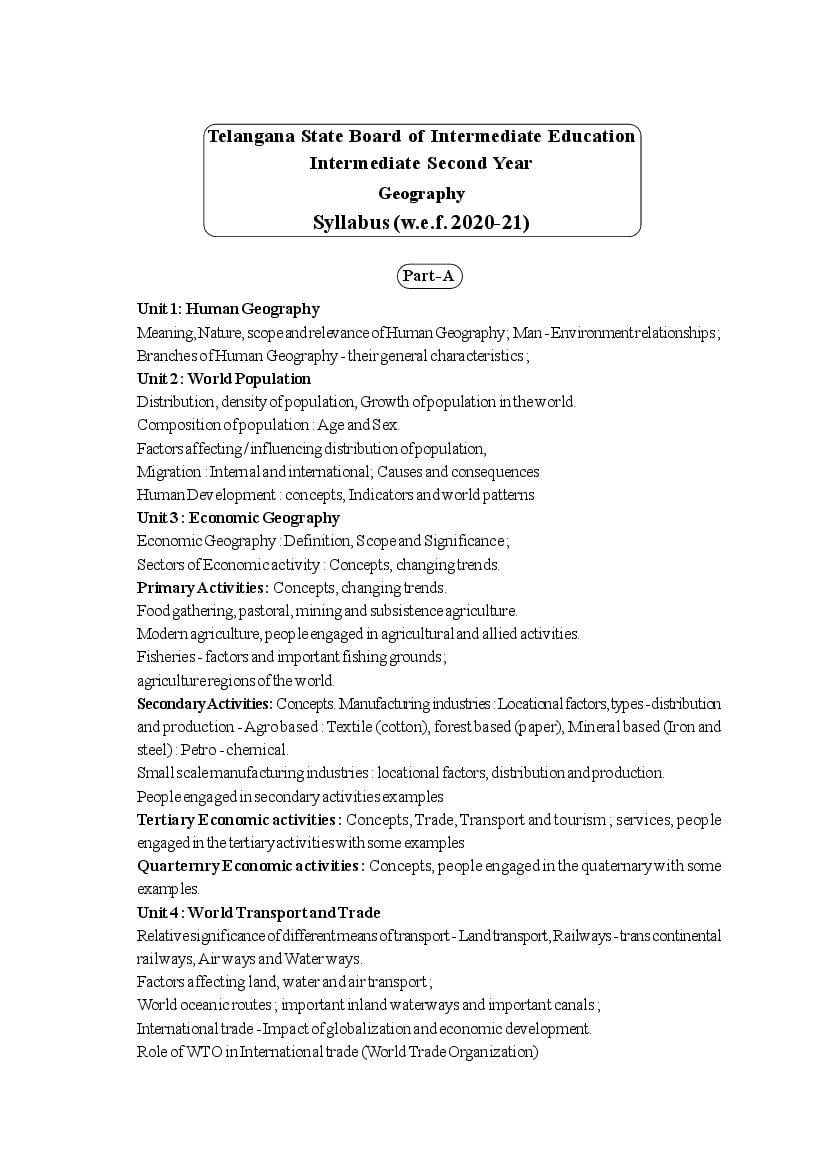
Intermediate Second Year
Geography
Syllabus (w.e.f. 2020-21)
Part - A
Unit 1: Human Geography
Meaning, Nature, scope and relevance of Human Geography ; Man - Environment relationships ;
Branches of Human Geography - their general characteristics ;
Unit 2 : World Population
Distribution, density of population, Growth of population in the world.
Composition of population : Age and Sex.
Factors affecting / influencing distribution of population,
Migration : Internal and international; Causes and consequences
Human Development : concepts, Indicators and world patterns
Unit 3 : Economic Geography
Economic Geography : Definition, Scope and Significance ;
Sectors of Economic activity : Concepts, changing trends.
Primary Activities : Concepts, changing trends.
Food gathering, pastoral, mining and subsistence agriculture.
Modern agriculture, people engaged in agricultural and allied activities.
Fisheries - factors and important fishing grounds ;
agriculture regions of the world.
SecondaryActivities : Concepts. Manufacturing industries : Locational factors, types - distribution
and production - Agro based : Textile (cotton), forest based (paper), Mineral based (Iron and
steel) : Petro - chemical.
Small scale manufacturing industries : locational factors, distribution and production.
People engaged in secondary activities examples
Tertiary Economic activities : Concepts, Trade, Transport and tourism ; services, people
engaged in the tertiary activities with some examples
Quarternry Economic activities : Concepts, people engaged in the quaternary with some
examples.
Unit 4 : World Transport and Trade
Relative significance of different means of transport - Land transport, Railways - trans continental
railways, Air ways and Water ways.
Factors affecting land, water and air transport ;
World oceanic routes ; important inland waterways and important canals ;
International trade - Impact of globalization and economic development.
Role of WTO in International trade (World Trade Organization)
Page 2
Resources : Definition, Classificaiton - Resource depletion
Environment : Meaning, definition and components ;
Environmental conservation and management ; sustainable development.
Unit 6 : Human Settlements
Settlement types - rural and urban ; urbanization trends and consequences
Part - B : Geography of India
Unit 7 : Physiography
Locational characteristics ; Physical setting ; Physiographic divisions; Geology, Drainage
system : The Himalayan and Peninsular System
Unit 8 : Climate
Origin of monsoon, climatic regions in India ; distribution of temperature and rainfall
Soils : Types and distribution, characteristics ; Soil degration and conservation
Vegetation : Types and distribution Wild life conservation, Biosphere reserves
Unit 9 : Population
Population : Size, Growth, Distribution and Density from 1901-2011 ; demographic
characteristics : literacy, sex ratio ; regional variations in population growth,
Trends of Urbanization, population problems.
Migration : International, National, causes and consequences.
Human Development : Introduction and Regional Pattern
Unit 10 : Resources
Mineral and Energy Resource Base : distribution and production Minerals - Iron ore,
Manganese and Bauxite ;
Power resources - Coal, Petroleum and natural gas, hydroelectric power ; Non -
conventional sources of energy (Solar, Wind and Biogas), Conservation of Resources.
Unit 11 : Land Resources
Agriculture : General Land Use, Land Use Classification Distribution and production of
Major Crops - wheat, rice, sugarcane, cotton, caster and ground nut, Coffee and tea - their
distribution, production and trade ;
Impacts of Green revolution on Indian agriculture ;
Problems of Indian agriculture. Land Degradation
Unit 12 : Water Resources
Irrigation and Power : Types of Irrigation, Wells, canals and tanks ; Major multipurpose
projects : Bakra Nangal, Nagarujuna Sagar, Narmada and Damodar Valley Corporation.
Rain Water Harvesting and Watershed Management.
Page 3
Location factors, growth, distribution and trade
Iron and Steel, Petro Chemicals, Pharmaceuticals and Knowledge based industries (IT),
Globalization and Economic Development, SEZs
Unit 14 : Transport and Trade
Means of transport ; roadways, railways, airways and water ways, Major ports of India’s
International trade.
Part C - Telangana
Unit 15 : Telangana
Administrative regions ; physiography, Geology, Drainage :
Unit 16 : Climate
Distribution of climate, temperature and rainfall.
Soils : Types and distribution, characteristics ; Soil degradation and conservation
Vegetation : Types and distribution
Unit 17 : Population
Size, Growth, Distribution and Density from 1961-2011 ; demographic characteristics :
literacy, sex ratio ; Rural and Urban populations.
Second Year Practical Syllabus
Representation of Data
1. Diagrammatic Representation of Geographical Data: Types and their uses ;
One - Dimensional : Line diagram, bar diagrams - simple bar, compound bar, multiple
bar diagram ; pyramid diagram - age - sex pyramid.
Two - dimensional : Square and Rectangular diagrams, Pie diagram ;
Three- Dimensional : Cube and Sphere diagrams.
2. Distribution maps : Dot, Isopleth maps - uses, merits and demerits, Choropleth,
Chorochromatic and choroschematic methods and their charactristics, Isotherm,
Isobars and Isohyets.
3. Sources and Data : Tabulation and Classification of Data ; Frequency Distribution,
Histogram, Frequency Polygon and Ogive Curve.
4. Measures of Central Tendency : Mean Median and Mode. Measures of dispersion :
Range, Quartiles, Mean Diviation and Standard Deviation, relative measure of
dispersion.
5. Introduction to GIS : Introduction Geographical Information System (GIS) and
Global Positioning System (GPS).
Document Details
| Board / Org | Telangana Board |
| Exam | Class 12 |
| Type | Syllabus |
| Pages | 3 |
| Updated | 22 Jul 2026 |