Telangana Class 12 Syllabus 2024 Chemistry
Finished viewing? Save it for later —
Download Telangana Class 12 Syllabus 2024 Chemistry (PDF · 7 pages)About Telangana Class 12 Syllabus 2024 Chemistry
Telangana Class 12 Syllabus 2024 Chemistry is available here for free download. Published by Telangana Board for Class 12, this syllabus can be viewed online or downloaded as a PDF (7 pages). Candidates preparing for Class 12 can use Telangana Class 12 Syllabus 2024 Chemistry to understand the exam pattern, the type of questions asked, and the overall difficulty level.
Frequently Asked Questions
How can I download Telangana Class 12 Syllabus 2024 Chemistry?
Open this page and click the Download button to save Telangana Class 12 Syllabus 2024 Chemistry as a PDF. It is completely free on AglaSem Docs.
Is Telangana Class 12 Syllabus 2024 Chemistry free to download?
Yes. Telangana Class 12 Syllabus 2024 Chemistry can be viewed online and downloaded as a PDF free of cost on AglaSem Docs.
How many pages does Telangana Class 12 Syllabus 2024 Chemistry have?
Telangana Class 12 Syllabus 2024 Chemistry contains 7 pages, which you can read online or download together as a single PDF.
Where can I find more Class 12 study material?
You can find more Class 12 question papers, sample papers, syllabus, and answer keys on AglaSem Docs.
Telangana Class 12 Syllabus 2024 Chemistry – Text
Read the full text of this syllabus below — useful to quickly search, copy and reference the content online without downloading the PDF.
📄 View text version (7 pages)
Page 1
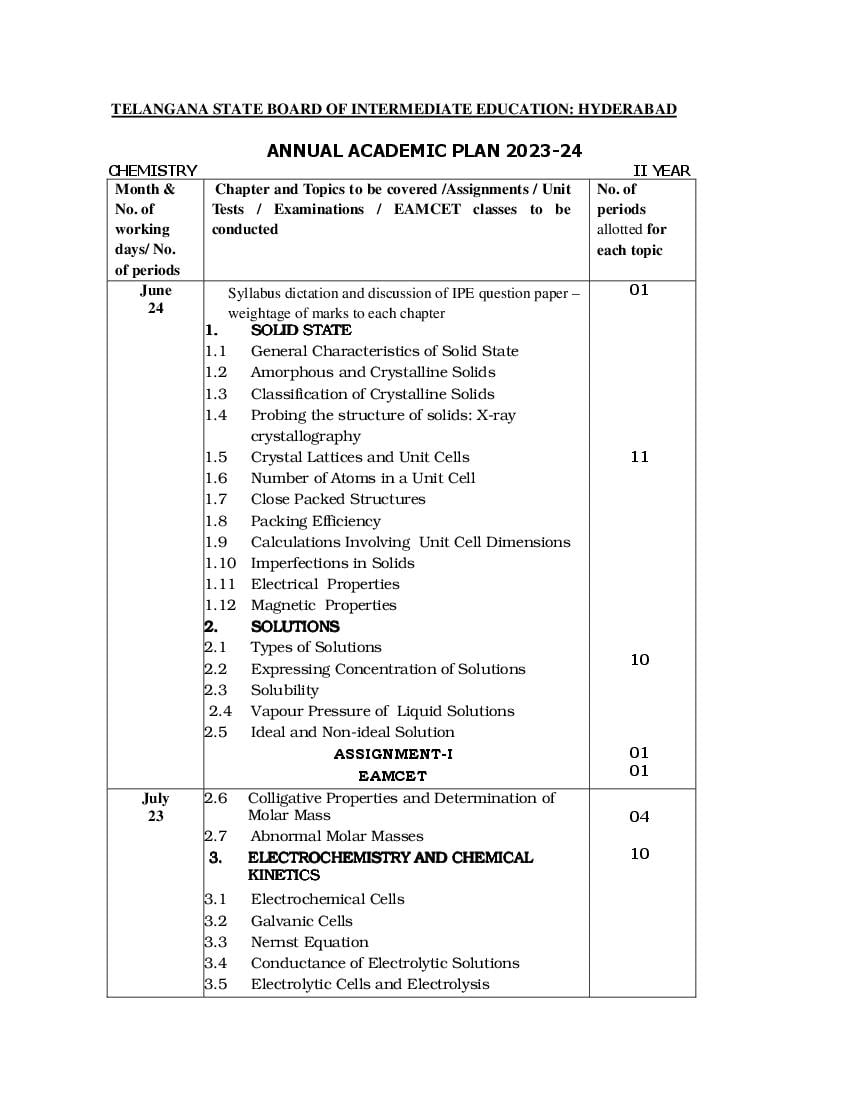
ANNUAL ACADEMIC PLAN 2023-24
CHEMISTRY II YEAR
Month & Chapter and Topics to be covered /Assignments / Unit No. of
No. of Tests / Examinations / EAMCET classes to be periods
working conducted allotted for
days/ No. each topic
of periods
June Syllabus dictation and discussion of IPE question paper – 01
24 weightage of marks to each chapter
1. SOLID STATE
1.1 General Characteristics of Solid State
1.2 Amorphous and Crystalline Solids
1.3 Classification of Crystalline Solids
1.4 Probing the structure of solids: X-ray
crystallography
1.5 Crystal Lattices and Unit Cells 11
1.6 Number of Atoms in a Unit Cell
1.7 Close Packed Structures
1.8 Packing Efficiency
1.9 Calculations Involving Unit Cell Dimensions
1.10 Imperfections in Solids
1.11 Electrical Properties
1.12 Magnetic Properties
2. SOLUTIONS
2.1 Types of Solutions
10
2.2 Expressing Concentration of Solutions
2.3 Solubility
2.4 Vapour Pressure of Liquid Solutions
2.5 Ideal and Non-ideal Solution
ASSIGNMENT-I 01
EAMCET 01
July 2.6 Colligative Properties and Determination of
23 Molar Mass 04
2.7 Abnormal Molar Masses
3. ELECTROCHEMISTRY AND CHEMICALCHEMICAL 10
KINETICS
3.1 Electrochemical Cells
3.2 Galvanic Cells
3.3 Nernst Equation
3.4 Conductance of Electrolytic Solutions
3.5 Electrolytic Cells and Electrolysis
Page 2
(a) Preparation of one lyophilic and onelyophobsol
(b) Study of the role of emulsifying agents in
stabilizing the emulsions of different oils
3.6 Batteries 03
3.7 Fuel Cells
3.8 Corrosion
CHEMICAL KINETICS
3.9 Rate of a Chemical Reaction 03
3.10 Factors Influencing Rate of a Reaction
ASSIGNMENT-II 01
UNIT TEST-I 01
EAMCET 01
August 3.11 Integrated Rate Equations 06
25 3.12 Pseudo First Order Reaction
3.13 Temperature Dependence of the Rate of a
Reaction
3.14 Collision Theory of Chemical Reaction Rates
4. SURFACE CHEMISTRY 08
4.1 Adsorption
4.2 Catalysis
4.3 Colloids
4.4 Classification of Colloids
4.5 Emulsions
4.6 Colloids Around Us
PRACTICALS: B. Chemical Kinetics
C. Solutions
5. GENERAL PRINCIPLES OF METALLURGY
METALLURGY 08
5.1 Occurance of Metals
5.2 Concentration of Ores
5.3 Extraction of Crude Metal from Concentrated Ore
5.4 Thermodynamic Principles of Metallurgy
5.5 Electrochemical Principles of Metallurgy
5.6 Oxidation and Reduction
5.7 Refining of Crude Metal
5.8 Uses of Aluminium, Copper, Zinc and Iron
ASSIGNMENT-III 01
UNIT TEST-II 01
EAMCET 01
September 6. p-BLOCK ELEMENTS GROUP-
GROUP-15 ELEMENTS 06
22 6.1 Introduction
6.2 Dinitrogen
6.3 Ammonia
6.4 Oxides of nitrogen
Page 3
6.6 Phosphorous-allotropic forms
6.7 Phosphine
6.8 Phosphorous halides
6.9 Oxoacids of phosphorous
GROUP-
GROUP-16 ELEMENTS 06
6.10 Introduction
6.11 Dioxygen
6.12 Simple Oxides
6.13 Ozone
6.14 Sulphur-Allotropic forms
6.15 Sulphur dioxide
6.16 Oxoacids of Sulphur
6.17 Sulphuric Acid
GROUP-
GROUP-17 ELEMENTS
07
6.18 Introduction
6.19 Chlorine
6.20 Hydrogen Chloride
6.21 Oxoacids of Halogens
6.22 Interhalogen Compounds
ASSIGNMENT-IV 01
UNIT TEST-III 01
EAMCET 01
October GROUP-
GROUP-18 ELEMENTS 04
18 6.23 Introduction- Occurance, Electronic
configuration Ionisation
Enthalpy,Atomic radii, Electron Gain
Enthalpy Physical and Chemical properties
PRACTICALS :
D. Electrochemistry E. Chromatography
F. Preparation of Inorganic Compounds
7. d AND f BLOCK ELEMENTS & 05
COORDINATION COMPOUNDS
COMPOUNDS
7.1 Position in the Periodic Table
7.2 Electronic Configuration
7.3 General Properties of Transition Elements (d-
Block)
7.4 Some Important Compounds of Transition
Elements
7.5 Inner Transition Elements(f-Block)
7.6 Actinoids 07
7.7 Some Applications of d and f Block Elements
7.8 Werner’s Theory of Coordination Compounds
7.9 Definitions of Some Terms used in
Coordination Compounds
Page 4
7.11 Isomerism in Coordination Compounds
7.12 Bonding in Coordination Compounds
ASSIGNMENT-IV 01
EAMCET 01
MID TERM HOLIDAYS
FROM 19-10-2023 TO 25-10-2023
November 7.13 Bonding in Metal Carbonyls 03
24 7.14 Stability of Coordination Compounds
7.15 Importance and Applications of Coordination
Compounds
8. POLYMERS
06
8.1 Classification of Polymers
8.2 Types of Polymerization Reactions
8.3 Molecular Mass of Polymers
8.4 Biodegradable Polymers
8.5 Polymers of Commercial Importance
PRACTICALS : G. Preparation of Organic
Compounds
08
9. BIOMOLECULES
9.1 Carbohydrates
9.2 Proteins
9.3 Enzymes
9.4 Vitamins
9.5. Nucleic acids
9.6 Hormones
EAMCET 01
HALF YEARLY EXAMINATIONS 06
FROM 20-11-2023 TO 25-11-2023
December 10. CHEMISTRY IN EVERYDAY LIFE 06
23 10.1 Drugs and their Classification
10.2 Drug-Target Interaction
10.3 Therapeutic Action of Different Classes of
Drugs
10.4 Chemicals in Food
10.5 Cleansing Agents
PRACTICALS :
H. Tests for the functional groups present in
organic compounds
I. Characteristic tests of carbohydrates, fats and
Proteins
Page 5
11.1 Classification
11.2 Nature of C-X bond
11.3 Methods of Preparation
11.4 Physical Properties
11.5 Chemical Reactions
11.6 Polyhalogen Compounds
12. ORGANIC COMPOUNDS CONTAINING C, H 04
AND O (Alcohols, Phenols,
Phenols, Ethers, Aldehydes, Ketones and Carboxylic acids)
Alcohols, Phenols, Ethers
12.1 Classification -Alcohols, Phenols and Ethers
12.2 Nomenclature- Alcohols, Phenols and Ethers
12.3 Structures of Hydroxy and Ether Functional Groups
ASSIGNMENT-VI 01
UNIT TEST-IV 01
EAMCET 01
January 12.4 Alcohols and Phenols 10
23 12.5 Physical Propertics
12.6 Chemical Reactions
12.7 Some Commercially Important Alcohols
12.8 Ethers
Aldehydes and Ketones
12.9 Nomenclature and Structure of Carbonyl
Group
12.10 Preparation of Aldehydes and ketones.
12.11 Physical Properties
12.12 Chemical Reactions
12.13 Uses of Aldehydes and Ketones
Carboxylic Acids
12.14 Nomenclature and Structure of Carboxyl
Group
12.15 Methods of Preparation of Carboxylic Acids
12.16 Physical Properties
12.17 Chemical Reactions
12.18 Uses of Carboxylic Acids
PRACTICALS : J. Determination of
concentration/molarity of KMnO4 solution by
titrating it against a standard solution of:
(i) Oxalic acid,
(ii) Ferrous ammonium sulphate
Page 6
Determination of one cation and one anion
in a given salt containing anions and
cations studied in I year (Salts : 1 to 6)
13.
13 ORGANIC COMPOUNDS CONTAINING
NITROGEN
Amines
13.1 Structure of Amines 03
13.2 Classification
13.3 Nomenclature
13.4 Preparation of Amines
13.5 Physical Properties
13.6 Chemical Reactions
Diazonium salts
13.7 Methods of Preparation of Diazonium Salts
13.8 Physical Properties
13.9 Chemical Reactions 03
13.10 Importance of Diazonium Salts in Synthesis of
Aromatic Compounds
Cyanides and Isocyanides
13.11 Structure of cyanides and isocyanides
13.12 Preparation
EAMCET 01
SANKRANTHI HOLIDAYS
FROM 13-01-2024 TO 16-01-2024
PRACTICALS : K. Qualitative analysis
Determination of one cation and one anion in a
given salt containing anions and cationsstudied
in I year (Salts : 7to12)
PRE-FINAL EXAMINATIONS
06
FROM 22-01-2024 TO 29-01-2024
February PROJECT
23
REVISION
I.P.E. PRACTICALS 2024
March I.P.E. THEORY EXAMINATIONS
22 1ST WEEK OF MARCH 2024
LAST WORKING DAY: 31.03.2024
Page 7
FROM 01-04-2024 TO 31-05-2024
ADVANCED SUPPLIMENTARY EXAMINATIONS
(IPASE)
Last week of May 2024
Re-Opening of Colleges : 01-06-2024
Prepared by: Smt. G. SRILATHA JL. In Chemistry
GOVT. Jr. College, KANDUKUR.
Document Details
| Board / Org | Telangana Board |
| Exam | Class 12 |
| Type | Syllabus |
| Pages | 7 |
| Updated | 22 Jul 2026 |